



 by Tom Gurney
Tom Gurney BSc (Hons) is an art history expert with over 20 years experience
Published on June 19, 2020 / Updated on November 13, 2026
Email: tomgurney1@gmail.com / Phone: +44 7429 011000
Quotes: Introduction
In October 1804 Antonio Canova wrote to the director of the Uffizi about two sculptures of Venus. One was a replica of the ancient Medici statue. The other was a standing figure he had designed himself. In the same letter he hoped the first would deserve to be called a twin and wished that his correspondent could see the model for the second. The two remarks catch him at a point that the finished marble in Florence can easily obscure. The work that became Venus Italica was still a model, and the copy was a separate project. [1] [2]
Canova's letters give that kind of detail about many parts of his working life. He could describe a plan to a friend, explain an urgent shipment to a cardinal or thank a collector for a chance to study ancient sculpture. A patron's reply can tell us what was wanted from a new marble. The excerpts below identify who was writing, to whom and when. The passages from the letters to Puccini, Quatremère, Consalvi and Cicognara appear in new English translations from the Italian. Bedford wrote in English. The excerpt addressed to Elgin follows the translation published in 1816. [1] [3] [4] [5] [6] [7]
Antonio Canova Quotes
At a Glance
- StudioLetters describe designs and commissions at stages that the finished sculptures can no longer show. [1] [3] [7]
- PatronageBedford entrusted the changes to his version of The Three Graces to Canova. [4]
- Public workCanova reported the recovery and packing of sculptures and paintings in Paris to Cardinal Ercole Consalvi. [5]
Contents
- Two Venuses in one studio
- A statue of Peace
- How much should a second marble change?
- A dispatch from Paris
- What Canova saw in London
- Two gods for the Prince Regent
Two Venuses in one studio
Antonio Canova to Tommaso Puccini, 9 October 1804, from Rome. [1]
The model of another standing Venus of my own. [1]
The copy had a particular destination in mind. The ancient Medici Venus had been removed from Florence and taken to France, leaving the Uffizi without one of its celebrated works. When Canova accepted the commission in 1803, he asked for a plaster cast of the antique. The cast would give him a full figure to measure and consult in Rome. Giovanni degli Alessandri, who helped arrange the commission, expected Canova to reconsider the restored parts. The arms of the ancient marble had been a subject of discussion in Florence before its removal. Even a figure intended as a twin could therefore involve choices about how to place the hands. [1] [2]
Canova's short phrase to Puccini puts the other figure in a different category. It was his own Venus, and he wanted the director to see the model. In the marble that ultimately went to Florence, the goddess gathers a cloth across her chest. The hands come together high on the body, where the cloth collects in folds. In the ancient figure, the hands are at different heights. The original letter lets us place that change in the studio before the Florentine gallery displayed the new work as a replacement. A commission for a copy and a sculptor's proposal for a new design had existed side by side. [1] [2]
A statue of Peace
Antonio Canova to Antoine-Chrysostome Quatremère de Quincy, 11 February 1812. [3]
The statue of Peace will be made all the same. Let war come. It will be unable to prevent it. [3]
In January the French writer Quatremère had pointed out an awkward coincidence. Canova was preparing a statue of Peace for a Russian patron while France and Russia were moving towards war. He urged him to hurry. Canova replied that the commission would go ahead and went on to doubt that there would soon be occasion for a statue celebrating a general peace. The two men could use the same word for a figure in the studio and for a state of affairs that seemed increasingly far away. Canova's reply moves quickly between those meanings. [3]
The Russian patron, Count Nikolai Rumyantsev, had commissioned the work to commemorate the diplomatic accomplishments of his family. The National Edition tracks the sculpture beyond Canova's February letter. By August his half-brother, Giambattista Sartori, reported work on a clay figure slightly larger than life. A plaster at Possagno bears an inscription dating its completion to September 1812. The marble followed after 1815. The letter establishes what Canova was prepared to undertake as the prospect of war approached. The dated plaster and the later marble tell us how long it took the studio to give that intention a permanent form. [3] [8]
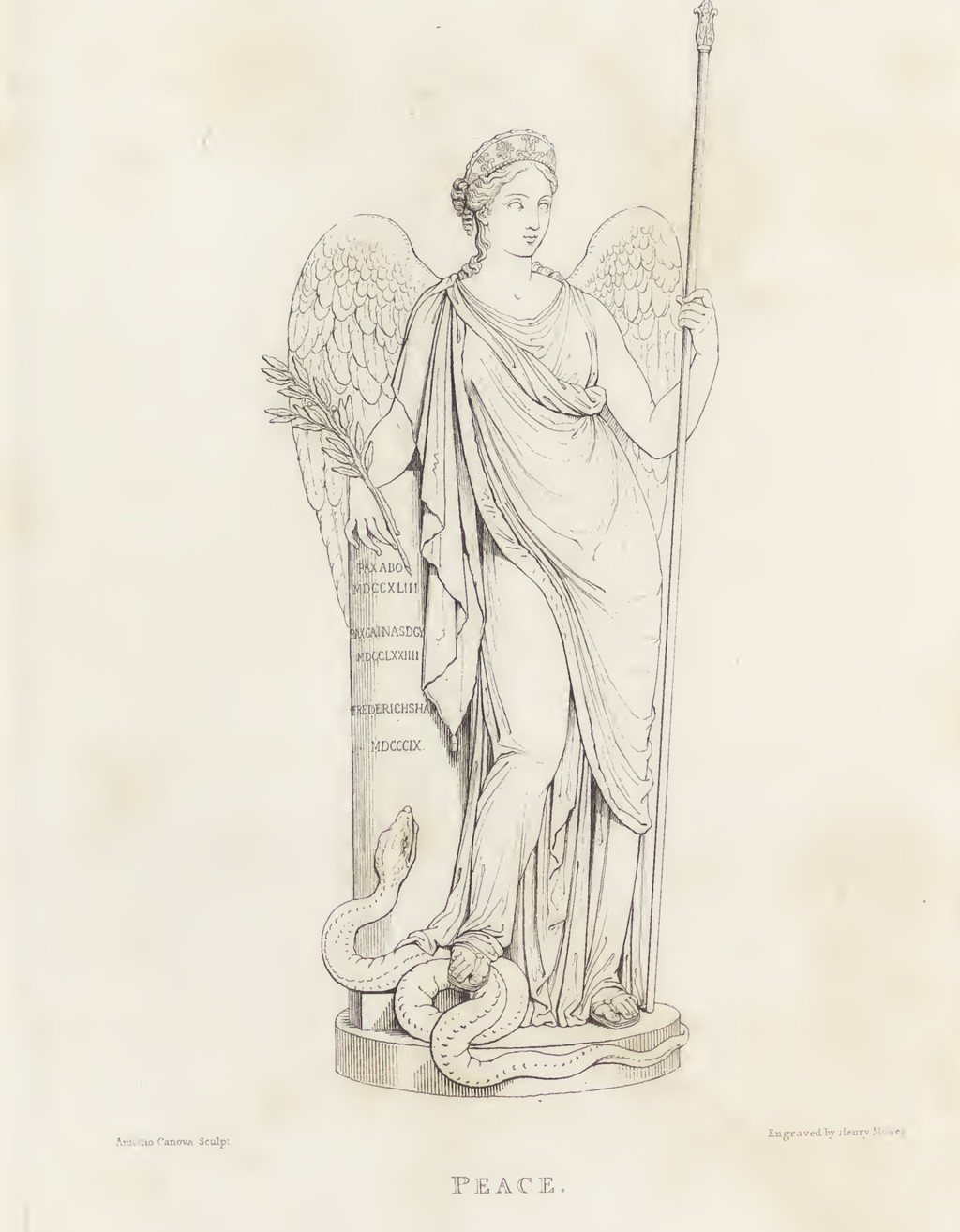
Moses’s engraving of Peace shows the winged figure with her tall staff. Henry Moses, after Antonio Canova, engraving published in London, 1824. Getty Research Institute. Image source. Public domain. Scan margins trimmed and image resized.
Videos on Canova
Explore Canova’s workshop methods and the settings for his sculpture.
Antonio Canova in the Vatican Museums
The Vatican Museums introduce Canova’s Roman studio and their collection of his work.
Watch on YouTubeHow much should a second marble change?
John Russell, sixth Duke of Bedford, to Antonio Canova, January 1815. [4]
I leave the variations in the group … entirely to your judgement. [4]
Bedford had visited the Roman studio in December 1814 and seen the unfinished Three Graces. Joséphine de Beauharnais, who commissioned the marble, had died that May. Her son Eugène wanted the sculpture, and Canova offered Bedford another version with changes. The duke's letter accepts those changes without prescribing them. His condition was about the effect the three figures made together. He wanted the quality of grace that had caught his attention in Rome to survive. [4]
The two marbles give that request visible particulars. Canova used white marble for the Bedford group and made the support beside the women round. He also broadened the waist of the central figure slightly. The women's arms still link one body to the next across the group. At Woburn Abbey, daylight entered the dedicated room from above, and the base could turn. The Bedford and Hermitage groups now let viewers examine which details Canova varied while preserving the arrangement that prompted the duke to write. [4]
A dispatch from Paris
Antonio Canova to Cardinal Ercole Consalvi, Paris, 10 October 1815. [5]
I have already recovered about forty pieces of sculpture and more than thirty paintings. [5]
Canova was writing to the papal secretary of state about the recovery of works taken under French rule. He said that the pieces were being guarded at an Austrian barracks, alongside works destined for several other Italian states. The figures in the dispatch are a count of works recovered by that date. He still had to arrange crates, secure transport and prepare the principal sculptures and paintings for a convoy leaving under armed escort. He asked Consalvi to see that the sovereigns and ministers who had helped were thanked, singling out the British Prince Regent. [5]
Towards the end the letter changes register. Canova describes how little time he and his brother had to eat or sleep while the work of packing and recovery continued. The page moves from the inventory to the people trying to get the objects ready. In a letter dated 25 October he reports that the convoy carrying the Apollo and Raphael's Transfiguration had left that morning. Read together, the letters separate the moment when works were taken into custody from the moment when particular crates were on their way to Italy. [5]
What Canova saw in London
Antonio Canova to the Earl of Elgin, London, 10 November 1815, in the English translation published the following year. [6]
I admire in them the truth of nature combined with the choice of beautiful forms. [6]
Canova was thanking Elgin for the opportunity to see the sculptures brought from Greece. He writes about returning to look again and using what time he had in London to study them. In the sentence above, the observed body and the sculptor's choice of form belong together. Canova goes on to admire the lifelike effect of the nude figures and the skill with which their makers concealed the labour of art. His words give a reader something to look for in his own work. In a finished Canova sculpture the smooth shoulder and the turn of a joint can look easy even though they passed through stages of modelling, measurement and carving. [6] [8]
The English text was printed with two memoirs by the antiquarian Ennio Quirino Visconti on sculptures in Elgin's collection. Canova's thanks are addressed to the collector himself. The printed setting placed that expression of thanks before readers interested in ancient art. The Paris dispatch and the London letter came a month apart. One records the practical business of sending works back to Italy. The other records what seeing ancient marble at first hand meant to him as a sculptor. [5] [6]
Two gods for the Prince Regent
Antonio Canova to Leopoldo Cicognara, 17 January 1816. [7]
For the Prince Regent I shall make an ideal group of Venus and Mars, symbolising Peace and War. [7]
Canova was writing to the president of the Venice academy about commissions from British patrons. His line to Cicognara gives the pair of gods and the meaning he had in mind. The commission was for Carlton House. By August the prince's intermediary, Charles Long, was asking for a drawing and Canova had begun modelling in clay. Those details come from later correspondence, when the group still had to be worked out at full size and the prince had yet to see how the two figures would stand together. [7]
In the finished group the spear remains upright in Mars's hand, but his face turns to Venus. The sword stays in its sheath and the shield is propped low at the back. Fruit spills from a horn of plenty beside the armour. The January letter puts the words Peace and War alongside the figures. The marble gives those words a visible relationship through the turn of a head, the meeting of the bodies and the placement of the weapons. [7]
Explore Canova’s works
Browse the sculptures and paintings covered in this guide. Several entries compare versions or examine details of a larger work.
Discussion
Look again at the images and ideas explored in Quotes. These editorial prompts invite your observations.
Reader Insights
Which letter gives the clearest view of Canova’s working methods?
What do the different recipients change about the way he describes his work?
Join the Conversation
Share a detail, comparison or question about Quotes below.
References
- Hugh Honour, “Canova's Statues of Venus,” The Burlington Magazine 114 (1972), pp. 658–671, transcribing Canova to Tommaso Puccini, 9 October 1804, Puccini papers, Biblioteca Forteguerriana, Pistoia, n. 20. View source.
- Uffizi Galleries, Venus Italica, Palatine Gallery, inv. 1912 no. 878. View source.
- Edizione Nazionale delle Opere di Antonio Canova, Epistolario (1812), introduction pp. XLVIII–L, including Quatremère de Quincy to Canova, 10 January, no. 17, and Canova's reply of 11 February, no. 74, p. 102. View source.
- Victoria and Albert Museum, “The Three Graces by Antonio Canova,” including the Duke of Bedford's letter to Canova, January 1815. View source.
- Antonio Canova, Lettere inedite di Antonio Canova al cardinale Ercole Consalvi, ed. Alessandro Ferrajoli (Rome, 1888), Paris letters of 10 and 25 October 1815, pp. 12–13 and 23 onwards. View source.
- Antonio Canova, letter to the Earl of Elgin, 10 November 1815, English translation in A Letter from the Chevalier Antonio Canova and Two Memoirs Read to the Royal Institute of France (London, 1816), pp. xxi–xxii. View source.
- Royal Collection Trust, Mars and Venus, RCIN 2038, including Canova to Leopoldo Cicognara, 17 January 1816. View source.
- National Gallery of Art, Canova: Sketching in Clay, exhibition catalogue on modelling and carving, including the clay and plaster studies for Peace. View source.


 Antonio Canova.jpg)

