


 Antonio Canova.jpg)
 by Tom Gurney
Tom Gurney BSc (Hons) is an art history expert with over 20 years experience
Published on June 19, 2020 / Updated on November 13, 2026
Email: tomgurney1@gmail.com / Phone: +44 7429 011000
Perseus Triumphant (with Head of Medusa): Introduction
Perseus holds his left arm out from his body and turns his face towards the head in his hand. The arm draws a line from the bare shoulder to the tight grip in Medusa’s hair. Then the head drops into the space below the fist. In the other hand, much lower, is the sword. You can read the whole encounter in the distance between those two hands. One still holds the means by which Perseus won. The other shows what he won, and his own profile sends your eye back to it. [1] [2]
Antonio Canova carved the first marble in late 1800 and early 1801. It stands in the Octagonal Court of the Vatican Museums. He returned to the design for the Polish countess Valeria Tarnowska, whose marble, dated 1804–06, is at the Metropolitan Museum of Art in New York. The two versions share the same pose, but the arrangement around the raised arm changes. In the Vatican marble, a support joins the arm to the drapery below. In New York, light and the space of the gallery show through the gap. The change sharpens the impression that Perseus has just lifted the head and could lower it again. [1] [2] [3]
Perseus Triumphant (with Head of Medusa) Antonio Canova
At a Glance
- ObjectMet marble, 1804–06
Contents
- What Perseus carries
- How the Apollo Belvedere became the model
- The marble that took Apollo’s place
- The version for Countess Tarnowska
- Looking around the two marbles
What Perseus carries
The winged headgear, the sandals and the blade mark Perseus out among classical heroes. Canova gives each attribute a different scale and position. Wings rise from the cap and break up the outline of the hero’s own head. The small forms at his feet take longer to find. The blade, with its projecting hook, extends sideways from the lowered hand. The low sword makes a diagonal that leads back through the figure to the raised arm. The two objects are almost as far apart as Canova could put them while keeping each within easy reach of the body. [1] [2]
Ancient accounts vary in their details. In the Library attributed to Apollodorus, nymphs equip Perseus with winged sandals, a pouch for the head and the cap of Hades, which makes its wearer invisible. Hermes supplies a hard, curved cutting weapon. When Perseus finds the Gorgons asleep, Athena guides his hand while he watches Medusa’s reflection in a bronze shield. The severed head retains its power, and he puts it into the pouch. Canova keeps the cap, sandals and weapon visible in both marbles. With the shield and pouch absent, the exposed head and the direction in which Perseus turns become the centre of the scene. [1] [2] [4]
An Attic jar at the Met shows what an artist could do with the earlier moment. In the painting attributed to Polygnotos, Perseus brings his sword to the sleeping Medusa and looks towards Athena. The space between those figures matters because it separates the act of cutting from the act of looking. Canova brings those two things into a different relation. His hero has already lowered the blade and turns in the same direction as the hand that bears Medusa. Her face is largely available to us as we approach the front of the statue, even though her eyes and his are harder to align from that position. [2] [5]
In its account of the 2023 Canova exhibition, the Vatican suggests that Perseus has become stone by looking at his trophy. The Met’s close reading takes the joke the other way and points to the sculptor’s ability to make stone resemble living flesh. Both readings begin with something you can see. A curve of the shoulder leads to the hand and its burden, while the sloping hips and relaxed knee suggest a man able to shift his weight. A figure that looks ready to move also seems fixed in the very act the myth tells him to avoid. [3] [6]
Canova set a label beside the finished statue in his studio. In it he explained the pointed and hooked blade by referring to ancient monuments and the term harpē. For the cap, he invoked a figure of Pallas Athena that had belonged to Cardinal Gualtieri’s collection. His account had Mercury give Perseus wings to attach to Pluto’s helmet and followed a tradition that assigned the weapon to Vulcan. The equipment could vary between texts. For his own purposes, Canova needed a recognisable shape for each object and sought precedents he could turn into marble. [2]
 in Detail Antonio Canova.jpg)
How the Apollo Belvedere became the model
The Apollo Belvedere had been at the Vatican since the early sixteenth century. The museum identifies it as a Roman marble based on a Greek bronze probably made by Leochares around 330 BC. Apollo is shown after loosing an arrow. His bare torso turns above a slight shift in the hips, his head looks towards his extended left arm, and his cloak gathers on the same side. Johann Joachim Winckelmann’s praise made this particular antique a touchstone for the eighteenth-century study of Greek art. An artist could expect collectors who knew their classical sculpture to recognise its stance. [1] [7]
In the Perseus, the turn of the head and the line of the left arm recall the Apollo before the smaller details come into focus. Both figures have a quiet face and an open chest, and both suggest a movement just completed. The difference is where that movement sends the eye. Apollo’s bow would have aimed beyond the hand, at something outside the statue. Perseus ends the line with a face. The head gives the arm an apparent weight and draws our attention back into the space of the figure. The composition retains the older statue’s breadth while bringing the story within reach of the hero’s own fingers. [1] [2] [7]
Medusa had an ancient model of her own. Art Institute of Chicago curator Bruce Boucher identifies the Rondanini Medusa, a high-relief marble now in Munich, as the principal source for Canova’s treatment. Compare the even features at the centre of the head with the livelier forms in the hair. The mouth falls open a little and serpents curl beside the cheeks. In the Vatican marble, the head can read as a smooth, almost symmetrical face at a distance. As you come closer the snakes disturb that symmetry, and the slight opening of the mouth gives the face an expression distinct from Perseus’s composed profile. Canova used one ancient model for the body and another for the head that sets the body’s calm in relief. [1] [8]
Videos on Canova
Explore Canova’s workshop methods and the settings for his sculpture.
Antonio Canova in the Vatican Museums
The Vatican Museums introduce Canova’s Roman studio and their collection of his work.
Watch on YouTubeThe marble that took Apollo’s place
The plaster at the Museo Gypsotheca Antonio Canova in Possagno is dated 1801 and measures 240 centimetres high. The museum dates the beginning of work on the design to 1797. The Vatican dates the carving of its marble to a period of months straddling 1800 and 1801. On 9 May 1801, Canova wrote that he had recently finished the statue and described it by comparison with the size of the Apollo. The design had been taking shape over several years, and by the time he wrote the letter its antique counterpart had already left Rome. [1] [7] [9] [10]
Onorato Duveyriez, a French tribune, showed interest while Canova was still working on the model. The Vatican’s collection page identifies him as the first owner, while its 2023 exhibition and the conservation account describe the work as Canova’s own initiative. The completed statue was intended for the Cisalpine Republic’s Foro Bonaparte in Milan, and the conservation account records the involvement of Giuseppe Bossi, secretary of the Brera academy, in that plan. It was Pope Pius VII who ultimately acquired it for the Vatican. [1] [6] [10]
The Apollo had gone to Paris after the Treaty of Tolentino. Pius VII placed the new Perseus on its vacant pedestal. The borrowed pose became an unusually direct comparison once it occupied the place where visitors expected to see the antique itself. It also gave the museum a work by a living sculptor at a site identified with its ancient marbles. After the Napoleonic period the Apollo returned. Today both sculptures can be seen in the Octagonal Court. The Vatican Perseus stands with Canova’s two boxers, Creugas and Damoxenos, whose tense stances and poised arms give another point of comparison for the quieter victor. [1] [6] [7] [9] [10]
The version for Countess Tarnowska
Valeria Tarnowska recorded a visit to Canova in her diary on 5 December 1803. She was struck by the contrast between his unassuming manner and the sculptures that surrounded him in the studio. The contract she secured the following spring specified Carrara marble and Canova’s own hand. He signed it on 14 April 1804. The Met lists her and Count Jan Tarnowski as the patrons and records that the contract called for the new marble to resemble the one in the Vatican. Canova’s studio could use plaster to carry measurements from a design to a new block, a process in which assistants often did preliminary work before he finished the surfaces. [2] [11] The Met considers it likely that this marble was based on a studio plaster. In a list dictated in 1816, Canova remembered sending the countess a replica with a few variations. [2]
Some of those variations become clear if you compare the space below the extended arm in the two marbles. The Vatican version has a stone strut beneath the arm. The Met version omits it and draws the cloth into a fuller sweep, leaving the length of the arm and its turn at the elbow easier to see against the surroundings. There is also a slight narrowing of the torso. From the front, the changes give the upper body and its extended arm a more continuous outline. As you move towards the raised hand, the deeper folds of the cloth start to overlap the torso and show how much of that movement passes behind the figure. [1] [2] [3]
The newer statue measures 242.6 centimetres high overall. A letter shows that it was on its way to Poland by early summer 1806. The family had intended to put it in their palace at Dzików, but concern about the floor led them to install it at the countess’s father’s estate at Horochów. Canova’s 1807 letter to Tarnowska raises a second problem of weight on a much smaller scale. He told her that he was sending a plaster Medusa, which she could substitute for the marble head if she feared the strain on the arm. He even suggested putting a candle inside the hollow marble head to use it as a table ornament. The Met also holds a separate studio plaster of Medusa’s head, dated 1806–07, of the kind described in the correspondence. That plaster head measures just under 32 centimetres high without its modern mounting rod. Seen by itself, it is close enough to life size to meet at eye level, a very different encounter from looking up at it in Perseus’s hand. [2] [12]
The two problems of weight are worth keeping in mind in front of the New York marble. At floor level a massive object required a secure place to stand. Above shoulder height a small piece of it threatened, at least in the sculptor’s correspondence, to bear too heavily on its arm. You see neither concern in the shape of the gesture. Canova gave the figure the easy turn of a person lifting something by hand. Even the long fall of cloth lets the eye move past the arm to where the weight seems to hang from a few fingers. [2] [3]
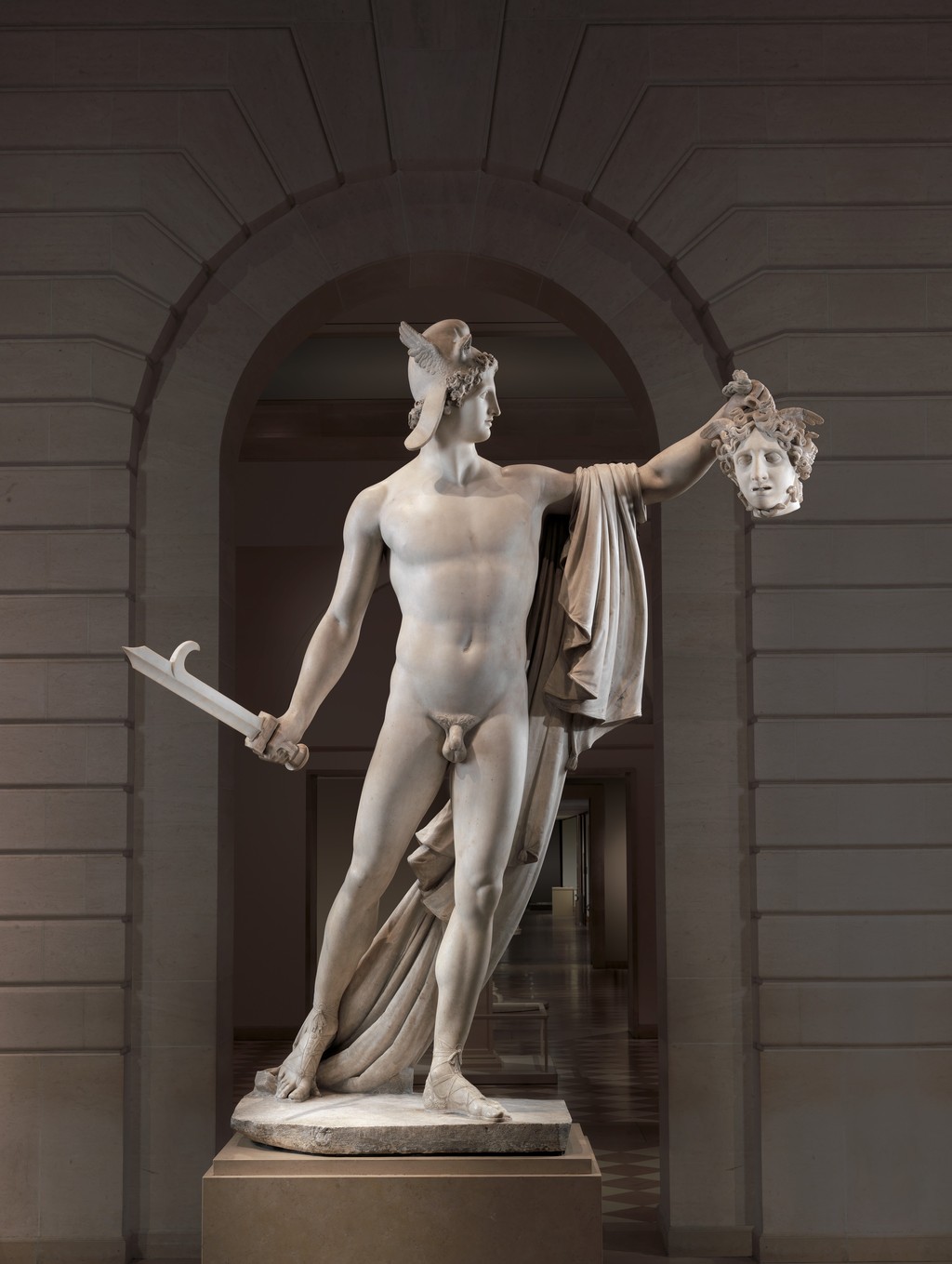
The Met marble shows the open interval beneath the outstretched arm holding Medusa’s head. The Metropolitan Museum of Art, 67.110.1. Image source. CC0 / Public domain. Resized from source.
Looking around the two marbles
From square in front of the Vatican statue, the outline of Perseus is broad and legible. The face is in profile, the blade sits low, and the head has room at the end of the raised arm. Looking up towards that arm brings the support into view. The cloth falls from the same area, making its thicker, folded passage a place for the stone connection to meet the rest of the design. In the Octagonal Court, the figure also belongs to a cabinet with other sculpture on either side. The main view reads easily across the setting because the hands and the things they hold reach so far past the torso. [1] [6] [9]
In the Met’s sculpture court, try following the hem of the cloak as you change position. In front, it hangs to one side of the body and marks the long line from hand towards foot. In an oblique view, its sweep behind the legs becomes clearer and you can see how far the left hand projects. The folds also give you a way to compare the surfaces. The light falls across the chest in broad areas, breaks into strips along the cloth and picks out the much smaller turns of hair around Medusa’s face. Her head commands attention even when you are still some distance from it. [2] [3]
The two versions have also been compared at closer quarters than a gallery visit allows. Conservators treating the Vatican marble examined the Met version and studied the Possagno plasters. Their project account records cleaning the marble, resetting the position of Medusa’s head and replacing metal fittings in line with evidence of the original assembly. The pedestal needed attention too. Fissures and deterioration had affected stability, so the work on the base included a system designed to address vibration. The joins mattered to the restoration because the position of even a small part affects how we read the gesture as a whole. [10]
Canova had chosen the moment after combat before, in Theseus and the Minotaur. There the hero sits above a defeated body, and the composition brings your eye down to the figure beneath him. Perseus remains standing and carries the evidence of his victory out to one side. As you come back round to the front, look again at the distance from his face to Medusa’s. The space between them is large enough to give the trophy a distinct outline, yet small enough for that single turn of the head to hold them in conversation. [1] [2] [13]
Explore Canova’s works
Browse the sculptures and paintings covered in this guide. Several entries compare versions or examine details of a larger work.
Discussion
Look again at the images and ideas explored in Perseus Triumphant (with Head of Medusa). These editorial prompts invite your observations.
Reader Insights
What do you notice first, Perseus or the head he holds?
How does the opening under the raised arm affect the New York version?
Join the Conversation
Share a detail, comparison or question about Perseus Triumphant (with Head of Medusa) below.
References
- Vatican Museums, Perseus Triumphant, Museo Pio Clementino, Octagonal Court. View source.
- The Metropolitan Museum of Art, Perseus with the Head of Medusa, 67.110.1, collection record, photographs and audio commentary. View source.
- The Metropolitan Museum of Art, Perseus with the Head of Medusa, Viewpoints. View source.
- Pseudo-Apollodorus, Library, 2.4.2–3, translated by James George Frazer. View source.
- The Metropolitan Museum of Art, Terracotta pelike (jar), attributed to Polygnotos, 45.11.1. View source.
- Holy See Press Office, Antonio Canova nei Musei Vaticani, exhibition announcement, 20 October 2023 (in Italian). View source.
- Vatican Museums, Apollo Belvedere, Museo Pio Clementino, Octagonal Court. View source.
- Bruce Boucher, Head of Medusa, Art Institute of Chicago Museum Studies, vol. 29, no. 2, pp. 62–63. View source.
- Museo Gypsotheca Antonio Canova, Perseus, plaster, inv. 142. View source.
- Patrons of the Arts in the Vatican Museums, Perseus, conservation report and photographs. View source.
- The Metropolitan Museum of Art, Antonio Canova (1757–1822), Heilbrunn Timeline of Art History. View source.
- The Metropolitan Museum of Art, Head of Medusa, studio of Antonio Canova, plaster cast. View source.
- Victoria and Albert Museum, Antonio Canova: An Introduction. View source.


