



 by Tom Gurney
Tom Gurney BSc (Hons) is an art history expert with over 20 years experience
Published on June 19, 2020 / Updated on November 13, 2026
Email: tomgurney1@gmail.com / Phone: +44 7429 011000
The Three Graces: Introduction
The three women in Antonio Canova’s The Three Graces stand so close that, from the front, it takes a moment to work out whose hands are whose. Move towards either side and the embrace changes shape. One shoulder comes forward, a face disappears, and the cloth that seemed to hang in front of the figures comes into view again at a hip. At Woburn Abbey, the Duke of Bedford displayed the sculpture on a rotating pedestal in a room designed for it. A visitor could follow those changes as the marble turned. [1] [2]
The Bedford marble, completed by 1817 and now jointly owned by the Victoria and Albert Museum and the National Galleries of Scotland, was Canova’s second version. He made the first for Joséphine de Beauharnais. It passed through her son Eugène’s family to the State Hermitage Museum in St Petersburg. A full-size plaster in Possagno and a pair of engravings help explain how Canova arrived at the composition and what a viewer gains from seeing it at more than one angle. [1] [2] [3] [4]
The Three Graces Antonio Canova
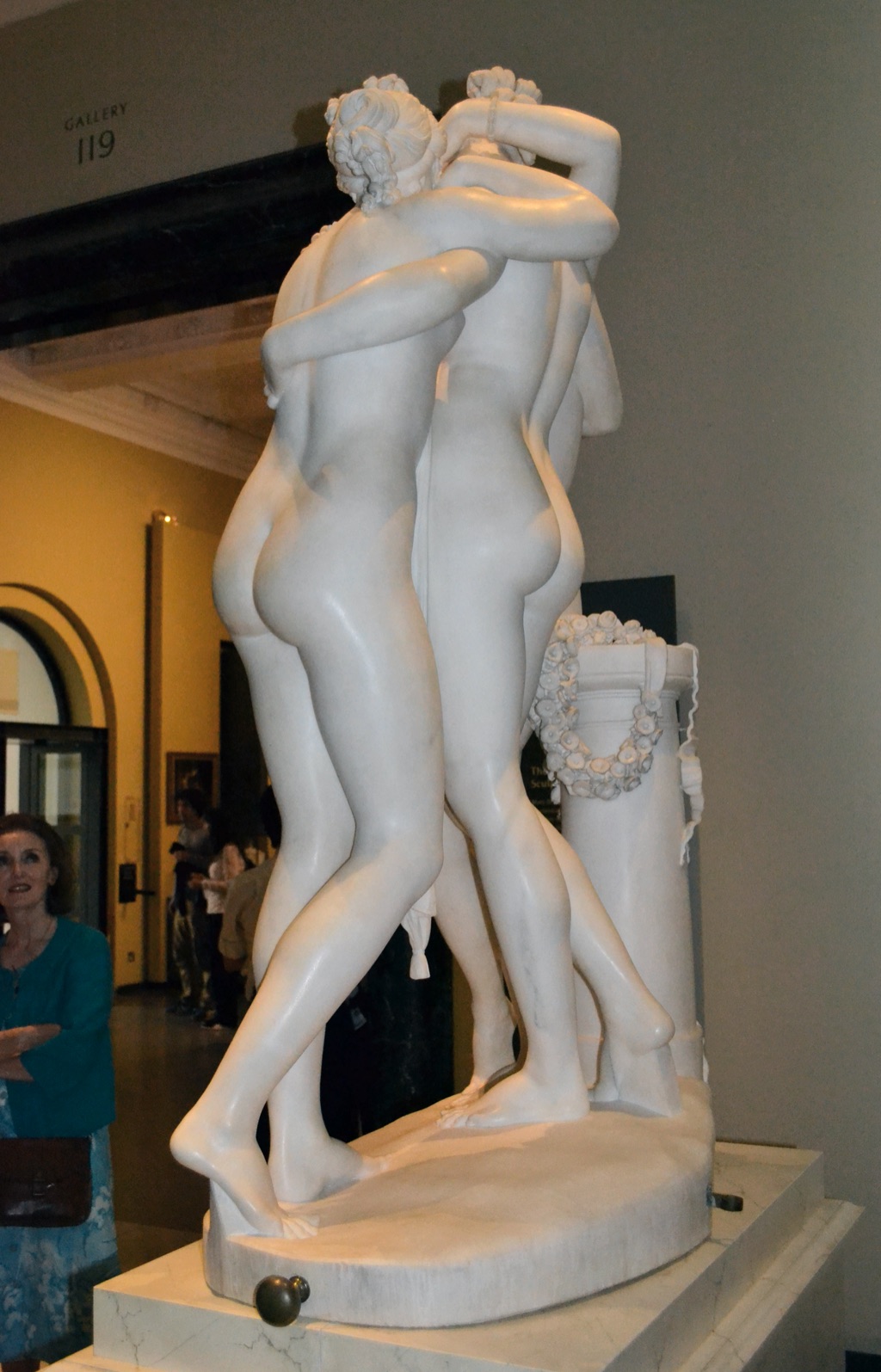
The Bedford marble from behind, showing the round support. ketrin1407. Image source. CC BY 2.0. Resized for display.
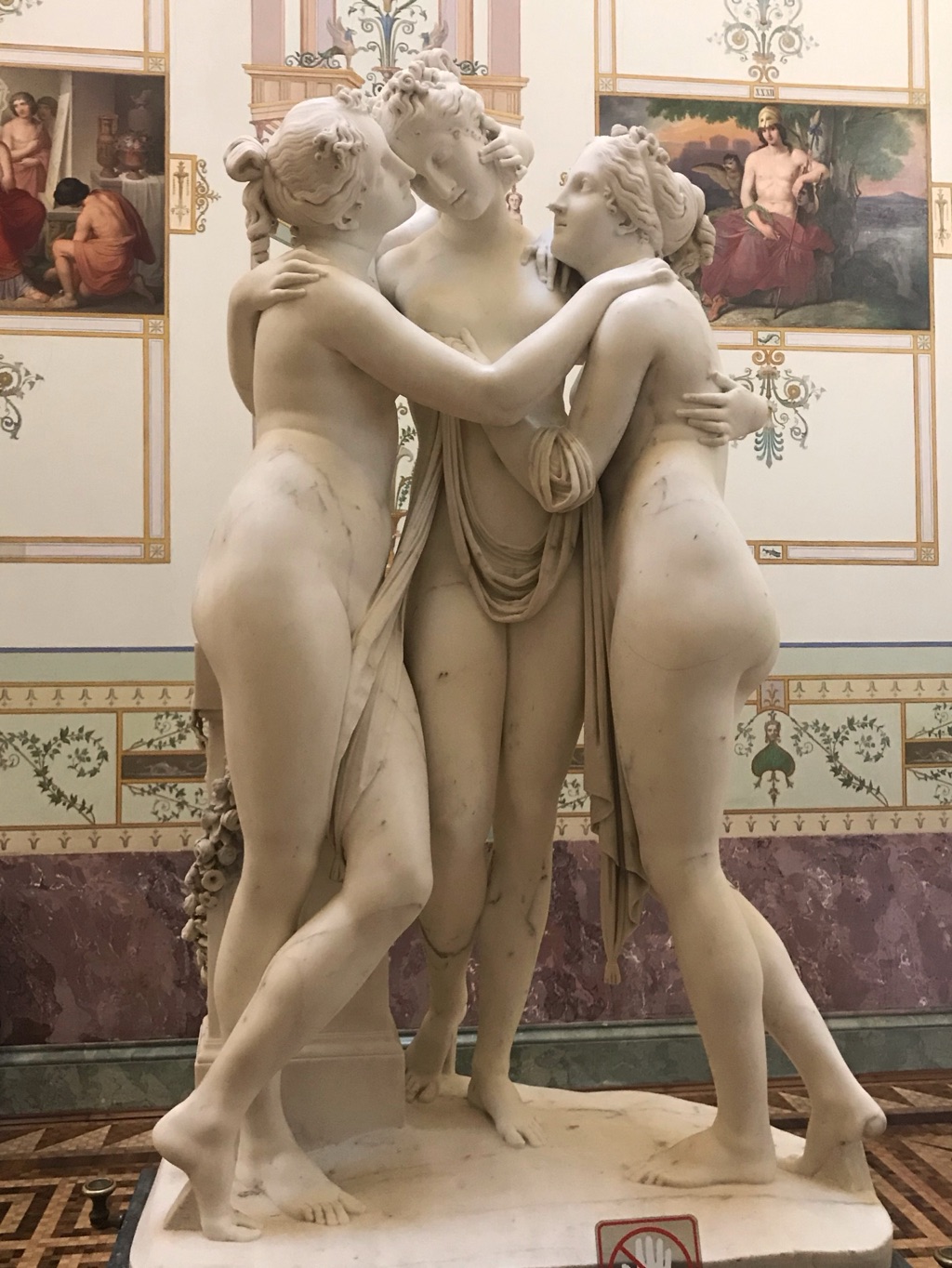
The earlier marble commissioned by Joséphine, in the Hermitage. Pugilist. Image source. CC BY-SA 4.0. Resized for display. The resized photograph uses the same licence.
At a Glance
- SubjectAglaia, Euphrosyne and Thalia, the daughters of Zeus and Eurynome in Hesiod’s Theogony. [5]
- First marbleJoséphine de Beauharnais’s commission, dated 1813–16 by the State Hermitage Museum. It is 182 cm high and entered the collection in 1901. [3]
- Bedford marbleCompleted by 1817 for the Duke and Duchess of Bedford. The National Galleries of Scotland records a height of 173 cm and a weight of 585 kg. [1] [2]
- PlasterCanova’s full-size model of 1813 survives in the Museo Gypsotheca Antonio Canova in Possagno. [4]
This work across Antonio Canova’s career
Venus Victrix
1804–08 Collection recordMars and Venus
1815–19 Collection recordThe Three Graces (Bedford marble) (current article)
Completed by 1817 [1]Contents
- The three sisters and the antique pose
- Walking around the Bedford marble
- Joséphine’s commission and the road to St Petersburg
- The Bedford commission and the differences in marble
- The Temple of the Graces at Woburn Abbey
- Two views on paper
- The Graces in paint and relief
- The plaster and the light at Possagno
- The sculpture in Bedford’s book
- Canova and Thorvaldsen on the same subject
The three sisters and the antique pose
Hesiod names the three sisters Aglaia, Euphrosyne and Thalia in lines 907–11 of the Theogony. Their mother is Eurynome, daughter of Ocean, and their father is Zeus. The poem describes the love that issues from the sisters’ eyes and the sweetness of their gaze. In ancient art and mythology they accompany Aphrodite and are associated with pleasures such as dancing, beauty and sociability. Canova gives their gaze a direction. The sisters look in towards one another, and the inclination of each head brings it within reach of another. [5] [6] [2]
A second-century Roman marble at the Metropolitan Museum of Art shows an older arrangement of the subject. It reproduces a Greek design in which the two outer figures face forward and the middle one turns her back. Their arms link the three bodies into a shallow row. The Metropolitan Museum notes how widely this arrangement circulated, on objects ranging from mirrors to sarcophagi. Canova considered a related arrangement in preparatory drawings and a clay sketch. In those studies a figure seen from the back puts her arms around her companions’ shoulders. [6] [7]
Canova’s final design turns the outer bodies towards the middle, with the central figure’s torso open to the principal view and her head turned to one companion. The group is still immediately legible as three figures, but its outline depends on where the viewer stands. The old subject already offered a sculptor front and back views of the body within a single composition. Canova kept that variety and made the sequence unfold as a viewer moved around the group. [2] [7]
Walking around the Bedford marble
From the front the heads make an uneven arc. The central figure stands a little higher, one face comes close in profile and the other turns far enough inward that the line of the cheek gives way to hair and the back of the neck. Lower down, the bodies angle differently. One outer figure presents much of her front and her neighbour turns an outer hip towards us. That difference in orientation gives the three women room to draw their heads together without aligning their feet and shoulders. [1] [2]
Follow a forearm across the group before trying to read the whole embrace. Where fingers meet the upper arm or shoulder of a neighbour, a narrow shadow gives the point of contact definition. A little farther along, one figure’s back may hide the upper arm that explains the gesture. From the side the hidden shoulder comes into view and the fingertips that were so clear at the front can be hard to see. The changes in overlap make the pose intelligible in stages. [1] [2]
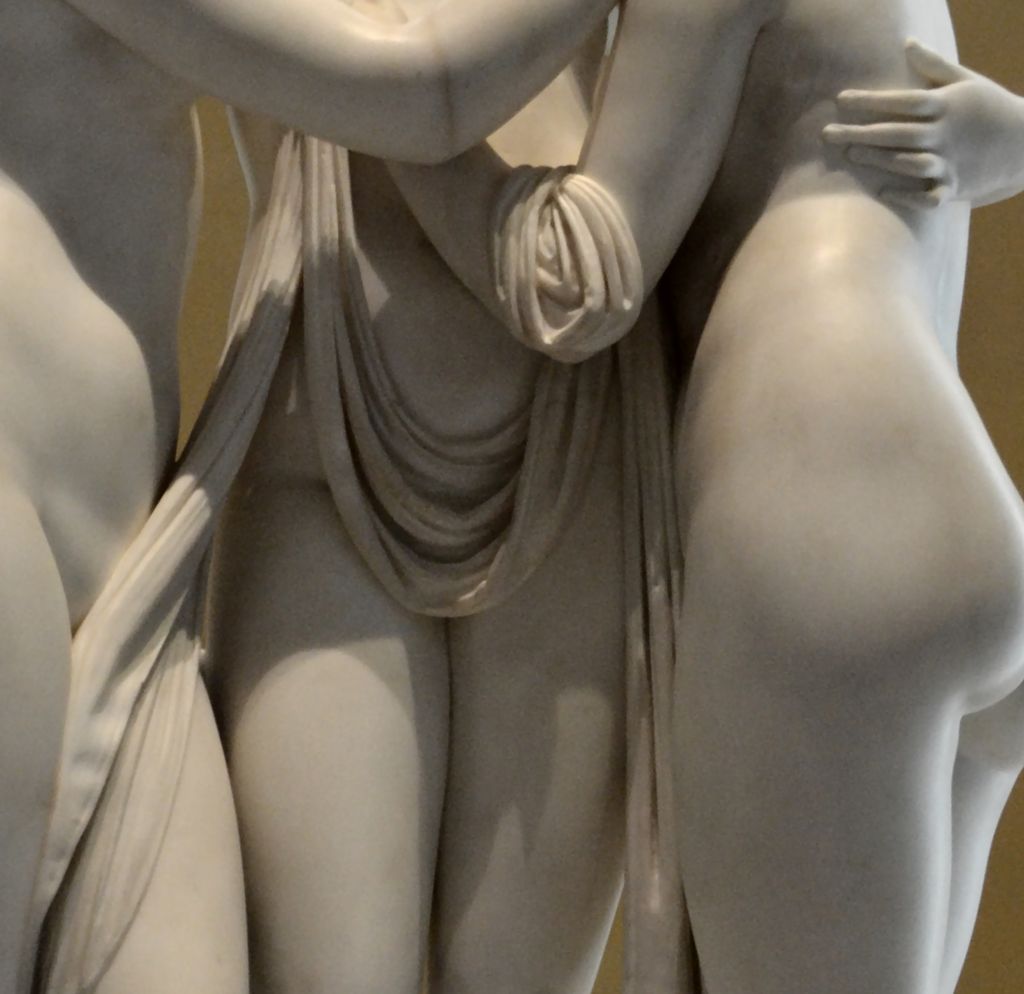
The drapery follows a lower course than the arms. Across the front, its folds sag in a succession of shallow arcs. At a side they gather and turn around the body. The change in texture is especially easy to see where the folds cross smooth flesh. Shadows collect in the narrow furrows of the cloth while the neighbouring surfaces of a thigh or waist hold a broad light. At the top of the group, the closely cut waves and braids of the hair catch light in smaller patches. The same illumination that draws the bodies together lets a viewer distinguish cloth, skin and hair. [1]
From behind, shoulders and backs have more visual weight. A band of arms still draws the eye across the group, but faces no longer lead it from one sister to the next. The round pillar and the garland occupy more of the view. There is a moment along the way when two bodies seem to form a single broad silhouette. A further step lets light appear between the outlines again. The closer the viewer pays attention to the joins, the more the spaces around them matter. [1] [2]
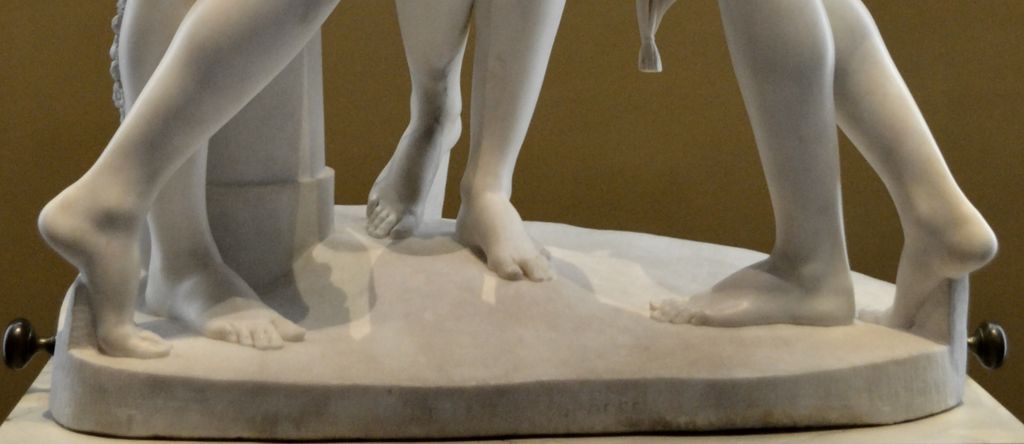
Look at the feet last. The women stay within a remarkably small area even where a bent leg or raised heel suggests movement. The shoulders and heads describe a much wider turn than the stance below them. In the Bedford version the upright pillar gives the eye a fixed line against which to measure those shifts. The movement belongs to the embrace and to the act of looking around it. The three women seem to be settling closer to one another within a pose they can hold. [1] [2]
Annotated Details from The Three Graces
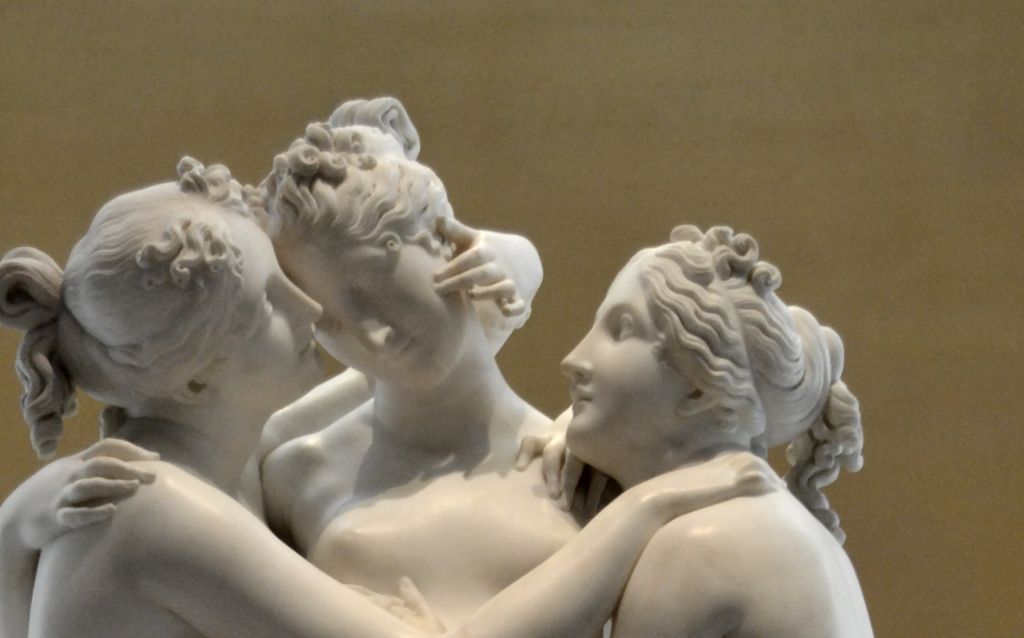
In this view of the Bedford marble, the faces, arms and feet each form a different pattern. Photograph by ketrin1407, Flickr, CC BY 2.0. The photograph was resized, annotated and cropped for the details.
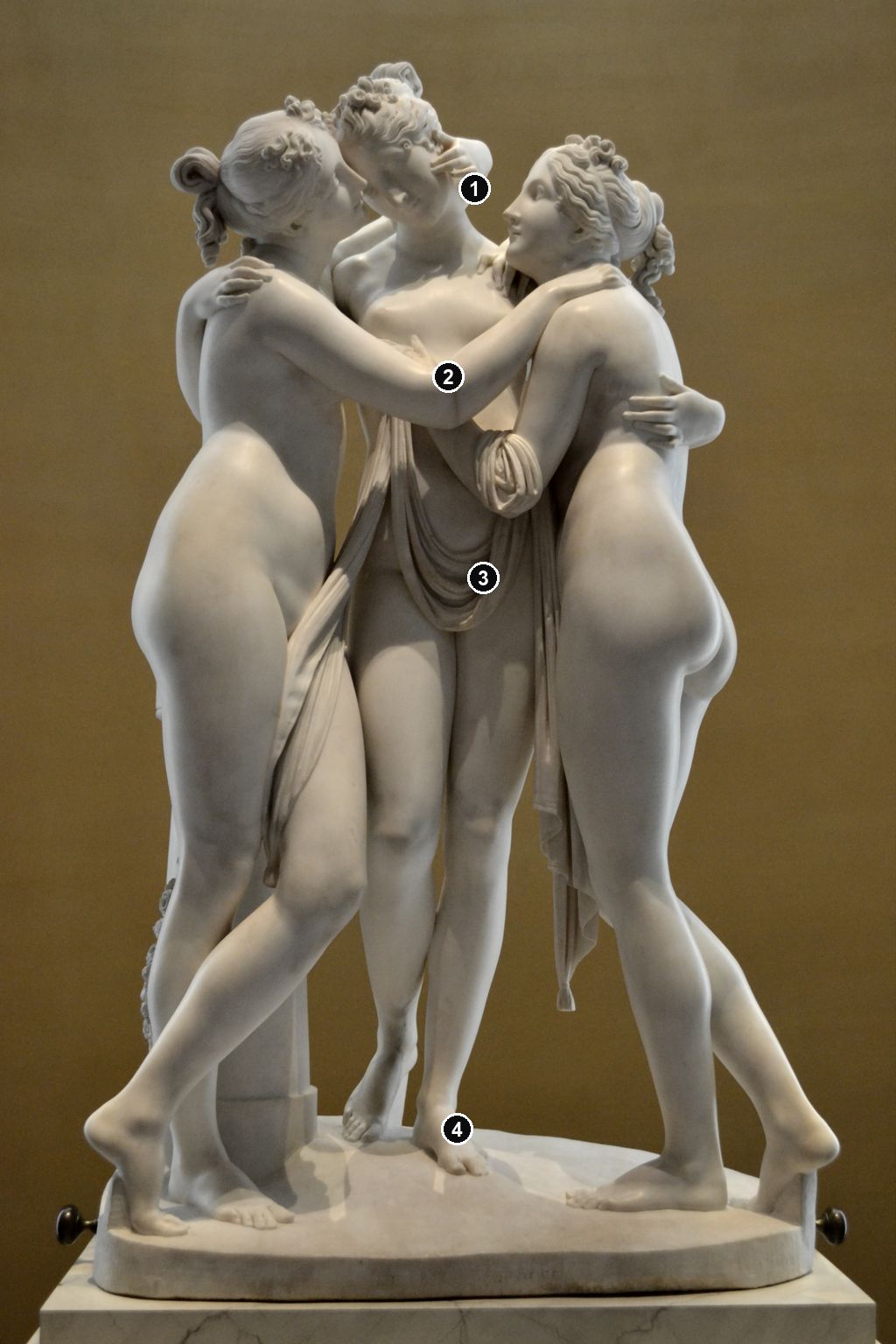
Details from THE THREE GRACES
Follow the interlocking gestures from the faces down to the marble base.
Inclined heads
The middle figure tilts her head towards the figure on the left. The figure on the right looks up into the group. Their faces draw attention inward.
Interlocking arms
Trace the arms across the front of the group. The hand on a shoulder may belong to a figure whose torso sits on the opposite side.
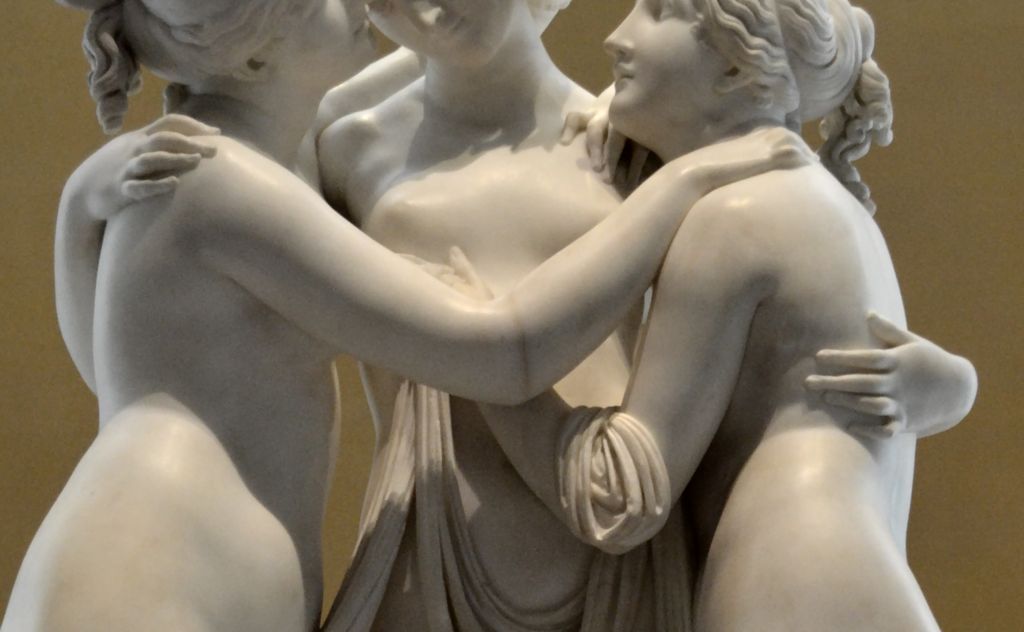
A shared fold
A loop of drapery crosses the central figure and drops into the opening between the bodies. The folds give the group a continuous line below the arms.
Feet on the base
The two outside figures angle their legs outwards. The middle figure’s feet are nearer together. These different stances spread the group at the base.
Joséphine’s commission and the road to St Petersburg
The earliest documented proposal for the marble came in a letter of 11 June 1812 from Joséphine’s secretary, J. Deschamps. Canova had visited Joséphine at Malmaison in 1810 while in France to work on a portrait of Marie-Louise, Napoleon’s second wife. The Hermitage scholar Sergey Androsov raises the possibility that new work was discussed at that meeting. The 1812 letter establishes the commission’s documentary starting point. By October Canova told Joséphine that he had made a small clay sketch. [7]
Drawings in Bassano preserve both the backward-facing figure of the earlier scheme and experiments with figures turning towards one another. Androsov also points to a drawing in the Museo Correr in Venice that approaches the arrangement of the marble. In the small terracotta now in Lyon, three slender women are already gathered closely. Their bodies are more elongated than those in the marble, and the point where a hand meets a head or a shoulder was still open to revision. Lyon dates the terracotta to 1810. Androsov places it between June and September 1812 and suggests that it may be the clay sketch Canova mentioned that October. The exact dating remains uncertain. The object’s later history is clearer. Canova gave it to Juliette Récamier, who bequeathed it to the museum in Lyon. [7] [8]
The full-size plaster in Possagno carries an inscription recording that it was begun in June and finished in August 1813. At this scale Canova could judge how three life-size bodies would touch and where a fold could remain visible. Androsov notes that, compared with the Lyon clay, the central figure embraces her neighbour at the shoulder instead of the head. He also identifies a change from the clay’s fluted column to a square altar in the plaster. The first marble closely follows that model. Canova returned to this arrangement when he made the second version, even as he reconsidered the support. [4] [7] [9]
In October 1813 Canova requested an advance of 20,000 francs and expected the work to take about two years. Joséphine died in May 1814, before the carving was finished. Her son Eugène confirmed the order through his secretary in June. In spring 1816 Canova described the work as close to completion in a letter to Quatremère de Quincy. Androsov records that Eugène paid and obtained an export licence in March 1817. That sequence accounts for the Hermitage’s 1813–16 dating of the work and the later date of its departure from Rome. [3] [7]
Eugène took the marble to Munich, where he settled after receiving the title Duke of Leuchtenberg from his father-in-law, the king of Bavaria. The sculpture stayed in Munich into the 1850s. Eugène’s son Maximilian married Grand Duchess Maria Nikolaevna, a daughter of Nicholas I, and moved to St Petersburg, bringing his collection. The Hermitage bought the group from their heirs in 1901. Some other Canova marbles that Joséphine had owned, including her full-length Paris, had entered the Russian imperial collection from her heirs in 1815. The Graces travelled through a later generation of the family. [3] [7]
The Bedford commission and the differences in marble
John Russell, the sixth Duke of Bedford, visited Canova’s Roman studio in December 1814, while the first marble was still in progress. The plaster and the work already done in stone impressed him. In a letter of 21 January 1815 he expressed interest in acquiring the group or commissioning another. Eugène’s claim to the first version meant that Canova undertook a second for the Bedfords. The duke’s letter left the particulars of the revisions to the sculptor. He wanted the quality he had admired in Rome to survive the changes. [1] [2] [7]
The round column is the clearest difference. In the Hermitage version a four-sided altar accompanies the figures and carries floral offerings. The Bedford support has a round shaft, a base and a Doric capital. A carved garland hangs from it. From some angles the shaft is almost swallowed by the figures. Viewed obliquely or from behind, its clean vertical form helps the viewer register how strongly the women twist above their standing legs. The square support on the first marble offers planes and edges that come and go more abruptly as the angle changes. Both supports are part of the sculpted composition. The pedestal at Woburn was a separate furnishing below it. [1] [3] [7]
The V&A also records that Canova chose white marble for the Bedford version in place of the first group’s veined stone and slightly broadened the central figure’s waist. The waist is an adjustment within the pose, easiest to examine from matching viewpoints in the two works. The stone changes the way a viewer reads the surface. Veining can run across the contours, while in the whiter Bedford marble gradations between light and shadow do more of the work of defining them. The change in material accompanies a change in the silhouette even though the grouping is recognisably the same. [1] [2] [3]
Canova’s use of sculptural models made these revisions possible. A small clay sketch can register the turn of a torso with little more than a stroke or a finger’s pressure. A full-scale plaster fixes the relation between bodies closely enough for those distances to be measured and carried over into stone. In Canova’s workshop, assistants could use reference points in plaster to guide the removal of marble. The Possagno plaster served as the basis for both carvings. The recorded differences show how the workshop could reuse measurements while Canova retained the freedom to alter the support or revise a figure. Androsov identifies the first group as carved from a single block, which gives some idea of the planning required before those closely spaced arms could be freed from the surrounding stone. [4] [7] [9] [10]
Videos on Canova
Explore Canova’s workshop methods and the settings for his sculpture.
How does an artist copy the 200-year-old techniques of master sculptor Antonio Canova?
A sculptor demonstrates how Canova’s workshop methods can be used to recreate a marble Venus.
Watch on YouTubeThe Temple of the Graces at Woburn Abbey
Canova visited Woburn in 1815, before the new room was built. According to the V&A, he appears to have advised on where and how the sculpture should be lit. Jeffrey Wyatville set the circular Temple of the Graces at the west end of the sculpture gallery. A glazed opening in the coffered dome lit the room from overhead. An architectural account records coloured marble paving and inlaid brass figures on the floor, with doors beyond an apsidal anteroom. The passage from the larger gallery into this room made the Graces the focus of a visitor’s approach. [1] [11]
The room also gave the three bodies a background against which their contours could be picked out as they turned. Overhead light would catch the crowns of the heads and the rounded tops of the shoulders. The folds below the arms and the intervals between the figures would retain shadow. In a group this close, those differences matter. Even where one figure partly hides another, a dark edge under a wrist or at the boundary of a neck can help a viewer distinguish the bodies. [1] [11]
The eighteenth-century marble pedestal, once thought ancient, allowed the sculpture to rotate. The rotunda framed the initial sight of the group, and the turning pedestal made its successive views available from a standing position. The Bedford collection contained antiquities alongside works by contemporary British sculptors such as Joseph Nollekens, Francis Chantrey and Richard Westmacott. The adjoining gallery gave visitors examples of both ancient and recent sculpture against which to judge how Canova worked with a classical subject. [1] [11]
Sources agree on completion by 1817. The V&A dates delivery to Woburn to that year, while Androsov puts the transfer to England in spring 1818 and Possagno places the installation at the abbey in the following year. The chronology is clearest when carving, shipment and installation are treated as separate events. The sculpture remained associated with the Woburn collection until its joint acquisition for public collections in 1994. The National Heritage Memorial Fund contributed £3 million to that purchase. The work carries the accession number A.4-1994 at the V&A and NG 2626 at the National Galleries of Scotland. [1] [2] [7] [9] [12]
Bedford’s description of the sculpture’s morbidezza points to one aspect of the experience the room was designed to give. In his catalogue of the marbles he used the term for a finish that makes the stone look soft enough to yield to touch. The effect depends in part on differences in carving within a small area. The shallow curve of an upper arm carries light away from the deeper cuts between the fingers resting on it. The sculptor makes one piece of stone suggest both the pressure of the fingers and the softness of the surface they meet. [1]
Two early Italian accounts also put the embrace at the centre of the work. Isabella Teotochi Albrizzi singled out the affectionate way the sisters hold each other, while Leopoldo Cicognara traced the effect through the knots made by hands and arms. His description also stresses the figures’ agility. That agility is visible even where the feet remain still. Watch how a head inclines to meet a shoulder, or how an arm reaches around a back without pulling the neighbouring body off balance. [9]
Two views on paper
While Canova was working on the first group, Domenico Marchetti reproduced it in two prints after drawings by Giovanni Tognoli. Androsov dates the engraving work to 1814–15 and records Canova’s supervision. Both plates include a dedication to Empress Elizabeth Alexeievna of Russia and the Russian double-headed eagle. The inscriptions addressed a Russian patron of the arts long before Eugène’s family collection reached St Petersburg. The dedication concerns the images. Ownership of the marble followed the Leuchtenberg family. [7] [13] [14]
In the front view, Evfrosine Aglaia Talia, the altar appears in shadow between the legs. The three heads form a compact cluster with a comparatively open area below them where light plays across the central torso. In the rear view, Talia Aglaia Evfrosine, the altar and its hanging garland take a prominent place on the right. Across the middle, the viewer sees how much of the embrace consists of hands and forearms laid across shoulders and backs. The names run beneath the plinth in the reverse order in the second print, following the change of viewpoint. They identify the sisters in these engraved views. The marbles can be read by the positions and gestures of the figures without treating the inscriptions as fixed labels for every view. [7] [13] [14]
The Istituto Centrale per la Grafica identifies the surviving impressions as etching and engraving and describes them as states with veils introduced for censorship. Extra fabric in the front impression crosses the outer figures’ hips in translucent bands. The rear impression gives the central hips a sweep of veil that climbs diagonally across the lower back. Those printed folds matter when comparing the images with the Hermitage marble. In the sculpture, the scarf binds specific points in the three-dimensional group. On paper, added lines cover parts of the body and change the amount of clear space around the contour. A print preserves the evidence of one chosen angle and the decisions made to publish it. Turning from one sheet to the other recovers something of the experience of walking around the group. The two fixed views leave the intervening overlaps for the viewer to imagine. [3] [7] [13] [14]
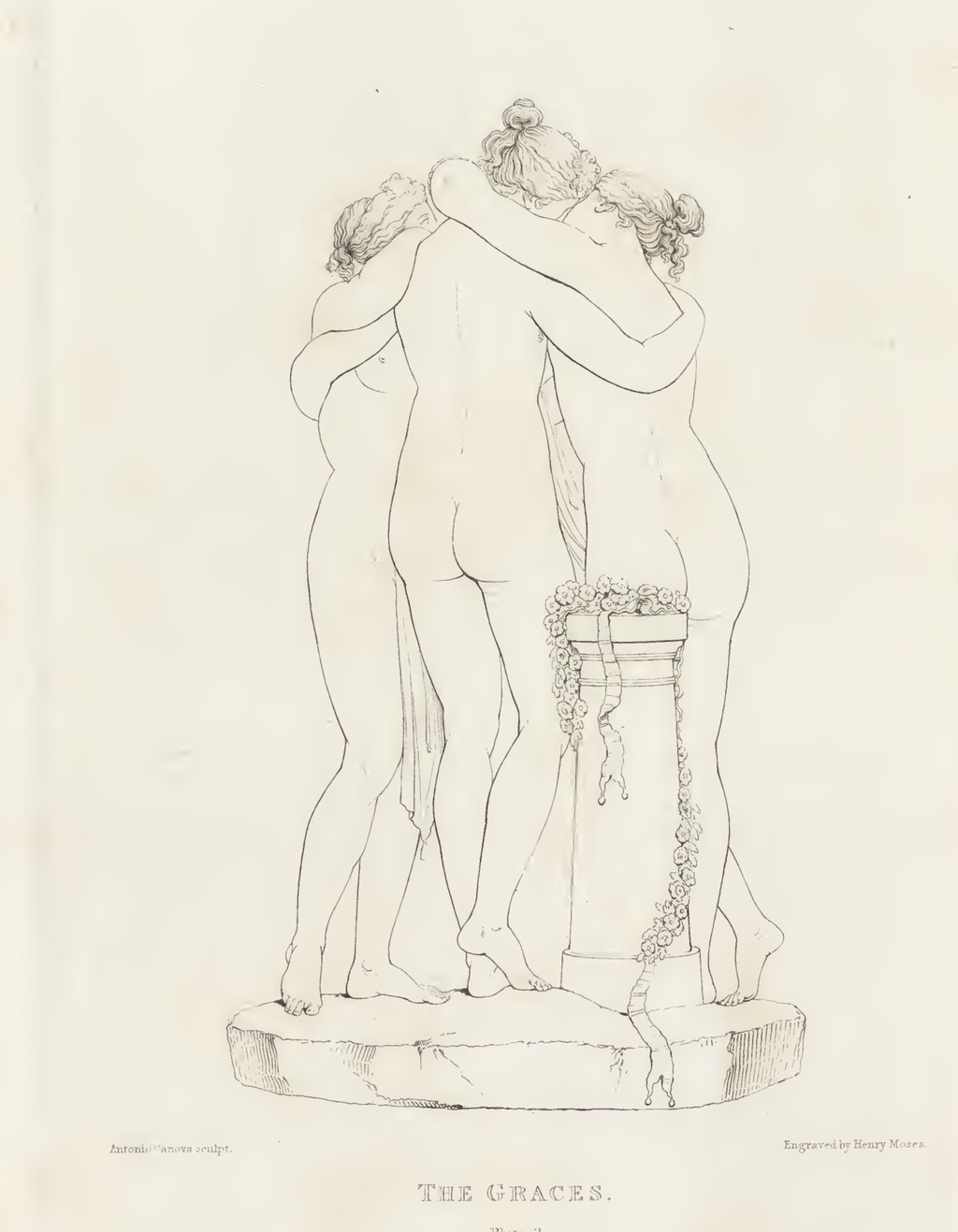
Moses’s second view gives the support and the backs of the three figures a more prominent place. Henry Moses, after Antonio Canova, engraving published in London, 1824. Getty Research Institute. Image source. Public domain. Scan margins trimmed and image resized.
The Graces in paint and relief
Canova had worked with the subject in several media before the commission arrived. Italy’s national catalogue records a signed Le grazie of 1799 in oil on canvas and distinguishes it from the tempera Dance of the Graces with a Cupid. The oil was made during a stay in Possagno alongside two other paintings, The Surprise and Venus with Cupid. Giuseppe Pavanello relates the three oils through their treatment of the female nude and their engagement with Titian and Correggio. Giovanni Martino De Boni’s print after Canova’s design for the dance with Cupid belongs to a separate series of graphic works. Its subject is a dance, with a musician and other elements around the three figures. Marchetti’s prints, by comparison, take a specific freestanding sculpture as their subject. [13] [15] [16]
In The Dance of Venus and the Graces before Mars, dated 1797–99 by the Fondazione Federico Zeri, a veil rises above the dancers and the flow of the garland can be read across the width of the sheet. Zeri catalogues the paper tempera as a pair with The Rape of Helen. The detail of the dancing figures brings the turns of the feet, raised veil and linking gestures close. The complete scene sets that action before Mars. The museum in Possagno also records a 1797 bas-relief on the same theme, in which dancing and music share the shallow space. [17] [18]
The tempera gives a viewer the dancers, the cloth above them and the spectators in a single field. Its open gestures can be read across the dark ground. In the marble Canova brought the hands and heads close and let the stone bodies hide parts of the action. A veil can stretch in a long curve overhead on paper. In the standing group, the carved scarf hangs low across the figures and changes direction where it touches them. Both works ask us to follow gestures across several bodies, while the marble gives those gestures a sequence through space. [1] [2] [17]
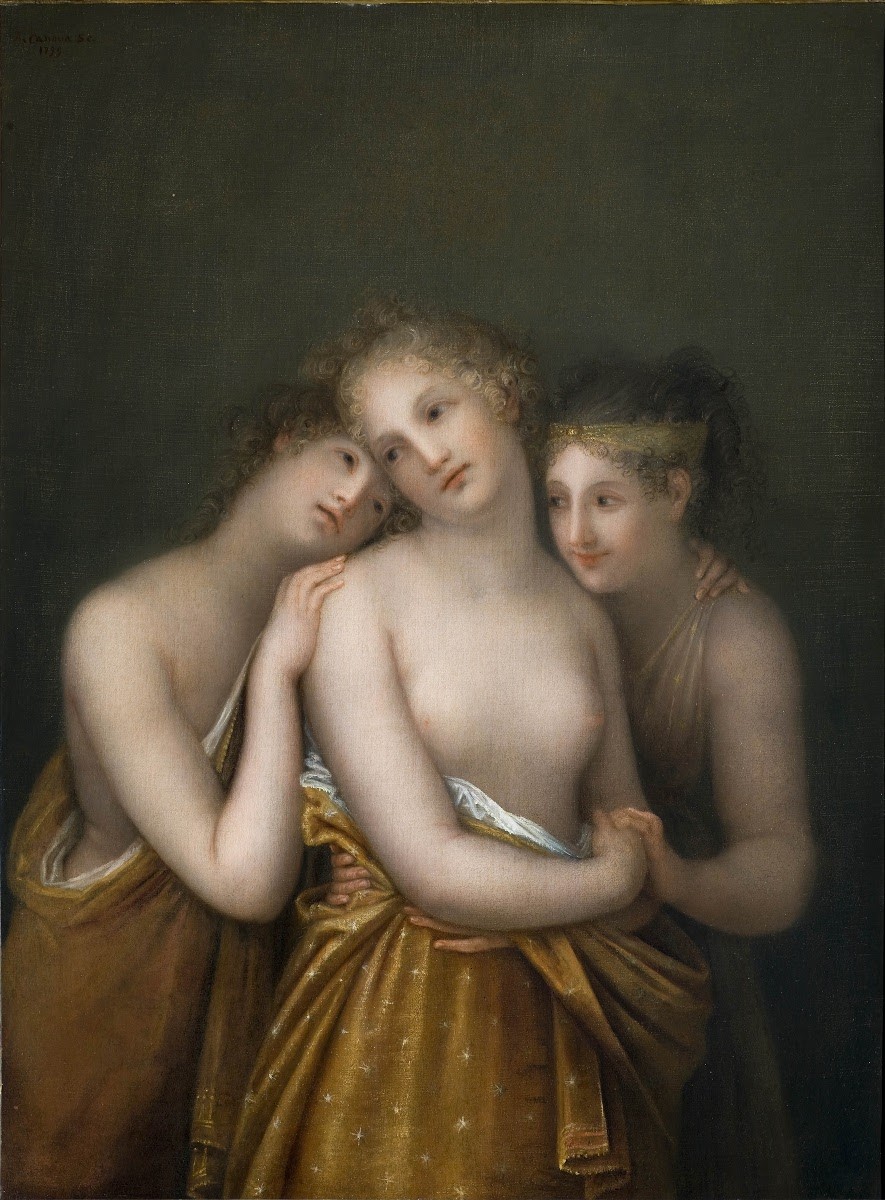
In Canova’s painted Graces, the figures draw close together as they do in the marble group. Museo Gypsotheca Antonio Canova, Possagno. Image source. Public domain. Resized from source.
The plaster and the light at Possagno
The surviving model is 170 cm high. In a workshop it gave Canova and his assistants a common object from which to take measurements. Its display history gives it another role. In the mid-twentieth century Carlo Scarpa placed the plaster at the end of a low room in the new wing of the Gypsotheca, inaugurated in 1957. The building drew daylight through corner glazing, with water by the sculpture reflecting light onto the plaster. The museum’s account describes how this changing illumination brought different contours into prominence. Its collection record now places the plaster in the nineteenth-century wing. [4] [19]
Woburn and Scarpa’s gallery offered different ways to discover the same arrangement of bodies. At Woburn the opening in the dome set the light above the figures and the pedestal let the group turn beneath it. In Scarpa’s arrangement the plaster stood still and the brightness could shift with the daylight. The front view established the embrace in either setting. The details that emerged next depended on what moved and what caught the light. [1] [11] [19]
The sculpture in Bedford’s book
The duke commissioned a book in which the modern sculpture could be read alongside the antiquities in his collection. Published in London in 1822, the Outline Engravings and Descriptions of the Woburn Abbey Marbles used plates cut by Henry Moses from drawings by Henry Corbould. The copy now at Sir John Soane’s Museum contains proofs on India paper and a letter dated 3 April 1823, when Bedford presented it to the architect Charles Heathcote Tatham. A visitor to Woburn saw the work among other sculptures and in its rotunda. The gift to Tatham carried that setting into a book that could be studied away from the house. Its plates and appendix also put the collector’s taste before readers who might never see the original. [20]
One of the appendix’s two essays was Ugo Foscolo’s Dissertation on an Ancient Hymn to the Graces. It accompanied the passage about the Graces’ veil that Foscolo chose to publish from his unfinished poem. The Italian cultural archive traces further work on the poem in manuscripts kept in Livorno and Milan. The published passage gave the reader another way to think about cloth and movement alongside Canova’s marble. On the sculpture, the scarf emerges from behind an arm and gathers weight as it falls. In the printed book the veil could also be approached as an idea worked out over successive drafts. The association belongs to the history of Bedford’s collection and Foscolo’s publication. Canova had already carved the Bedford group when the book appeared. [1] [20] [21]
A visitor writing in 1820 discussed Canova and Thorvaldsen in the course of the same tour. The account records regulated Monday access and singles out the room the duke gave Canova’s group. Its praise for Canova comes amid a sharp comparison with Thorvaldsen, whose work the writer saw elsewhere in the collection and at Woburn. The arrangement gave the works unequal kinds of attention. Reliefs could be encountered in sequence, while the Graces had a room in which one group could hold the visitor’s gaze. The report gives a record of one visitor’s response to that arrangement. [11] [22]
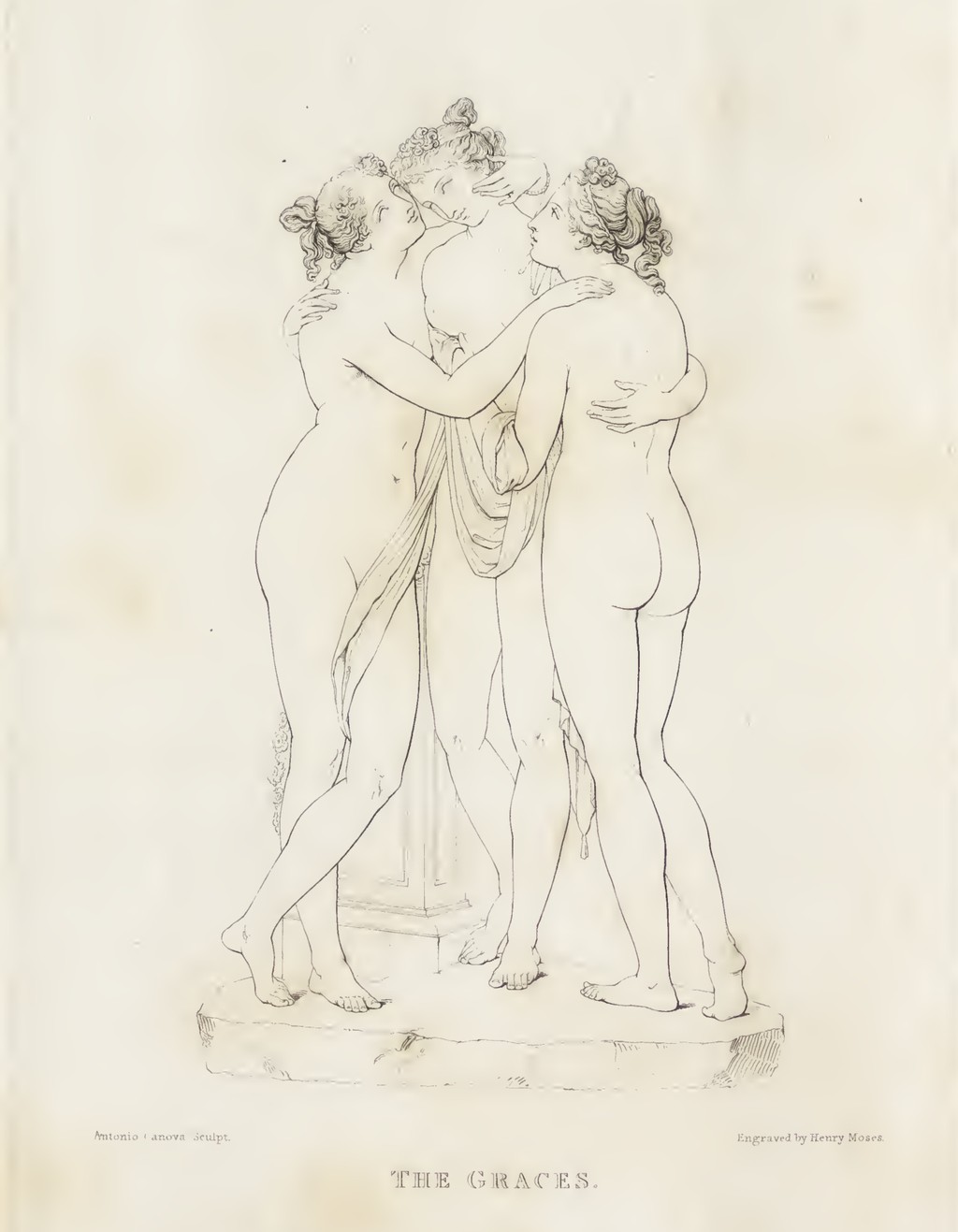
The front engraving makes the three heads and interlocked arms legible as a group. Henry Moses, after Antonio Canova, engraving published in London, 1824. Getty Research Institute. Image source. Public domain. Scan margins trimmed and image resized.
Canova and Thorvaldsen on the same subject
Thorvaldsen’s own Cupid and the Graces provides a comparison independent of the visitor’s preference. His museum dates the full-size plaster model to April 1819. It is 171 centimetres high, close to the 170 centimetres of Canova’s model at Possagno. Seen from the front, Thorvaldsen’s figures form a compact group whose faces turn towards the activity of their hands. Cupid occupies the lower part with a lyre. His small body introduces another level beneath the three heads and gives the viewer a place to start looking from the floor upwards. Canova keeps the lower register quieter. A pillar or altar occupies the space beside the legs, and the main activity lies in the touch and balance of the standing figures. [4] [23] [24]
In the Thorvaldsen group, the subject turns on an object the sisters can examine. Canova uses the scarf and the support to vary the outline while keeping the encounter between the women. The difference is apparent even from across a gallery. In one composition a fourth figure draws the eye down and the sisters’ attention leads it back up. In the other, an inclination of the head and the crossing arms carry attention from one woman to the next. Thorvaldsen returned to the subject in relief. There the Copenhagen catalogue explicitly identifies the arrow the Graces inspect and Cupid playing his lyre. Reading the relief alongside the freestanding model helps show how a sculptor could carry the same action into a shallow field. Canova’s painted and carved groups offer their own variations on that problem. [1] [18] [23] [24]
From a private collection to two museums
The modern acquisition brought a different set of choices about where the group could be seen. In September 1993 the J. Paul Getty Trust agreed to buy it for £7.6 million, subject to an export licence. The licence decision was deferred, giving British institutions time to raise funds. An October 1994 Court of Appeal judgment records the conditional terms and the Getty Trust’s challenge to the later deferral and to public funding. A parliamentary answer from January lists the work and the valuation while the recommendation was still under consideration. These sources follow the dispute as it unfolded, before the collection records give the outcome. [25] [26]
The Victoria and Albert Museum and the National Galleries of Scotland acquired the sculpture jointly. The National Heritage Memorial Fund awarded £3 million, and the Art Fund records that it doubled its grant during the campaign. The two accession numbers therefore describe a single marble held jointly. They are different from the Hermitage number, which identifies the independently carved first version. The arrangement also changed the terms of looking. At Woburn, the room and the turning pedestal were part of a private collection with regulated access. In the public collections, readers can encounter the work through two institutional catalogues and compare it with the first marble using records from three museums. [1] [2] [3] [12] [27]
Explore Canova’s works
Browse the sculptures and paintings covered in this guide. Several entries compare versions or examine details of a larger work.
Discussion
Look again at the images and ideas explored in The Three Graces. These editorial prompts invite your observations.
Reader Insights
Follow one hand around the group. How does the embrace change from the front and back?
What would the rotating pedestal at Woburn have let a visitor see?
Join the Conversation
Share a detail, comparison or question about The Three Graces below.
References
- Victoria and Albert Museum, The Three Graces by Antonio Canova, A.4-1994. View source.
- National Galleries of Scotland, The Three Graces, NG 2626. View source.
- State Hermitage Museum, Три Грации (The Three Graces), collection record Н.ск-506 (in Russian). View source.
- Museo Gypsotheca Antonio Canova, Le Grazie, plaster, inv. 237 (in Italian). View source.
- Hesiod, Theogony, lines 907–11, English translation at the Center for Hellenic Studies. View source.
- The Metropolitan Museum of Art, Marble Statue Group of the Three Graces, 2010.260. View source.
- Sergey Androsov, Italian Sculpture, 17th–18th Centuries, State Hermitage Publishers, 2014, cat. 247, pp. 271–75 (in Russian). View source.
- Musée des Beaux-Arts de Lyon, Les Trois Grâces, terracotta, inv. H 794 (in French). View source.
- Museo Gypsotheca Antonio Canova, Sara Irmi, Le Grazie del Duca di Bedford, 2023 (in Italian). View source.
- National Gallery of Art, Canova: Sketching in Clay, exhibition wall texts, section on the sculptural process, 2023. View source.
- Bedfordshire Historic Environment Record, Sculpture Gallery, adjoining south side of south stableblock, Woburn Park, MBD4951, via Historic England’s Heritage Gateway. View source.
- National Heritage Memorial Fund, The Three Graces by Antonio Canova, 1994 acquisition grant. View source.
- Istituto Centrale per la Grafica, Domenico Marchetti after Giovanni Tognoli, Evfrosine Aglaia Talia, S-CL2179_311, second state (in Italian). View source.
- Istituto Centrale per la Grafica, Domenico Marchetti after Giovanni Tognoli, Talia Aglaia Evfrosine, S-CL2179_312, third state (in Italian). View source.
- Catalogo generale dei Beni Culturali, Le grazie, oil on canvas, inv. 132, national catalogue 0500432558 (in Italian). View source.
- Istituto Centrale per la Grafica, Giovanni Martino De Boni after Antonio Canova, Danza delle Grazie con Amorino, S-FN31963 (in Italian). View source.
- Fondazione Federico Zeri, Ratto di Elena, Danza di Venere e delle Grazie davanti a Marte, no. 96420, citing Elena Bassi’s 1957 catalogue, pp. 116–18, no. 97 (in Italian). View source.
- Museo Gypsotheca Antonio Canova, Mario Guderzo, Canova e la danza (in Italian). View source.
- Museo Gypsotheca Antonio Canova, Ala Scarpa, history and design of the Scarpa wing (in Italian). View source.
- Sir John Soane’s Museum, Outline Engravings and Descriptions of the Woburn Abbey Marbles, London, 1822, reference 2920 and 1823 presentation letter. View source.
- Internet Culturale, Ugo Foscolo: Le Grazie, manuscript and publication history. View source.
- Thorvaldsens Museum Archives, contemporary 1820 account of a visit to Woburn Abbey, EA9131. View source.
- Thorvaldsens Museum, Bertel Thorvaldsen, Cupid and the Graces, original plaster model, A29. View source.
- Thorvaldsens Museum, Bertel Thorvaldsen, The Graces with Cupid’s Arrow, and Cupid Playing His Lyre, A31. View source.
- Court of Appeal of England and Wales, Secretary of State for National Heritage and Another v J Paul Getty Trust, 27 October 1994, paragraphs 2–15. View source.
- House of Commons, Works of Art (Export Licences), written answer, 18 January 1994. View source.
- Art Fund, The Three Graces, record of the 1994 acquisition campaign. View source.


 Antonio Canova.jpg)

