



 by Tom Gurney
Tom Gurney BSc (Hons) is an art history expert with over 20 years experience
Published on June 19, 2020 / Updated on November 13, 2026
Email: tomgurney1@gmail.com / Phone: +44 7429 011000
Venus Italica: Introduction
Venus has pulled a cloth across her chest. Her hands gather the folds high on one side of her body while her face turns towards the other. Below her wrists the cloth loosens, leaving a long ridge that falls between the legs. A little vessel at her feet helps explain the gesture. Antonio Canova shows the goddess just out of the bath, with her attention already somewhere beyond the task of drying herself. The marble is 171.5 centimetres high and stands in the Room of Venus at the Pitti Palace in Florence. [1]
The statue first went on view in the Uffizi, where the ancient Medici Venus had stood before the French took it to Paris. Florentine officials initially wanted a marble copy of the missing statue. Canova began work on one and also modelled a Venus of his own design. It was this second project that eventually filled the vacancy in the gallery. The two figures can now be seen in different Florentine collections, Canova’s in the Palatine Gallery and the antique back in the Uffizi’s Tribune. [1] [2] [3]
Venus Italica Antonio Canova
At a Glance
- ArtistAntonio Canova. [1]
- Florentine marble171.5 cm high, Palatine Gallery, Pitti Palace, inventory 1912 no. 878. [1]
- Arrival at the Uffizi29 April 1812. [1]
- Ancient comparisonMedici Venus, Uffizi, inventory 1914 no. 224. [2]
Contents
- How the cloth changes the pose
- How the Medici Venus reached Paris
- Two commissions in Canova’s studio
- A revolving base in the Tribune
- What Florentine viewers saw
- The workshop marble in New York
How the cloth changes the pose
The cloth tells you where Venus’s hands have been a moment before. The loose material has come up from below, bunching under the fingers before spreading across the front of the body. From the shoulders down, the pose seems to close around that handful of fabric. The bare back gives a different impression. From behind, it is possible to follow the curve of the spine and the turn of the shoulders without the folds crossing the figure. The cloth reappears near the legs, where it narrows towards the plinth. The statue offers an almost uninterrupted study of the back at the same time as it gives the hands a practical task at the front. [1] [3]
The turn of the head is small enough that the torso stays easy to read. Its effect becomes clearer from the side, where the nose and chin project beyond the curve of the neck. The figure’s attention seems to reach farther than her body does. Lower down, one leg takes the weight and the other bends. That change at the knees breaks the column of folds and allows the lower edge of the cloth to fall unevenly. Canova places the bath vessel low enough that it takes a deliberate second look to find it. The action reads first through the crossing arms and only afterwards through the object that supplies the setting. [1] [3]
The ancient Medici Venus belongs to the family of figures called Venus pudica, in which the goddess’s hands cover her breast and pubis. One hand moves across her chest and the other drops towards her thighs. The position leaves a gap between the arms and the waist. There is a different division of forms at the base, where a dolphin rises beside one leg and small figures climb around it. Canova brings both hands towards the same bundle of cloth, so the two gestures become a single action. The cloth also gives him a way to carry the movement of the hands down towards the ground without making the arms extend to different heights. [1] [2] [3]
The Uffizi dates the Medici marble to the late second or early first century BC and measures it at 153 centimetres. Its catalogue connects the pose to the lost Aphrodite of Knidos by Praxiteles, known through later interpretations. The Florentine statue itself had been assembled and restored. The ancient base bears the name of Cleomenes, but the Uffizi explains that the signed element was associated with the figure after its discovery. The visible arms, too, had a history. In 1785 Francesco Carradori tried a new pair of arms on a cast before the gallery decided to keep the existing ones. When Florentine officials approached Canova, the position of the antique’s hands was already a matter of debate. [2] [3]
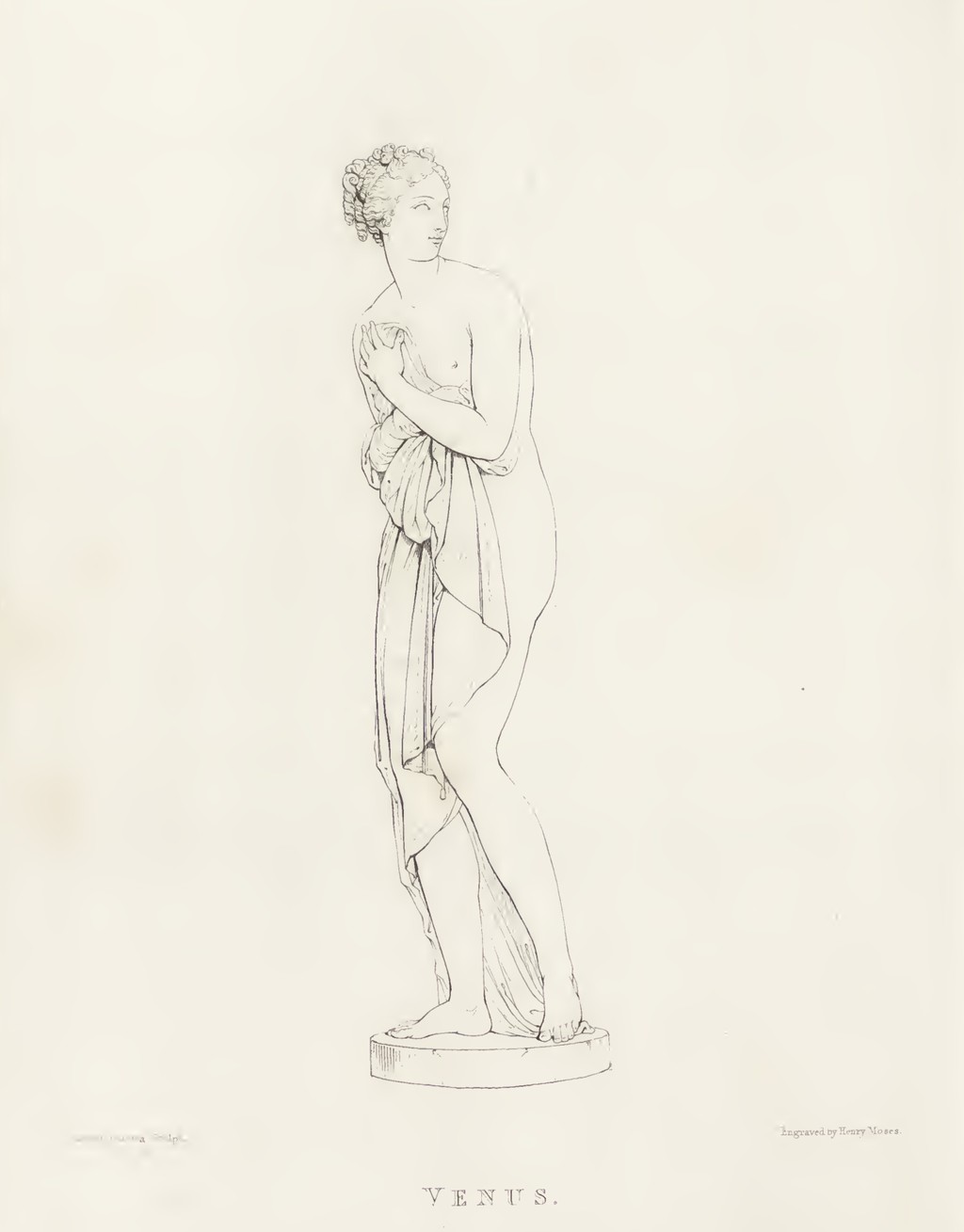
Moses’s plate shows the long folds hanging from the hands of Canova’s standing Venus. Henry Moses, after Antonio Canova, engraving published in London, 1824. Getty Research Institute. Image source. Public domain. Scan margins trimmed and image resized.
How the Medici Venus reached Paris
In 1800 Tommaso Puccini, director of the Uffizi, organised the removal of important works to Palermo for safekeeping as French troops threatened Tuscany. The Venus went with them. A dispatch of 2 September 1802 from the French ambassador in Naples, Charles-Jean-Marie Alquier, told the prefect in Marseille that he had chartered the Saint Louis to carry the statue directly from Palermo. The arrangement was in place before the crate was opened. On 11 September, in Puccini’s absence, a local official brought the French representative to the depot. Artists called to identify the figure confirmed that it was the one they knew from Florence. [4] [5]
The handover was contested. The diplomatic correspondence includes a protest from Ludovico of Bourbon, King of Etruria, addressed to Napoleon, then First Consul. Ludovico expressed surprise that the French ambassador had obtained the Venus from the Neapolitan government and drew attention to how its loss would be received in Tuscany. By August 1803 the marble stood in the Salle de Vénus at the Musée Napoléon in Paris. There it could be seen alongside the Capitoline Venus, another celebrated ancient treatment of the covering gesture. In Florence, an empty pedestal made the loss visible to anyone who knew the Tribune. [3] [4] [5]
Two commissions in Canova’s studio
The Uffizi puts Ludovico’s initial approach to Canova in 1802, when the sculptor passed through Florence. The surviving correspondence allows the request and acceptance to be dated separately. Giovanni degli Alessandri, who handled the negotiations, pressed the proposal in a letter of 31 January 1803. On 4 February Canova agreed to undertake the work and asked him to send a plaster cast of the Medici Venus. By early April the cast was in his Roman studio. In March Alessandri had written that people in Florence expected Canova to improve the parts that had been restored. Even the proposed copy had room for invention. [1] [3]
Ludovico died in June 1803. His widow, Marie Louise of Bourbon, continued the project as Queen Regent. A letter from the painter Pietro Benvenuti in October records a block of marble already in the studio, and in November Canova reported that work with the measuring points had begun. On 9 October 1804 Canova wrote to Puccini about the replica and, in the same letter, mentioned a model for another standing Venus of his own design. An account of his studio written in February 1805 lists a copy for Florence and a separate figure emerging from the bath. The studio had room for both ideas, and so, at first, did the Florentine commission. [3]
The Uffizi dates the Queen Regent’s confirmation of the new statue to 1805. An 1812 memorandum by Alessandri places her verbal commission in the year after the 1803 negotiations, while the letter evidence led historian Hugh Honour to favour 1805. The Met’s account assigns a 1804 order to Ludovico, a description that sits uneasily with the king’s death the previous year. In June 1806 Alessandri was still asking about both works, and Canova referred to the pair again in July 1807. After that, the correspondence follows the statue of his own invention. The fate of the rough-hewn copy is uncertain. [1] [3] [6]
Videos on Canova
Explore Canova’s workshop methods and the settings for his sculpture.
From Sketch to Stone | Canova: Sketching in Clay
Watch sculptor Fred X. Brownstein recreate a Canova Venus, using clay, plaster and marble.
Watch on YouTubeA revolving base in the Tribune
After Etruria passed into French hands, the new Venus still needed a buyer. Elisa Baciocchi, Napoleon’s sister and Grand Duchess of Tuscany from 1809, obtained his agreement to fund it for the gallery. The Uffizi’s catalogue gives 25,000 francs as the agreed sum. The final settlement traced by Honour was 24,000 francs, paid in two instalments. In a letter of March 1812 authorising the acquisition, the imperial administration described the new work as a replacement for the statue sent to Paris. By then the Florentine officials were looking to the independent design to do the job first proposed for the copy. [1] [3]
The statue reached Florence on 29 April 1812. The Uffizi labels the work 1812 in its object catalogue and 1811–12 in its exhibition account. Honour cites letters about finishing the Florence marble in 1811, before it was sent, and dates the related Munich marble’s completion to 1810. The Met gives 1810 for the first execution of the design in its date field. An early carving, the completion of the Florence marble and its public arrival are separate points in the history of the figure. Canova himself told Alessandri that he had made another version before the Florentine one and had varied the latter. [1] [3] [5] [6]
In the Tribune, the new statue acquired a revolving base of its own. Honour’s account records a brief placement on the antique pedestal before Canova asked for a different one. Turning the marble could give someone standing in one spot a view of the arms closing over the cloth, the head in profile and the long sweep of the back. The base made the change from one view to the next part of the encounter. A revolving mount also served a very different commission, Canova’s reclining portrait of Pauline Borghese as Venus Victrix. The mount in that case turns the whole chaise. Here it brings a compact standing figure round on her own axis. [1] [3] [7]
What Florentine viewers saw
In May 1812 Canova wrote to Leopoldo Cicognara about the unexpected warmth of the public reception. The Uffizi credits the poet Giovanni Rosini with calling the figure Italica in a sonnet. The title gave Florence a way to distinguish its new work from the ancient one, while the talk around the installation kept the comparison alive. Ugo Foscolo found the modern figure more like a woman who could inspire love than the remote goddess he saw in the ancient marble. In the first hymn of Le Grazie, he addresses Canova and invokes the goddess the sculptor had set beside the Arno as a guardian of the arts. [1] [3] [8]
After Napoleon’s fall, Canova travelled to Paris in 1815 for the Papal States to negotiate the recovery of works removed under French rule. The Uffizi’s Medici Venus catalogue cites a receipt from its custodians for the statue’s return at the beginning of 1816. The ancient Venus went back to the Tribune. Canova wrote to Alessandri on 27 February 1816 that he would prefer his own figure to stand in the gallery’s room of Venetian painting, where he thought the light was good and visitors would still see it. His work went instead to the Pitti Palace. Today the comparison involves two rooms as well as two figures. The antique again stands among the objects that made the Tribune famous. At Pitti the sculpture Canova made to take its place is seen among the framed paintings of a palace gallery. [1] [2] [3] [5]
The workshop marble in New York
The Metropolitan Museum of Art holds a Carrara marble variant, 175.3 centimetres high, which it attributes to Canova’s workshop and dates probably to about 1822–23. The third Marquess of Londonderry bought it from the studio in late 1826 or early 1827. It remained at Londonderry House in London until 1962. Its date spans the year of Canova’s death, and the museum’s attribution leaves the carving with the workshop. The New York figure carries the same title as the Pitti statue because it repeats the design. Its accession number, 2003.21.1, identifies a different object with a separate history. [1] [6]
The Met photographs show two angles close enough together to follow what the turn of the head does. In one, the nose projects sharply in profile while the fingers lie open against the gathered cloth. From the other, more of the face comes into view and the bending leg stands out against the falling drapery. The folds on the New York marble collect in a narrow upright bundle beside the feet. In the Florence marble, the rear view published by Honour shows the descending cloth drawn more smoothly into the plinth. At first the turn and the closed arms make the works look nearly identical. Looking lower down reveals how the stone was handled differently within the same arrangement. [3] [6]
The resemblance also explains why the material and collection matter when identifying a Venus Italica. The Museo Gypsotheca Antonio Canova at Possagno records a plaster example, inventory 207. The Fitzwilliam Museum records another plaster as a cast after the Pitti marble and dates it to about 1819. That cast was given to the museum in 1849. At Florence a revolving base let viewers examine one figure from several positions. With casts and workshop marbles, viewers in other cities could examine the pose at full scale and discover the turn of the head and the fall of the cloth for themselves. [1] [6] [9] [10]
Explore Canova’s works
Browse the sculptures and paintings covered in this guide. Several entries compare versions or examine details of a larger work.
Discussion
Look again at the images and ideas explored in Venus Italica. These editorial prompts invite your observations.
Reader Insights
How does the drapery change the silhouette of Canova’s Venus?
What differences can you see between the first marble and the Met variant?
Join the Conversation
Share a detail, comparison or question about Venus Italica below.
References
- Uffizi Galleries, Venus Italica, Palatine Gallery, inventory 1912 no. 878. View source.
- Uffizi Galleries, Medici Venus, inventory 1914 no. 224. Catalogue text by Fabrizio Paolucci. View source.
- Hugh Honour, Canova’s Statues of Venus, The Burlington Magazine 114 (1972), pp. 658–671. Archival letters and memoranda, and comparative photographs. View source.
- Chiara Pasquinelli, Il rapimento della Venere dei Medici nel 1802, Studi di Memofonte 3 (2009). Diplomatic correspondence and archival appendix. View source.
- Uffizi Galleries, Uffizi and Napoleon, exhibition entries on the Venus Italica and the Medici Venus. View source.
- Metropolitan Museum of Art, Venus Italica, Workshop of Antonio Canova, accession 2003.21.1. View source.
- Galleria Borghese, Paolina Borghese Bonaparte as Venus Victrix, inventory LIV. View source.
- Ugo Foscolo, Le Grazie, Inno primo, Venere, transcribed by Liber Liber. View source.
- Museo Gypsotheca Antonio Canova, Italic Venus, inventory 207. View source.
- Fitzwilliam Museum, Venus Italica (or Italian Venus), plaster cast, M.1-1849. View source.


 Antonio Canova.jpg)

