


 by Tom Gurney
Tom Gurney BSc (Hons) is an art history expert with over 20 years experience
Page Created on / Page Updated on
Email: tomgurney1@gmail.com / Phone: +44 7429 011000
Alphonse Mucha: Posters, Art Nouveau and the Slav Epic
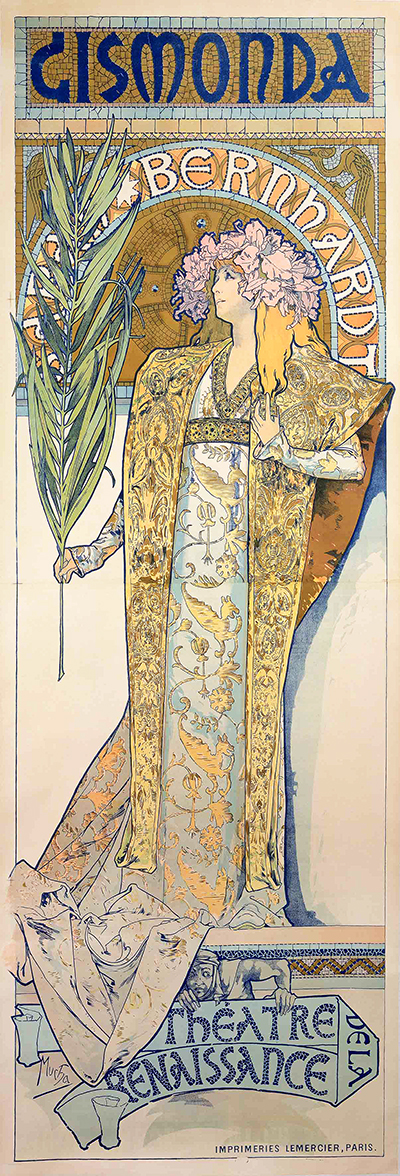
A woman stands almost still beneath a patterned arch. In her raised hand is a palm branch; around her are lettering, ornament and the narrow frame of a Paris theatre poster. Alphonse Mucha’s Gismonda advertised Sarah Bernhardt’s performance, yet its scale and composure made it a striking presence on the street in its own right. Designed in 1894 and posted at the start of 1895, it helped make Mucha famous. Four decades later, his work could be found in another form altogether: the immense historical canvases of the Slav Epic.[1][2][3]
Those two achievements are often presented as separate stories. Seen together, they reveal an artist repeatedly asking what an image could do in public. A theatre poster had to catch the eye from a distance; a decorative print could bring art into an ordinary room; a designed object could place beauty into daily use; a monumental cycle could give visual form to Mucha’s hopes for the Slavic peoples. Their purposes and audiences differed, but each made art part of shared life.[4][5][6]
Mucha worked as an illustrator, poster designer, painter, photographer and designer of objects and interiors. His career moved from Moravia through Vienna and Paris to the United States and back to Bohemia. The familiar flowing hair, flowers and ornamental circles are a useful starting point, but they are only part of what he made. This introduction follows the major changes in his work and offers paths into individual pictures, series and materials.
At a Glance
- Born24 July 1860 in Ivančice, Moravia, then part of the Austrian Empire.
- Died14 July 1939 in Prague.
- Known fortheatrical and advertising posters, decorative panels, book illustration, designs for jewellery and interiors, and the twenty paintings of the Slav Epic.
- Principal working centresVienna, Paris, several periods in the United States, and Bohemia.
- Paris breakthroughthe poster for Sarah Bernhardt’s Gismonda, designed in 1894 and displayed from 1 January 1895.
- Major late projectthe Slav Epic, painted from 1911 to 1926 and formally presented to Prague in 1928.
- A good first comparisonGismonda, the 1896 JOB poster and the Slav Epic.
These dates describe a long and varied career, not a neat progression from commercial work to painting. Mucha continued to use graphic design for public and civic purposes after his Paris years. His early training as a theatre artist also remained relevant: the control of costume, pose, setting and dramatic effect is visible in very different later projects.[1][5]
Contents
- From Moravia to the Paris stage
- A poster made for the street
- Pictures for ordinary rooms
- Drawing, photography and the work behind the image
- Books, jewellery and designed spaces
- Return to Bohemia and the Slav Epic
- The artist in public life
- How to look at a Mucha work
- Where to begin
Alphonse Mucha in context
Symbolism
c. 1886–1910; parallel contextArt Nouveau
c. 1890–1914Alphonse Mucha
1860–1939Henri de Toulouse-Lautrec
1864–1901; Paris poster comparisonGustav Klimt
1862–1918; Vienna modernist comparisonFollow Alphonse Mucha’s career through four stages
From Moravia to Paris
Mucha’s early path led through theatre painting in Vienna, patron-supported study in Munich and Paris, and magazine and book illustration. Paris gave him the skills and contacts for his later poster work.
A new public audience
The 1894 Gismonda design began his Bernhardt collaboration. Champenois printed advertising posters and decorative panels, while Mucha also developed books, jewellery and other applied designs.
Finding support for a larger project
Mucha visited the United States repeatedly while seeking the backing needed for a monumental history of the Slavs. Charles Richard Crane agreed to sponsor the Slav Epic in 1909.
Painting and public work in Bohemia
After returning in 1910, Mucha worked on the twenty Slav Epic canvases from 1911 to 1926. Civic and decorative projects remained part of his practice, and the completed cycle was presented to Prague in 1928.
From Moravia to the Paris stage
Mucha grew up in Ivančice and sought artistic work before he had a clear route into formal training. A job painting theatrical scenery took him to Vienna. After that employment ended, portrait commissions in Moravia brought him the support of Count Khuen Belasi, who helped him study in Munich and then Paris. When the patronage ended, Mucha earned a living through illustration for books and periodicals. This was practical, deadline-driven work, and it prepared him to build images that could communicate quickly in print.[1]
The turning point came with Gismonda. The much-retold story of a Christmas holiday emergency at the printer Lemercier is presented as legend by the Mucha Foundation; the secure essentials are the Bernhardt commission, the poster Mucha designed in late 1894 and its appearance on Paris streets on 1 January 1895. The poster advertised a January run of a play first performed the previous autumn. Bernhardt liked the result, and Mucha went on to design posters and other theatrical material for her.[2][7][14]
The poster is worth looking at as a theatrical image rather than only as an Art Nouveau landmark. Bernhardt appears as the Byzantine noblewoman of Victorien Sardou’s play. The orchid headdress, richly patterned costume and palm branch refer to a moment near its conclusion. Mucha places the full-length figure on a shallow arched platform. Her upright stillness gives her the dignity of a stage presence without recounting the plot. The extraordinary height of the colour lithograph, over two metres, allowed that quiet figure to command attention outdoors.[7]
Bernhardt and Mucha made a recognisable public image together. After Gismonda, he designed posters for La Dame aux Camélias, Lorenzaccio, La Samaritaine, Médée, La Tosca and Hamlet. These are distinct roles and productions, yet the extended formats and carefully framed figures let audiences identify the actress at once. Mucha also worked on stage and costume designs. Bernhardt’s fame helped circulate his work; his designs, in turn, shaped how the star appeared to the public.[2]
The partnership should not turn Mucha’s career into a single origin story. He was already an experienced illustrator, and his later success depended on printers, publishers, commissioners and buyers as well as his own invention. The Sarah Bernhardt pages and the poster collection let those relationships be followed through individual works.
By 1897, Mucha's reputation could sustain exhibitions devoted to his work. The Mucha Museum's Czech chronology records 107 works at Paris's Bodinière gallery in February and 448 at the Salon des Cent in May.[17] These are reported exhibition counts, not a census of everything he had made. The Mucha Foundation says that six issues of the Salon's associated magazine, La Plume, were devoted to him around the solo show.[18] The link between exhibition and periodical shows a second way printed images spread his name: audiences could encounter Mucha on gallery walls and in a magazine connected to that gallery.
A surviving advertisement for the June 1897 Salon exhibition makes this network tangible. The Albertina catalogues a colour lithograph issued by Affiches artistiques de la Plume and printed by F. Champenois, with the address 31 rue Bonaparte in its title; its particular sheet measures 68.5 × 46 cm.[19] That size belongs to the Vienna collection's impression. The poster announced an exhibition of Mucha's work while also being a Mucha print in its own right—a concise example of a commercial graphic artist entering the exhibition world through the same medium that had made him famous.
Bernhardt's role in that transition went beyond sitting for posters. The Mucha Foundation records that she wrote the preface to the catalogue of his first solo exhibition, at the Galerie de la Bodinière, 18 rue Saint-Lazare, in 1897.[20] A theatre celebrity thus introduced Mucha to visitors encountering him as an exhibiting artist. The detail makes their partnership more reciprocal than a simple story in which he made advertisements for her: her public standing also helped frame his work in a gallery.
A poster made for the street
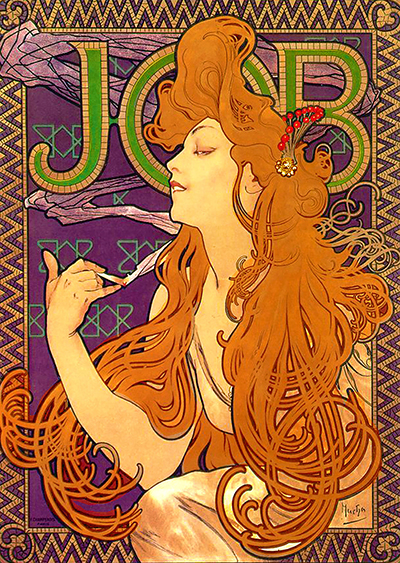
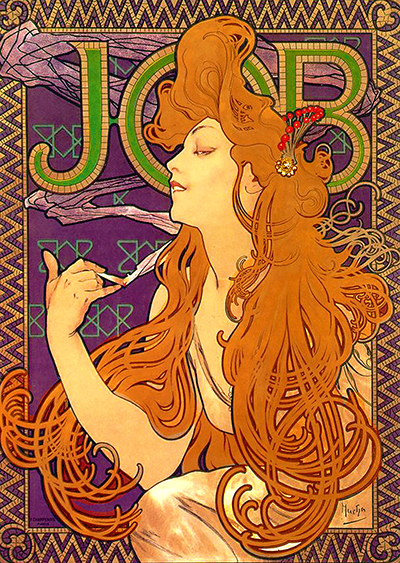
Mucha’s 1896 advertisement for JOB rolling papers shows how differently he could use a figure in commercial print. Where Gismonda is upright and composed, the JOB woman tilts her head back. Smoke rises from her tobacco and curls into the abundant hair and surrounding pattern. Repeated JOB monograms turn the background into a branded surface. The lettering belongs to the design rather than arriving as an afterthought.[8]
Its appeal lies partly in the way small movements become large graphic events. Hair crosses the picture in sweeping curves; smoke repeats those curves; a border contains the movement while keeping the image legible. Even if the product name is covered, the composition still holds together. Yet the brand was central to the commission. The 1896 poster advertised JOB rolling papers, and Mucha made a different JOB design in 1898. A French exposition jury report published in 1902 identified Société Pierre Bardou-Job as the trademark's exclusive owner; the Mucha Foundation instead uses the Joseph Bardou name when describing the brand's origins. The sources describe different moments and should not be collapsed into a single claim about who commissioned this particular poster.[8][21] Prints, reissues and reproductions can easily blur the two Mucha designs, so the date and pictured version matter.
Paris in the 1890s offered artists an expanding world of illustrated magazines, theatrical publicity, shops and printed advertising. A poster was seen among competing images and could be damaged, replaced or collected. Mucha’s designs balanced immediate recognition with details that reward a closer look: a flower, a piece of jewellery, a patterned border or lettering shaped to the subject. The meeting of figure and ornament is a method of organising attention, not merely a collection of pretty motifs.
The breadth of the commissions also matters. Mucha made images for performers, bicycles, foods, drinks and other goods. The subject of an advertisement does not by itself tell us what Mucha endorsed or consumed; it tells us what a commissioner wanted the public to notice. For a closer account of how particular prints differ, start with the JOB page and continue through the poster collection.
Pictures for ordinary rooms
Some of Mucha’s best-known images were conceived for a different setting. Decorative panels, or panneaux décoratifs, were commercially printed pictures without an advertising message. They could be bought and displayed inside a home. The printer F. Champenois helped develop and market this form, issuing Mucha’s designs in different versions. The artist used it to make carefully composed, relatively accessible images for a broad audience.[4]
The 1896 Seasons gave spring, summer, autumn and winter separate female figures and settings. Later series explored The Flowers and The Arts in 1898, The Times of the Day in 1899, The Precious Stones in 1900 and The Moon and the Stars in 1902. A single panel can be enjoyed independently, but a group invites comparison. Pose, foliage, colour and surrounding shapes change from one member to the next. Looking across the series is often more revealing than trying to find one universal meaning for the Mucha woman.[4]
The change from advertisement to decorative print was not simply a matter of removing words. Without a product to name, the border, figure and colour can carry the whole experience. In The Times of the Day, for example, the sequence moves through different hours and moods. In The Flowers, each figure belongs to a particular floral world. These designs ask how a repeated format can produce variation rather than repetition.[4]
Prints also have material histories. A design might appear with a publisher’s imprint, without text, in a changed format or as part of another edition. A digital image can make all of these seem like one stable artwork. Details of lettering, sheet size and printed state help identify what is actually being shown. The prints section follows that wider world, while the individual series pages allow each panel to be seen alongside its companions.
Mucha’s belief that art should be available beyond private collectors helps explain why he valued this work. That ideal did not erase the commercial realities of printing and sales. It was achieved through them: design, printing, distribution and domestic display made these pictures visible to people who would never own a unique painting.[4]
Drawing, photography and the work behind the image
The smooth appearance of a finished lithograph can conceal the choices that preceded it. Mucha drew figures, flowers, lettering and ornamental structures. Studies could test a pose or isolate a detail before a printer translated the design into a colour image. The surviving drawings show decisions in motion, including ideas that changed or were never used.[5][9]
Photography was another working tool. Mucha began taking photographs in the 1880s and used a camera extensively after moving to a larger Paris studio in 1896. The Mucha Foundation describes a studio full of light where he photographed models frequently. These images preserve poses, costumes and staged arrangements; later photographs also helped with the large historical compositions of the Slav Epic.[10]
A photograph and a finished work should still be read separately. A posed model is evidence of an artist gathering visual material, not automatic proof that every detail of a later picture was copied from that exposure. Mucha could change a gesture, costume or setting as a design developed. In other cases a photograph may document a work in progress or a group of models assembled for an immense canvas. The photography and working methods guide follows these different uses of the camera.
This close attention to preparation also changes how we look at the decorative surface. The flowing line did not appear without effort. In a successful poster, it joins a readable outline to a carefully paced field of smaller details. A viewer first notices the figure and then finds the work of the designer in each transition between hair, fabric, flower, border and type.
Books, jewellery and designed spaces
Mucha’s designs travelled beyond sheets meant for walls. The illustrated book Le Pater, published in Paris on 20 December 1899, takes the Lord’s Prayer as the basis for a sequence of images and text. Each of seven verse groups has three pages: a decorated presentation of the verse, Mucha’s interpretation and a monochrome allegorical image. It is a book to be read and turned, not a single picture that happens to have a religious title.[11]
The project shows Mucha treating the relationship between word, ornament and image as a serious expressive problem. The dark allegorical pages differ markedly from the pastel colour and airy surfaces often associated with his posters. Their symbolism should be approached through the sequence and its accompanying text, rather than guessed from an isolated detail. The Le Pater page explores the book as a whole.
An earlier book shows a different kind of publishing pressure. For Ilsée, Princesse de Tripoli (1897), issued by Henri Piazza with a text by Robert de Flers, the Mucha Foundation reports that Mucha had only three months to prepare 134 colour lithographs. His account of the work describes drawing on several lithographic stones at once and passing ornamental tracings to other workers for colour development.[22] Those production details do not make the book any less his design. They show how a highly worked page could depend on a printer's schedule and coordinated labour. The book's connection to Edmond Rostand's La Princesse Lointaine, written for Bernhardt, also joins the illustrated volume to the same Paris theatre world that made his posters familiar.[22]
He also designed objects that could be worn, held or used. By about 1900, the Mucha Foundation records his work on jewellery, utensils, packaging and interiors. His collaboration with the jeweller Georges Fouquet included pieces of jewellery and a scheme for Fouquet’s Paris boutique. Mucha’s design books Documents décoratifs (1902) and Figures décoratives (1905) offered patterns and figures that other makers could adapt.[5]
A surviving drawing makes the shop commission specific. The Musée Carnavalet catalogues Mucha's 20 December 1900 plan for the floor mosaic of Fouquet's new boutique at 6 rue Royale. Its written labels place a cash desk, basin, fireplace, furniture and entrance mat within the scheme.[23] This is evidence of an interior planned for transactions and movement, not merely ornamental walls. The drawing was given to the museum by Fouquet in 1949; the shop décor was reassembled there in 1989.[23] Those later events also separate the design's original setting from the way visitors encounter it today.
These activities connect the drawing table to craft and manufacture. A bracelet made from a Mucha design involves another maker’s materials and skill; a shop interior is experienced by moving through a space; a design handbook invites reuse by readers. Treating all of them as if they were flat posters would miss the change of scale and purpose. The jewellery and design guide takes up these objects and collaborations in their own terms.
Return to Bohemia and the Slav Epic
The idea for the Slav Epic took shape while Mucha was working on the Bosnia-Herzegovina pavilion for the 1900 Paris Exposition. The commission led him to travel in the Balkans and think about how a large visual history of Slavic peoples might be made. Such a project needed more than an idea: it required space, time and a financial backer. During repeated visits to the United States, Mucha sought that support. In 1909 the American businessman Charles Richard Crane agreed to sponsor the cycle. Mucha returned to Bohemia in 1910 and worked on the canvases at Zbiroh Castle.[1][3]
The pavilion work had its own patron and political setting. The Mucha Museum describes an Austro-Hungarian government mandate for the 1900 exposition, while the Musée d'Orsay says the pavilion's decorations staged Bosnian legends within an exposition where national pavilions represented identity amid competing nationalisms.[24][25] It was a commissioned display for a territory under imperial administration; the later Epic was Mucha's own historical project, made with Crane's support. Treating the pavilion solely as a rehearsal for the paintings would erase that difference. A frieze surviving from the 1900 scheme is catalogued by the Musée d'Orsay as détrempe on canvas, donated by Mucha's son Jiří in 1979.[26] The material record anchors a bridge between decorative public space and large historical painting without making the two works identical.
The finished series contains twenty monumental paintings. The Mucha Foundation divides them into ten episodes concerned with Czech history and ten with other Slavic histories. Work on the cycle occupied Mucha from 1911 to 1926. Its first completed canvas, The Slavs in Their Original Homeland (1912), shows a couple hiding as their village burns in the distance. Above them appear symbolic figures associated with war and peace. The scene begins with fear and vulnerability; the hope of future freedom is projected into the same image.[3][12]
The last canvas, The Apotheosis of the Slavs (1926), gathers periods of history into a composition organised by colour. Its parts refer to early history, conflict, struggle and the new political order after the First World War. It is not a documentary summary of every Slavic people’s past. It is Mucha’s ambitious, symbolic account of history and a statement of hopes he held for the future.[3][13]
Scale changes the way these works address a viewer. In a poster, a single figure and compact border can seize attention from across a street. In the Epic, large groups, landscape, architecture and symbolic figures unfold over canvases several metres wide. The methods still share something: both make a legible public image out of carefully arranged bodies and signs. The purposes, however, are distinct. One announces a performance or product; the other asks its audience to see historical episodes as part of a larger collective story.
Mucha and Crane formally gave the completed cycle to Prague in 1928. Its later display history has been complicated, so no one present location can stand for the whole history of the work. The Slav Epic guide introduces the cycle’s structure and the individual paintings.[1][3]
The artist in public life
Mucha’s return to Bohemia did not mean that graphic art ceased to matter to him. The Mucha Foundation’s account of his later work includes civic and decorative designs as well as painting. His practice had long crossed the boundary between a unique artwork and an image made for wider circulation. That experience suited a period in which public symbols, interiors and printed material could carry collective meaning.[1][5]
The new Czechoslovak state needed such images after 1918. Czech Post identifies Mucha as the designer of its first Hradčany stamps, issued on 18 December 1918.[27] A small view of Prague Castle travelled through routine correspondence. The Czech National Bank credits him with the first definitive 100-koruna treasury note, dated 15 April 1919 and valid from 7 July. Its design put the coats of arms of Bohemia, Moravia, Silesia and Slovakia on one side, and idealised female heads based on his wife Marie with the denomination in six languages on the other.[28] The plates and printing involved other named specialists, so the finished note was a designed and manufactured public object rather than a studio painting. These specific credits should not be stretched into an assertion that Mucha designed every early Czechoslovak note.
Public work could also be made for one architectural setting. In St Vitus Cathedral, Prague, Mucha designed a window centred on the young St Wenceslas with his grandmother St Ludmila. The cathedral dates its installation in the New Archbishop's Chapel to 1931, names the Slavia mutual insurance bank as sponsor and Jan Veselý as the glass painter, and records revisions after an earlier design was criticised.[29] The window belongs to a religious building, yet its making involved a modern corporate patron, a specialist craftsperson and a committee. It is another example of Mucha adapting a recognisable visual language to a particular public place and to the people who would use it.
This is one reason a chronological account alone cannot explain the work. The same artist might prepare a painting, design a printed image and think about how a room should look. The relationship between these tasks changed with the place, patron and audience. The biography follows the life in more detail; the paintings section places individual canvases and studies in view.
Mucha died in Prague in July 1939, shortly after the German occupation of Czechoslovakia. The circumstances belong to a difficult final chapter of his life, while the work he left spans a much longer history. The posters remain visible and influential because they are easy to reproduce. His paintings, books, photographs and design projects ask for a wider understanding of what that fame represents.[1]
How to look at a Mucha work
Begin with what sort of thing it is. A theatre poster, decorative panel, book page, design drawing, piece of jewellery and monumental canvas reach their audiences in different ways. Then look for the choices that make it work in that setting. Is the figure readable at a distance? Does lettering identify a performance or product? Does a border pull the eye inward? Is the image one part of a series whose meaning changes when its neighbours are visible?
Next, follow the line. Mucha’s long contours often join a body to its surrounding pattern: hair becomes a rhythm, fabric enters a border, and plants repeat or soften the shape of a pose. This is where the familiar Art Nouveau appearance is made. The Art Nouveau guide puts that visual language beside the wider movement rather than treating Mucha as its only maker.
Finally, check the object’s identity. Dates can refer to design, printing, publication or public display. A repeated title can name different editions or even different designs. The 1896 JOB poster and the 1898 Great JOB are one example; Gismonda’s 1894 design and 1895 street appearance are another. Looking closely at the pictured sheet is often the best way to begin asking the right historical question.[2][7][8]
Authorship needs the same care. Art Nouveau posters by several artists can share a tall format, flowing line and ornamental figure. A Delacre biscuit-and-chocolate advertisement once attributed to Mucha is catalogued by Brussels heritage authorities to the Belgian poster artist Privat-Livemont; its printed signature names him and its text names a Brussels printer. A poster for Felix Salten's Jung Wiener Theater has likewise circulated with a Mucha credit, although the Belvedere's Koloman Moser catalogue records the MK monogram, Vienna printer and theatre inscription. These cases show why style resemblance is a starting question rather than proof. A signature, object record, patron and printed location can restore the artist and purpose that a cropped or loosely captioned reproduction has lost.[15][16]
Readers can follow the corrected accounts of Privat-Livemont's Delacre poster and Moser's Vienna theatre poster. They sit beside Mucha's work as useful comparisons, not additions to his catalogue. The distinction also protects the real breadth of his practice: there is no need to assign every attractive Art Nouveau poster to the movement's most familiar name.
Where to begin
- For a single theatre image, see Gismonda and then Sarah Bernhardt’s posters.
- For commercial graphic design, start with the 1896 JOB poster and explore Mucha’s posters.
- For pictures made to live on a wall, browse prints and decorative panels.
- For the process behind finished images, move to drawings and photography and working methods.
- For an illustrated book that opens a different side of his imagination, read about Le Pater.
- For large historical painting, enter the Slav Epic through the first and last canvases.
- For the work that crossed from the page into daily life, explore jewellery and design.
The paths meet in the work itself. Mucha made images that could be seen on a Paris street, kept in a book, hung at home, worn or encountered in a hall. Their continued appeal is a reason to look more carefully at their original purposes, materials and audiences. The famous style becomes richer when the different works are allowed to remain different.
Essential works
Gismonda
1894 · The Bernhardt theatre poster that launched Mucha’s Paris breakthrough.
JOB poster
1896 · A rolling paper advertisement that joins hair, smoke and the brand name.
Zodiac
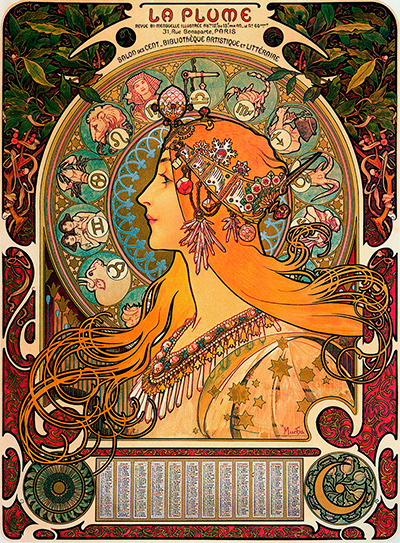
1896–97 · A calendar design that circulated in several printed states.
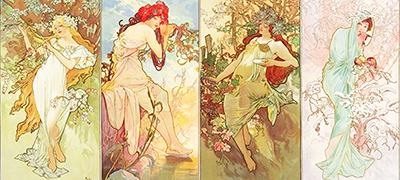
The Seasons (series)
1896 · Four decorative panels personifying the annual cycle.
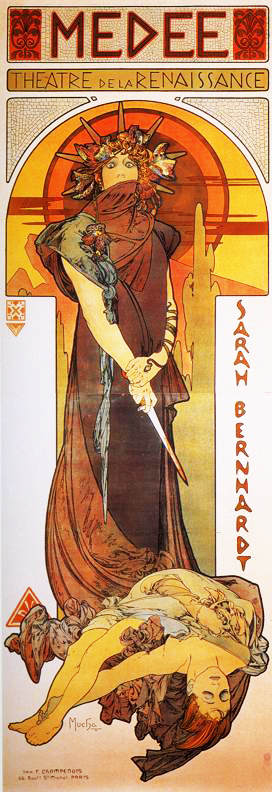
Medea
1898 · Bernhardt in a tragic role, framed by Mucha’s dramatic design.
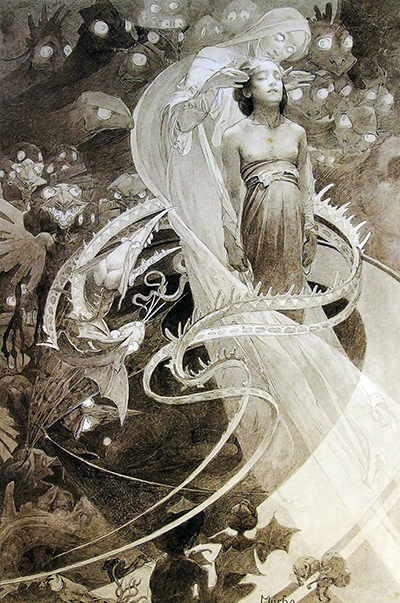
Le Pater
1899 · Mucha’s illustrated book joining text and spiritual allegory.
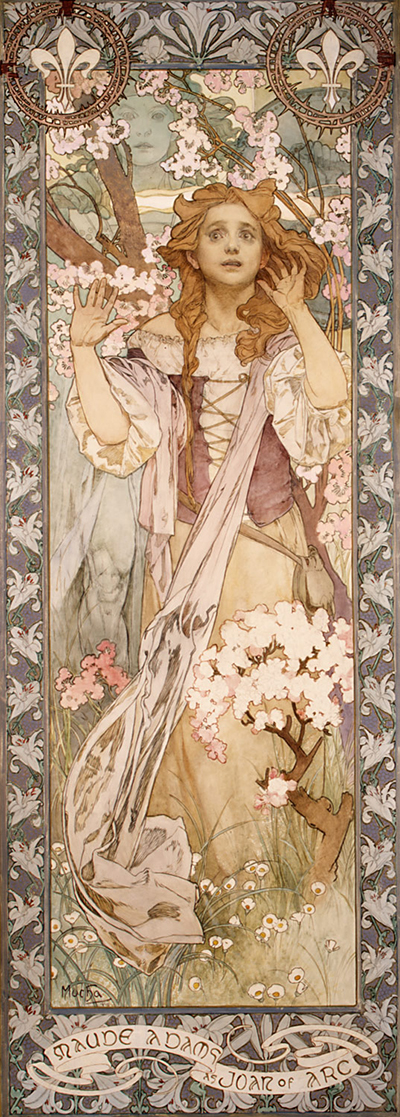
Maude Adams as Joan of Arc
1909 · A later stage portrait commissioned for Maude Adams.
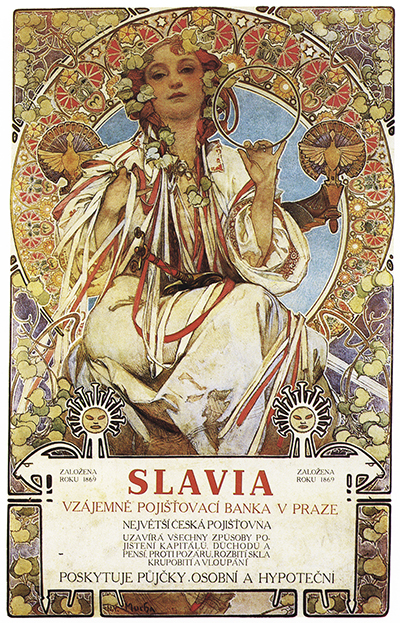
Slavia insurance poster
1907 · A Czech insurance poster made before Mucha’s return to Prague.
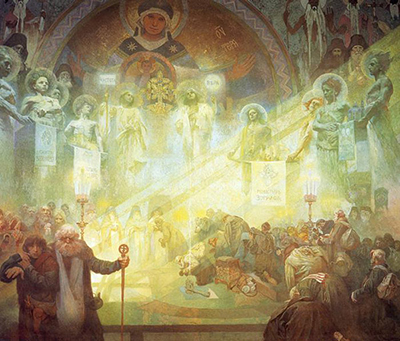
The Slav Epic (series)
1911–1926 · The twenty-canvas historical cycle as a whole.
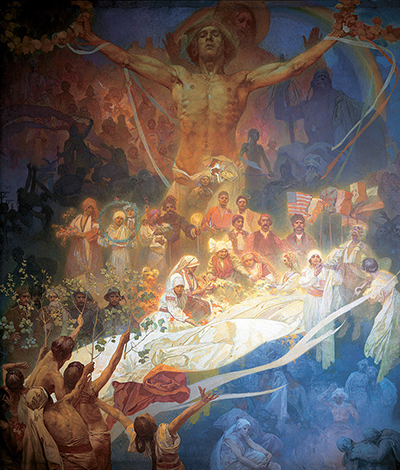
Apotheosis of the Slavs
1926 · The colour-organised concluding canvas of the Slav Epic.
Watch: Alphonse Mucha
Follow Mucha’s work from Art Nouveau Paris to his later Czech projects.
Alphonse Mucha: Plongez dans l’Art nouveau !
A French museum introduction to Mucha’s Art Nouveau years, poster work and decorative language.
Watch on YouTubeArtworks directory
| Name | Date | Medium |
|---|---|---|
| 'Accept Love and Enthusiasm from Your Son, Mother of the Holy Nation': study for the mural 'By Own Strength III' at the Lord Mayor's Hall, Obecní Dům, Prague | 1910-1911 | Pencil and charcoal on canvas |
| 'By force towards freedom, with love towards unity!': study for the mural 'By Own Strength II' at the Lord Mayor's Hall, Obecní Dům, Prague | 1910-1911 | Pencil and charcoal on canvas |
| 'The Passing Wind Takes Youth Away': design for a fan and the façade of the 'Pavilion of Man' (unrealised) | 1899 | Colour lithograph |
| 'Through humiliated and tortured, you will live again, my country!': study for the mural 'By Own Strength II' at the Lord Mayor's Hall, Obecní Dům, Prague | 1910-1911 | Pencil and charcoal on canvas |
| 1918-1928: Poster for the 10th Anniversary of the Independence of the Republic of Czechoslovakia | 1928 | Colour lithograph |
| 6th Sokol Festival | 1912 | Colour lithograph |
| 8th Sokol Festival | 1925 | Colour lithograph |
| After the Battle of Grunwald | 1924 | egg tempera on canvas |
| After the Battle of Vitkov Hill | 1923 | egg tempera on canvas |
| Age of Love | 1936–1938 | |
| Age of Reason | 1936–1938 | |
| Age of Wisdom | 1936–1938 | |
| Amants | 1895 | Colour lithograph |
| Apotheosis of the Slavs | 1926 | Egg tempera on canvas |
| As Hamlet | 1899 | colour lithograph |
| Au Quartier Latin | 1898 | Magazine cover |
| Banknotes of Czechoslovakia, designed by Mucha: 500 crown; 50 Crown; 10 Crown | 1929 | Banknotes |
| Bieres de la Meuse | 1897 | Colour lithograph |
| Biscuits Champagne Lefevre Utile | 1896 | Colour lithograph |
| Biscuits Lefevre Utile | 1896 design for 1897 calendar; Foundation object/Carnavalet 1897 | Colour lithograph |
| Blessed are the Pure in Heart | 1906 | Printed magazine illustration |
| Bleu Deschamps | 1903 (deposit) | Colour lithograph |
| Bosnia & Herzegovina Pavilion - illustration featured in 'Le Figaro Illustré' (1 March 1900) | 1900 | Reproduction from Le Figaro Illustré after watercolour original |
| Bosnia-Herzegovina Pavilion: cartoon for the mural 'The Roman Period and the Arrival of the Slavs' | 1899-1900 | ink and crayon on paper |
| Bosnia-Herzegovina Pavilion: fragment of the upper frieze featuring Ivo and Anica, characters from Bosnian legends | 1899-1900 | tempera and watercolour on canvas |
| Bosnian Legends: Death of Hasanaga's Bride | 1899 | Charcoal on paper |
| Bosnian Legends: Murcia - The Plague Lady | 1899 | Charcoal on paper |
| Bosnian Pavilion Restaurant at the Paris Exhibition 1900: design for the menu | 1900 | Pencil and watercolour on paper |
| Boutique Fouquet (interior design) | 1901 | Shop interior design |
| Boutique Fouquet: sketches of the shop's signboard and decorative details | c.1900 | Pencil, ink and watercolour on paper |
| Box for Lefèvre-Utile biscuits: Gaufrettes Vanille | c.1900 | Tin box covered with lithographed label |
| Box for Lefèvre-Utile biscuits: Madère | c.1900 | Tin box covered with lithographed label |
| Brightness of the Day | 1899 | Colour lithograph |
| Broach with Pendant | 1900 | Gold, ivory, mother-of-pearl and semi-precious stones |
| Byzantine Head - The Blonde | 1897 | Colour lithograph |
| Byzantine Heads (pair) | 1897 | Colour lithograph |
| Byzantine Heads: Brunette | 1897 | Colour lithograph |
| Bénédictine | 1898 (BnF deposit); Hamburg 1899; MNAC 1896 or 1898 | Colour lithograph |
| Champagne Ruinart | 1896 | Colour lithograph |
| Chocolat Ideal | before or in 1897 (catalogue conflict) | Colour lithograph |
| Chocolat Masson (1897 calendar) | 1896–1897 | Colour lithograph |
| Choirboys at Petrov Church, Brno | 1905 | Watercolour on cardboard |
| Cloches de Noel | 1900 | Illustrated book |
| Comedy: study for a mural for the German Theatre, New York | 1908 | Oil on canvas |
| Cours Mucha: poster advertising Mucha's art classes held at the Académie Colarossi, Paris | 1900 | colour lithograph |
| Creative Force - Jan z Pernštýna: study for a pendentive of the Lord Mayor’s Hall, Obecní Dům, Prague | 1910-1911 | Oil on canvas |
| Crucifixion | c.1868 | Pencil, crayon and watercolour on paper |
| Cycles Perfecta | 1897 or 1902 (catalogue conflict) | Colour lithograph |
| Dance | 1898 | Colour lithograph |
| Dead Couple - Abandoned | c.1899-1900 | Charcoal and pastel on blue paper |
| Defense of Sziget against the Turks by Nicholas Zrinsky | 1914 | egg tempera on canvas |
| Design for a champagne poster | c. 1896 | Charcoal and pastel on paper |
| Design for a display stand at the Paris Exhibition 1900 | c.1899-1900 | Pencil and wash on paper |
| Design for Champagne Ruinart | c. 1896 | Pencil, watercolour and gold leaf on paper |
| Design for the cover of the magazine 'Fantaz' | 1882 | Ink and watercolour on paper |
| Design for the heading of the cover of the magazine 'Krokodil' | 1885 | Pen and ink on cardboard |
| Design for the poster for the Mucha Exhibition at the Brooklyn Museum, New York, January-February 1921 | 1920 | Pen and ink and watercolour on paper |
| Designs for cutlery | c.1900 | Charcoal and white on card |
| Designs for tableware | c.1900 | Charcoal, coloured pencil and white on card |
| Diadem for 'La princesse lointaine' | 1895 | metal and pearls |
| Diploma of Ivančice: Mock diploma honouring a local celebrity, with illustration of the first line of 'May', a poem by Karel Hynek Mácha | 1882 | Pen and ink and watercolour on paper |
| Documents décoratifs: designs for a watch and accessories (unused) | 1901-1902 | Pencil, ink and white on paper |
| Documents décoratifs: final study for Plate 25, featuring studies of lily | 1901-1902 | Pencil on paper |
| Documents décoratifs: final study for Plate 43 | 1901-1902 | Pencil, ink and wash, heightened with white on paper |
| Documents décoratifs: final study for Plate 49 | 1901-1902 | Pencil and white on paper |
| Documents décoratifs: final study for Plate 50 | 1901-1902 | Pencil and white on paper |
| Documents décoratifs: final study for Plate 60 | 1901-1902 | Pencil, ink and wash, heightened with white on paper |
| Documents décoratifs: final study for Plate 63 | 1901-1902 | Pencil and white on paper |
| Documents décoratifs: final study for Plate 67 | 1901-1902 | Pencil and white on paper |
| Documents décoratifs: final study for Plate 71 | 1901-1902 | Pencil and white on paper |
| Documents décoratifs: final study for Plate 72 | 1901-1902 | Pencil and wash, heightened with white on paper |
| Documents décoratifs: line drawing for Plate 33, featuring lily motifs | 1901-1902 | Pencil, pen and ink on paper |
| Documents décoratifs: Plate 54 | 1902 | Lithograph |
| Dreaming of Freedom: study for a Panel of the Small Reception Room at the Lord Mayor’s Hall, Obecní Dům, Prague | 1910-1911 | Pen and ink and watercolour on paper |
| Dusk | 1899 | Colour lithograph |
| Evening | 1899 | Colour lithograph |
| F. Champenois (Rêverie imprint) | 1898 | Colour lithograph |
| F. Guillot-Pelletier calendar (1898) | 1897–1898 | Colour lithograph |
| Feather | 1899 | Colour lithograph |
| Figures décoratives: final study for Plate 2 | 1904-1905 | Pencil and white on paper |
| Figures décoratives: final study for Plate 3 | 1904-1905 | Pencil and white on paper |
| Figures décoratives: final study for Plate14 | 1904-1905 | Pencil with white on paper |
| Figures décoratives: sketch study for Plate14 | 1904-1905 | Blue pencil on paper |
| Flirt Lefevre Utile | 1899 (Foundation design); BnF legal deposit 1900 | Colour lithograph |
| Flower | 1897 | Colour lithograph |
| Flower: final study for decorative panel | 1897 | Pencil, ink and watercolour on paper |
| France Embraces Bohemia | 1918 | oil on canvas |
| Fruit | 1897 | Colour lithograph |
| Georges Fouquet (1858-1929), Paris, after design by Mucha: Ornamental Chain with pendants | 1900 | Gold, enamel, fresh-water pearls, mother of pearl and semi-precious stones |
| Georges Fouquet (1858-1929), Paris, after Mucha design: 'Peacock' Ring (Exhibited at the Paris Exhibition 1900) | 1900 | Opal and gold |
| Girl Weeping | c.1899-1900 | Black chalk and pastel on paper |
| Girl with Loose Hair and Tulips | 1920 | Oil on canvas |
| Gismonda | 1894 | Colour lithograph |
| Head of a Girl, statue for the stand of the Houbigant Perfumery at the Paris Exhibition 1900 | 1900 | Bronze, silver and parcel gilt |
| Head of Sarah Bernhardt: Study for 'Lorenzaccio' | 1896 | Pencil on paper |
| Heather from Coastal Cliffs | 1902 | Colour lithograph |
| Heidsieck & Co | 1901 | Colour lithograph |
| Holy Mount Athos | 1926 | Egg tempera on canvas |
| Ilsée, Princesse de Tripoli | 1897 | Illustrated book |
| In the Desert: Study for an illustration for the Světozor magazine | 1889 | Pencil, watercolour and gouache on paper |
| Incantation (Salammbô) | 1897 | Lithograph |
| Independence - Jiří z Poděbrad: study for a pendentive of the Lord Mayor’s Hall, Obecní Dům, Prague | 1910-1911 | Oil on canvas |
| Interior and furniture designs | c.1900 | Pencil on paper |
| Interior of Boutique Fouquet: design for a wall-mounted display cabinet with statuette and mirror | c.1900 | Pencil on paper |
| Interior of Boutique Fouquet: design for the fireplace with statuettes, mirror, and the ornamental details of the wall | c.1900 | Pencil and watercolour on cardboard |
| Interior of Boutique Fouquet: sketches of the fireplace with statue, mirror, display cabinet, and the ornamental details of the wall | c.1900 | Pencil, pen and ink on paper |
| Ivy | 1901 | Colour lithograph |
| Jan Milic of Kromeriz | 1916 | egg tempera on canvas |
| Jaroslava and Jiří, the Artist’s Children | 1918 | Oil on canvas |
| JOB poster | 1896 | Colour lithograph |
| Judgement of Paris (calendar for Vieillemard printing company) | 1895 | Colour lithograph |
| Justice - Master Jan Hus: study for a pendentive of the Lord Mayor's Hall, Obecní dům, Prague | 1910-1911 | Oil on canvas |
| L'Annee Qui Vient | 1897 | red chalk on paper |
| L'Illustration magazine - cover for Christmas 1896/1897 | 1896 | Magazine cover |
| L'Illustré Soleil du Dimanche | 1897 | Magazine cover |
| La Dame aux Camélias: designs for cover and interior of special programme | 1896 | Pencil and watercolour on paper |
| La Nature | 1899-1900 | Bronze and amethyst |
| La Plume | 1897 | Magazine cover |
| La Samaritaine | 1897 | colour lithograph |
| Lance Parfum Rodo | 1896; Albertina print c. 1900 | Colour lithograph |
| Laurel | 1901 | Colour lithograph |
| Le Monde Illustré | 1900 | Magazine cover |
| Le Pater | 1899 | Illustrated book |
| Le Pater: early study for the 1st allegorical scene 'Our Father who art in Heaven' (1899) (Mucha Foundation object 300) | 1899 | Pencil on paper |
| Le Pater: early study for the 1st allegorical scene 'Our Father who art in Heaven' (1899) (Mucha Foundation object 302) | 1899 | Pastel on paper |
| Le Pater: study for the 6th allegorical scene 'Forgive us our debts, as we forgive our debtors' | 1899 | Charcoal and ink wash on paper |
| Lefevre Utile | 1904 | Advertisement |
| Leslie Carter | 1908 | Colour lithograph |
| Letem Českým Světem | 1898 | Printed book |
| Lorenzaccio | 1896 | Colour lithograph |
| Luchon poster (attributed to Mucha) | 1895 | Colour lithograph |
| Madonna of the Lilies | 1905 | Tempera on canvas |
| Master Jan Hus Preaching at the Bethlehem Chapel | 1916 | egg tempera on canvas |
| Maude Adams | 1908 | Lithograph, hand-coloured in watercolour and gouache |
| Maude Adams as Joan of Arc | 1909 | Oil on canvas |
| Medea | 1898 | Colour lithograph |
| Menu for the Bosnian Pavilion Restaurant at the Paris Exhibition 1900 | 1900 | Colour lithograph |
| Militancy - Jan Žižka: study for a pendentive of the Lord Mayor's Hall, Obecní dům, Prague | 1910-1911 | Oil on canvas |
| Military Camp in Winter, near a City on Fire | c.1899-1900 | Pastel on paper |
| Moet et Chandon | 1899 | Colour lithograph |
| Monaco Monte Carlo | 1897 | Colour lithograph |
| Moon | 1902 | |
| Moravian Teachers' Choir | 1911 | Colour lithograph |
| Morning Alphonse Mucha Painting / AlphonseMucha.org | 1899 | Colour lithograph |
| Morning Star | 1902 | Colour lithograph |
| Moët & Chandon White Star | 1899 | Colour lithograph |
| Mrs Mucha’s Necklace | 1906 | gold, enamel and semi-precious stones |
| Mural for the Bosnia-Herzegovina Pavilion: The Roman Period and the Arrival of the Slavs | 1900 | tempera and watercolour on canvas |
| Murals by Mucha in the Lord Mayor's Hall, Obecní Dům (Municipal House), Prague (1910-1911) | ||
| Music | 1898 | Colour lithograph |
| Nativity | c. 1934 | oil on canvas |
| Nestle's Food for Infants | 1897 | Colour lithograph |
| Night | 1899 | Colour lithograph |
| Nude on a Rock | 1898-1899 | Bronze |
| Official Banquet of the Paris Exhibition 1900: design for the menu featuring a fashionable woman wearing a Mucha-style jewellery | 1900 | Pencil, gouache and wash on grey paper |
| Ornamental motifs designed for 'Combinaisons Ornementales se Multipliant à l'Infini à l'Aide du Miroir' (1901) | c.1900-1901 | Blue and red pencil on paper |
| Packaging for 'Savon Mucha Violette' | 1906 | Colour lithograph |
| Packaging for Lefèvre-Utile biscuits: Boudoir | 1901 | Colour lithograph |
| Page's Costume: study for an illustration for 'Le Costume au Théâtre' | 1890 | Pencil and watercolour on cardboard |
| Painting | 1898 | Colour lithograph |
| Peonies | 1897–1898 | Ink and watercolour |
| Petr Chelcicky at Vodnany | 1918 | egg tempera on canvas |
| Poetry | 1898 | Colour lithograph |
| Portrait of Jaroslava | c.1927-1935 | Oil on canvas |
| Portrait of Josephine Crane Bradley as Slavia | 1908 | Oil and tempera on canvas |
| Portrait of Marie Chytilová (Maruška), Mucha's Future Wife | 1903 | pastel on paper |
| Portrait of Mucha's Sister, Angela | c.1880 | Oil on canvas |
| Portrait of Mucha's Sister, Anna | c.1885 | Oil on canvas |
| Portrait of Mucha's Son, Jiří | 1925 | Oil on canvas |
| Portrait of Mucha's Wife, Maruška | 1908/17 | Oil on canvas |
| Portrait of Woman | c. mid 1910s - 1925 | Blue pastel on grey paper |
| Poster for 'Hommage Respectueux de Nestlé' (the Nestlé Company's tribute to Queen Victoria's 60th Jubilee) | 1897 | Colour lithograph |
| Poster for 'Imprimerie Cassan Fils' | 1896 | Colour lithograph |
| JOB poster (1898) | 1898 | Colour lithograph |
| Poster for 'La Dame aux Camélias' | 1896 | Colour lithograph |
| Poster for 'La Tosca' | 1899 | Colour lithograph |
| Poster for 'Regional Exhibition at Ivančice 1913' | 1912 | Colour lithograph |
| Poster for 'The Slav Epic Exhibition, Brno, 1930' | 1928-1930 | Colour lithograph |
| Poster for 'Waverley Cycles' | 1898 | Colour lithograph |
| Poster for the 'Lottery of the Union of Southwestern Moravia' | 1912 | Colour lithograph |
| Poster for the Austrian Pavilion at the Paris Exhibition 1900 | 1900 | Colour lithograph |
| Prague Subjugated: study for a Panel of the Small Reception Room at the Lord Mayor’s Hall, Obecní Dům, Prague | 1910-1911 | Pen and ink and watercolour on paper |
| Primrose | 1899 | Colour lithograph |
| Primrose and Feather (paired image) | 1899 | Colour lithographs (paired image) |
| Princess Hyacinth (Princezna Hyacinta) | 1911 | Colour lithograph |
| Print proof for the Biscuits Lefèvre-Utile tin | 1899 | Lithograph |
| Reverie | 1898 | Colour lithograph |
| Russia Restituenda [Russia Must Recover] | 1922 | Colour lithograph |
| Salome | 1897 | Colour lithograph |
| Salon des Cent | 1896 | Colour lithograph |
| Salon of the Hundred | 1897 | Colour lithograph |
| Sarah Bernhardt - La Princesse Lointaine - Lefevre Utile | 1903 | Colour lithograph |
| Sarah Bernhardt as La Princesse Lointaine: poster for 'La Plume' magazine | 1897 | Colour lithograph |
| Sarah Bernhardt in the role of the Duc de Reichstadt in L’Aiglon | 1900 | Pencil on paper |
| Sarah Bernhardt: study of her full-standing figure | c.1896 | Pen and ink on paper |
| Savonnerie de Bagnolet calendar | 1898 (calendar) | Printed advertising calendar |
| Self-portrait (1899) | 1899 | Oil on board |
| Self-portrait (1907) | 1907 | Blue and white crayon on blue Ingres paper |
| Self-portrait, sketching in his apartment, Paris | late 1880s | oil on canvas |
| Sketches of flowers for Documents décoratifs | c.1900-1901 | Pen and ink on paper |
| Slavia insurance poster | 1907 | Poster |
| Slavs in their Original Homeland | 1912 | Egg tempera on canvas |
| Snake Bracelet with a Ring | 1899 | Gold, enamel, opal, ruby and diamond |
| Société Populaire des Beaux Arts | 1897 | Colour lithograph |
| Song of Bohemia | 1918 | oil on canvas |
| St. Vitus Cathedral Stained-glass Window, Prague: final design for the central panels, featuring SS Cyril and Methodius | 1931 | Ink and watercolour on paper |
| St. Vitus Cathedral Stained-glass Window, Prague: final design for the central panels, featuring St. Ludmila | 1931 | Ink and watercolour on paper |
| St. Vitus Cathedral Stained-glass Window, Prague: final design for the central panels, featuring St. Wenceslas (Duke of Bohemia) kneeling next to his Grandmother, St. Ludmila | 1931 | Ink and watercolour on paper |
| St.Vitus Cathedral Stained-glass Window, Prague: final design for the bottom left panels | 1931 | Ink and watercolour on paper |
| St.Vitus Cathedral Stained-glass Window, Prague: final design for the bottom right panels | 1931 | Ink and watercolour on paper |
| Stained-glass Window designed by Mucha at St. Vitus Cathedral, Prague | Early 1930s | N/A |
| Study for 'The Age of Reason' | 1936-1938 | Pencil and watercolour on paper |
| Study for 'The Slav Epic cycle' No.19: The Abolition of Serfdom in Russia | 1913-1914 | Watercolour and gouache on paper |
| Study for 'The Slav Epic' cycle No.14: The Sacrifice at Szigetvár by Nikola Zrinski | c.1913-1914 | Photographed drawings stuck together, tinted with watercolour and gouache |
| Study for 'The Slav Epic' cycle No.17: The Holy Mount Athos (1926) | c.1925-26 | Charcoal heightened with white on cardboard |
| Study for 'The Slav Epic' cycle No.18: The Oath of Omladina under the Slavic Linden Tree | c.1925-1926 | Pencil and watercolour on paper |
| Study for 'The Slav Epic' cycle No.1: The Slavs in Their Original Homeland (1912) | c.1910-1912 | Oil on canvas |
| Study for 'The Slav Epic' cycle No.2: The Celebration of Svantovít | c.1910-1912 | Oil on canvas |
| Study for 'The Slav Epic' cycle No.7: Jan Milíč of Kroměříž | c.1915-1916 | Oil on canvas |
| Study for 'The Slav Epic' cycle No.9: Master Jan Hus Preaching at the Bethlehem Chapel. The Magic of the Word: Truth Prevails (1412). | c.1915-1916 | Oil on canvas |
| Study for 'The Three Ages' triptych: Reason, Wisdom and Love [unfinished project] | 1936-1938 | Pencil and watercolour on paper |
| Study for 'Woman in the Wilderness' (c. 1922-1923) (Mucha Foundation object 315) | c. 1922-1923 | oil on canvas |
| Study for 'Woman in the Wilderness' (c. 1922-1923) (Mucha Foundation object 316) | c. 1922-1923 | oil on canvas |
| Study for Savon Notre Dame | c. 1896 | pencil and watercolour on paper |
| Study for the poster 'Russia Restituenda [Russia Must Recover]' | 1922 | Pen and ink and watercolour on paper |
| Study of a Male Nude | 1885-1887 | Oil on canvas |
| The Abolition of Serfdom in Russia | 1914 | Egg tempera on canvas |
| The Arts (series) | 1898 | Colour lithograph |
| The Arts: study for 'Dance' | 1898 | Pencil and watercolour on paper |
| The Arts: study for 'Music' | 1898 | Pencil and watercolour on paper |
| The Arts: study for 'Painting' | 1898 | Pencil and watercolour on paper |
| The Arts: study for 'Poetry' | 1898 | Pencil and watercolour on paper |
| The Bohemian King Premysl Otakar II | 1924 | egg tempera on canvas |
| The Bulgarian Tsar Simeon | 1923 | egg tempera on canvas |
| The Burr McIntosh Monthly, 1907 | 1907 | Magazine cover |
| The Celebration of Svantovit | 1912 | egg tempera on canvas |
| The Coronation of the Serbian Tsar Stefan Dusan as East Roman Emperor | 1923 | egg tempera on canvas |
| The Devil and Mr Twardowsky: study for an illustration for 'The Tale of Pan Twardowsky' (a variation of 'Faust') | c.1887-1888 | Charcoal on paper |
| The Flowers (series) | 1898 | Colour lithographs |
| The Flowers: Carnation | 1898 | Colour lithograph |
| The Flowers: Iris | 1898 | Colour lithograph |
| The Flowers: Lily | 1898 | Colour lithograph |
| The Flowers: Rose | 1898 | Colour lithograph |
| The Hussite King Jiri of Podebrady | 1923 | Egg tempera on canvas |
| The Introduction of the Slavonic Liturgy | 1912 | egg tempera on canvas |
| The Last Days of Jan Amos Komensky (Comenius) in Naarden | 1918 | Egg tempera on canvas |
| The Light of Hope | 1933 | Oil on canvas |
| The Meeting at Krizky | 1916 | egg tempera on canvas |
| The Months (January-June) | 1899 | Colour lithograph |
| The Months (July-December) | 1899 | Colour lithograph |
| The Moon and the Stars (four-panel montage) | 1902 | Colour lithographs (four-panel montage) |
| The Moon and the Stars (series) | 1902 | Colour lithograph |
| The Moon and the Stars: study for 'The Evening Star' | 1902 | Ink and watercolour on paper |
| The Moon and the Stars: study for 'The Pole Star' | 1902 | Ink and watercolour on paper |
| The New York Daily News art supplement | 1904 | Printed art supplement |
| The Oath of Concord of the Slavs (unfinished) | 1939 | oil on canvas |
| The Oath of Omladina under the Slavic Linden Tree | 1926, unfinished | Egg tempera on canvas |
| The Precious Stones (four-panel montage) | 1900 | Colour lithographs (four-panel montage) |
| The Precious Stones (series) | 1900 | Colour lithograph |
| The Precious Stones: Amethyst | 1900 | Colour lithograph |
| The Precious Stones: Emerald | 1900 | Colour lithograph |
| The Precious Stones: Ruby | 1900 | Colour lithograph |
| The Printing of the Bible of Kralice in Ivancice | 1914 | egg tempera on canvas |
| The Seasons (series) | 1896 | Colour lithograph |
| The Seasons (series) (1900) | 1900 | Colour lithograph |
| The Seasons (variation in screen format) | 1896 | Colour lithograph |
| The Seasons: Autumn (1896) | 1896 | Colour lithograph |
| The Seasons: Autumn (1900) | 1900 | Colour lithograph |
| The Seasons: Spring | 1900 | Colour lithograph |
| The Seasons: Spring (1896) | 1896 | Colour lithograph |
| The Seasons: Summer | 1900 | Colour lithograph |
| The Seasons: Summer (1896) | 1896 | Colour lithograph |
| The Seasons: Winter | 1900 | Colour lithograph |
| The Seasons: Winter (1896) | 1896 | Colour lithograph |
| The Slavonic Concord: study for the ceiling painting for the Lord Mayor's Hall, Obecní Dům, Prague | 1910-1911 | Oil on canvas |
| The Threat | 1912 | Colour lithograph |
| The Times of the Day (series) | 1899 | Colour lithograph |
| The West End Review | 1897 (Foundation); 1898 promotional cover | Colour lithograph |
| Thistle from the Sands | 1902 | Colour lithograph |
| Théâtre de la Renaissance: design for poster advertising Sarah Bernhardt's theatre | c.1895 | Pen and ink on paper |
| Tin for Lefèvre-Utile biscuits | 1899 | Circular tin with lid and handle; colour print on metal |
| Topaz | 1900 | Colour lithograph |
| Tragedy - study for a mural for the German theatre New York | 1908 | Oil and tempera on canvas |
| Trappistine Liquors | 1897 | colour lithograph |
| Wiener Chic | 1905 | Magazine cover |
| Woman in the Wilderness | 1923 | Oil on canvas |
| Woman masked in white head-scarf - study for the illustration of the Bosnia & Herzegovina Pavilion featured in 'Le Figaro Illustré' (1 March 1900) | 1899 | Pencil and wash heightened with white on paper |
| Woman with a Daisy - textile designed by Mucha | 1900 | Printed upholstery fabric |
| Zdenka Cerny | 1913 | Colour lithograph |
| Zodiac (La Plume calendar) | 1896–97 | Colour lithograph |
| Zodiac (textless decorative panel) | 1896 | Colour lithograph |
| ‘At the sight of the two storks the owl rose.’ Study for an illustration for Contes de Grand-mères | 1891 | Watercolour and gouache on paper |
Frequently Asked Questions
What is Alphonse Mucha best known for?
When did Mucha make Gismonda?
What is the Slav Epic?
Discussion
Mucha’s career moved between posters, decorative prints, designed objects and large historical paintings.
The same artist addressed viewers in streets, homes, shops and public exhibition rooms.
Reader Insights
Which work first comes to mind when you think of Mucha?
What changes when you compare a poster with one of the Slav Epic canvases?
Where do you see a shared approach across his different materials?
Join the Conversation
Share which route into Mucha’s work you would follow next and why.
References
- Mucha Foundation, “Mucha at a glance.” View source.
- Mucha Foundation, “Sarah Bernhardt,” thematic collection. View source.
- Mucha Foundation, “Slav Epic,” thematic collection. View source.
- Mucha Foundation, “Art Posters,” thematic collection. View source.
- Mucha Foundation, “Decorative designs,” collection overview. View source.
- Mucha Museum, exhibition account. View source.
- Mucha Foundation, “Poster for ‘Gismonda’ (1894),” object record. View source.
- Mucha Foundation, JOB poster (1896), object record. View source.
- Mucha Foundation, “Drawings,” collection overview. View source.
- Mucha Foundation, “Studio, Models and Staged Photography,” thematic collection. View source.
- Mucha Foundation, “Le Pater (1899),” object record. View source.
- Mucha Foundation, “The Slav Epic, No. 1: The Slavs in Their Original Homeland (1912),” object record. View source.
- Mucha Foundation, “The Slav Epic, No. 20: Apotheosis: Slavs for Humanity (1926),” object record. View source.
- Bibliothèque nationale de France, “Gismonda: Théâtre de la Renaissance, Act I, Scene VII,” 1894 print record documenting the play’s first performance. View source.
- Brussels regional heritage inventory, Biscuits & Chocolat Delacre, Commune de Schaerbeek, inventory 1605. View source.
- Belvedere, Koloman Moser work catalogue, Jung Wiener Theater zum lieben Augustin, DG 305. View source.
- Mucha Museum, Prague, Czech artist chronology, 1897 entries for the Bodinière and Salon des Cent exhibitions. Museum chronology.
- Mucha Foundation, Czech La Plume object record, on the 1897 solo exhibition and six magazine issues devoted to Mucha. Foundation record.
- Albertina, Salon des Cent; Juin 1897, collection object DG2003/967, printer, publisher and measured sheet. Museum catalogue.
- Mucha Foundation, artist timeline, on the 1897 Bodinière exhibition, its address and Sarah Bernhardt's catalogue preface. Foundation timeline.
- Exposition universelle internationale de 1900, Jury international, Rapports du Jury international, vol. 15, part 1 (Paris: Imprimerie nationale, 1902), group XV, class 92, “Société Pierre Bardou-Job,” on JOB trademark ownership. Digitised report.
- Mucha Foundation, Ilsée, Princesse de Tripoli (1897), object record, on the publisher, literary connection, production schedule and Mucha's account of lithographic work. Foundation record.
- Paris Musées / Musée Carnavalet, plan of the floor mosaic for Fouquet's boutique, dated 20 December 1900, inventory D.8078-60. Museum catalogue.
- Mucha Museum, Prague, artist chronology, 1899 Austro-Hungarian mandate for the 1900 Paris exposition. Museum chronology.
- Musée d'Orsay, “Les pavillons nationaux aux expositions universelles,” on the 1900 national-pavilion setting and Mucha's Bosnia-Herzegovina decoration. Museum account.
- Musée d'Orsay, Frise décorant le pavillon de la Bosnie-Herzégovine (1900), object record, medium and 1979 gift. Museum catalogue.
- Czech Post / PostFila, 100 let Poštovního muzea (2018), information sheet on the first Hradčany issue. Postal record.
- Czech National Bank, historical account of the first definitive 100-koruna treasury note, including Mucha's design and the specialists who made its plates. Bank record.
- St Vitus Cathedral, account of the New Archbishop's Chapel window, its sponsor, revision, glass painter and 1931 installation. Cathedral account.