



 by Tom Gurney
Tom Gurney BSc (Hons) is an art history expert with over 20 years experience
Published on June 19, 2020 / Updated on November 13, 2026
Email: tomgurney1@gmail.com / Phone: +44 7429 011000
Orpheus: Introduction
Orpheus lifts his right hand to his forehead as he looks back. His left hand is open, with the palm turned out and the fingers spread. His front foot is already planted on the rocky ground and his other heel is raised. Antonio Canova makes the body look as if it has just stopped, while the turn of the head sends our attention back along the path he has taken. [1]
The statue stands in the Museo Correr in Venice with its companion, Eurydice. Canova carved the two figures in soft stone for the Venetian senator Giovanni Falier. They originally stood on the pillars of the gate at Falier’s villa near Asolo, where the width of an entrance separated the musician from the woman he had come to rescue. [2] [3]
Orpheus Antonio Canova
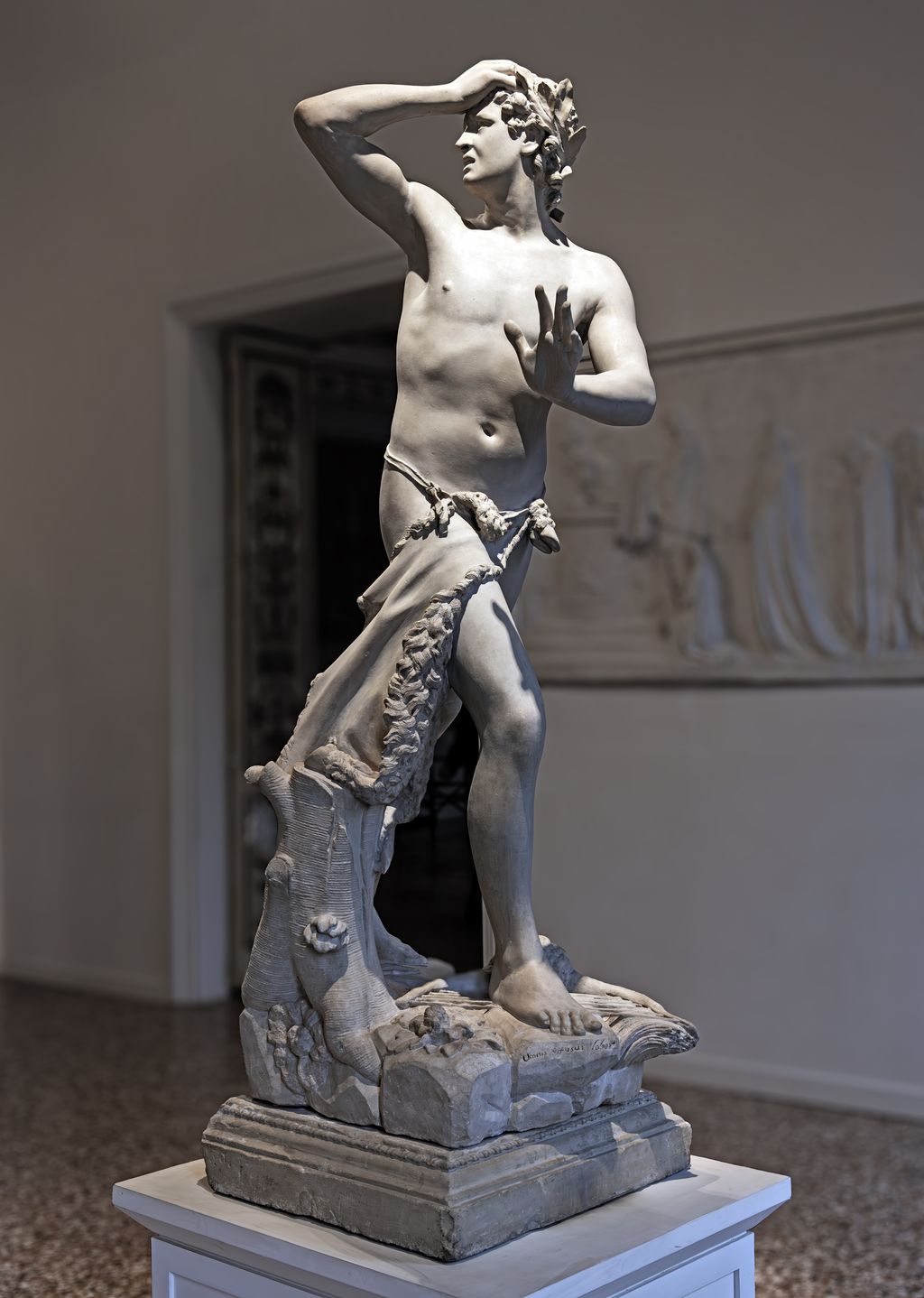
Orpheus at the Museo Correr, with one hand at his forehead and the other open. Didier Descouens. Image source. CC BY-SA 4.0. Resized for display. The resized photograph uses the same licence.
At a Glance
- ArtistAntonio Canova.
- Date and material1775–76, soft stone. [2] [3]
- Original settingVilla Falier at Pradazzi, near Asolo. [2] [3]
- CollectionMuseo Correr, Venice, Cl. XXV no. 1072. [4]
Contents
- The two hands
- The look that breaks the bargain
- From the Sensa fair to the villa gate
- The marble repetition in Saint Petersburg
The two hands
From a low angle, the right forearm forms a line above Orpheus’s eyes. The hand touches the hair, and the elbow projects well beyond the line of the head. The gesture resembles shielding the eyes, though the mouth and the tension in the neck suggest the shock of what he sees. Walk towards the other side and the open left hand becomes clearer. It is held away from the chest, with space between the fingers. The two arms make separate shapes above the waist. One folds back towards the head while the other opens out into the surrounding space. [1]
The torso still carries something of the stride. The front foot takes the weight, and behind it the rear foot touches down at the toes. The hips turn less sharply than the head. Around the waist, a narrow tie gathers a goatskin, which falls diagonally across the upper leg and comes to rest against a cut trunk. Its rough edge stands out against the smoother thigh. Look below the hide and there are flowers and fruit among the rocks. The trunk gives the composition a solid support close to the base while the elbows and open palm make the upper part spread wide. [1] [5]
Canova makes the fingers and the plants work at different distances. The silhouette of the open hand reads readily across a room, even from a position where the face is partly hidden by the raised arm. Up close, the curls and leaves at the head and the broken edge of the hide give smaller changes of light. That difference is worth looking for in a work originally seen from below. The broad gestures register while you are still approaching, and the finer carving emerges as your angle changes. [1] [2] [5]
The look that breaks the bargain
Orpheus had descended to the underworld after Eurydice died. In Virgil’s Georgics his music moves the dead and their rulers, and he is allowed to lead her back towards the upper world on condition that she follows behind him. Almost at the light, he stops and looks. His labour is undone in the instant of the glance. Eurydice speaks a farewell as the darkness closes around her. Canova’s pair carries lines from Virgil on the bases, where the written words accompany the two bodies through the same episode. [5] [6]
The spread fingers can be read as a reflex, the way a hand sometimes rises before a person has had time to speak. The other hand, above the eyes, draws attention to the act that has cost him Eurydice. Canova’s early notes on the myth survive in a small notebook that passed down through the Falier family. Giuseppe Pavanello, who published the notes, found that the prose story Canova was working from allowed Eurydice to know about the prohibition against looking. He could not identify the text. The notebook and the inscriptions show two kinds of evidence of Canova’s attention to the story, one private and the other addressed to a viewer. [1] [5] [7]
In the Correr’s paired display, Eurydice tilts away as Orpheus looks across. One of her arms extends into the interval between them, while a hand rising from below closes around her other wrist. Orpheus’s fingers, though held wide, are too far away to touch her. Each figure has its own base, and the carving brings the loss into the space between those bases. That effect has a practical difference from the one Canova would achieve a few years later in Daedalus and Icarus. In the later group, a thread physically spans part of the gap between the figures. Here the viewer has only the direction of a look and a gesture to follow. [1] [2] [8]
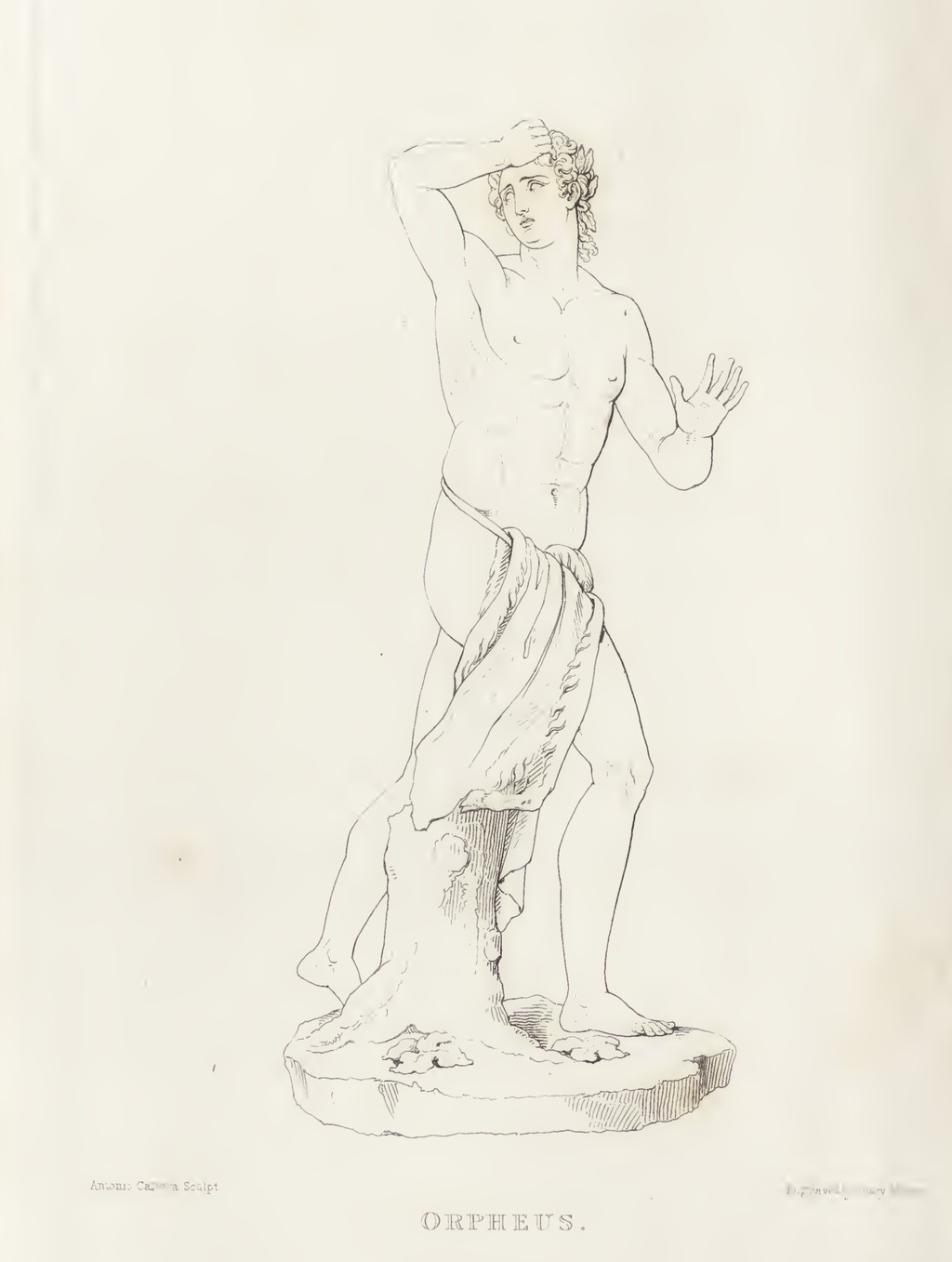
The engraved Orpheus turns his head and extends one arm into the space beside him. Henry Moses, after Antonio Canova, engraving published in London, 1824. Getty Research Institute. Image source. Public domain. Scan margins trimmed and image resized.
Videos on Canova
Explore Canova’s workshop methods and the settings for his sculpture.
From Sketch to Stone | Canova: Sketching in Clay
Watch sculptor Fred X. Brownstein recreate a Canova Venus, using clay, plaster and marble.
Watch on YouTubeFrom the Sensa fair to the villa gate
Falier’s commission gave the young Canova a chance to work at the scale of a person. The Museo Gypsotheca Antonio Canova dates the start of his own studio at Santo Stefano in Venice to 1775. The two statues belong to that period of transition from workshop training to independent commissions. The earlier Eurydice was probably finished by 1775, according to Pavanello, while the Correr dates the pair to 1775–76. [2] [7] [9]
Before the two figures stood together at the villa, Orpheus had a public audience in Venice. Possagno dates the display at the Sensa, the Ascension fair, to 1776. Franco Miracco’s reconstruction of the fair places Orpheus in booth 49 of the new exhibition enclosure in 1777, with Eurydice still at Pradazzi. He records a Canaletto painting exhibited in the same room. Seen on his own, the musician had to carry the action through his pose and the lines on his base. At Asolo, the corresponding figure across the gate supplied the object of his gaze. [5] [9]
The gate gave visitors a reason to pass between the statues. Seen from farther away they could mark the two sides of the entrance. As a visitor approached, the two figures would move farther apart in the field of vision, until taking in both would mean turning the head. The museum display preserves the separation of the stones and brings their gestures close enough to compare in a single view. The statues were bequeathed to the Correr in 1954. [2] [7] [8]
An early engraving in The Works of Antonio Canova in Sculpture and Modelling gives another way of seeing Orpheus on his own. It isolates the figure against a blank page and shows the palm at an angle, just far enough from the body to reveal each finger. The outlined turn of the head and the lifted heel remain legible even with the colour and weight of the stone taken away. The plate lets the eye linger on the gestures that had to make sense by themselves when the statue was on view at the fair. [5] [10]
The marble repetition in Saint Petersburg
The State Hermitage Museum holds a separate Orpheus in marble, 140 centimetres high. Sergei Androsov identifies it as the smaller repetition Canova made in 1777 for the Venetian senator Marco Antonio Grimani. Androsov points to the more finely worked details, the signature on the trunk and the additional Italian verse on the base. The marble has its own history of garden display. It stood in the Summer Garden in Saint Petersburg before entering the Hermitage in 1866. The left arm and horn were restored around 1910, a distinction worth keeping in mind when comparing the gesture or attributes with the Venice figure. [11]
Canova returned to the pair in another medium much later in life. In 1816, when he entered the Roman patriciate, he chose a lyre and a serpent for his coat of arms. The lyre stood for Orpheus and the serpent for Eurydice. The editors of his correspondence connect that choice with his first statues and the patron who commissioned them. After decades of carving, Canova used two small emblems to recall the work with which his public career had begun. [12]
Explore Canova’s works
Browse the sculptures and paintings covered in this guide. Several entries compare versions or examine details of a larger work.
Discussion
Look again at the images and ideas explored in Orpheus. These editorial prompts invite your observations.
Reader Insights
What do the two hands tell you about Orpheus’s reaction?
How might seeing Orpheus and Eurydice on opposite pillars change how you read their gestures?
Join the Conversation
Share a detail, comparison or question about Orpheus below.
References
- Didier Descouens, Orfeo by Antonio Canova, photograph of Museo Correr Cl. XXV no. 1072. View source.
- Museo Correr, The Canova Collection at the Correr Museum, room II and the original Villa Falier gate setting. View source.
- Fondazione Federico Zeri, Canova Antonio, Orfeo, work record 83571. View source.
- Fondazione Musei Civici di Venezia, Sublime Canova, sculpture handlist, Museo Correr Cl. XXV no. 1072. View source.
- Franco Miracco, 1777, l’anno della nuova fiera della Sensa, Ateneo Veneto, pp. 151–64. View source.
- Virgil, Georgics, book IV, lines 453–527, translated by H. Rushton Fairclough. View source.
- Giuseppe Pavanello, I primi scritti di Antonio Canova, research on Canova’s notebook, with the bequest noted in the first endnote. View source.
- Didier Descouens, Orpheus and Eurydice by Antonio Canova, photograph of the Museo Correr display, May 2023. View source.
- Museo Gypsotheca Antonio Canova, Biografia di Antonio Canova, section on his Venetian training. View source.
- Getty Research Institute, The Works of Antonio Canova in Sculpture and Modelling, digitised copy, Orpheus plate. View source.
- Sergei Androsov, State Hermitage Museum sculpture catalogue, Orpheus, no. 238, pp. 254–55, inv. Н. ск. 315. View source.
- Edizione Nazionale delle Opere di Antonio Canova, Epistolario, vol. XVIII, introduction, p. xi. View source.


 Antonio Canova.jpg)

