



 by Tom Gurney
Tom Gurney BSc (Hons) is an art history expert with over 20 years experience
Published on June 19, 2020 / Updated on November 13, 2026
Email: tomgurney1@gmail.com / Phone: +44 7429 011000
The Graces and Venus Dance before Mars: Introduction
Mars sits at the far right, his helmet crest rising above a bare shoulder. His feet stretch towards a woman playing the lyre, who turns her face towards the dancers. On the other side, two children lift smoking torches. Antonio Canova arranged the figures in a low band against a black field and hung a continuous border of flowers above them. The dance occupies the centre, but the people at the edges determine where the eye enters and how far it travels. [1]
The complete Dance of Venus and the Graces before Mars is a tempera on paper at Possagno. Fondazione Federico Zeri catalogues it together with The Rape of Helen, a sheet of the same size. A larger plaster relief at Possagno presents the dance before Mars in almost the same arrangement. The paper scene, its companion and the relief show how Canova varied a set of movements by changing the figures around them, the space under their feet and the materials through which we see them. [1] [2] [3]
The Graces and Venus Dance before Mars Antonio Canova
At a Glance
- Artist and mediumAntonio Canova, tempera on paper. [1]
- CollectionMuseo Gypsotheca Antonio Canova, Possagno, inventory 98. [1] [4]
- Size and companion26.5 × 41 centimetres, the same size as The Rape of Helen. [1]
- Related reliefPlaster, 1797, 144 × 160 centimetres, also at Possagno. [2] [3]
Contents
- From the torches to the throne
- Music beside Mars
- Helen’s dance on the companion sheet
- The design in plaster
From the torches to the throne
The two torchbearers at the left occupy very little of the picture’s height, yet their raised arms send two long lines into the black. The outer child wears a loop of flowers across his body. The child nearer the dancers lifts one leg and reaches towards the nearest woman. The torches give both children something to hold above their heads and carry their gestures beyond the scale of their small bodies. Each flame is bright at its base and gives way to a darker trail of smoke that curves in the open space. [1]
The top of the sheet is busy in a different way. Flowers hang in a series of shallow loops tied at regular intervals, a repeated pattern that crosses the whole scene. Below, small tufts of grass punctuate a narrow strip of ground. The feet stand out against this strip, so the short gap under a heel or the point at which a toe touches down is easy to see. The thin boundaries at the top and bottom leave much of the sheet dark. Canova can set a flame, a hand or the rim of a veil against that darkness without the lines running into a painted wall or landscape. [1]
The three central women gather beneath a lifted wreath. The closer view of the dancers makes their linked hands and shifts of weight easier to follow. In the whole picture, the dancer at the right of the group also extends her leg towards the musician. The two figures’ feet nearly meet. One gesture carries the eye out of the tight group and the other brings it towards Mars, whose legs extend back towards the centre from the opposite direction. [1]
Music beside Mars
The lyre player stands close to the throne but faces back towards the dancers. The instrument comes forward from her chest, where the strings and curved arms of the frame are visible against the dark. A loop of fabric bends out behind her shoulders. Its curve answers the veil above the central group, even though her hands are occupied by the instrument. The result is a figure who belongs to the dance through her clothes and the position of her feet while playing a separate part in it. [1] [3]
Mars is easy to pick out because his helmet rises above a seated body. The long red crest bends back, and a red cloth hangs in folds beneath the seat. His forearm lies along the arm of the throne, and a small winged child rests against his lap, holding a garland that falls across his legs. The torches at the other end of the picture make the children look busy. This child can settle in the space left by the seated god. The helmet identifies Mars through his usual military equipment, while the throne and the direction of his face give him the place of a spectator. [1]
Videos on Canova
Explore Canova’s workshop methods and the settings for his sculpture.
From Sketch to Stone | Canova: Sketching in Clay
Watch sculptor Fred X. Brownstein recreate a Canova Venus, using clay, plaster and marble.
Watch on YouTubeHelen’s dance on the companion sheet
The two temperas can be compared in a photograph that shows them one above the other. In The Rape of Helen, three women again dance beneath looping fabric. The faces and arms, however, stretch across the right half of the sheet. The outer dancer lifts a garland beside a small figure on a tall pedestal. At the opposite side two men stand close together. One arm reaches towards the women, while a kneeling attendant looks up from a basket of flowers. The older photograph is monochrome, but the placement of the gestures and the line of the garland are clear. [1] [4]
The dance before Mars puts its principal spectator on the right, where he can receive the movement coming from the middle. In the Helen scene, the standing men watch from the left and the pedestal ends the line on the right. The paved floor and the steps of the pedestal make the ground more structured than the grassy band beneath Mars. Seen together, the pictures share dark space, lifted fabric and a close group of three women. A turn of the head or an arm extended into the empty space has a different force when it comes from someone standing at the edge of the gathering. [1] [4]
The design in plaster
The 1797 plaster is considerably larger than the tempera. Its outer border encloses the familiar sequence of torchbearers, women, musician and seated god. Mars’s feet extend across a footstool, and the draped edge of his seat falls towards the bottom of the panel. The figures project from the ground to different degrees. The folds at the musician’s legs and the garland over Mars’s lap make shallow ridges, while the bodies cast stronger shadows. Under side lighting those differences in depth become part of the drawing that the viewer sees. [2] [3]
The paper tempera gives colour some of the work performed by depth and shadow in the relief. The red beneath Mars’s seat connects him to the small red ribbons near the dancers. Cool blue fabric on the musician sets her apart from the lighter greens and creams at the centre. The plaster has other ways to separate these forms. The lyre player’s body interrupts the curve behind her, and the seat’s folds push forward against the flatter background. The shared arrangement gives a viewer a way to compare the two objects without needing to assume that every detail was transferred in the same way. [1] [2] [3]
Zeri dates the paper pair to 1797–99. In the 2015 exhibition catalogue Canova. La bellezza e la virtù, Francesco Leone identifies the dance as Possagno inventory 98 and places its design among temperas conceived between 1806 and 1808. He links it to the relief completed in 1797 and notes related poses in the Helen sheet. The records agree that Canova returned to the composition across materials. The precise date of the paper version remains open. [1] [2] [4]
The museum at Possagno relates Canova’s painted studies, including the paper temperas, to his study of ancient wall paintings, especially the dancers on dark grounds found at Pompeii and Herculaneum. In this scene the empty dark field lets the artist leave a long interval between two gestures without losing the thread of the dance. The flower border continues across that interval. Below it, the woman with the lyre picks up the movement of the three dancers, while Mars brings it to rest at the edge of the sheet. [1] [3] [5]
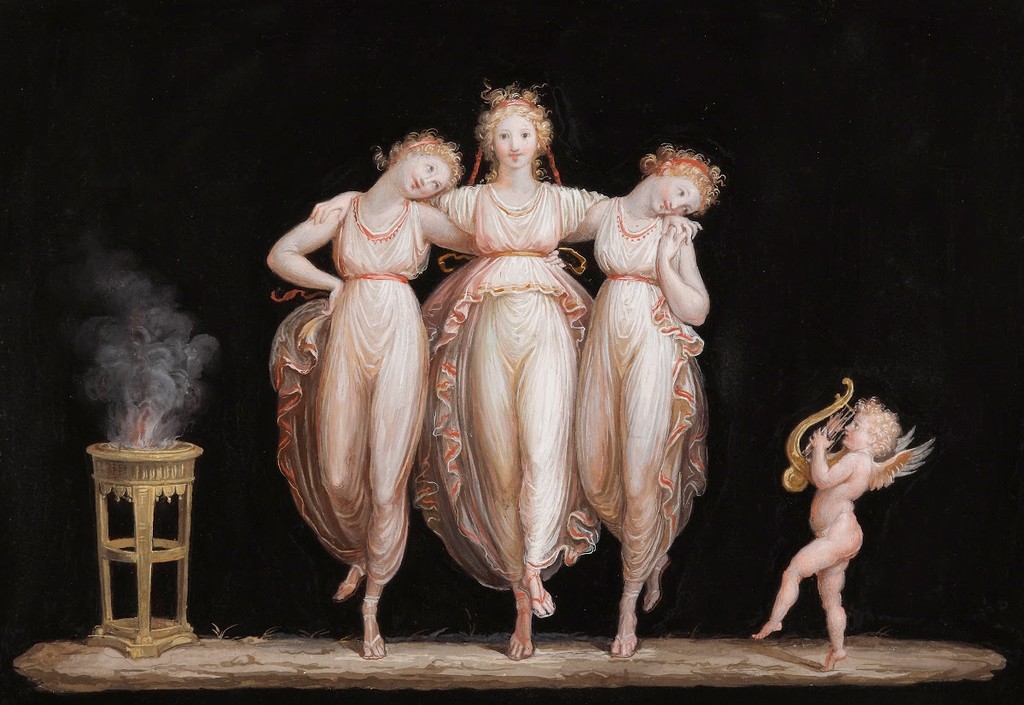
A related dance composition brings three of Canova’s dancers together beside Cupid and his tripod. Museo Gypsotheca Antonio Canova, Possagno. Image source. Public domain. Resized from source.
Explore Canova’s works
Browse the sculptures and paintings covered in this guide. Several entries compare versions or examine details of a larger work.
Discussion
Look again at the images and ideas explored in The Graces and Venus Dance before Mars. These editorial prompts invite your observations.
Reader Insights
How do the spectators affect the way you read the dance?
What changes between the complete scene and the separate detail?
Join the Conversation
Share a detail, comparison or question about The Graces and Venus Dance before Mars below.
References
- Fondazione Federico Zeri, Ratto di Elena, Danza di Venere e delle Grazie davanti a Marte, catalogue entry 94611, including photographs of the individual works and the pair. View source.
- Fondazione Federico Zeri, Danza di Venere e delle Grazie davanti a Marte, plaster relief, catalogue entry 81927, with photograph. View source.
- Mario Guderzo, Museo Gypsotheca Antonio Canova, Canova e la danza, account of the relief and the artist’s exploration of dance. View source.
- Francesco Leone, catalogue discussion in Canova. La bellezza e la virtù, Turin, 2015, pp. 92–95. View source.
- Museo Gypsotheca Antonio Canova, Birth House, account of the paintings and paper temperas. View source.


 Antonio Canova.jpg)

