


 by Tom Gurney
Tom Gurney BSc (Hons) is an art history expert with over 20 years experience
Published on June 19, 2020 / Updated on October 30, 2026
Email: tomgurney1@gmail.com / Phone: +44 7429 011000
Édouard Manet: Introduction
Édouard Manet made modern life difficult to overlook. A woman meets the viewer’s gaze from a bed whose arrangement recalls a Renaissance Venus. A child turns towards railway steam while her companion looks away from it. A barmaid stands behind bottles and flowers, with a crowded music hall reflected behind her. The subjects are recognisable, yet the pictures keep unsettling our expectations about space, attention and the people we are looking at.
Born in Paris in 1832, Manet worked at a moment when the city, its public life and its art were changing rapidly. He painted fashionable gatherings, performers, friends, workers, political violence, flowers and fruit. His strong contrasts and visible brushwork could look startlingly unfinished to contemporaries accustomed to a smoother surface. His treatment of familiar subjects could be just as challenging: people appeared without the stories or idealising conventions that made their presence comfortable.[1][2][3]
Manet’s relationship with tradition was unusually active. He studied earlier painting and repeatedly transformed it, bringing the authority of Titian, Velázquez and Goya into contact with contemporary Paris. He also exchanged ideas with the artists who became known as the Impressionists, while choosing a different path through exhibitions and public recognition. His career is best approached through these connections, and through the particular decisions that make each painting hold our attention.[1][4]
At a Glance
- ArtistÉdouard Manet
- Born23 January 1832, Paris
- Died30 April 1883, Paris
- NationalityFrench
- TrainingThomas Couture’s studio and sustained study of earlier art
- Principal mediaOil painting, pastel, drawing, watercolour and printmaking
- Central subjectsModern Paris, portraits, performers, leisure, contemporary history and still life
- Major paintingsLe Déjeuner sur l’herbe, Olympia, The Railway and A Bar at the Folies-Bergère
- Relationship to ImpressionismA close participant in its artistic world who did not exhibit in the group’s eight independent exhibitions
- An important distinctionÉdouard Manet and Claude Monet were different artists, friends and colleagues[1][2][5]
Édouard Manet’s artistic connections
Explore earlier examples and exchanges with fellow painters. Each connection opens a short explanation and a route for further reading.
- Diego Velázquez: Manet studied Spanish painting before visiting Madrid in 1865. Velázquez offered an important example for the concentrated presence and sparse settings of figures such as The Fifer. [4]
- Titian and Venetian painting: Venetian pastoral painting supplied a precedent for Le Déjeuner sur l’herbe. Manet recast an inherited arrangement through contemporary figures, opening a distance between familiar art history and the new picture. [6]
- Berthe Morisot: Their artistic relationship ran in both directions. Morisot’s outdoor practice, lighter colour and mobile brushwork offered Manet another example, while her own career extended beyond the portraits for which she posed. [7]
- Claude Monet: In the summer of1874 Manet painted members of Monet’s family at Argenteuil. The garden and river connected their friendship with opportunities to consider figures, colour and outdoor light. [8]
- Edgar Degas: Both artists engaged with modern life and earlier painting. Degas helped organise the independent Impressionist exhibitions, while Manet continued seeking the Salon audience; their different choices give the relationship its interest. [1]
Édouard Manet in context
Édouard Manet
1832–1883Edgar Degas
1834–1917Claude Monet
1840–1926Berthe Morisot
1841–1895Pierre-Auguste Renoir
1841–1919Contents
- Why Manet Matters
- Learning from the Louvre and the Studio
- The Salon and the Search for an Audience
- Paint That Remains Visible
- Paris as a Modern Subject
- Portraits Models and Individual Lives
- Manet Morisot Monet and Degas
- Contemporary History and Political Violence
- Drawings Prints and Writers
- Fashion Flowers and the Last Years
Why Manet Matters
Manet changed what an ambitious painting could ask a viewer to consider. A scene from daily life could carry the scale and pictorial seriousness associated with history painting. A portrait could withhold a clear social encounter. A quotation from an old master could make a contemporary figure more provocative, because it brought inherited expectations into unusually sharp focus.
In Olympia, the reclining nude recalls Titian’s Venus of Urbino, but Manet presents her as a contemporary courtesan. Her direct look refuses the easy distance that a mythological identity might have supplied. When the picture appeared at the Salon of 1865, its treatment of the body and its represented social situation prompted a fierce response. The work made the traditions of painting part of the encounter it was staging.[9]
Other pictures challenge us more quietly. The Railway provides a book, a puppy, a child and a cloud of steam, but no explanation that joins every element into a story. The two figures occupy the same foreground while attending to different things. Their relationship remains uncertain. A railway scene becomes an examination of looking, interruption and the limits of what an image tells us.[10]
Manet’s work also rewards attention to its economy of paint. Black clothing, pale flesh, a strip of green or an abrupt patch of white can establish an entire figure. He lets us recognise a person or an object while remaining aware of the coloured marks that create it. That balance helped make his art a point of reference for painters seeking a language adequate to their own time.
Calling him a founder of modern painting describes his importance, but it should not make his choices seem inevitable. He wanted an audience, continued to seek official recognition and sometimes won it. His work developed through admiration, rivalry, criticism and revision. The tension between those ambitions gives his paintings much of their energy.[1][2]
Four stages of Édouard Manet’s career
These periods group related developments; painting, travel and local work overlap across their boundaries.
Training, travel and the first Salon success
Manet trained with Thomas Couture, studied earlier paintings through travel and copying, and established an independent practice. At the 1861 Salon, The Spanish Singer brought him an honourable mention. [2]
Bringing contemporary people into ambitious painting
He made modern Paris a subject for ambitious painting. Le Déjeuner sur l’herbe and Olympia provoked public debate, while portraits and performance pictures connected his studio with friends, writers and entertainers. [2]
Working among a changing circle of painters
War and its aftermath changed his surroundings. Alongside café, street and portrait subjects, he painted with friends around Argenteuil, exploring river life and gardens without joining the independent Impressionist exhibitions. [2]
Portraits, flowers, letters and the Salon
Illness increasingly restricted his movements, while pastel portraits, illustrated letters and flower paintings brought subjects close to hand. Public ambition continued: his final Salon appearance paired A Bar at the Folies-Bergère with Jeanne (Spring) in 1882. [5]
Learning from the Louvre and the Studio
Manet’s education joined formal training to independent looking. He entered Thomas Couture’s studio in 1850, after an unsuccessful beginning towards a naval career. The Louvre and travels in Italy supplied further opportunities to study painting at close quarters. Copying older works gave him practical knowledge of arrangements, colour and the handling of figures, as well as subjects he could later adapt.[1]
The importance of that training appears throughout his career. He did not need to reject the museum in order to paint modern life. Instead, an older composition could become the starting point for a new encounter. In Le Déjeuner sur l’herbe, the central group draws on an engraving by Marcantonio Raimondi after Raphael’s Judgement of Paris. The wider idea of clothed and unclothed figures in a pastoral setting also recalls Titian’s Concert champêtre, then attributed to Giorgione.[6]
The changes are decisive. Manet’s figures do not inhabit a clearly identified myth. Their clothes, faces and direct presence belong to a contemporary world, while the borrowed arrangement retains the authority of art history. The quotation does not resolve the scene; it makes the distance between an accepted precedent and an unsettling new picture easier to feel.
Spanish painting offered another powerful example. Before visiting Spain in 1865, Manet had already painted costumed figures and studied works available in France. The Spanish Singer, painted in 1860, brought a studio model, costume props and a forceful arrangement of colour together. Its success at the Salon of 1861 showed that his engagement with earlier art could produce a picture that felt fresh to other painters.[4]
After the Madrid visit, the sparse space and concentrated presence of Velázquez’s figures became particularly important to him. In The Fifer, a contemporary young musician stands against a background that scarcely declares where the ground ends and the air begins. Black, white and red give the figure clarity without surrounding him with an elaborate setting. The older Spanish example has become a new way of presenting a modern subject.[11]
The Salon and the Search for an Audience
The Paris Salon mattered because it brought pictures before a large public and placed them within an official structure of selection and reward. Manet repeatedly submitted work to its juries. His persistence complicates the image of an artist wholly detached from institutions: he wanted to change painting while gaining recognition in a place where that change could be widely seen.[2]
His early reception moved between acceptance and refusal. The Spanish Singer received an honourable mention in 1861. Two years later, the jury rejected Le Déjeuner sur l’herbe. Manet showed it under the title Le Bain at the Salon des Refusés, the exhibition authorised that year for rejected works. The picture became a focus of attention and ridicule.[4][6]
The naked woman among clothed men was one source of the disturbance. So was the painting’s appearance. Strong light and dark passages replaced the continuous transitions viewers expected; the figures seemed imperfectly settled into their landscape. Familiar techniques for making a painted world coherent had been interrupted. Subject and handling worked together, so that disagreement about what the picture showed was inseparable from disagreement about how it was painted.[6]
Olympia intensified the conflict when it appeared at the Salon in 1865. Its sources in earlier art were substantial, but they did not protect its contemporary figure from attack. Manet could use the form of an admired nude and still expose a sharp boundary in public taste: what was permissible at a mythological distance could become intolerable when presented as part of the viewer’s own society.[9]
He also looked beyond the Salon. In 1867, during the Exposition Universelle, he organised an independent pavilion to present a substantial group of his works together. The display allowed visitors to judge a developing body of painting rather than one or two contentious submissions. Émile Zola’s defence of the artist belonged to this effort to make his work understood as a connected achievement.[2][4]
Recognition eventually became more secure. In 1881, Manet received a Salon medal and was appointed a chevalier of the Légion d’honneur. His late successes did not erase the earlier hostility, but they demonstrate that the career was more varied than a simple sequence of rejections. He continued to care about being seen and judged by the public whose expectations he had challenged.[2][5]
Paint That Remains Visible
One of the pleasures of looking at Manet is the movement between the image and its making. A light shape becomes a sleeve; a dark passage becomes a hat; a few marks establish a face in a crowd. Come closer and those elements separate again into paint. The picture can remain convincing without every detail being equally complete.
His blacks are especially important. In the portrait of Berthe Morisot with violets, dark dress and hat form a strong surrounding shape for a brightly lit face. Small changes within the dark areas prevent them from becoming empty silhouettes. The pale background and the light entering from one side sharpen the contrast, while the little bouquet introduces a quieter point of attention.[12]
His use of black resists a simple equation of Impressionism with light colours. His colour could become brighter, particularly in outdoor subjects, without abandoning the pictorial force of dark clothing or a deep accent. The black iron bars in The Railway divide the scene with extraordinary insistence, even as white steam loosens the space beyond them.
Edges matter as much as individual colours. Some forms are bounded sharply; others dissolve into neighbouring tones. The viewer completes connections that the brush has only suggested. In a crowd, this can make the scene feel active and difficult to hold still. In a portrait, it can direct attention towards a face or a hand without describing everything around it at the same level.
The resulting freshness does not prove that a painting was made quickly. Recent discussion of Boating describes substantial changes to its figures, sail and rope. Begun in 1874, the composition continued to develop before its first public showing in 1876. Its seemingly immediate arrangement could emerge through repeated decisions, including the addition of the woman after the man and boat were already under way.[7]
That history changes how the surface is read. A visible stroke can be the end of a long search. A simplified background can be a carefully chosen means of making the foreground more forceful. Manet’s pictures often preserve the liveliness of looking while concealing much of the labour that made such an effect possible.
Paris as a Modern Subject
Manet’s Paris was a city of new boulevards, railway stations, public entertainments and rapidly changing neighbourhoods. Its modernisation created spaces for display and movement while displacing older ways of living. The places in his paintings belong to this particular environment: they are neither interchangeable urban scenery nor neutral settings for fashionable clothes.[3]
Music in the Tuileries brings together the shaded garden, the crowd and the experience of seeing people in public. Hats, faces and pale dresses interrupt one another. The figures can be recognised as a gathering without becoming an orderly procession of isolated portraits. The painter’s own social world enters a picture whose visual density makes looking feel like an activity within that world.
The café and the theatre offered related possibilities. People could gather to watch a performance while becoming visible to one another. A bar, balcony or table provided a boundary between bodies and a structure through which to arrange them. Manet used such boundaries repeatedly, giving social space a physical presence in the picture.[3]
In The Railway, modern transport appears largely through its effects. Steam obscures the tracks, and the child’s attention moves beyond the iron fence. The seated woman looks back towards us. The painting makes the station felt while withholding the view that its title might lead us to expect. Industry enters a scene of figures through barriers, atmosphere and interrupted sight.[10]
Modern Paris included people who were less securely placed within its prosperity. Manet’s musicians, street performers and solitary figures sit beside his portraits of friends and fashionable society. These subjects should not all be read as illustrated statements of a single political position. Their variety nevertheless prevents his world from being reduced to the pleasures of an affluent audience.[3]
The poet Charles Baudelaire helped articulate the value of contemporary urban experience. His idea that fleeting appearances and current fashions could matter to serious art offers a useful companion to Manet’s work. Yet a painting need not be treated as an illustration of a poem. The relationship is more productive when it helps us notice what the artist makes of a crowd, an encounter or a particular way of being seen.[3]
Portraits Models and Individual Lives
Manet’s portraits can look direct while leaving the encounter open. A person may face the viewer, turn aside, occupy an indefinite interior or appear among objects that suggest a profession or friendship. The clothes and pose are important, but they rarely provide the complete explanation of a sitter’s character.
Berthe Morisot’s portraits are a strong example. In the 1872 picture with violets, the dark clothing and bright face create a concentrated, alert presence. She was also a painter with an independent career. Recognising that fact changes the encounter: this is an artist looking at another artist, within a relationship that involved admiration, exchange and eventually family ties.[7][12]
Victorine Meurent’s presence requires a similar distinction between person and role. She posed for some of Manet’s best-known figures, including the woman in Olympia, and was herself an artist who exhibited at the Salon. A scene in which she appears cannot simply be read as a record of her own occupation or private life. The same model could take on very different identities within different paintings.[10][13]
The woman presenting flowers in Olympia was posed by Laure. Restoring her name directs attention towards a figure who was long treated as secondary in accounts of the picture. It also opens questions about the models and social relationships through which modern art was made. The represented role of an attendant does not supply a complete biography of the person who performed it.[14]
Manet also portrayed artists whose professional lives intersected with his. Eva Gonzalès was his pupil and a painter in her own right. Her portrait presents her at work, engaging with the established image of an artist before an easel. The relationship belongs to the history of artistic training and ambition as well as to the making of a likeness.[15]
The family pictures bring another register of familiarity. Suzanne Leenhoff, whom Manet married in 1863, appears in different settings across his career. Domestic relationships can help identify a subject, but they do not turn every grouping into a solved story. Manet’s paintings often retain a distance between knowing who posed and understanding exactly what their represented encounter means.[2][3]
Manet Morisot Monet and Degas
The younger artists around Manet found in his work a powerful example of independence. Their relationship to him was not simply that of followers to a fixed master. They also offered subjects, methods and alternatives that affected his own painting. The exchange became especially apparent during the 1870s.[1][7]
Morisot’s contribution has often been obscured by attention to the portraits she sat for. The artistic relationship ran in both directions. Her experience of outdoor painting, lighter colour and mobile brushwork became increasingly important to Manet. Her paintings should therefore be considered alongside his, allowing similarities to emerge without dissolving their distinct ways of working.[7]
Claude Monet was another close colleague. In the summer of 1874, Manet painted members of Monet’s family at Argenteuil, where artists worked in overlapping company along the Seine. The river, garden and boat offered settings for experimenting with brighter colour and the arrangement of figures in outdoor light. Friendship became visible through subjects shared at a particular time and place.[8]
The similarity of their names sometimes obscures the difference between the two men. Manet’s Boating and The Monet Family in Their Garden are works by Édouard Manet; Claude Monet is the fellow painter who appears elsewhere in his work. Their artistic contact does not make their pictures interchangeable. Each made different choices about what a scene could become.
Edgar Degas shared Manet’s interest in modern subjects and earlier masters, but their careers also diverged. Degas played an important part in organising the independent Impressionist exhibitions. Manet declined to join them, continuing to seek the Salon audience. Their friendship and rivalry are most revealing when those differences are kept in view.[1]
Manet consequently belongs within the history of Impressionism while resisting a simple definition by it. He shared subjects and ideas with its central artists, but participation in an artistic conversation was not the same thing as participation in the group’s exhibitions. This distinction helps explain both his independence and his continuing importance to that circle.[1][2]
Contemporary History and Political Violence
Modern life also meant war, imperial ambition and civil conflict. Manet’s work includes subjects far removed from the café or the garden. His response to the execution of Emperor Maximilian in Mexico became a sustained project involving several large paintings, a smaller oil study and a lithograph.[16]
Maximilian was executed in 1867 after the collapse of the imperial regime supported by Napoleon III’s France. Manet developed his compositions as reports and documentary material reached Europe. The pictures therefore combine contemporary evidence, posed figures and artistic decisions made at a distance from the event. They are painted constructions of recent history, not eyewitness records.[16]
The successive versions make that process unusually clear. The position of figures, the uniforms, the setting and the relations between the soldiers and victims changed. Goya’s treatment of execution and war supplied important precedents. Manet brought that inheritance into contact with a politically dangerous contemporary subject, making the history of painting part of his response to the history unfolding around him.[16]
The lithograph encountered an explicit restriction: the authorities refused permission for its sale. This should be distinguished from a general story in which every version met the same fate. Paintings and prints could enter public life through different channels, and political controversy affected those channels differently.[16]
The London canvas later acquired another history when its surviving fragments were brought together by Degas. That act of collecting preserved part of a work whose physical survival had become precarious. It is a reminder that Manet’s reputation was shaped after his death through care, selection and the recovery of objects as well as through critical praise.[16]
Drawings Prints and Writers
Painting was Manet’s most visible medium, but work on paper offered other kinds of invention and exchange. A subject could move from a canvas to an etching, changing scale, direction and the means through which light and texture were conveyed. A print could circulate among friends or enter a published set, reaching people who might never encounter the painting itself.[4][17]
The etched Spanish Singer is a useful example. Its composition repeats and reverses the successful painting while translating colour into marks and tone. An individual impression has its own physical identity and printing history. Looking between the painting and the sheet reveals both the continuity of the motif and the work required to remake it in another medium.[17]
Manet’s relationships with writers also extended beyond portraits and reviews. With Stéphane Mallarmé, he worked on the illustrated French translation of Edgar Allan Poe’s The Raven, published in 1875, and on L’Après-midi d’un faune in 1876. These collaborations joined image, text and the physical form of the book.[18]
His 1876 portrait of Mallarmé offers a quieter view of that relationship. The poet sits informally with papers and a cigar, presented through a small, vigorously handled canvas. The picture makes a professional and intellectual connection visible through the relaxed presence of a particular person. Its modest size allows a different intimacy from the large Salon paintings.[18]
Drawing, watercolour and pastel likewise belong within the full account of his work. They could support preparation, observation, portraiture or personal communication. His illustrated letters from Bellevue give especially clear evidence of art entering everyday exchange: the image becomes part of a message sent to someone he knew.[5]
Fashion Flowers and the Last Years
Manet’s later work widened the range of his attention. Fashionable portraits, garden subjects, pastels, illustrated letters and small still lifes accompanied the ambitious paintings intended for public exhibition. These works can be easily overshadowed by the scandals of the 1860s, yet they give a rich account of how his practice continued to change.[5]
Spring, painted in 1881 and exhibited at the Salon in 1882, presents a young woman in profile with a parasol and floral dress. Fashion becomes an arrangement of colour and pattern, and a means of representing contemporary presence. Its favourable reception also belongs to the period in which Manet was gaining official honours.[5]
The small Asparagus of 1880 offers a different kind of concentration. A single stalk lies against a pale surface. Orsay relates the picture to a larger bunch sold to Charles Ephrussi and to the artist’s witty response when the collector sent more than the asking price. The anecdote helps explain the painting as a personal gesture, while its narrow range of mauves, grays and whites rewards attention independently of the story.[19]
Flowers and fruit gave Manet equally compact subjects through which to explore colour, surface and the placement of forms. Small scale could encourage intimacy without making a work slight in interest. A few stems, a transparent vase or the edge of a piece of fruit can become the focus of decisions as exacting as those required by a crowded scene.
Illness restricted his mobility and working life, but it does not explain every choice in these pictures. Scott Allan’s account of the late work emphasises the persistence of artistic agency: the turn towards fashion, pastel, flowers and elegant contemporary women developed through relationships, interests and ambitions as well as physical circumstances. The paintings deserve to be looked at as decisions made by an active artist.[5]
At the other end of scale and complexity stands A Bar at the Folies-Bergère. Exhibited with Spring in 1882, it gathers the pleasures and uncertainties of modern public life into a dense arrangement of counter, figure and mirror. The barmaid Suzon posed in Manet’s studio, although the setting draws on a place he had visited and sketched. The final picture joins observation to deliberate reconstruction.[20][5]
Ten Paintings to Begin With
The Spanish Singer
Painted in 1860, The Spanish Singer introduces Manet’s early success and his imaginative use of Spanish art. The costumed model, green bench and angled guitar show how a small group of studio materials could create a commanding figure. Its 1861 Salon reception provides a useful starting point before the more notorious pictures that followed.[4]
Music in the Tuileries
Music in the Tuileries turns a fashionable gathering into a busy field of hats, faces, trees and pale clothing. The crowd matters as a social subject and as a challenge to the eye. Instead of describing every person equally, Manet lets individual appearances emerge within the density of the whole.[3]
Le Déjeuner sur l’herbe
Le Déjeuner sur l’herbe brings older pastoral and compositional sources into a contemporary encounter. Its 1863 display at the Salon des Refusés made the painting a public controversy. The figures’ presence and the abrupt handling of space are central to the work’s power; neither can be understood entirely apart from the other.[6]
Olympia
Olympia, painted in 1863 and shown in 1865, transforms the reclining nude into a confrontation with contemporary society. The woman’s gaze, Laure’s presentation of flowers, the pale bed and the dark surrounding areas sustain the encounter. Its subsequent history includes the public subscription organised on Monet’s initiative that brought it into state ownership in 1890.[9][14]
The Fifer
The Fifer isolates a young musician through a small range of emphatic colours and a setting with almost no declared depth. Rejected by the Salon jury in 1866, it shows how radical simplification could make a familiar figure difficult for contemporaries to accept. It is an especially clear place to look at the relation between shape, colour and presence.[11]
The Execution of Emperor Maximilian
The Execution of Emperor Maximilian is best approached through its different versions. They reveal Manet testing how to represent a recent political death while working from distant reports, models and earlier art. The variations are part of the subject’s history, not minor alternatives to be collapsed into a single image.[16]
The Balcony
In The Balcony, figures occupy the threshold between an interior and the public space beyond a green railing. Bright dresses and a dark room create a striking division. The painting invites recognition of a social setting while keeping the figures’ separate attentions and their relationship to the viewer unresolved.[1][3]
Berthe Morisot with a Bouquet of Violets
The 1872 portrait of Morisot concentrates the expressive range of black around a luminous face. Its force comes from a modest group of elements rather than an elaborate setting. Knowing the sitter as a fellow painter adds the history of an artistic relationship to the immediate experience of the likeness.[7][12]
The Railway
The Railway, painted in 1873, puts a modern station behind an insistent fence and a cloud of steam. The woman looks out while the child looks away. The picture gives plentiful visual information without turning it into a settled narrative, making it one of Manet’s most absorbing studies of divided attention.[10]
A Bar at the Folies-Bergère
A Bar at the Folies-Bergère places a still central figure before an animated reflected crowd. Bottles, fruit and flowers draw the eye across the counter, while the shifted reflections complicate our position. This final major painting brings the physical attractions and perceptual difficulties of Manet’s modern world together.[20]
How to Look at a Manet
Begin with the largest relationships. Notice where the darks collect, where the strongest light falls and which shape first draws your attention. In a figure painting, compare the head with the hands and the surrounding clothes. In a still life, follow the spaces between objects as carefully as the objects themselves.
Then look for boundaries. A railing, table edge, mirror or strip of wall may organise the whole scene. Ask what it separates and what it allows us to see. In The Balcony and The Railway, barriers are both physical objects and strong graphic structures. In the Bar, the mirror appears to open space while making its exact arrangement harder to settle.
Attend to differences in finish. A face may be carefully concentrated while an adjacent sleeve is described with broad strokes. A background figure may dissolve into a mark that remains perfectly effective at a distance. These variations guide attention; they can also preserve the sense that an encounter is unfolding faster than it can be fully inspected.
Finally, distinguish what is visible from what a story supplies. A sitter’s identity can be documented while a represented relationship remains uncertain. A bright surface need not prove happiness, and a remote expression need not prove despair. The paintings often become more interesting when their precise information and their withheld information are both allowed to matter.
A Reputation That Continues to Change
Manet died in 1883, and his work soon entered a new life through memorial exhibitions, collecting and public debate. The significance of a controversial picture could change as it moved from the Salon or studio into a private collection and eventually a museum. The paths of individual objects are part of the larger history of his reputation.[2][16]
That reputation has also depended on which works and people received attention. The large pictures of the 1860s and the Bar became central to accounts of modern painting. The late portraits and still lifes were sometimes dismissed. More recent exhibitions have argued for their seriousness and for the importance of the women, models and fellow artists through whom Manet’s world was formed.[7][5][14]
These changes do not require the paintings to become illustrations of a single theory. They encourage a broader encounter with them. The artist who painted Olympia also painted a stalk of asparagus; the man who sought the Salon audience also worked closely with painters who exhibited independently. Ambition, sociability, resistance and pleasure coexist across the work.
Moving between different scales and subjects reveals the range of his work. Compare an early costumed figure with a late portrait, a crowded public scene with a small still life, or a painting with its related print. Across those changes, Manet’s concentrated shapes, acute sense of contemporary appearance and ability to make looking itself feel active remain unmistakable.
Artist Up Close
Manet’s working life was sustained by conversation as well as solitary labour. Painters, writers, models and collectors entered his studio and his pictures, bringing different skills and ambitions with them. The result is an art closely attached to particular people and places, yet open enough to keep provoking new encounters. The biography, paintings and prints offer different ways to follow those connections.
Essential Édouard Manet works
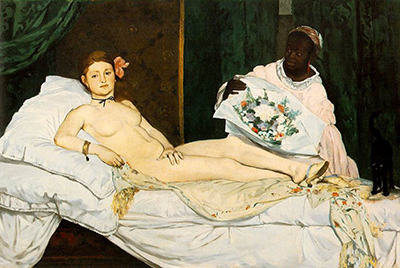
Olympia
1863 · A reclining figure, a direct gaze and a difficult public reception.
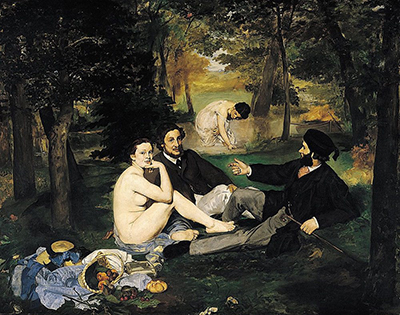
Le Déjeuner sur l’herbe
1863 · An inherited composition becomes an unsettling contemporary encounter.
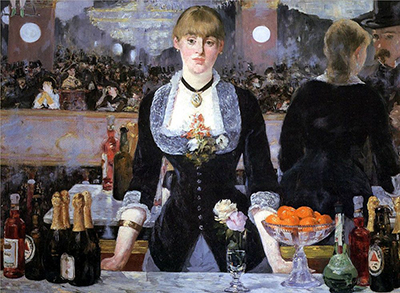
A Bar at the Folies-Bergère
1882 · A counter, a barmaid and the ambiguities of a great mirror.
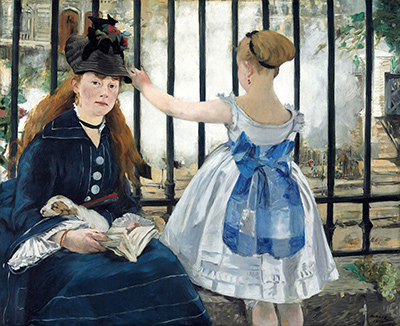
The Railway
1873 · Figures, iron railings and steam at the edge of the modern railway.
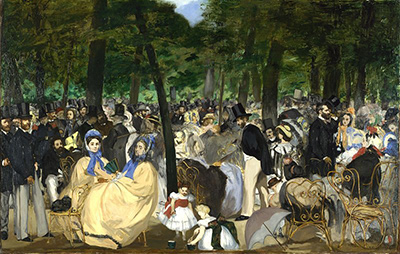
Music in the Tuileries
1862 · A fashionable crowd becomes a shifting field of hats, faces and trees.
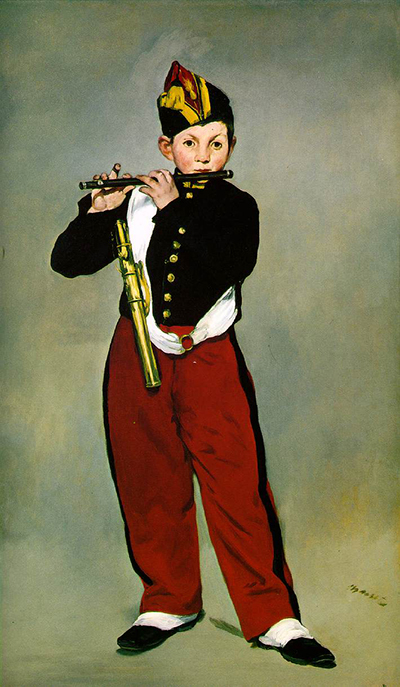
The Fifer
1866 · A young musician isolated through emphatic colours and sparse space.
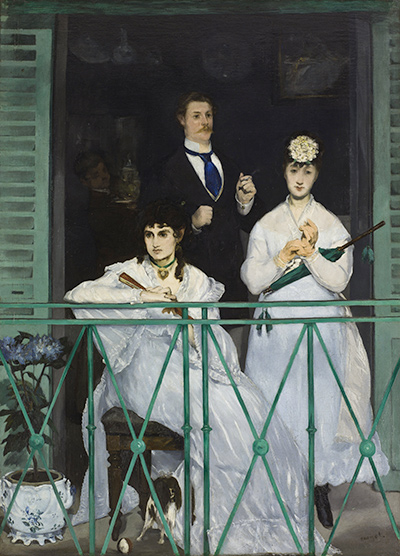
The Balcony
1868–69 · Three principal figures poised between an interior and the city.
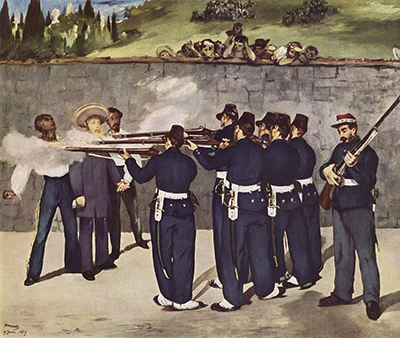
The Execution of Emperor Maximilian
1867–69, multiple versions · Related versions reconsider the representation of contemporary violence.
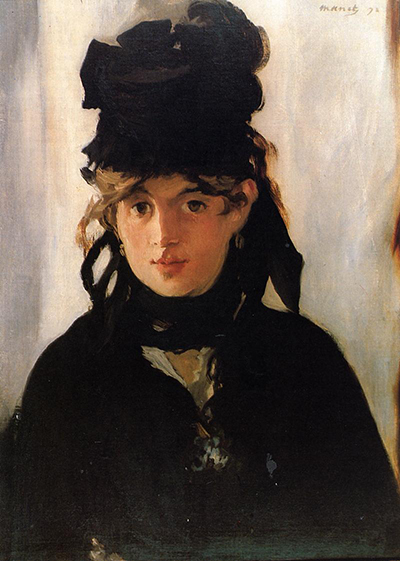
Berthe Morisot with a Bouquet of Violets
1872 · Black clothing, light and the presence of a fellow painter.
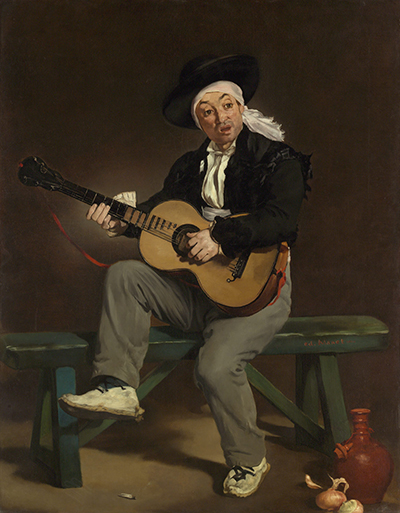
The Spanish Singer
1860 · A costumed studio figure and an early Salon success.
Artworks directory
Explore selected paintings, drawings and prints by Édouard Manet. Search by title or another recorded name.

Frequently Asked Questions
No. Édouard Manet and Claude Monet were different artists and colleagues. Manet painted Monet’s family at Argenteuil in 1874 and portrayed the fellow painter in other works.[8]
Le Déjeuner sur l’herbe, Olympia, The Fifer, The Railway and A Bar at the Folies-Bergère are among the works through which he is most often approached. His portraits, prints and small still lifes reveal other important aspects of his practice.
Discussion
Look again at the images and ideas explored in Édouard Manet. These editorial prompts invite your observations.
Reader Insights
Look at The Spanish Singer beside Olympia. Consider which features make a figure immediately accessible, and which make the viewer’s encounter more demanding.
Choose a railing, mirror or guitar and follow the way it organises the image. Consider how its practical role in the scene interacts with its shape on the surface.
Spend time with a small still life after looking at a major figure painting. Notice whether Manet’s approach to edges, colour and concentrated attention changes with the scale of the subject.
Join the Conversation
Share a detail, comparison or question about Édouard Manet below.
References
- Stéphane Guégan and Isolde Pludermacher, Manet / Degas, exhibition booklet, Musée d’Orsay, 2023, eight-page public guide. View source. (in French).
- Rebecca Rabinow, “Édouard Manet (1832–1883),” Heilbrunn Timeline of Art History, Metropolitan Museum of Art, 1 October 2004. View source.
- Theodore Reff, “Manet and the Paris of Haussmann and Baudelaire,” in Manet and Modern Paris, National Gallery of Art, 1982, pp.13–28; chronological entry for 1863, p.268. View source.
- Juliet Wilson-Bareau, “Manet and Spain,” relevant passages pp.217–218; catalogue entries 131, 132 and 163, pp.485–486 and 505, in Gary Tinterow and Geneviève Lacambre, eds., Manet/Velázquez: The French Taste for Spanish Painting, Metropolitan Museum of Art, 2003. View source.
- Scott Allan, “Exhibition Manet and Modern Beauty Explores the Artist’s Last Years,” Getty, 26 May 2019. View source.
- Musée d’Orsay, Le Déjeuner sur l’herbe, 1863, object RF 1668, collection record and commentary. View source. (in French).
- Heather Lemonedes Brown, “Manet & Morisot: An Artistic Friendship,” Cleveland Art, 11 February 2026. View source.
- The Metropolitan Museum of Art, The Monet Family in Their Garden at Argenteuil, 1874, object 1976.201.14. View source.
- Musée d’Orsay, Olympia, 1863, object RF 644, collection record, commentary and provenance. View source. (in French).
- National Gallery of Art, The Railway, 1873, object 1956.10.1, collection record and commentary. View source.
- Musée d’Orsay, Le Fifre, 1866, collection record and commentary. View source. (in French).
- Musée d’Orsay, Berthe Morisot au bouquet de violettes, 1872, object RF 1998 30, collection record and commentary. View source. (in French).
- Museum of Fine Arts, Boston, Victorine Meurent, about 1862, object 46.846, collection record. View source.
- Musée d’Orsay, Some Black Parisians: Glenn Ligon, 2019, exhibition account discussing Laure. View source.
- The National Gallery, London, Eva Gonzalès, scholarly collection catalogue, 2024. View source.
- The National Gallery, London, In the Line of Fire: Manet’s The Execution of Maximilian, sections on the painting’s history, historical background, genesis, artistic sources and contemporary history. View source.
- The Metropolitan Museum of Art, The Spanish Singer, 1861–62, etching and bitten tone, object 52.608.2. View source.
- Musée d’Orsay, Stéphane Mallarmé, 1876, object RF 2661, collection record and commentary. View source.
- Musée d’Orsay, L’Asperge, 1880, object RF 1959 18, collection record and commentary. View source. (in French).
- The Courtauld, A Bar at the Folies-Bergère, 1882, collection highlight. View source.
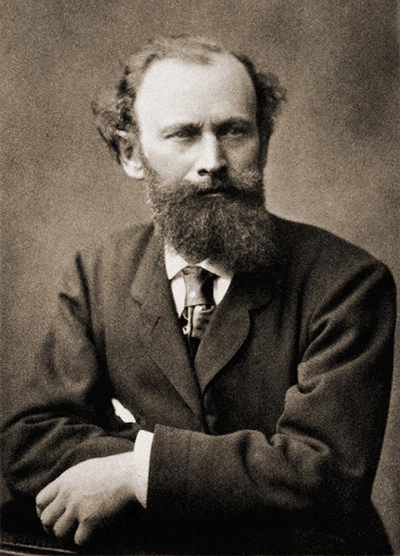
- Splash image, Charles Reutlinger, Édouard Manet; negative about 1875, print about 1876–1882. Photographic detail, The J. Paul Getty Museum, Los Angeles, 84.XB.300.17. Charles Reutlinger; The J. Paul Getty Museum, Los Angeles. Image source. CC0 / Public domain. Photographic detail cropped from the decorated mount; original orientation and colour retained. No enlargement or retouching.