



 by Tom Gurney
Tom Gurney BSc (Hons) is an art history expert with over 20 years experience
Published on June 19, 2020 / Updated on November 13, 2026
Email: tomgurney1@gmail.com / Phone: +44 7429 011000
Antonio Canova: Introduction
A pair of sculptor’s tools lies at the feet of Daedalus in one of Antonio Canova’s earliest marbles. The old man bends over the wings he is making for his son, Icarus, and a thread leads from his hand to the boy’s wing. It almost closes a circle around the space between them. That space is as carefully composed as the two bodies. Look through it and you can see why a sculptor would choose this moment in the story, when a practical task brings two people into a particular relation. Move to one side and the gap narrows, giving way to the slope of a shoulder or the projection of a wing. Canova makes the act of looking part of the encounter. [1]
Canova (1757–1822) was an Italian sculptor at the centre of Neoclassicism, the renewed engagement with the art of Greece and Rome that shaped European taste around 1800. He carved mythological groups, portraits and funerary monuments, and also worked in drawing and painting. His marbles invite several kinds of attention. In Psyche Revived by Cupid’s Kiss, an embrace depends on the space the figures leave around their faces. In The Three Graces, you can follow an arm around one figure and discover that the hand belongs to another. Those small shifts of attention become much more pronounced when the figures are set high in a church or grouped around a monument. [2] [3] [4] [5] [6] [7]
Antonio Canova
At a Glance
- Life1757–1822. Born in Possagno and trained in Venice. [2]
- Known forMarble sculpture, including mythological groups, portraits and memorials. [2]
Canova’s artistic connections
Patrons, earlier artists and studio collaborators helped shape where Canova worked and how his designs travelled.
- Giambattista Piazzetta: The Correr compares the naturalism of Canova’s Daedalus with the heads painted by Piazzetta. [1]
- Pietro Vettor Pisani: Pisani commissioned Daedalus and Icarus for his palace on the Grand Canal. [1]
- John Russell, Duke of Bedford: Bedford commissioned the second Three Graces after seeing the composition in Canova’s studio. [4]
- Adamo Tadolini: Tadolini inherited the pointing plaster for Cupid and Psyche and used it to make further versions. [8]
Antonio Canova in context
Daedalus and Icarus
1777–79 [1]Venus Victrix
1804–08 [9]The Three Graces (Bedford marble)
Completed by 1817 [4]Mars and Venus
1815–19 [10]Contents
- From Venice to Rome
- Four marbles to look at from more than one side
- How a model became a marble
- A pope, a procession and a president
- Drawings, paintings and prints
From Venice to Rome
Canova was born in Possagno, in the foothills north-west of Venice, in 1757. His grandfather Pasino, a stonecutter, introduced him to the trade and arranged for him to learn in the workshop of Giuseppe Bernardi. In Venice the young Canova could study casts of ancient sculpture in collections such as Filippo Farsetti’s, as well as the city’s own painting and sculpture. For Senator Giovanni Falier he made Orpheus and Eurydice, separate figures whose turning bodies bring the loss of Eurydice into the space between them. For Pietro Vettor Pisani he made Daedalus and Icarus, in which Daedalus’s lined face and bent body play against the boy’s smoother skin and more upright bearing. The Museo Correr traces the old man’s appearance to a Venetian tradition of painting, especially the heads of Giambattista Piazzetta. [1] [2] [11]
Canova first visited Rome in 1779 and established his studio there in 1781. Girolamo Zulian, the Venetian ambassador, helped him find his footing. Rome gave him access to ancient works in the original, alongside artists and antiquarians who debated what a modern sculptor could learn from them. One answer was Theseus and the Minotaur, his marble of 1782. Theseus sits on the fallen creature and looks down. The slope of the hero’s shoulders and the Minotaur’s hanging head give the action a past tense. By choosing the aftermath, Canova can leave the viewer to imagine the violence and make the weight of one body on the other carry the story. [2] [7]
The work established his reputation in Rome. Papal monuments soon put that reputation to a public test. By the early nineteenth century Canova was portraying members of the Bonaparte family and, as inspector general of antiquities and fine arts in the Papal States, exercising authority over the export of works of art. In 1815 Pope Pius VII sent him to Paris to negotiate the return of works removed during the French campaigns. He continued to take major commissions, including Mars and Venus for the British Prince Regent and a portrait for North Carolina. In 1819 construction began on the temple he designed for Possagno. Canova died in Venice in 1822, before it was completed. His biography follows the people and places behind those changes of fortune. [2] [6] [11] [7] [10]
Four stages of Antonio Canova’s career
The periods overlap. Studio work continued while Canova travelled and undertook public duties.
Learning to sculpt in Venice
Early work for Falier and Pisani gave Canova opportunities to organise figures on a large scale. The thread and tools in Daedalus and Icarus give his Venetian group a tangible centre.[1]
Commissions in Rome
Canova established his studio in Rome and drew on classical sculpture for mythological works. Papal memorials required him to fit figures and gestures to church architecture.[11]
Sculpture and imperial portraiture
Canova modelled Napoleon and carved Pauline Bonaparte as Venus. Her Borghese portrait combines a likeness, a mythological attribute and furniture that shaped how the marble could be viewed.[9]
Commissions after the Napoleonic wars
Canova’s 1815 visit to London led to Mars and Venus for the Prince Regent. A letter to Cicognara identifies the two figures with war and peace.[10]
Four marbles to look at from more than one side
Psyche Revived by Cupid’s Kiss
In the Louvre’s Psyche Revived by Cupid’s Kiss, Cupid bends over Psyche and she lifts her arms around his head. Start with the empty space their faces and arms enclose. At the centre of a work named for a kiss there is still a little air between the two mouths. Then follow Cupid’s wings away from that centre. Their long edges draw the eye outward even as his lowered head leads it back. From the rear, the rock and the small vessel become more prominent. The vessel recalls the ordeal from which Cupid rescues Psyche in the story told by Apuleius. [3] [8]
John Campbell commissioned the group in 1787. Canova completed it in 1793, but the marble stayed in the studio and never reached Campbell. Joachim Murat later acquired it. A second reclining version was made for Prince Nikolai Yusupov and is in the Hermitage. One way to tell the two reclining groups apart is to look at Psyche’s legs. In the Hermitage marble the drapery covers them completely. In the Louvre’s collection alone, there is also a separate group in which Cupid and Psyche stand together. [3] [8] [12] [13]
The Three Graces
In The Three Graces the heads incline towards one another at slightly different heights. From the familiar front view the sisters read as a group, but the back makes the embrace easier to untangle. Watch the movement pass from a bent elbow to a hand on a companion’s shoulder or waist. The drapery links the figures lower down, where it introduces another rhythm across the legs. Canova gives each sister a distinct stance within a group whose effect depends on their closeness. [4]
Joséphine de Beauharnais commissioned the first marble, now in the Hermitage. John Russell, the sixth Duke of Bedford, saw the group in Canova’s studio and commissioned another version, now jointly owned by the V&A and National Galleries of Scotland. One easy way to distinguish them is to look at the support beside the figures. The first has a square pillar and the Bedford marble a round one. At Woburn Abbey, Bedford installed his marble in a purpose-built, top-lit rotunda on a plinth that allowed the group to turn. Light from above and a changing view made it possible to follow the shifts between skin, drapery and the shadows of the linked arms. [4] [14]
Pauline Borghese as Venus Victrix
Canova gave Napoleon’s sister Pauline an apple to identify her as the goddess who won the Judgement of Paris. The portrait Venus Victrix has the length and low profile of an antique reclining figure, but its textures hold the eye at close quarters. Look at the mattress where the body presses into it. The shallow depression gives weight to the sitter, while the fine folds over her legs make the drapery seem almost weightless. The Galleria Borghese connects the mattress to Gian Lorenzo Bernini’s treatment of the same material in the Sleeping Hermaphrodite, then part of the Borghese collection. [9]
The portrait was commissioned in 1804 by Pauline’s husband, Camillo Borghese. Its couch also determines how the portrait can be seen. The decorated drape conceals a mechanism that allows the work to rotate. As the angle changes, Pauline’s face and hand come into or slip out of profile, the apple can be easier to see, and the projecting knee and fall of cloth change the outline. The Borghese catalogue also describes how the finish brought out the effect of skin in candlelight. The portrait’s play with likeness and mythology was intended to be experienced in a room, under changing conditions of light and view. [4] [9]
Perseus with the Head of Medusa
Canova’s Perseus with the Head of Medusa takes its bearings from the Apollo Belvedere. Pius VII bought the first marble and set it in the Vatican niche left empty when the Apollo was taken to Paris. The wide gesture of Canova’s hero recalls the ancient statue, but his attention goes to the severed head in his raised hand. The story unfolds along the line of that look. Canova drew on a second ancient sculpture, the Rondanini Medusa, for the features of the head itself. [15]
The marble made for the Tarnowskis in 1804–06, now at the Metropolitan Museum of Art, opens a larger gap under Perseus’s raised arm. Canova omitted the strut used in the Vatican version and gave the hanging cloth a more pronounced swing. Look at what this does to the outline. The arm, hanging drapery and stretch of open space register as distinct shapes. Canova had found a way to alter the composition through the support as well as through the figure. [15]
Videos on Canova
Explore Canova’s workshop methods and the settings for his sculpture.
How does an artist copy the 200-year-old techniques of master sculptor Antonio Canova?
A sculptor demonstrates how Canova’s workshop methods can be used to recreate a marble Venus.
Watch on YouTubeHow a model became a marble
The surviving clay sketches show Canova making decisions that the marbles carry so smoothly they can seem inevitable. In Adam and Eve Mourning the Dead Abel, he tried different placements for the grieving parents. In one study he made the two figures from a single mass of clay at the centre of the composition. Each arrangement changes the way grief travels through the group, from the angle of one body to the reach of another. Canova never made the group in marble. The clay records an inquiry that can be followed in its own right. [16] [17]
Some models were finished with a different purpose in mind. In the small painted terracotta Pope Clement XIV of 1783, Canova worked the figure to a high finish and painted it white. The curators of Canova: Sketching in Clay suggest that he may have shown it to the patron, who could see in miniature how the pope and his raised hand would read in marble. An early drawing or soft clay study allowed a pose to change quickly. A more finished model made it possible to judge the effect before committing to the expense of a full-size sculpture. [16] [18]
Full-size plaster models gave the studio a durable form to work from. The Met’s 1794 plaster of Cupid and Psyche, prepared for the second reclining version, still has metal pins across its surface. They served as measuring points for transferring the form to a marble block. Assistants could bring the stone close to the intended shape using those measurements. Canova commonly took charge of the final finishing, the stage at which even slight changes to the modelling and polish could affect how light rested on a face or caught the ridge of a fold. The plaster survived as a tool after Canova’s death. His assistant Adamo Tadolini inherited it and used it to produce further versions. The sculptures bring together works in these different materials. [8] [9] [15] [18]
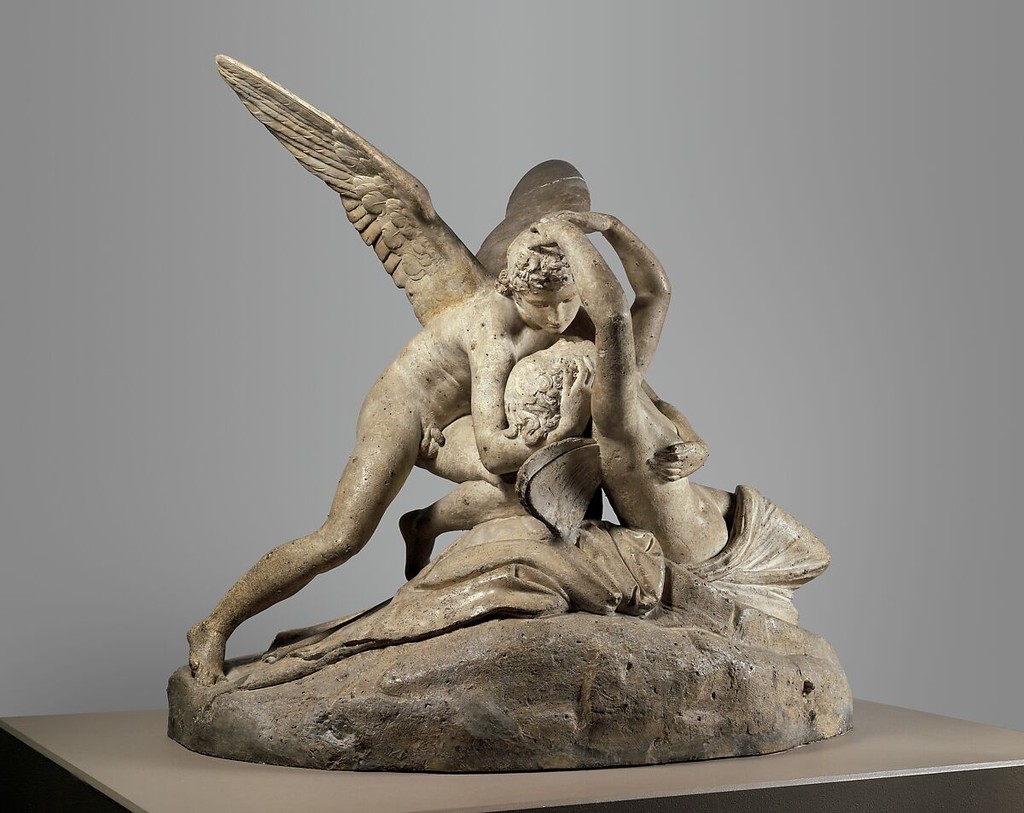
Metal points on the full-size plaster of Cupid and Psyche guided the transfer into marble. The Metropolitan Museum of Art. Image source. CC0 / Public domain. Resized from source.
A pope, a procession and a president
In the Tomb of Pope Clement XIV, completed in 1787 for Santi Apostoli in Rome, the pontiff appears seated high above the viewer. His arm stretches out above the two lower figures. The broad gaps between them keep the gestures legible across the church. Canova had to plan the effect of several distinct statues at different heights, as well as the work of carving each of them. Francesco Chiarottini’s drawing of Canova’s studio shows plaster and marble versions of the pope beneath a wooden frame, with assistants working elsewhere in the room. [7] [18] [19]
The Funeral Monument to Maria Christina of Austria was commissioned by her husband, Duke Albert of Saxe-Teschen, and installed in Vienna’s Augustinian Church in 1805. Here the figures on the steps lead the eye across the monument towards the dark doorway of a pyramid. An urn is borne towards the opening, a winged figure leans against a lion, and the archduchess appears in a portrait medallion high above. Maria Christina was buried in Vienna’s Imperial Crypt, which makes the pyramid a cenotaph, a monument that commemorates the dead without containing their remains. The procession makes the approach to an imagined burial present every time a viewer follows the figures up the steps. [20] [21] [22]
For the North Carolina State House, Canova showed George Washington as a seated figure in Roman armour, drafting his farewell address. The tablet brings the subject into focus. In one preparatory plaster the inscription concerns homeland, liberty and law. In the full-size plaster of 1818 it identifies Washington and addresses the people of the United States. The quiet action of writing makes the classical costume serve the portrayal of a president relinquishing office. The marble arrived in Raleigh in 1821 and was destroyed in the State House fire of 1831. The full-size plaster in Possagno preserves the design, down to the words Washington was shown setting on the tablet. [5] [6] [23]
Drawings, paintings and prints
The Museo Correr’s drawings show how Canova could investigate a gesture with very little material. The museum distinguishes exploratory pencil drawings, in which he could feel out a subject or arrangement, from the assured ink lines he used for more developed gestures. Try following the outer edge of a figure on paper, then follow the same kind of line around a sculpture. A pen line can establish a pose with a curve from shoulder to hip. In a marble, whether you see that curve at all depends on where you stand and which other forms cross it. [1]
The paintings offer a different way to see his interest in movement. In the temperas on paper made around the turn of the nineteenth century, pale figures and coloured drapery stand out against black grounds inspired by ancient wall painting. In The Graces and Venus Dance before Mars, the dancers spread across the sheet, with lifted heels, turned heads and a veil that carries the movement past a raised arm. Compare this with the marble Three Graces. On paper the figures can extend across the dark field, and their rhythm survives in one view. In the marble the embrace is compact, and following its rhythm takes the eye around the group. [4] [24] [25]
Prints after Canova bring the sculpture back to a single viewpoint. An engraving of Maria Christina’s monument by Pietro Bonato, after Domenico del Frate, shows how the pyramid and the steps hold the procession together when seen from the front. The lion and the figures are all legible at once, and the dark doorway still draws the eye. Bonato’s print also preserves the longer dedication of Canova’s early designs. The monument in Vienna bears a much shorter one. A print can therefore show something of the work’s history as well as preserve a view of its design. To see another side of that history, compare the early Venetian marbles at the Correr with the models at Possagno, where the terracottas and plasters make the choices behind a finished statue visible at a different scale. [1] [20] [22] [26]
Essential Antonio Canova works

Psyche Revived by Cupid's Kiss
1787–93 · An embrace framed by wings and the space between two faces.[3]

The Three Graces
Bedford marble completed by 1817 · Hands and shoulders guide the eye around three closely linked figures.[4]

Venus Victrix
1804–08 · An apple gives Pauline Borghese the role of Venus.[9]

Theseus and the Minotaur
1782 · The seated victor gives the aftermath of the fight its stillness.[7]

George Washington
Full-size model, 1818 · Canova showed Washington writing rather than standing in command.[5]

Daedalus and Icarus
1777–79 · A thread connects the old craftsman and the young figure preparing to fly.[1]
Explore Canova’s works
Browse the sculptures and paintings covered in this guide. Several entries compare versions or examine details of a larger work.
Discussion
Look again at the images and ideas explored in Antonio Canova. These editorial prompts invite your observations.
Reader Insights
Which of Canova’s groups changes most when you imagine walking around it?
Which early work would you compare with Canova’s mature marbles?
Join the Conversation
Share a detail, comparison or question about Antonio Canova below.
References
- Museo Correr, Le Sale Neoclassiche e Collezione canoviana (in Italian),. View source.
- Christina Ferando, The Metropolitan Museum of Art, Antonio Canova (1757–1822), 1 July 2016,. View source.
- Musée du Louvre, L’Amour et Psyché à demi couchée, MR 1777 (in French),. View source.
- Victoria and Albert Museum, The Three Graces by Antonio Canova,. View source.
- The Frick Collection, Modello for George Washington, 1818,. View source.
- The Frick Collection, Canova’s George Washington, exhibition introduction,. View source.
- Victoria and Albert Museum, Antonio Canova – an introduction,. View source.
- The Metropolitan Museum of Art, Cupid and Psyche, 1794, 05.46,. View source.
- Galleria Borghese, Paolina Borghese Bonaparte as Venus Victrix, inv. LIV,. View source.
- Royal Collection Trust, Mars and Venus, RCIN 2038,. View source.
- Museo Gypsotheca Antonio Canova, Biografia di Antonio Canova (in Italian),. View source.
- Musée du Louvre, L’Amour et Psyché debout, MR 1776 (in French),. View source.
- Sergey Androsov, State Hermitage Museum, Italian Sculpture, 17th–18th Centuries, State Hermitage Publishers, 2014, cat. 241, pp. 260–62 (in Russian),. View source.
- National Galleries of Scotland, The Three Graces, NG 2626,. View source.
- The Metropolitan Museum of Art, Perseus with the Head of Medusa, 1804–06, 67.110.1,. View source.
- C. D. Dickerson III and Emerson Bowyer, with contributions from Anthony Sigel and Elyse Nelson, Canova: Sketching in Clay, National Gallery of Art and Art Institute of Chicago, 2023,. View source.
- National Gallery of Art, Who Is Antonio Canova? 10 Things to Know,. View source.
- National Gallery of Art, Canova: Sketching in Clay, exhibition wall text and object labels, 2023,. View source.
- Museo Gypsotheca Antonio Canova, L’Opera di Antonio Canova, sections on the Chiarottini drawing and the passage from drawing to marble (in Italian),. View source.
- Albertina, Das Kenotaph der Erzherzogin Marie Christine in der Augustinerkirche in Wien, inv. 14390 (in German),. View source.
- Princeton University Art Museum, Charles Swagers, The Tomb of Maria Christina of Austria, by Antonio Canova, catalogue commentary on the monument,. View source.
- Wellcome Collection, Pietro Bonato after Domenico del Frate after Antonio Canova, engraving of the cenotaph of Maria Christina of Austria, 1805, 3087377i,. View source.
- The Frick Collection, Bozzetto for George Washington, 1817,. View source.
- Museo Gypsotheca Antonio Canova, Ala Scarpa collection guide, PDF pp. 51–53, Le tempere (in Italian),. View source.
- Fondazione Federico Zeri, Università di Bologna, Ratto di Elena, Danza di Venere e delle Grazie davanti a Marte, record no. 94611 (in Italian),. View source.
- Museo Gypsotheca Antonio Canova, Ala Scarpa, collection and display of the plasters and terracottas (in Italian),. View source.

 Antonio Canova.jpg)