



 by Tom Gurney
Tom Gurney BSc (Hons) is an art history expert with over 20 years experience
Published on June 19, 2020 / Updated on November 13, 2026
Email: tomgurney1@gmail.com / Phone: +44 7429 011000
Dancer with Finger on Chin: Introduction
A dancer touches her chin with the tip of her right index finger. She tilts her head towards it while the other arm bends out at the elbow. A garland hangs from that forearm, close to the folds at her hip. Below, one bare foot crosses in front of the other. The foot on the ground bears her weight at the ball, with the heel lifted. Antonio Canova uses a small contact at the face and another at the ground to make a marble figure appear poised in the middle of a step. [1]
The National Gallery of Art in Washington holds the marble once owned by the third Marquess of Londonderry. It dates the model to 1809–14 and the carving of its statue to 1819–23. The design had already been commissioned by the Forlì banker Domenico Manzoni, whose marble was recorded as finished in 1814. The plaster at Possagno and a fragment in Rome preserve different kinds of evidence for how the pose travelled between objects. [1] [2] [3]
Dancer with Finger on Chin Antonio Canova
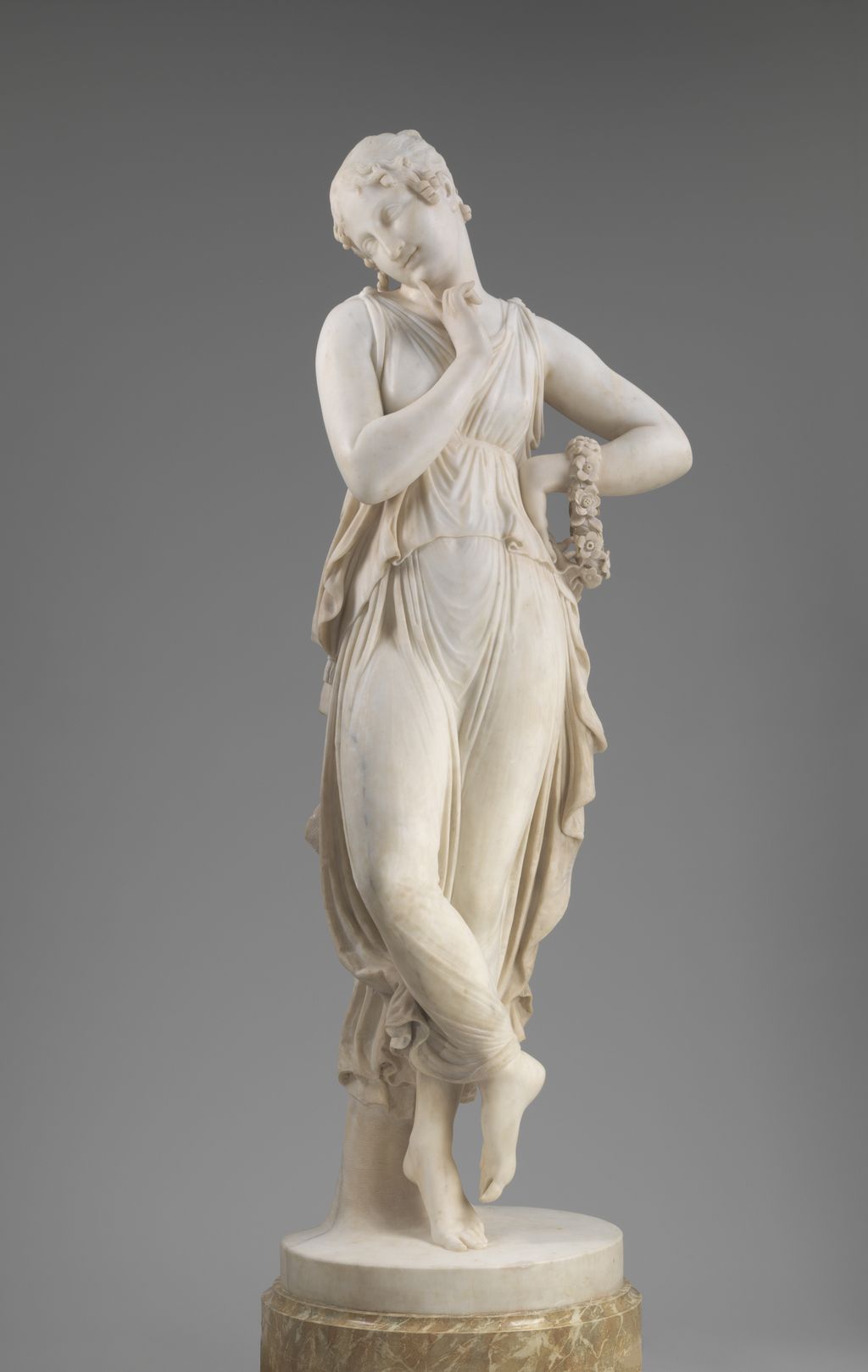
The Washington marble from the front, with the dancer’s raised hand and garland. National Gallery of Art. Image source. CC0 / Public domain. Resized for display.
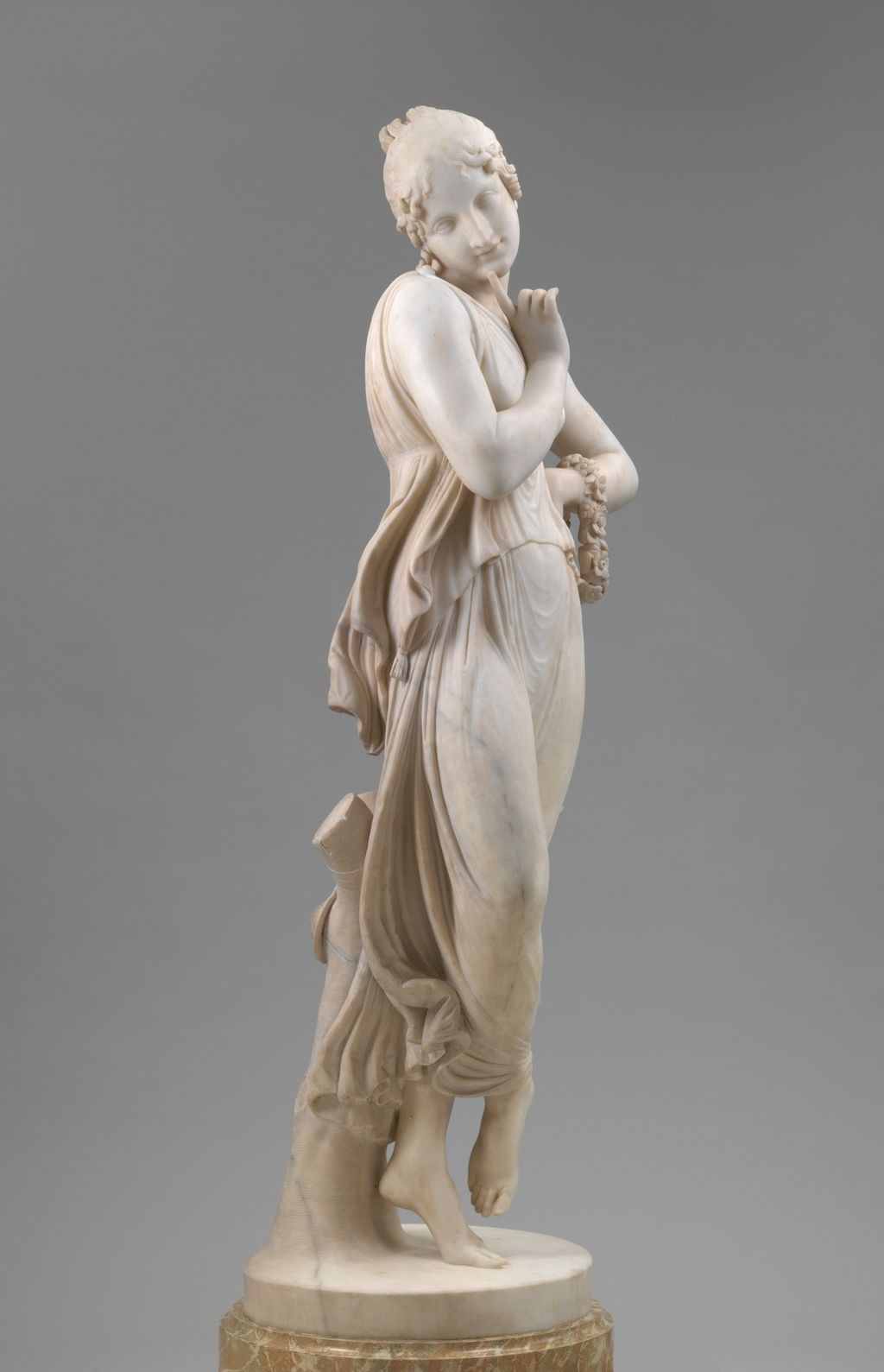
An oblique view shows the folded fabric and the support behind the dancer. National Gallery of Art. Image source. CC0 / Public domain. Resized for display.
At a Glance
- Washington marbleNational Gallery of Art, 2003.62.1, approximately 177 cm high. [1]
- Possagno modelPlaster dated 1809, inventory 197. [2] [4]
- Villa Torlonia fragmentCarrara marble, first half of the nineteenth century, inventory MCN 26. [3]
Contents
- From the chin to the raised heel
- A gesture from tempera to plaster
- Manzoni’s commission in Forlì
- The Londonderry marble
- The fragment and the other dancers
- Annotated details
From the chin to the raised heel
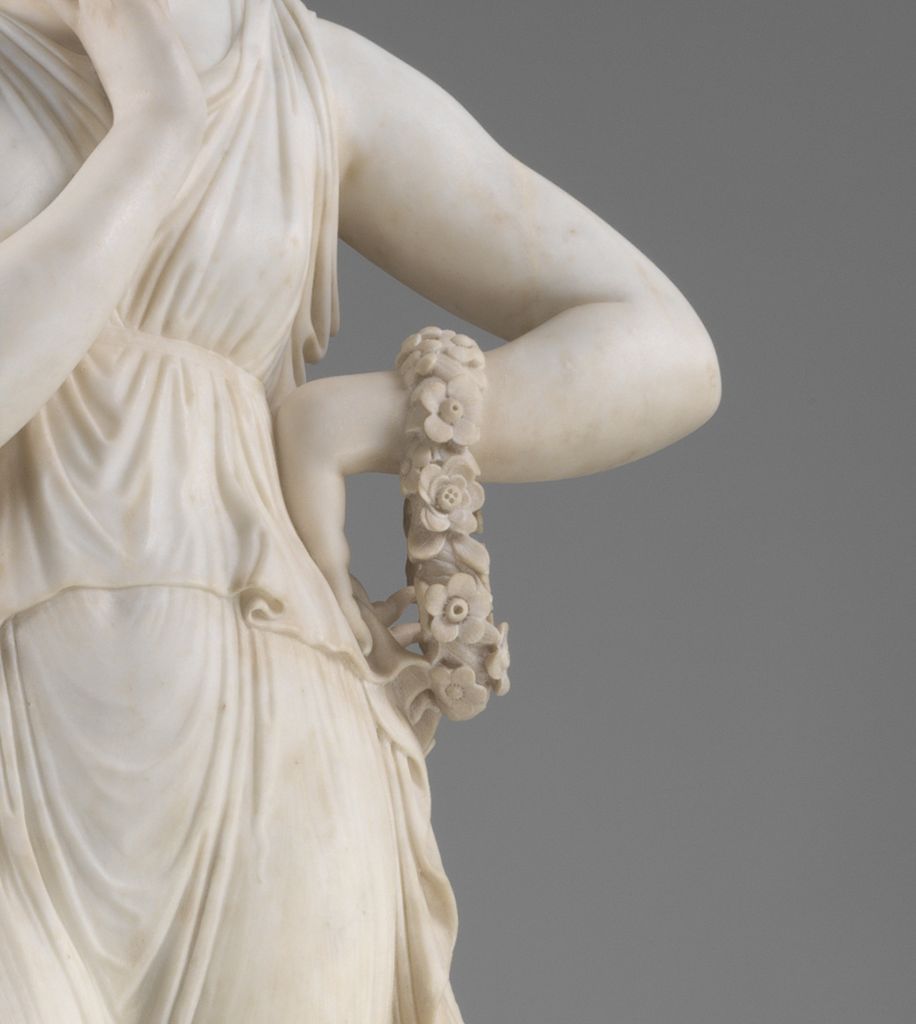
Viewed from the front, the raised forearm crosses the upper body and leads to the point where the finger meets the chin. The head tips down, and the eyes turn with it. The elbow on the other side projects beyond the outline of the dress. Its bent arm brings the back of the hand against the hip, leaving an opening above the wrist. The hanging flowers trace the outside of the dress for a short distance. The two sides of the pose have different shapes, one drawing the eye in towards the face and the other carrying it out towards the garland. [1]
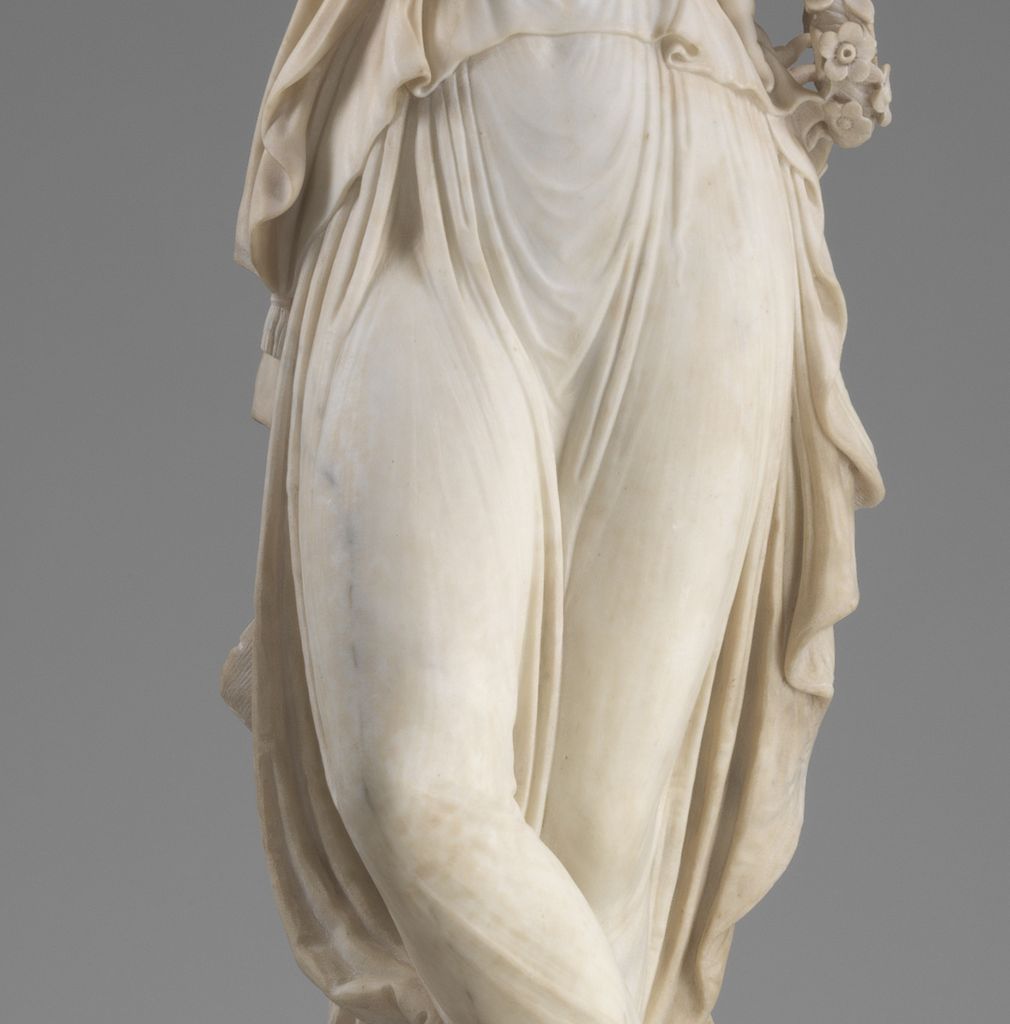
Follow the folds from the high band under the bust. A long section of cloth curves across the leg that bends and crosses in front. The fabric lies close enough for the knee to show through, then gathers into thicker folds near the lower legs. From an oblique angle, the hanging fabric at the side of the body stands clear of the smoother surface over the thigh. Around the shoulder, a loop of cloth projects into the space behind the arm. Canova gives the dress enough thickness to hold shadow where it folds over itself, even where the marble seems thin across the leg. [1]
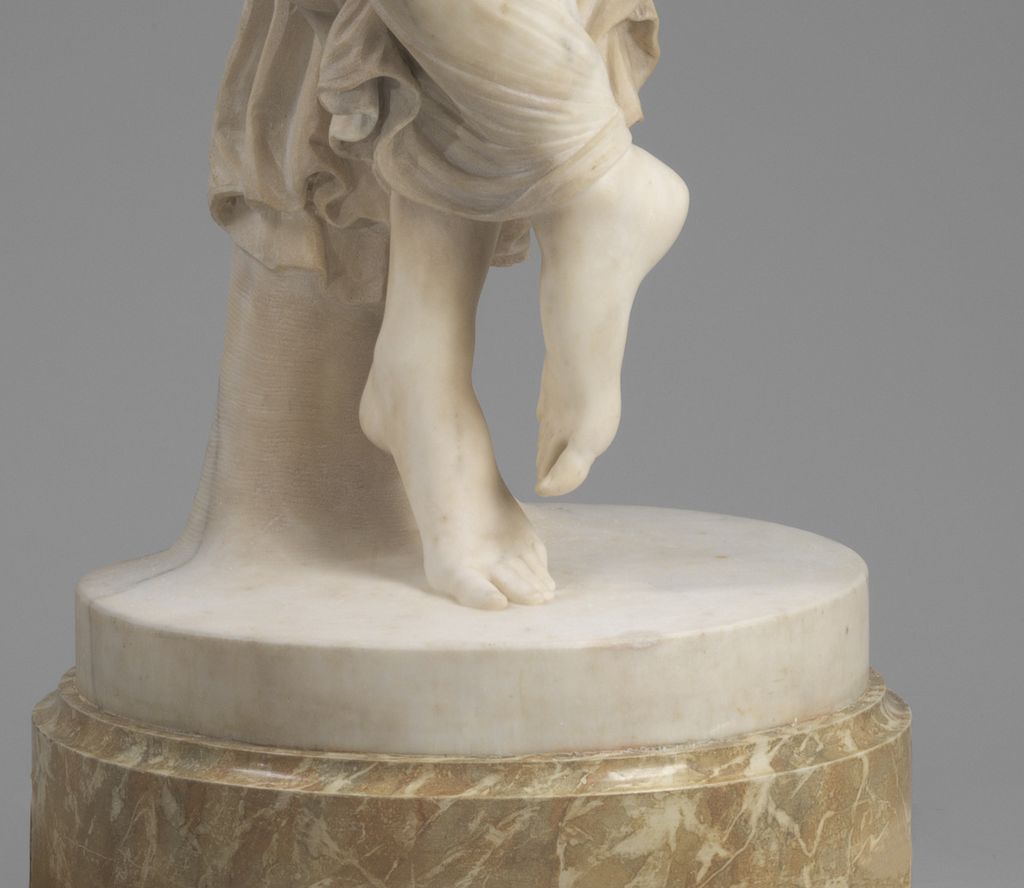
The side view makes the balance easier to read. The crossing foot hangs with its toes directed down, while the ball of the other foot stays on the base. The upright support comes into view behind the legs, joining the figure to the base through a broader mass of stone. From the front, the feet and clothing screen much of it. The difference between the two views lets the sculptor show a moment of apparent instability while giving the marble a substantial support. In Hebe, a lifted heel also suggests a step, though the support takes the form of a cloud or a tree trunk, depending on the version. [1] [5]
Annotated Details from Dancer with Finger on Chin
The Washington marble from the front. Photograph from National Gallery of Art. Public domain. Resized, annotated and cropped for the details.
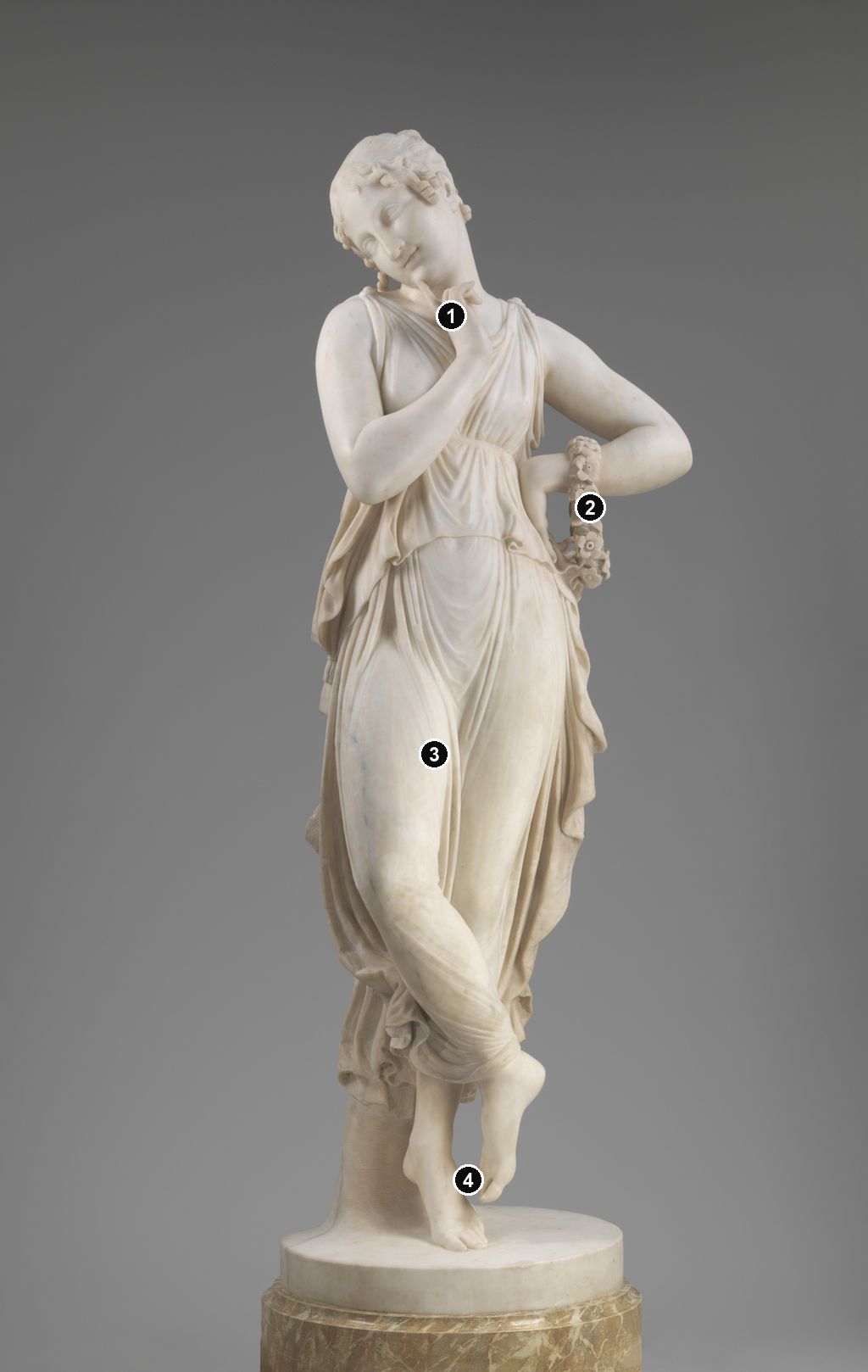
Details from DANCER WITH FINGER ON CHIN
Compare the small hand gesture with the movement of the skirt and feet.
Finger at the chin
The dancer inclines her head towards her lifted hand. The other elbow points outward.
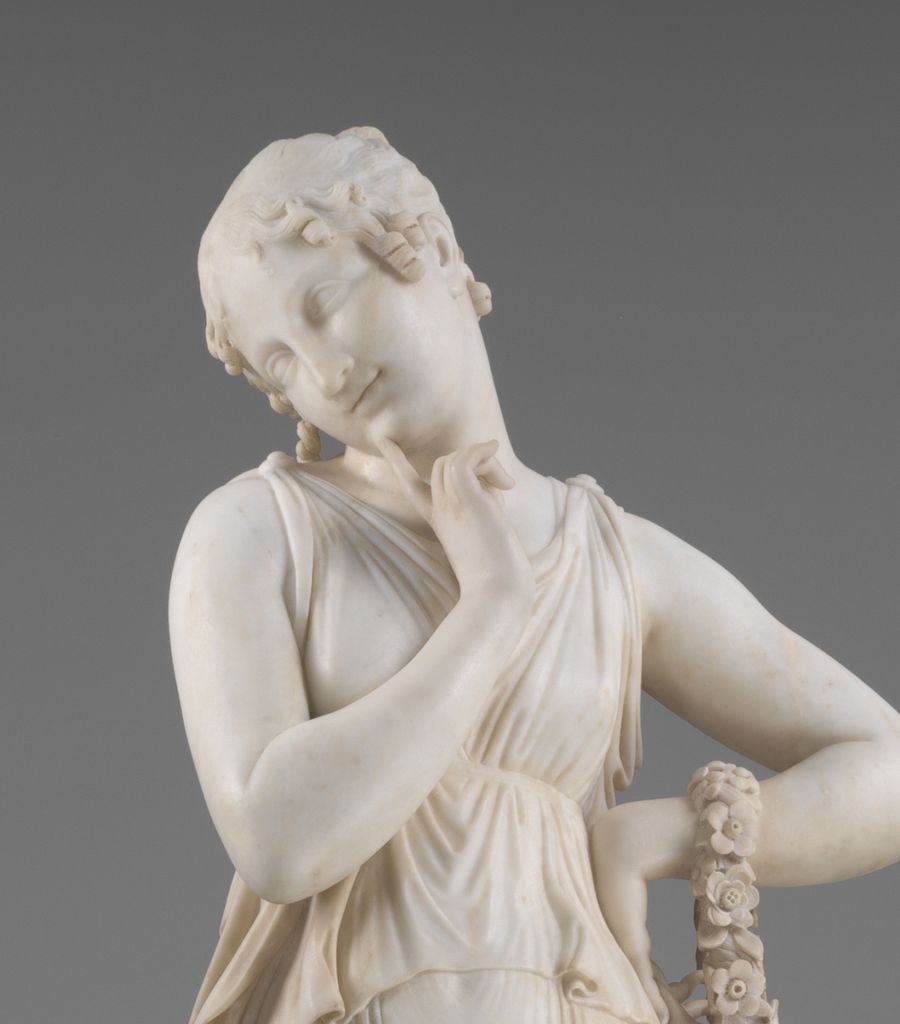
The garland
A garland hangs beside the bent elbow, where its flowers interrupt the long lines of the dress.
Folds across the skirt
The folds draw down from the waist, then turn across the leg as the figure shifts her weight.
The two feet
One foot takes the dancer’s weight at the toes. The other hangs just above the plinth.
A gesture from tempera to plaster
In a tempera on paper now at Possagno, Two Dancers, one figure already brings her hand to her chin and crosses one leg in front of the other. Pinacoteca Agnelli dates the sheet to 1799. The figure stands against a dark ground, and the folds of her pale dress run down the paper in slender lines. A small drum and the second dancer help place the pose in a performance. In the Washington marble, a single body has to convey the step. The crossing feet, bend at the wrist and drapery carry the action, and they can be read as the viewer changes position. [1] [4] [6]
The plaster at Possagno gives the design a life-size form. It measures 177 by 58 by 53 centimetres in the museum’s guide, and its inscription records the year 1809. The guide also notes an inscription describing the unhappy days in which Canova worked on it. The museum relates the words to the removal of Pope Pius VII from Rome and to the illness of Luigia Giuli, who had long worked for Canova. Those circumstances belong to the history of the model. The marble’s lowered head and slight smile leave the dancer’s own thoughts open. [1] [2] [7]
A full-size plaster could preserve the arrangement after one marble left the studio. In Canova’s workshop, assistants measured fixed points on such models and used them to guide the cutting of a block. The process could carry the position of a knee or the distance from wrist to shoulder into another material. The workshop then had to carve the spaces around those forms and finish surfaces such as petals, curls and overlapping folds. Pinacoteca Agnelli identifies its own finger-on-chin plaster as a cast made from the Manzoni marble. It and the Possagno model record different stages in the life of the design. [2] [8] [9]
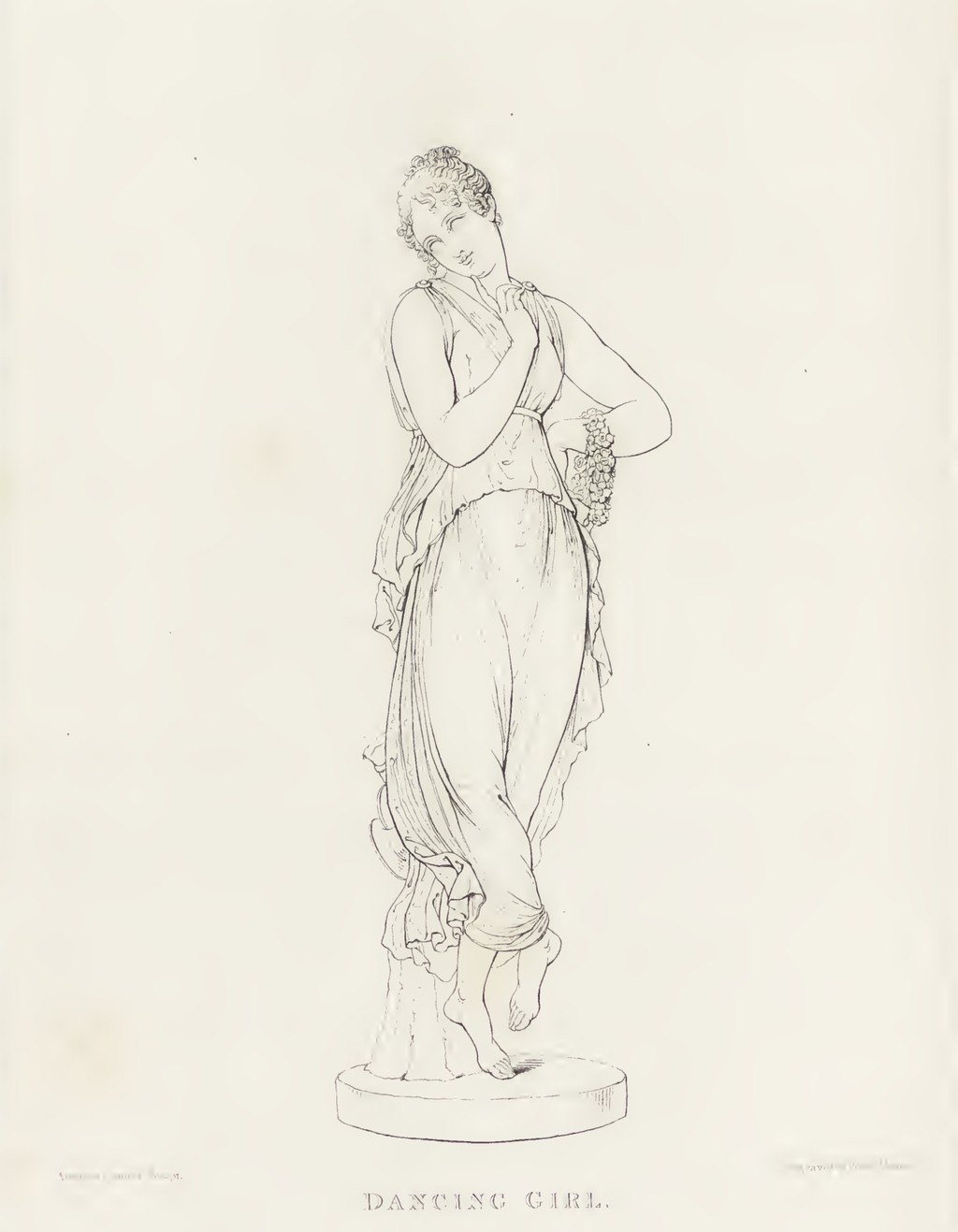
In Moses’s engraving, the raised hand comes to the chin and the drapery opens around the lifted heel. Henry Moses, after Antonio Canova, engraving published in London, 1824. Getty Research Institute. Image source. Public domain. Scan margins trimmed and image resized.
Videos on Canova
Explore Canova’s workshop methods and the settings for his sculpture.
From Sketch to Stone | Canova: Sketching in Clay
Watch sculptor Fred X. Brownstein recreate a Canova Venus, using clay, plaster and marble.
Watch on YouTubeManzoni’s commission in Forlì
The editors of Canova’s correspondence date Manzoni’s commission to 1810 through the writer Pietro Giordani. Giordani had seen the model in the studio and thought the face resembled Gertrude, Manzoni’s wife. Since the plaster preceded the commission, his observation tells us how one early viewer responded to the figure. Villa Torlonia dates the commission to 1811 and gives a price of 4,400 scudi. The letters document instalments of 1,000 and 500 scudi in January and June 1812. [2] [3]
The correspondence places the carving of the Manzoni marble in 1814 and its delivery in 1818, after the banker had been killed. It went to his widow for an installation in a circular room prepared with Canova’s advice. Such a room gives some idea of how an early owner could have encountered the work. As the viewer moves, the distance between the bent elbow and the body appears to change, and the garland and support come in and out of view. The room’s shape suited a figure whose movement is easier to follow from several sides. [1] [2]
The Londonderry marble
The Washington provenance begins in Canova’s studio and gives the marquess’s purchase as about 1823. A letter dated 20 February places him in Rome that year, after Canova’s death the previous October. The gallery notes that he might have bought the sculpture on this visit. An earlier suggestion placed the acquisition during his years as ambassador in Vienna, for which the gallery finds no proof. The carving range on the Washington record extends into 1823, leaving open how far work on that marble continued in the studio after Canova’s death. [1]
The traditional account traces Manzoni’s marble from Forlì to Count Guryev, the Russian ambassador in Rome, in 1830 and then to Saint Petersburg, where its trail ends. Alessio Costarelli has proposed that the Washington sculpture could be the Manzoni marble. His study of Londonderry’s Canova dancers brought a document in the Royal Academy Library into the discussion, and the National Gallery includes the identification as a proposal in its bibliography. Its object entry retains the later carving dates and the approximate purchase date. The resemblance between the Washington marble and the Manzoni design is clear, while their recorded histories leave the identification unsettled. [1] [4] [9] [10]
The statue passed down in the Londonderry family and was sold at Sotheby’s in London in November 1962. It was bought for Lillian Rojtman Berkman and entered the National Gallery in 2003. During conservation, the gallery treated a fracture running almost the length of the figure, thought to have occurred during transport to Londonderry in 1823. Conservators filled the crack with a wax-resin and cleaned away dark residue. The damage and repair belong to the history of this particular marble. [1] [11]
The fragment and the other dancers
The Carrara marble at Villa Torlonia came from the villa’s Tribuna with fountain. The museum dates it to the first half of the nineteenth century and identifies it as a version of the Manzoni design. The head, arms and feet are gone. The title therefore depends on what survives of the torso and drapery rather than the finger itself. The fitted fabric over the bent leg and the layered folds below the waist show why the body could identify the design even after losing its most familiar gesture. [1] [3]
Canova also made a dancer with both hands on her hips for Joséphine de Beauharnais and a dancer with cymbals for Andrei Razumovsky. In the hands-on-hips design, the elbows spread to either side of the waist. The cymbal dancer lifts her hands to play, making the arms part of the music as well as the step. In the Washington marble, the raised hand stays within the outline of the figure and the eyes follow the inclination of the head. The differences start with what the hands are doing, then extend through the shoulders, clothing and feet. [1] [2] [12]
Explore Canova’s works
Browse the sculptures and paintings covered in this guide. Several entries compare versions or examine details of a larger work.
Discussion
Look again at the images and ideas explored in Dancer with Finger on Chin. These editorial prompts invite your observations.
Reader Insights
What do the dancer’s feet tell you about the movement she is making?
How does the view from the side change the gesture at her chin?
Join the Conversation
Share a detail, comparison or question about Dancer with Finger on Chin below.
References
- National Gallery of Art, Dancer with Finger on Chin, marble, 2003.62.1. Collection record, photographs, provenance and bibliography. View source.
- Edizione Nazionale delle Opere di Antonio Canova, Epistolario 1812, introduction, pp. LI–LIII and letters cited in note 202. View source.
- Musei di Villa Torlonia, Dancer resting her chin on a finger, MCN 26. View source.
- Catalogo generale dei Beni Culturali, Due danzatrice, 0500432534, including Possagno plaster inventory and the Manzoni marble's sale. View source.
- Museo Gypsotheca Antonio Canova, Ebe, exhibition on the design and its versions. View source.
- Pinacoteca Agnelli, Lucy McKenzie and Antonio Canova: Vulcanizzato, exhibition booklet, reproduction and caption for Due Danzatrici. View source.
- Museo Gypsotheca Antonio Canova, Ala Scarpa, museum guide, section on the dancers. View source.
- National Gallery of Art, Canova: Sketching in Clay, exhibition wall text on plaster casting and pointing. View source.
- Pinacoteca Agnelli, La Collezione Permanente, catalogue booklet, pp. 38–39. View source.
- Alessio Costarelli, “Dancing Girl statues by Antonio Canova (1757–1822) belonging to Lord Londonderry: a new document and some hypotheses”, The British Art Journal 22, winter 2021–22, pp. 3–7. View source.
- National Gallery of Art, Annual Report 2006, conservation report on the Washington marble. View source.
- Staatliche Museen zu Berlin, Canova and the Dance, 2016 exhibition wall texts. View source.


 Antonio Canova.jpg)

