



 by Tom Gurney
Tom Gurney BSc (Hons) is an art history expert with over 20 years experience
Published on June 19, 2020 / Updated on November 13, 2026
Email: tomgurney1@gmail.com / Phone: +44 7429 011000
The Genius of Death: Introduction
The head tilts above a broad wedge of marble. The eyes turn up beneath smooth lids and the lips part slightly. A cluster of curls rises at the crown, and loose locks fall behind the jaw. The State Hermitage Museum calls this bust Head of the Genius of Death and records its height as 83 centimetres. It relates the head to the seated funerary figure that Antonio Canova carved for Pope Clement XIII’s monument in St Peter’s Basilica. [1] [2]
Dark veins cross the face, and the museum records cracks and spots around the left cheek and chin. Canova wrote in 1790 that he had bought another block of marble after finding stains in a large figure for the tomb. The Hermitage proposes that its bust may survive from the rejected figure. The letter documents the purchase and delay. The link between the discarded stone and the bust rests on the head’s scale, the form of its base and the marks in the marble. [1] [3]
The Genius of Death Antonio Canova
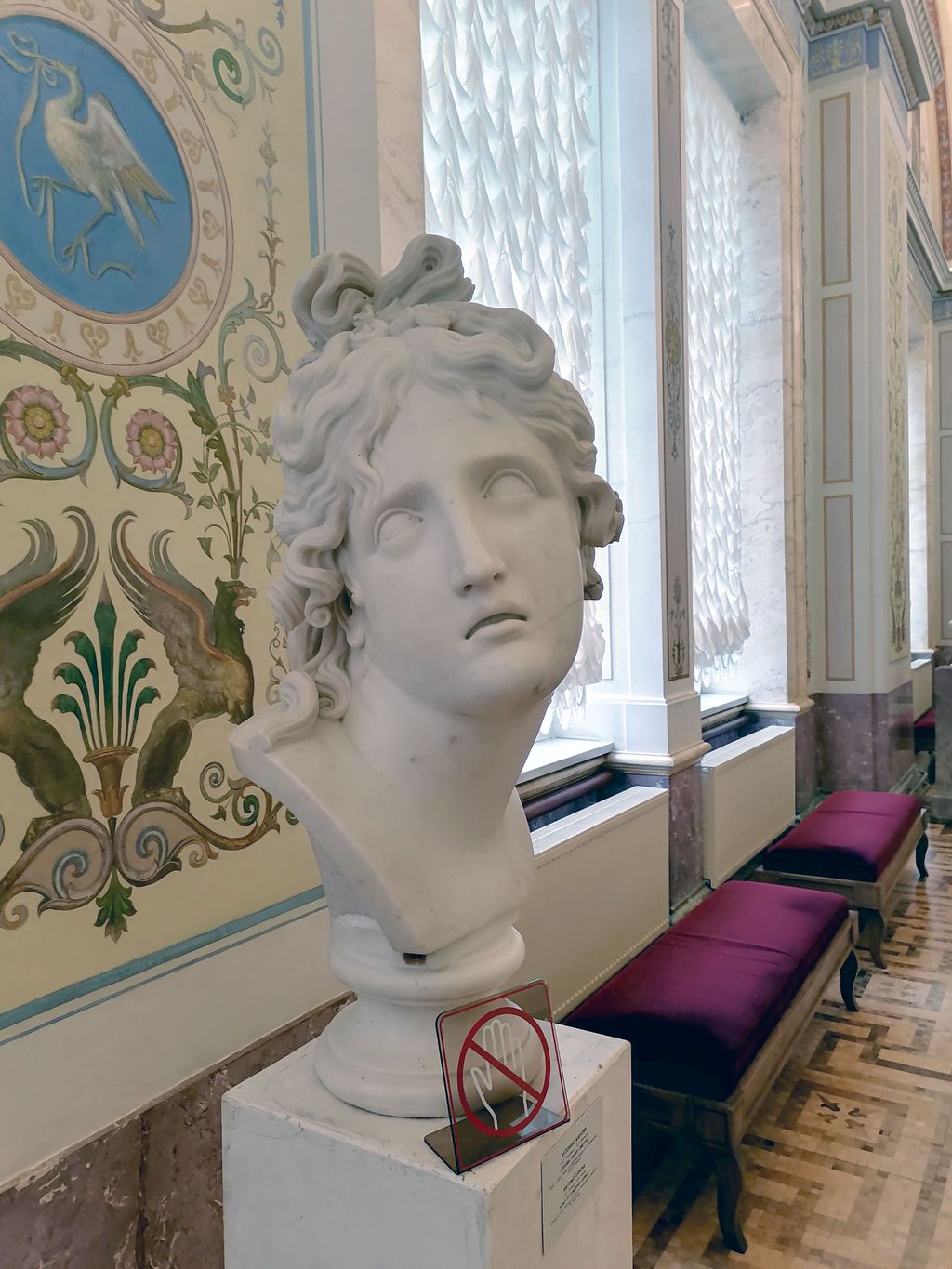
The Hermitage marble head from three-quarter view, with its tilted face and swept curls. Netelo. Image source. CC BY-SA 4.0. Resized for display. The resized photograph uses the same licence.
At a Glance
- ObjectMarble bust, State Hermitage Museum, inv. Н. ск. 115. [1]
- Proposed date1789, based on the chronology of the model and the first marble. [1]
- Related sculptureThe seated funerary Genius on the monument to Clement XIII in St Peter’s. [1] [4]
- Hermitage acquisitionFrom the painter Vasily Sazonov in 1851. [1]
Contents
- The head in the Hermitage
- A youth beside the sarcophagus
- Why Canova bought another block
- A marble in Russia and a bronze made after it
- The Verona plaster
The head in the Hermitage
The neck rises on a slant from the chest. Follow the edge on the side where the hair hangs down and it cuts sharply away towards the mounting. From the front, one can trace a diagonal from that edge through the neck to the crown. The effect is quite different from a portrait bust with both shoulders extending evenly across a pedestal. The eye follows the head’s movement beyond the point where the chest ends. In the gallery photograph the rounded mounting sits beneath that irregular edge, which remains visible. [1] [2]
The face and hair handle light in different ways. Light spreads over the broad planes beside the nose and down the neck. Along the hairline it breaks into small shadows where curls overlap. At the left ear, Androsov records that part of a lock is missing. The marks on the cheek and chin fall within the smooth area of the face, where they can be followed across the stone. Those marks play a part in the museum’s account of the bust’s origin. The damaged curl is a separate condition detail and does not establish when or why the bust acquired its present shape. [1] [2]
The movement of the head becomes easier to read when the rest of the figure comes into view. The bust has no arm beneath it, so the tilt can seem like the beginning of a turn towards something high up. On the Tomb of Pope Clement XIII, a bent arm receives the weight of the head. The full figure sits at the right of the sarcophagus as seen from the front. The lean belongs to a seated posture, with the torso and thighs arranged below it. Canova’s monument gives the angle of the head a physical cause that the bust leaves to the imagination. [1] [2] [4] [5]

A youth beside the sarcophagus
In St Peter’s, the figure’s wings rise behind his shoulders. He holds a torch with its burning end turned down, an emblem of life extinguished. The youth is almost nude, with drapery around his seat. Look from him to Religion on the other side of the monument and the way the two figures occupy the wall changes. Her upright body and tall cross lead the eye upwards. His bowed posture, low torch and wings bring the eye back towards the lower ledge and the lions. The Verona museum describes the design as joining a classical funerary figure to imagery familiar from the Christian angel. [4] [5] [6]
A print can make those relationships clearer than an isolated view of the bust. Antonio Banzo’s engraving after Stefano Tofanelli brings the sarcophagus, both figures and the pope into a single frontal arrangement. The youth’s size and position in relation to the monument are immediately apparent. In the basilica photograph taken at an angle, his wings and arm project forward of the recess beneath the sarcophagus. The print keeps the outlines together on a sheet. The photograph shows how the figure occupies the depth of the installation, while the Hermitage bust lets the viewer inspect a head at close quarters. [2] [5] [7]
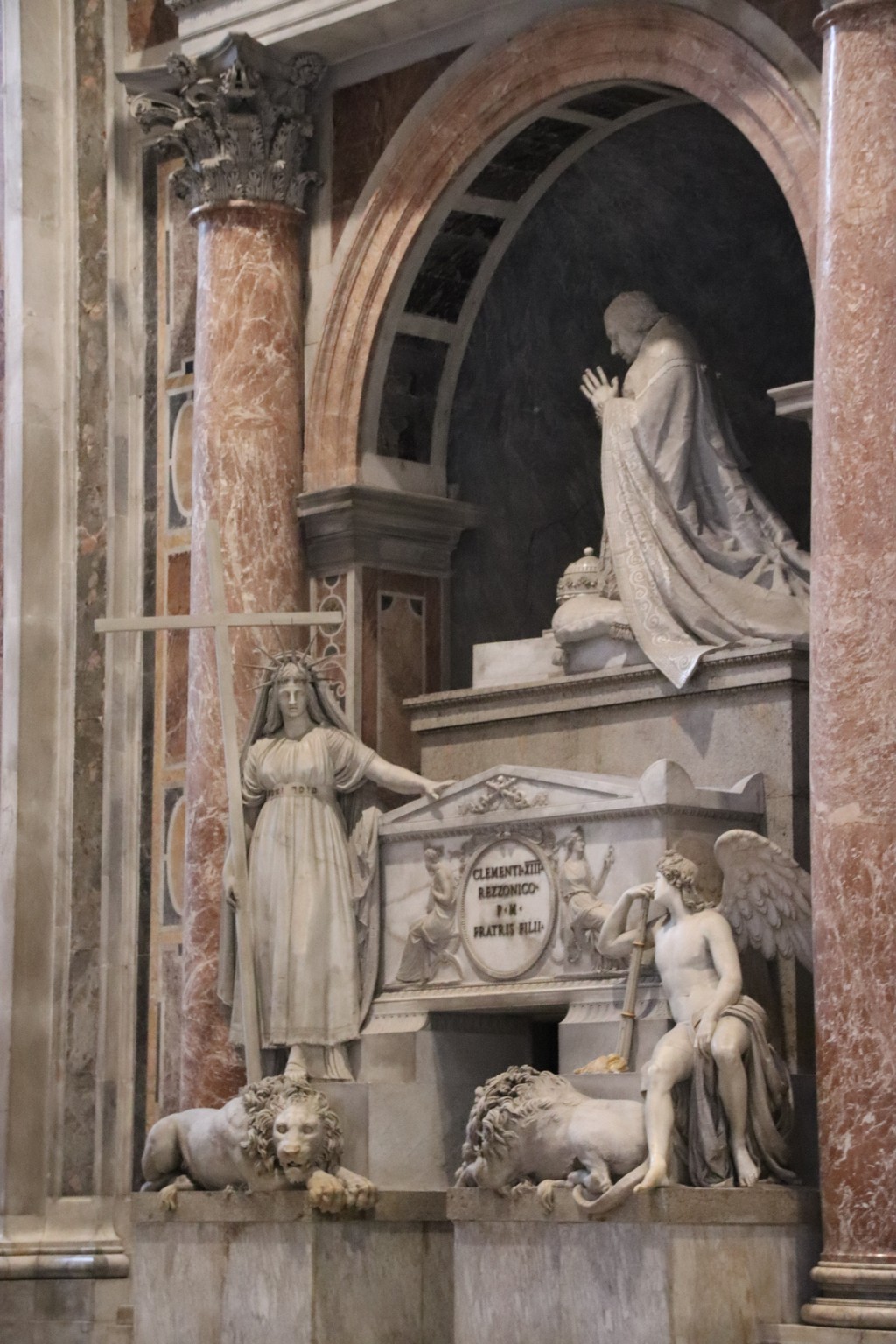
The monument to Clement XIII shows the winged Genius at the lower right of the tomb. Gary Todd. Image source. Public domain. Resized from source.
Videos on Canova
Explore Canova’s workshop methods and the settings for his sculpture.
Antonio Canova in the Vatican Museums
The Vatican Museums introduce Canova’s Roman studio and their collection of his work.
Watch on YouTubeWhy Canova bought another block
The Rezzonico family commissioned the memorial in 1784. Androsov places the completion of the life-size model for the Genius in 1788 and proposes the following year for work on the first marble. Canova was already concerned with the stone supplied for the commission. In February 1787 he wrote to Carlo del Medico Staffetti about the quality of the blocks for two of the statues, comparing them with the one supplied for the pope. Working at the scale of a church monument required blocks large enough for the figures and consistent enough in colour for their intended setting. [1] [3]
In February 1790 Canova reported that he had found numerous stains in one of the large statues and decided to replace the block at his own expense. The editors of the National Edition identify the figure as the Genius. Canova put the expense at five hundred scudi and expected a delay of several months. He considered the marks especially conspicuous on a nude sculpture in such a prominent church. The work was completed in marble in 1791, according to Androsov, and the monument was unveiled in April 1792. [1] [3]
Androsov traces the suggestion that the Hermitage marble came from the first statue to the scholar Zhanna Matsulevich in the 1920s. The head is the right scale for the monument, and the stone carries the kind of discolouration that would have mattered to Canova. The unusual outline of the bust also fits the possibility that it was cut out of a larger carving. Those clues are consistent with the proposal, though the letter is silent about what became of the old block. The marks gain significance because the letter independently establishes that a problem of this kind affected the commission. On their own they could occur in any piece of veined marble. [1] [3]
A marble in Russia and a bronze made after it
The museum acquired the marble in 1851 from Vasily Sazonov, an academic painter. Androsov reports that Sazonov named a Count Rumyantsev as an earlier owner and suggests Nikolay Petrovich Rumyantsev, who later commissioned Canova’s Peace. This would give the head an early route from Italy to St Petersburg. Androsov proposes that the count may have brought it there around 1795 and made it available for copying at the Imperial Academy of Arts. That is a possible sequence, with the 1851 transfer on a firmer footing than the earlier steps. [1] [8]
Androsov identifies a bronze recorded at the Imperial Academy in 1795 as a copy from the Hermitage marble. The Tsarskoye Selo museum separately lists a bronze Genius of Death after Canova in its account of the sculpture of the Catherine Park. The museum places it in a programme of casting that reproduced works admired at the Russian court, including many taken from antique models. A recent work by Canova thus circulated in bronze in a collection shaped in large part by classical sculpture. The bronze provides evidence of the design’s early reception and gives the Hermitage catalogue an additional reason to identify the marble as an eighteenth-century work. [1] [9]
The Verona plaster
Verona’s Galleria d’Arte Moderna Achille Forti holds a plaster bust catalogued as a cast after the Genius on the monument, made by an unidentified caster. The Italian national catalogue gives a range of 1790–1810 and records that the Pindemonte descendants of the Rezzonico family gave it to Verona in 1858, together with a cast of the pope’s bust. The gift brought two faces from the same monument into a civic collection where they could be looked at separately from the architecture. As a cast, it records a set of carved forms in a different material. The veins and spots that matter to the history of the Hermitage bust belong to the marble itself and cannot be traced through plaster in the same way. [1] [6] [10]
The Verona object and the Tsarskoye Selo bronze preserve the design through different routes. The Verona catalogue relates the plaster to the installed figure, while the Hermitage catalogue relates the bronze to its separate marble. A photograph of one reproduction may show the familiar tilt of the neck and the same gathering of curls without showing the object from which it was made. Material, the line where the bust ends and the history of each cast provide evidence that the likeness alone cannot supply. [1] [6] [9] [10]
Explore Canova’s works
Browse the sculptures and paintings covered in this guide. Several entries compare versions or examine details of a larger work.
Discussion
Look again at the images and ideas explored in The Genius of Death. These editorial prompts invite your observations.
Reader Insights
How does the tilt of the head affect the figure’s expression?
How does the bust change your reading of the figure in the tomb?
Join the Conversation
Share a detail, comparison or question about The Genius of Death below.
References
- Sergey Androsov, Italian Sculpture, 17th–18th Centuries, State Hermitage Museum, 2014, cat. 239, pp. 256–258, Head of the Genius of Death, inv. Н. ск. 115. View source.
- Netelo, Hermitage hall 241: Antonio Canova, Head of Funerary Genius, photograph of the Hermitage marble, 23 October 2020. View source.
- Giuseppe Pavanello, ed., Antonio Canova, Epistolario (1779–1794), Edizione Nazionale, introduction §16, with letters of 10 February 1787 and 20 February 1790. View source.
- Fondazione Federico Zeri, Ritratto di papa Clemente XIII, Allegoria della Religione, Genio funebre, Allegorie della Carità e della Speranza, Leoni, Iscrizione, object and photograph catalogue. View source.
- Gary Todd, St Peter’s Basilica, Monument to Pope Clement XIII, by Antonio Canova, 1792, photograph, 2019. View source.
- Galleria d’Arte Moderna Achille Forti, Bust of the Genius of Death (from the funeral monument to Clement XIII), collection photograph and interpretation. View source.
- Museo Nacional de Cerámica y Artes Suntuarias González Martí, Antonio Banzo after Stefano Tofanelli, Tomb of Pope Clement XIII, inv. CE4/00437. View source.
- Comune di Firenze, La pace di Kiev, exhibition account of Rumyantsev’s commission of Canova’s Peace. View source.
- Tsarskoye Selo State Museum and Heritage Site, Park Sculpture, Catherine Park, on the bronze copies and their display. View source.
- Catalogo generale dei Beni Culturali, Busto del Genio, national catalogue 0500729010, Verona, inv. 6285-4C0849. View source.


 Antonio Canova.jpg)

