



 by Tom Gurney
Tom Gurney BSc (Hons) is an art history expert with over 20 years experience
Published on June 19, 2020 / Updated on November 13, 2026
Email: tomgurney1@gmail.com / Phone: +44 7429 011000
Vestal Virgin: Introduction
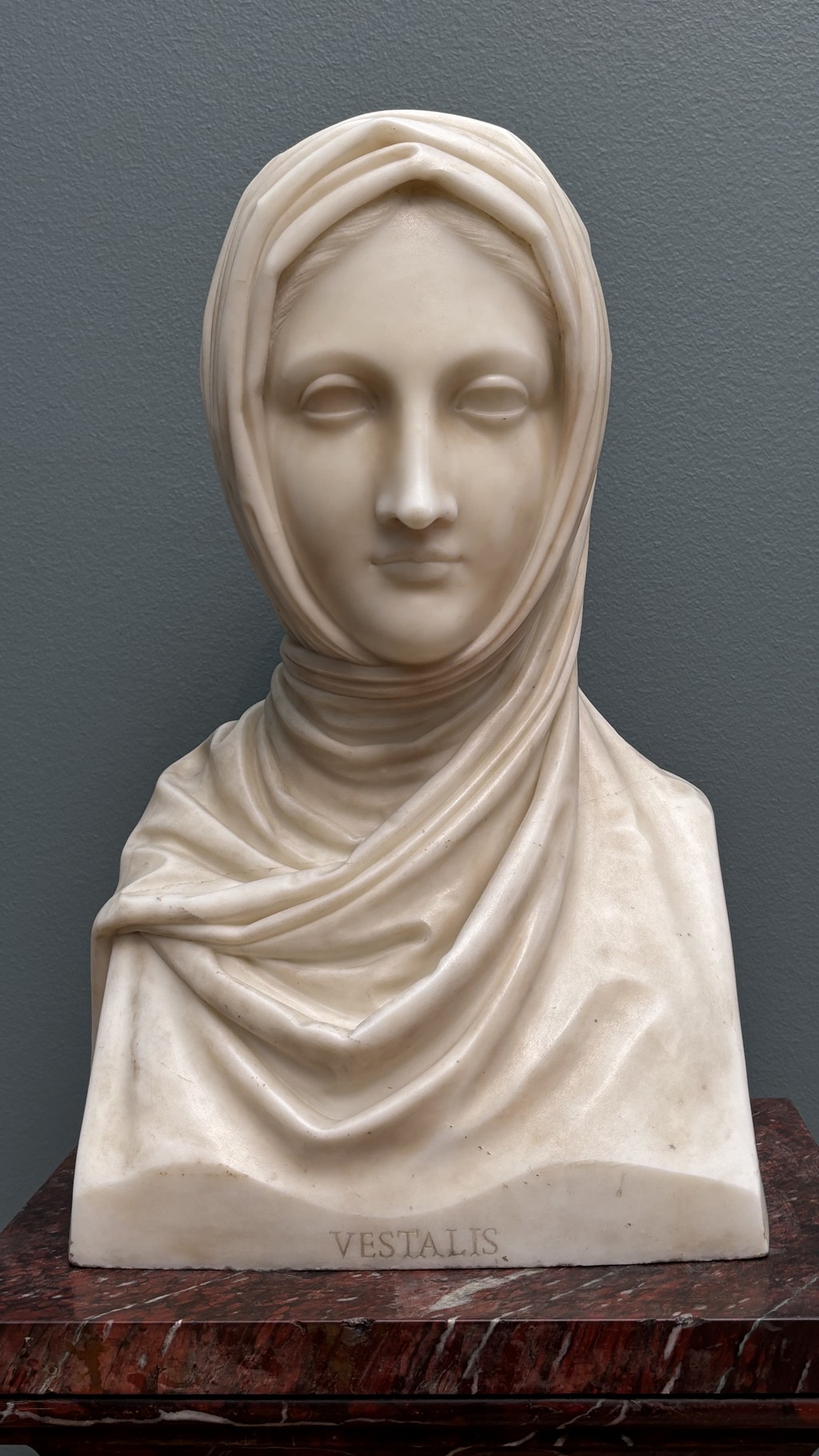
The veil rises to a small peak over the forehead, comes down close beside both cheeks, and gathers under the chin. The face looks straight ahead. Below it, the folds turn across the chest in a broad diagonal and end just above the letters VESTALIS. Antonio Canova carved this marble for the Milanese banker Luigi Uboldi. It entered the collection at Brera through Uboldi’s bequest and spent more than a century on deposit at Milan’s Galleria d’Arte Moderna. [1] [2] [3]
The sculpture is only 58 centimetres high, but the plain lower edge gives it the weight of a larger piece of stone. Its scale lets the viewer follow the changes in the carving at close range, from the narrow shadow around an eyelid to the wide, shallow folds across the shoulders. Brera dates the marble to 1818–19, the period in which Canova also made other versions of the veiled priestess. [1] [2]
Vestal Virgin Antonio Canova
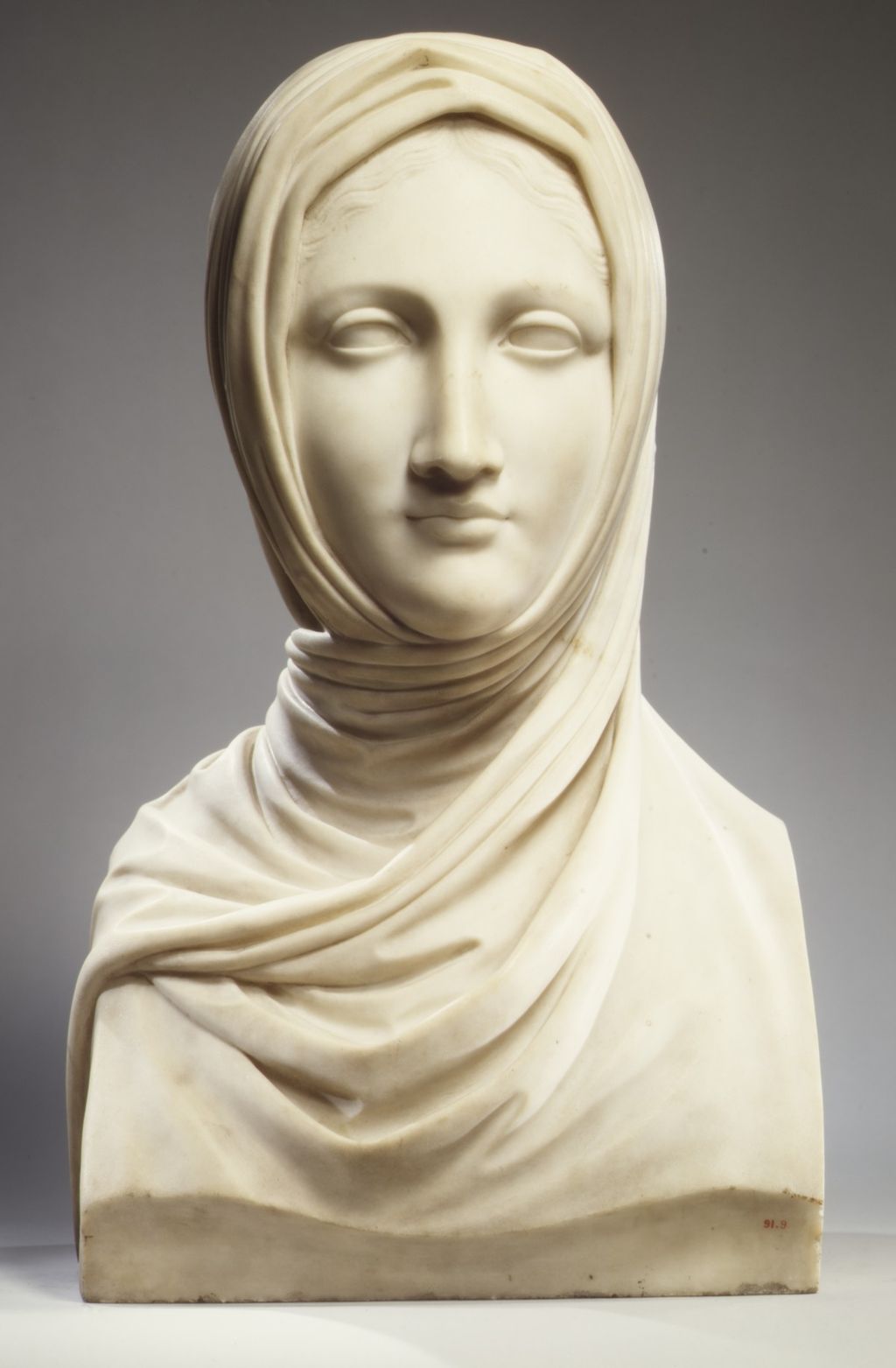
A separate workshop version of the Vestal bust, Metropolitan Museum of Art, 91.9. The Metropolitan Museum of Art. Image source. CC0 / Public domain. Resized for display.
At a Glance
- Milan marbleAntonio Canova, 1818–19, Carrara marble, 58 × 31 × 23 cm. [1] [2] [3]
- Inscription and inventoryVESTALIS, cut at the centre of the lower edge. GAM 478 in the Galleria d’Arte Moderna inventory. [1]
- Patron and ownershipMade for Luigi Uboldi and bequeathed to Brera, where it entered the collection in 1826. [1] [2]
Contents
- How the veil frames the face
- The name on the marble
- Uboldi’s commission and the move to Brera
- The Vestal among Canova’s ideal heads
- The related marbles
How the veil frames the face
The opening of the veil comes to a soft point at the hairline. A few shallow lines of hair show above the temples. The cloth casts a narrow shadow beside each cheek, bringing the shape of the face into focus. Within that frame the nose and the closed mouth establish a strong vertical axis. The eyes sit within clearly carved lids, with smooth surfaces where a portrait might have marked the pupils. The gaze is difficult to locate in space even though the head faces forward. [1] [2] [3]
The arrangement changes under the chin. The folds there come close together, one ridge almost on top of the next. Follow the outside edge from the viewer’s right and it runs down across the front towards the opposite shoulder. Two broad arcs hang below that edge, each dipping towards the middle of the bust. Their ends lose definition where they meet the larger planes of the cloth. The packed folds at the throat suggest fabric wound close around the head, while the lower folds show how the same length of cloth hangs when it is allowed to fall. [1] [2] [3]
The catalogue photograph shows light travelling across the forehead and cheeks in broad patches. Smaller highlights appear at the lip and on the edges of the folds. The effect depends on the slopes in the stone. The area between the eyebrow and the cheek can take light over an uninterrupted curve, whereas the channels under the cloth catch shadows within a very short distance. Brera’s curators single out the treatment of both skin and drapery in their account of the bust. The carved letters ask for a third kind of looking. Their fine grooves become easier to read when light falls across the plain band below the drapery. [1] [2]
The name on the marble
VESTALIS identifies a priestess of Vesta. The Roman historian Dionysius of Halicarnassus describes the Vestals as guardians of the sacred fire. In his account, recruits undertook a long term of service divided between learning, carrying out the rites and teaching them to others. The veil is the sign of that religious office that Canova chose to give most room in the marble. The squared sides leave no place for hands or ritual implements. The inscription carries the identification that a larger figure might give through an action. [1] [4]
Brera also uses the name Tuccia in discussing the work. Dionysius tells how Tuccia answered an accusation of breaking her vows by drawing water from the Tiber in a sieve and carrying it to the Forum without losing it. Antonio Corradini included the sieve in his sculpture of Tuccia at Palazzo Barberini in Rome. His veil extends across the face and lets the viewer discover the features beneath it. Canova leaves the face in the open and uses the veil around its edge. With the sieve outside the composition, the Milan bust can be read as a Vestal through her clothing and the Latin word on the stone. The particular story comes from the name Tuccia in the work’s reception. [1] [2] [4] [5]
Videos on Canova
Explore Canova’s workshop methods and the settings for his sculpture.
From Sketch to Stone | Canova: Sketching in Clay
Watch sculptor Fred X. Brownstein recreate a Canova Venus, using clay, plaster and marble.
Watch on YouTubeUboldi’s commission and the move to Brera
The Milan inventory dates the commission to 1818. The Galleria d’Arte Moderna’s account records the sale to Uboldi in 1819, and an early catalogue of the plaster collection at Possagno describes a model dated 1819 for the marble commissioned by the banker. That catalogue lists the plaster as an Erma di una Vestale. The term refers to the way the shoulders finish in a solid block with upright edges, a form derived from ancient sculpture. The Milan work still has the scale of a bust. Its plain base and the continuous fall of the cloth allow the head and its support to be read as one form. [1] [2] [3] [6]
Uboldi’s bequest brought the marble into Brera’s collection in 1826. Brera records that the gift was intended to benefit students at the academy. A student could see at close range how far Canova cut into the stone to separate two folds and how little he needed to take away to shape the eyelid. In 1902 the work went on deposit to the Galleria d’Arte Moderna, where it was entered in the inventory as GAM 478. The two Milan institutions therefore appear in its history for different reasons. Brera holds the work, and the Galleria d’Arte Moderna preserved and displayed it under its own inventory number. The marble returned to Brera for the exhibition La Bellezza e l’Ideale, which opened in 2025. [1] [2]
The Vestal among Canova’s ideal heads
The Galleria d’Arte Moderna places the Vestal in a series of heads that Canova developed from the 1810s, beginning with a bust of Clio or Calliope. The series uses the scale and format of a portrait for figures known from literature, religion or myth. Details such as a coiffure or the edge of a garment could give one head a character of its own. The Vestal’s design gives almost all that work to the veil. It conceals most of the hair, covers the neck and unifies the shoulders. In Canova’s Bust of Paris, the cap leaves curls exposed around the face and the head turns sharply above a bare chest. The Milan bust encloses the head and keeps it facing the viewer. [1] [2] [3]
The related marbles
A veiled Vestal made for Frederick Webb is now at the Calouste Gulbenkian Museum in Lisbon. The museum dates its marble to 1818 and traces it to Webb through the record of a later owner, Lord Taunton, who bought it at Webb’s sale. The Los Angeles Herm of a Vestal Virgin, dated 1821–22, belongs to the Getty. Correspondence links a Vestal herm to the Neapolitan collector Paolo Marulli d’Ascoli, and the Getty lists him as the possible original patron of its marble. Its cloth also descends into a squared lower section. The commission, date and location distinguish it from the work Uboldi left to Brera. [7] [8] [9]
The Metropolitan Museum of Art’s The Vestal is a third comparison. It stands 50.2 centimetres high, is attributed to Canova’s workshop and is dated approximately 1819–23. The photograph shows closely related folds across the chest and a nearly frontal head. Small waves of hair are easier to pick out across the forehead, and the lower band lacks the Milan marble’s prominent Latin lettering. The Met counts thirteen known versions of the subject in plaster and marble. Brera and the Gulbenkian discuss a narrower group of three related marbles. Looking at the material, inscription and provenance gives a firmer identification than the title alone. [1] [2] [7] [10]
The Met also points to a possible resemblance to the ancient veiled head known as the Zingarella in Naples. The suggestion places the repeated design within Canova’s study of antique heads. The Milan marble has a particular way of distributing the viewer’s attention. The still face is framed by the tightest folds, and the cloth then carries the eye down to a word that names the figure’s office. The compact form brings expression, clothing and inscription together in a single view. [1] [2] [10]
The Getty’s herm brings the veil and squared base together in a related Vestal design. A2D4. Image source. CC0 / Public domain. Resized from source.
Explore Canova’s works
Browse the sculptures and paintings covered in this guide. Several entries compare versions or examine details of a larger work.
Discussion
Look again at the images and ideas explored in Vestal Virgin. These editorial prompts invite your observations.
Reader Insights
What changes when you follow the edge of the veil around the face?
What does the inscription contribute to your reading of the bust?
Join the Conversation
Share a detail, comparison or question about Vestal Virgin below.
References
- Galleria d’Arte Moderna di Milano and Regione Lombardia, Vestale, complete SIRBeC record 2d050-00144, inventory GAM 478, with catalogue photograph. View source.
- Pinacoteca di Brera, La Bellezza e l’Ideale, exhibition catalogue, object illustration and essays on the Brera collection. View source.
- Galleria d’Arte Moderna di Milano, Vestal Virgin, museum entry and photograph published by Google Arts & Culture. View source.
- Dionysius of Halicarnassus, Roman Antiquities, book II, chapters 64–69, translated by Earnest Cary. View source.
- Gallerie Nazionali di Arte Antica, Portraits and Self Portraits, Palazzo Barberini exhibition booklet, entry on Antonio Corradini’s La Velata. View source.
- Gypsotheca canoviana, Gypsotheca canoviana eretta in Possagno da mons. Giambatista Sartori Canova, vescovo di Mindo, early printed catalogue, entry for Erma di una Vestale. View source.
- Calouste Gulbenkian Museum, Herm of the Vestal Tuccia, object entry and Webb provenance, published by Google Arts & Culture. View source.
- J. Paul Getty Museum, Herm of a Vestal Virgin, 85.SA.353, object record. View source.
- Ian Wardropper, Bertel Thorvaldsen’s Nessus Abducting Deianira, Metropolitan Museum Journal 41 (2006), discussion of Marulli’s correspondence and Canova’s herm. View source.
- Metropolitan Museum of Art, The Vestal, workshop of Antonio Canova, 91.9, object record and photographs. View source.


 Antonio Canova.jpg)

