



 by Tom Gurney
Tom Gurney BSc (Hons) is an art history expert with over 20 years experience
Published on June 19, 2020 / Updated on November 13, 2026
Email: tomgurney1@gmail.com / Phone: +44 7429 011000
Venus and Adonis: Introduction
Venus reaches up to Adonis’s jaw while he rests his left hand against her back. Their heads incline towards each other, but his free arm hangs at his side and one foot is set well apart from hers. The hunting dog sits behind the couple. From the angle in the Geneva museum’s photograph, the animal all but disappears, leaving the touch of Venus’s fingers and the young man’s answering gaze to tell the story. Antonio Canova gives the lovers time to look at each other before the hunt that will end Adonis’s life. [1] [2]
The white marble belongs to the City of Geneva and is held by the Musée d’art et d’histoire. Canova made it for the Marquis of Salza, Francesco Berio, who displayed it in a small temple in his garden in Naples. When Guillaume Favre acquired the sculpture for his villa in Geneva, Canova asked to see it again. The group passed through his studio a second time before it left Italy. [1] [2] [3]
Venus and Adonis Antonio Canova
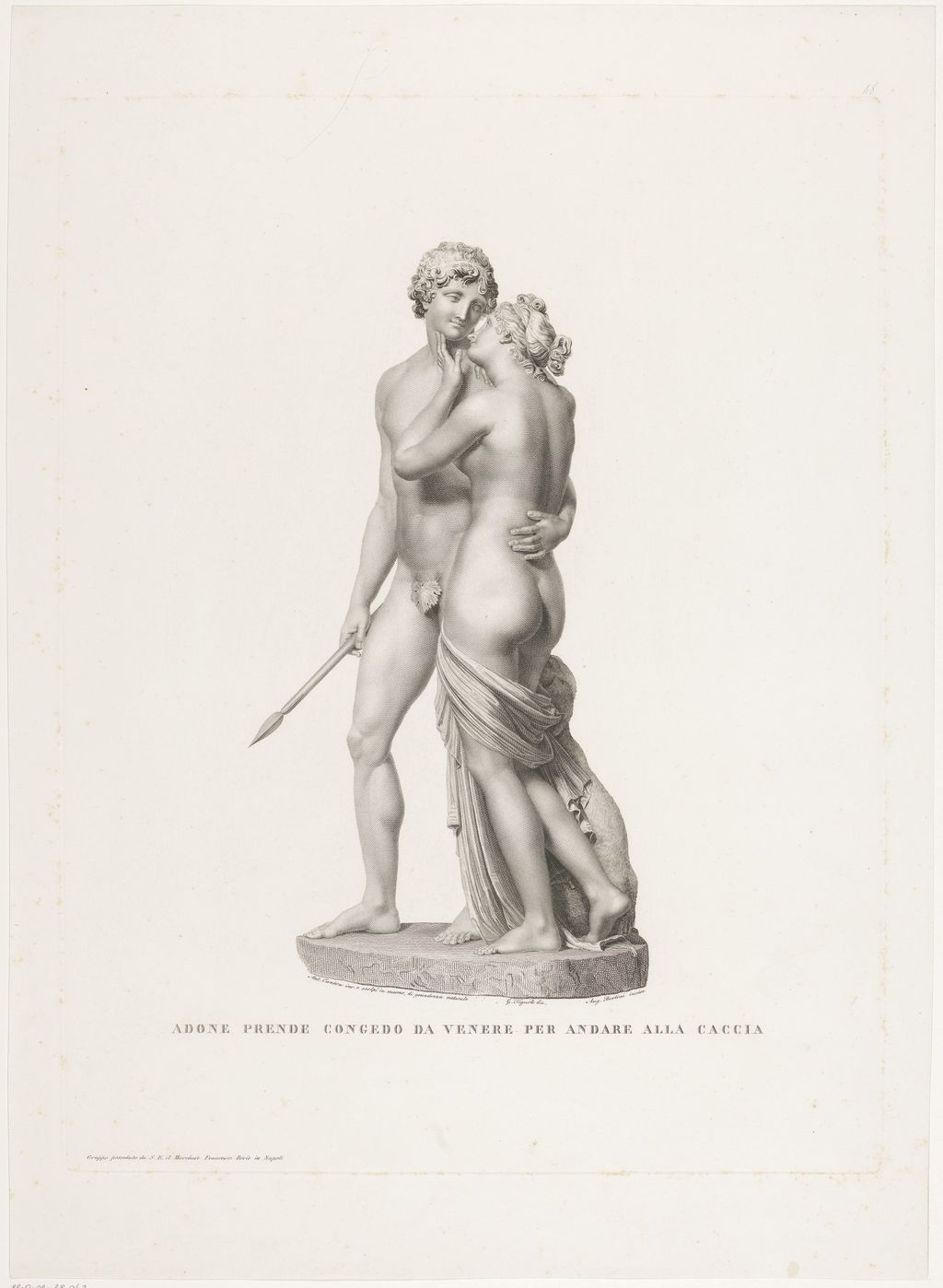
Bertini’s engraving after Tognolli shows the farewell group and gives Adonis a full hunting spear. Rijksmuseum. Image source. Public domain. Resized for display.
At a Glance
- Geneva marbleMusée d’art et d’histoire, inventory LG 4929, about 185 centimetres high. [1]
- DatesThe museum records the carving as 1789–94 and the later work as 1820. Its teaching dossier labels the work 1795. [1] [2]
- Possagno plasterMuseo Gypsotheca Antonio Canova, inventory 66, dated 1794, 183.6 centimetres high. [3]
- SubjectVenus and the mortal hunter Adonis share a farewell before the hunt. [2] [3]
Contents
- The touch at the jaw
- The dog behind them
- From clay to plaster
- A temple in Naples
- From Villa La Grange to the museum
The touch at the jaw
Adonis stands with his weight on his left leg and the right foot set out to one side. The line from his hip through his chest stays almost upright, then his head tips towards Venus. She turns her upper body in towards his chest and raises her face to meet his. A fold of cloth passes low across her hip and falls to the base between them. The narrow space below the faces lets the profiles remain distinct. If you follow the edge of that opening, the small point where her fingers touch his jaw becomes the centre of the group. [1] [2] [3]
Adonis’s other hand is best read from the side or back. His left arm goes around Venus and the fingers lie against the small of her back. That contact is firmer and lower than hers. From the front, Venus’s raised forearm draws a diagonal across his chest. From behind her, the curve of her bare back leads down to his hand. Canova gives each figure a gesture that can be found more clearly from a different angle. The two hands are far enough apart that the embrace takes time to follow. [1] [2] [3]
Lower down, the drapery travels around Venus’s legs and gathers in a vertical fall near the feet. In the Geneva photograph, the deepest grooves of that hanging cloth take dark shadows while the turn at her hip picks up the light. The hair is worked differently again. Adonis’s curls break up the outline where the head turns. Venus’s hair is drawn back, leaving the cheek and neck clear. Between the folds and curls, long stretches of smooth marble carry the subtler changes of direction in the shoulders and torso. [1] [2] [3]
The dog behind them
In Ovid’s Metamorphoses, Venus warns Adonis against hunting dangerous animals. She leaves in her chariot, and his dogs pick up a boar’s trail. Adonis wounds the animal and it turns on him, injuring him fatally with its tusks. Venus hears his cries and comes back to find him on the ground. She makes a flower spring from his blood. Canova’s group belongs to an earlier point in the story. In the marble the figures remain close, and the sign of what will happen next is tucked behind them. [2] [3] [4]
The single dog sits below the line of the hips. From the front the two bodies command the view. Move around Venus and the animal begins to show behind her legs. The rougher treatment of its coat distinguishes it from the flesh of the couple. It has the stillness of an animal waiting for its master, with enough of its head and body visible from the side to bring the hunt into the scene. The detail changes the meaning of the low arm at Adonis’s side. In the Geneva marble the object in his hand survives only as a short fragment. The museum suggests it may have been a javelin or a hunting stick. [1] [2] [3]
Titian’s Venus and Adonis at the Metropolitan Museum of Art gives the impending hunt a more conspicuous place. Adonis is already stepping away from the seated Venus, and the dogs pull towards the edge of the canvas. Canova’s Adonis remains within reach. The differences are easy to see if you begin with Venus’s arms. Titian’s Venus stretches across the hunter’s path as her own body twists on the seat. Canova’s goddess can still touch his face with her fingertips. The choice of a standing, nearly stationary couple leaves the threat to be discovered as the viewer moves around them. [1] [2] [5]
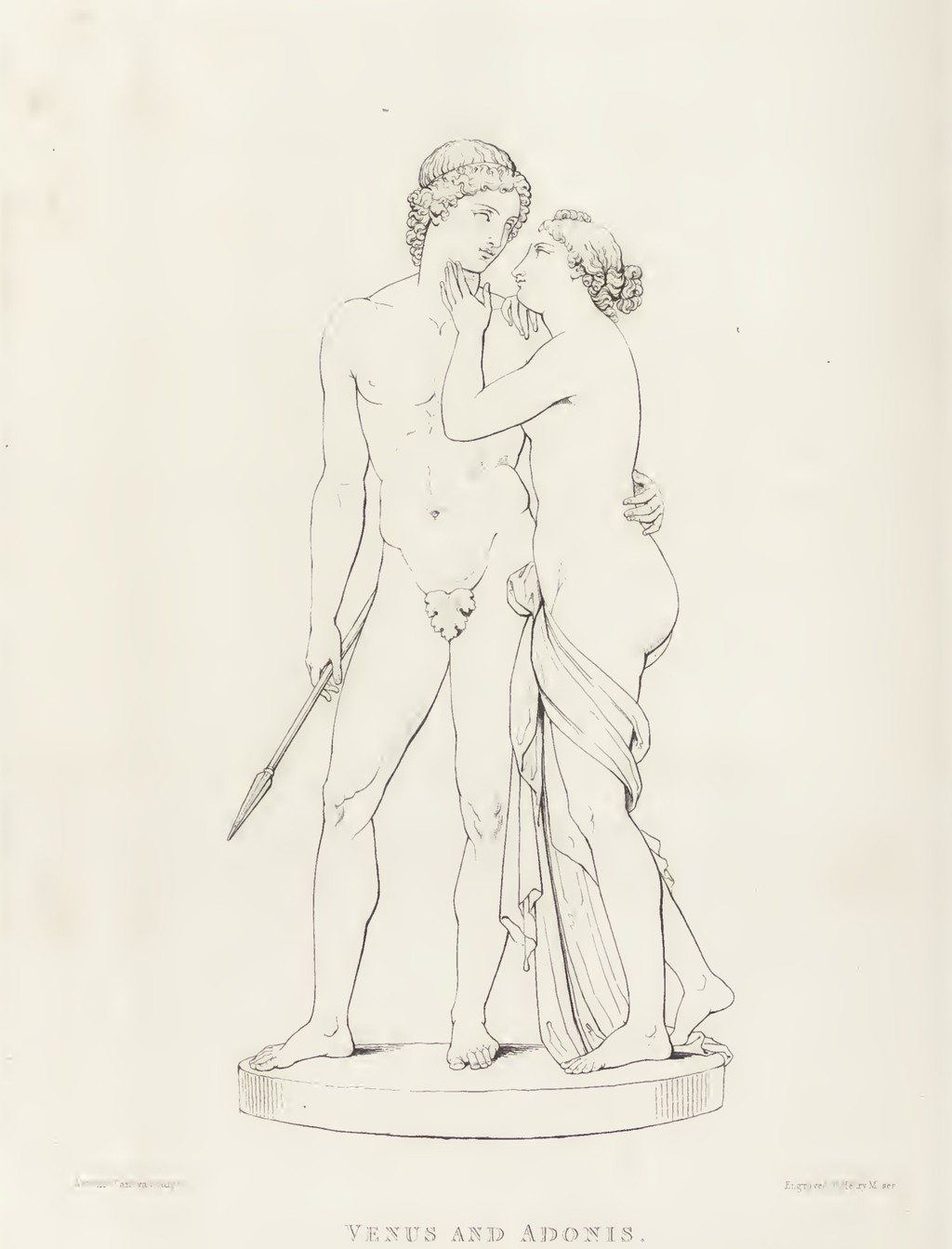
In Moses’s engraving, the dog sits low beside the two standing figures. Henry Moses, after Antonio Canova, engraving published in London, 1824. Getty Research Institute. Image source. Public domain. Scan margins trimmed and image resized.
Videos on Canova
Explore Canova’s workshop methods and the settings for his sculpture.
How does an artist copy the 200-year-old techniques of master sculptor Antonio Canova?
A sculptor demonstrates how Canova’s workshop methods can be used to recreate a marble Venus.
Watch on YouTubeFrom clay to plaster
A small terracotta from Possagno, dated about 1787 in the National Gallery of Art’s exhibition Canova: Sketching in Clay, shows how freely Canova handled the same subject. One figure bends above the other, whose body extends low across the clay base. The space under the higher figure’s arm helps separate the overlapping masses. Individual features barely register, and folds are ridges that broaden or taper under the pressure of a finger. Anthony Sigel’s study for the exhibition identifies a deep thumb impression on the back. The posture in the sketch is very different from that of the standing couple. What carries through is the attention to the angle at which one body meets another. [6]
Canova also explored a seated arrangement in Adonis Crowned by Venus. In that plaster at Possagno the lovers share the weight of a wreath between raised hands. Venus rests against Adonis’s knees, and their arms outline an arch above the centre of the composition. The museum associates the group with a commission from the Polish king Stanisław August Poniatowski that never proceeded to marble. The presence of two lovers and the same myth can make the objects easy to confuse. The wreath and seated pose identify a separate design. [7]
The 1794 Possagno plaster gives the Geneva composition at nearly the same height. Compare the hand at the cheek and the edge of the drapery in the museum’s close view. The fingers already rise individually towards Adonis’s jaw, and the fabric is gathered into a compact knot before dropping in a much longer fall. A plaster of this scale could hold exact relationships between parts that would be hard to carry over from a small clay sketch. In Canova’s studio assistants used measuring points, calipers and plumb lines to transfer a full-size form to stone. What the model fixes in volume, the finishing of the marble can vary in texture and in the way it catches light. [1] [3] [8]
A temple in Naples
Berio installed the marble in a small structure built for it in the garden of his Naples palace. A letter sent to Canova by Carlo Castone, Count della Torre di Rezzonico, in March 1795 mentions its Doric columns. The building belonged to a private residence, but the sculpture had a public showing in 1795 and became the subject of a dispute in the Neapolitan press. The public showing took place the year after the last year given for the carving by Possagno and the City of Geneva. The Geneva museum’s teaching dossier gives 1795 in its date field while still ending its account of the carving in 1794. [2] [3] [9]
The writers began with questions raised by the marble itself. Marcello Marchesini considered the choice of subject and the selection of a single instant from the story. Rezzonico considered how a sculptor shaped the block and brought the surface to its finish. Tommaso Gargallo then entered the argument, which widened into a debate about how well the two authors had managed to convey the experience of the work. A sculpture that takes time to see from several sides posed a problem for a writer who had to put those impressions in sequence. [9]
In his 1824 biography of Canova, Melchiorre Missirini describes a musical performance on the occasion of the Naples display. He also records an exemption from import duties on the grounds that the marble would adorn the capital and provide a model for students of the fine arts. These accounts give the garden setting a wider context. A sculpture encountered on a visit to a patron’s house could also matter to a city’s artists, writers and readers. Berio’s garden housed the stone. The printed dispute carried the work beyond it. [9] [10]
From Villa La Grange to the museum
After Berio’s death, the Swiss collector Guillaume Favre acquired the sculpture. The Geneva museum dates the purchase to 1820 and associates the work with the library of Villa La Grange. Before the journey to Switzerland, Canova asked Favre to send the piece back to his studio. Missirini says the sculptor worked on it for about twenty days. The museum records renewed polishing on the bodies and further work to the cloth at Venus’s hips. The smooth transitions on the bodies and the finely cut folds belong to the marble as viewers see it today. The accounts establish a second period of work without locating every later cut. [1] [2] [10] [11]
By 1917 the sculpture formed part of the property that Guillaume’s descendant William Favre gave to the City of Geneva, along with the estate, library and other furnishings and works of art. A museum publication records the group on the landing of the fine arts floor. In its photograph the work stands on a round pedestal decorated with garlands, with enough space around the platform to look past the side of either figure. A library, a garden pavilion and a museum landing each give a visitor a different approach to the same two bodies. [1] [2]
Angelo Bertini’s engraving after a drawing by Giovanni Tognolli offers another way of meeting the sculpture. The print fixes a view from over Venus’s shoulder, so Adonis’s hand and the sweep of the cloth over her hip are easy to see. It gives the hunting implement a long shaft and pointed tip and catches the dog close to Venus’s legs. A viewer can compare that outline with the fragment in the Geneva marble, but the engraving alone cannot settle what survived at each stage in the sculpture’s history. [1] [2] [12]
A print by Pietro Fontana after Domenico del Frate also gives Adonis a long spear. The Thorvaldsens Museum notes that the hound is reduced in this view to a leg visible behind the two figures. Fontana dedicated the engraving to Count Tiberio Roberti, whom the inscription identifies as a friend of Canova. The two prints give later viewers slightly different routes into the story, even as they keep the embrace at the centre of the composition. [12] [13]
Canova later brought Venus together with another standing partner in Mars and Venus. Mars holds the weapon upright beside his body, where it can be read from across a room. The earlier Adonis carries his hunting implement low. The placement lets the eye follow the exchange between the faces before the hunter’s equipment enters the story. [1] [2] [12] [14]
Explore Canova’s works
Browse the sculptures and paintings covered in this guide. Several entries compare versions or examine details of a larger work.
Discussion
Look again at the images and ideas explored in Venus and Adonis. These editorial prompts invite your observations.
Reader Insights
How do the two figures convey a farewell?
What does the dog add when you look at the group from the side?
Join the Conversation
Share a detail, comparison or question about Venus and Adonis below.
References
- Musée d’art et d’histoire de Genève, Vénus et Adonis d’Antonio Canova, inventory LG 4929, institutional photograph and caption. View source.
- Musée d’art et d’histoire de Genève, Sculptures, le musée en mouvement, work sheet on Vénus et Adonis. View source.
- Museo Gypsotheca Antonio Canova, Venere e Adone, plaster, inventory 66. View source.
- Ovid, Metamorphoses, Book X, lines 503–559 and 708–739, translated by A. S. Kline, University of Virginia Electronic Text Center. View source.
- Metropolitan Museum of Art, Titian, Venus and Adonis, accession 49.7.16. View source.
- National Gallery of Art, Thinking in Clay: How Antonio Canova Made His Sculptures, adapted from Anthony Sigel’s exhibition catalogue essay. View source.
- Museo Gypsotheca Antonio Canova, Adonis Crowned by Venus, plaster, inventory 23. View source.
- Museo Gypsotheca Antonio Canova, Antonio Canova’s Opera, section on the passage from sketch to marble. View source.
- Christina Ferando, Canova and the Writing of Art Criticism in Eighteenth-Century Naples, Word & Image, vol. 30, no. 4, pp. 362–376. View source.
- Melchiorre Missirini, Della vita di Antonio Canova, 1824, book I, chapter IX, pp. 162–164. View source.
- Italian national catalogue of cultural heritage, Venere e Adone, Palazzo dell’Accademia, record 0900254637, Carrara plaster and account of the marble. View source.
- Rijksmuseum, Angelo Bertini after Giovanni Tognolli, Adonis neemt afscheid van Venus voor de jacht, engraving after Canova, RP-P-OB-38.963. View source.
- Thorvaldsens Museum, Pietro Fontana after Domenico del Frate, Venus and Adonis, engraving after Canova, E534. View source.
- Museo Gypsotheca Antonio Canova, Venus and Mars, plaster, inventory 246. View source.


 Antonio Canova.jpg)

