



 by Tom Gurney
Tom Gurney BSc (Hons) is an art history expert with over 20 years experience
Published on June 19, 2020 / Updated on November 13, 2026
Email: tomgurney1@gmail.com / Phone: +44 7429 011000
Eurydice: Introduction
A hand comes out of the flames and closes around Eurydice’s right wrist. Her arm hangs straight beneath her shoulder, its fingers pointing down. Her free arm drifts out to the side, with the open palm visible. Antonio Canova turns her head and chest away from the grip, making it possible to see in one figure both the pull of the underworld and Eurydice’s effort to keep moving towards the light. [1] [2]
Canova carved Eurydice in soft stone for the Venetian senator Giovanni Falier. Falier’s companion statue, Orpheus, was made after it. The pair originally stood on the gate pillars at the family’s villa near Asolo and is now in the Museo Correr in Venice. The museum dates the pair to 1775–76. The Fondazione Zeri’s entry for Eurydice alone gives 1773–75. [2] [3] [4]
Eurydice Antonio Canova
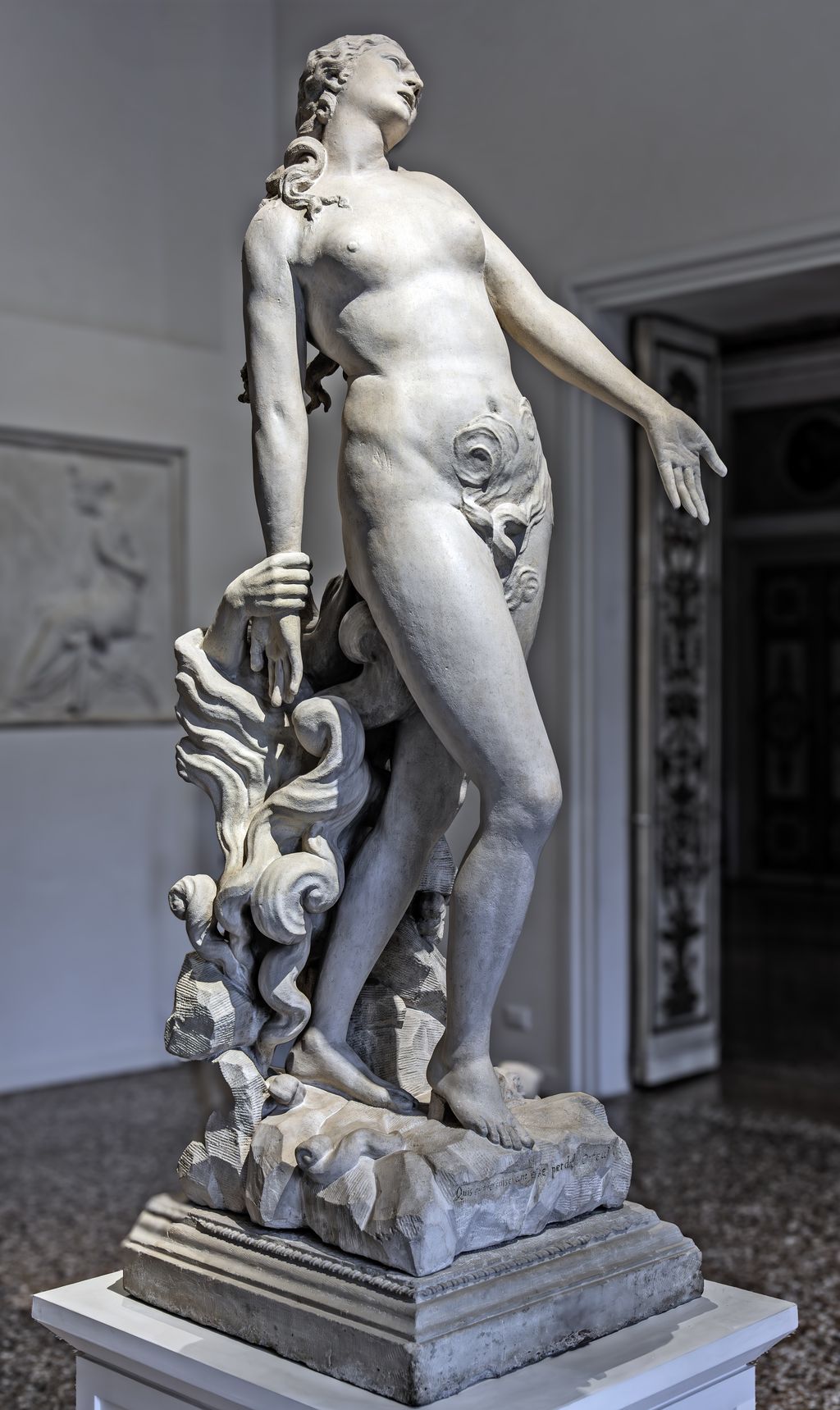
Eurydice at the Museo Correr, with a carved hand rising from the flames to grasp her wrist. Didier Descouens. Image source. CC BY-SA 4.0. Resized for display. The resized photograph uses the same licence.
At a Glance
- SculptorAntonio Canova. [1] [3]
- Date and material1773–75 in the Fondazione Zeri entry for Eurydice. The Museo Correr describes the pair as soft stone. [2] [3]
- Patron and original settingGiovanni Falier, whose villa near Asolo had the statues on its gate pillars. [2] [3]
- CollectionMuseo Correr, Venice, alongside Canova’s Orpheus. [2] [4]
Contents
- The hand in the flames
- What the poets give Eurydice
- A story Canova read in Venice
- The space between the gate pillars
The hand in the flames
The grip is easy to miss from a distance. The forearm below Eurydice’s shoulder appears to end in one long, uninterrupted line, until you see the thumb and fingers clasped just above her hand. The second wrist is almost swallowed by the stone flames. Their edges fold over one another and cast shadows that interrupt the light along her arm. The sculpted hand is about the size of hers, though it belongs to a figure we never see. That familiar scale makes the touch register before the flames tell us where it has come from. [1] [5]
Canova gives the two arms different jobs. The captured one pulls down from a shoulder that sits lower. The other extends diagonally out from the chest, then bends gently at the wrist. Its palm stays open and its fingers separate slightly at their tips. The empty space beyond the palm gives the gesture room. A viewer looking from that side sees a hand still able to reach. A viewer standing nearer the flames sees how little that freedom can achieve. [1] [5]
The twist runs down through the legs. One knee comes forward over the leading foot, whose toes nearly reach the edge of the uneven base. The trailing foot meets the rock farther back. Her chest rises and her chin turns to the side, as if her upper body has continued its movement after something has checked her step. Below the hips, the flame shapes close in against her figure and then spread into the stony mass beside her calf. The rock carries the figure’s weight and the flames give that support a part in the action. [1] [5]
The figure changes as you approach the height of her face. Look for the hair descending in coils towards one shoulder, the turn of her chin and the narrow shadow between the lips. At the base, the folds of flame and the angular ledges of rock hold darker shadows. In between, broad planes of the chest and thigh catch a gentler light. Canova gives separate textures to what might otherwise merge at a distance into a single pale silhouette. [1] [4]
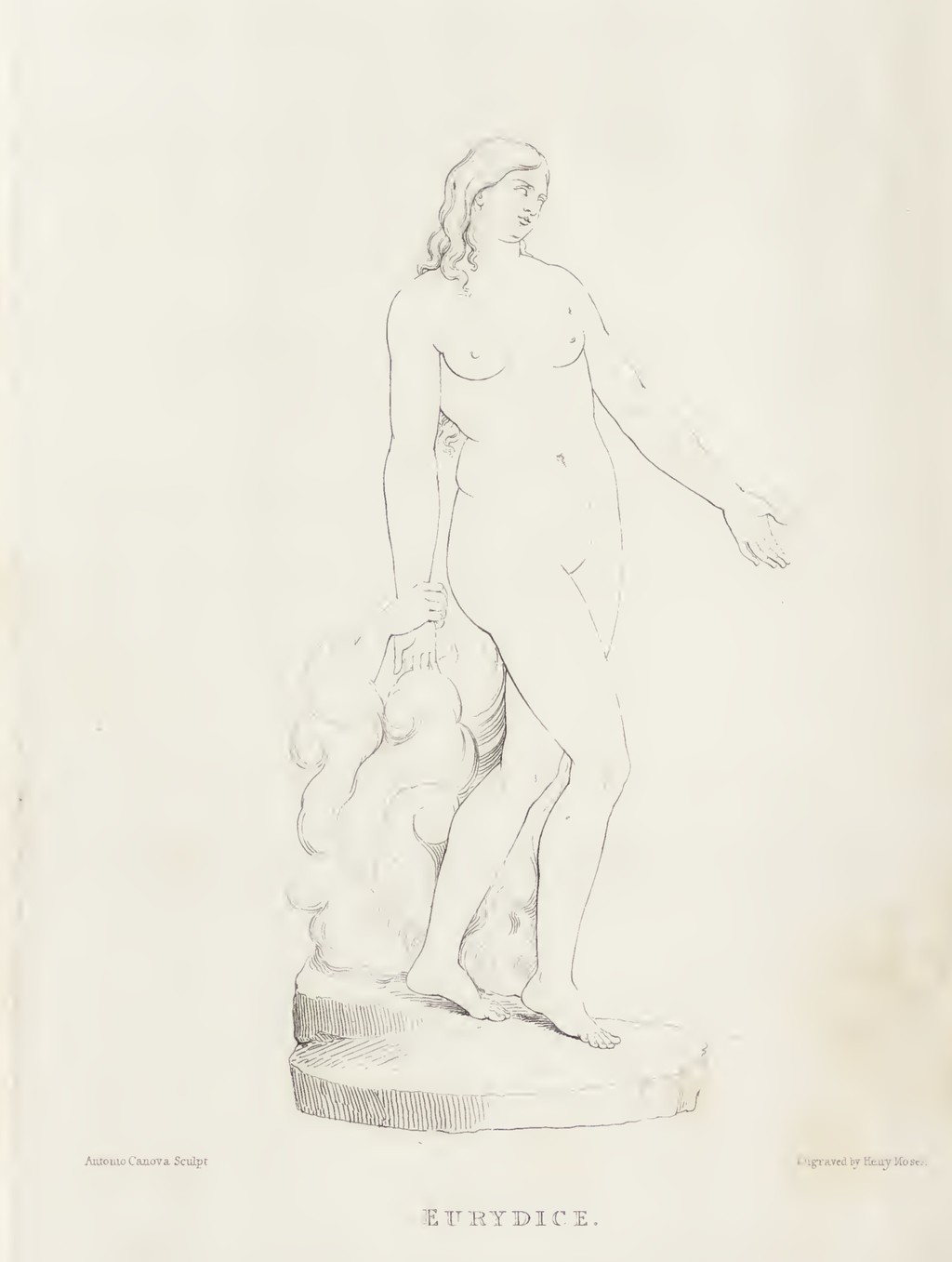
Moses shows Eurydice turning beside the hand that pulls her back into the underworld. Henry Moses, after Antonio Canova, engraving published in London, 1824. Getty Research Institute. Image source. Public domain. Scan margins trimmed and image resized.
Videos on Canova
Explore Canova’s workshop methods and the settings for his sculpture.
From Sketch to Stone | Canova: Sketching in Clay
Watch sculptor Fred X. Brownstein recreate a Canova Venus, using clay, plaster and marble.
Watch on YouTubeWhat the poets give Eurydice
In Book X of Ovid’s Metamorphoses, a snake bites Eurydice while she is walking with the naiads. Orpheus goes down to the dead and sings before the rulers of the underworld. They allow Eurydice to follow him on the condition that he keep his eyes ahead until both have emerged. He turns while they are still on the ascent, afraid she may fail and eager to see her. Ovid gives Eurydice a farewell as she falls back into the darkness. The statue belongs to this second loss, when the prospect of escape has just been taken away. [5] [6]
Virgil gives her a longer speech in the fourth book of the Georgics. Eurydice asks what madness has brought them both to ruin. She feels the darkness close around her and reaches out as she says goodbye. An account of the Falier sculptures by Franco Miracco notes that their bases carry words from Virgil. His version gives a way to read Eurydice’s open hand and lifted face together. She has something to say and someone to address, even as the hand at her wrist makes the direction of her return plain. [1] [7] [8]
The inscription is cut into a smooth strip on the front of Eurydice’s rough base. Its opening asks who has ruined both her and Orpheus. A visitor who bends to read it encounters her voice just beneath the foot that appears about to leave the rock. From that lower position the scoring on the stone around the inscription also becomes clear. Fine parallel grooves run across the angled faces of the base, while the toes above it are gently rounded. Canova places a line about Eurydice’s helplessness at the point where her body still seems most ready to move. [1] [7] [8]
Canova adds a visible force where the poets describe darkness and separation. The hand has a direction of pull, and the flames have enough volume to wrap around a leg. In Ovid, arms reach through empty air as Eurydice disappears. In the stone the viewer can trace the two motions at once, from the outward turn of her head and chest down to the fingers closed around her wrist. [1] [6] [7]
A story Canova read in Venice
The young sculptor left notes on the myth in a small notebook that passed down through the Falier family. Giuseppe Pavanello dates the notes tentatively to the period of the carving and thinks Eurydice was probably complete by 1775. He identifies a striking difference between the prose account Canova took notes from and the classical versions. The Eurydice in those notes knows Orpheus has been forbidden to look at her. The precise source of the prose remains unknown. The notes nevertheless show Canova considering a version in which she understands what is at stake during the climb. [9]
The subject was also being performed in the city where Canova was learning to work as a sculptor. Pavanello records a dramatic dialogue by Louis Brujas, staged and printed in Venice in 1774, that concentrated on the couple’s return from the underworld. Around the time the statues were taking shape, Venetian audiences could encounter the story as a conversation between two people. Seen in that setting, the free hand can be read as a reply to what Orpheus has done. Her head has already turned towards the person she is about to lose. [1] [9]
The space between the gate pillars
The Museo Correr’s collection guide places the statues on the pillars of Giovanni Falier’s villa gate. A visitor passing through would move between two figures with separate bases and separate directions of movement. The interval between them belonged to the garden entrance as well as to the scene. Canova could use a whole pillar for the rising line of Eurydice’s body and the downward pull of the flames, and leave the visitor to follow her gesture across the intervening space. The exact orientation of the figures on the pillars is harder to recover from their present installation. [2] [3] [4]
The museum’s paired photograph offers a comparison from a single viewpoint. In that arrangement, Eurydice’s palm hangs low on the side nearest Orpheus. His arm bends towards his forehead and his head turns back. Her tall, curved silhouette is fairly narrow from this angle, while the elbow over his head and the gap between his legs make his outline wider. She bends under an outside force. His gesture puts the shock of recognition into his own body. The two statues give the same reversal a shape that can be read from opposite sides of an opening. [1] [4]
Pavanello records that the statues were bequeathed to the Museo Correr in 1954. They now stand on separate pedestals indoors, where a viewer can see the flames and the grip near the base before stepping back to take in both bodies. In the nearby Daedalus and Icarus, Canova would bring two figures together on one base and make a thread cross the gap between them. Eurydice’s extended arm has to reach across an interval the sculpture itself leaves open. [2] [4] [9]
Explore Canova’s works
Browse the sculptures and paintings covered in this guide. Several entries compare versions or examine details of a larger work.
Discussion
Look again at the images and ideas explored in Eurydice. These editorial prompts invite your observations.
Reader Insights
What do Eurydice’s two hands tell you about what is happening to her?
How do the flames and the inscription change your reading of her movement?
Join the Conversation
Share a detail, comparison or question about Eurydice below.
References
- Didier Descouens, Eurydice by Antonio Canova at the Correr Museum in Venice. Photograph of the statue on Wikimedia Commons. View source.
- Museo Correr, The Canova Collection at the Museo Correr. English gallery guide. View source.
- Fondazione Federico Zeri, Canova Antonio, Euridice. Fototeca Zeri, entry 81826. View source.
- Museo Correr, Le Sale Neoclassiche e Collezione canoviana. Room guide and photograph of both statues. View source.
- Ateneo Veneto, Canova, educational notes on Eurydice, the grip and the flames. View source.
- Ovid, Metamorphoses, Book X, lines 1–85, translated by A. S. Kline. View source.
- Virgil, Georgics, Book IV, lines 453–527, translated by A. S. Kline. View source.
- Franco Miracco, 1777, l’anno della nuova fiera della Sensa, Ateneo Veneto, pp. 151–164, especially pp. 157–159 on the statues. View source.
- Giuseppe Pavanello, I primi scritti di Antonio Canova, on the Falier notebook, Venetian performances and the bequest. View source.


 Antonio Canova.jpg)

