



 by Tom Gurney
Tom Gurney BSc (Hons) is an art history expert with over 20 years experience
Published on June 19, 2020 / Updated on November 13, 2026
Email: tomgurney1@gmail.com / Phone: +44 7429 011000
Sleeping Nymph: Introduction
A woman lies face down on a low bed of rock. Her head turns to one side and rests on a bent arm, with the other hand lying loosely across the folds beneath her face. One knee bends, lifting a foot above the other leg. Antonio Canova made the figure almost two metres long, but its highest point is only a little above the level of her shoulder. The V&A's photographs show how the silhouette changes as you move around the marble. From the side, the face is visible. From behind, the bare back leads towards the hair and the face falls out of sight. [1] [2]
Canova made the plaster model in 1820. The Marquess of Lansdowne commissioned the marble the following year, and Canova's workshop completed it after his death in 1822. The finished sculpture went to Lansdowne House in London in 1824. Four letters acquired with it give different accounts of how much of the carving Canova did himself. [1] [2]
Sleeping Nymph Antonio Canova
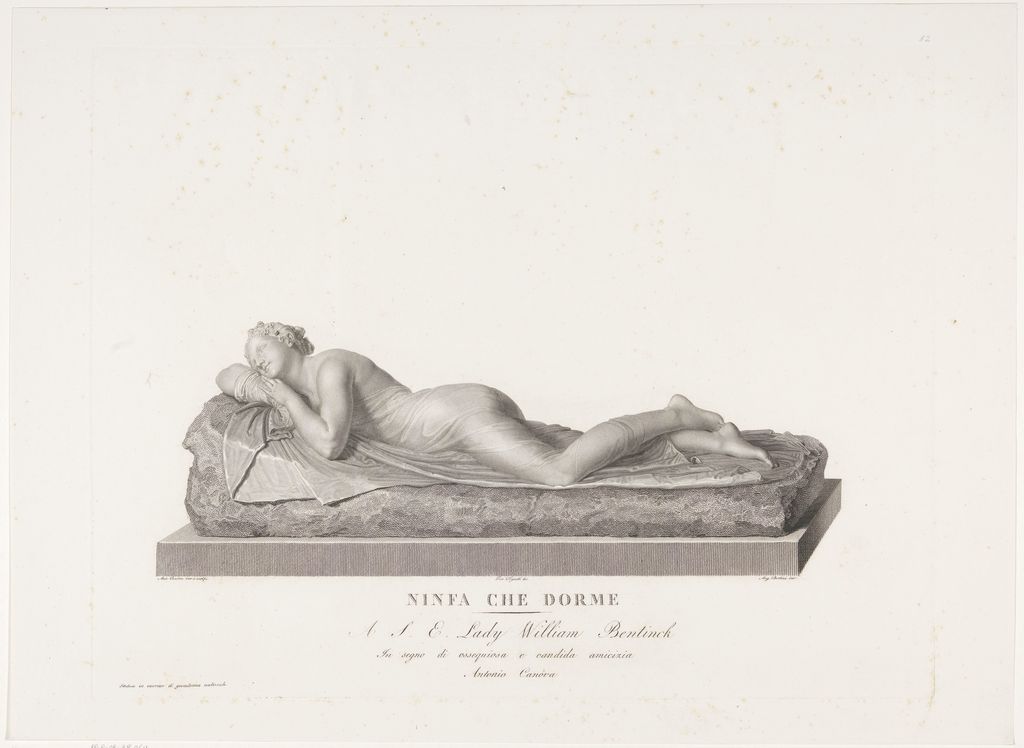
Bertini’s engraving after Tognolli shows the reclining design from the front. Rijksmuseum. Image source. Public domain. Resized for display.
At a Glance
- SculptorsAntonio Canova and his workshop. [1]
- MarbleCarved in Rome, 1821–24, 194.3 cm long. Victoria and Albert Museum, A.30-1930. [1]
- CommissionOrdered by the Marquess of Lansdowne in 1821 and sent to him in 1824. [1] [2]
Contents
- A body settling into the rock
- A Roman sleeper on a different bed
- The plaster, the commission and the carving
- Bertini's engraved nymph
- Other reclining figures by Canova
A body settling into the rock
Look along the near edge of the sculpture from the head towards the feet. A thick fold makes a rounded support for the head and arm. Below it, a broad corner of cloth drops over the stone in a triangle. The folds beside the torso lie flatter and run with the length of the body, while the bare rock below them has a broken edge that catches the light in patches. The carvers gave the impression of a surface hard enough to carry the sleeper's weight and a covering thin enough to take the shape of the ground beneath it. [1] [2]
The angle of the bent leg is clearer from the foot of the sculpture. What looks like a single rise in the outline from the side separates into a lifted foot, an extended leg and a fold of cloth between them. From this end you can see how far the pelvis turns away from the shoulders. A body lying evenly on its front would conceal that change. Here the turn makes one hip stand higher and brings the line of the waist into view. The foot stays close to the lower leg, giving the impression of a position the sleeper can hold without effort. [1]
The head is easy to miss from the back. Move to the end where the rock rises and the elaborate arrangement of hair comes into view before the features do. In the V&A's close photograph, a cluster of curls near the forehead catches the light above the closed eyelid. Below it the forearm makes a broader, smoother curve. You can follow the edge of the fingers where they rest against the cloth without seeing them grip it. The hand, the closed eye and the weight carried by the bent arm give the title its visible evidence. [1] [2]
A Roman sleeper on a different bed
The V&A connects the composition to the ancient Sleeping Hermaphrodite in the Louvre. The Louvre dates the figure to the first half of the second century AD. It was discovered in Rome in 1618 and bought from the Borghese collection in 1807. The pillow and mattress beneath it belong to a different period. Gian Lorenzo Bernini made them in marble, and the figure was mounted on them in 1620. The curved rim and the hollows in the mattress make the support look as if it yields under the figure. [2] [3]
Both sleepers reveal different things as you walk around them. The Louvre describes the antique's pose as a way of delaying recognition of Hermaphroditus until the viewer reaches the other side. In Canova's marble the change is from a broad view of the back to a close view of a face resting on an arm. The beds affect that movement. Bernini's mattress supplies a continuous edge to follow, while the rock under the nymph rises unevenly and the cloth drops over its edge near the head. A viewer walking along that side sees the folds and the stone alternately come forward. [1] [2] [3] [4]
Videos on Canova
Explore Canova’s workshop methods and the settings for his sculpture.
From Sketch to Stone | Canova: Sketching in Clay
Watch sculptor Fred X. Brownstein recreate a Canova Venus, using clay, plaster and marble.
Watch on YouTubeThe plaster, the commission and the carving
The plaster survives at the Museo Gypsotheca Antonio Canova in Possagno. It shows that the design had a life in the studio before Lansdowne ordered his marble. A plaster gave the carvers a full-size set of forms to work from. In Canova's workshop, fixed points in models provided measurements for transferring the depth and projection of forms into stone. On a figure of this length, the height of a shoulder and the width of the rock could be established relative to points well apart from one another. The method helps explain how the assistants could carry the design through when Canova was no longer there to direct them. [1] [5] [6]
The letters raise a narrower question about the London marble. Canova's half-brother, the Abbé Giovanni Battista Sartori Canova, said the sculptor had done none of the carving. A workshop assistant recalled that Canova worked on part of the back, from between the shoulders down towards the middle of the body. The two statements leave the extent of Canova's own carving uncertain. The V&A credits him and the workshop. The sculpture remained at Lansdowne House until 1930, when it was offered at Christie's in London as lot 119 and acquired for the museum with Art Fund support. [1] [2] [7] [8]
Bertini's engraved nymph
Angelo Bertini engraved Ninfa che dorme after a drawing by Giovanni Tognolli. The Italian national catalogue identifies the Possagno plaster as the basis for the image and records two payments to Bertini, in November 1821 and May 1822. The inscription on the Wellcome Collection's impression describes a life-size marble and includes a dedication to Lady William Bentinck in Canova's name. The payments belong to the period before Canova's death, while the print's description names the material in which collectors would have expected to see the design. [9] [10]
The Rijksmuseum's impression is just over half a metre wide at the plate mark. In another impression the dark cut under the hanging cloth brings out its point, and fine lines give depth to the rock beneath it. Bertini fixes the view, leaving the reader to follow the contour from the head to the raised foot in one direction. In the gallery the foot can disappear behind the near leg as you change position, and the rock becomes much deeper under the shoulder when seen from the head end. An engraving made after the model also preserves a view of the design independent of the marble that the workshop delivered to Lansdowne. [1] [9] [11] [12]
Other reclining figures by Canova
The two marbles known as Naiad can be distinguished from the Lansdowne figure by the lift of the upper body. The Darnley Reclining Naiad at the Metropolitan Museum of Art turns her head back over her shoulder. Her arms carry enough weight to keep her head away from the support. Canova's assistants also completed that marble after his death and delivered it in 1824, to Cobham Hall in Kent. The National Gallery of Art in Washington holds the separate Naiad acquired by the Marquess of Londonderry. Its photographs show an elbow propping up the figure and a finger touching the side of her head. In the V&A marble the head rests directly on the bent arm. The lower position changes how much of the face a viewer can see from the far side. [1] [13] [14]
The Sleeping Endymion at Chatsworth also depicts sleep, but the figure belongs to the story of the shepherd loved by the moon goddess Selene. Chatsworth records that Canova completed the Devonshire marble before he died and that it reached London in 1823. The late Recumbent Magdalene, commissioned by the Earl of Liverpool, puts a figure down on rock for a different reason. Its upward-turned face and open arms express the collapse of a grieving saint. It is a separate composition from the kneeling Penitent Magdalene. In Sleeping Nymph, where the arm receives the head and the fingers hang loosely, Canova makes the rock look like a place the figure has chosen to rest. [1] [15] [16]
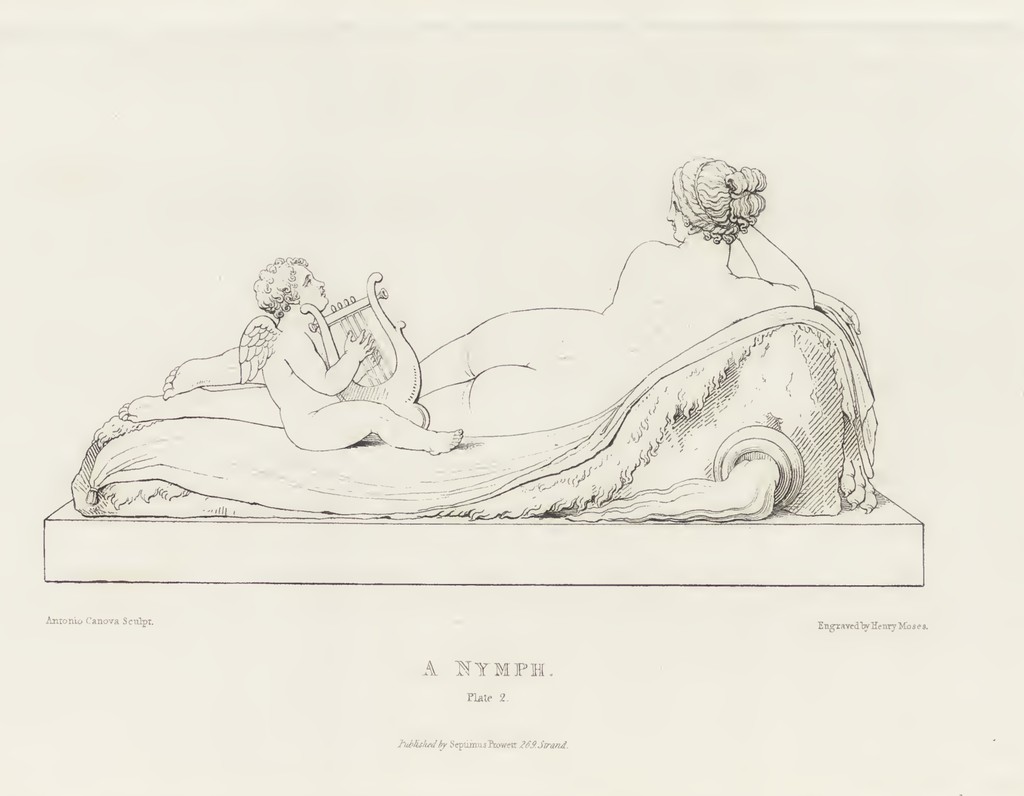
Moses’s engraving of another reclining design shows the nymph with a lyre-playing Cupid. Henry Moses, after Antonio Canova, engraving published in London, 1824. Getty Research Institute. Image source. Public domain. Scan margins trimmed and image resized.
Explore Canova’s works
Browse the sculptures and paintings covered in this guide. Several entries compare versions or examine details of a larger work.
Discussion
Look again at the images and ideas explored in Sleeping Nymph. These editorial prompts invite your observations.
Reader Insights
How do the pose and support suggest sleep?
Which details distinguish the Sleeping Nymph from the reclining Naiad?
Join the Conversation
Share a detail, comparison or question about Sleeping Nymph below.
References
- Victoria and Albert Museum, Sleeping Nymph, A.30-1930, collection data, provenance and photograph register. View source.
- Victoria and Albert Museum, Antonio Canova – an introduction, discussion and photograph of the Lansdowne marble. View source.
- Musée du Louvre, Hermaphrodite endormi, Ma 231 and Ma 231.1, ancient figure and Bernini's mattress. View source.
- Musée du Louvre, At the Heart of the Renaissance Palace, interpretation of the figure's successive views. View source.
- Museo Gypsotheca Antonio Canova, Canova Quattro Tempi, vol. II, photographic study of the Possagno plasters including Ninfa dormiente. View source.
- National Gallery of Art, Canova: Sketching in Clay, exhibition texts on modelling, pointing and carving. View source.
- Museo Gypsotheca Antonio Canova, Canova's biography, on Giovanni Battista Sartori Canova. View source.
- Art Fund, The Sleeping Nymph, 1930 acquisition record. View source.
- Catalogo generale dei Beni Culturali, Ninfa dormiente, national catalogue 0500432639, print after the Possagno model and payments to Bertini. View source.
- Wellcome Collection, A sleeping nymph, 3087406i, impression with dedication to Lady William Bentinck. View source.
- Rijksmuseum, Slapende nimf, RP-P-OB-38.964, Bertini after Tognolli and Canova. View source.
- Adam's, Country House Collections, p. 50, illustrated impression of Bertini's Ninfa che dorme, lot 929. View source.
- Metropolitan Museum of Art, Reclining Naiad, Darnley marble, 1970.1. View source.
- National Gallery of Art, Naiad, Londonderry marble, 2003.62.2. View source.
- Chatsworth, The Sleeping Endymion, Devonshire commission and mythology. View source.
- Christie's, Maddalena Giacente (Recumbent Magdalene), 2022 sale catalogue with commission and provenance research. View source.


 Antonio Canova.jpg)

