



 by Tom Gurney
Tom Gurney BSc (Hons) is an art history expert with over 20 years experience
Published on June 19, 2020 / Updated on November 13, 2026
Email: tomgurney1@gmail.com / Phone: +44 7429 011000
The Muse Terpsichore: Introduction
Terpsichore holds a lyre by one of its curved arms and turns her head away from it. The instrument rests on a high marble pedestal beside her, while her free arm hangs near the folds of her skirt. Her ankles cross at the base of the statue. Antonio Canova gives the Muse of dance and choral song a posture of rest, with movement concentrated in the turn of her neck and the sweep of the fabric across her legs. This life-size marble stands 182 centimetres high and belongs to the Fondazione Magnani-Rocca at Mamiano di Traversetolo, near Parma. [1] [2]
Canova began the figure as a portrait of Alexandrine de Bleschamps, the wife of Lucien Bonaparte. By the time it was finished, it belonged to a different commission and had a different face. The marble bears the date 1811, and the collector Giovanni Battista Sommariva received it in Paris in January 1813. The plaster at Villa Carlotta and the later marble at the Cleveland Museum of Art preserve two other stages in the history of the design. [1] [3] [4] [5]
The Muse Terpsichore Antonio Canova
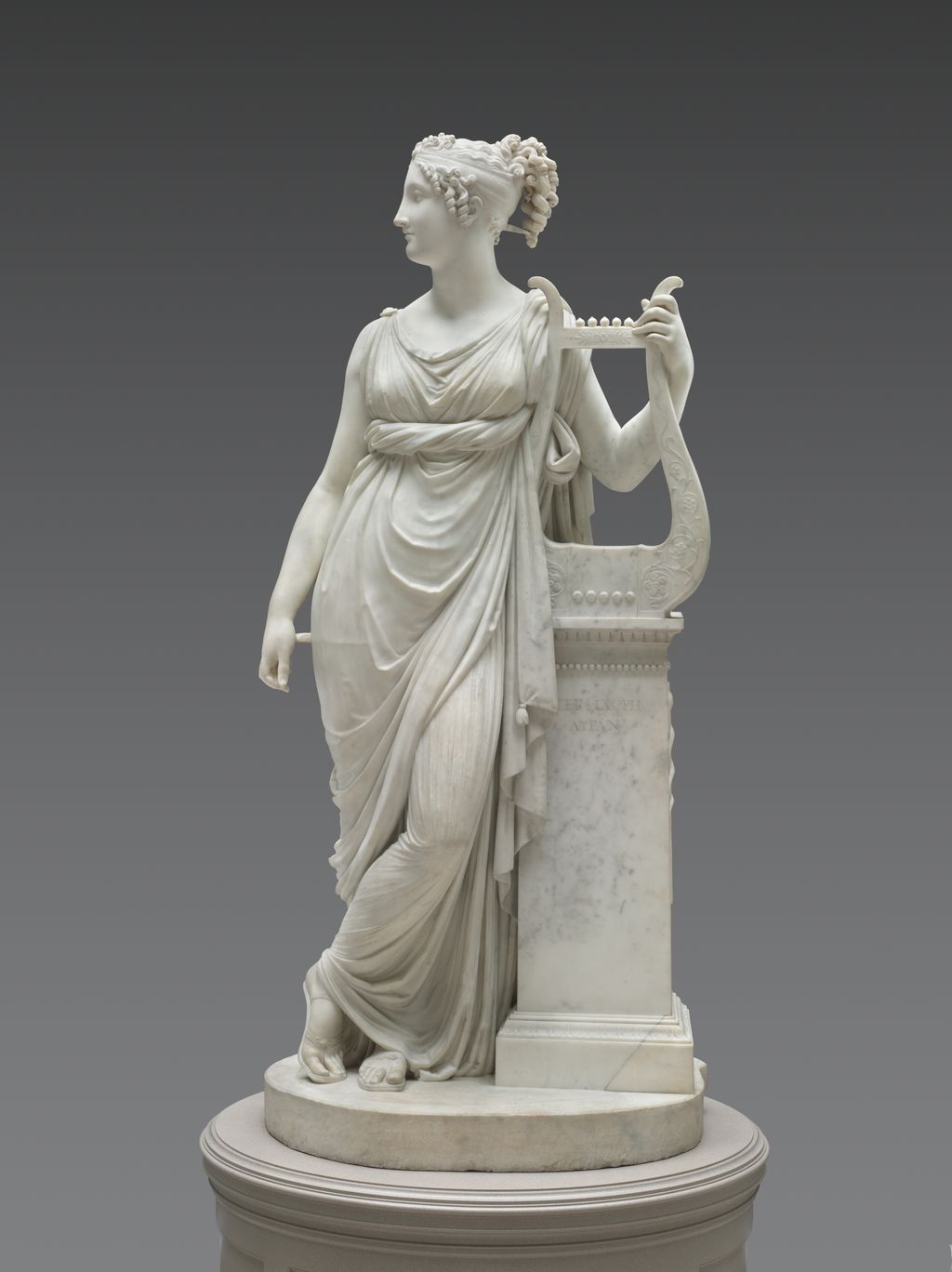
The separate marble made for Simon Houghton Clarke, now in Cleveland. Cleveland Museum of Art. Image source. CC0 / Public domain. Resized for display.
At a Glance
- Sommariva marbleCarrara marble, signed and dated 1811, Fondazione Magnani-Rocca. [1]
- Original working plasterSigned and dated 1811, Villa Carlotta, Lake Como. [4] [6]
- Clarke marbleSigned and dated 1816, Cleveland Museum of Art, 1968.212. [5] [7]
Contents
- The figure beside the lyre
- From Alexandrine to Sommariva
- The plaster at Villa Carlotta
- At the Salon and in Sommariva’s house
- The marble made for Simon Houghton Clarke
The figure beside the lyre
The lyre rises from the top of the rectangular pedestal almost to the Muse’s shoulder. The curves of the instrument leave an opening beside her upper arm, so a viewer can see the bent forearm through it. Her left hand wraps around the outer arm of the lyre, well away from the place where a musician would pluck the strings. The instrument explains who she is and gives her raised hand somewhere to rest. Her right arm drops almost straight, with the fingers loosely curled beside the skirt. The difference between the two arms gives the nearly upright figure a distinct outline on each side. [1] [2]
Canova makes the weight shift clear below the waist. A broad fold travels down across the body, revealing the shape of the bent leg before gathering again near the ankles. The hanging fabric beside the pedestal takes a more vertical course. Look higher and the same change of direction appears at the waist, where folds from both sides gather into a band beneath the chest. The dress gives the body a slight turn against the straight edge of the support. Its shallow ridges over the chest give way to deeper folds at the knee, where the fabric appears to hang clear of the body. [1] [2]
The pedestal carries part of the subject. Its Greek inscription identifies Terpsichore in her role as Muse of lyric poetry. On the side Canova carved caducei in low relief, which the foundation connects with Mercury’s gift to Apollo. The foundation records the sculptor’s signature and Roman-numeral date low on the back of the support. The music and the Muse can be read from the front, while the attributes and date reward a closer look around the pedestal. In Hebe, Canova places a cup and pitcher in the figure’s raised hands so their relationship suggests a pour. In Terpsichore the lyre has already come to rest on a flat surface. [1] [2] [8]
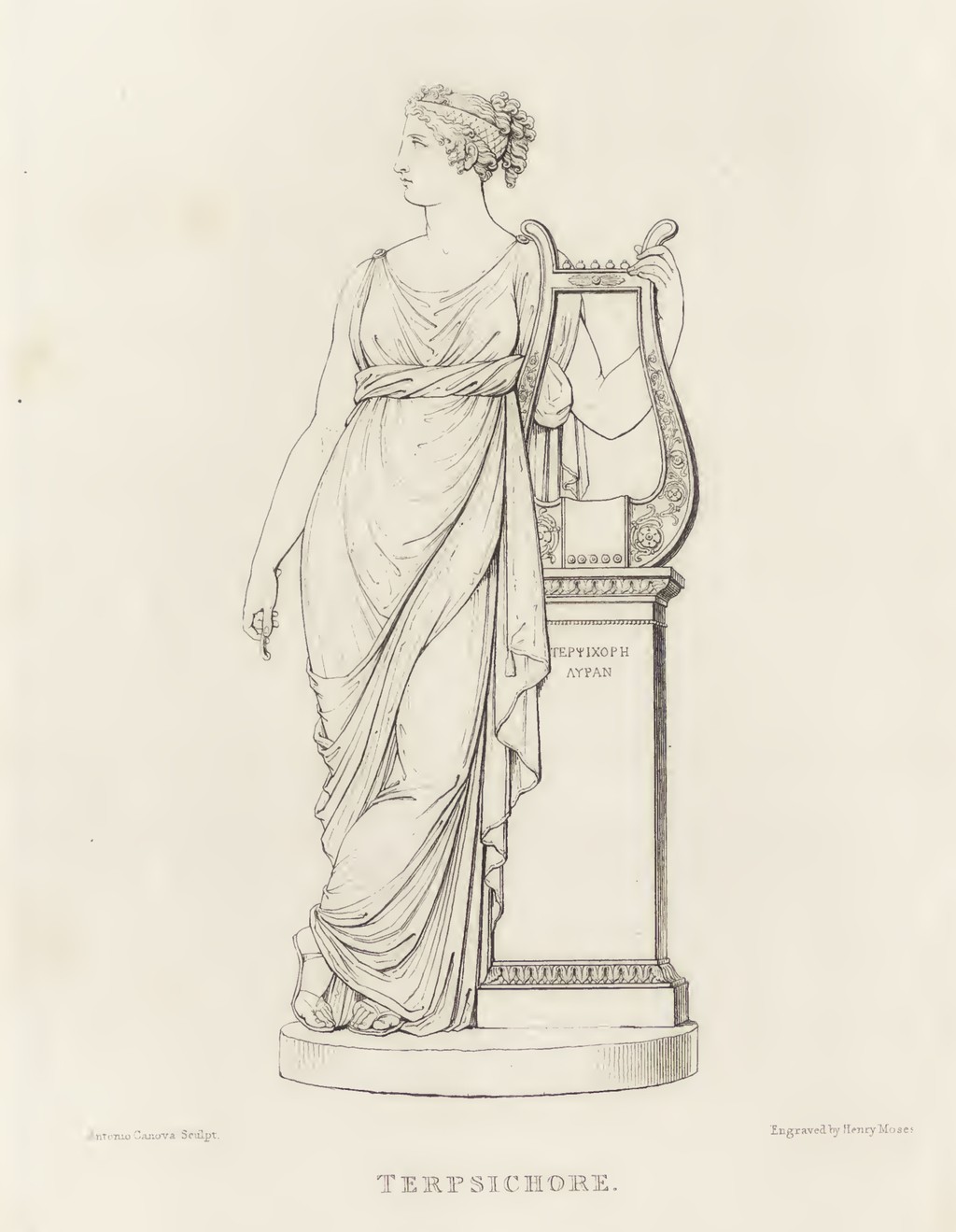
Moses’s engraving after Terpsichore shows the standing Muse next to the lyre. Henry Moses, after Antonio Canova, engraving published in London, 1824. Getty Research Institute. Image source. Public domain. Scan margins trimmed and image resized.
From Alexandrine to Sommariva
Canova began the project in 1808. In January 1809 he told the French writer and antiquarian Quatremère de Quincy that he had completed the figure’s model. Giuseppe Antonio Guattani described the work that year as a portrait of Alexandrine in the guise of a Muse. The Fondazione Magnani-Rocca associates two plaster busts at Possagno, numbers 193 and 194, with this early phase. The foundation points to the difference between the features in those portraits and the head on the finished figure. Its catalogue places Sommariva’s takeover in 1810 or 1811 and attributes the idealised head to that change of patron. [1] [3] [4]
The surviving correspondence gives the negotiations a firmer date. On 12 September 1811 Canova offered the statue to Sommariva, presenting it as a figure he had made on his own initiative. He had previously proposed a statue of Hector and had reconsidered its size in relation to the space in Sommariva’s house. The new offer describes the Muse in the language of a father sending his daughter to live with the collector. Sommariva picked up the conceit and later referred to the statue as his bride. The original commission and the terms in which Canova presented the figure to its new owner explain why the work could retain the Muse’s pose while acquiring an identity independent of the sitter. [1] [3] [4]
Videos on Canova
Explore Canova’s workshop methods and the settings for his sculpture.
From Sketch to Stone | Canova: Sketching in Clay
Watch sculptor Fred X. Brownstein recreate a Canova Venus, using clay, plaster and marble.
Watch on YouTubeThe plaster at Villa Carlotta
The Italian catalogue describes the Villa Carlotta plaster as the original working model used to transfer the design into marble. It measures 175 centimetres high and has small holes associated with the metal reference points. Villa Carlotta also records surviving points. At the scale of the finished figure, they gave the workshop fixed locations from which to measure the projection of a shoulder, the depth of a fold or the position of the elbow beside the lyre. The cast records those relationships in three dimensions. Its surface also preserves marks of a stage of work that disappears in the finished marble. [4] [6]
Sommariva acquired the plaster as well as the marble. Villa Carlotta relates the purchase to his wish to keep the design exclusive. The two objects had distinct settings. The model belonged to his collection at Lake Como, while the marble went to his house in Paris. A separate plaster at Possagno is catalogued as a cast taken from the original. It is distinct from the two portrait busts of Alexandrine also held there. [1] [4] [6]
At the Salon and in Sommariva’s house
The marble reached Paris on 13 January 1813 and was shown at the Salon alongside a dancer Canova made for Joséphine. In a letter dated 30 January, Quatremère told Canova that news of the war had kept attention away from the exhibition. He reported praise for the drapery alongside objections to the proportions of the neck, shoulders and chest. Later that year, Leopoldo Cicognara admired the turn of the neck and the line of the whole figure. He wrote that marks in the marble caught his attention at first, then ceased to trouble him as he looked. The foundation’s photograph shows the coloured markings running through the pale stone, particularly low on the figure and pedestal. [1] [3]
Sommariva’s letter of 31 March 1813 describes the marble on its pedestal near his bed in Paris, where artists and other admirers came to see it. A second public image placed the figure in a different setting. In Pierre-Paul Prud’hon’s portrait of Sommariva, dated 1813 by the Pinacoteca di Brera and shown at the Salon in 1814, Terpsichore appears with Canova’s Palamedes in an ideal landscape. The picture puts two sculptures behind their collector where they help identify him by his taste and patronage. His collection also included Canova’s kneeling Penitent Magdalene, a work he showed in a different room with its own lighting. [1] [4] [9] [10]
Terpsichore was offered as lot 131 at the Paris sale of Sommariva’s collection in 1839 and went unsold. The Fondazione Magnani-Rocca records it in the family’s Milan house by 1866 and on loan to Milan’s Galleria d’Arte Moderna from 1931 to 1940. Luigi Magnani bought the work in 1984. The marble and the plaster can now be studied in separate collections in northern Italy. [1] [2] [4]
The marble made for Simon Houghton Clarke
Canova returned to the composition for the British collector Sir Simon Houghton Clarke. The foundation dates the work on this second marble to 1814–16, and the Cleveland Museum of Art records an 1816 signature at the base of the column. It was exhibited at London’s Royal Academy in 1817. Cleveland records the statue at 177.5 centimetres high. The lyre, Greek inscription and entwined snakes still identify the subject, and the crossed ankles and turned head preserve the earlier arrangement. [1] [5] [7]
The two museums’ photographs let the eye follow corresponding details. In the Sommariva marble the folds gather and turn beside a broad band of coloured stone across the knee. In the Clarke marble, photographed more nearly from the front, the largely pale surfaces make the shadows beneath the waist and along the hanging edge of the skirt more prominent. The Cleveland photograph also gives a clear profile of the head, with curls framing the face and gathering high behind it. The pictures were taken from different positions. Read together with the signatures, they show how two individually finished marbles can preserve the same turn of the head, crossed stance and lyre while offering distinct surfaces to look at. [1] [2] [5] [7]
Explore Canova’s works
Browse the sculptures and paintings covered in this guide. Several entries compare versions or examine details of a larger work.
Discussion
Look again at the images and ideas explored in The Muse Terpsichore. These editorial prompts invite your observations.
Reader Insights
How does the instrument shape Terpsichore’s pose?
Which details help distinguish the two marbles?
Join the Conversation
Share a detail, comparison or question about The Muse Terpsichore below.
References
- Fondazione Magnani-Rocca, La Tersicore di Antonio Canova, collection catalogue, photograph and excerpts from contemporary correspondence. View source.
- Fondazione Magnani-Rocca, Tersicore by Antonio Canova, collection photographs and exhibition text. View source.
- Edizione Nazionale delle Opere di Antonio Canova, Epistolario, 1811, introduction, pp. XXV–XXVII and correspondence cited there. View source.
- Villa Carlotta, The Muse Terpsichore by Antonio Canova, original plaster, model-making and Sommariva’s letter of 31 March 1813. View source.
- Cleveland Museum of Art, Terpsichore Lyran (Muse of Lyric Poetry), 1816, 1968.212, collection record and photographs. View source.
- Ministero della Cultura, Tersicore, national catalogue CO290-00007_R03, Villa Carlotta plaster, also published in the Lombardy heritage catalogue. View source.
- Cleveland Museum of Art, Terpsichore Lyran, Open Access collection data, measurements, provenance and inscriptions. View source.
- Staatliche Museen zu Berlin, Canova and the Dance, exhibition including the Berlin Hebe. View source.
- Pinacoteca di Brera, Portrait of Giovanni Battista Sommariva, Pierre-Paul Prud’hon, 1813, inventory 950. View source.
- Christina Ferando, Defining Modern Sculpture, in Exhibiting Antonio Canova, on Sommariva’s installation of the Penitent Magdalene. View source.


 Antonio Canova.jpg)

