



 by Tom Gurney
Tom Gurney BSc (Hons) is an art history expert with over 20 years experience
Published on June 19, 2020 / Updated on November 13, 2026
Email: tomgurney1@gmail.com / Phone: +44 7429 011000
Bust of Paris: Introduction
Paris has turned his head towards his right shoulder. The line of the nose points away from the middle of the chest, and the neck tightens beneath the jaw. A roll of marble curls rises over his brow. Above it, a smooth cap bends forward at the tip. The Art Institute of Chicago dates the bust to 1809, when Antonio Canova was working on a standing statue of the same figure for Joséphine de Beauharnais. He carved this marble as a gift for Antoine Quatremère de Quincy, the French critic whose name he had inscribed on the back. [1] [2]
Bust of Paris Antonio Canova
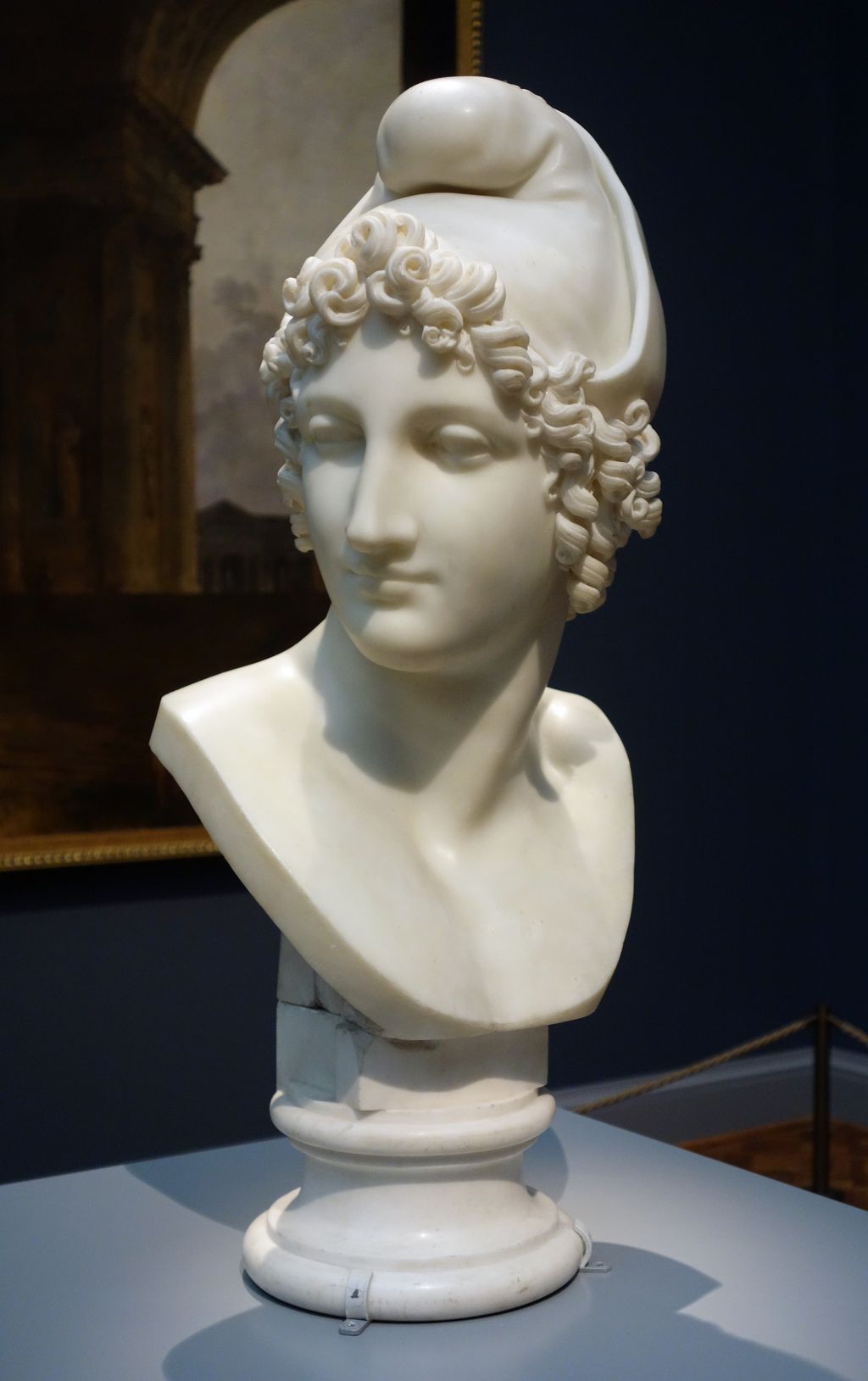
The Chicago marble in three-quarter view, with the cap and the edges of the bust visible. Mark Landon. Image source. CC BY 4.0. Resized for display.
At a Glance
- Artist and dateAntonio Canova, Rome, 1809. [1] [2]
- Material and sizeMarble, 69.9 × 30.8 × 28 centimetres, Art Institute of Chicago, 1984.530. [1]
- First ownerAntoine Quatremère de Quincy, who acknowledged the gift in March 1811. [2]
Contents
- The cap and the turn of the head
- The judge and the apple
- A gift from the studio in Rome
- Other busts of Paris
- From a Paris sale to Chicago
The cap and the turn of the head
From the front of the chest, the face is already beginning to move into profile. The cheek nearest the viewer is broad and bright, and the farther eye sits deeper in the shadow below the brow. Canova left the lips closed. Their corners lift slightly, making the expression easier to catch from one angle than another. As the viewer moves in the direction of the turn, the nose and mouth come into view together. The curve beneath the chin then becomes more apparent, as does the length of the exposed throat. [2] [3]
The Phrygian cap identifies Paris with the eastern Mediterranean world of Troy. Its outline rises above the tight curls and ends in a rounded tip that folds back over the forehead. Canova carved the edge of the cap as a continuous ridge. Beneath it, individual locks coil and overlap, especially at the temple and above the ear. In the deeper cuts between the locks the marble darkens. That brings out the smooth expanse of the cap and the cheek, where light changes more gradually. The curls also bridge the turn of the face. A viewer moving towards the back can still follow their line after the nose and mouth have disappeared. [2] [3]
The chest stops just below the collarbones in a deep curve. Seen from an angle, its outer edge runs from a squared shoulder down to a rounded point above the support. The outline repeats something of the bend at the top of the cap. The two curves enclose a face that seems to have turned before the rest of the body could follow. Because Canova cut the shoulders so close to the neck, even a small change of viewpoint shifts the relation between the head and the base. [2] [3]
The judge and the apple
In the account attributed to Apollodorus, Zeus has Hermes take Hera, Athena and Aphrodite to Mount Ida so that Paris can decide which goddess should receive the apple. Aphrodite promises him Helen and wins his decision. The Art Institute reads the turned head as the shepherd looking at the three goddesses. The cap helps identify the figure. The apple and the women are absent from the bust, so a viewer coming to it without the title might see a young man absorbed by something across the room. [1] [4]
Canova’s standing Paris clarifies the moment. In the marble made for Joséphine, the right hand holds the apple and the other rises towards the head. A tree trunk supports the leaning figure. The shift through the hips and the gesture of the raised hand draw attention to the interval before the decision. The bust keeps the turn of the head and cuts away those clues. Its subject comes through in the turned face and the attention it seems to direct beyond the frame of the marble. In another sculpture, Venus Victrix, Canova places the apple in the hand of Pauline Borghese. There it identifies the goddess who received the prize. [2] [5] [6]
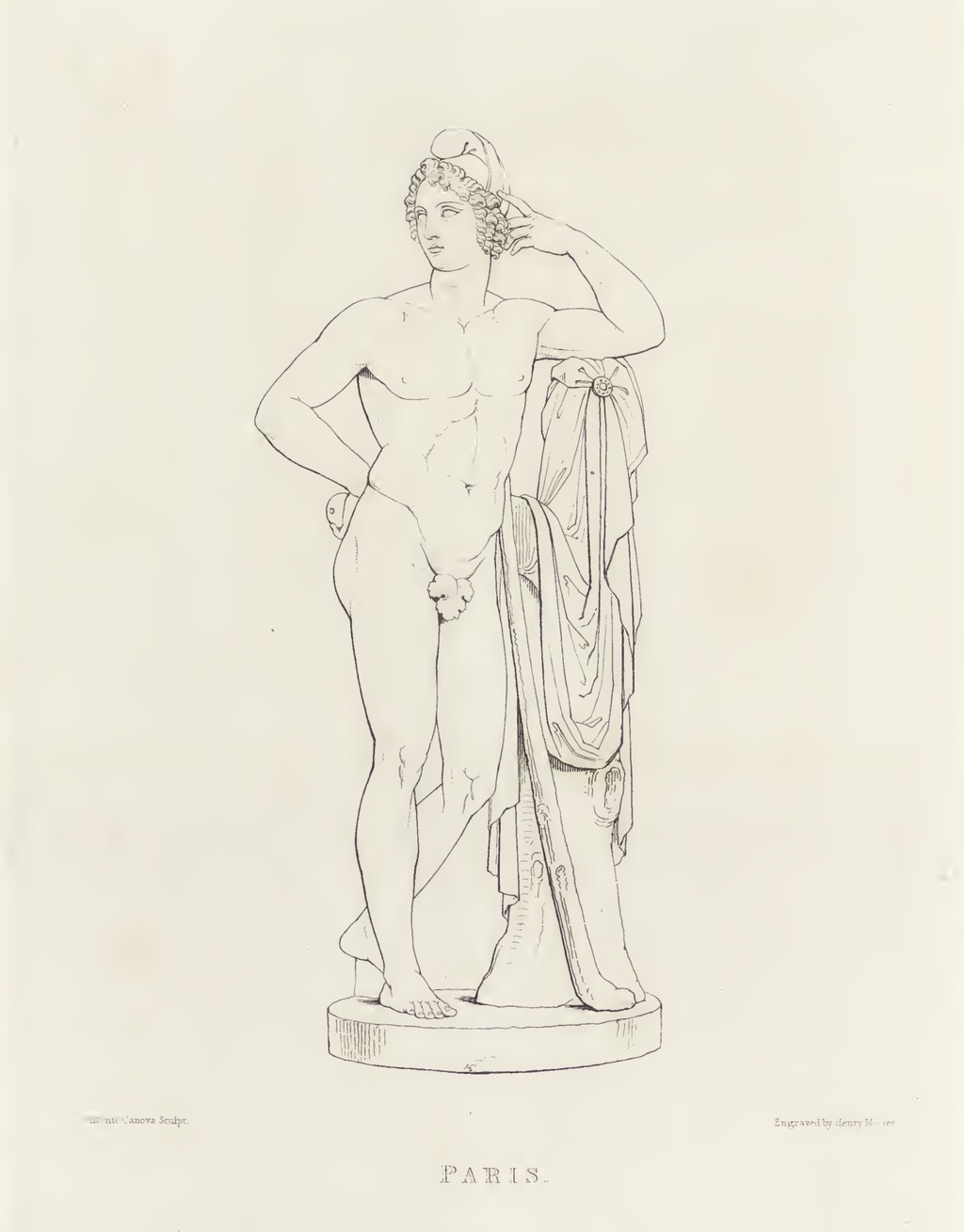
The full-length Paris, engraved by Moses, places the cap and the apple within the same design. Henry Moses, after Antonio Canova, engraving published in London, 1824. Getty Research Institute. Image source. Public domain. Scan margins trimmed and image resized.
Videos on Canova
Explore Canova’s workshop methods and the settings for his sculpture.
From Sketch to Stone | Canova: Sketching in Clay
Watch sculptor Fred X. Brownstein recreate a Canova Venus, using clay, plaster and marble.
Watch on YouTubeA gift from the studio in Rome
The dedication is on the back of the marble. In Latin it names Quatremère as Canova’s dearest friend, calls the bust a gift and gives Rome and 1809 as the place and year of its making. Someone looking only at the face would miss that record. In a letter of 31 December 1810, Canova told Quatremère that the crate had gone out more than a month earlier. He expected his friend might take the warm tone of the stone for wax and said that the marble had come from the same larger block as Joséphine’s statue. The connection between the two works lay in the stone as well as in the pose. [2]
Quatremère acknowledged the gift on 16 March 1811. He admired the way Canova brought the softness of the features together with an expression he associated with heroic character. By February 1813 he had also examined the standing Paris at Malmaison. His later account describes differences in the treatment of the eyes and mouth, and recalls Joséphine wishing she could exchange the statue’s head for the one on his bust. Quatremère thought the change would weaken both. He had studied the features as a composition on their own and could see how they served a different purpose when read with a body and its gestures. [2]
The gift grew out of a long exchange about works in progress. Canova sent drawings, prints and models from Rome and asked for advice. Quatremère helped bring his sculpture before French audiences, including by arranging Salon entries. Paris was a particularly apt subject for someone whose own judgement Canova valued. Quatremère could see both a young man about to award a prize for beauty and a sculptor’s carefully worked example of what beauty in marble might look like. [2]
Other busts of Paris
The Neue Pinakothek’s bust, WAF B 5, is almost the same height as Chicago’s. Its record dates it to 1812 and identifies it as another gift from Canova, this time to Crown Prince Ludwig of Bavaria. Ludwig also acquired a standing Paris, completed in 1816. The two Munich accessions therefore have a documented connection through their recipient, though they reached him in different years. Chicago’s dedication and the letters give its bust a separate place in the history of the design. [2] [7] [8]
The Hermitage bust, 66 centimetres high, has no equivalent dedication. It was once proposed as the gift to Quatremère. The catalogue of his 1850 estate sale, however, described the inscribed object now in Chicago. The Hermitage attributes its own bust to Canova with workshop participation and records it in the collection by 1859. Its catalogue identifies a bust of Helen of Troy in the same collection as the companion and suggests both may have been made for Ludwik Michał Pac around 1819. In that pairing, one head recalls the person making the judgement and the other the woman promised as his reward. [2] [5]
From a Paris sale to Chicago
The bust remained in Quatremère’s collection until his death in 1849. It was sold at his home in the rue de Condé the next April, and again at a Paris sale in 1851. By the time it came up at the Hôtel Drouot in 1908 it had belonged to Madame Chesnet. The Art Institute next traces it to the Pradere family in Buenos Aires, then to the dealer Casa Pardo and collector Francisco Murature in the same city. The museum acquired it in 1984 from Mary-Anne Martin Fine Art in New York. [1] [2]
The estate catalogue had preserved the wording of the dedication while the bust passed out of sight of many scholars. Finding those words on the Chicago marble gave the researchers a way to test the earlier Hermitage identification against the surviving objects. The evidence is still in the same place Canova put it. From the front the bust invites a viewer to follow Paris’s gaze. From behind, the inscription says who was meant to look back at him. [1] [2]
Explore Canova’s works
Browse the sculptures and paintings covered in this guide. Several entries compare versions or examine details of a larger work.
Discussion
Look again at the images and ideas explored in Bust of Paris. These editorial prompts invite your observations.
Reader Insights
Which part of the bust first tells you who the figure might be?
What changes when you compare this head with the full-length Paris?
Join the Conversation
Share a detail, comparison or question about Bust of Paris below.
References
- Art Institute of Chicago, Bust of Paris, 1809, marble, 1984.530. Collection record and provenance. View source.
- Ian Wardropper and Thomas F. Rowlands, Antonio Canova and Quatremère de Quincy: The Gift of Friendship, Art Institute of Chicago Museum Studies 15, no. 1 (1989), pp. 38–46. Includes excerpts from correspondence and photographs of the bust and inscription. View source.
- Mark Landon, Bust of Paris by Antonio Canova, photograph of Art Institute of Chicago 1984.530, 17 April 2025. View source.
- Apollodorus, Epitome, 3.2, translated by Sir James George Frazer, Perseus Digital Library. View source.
- Sergey Androsov, Italian Sculpture, 17th–18th Centuries, State Hermitage Museum, 2014, catalogue nos. 246 and 248–249. View source.
- Galleria Borghese, Paolina Borghese Bonaparte as Venus Victrix, collection record and iconography. View source.
- Bayerische Staatsgemäldesammlungen, Paris (Büste), 1812, Neue Pinakothek, WAF B 5. View source.
- Bayerische Staatsgemäldesammlungen, Paris, 1816, Neue Pinakothek, WAF B 4. View source.


 Antonio Canova.jpg)

