



 by Tom Gurney
Tom Gurney BSc (Hons) is an art history expert with over 20 years experience
Published on June 19, 2020 / Updated on November 13, 2026
Email: tomgurney1@gmail.com / Phone: +44 7429 011000
Daedalus and Icarus: Introduction
Daedalus reaches behind his son’s head to fit a wing to his right shoulder. His other hand is lower, near his waist, where he grips a thread stretched across the boy’s body. Icarus tilts his head towards the wing. Antonio Canova shows the two of them still on the ground, at a moment when their escape depends on how well the father can fasten a handful of feathers. [1] [2]
Canova completed Daedalus and Icarus in Venice in 1779. Pietro Vettor Pisani, a procurator of San Marco, commissioned the group for his palace on the Grand Canal. The finished marble stands in the Museo Correr. The Museo Gypsotheca Antonio Canova in Possagno holds a plaster of the same composition. [1] [3]
Daedalus and Icarus Antonio Canova
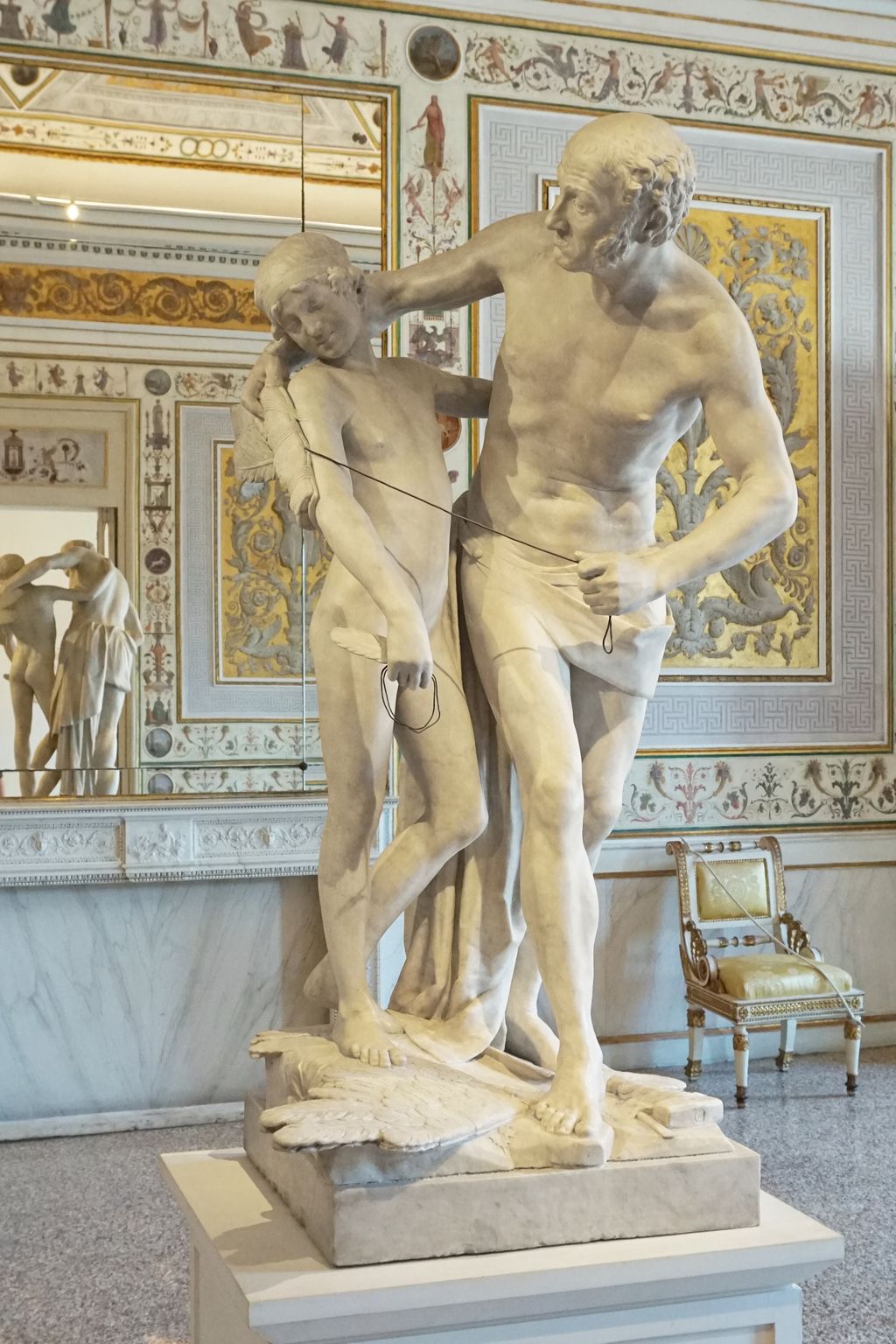
The Correr group, with the cord visible between the two figures. Armin Kleiner. Image source. CC BY-SA 4.0. Resized for display. The resized photograph uses the same licence.
At a Glance
- Artist and subjectAntonio Canova. Daedalus fits a wing to his son Icarus for their escape from Crete. [1] [2]
- Venice sculptureDated 1777–79 by the Museo Correr, which catalogues it as marble. Displayed in the Sala delle Vedute. [1]
- Possagno plasterDated 1777–79 by the Museo Gypsotheca Antonio Canova, inventory 1, 170 × 92 × 80 cm. [3]
This work across Antonio Canova’s career
Venus Victrix
1804–08 Collection recordMars and Venus
1815–19 Collection recordThe Three Graces (Bedford marble)
Completed by 1817 Collection recordContents
- The thread between the figures
- An older face and a younger body
- What Ovid tells us about the wings
- What the Possagno plaster shows
- From the Ascension fair to Rome
- The print and the group at the Correr
- Annotated details
The thread between the figures
From the front, Daedalus stands on the right. His right arm rises and passes behind the boy, placing his hand close to the upper end of the wing. His left elbow projects beyond his hip, bringing the forearm back across his own body. The two hands work at different heights. Look first for the lower hand and follow the taut thread from its grip towards Icarus’s upper arm. It runs diagonally across the boy’s chest and meets the edge of the wing. Its slope shows how far Daedalus has drawn it back. [1] [2]
The Museo Correr singles out the open space at the centre. From a frontal angle the arm behind Icarus leads the eye across the top of that opening, and the thread leads it back towards Daedalus below. You can still see through the gap even where the thread closes part of its outline. The figures would read as a much more solid pair if the father had both arms wrapped around his son. Instead, the separated shoulders leave room for the span of the thread to register and for the viewer to work out what the hands are doing. [1] [2]
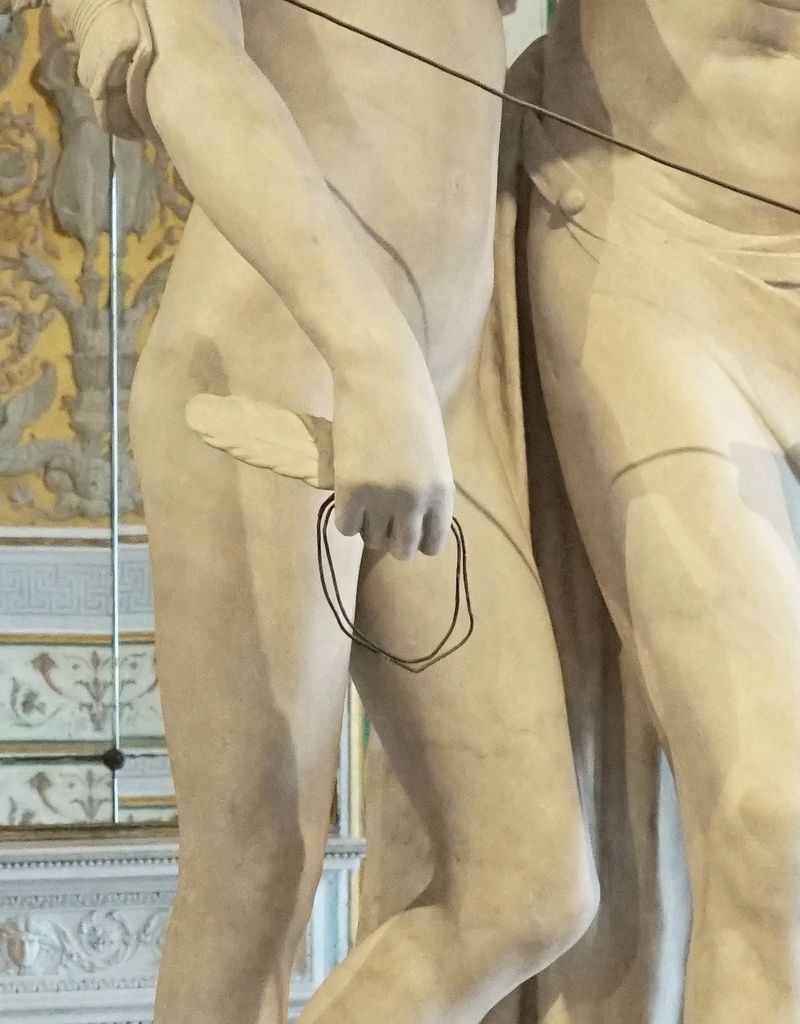
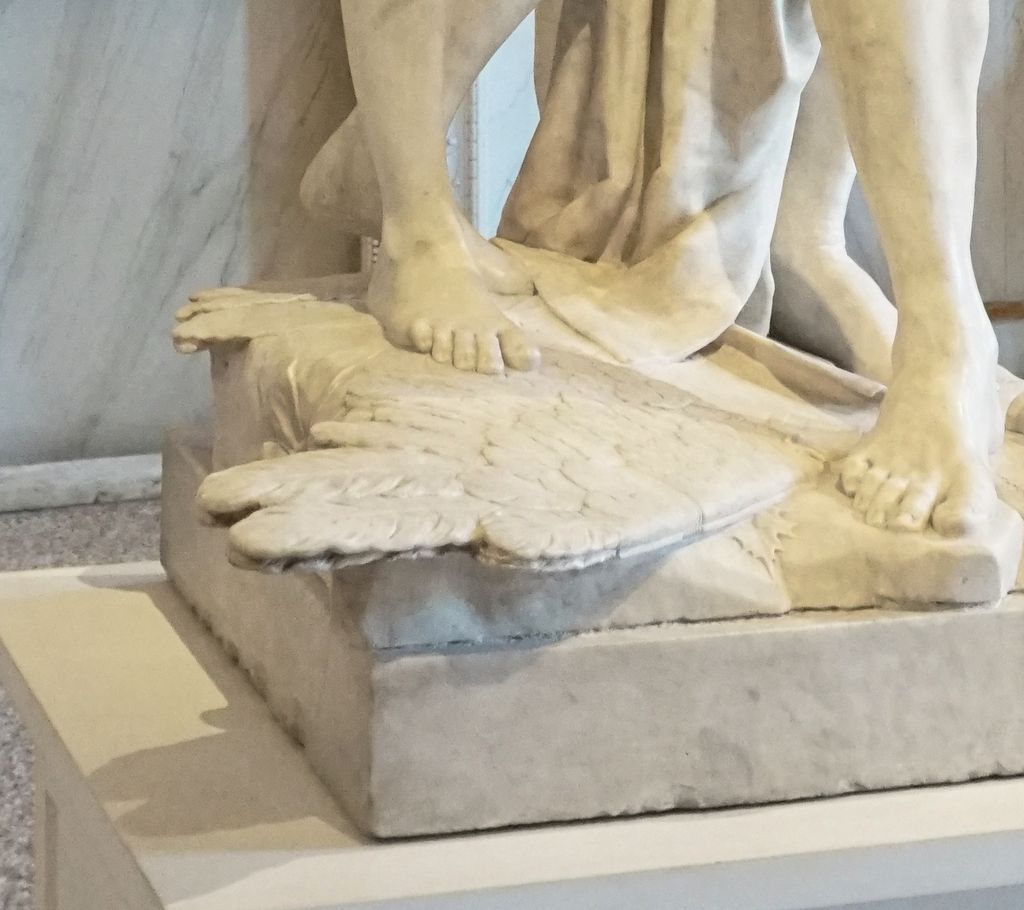
The wing hangs beside Icarus’s right arm. Its edge is narrow near the shoulder and the feathers fall in layers, with longer ones visible lower down. A loose loop hangs below the boy’s lowered hand. From there, follow the legs to the base. The museum identifies a mallet and chisel near Daedalus’s feet. The broad spread of feathers lies towards the other side. Canova sets the two kinds of object apart so that the area around the figures’ feet gives some account of the work that preceded the fastening. [1] [2]
Daedalus is an architect and inventor in the story. The mallet and chisel give him the tools of a sculptor. They also give Canova a way to put his own trade into the scene without asking the figures to break off what they are doing. Seen from above, the tools lie low and almost flush with the base. Their straight edges and blunt shapes are easy to distinguish from the feather tips. The Correr reads them as a connection between Canova and Daedalus. The choice suits a work that asks the eye to move between an object under construction and the hands that are making it. [1] [2]
Annotated Details from Daedalus and Icarus
The group at the Museo Correr in Venice. Photograph by Armin Kleiner, Wikimedia Commons. CC BY-SA 4.0. The photograph was resized, annotated and cropped. These adaptations use the same licence.
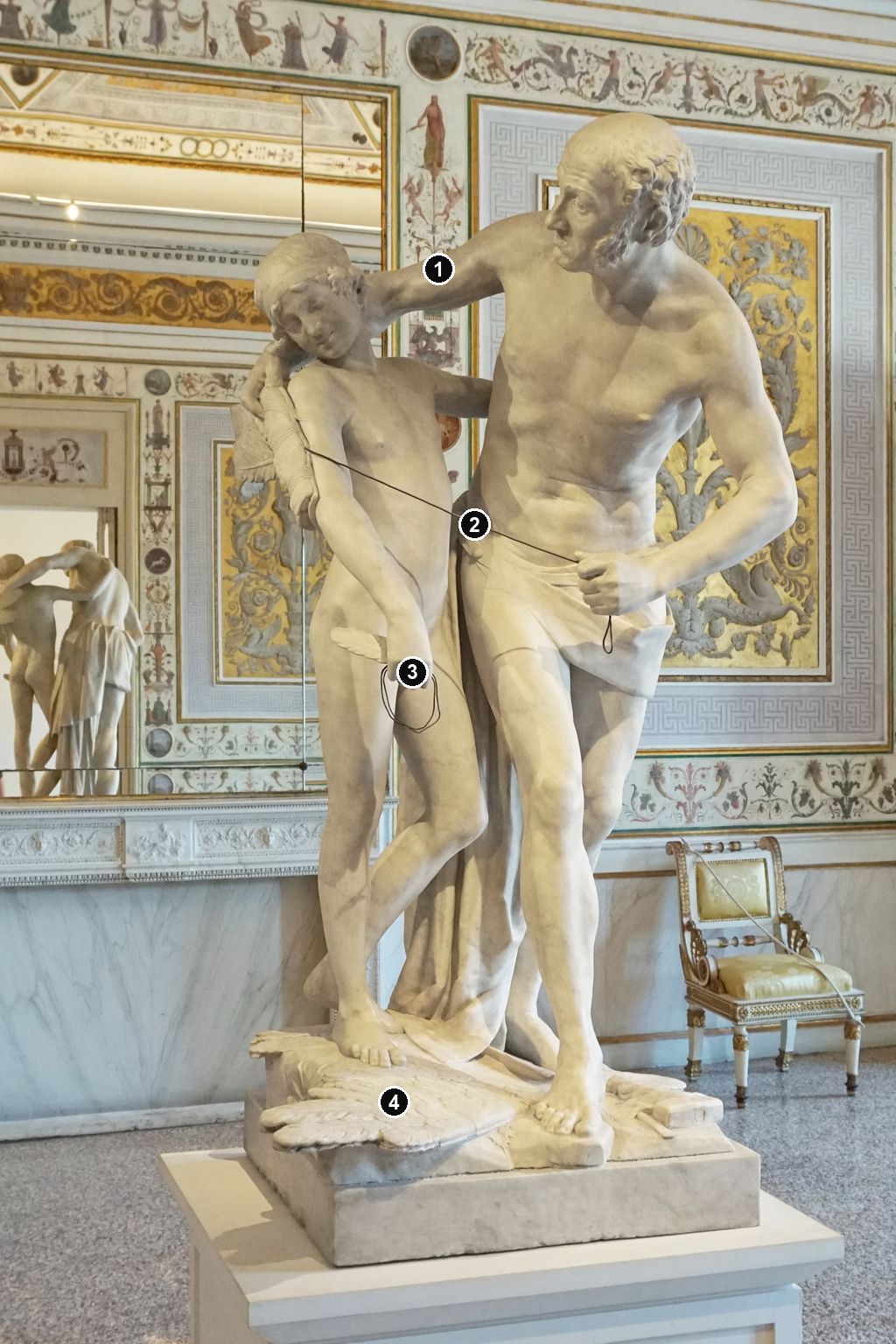
Details from DAEDALUS AND ICARUS
Look first at the two faces, then follow the cord and the feathers.
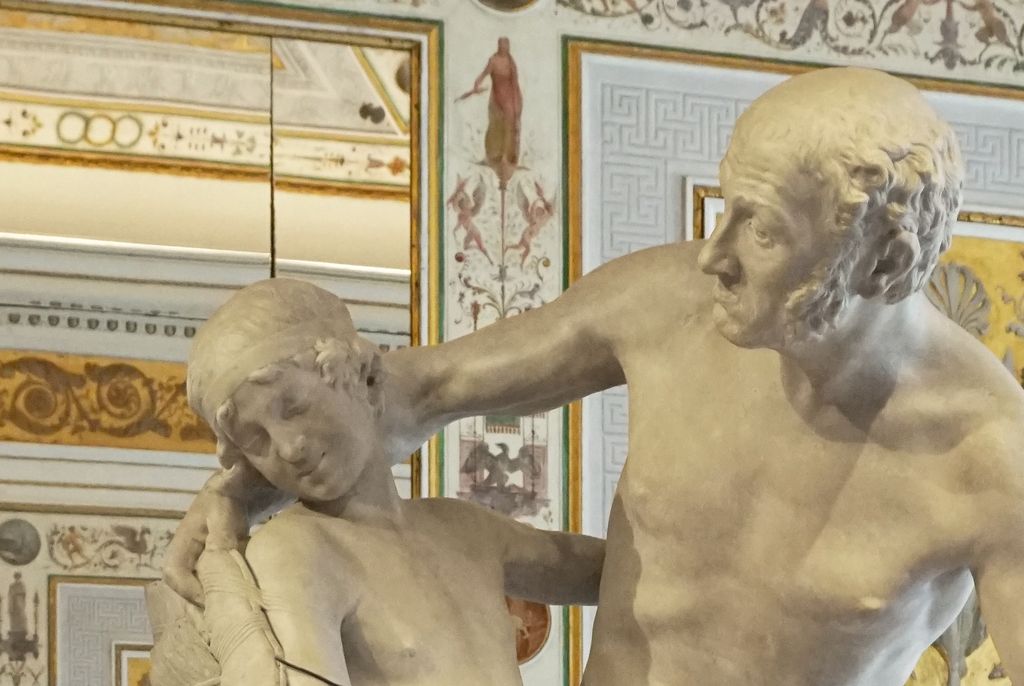
The two faces
Daedalus looks across at his son. Canova sets the older man’s brow and beard against the smoother cheek of Icarus.
The cord
A thin line crosses the space between the bodies and continues towards Daedalus’s working hand.
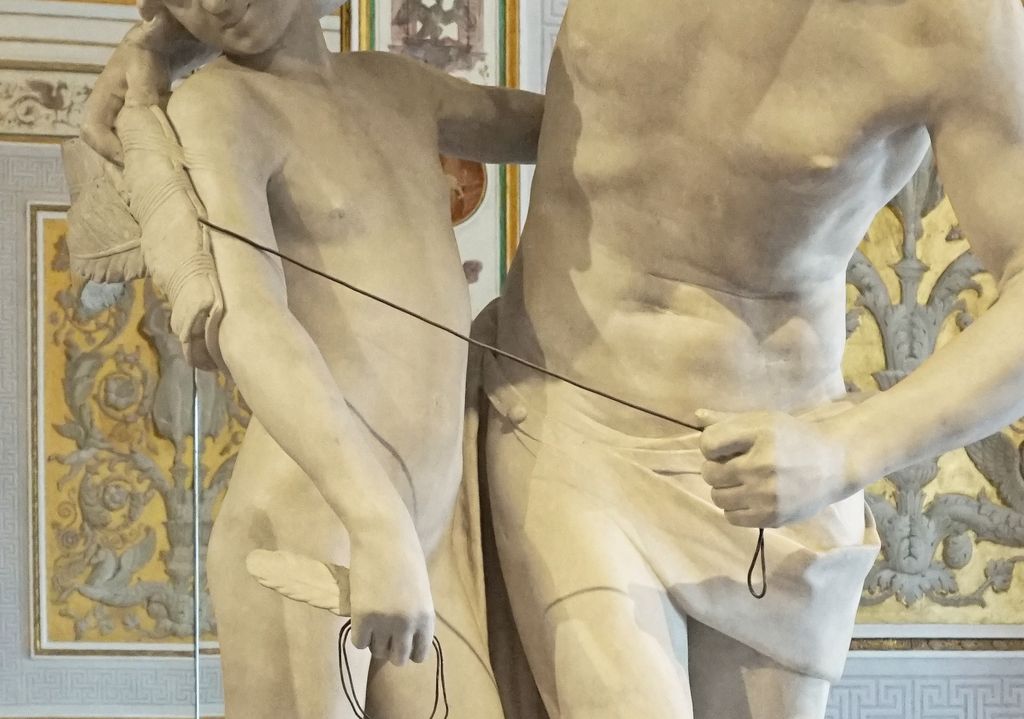
Icarus’s hand
The younger figure holds a loose loop low by his thigh while Daedalus works higher up.
Feathers at the feet
The feathers spread across the base. Their thin edges pick up the light beside the feet.
An older face and a younger body
The shift in expression begins at the brow. Daedalus’s head pitches forward and turns towards Icarus. His brow is drawn, his lips are set, and the folds around his eyes cast small shadows. The curls beside his ear and the beard break up the profile. His upper arm and shoulder still look strong enough to hold their position while he works, while the ridges and hollows across his torso give the body the irregularities of age. His son’s cheek, chest and abdomen have longer, smoother surfaces. The boy’s nearer arm hangs down and his knees take slightly different angles, as if he has had time to settle into the pose. [1] [2]
The Correr relates Icarus’s smooth young body to classical sculpture and Daedalus’s head to the naturalism of eighteenth-century Venice, particularly the character heads of Giambattista Piazzetta. The comparison is clearest when the two faces catch the light differently. A shadow in Daedalus’s beard makes the next ridge stand out, and the brow interrupts the light before it reaches the eyes. The same light can pass across much of Icarus’s cheek in one sweep. The contrast extends well beyond costume or hair. It depends on the number and depth of the small changes in the surface. [1] [2]
There is also a difference in what the two figures have to do. Daedalus has to maintain tension on the fastening, and the turn of his body brings his face close to the part that needs attention. Icarus holds himself in place, with his head tipped and his near hand hanging loose. The youth’s faint smile can read as interest or ease. Daedalus’s attention is easier to locate because his hands and his eyes all lead back to the wing. A viewer familiar with the myth can read foreboding in his concentration. The same expression makes sense for a father engaged in a difficult piece of work. [1] [2]
What Ovid tells us about the wings
In Ovid’s Metamorphoses, Minos controls the routes out of Crete by land and sea. Daedalus decides to escape by air. He lays out the feathers by length, ties them together with thread and secures them with wax, then bends them into the curve of a bird’s wing. While he works, Icarus plays with feathers and softens the wax with his thumb, unaware of the danger. In the Ars Amatoria, Ovid also describes the father fitting the wings to his son and compares Daedalus teaching Icarus to fly with a bird guiding its young. The Possagno catalogue names both poems in connection with the group. [3] [4] [5]
Daedalus warns Icarus that flying too low will make the feathers heavy with sea damp and flying too high will expose the wax to the heat of the sun. During the flight Icarus climbs, the wax softens and he falls into the sea. Canova leaves the height and speed of that episode to the reader’s memory. In the sculpture the feathers still have weight and hang down, and both figures have their feet on the same patch of ground. Ovid’s account makes the thin line across Icarus’s body legible as part of the invention. It also explains why someone who knows the end might spend longer looking at the fastening than at the wing itself. [1] [2] [4] [5]
Videos on Canova
Explore Canova’s workshop methods and the settings for his sculpture.
From Sketch to Stone | Canova: Sketching in Clay
Watch sculptor Fred X. Brownstein recreate a Canova Venus, using clay, plaster and marble.
Watch on YouTubeWhat the Possagno plaster shows
The plaster retains the relation of the boy’s tipped head to Daedalus’s outstretched arm, the feathered edge at the boy’s shoulder and the low hand that pulls back at the waist. In the museum’s frontal photograph, the thread seen in the Venice group does not span the opening. The gaze therefore travels more readily down the edge of Icarus’s body to his hand. Daedalus’s bent arm still looks active because the knuckles project and the wrist turns in. The photograph’s side lighting also makes the folds at his waist and the creases around his eyes especially clear. The two versions reward looking at different details before comparing their surfaces. [1] [2] [3]
The museum dates its plaster to 1777–79, the same range the Correr gives the composition. The historian Hugh Honour cites an early account that says Canova used relatively few measuring points on his model for Daedalus and Icarus. A sculptor could use such points to transfer distances from a model to stone while judging the forms between them by eye. Honour places the more systematic process for which Canova became known later in his Roman career. The surviving plaster shows how much of the design can be examined in another material, down to the direction of the gaze and the set of the shoulders. [1] [3] [6]
From the Ascension fair to Rome
An early biographical account from Canova’s circle says the Venetian senator Giovanni Falier helped bring about Pisani’s commission. It recalls Canova proposing two subjects, Daedalus and Icarus and the death of Procris. Pisani chose the first and agreed to pay 300 zecchini for the life-size group. The account places the completion of the work at Canova’s studio at San Maurizio in 1779 and says he showed it at the Ascension fair that year. Possagno likewise places the exhibition after completion in 1779. The Correr’s web page gives 1777 for the fair. The early account and Possagno’s chronology both support 1779 for the completed group’s public appearance. [1] [3] [7] [8]
The fair, known in Venice as the Fiera della Sensa, gave a wide audience the chance to see a work made for a private palace. The early account says spectators responded to the natural treatment of the figures. The same account distinguishes Pisani’s agreed price from the 100 zecchini Canova had left from the commission and could put towards travelling. His surviving travel notebooks begin in October 1779, and he was writing from Rome by November. The money made a study visit possible at a point when the Venetian group had already established what he could do with a large commission. [3] [7] [8] [9]
A plaster of the group went on to serve a different purpose in Rome. The editor of Canova’s correspondence identifies a cast exhibited at Palazzo Venezia, the Venetian embassy, and later recorded in his studio in a drawing by Francesco Chiarottini. The drawing, dated 1786, shows the group in a side room, alongside the plaster of Theseus with the Minotaur. Assistants are at work on sculptures for the monument to Pope Clement XIV in the larger room. The Venetian group had a place in the studio even as Canova was carrying out one of his first major Roman commissions. On 29 March 1794, the Earl of Bristol wrote asking for the Daedalus plaster. He joked that Canova had made Daedalus’s journey rather than Icarus’s and that he wanted to own the sculptor’s first flight. The letter shows that the Venetian design could still command attention in Rome after the artist had made his name there. [9] [10]
The print and the group at the Correr
An etching by Antonio Banzo after a drawing by Giovanni De Min made the composition available to viewers who could never walk around it. The Istituto Centrale per la Grafica provisionally dates the plate to the 1810s. Its inscription identifies the sculpture as a life-size marble in the Pisani house in San Polo. In the print, the thin line from the father’s lower hand to the boy’s shoulder is still legible. Fine marks distinguish the feathers and beard from the outlines of Icarus’s body. Those distinctions carry something of the difference between the two figures into a medium where the light and shadows stay the same however you turn the sheet. [11]
The Venice sculpture now stands in the centre of the Correr’s Sala delle Vedute. The museum dates Giuseppe Borsato’s painted decoration of the room from 1811 onward and lists the marble as 182 cm high. With the work raised on a pedestal and space around it, a frontal view lets the thread and the distance between the two bodies register together. From nearer the father’s side, his arm and torso begin to close that gap in projection. The wing stays close to Icarus’s body, which makes the shift in the opening especially apparent as the viewer moves. [1] [2] [12]
Canova took up the Cretan story again in Rome with Theseus and the Minotaur. There the thread belongs to Ariadne’s plan for bringing Theseus back out of the labyrinth Daedalus built. It hangs in coils near the dead Minotaur’s leg. In Venice it stays taut between a man and the wing he is fitting. In both groups the myth leaves a small object to tell part of the story. In Daedalus and Icarus, the thread has to be drawn out far enough for us to see the distance across which the father is working. [1] [4] [13]
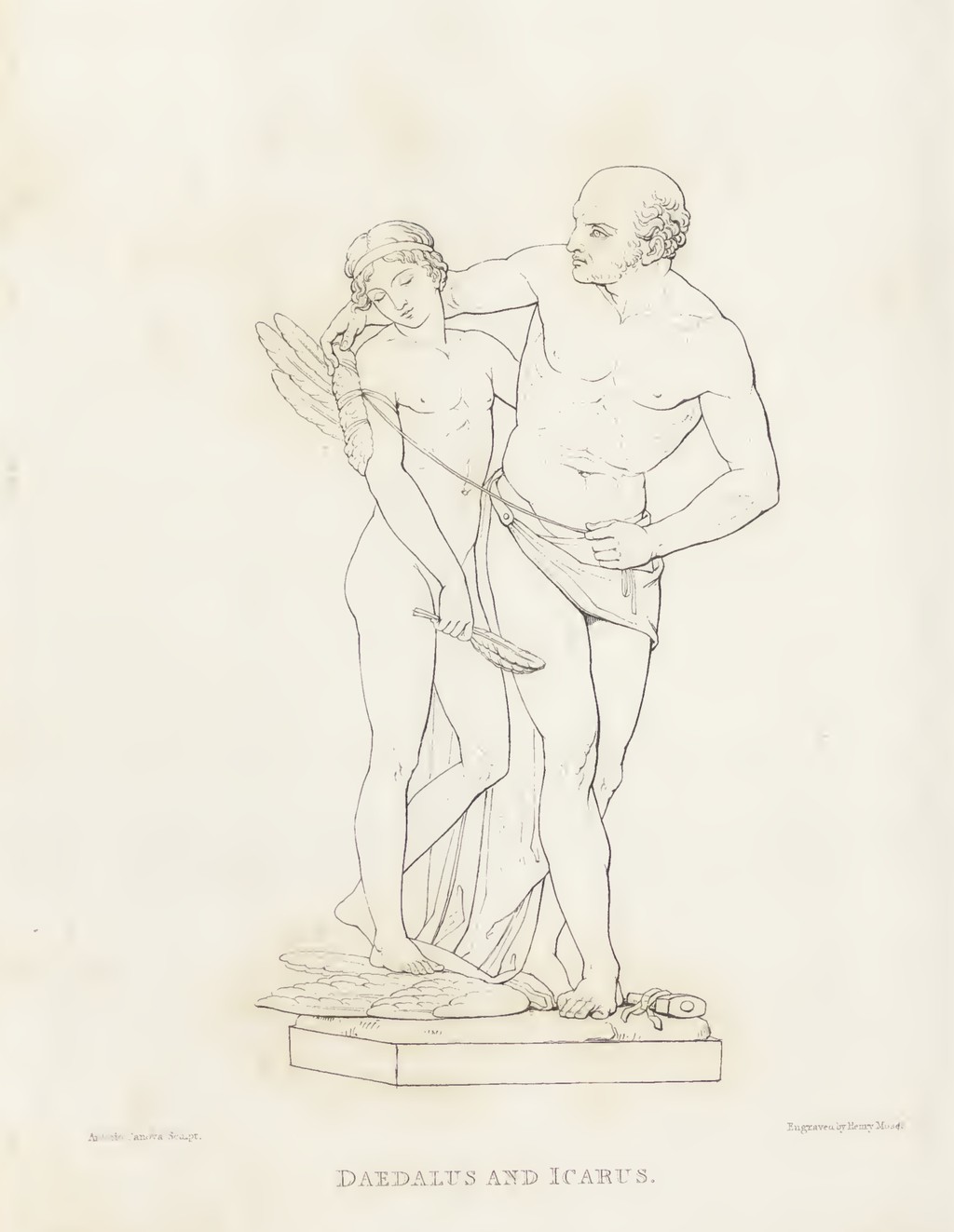
Moses’s outline engraving after Daedalus and Icarus shows the two figures and the wings between them. Henry Moses, after Antonio Canova, engraving published in London, 1824. Getty Research Institute. Image source. Public domain. Scan margins trimmed and image resized.
Explore Canova’s works
Browse the sculptures and paintings covered in this guide. Several entries compare versions or examine details of a larger work.
Discussion
Look again at the images and ideas explored in Daedalus and Icarus. These editorial prompts invite your observations.
Reader Insights
How does the thread lead your eye between the two figures?
How does Canova distinguish the ages of Daedalus and Icarus?
Join the Conversation
Share a detail, comparison or question about Daedalus and Icarus below.
References
- Museo Correr, Sale Neoclassiche e Collezione canoviana, Dedalo e Icaro and its display in the Sala delle Vedute. View source.
- Fondazione Federico Zeri, Canova Antonio, Dedalo e Icaro, Fototeca Zeri record 81820, with photographs of the Museo Correr sculpture. View source.
- Museo Gypsotheca Antonio Canova, Dedalo e Icaro, plaster, inventory 1, with object photographs. View source.
- Ovid, Metamorphoses, book VIII, lines 152–235, translated by A. S. Kline, University of Virginia. View source.
- Ovid, Ars Amatoria, book II, lines 21–96, translated by Henry T. Riley, Project Gutenberg. View source.
- Hugh Honour, La tecnica di Canova, on the Venetian group and the development of Canova’s working method. View source.
- Canova’s circle, early biographical sketch, excerpt edited by Dario Borso and published by Premio letterario Giovanni Comisso. View source.
- Hugh Honour and Paolo Mariuz, editors, Antonio Canova. Scritti, Edizione Nazionale, 2007, introduction and notes on the travel notebooks and the early biographical sketch. View source.
- Giuseppe Pavanello, editor, Antonio Canova. Epistolario (1779–1794), Edizione Nazionale, introduction, pp. XII and XXVII, and the Earl of Bristol’s letter of 29 March 1794. View source.
- Ente Regionale per il Patrimonio Culturale del Friuli Venezia Giulia, Francesco Chiarottini, Studio di Antonio Canova, 1786, record D_6756. View source.
- Istituto Centrale per la Grafica, Antonio Banzo after Giovanni De Min and Antonio Canova, Dedalo e Icaro, etching, S-CL2237_4586. View source.
- Fondazione Musei Civici di Venezia, Antonio Canova, Dedalo e Icaro, marble, 1777–79. View source.
- Victoria and Albert Museum, Theseus and the Minotaur, marble, Rome, 1782, A.5&A-1962. View source.


 Antonio Canova.jpg)

