



 by Tom Gurney
Tom Gurney BSc (Hons) is an art history expert with over 20 years experience
Published on June 19, 2020 / Updated on November 13, 2026
Email: tomgurney1@gmail.com / Phone: +44 7429 011000
Tomb of Clemens XIV: Introduction
At the bottom of Antonio Canova’s monument to Clement XIV is a door. On either side the marble base curves towards the wall, leaving a straight frame around the opening to the sacristy. Above it a woman leans against a sarcophagus, her head lowered towards her hands. A second woman sits below her, with a small lamb beside her seat. The pope is higher still. He lifts his right arm out from the throne and towards the space of the church. From a distance, the dark rectangle of the door and the raised hand are the two points that hold the whole arrangement together. [1] [2] [3]
Canova made the monument between 1783 and 1787 for the Basilica of Santi Apostoli in Rome. Its scale gave him a problem unlike those of his earlier independent figures. The three statues had to remain legible above the floor, alongside coloured columns and within a church people continued to use. Carlo Giorgi, a merchant who had benefited from Clement’s patronage, paid for the work. The engraver Giovanni Volpato helped put the commission in Canova’s hands. [1] [4]
Tomb of Clemens XIV Antonio Canova
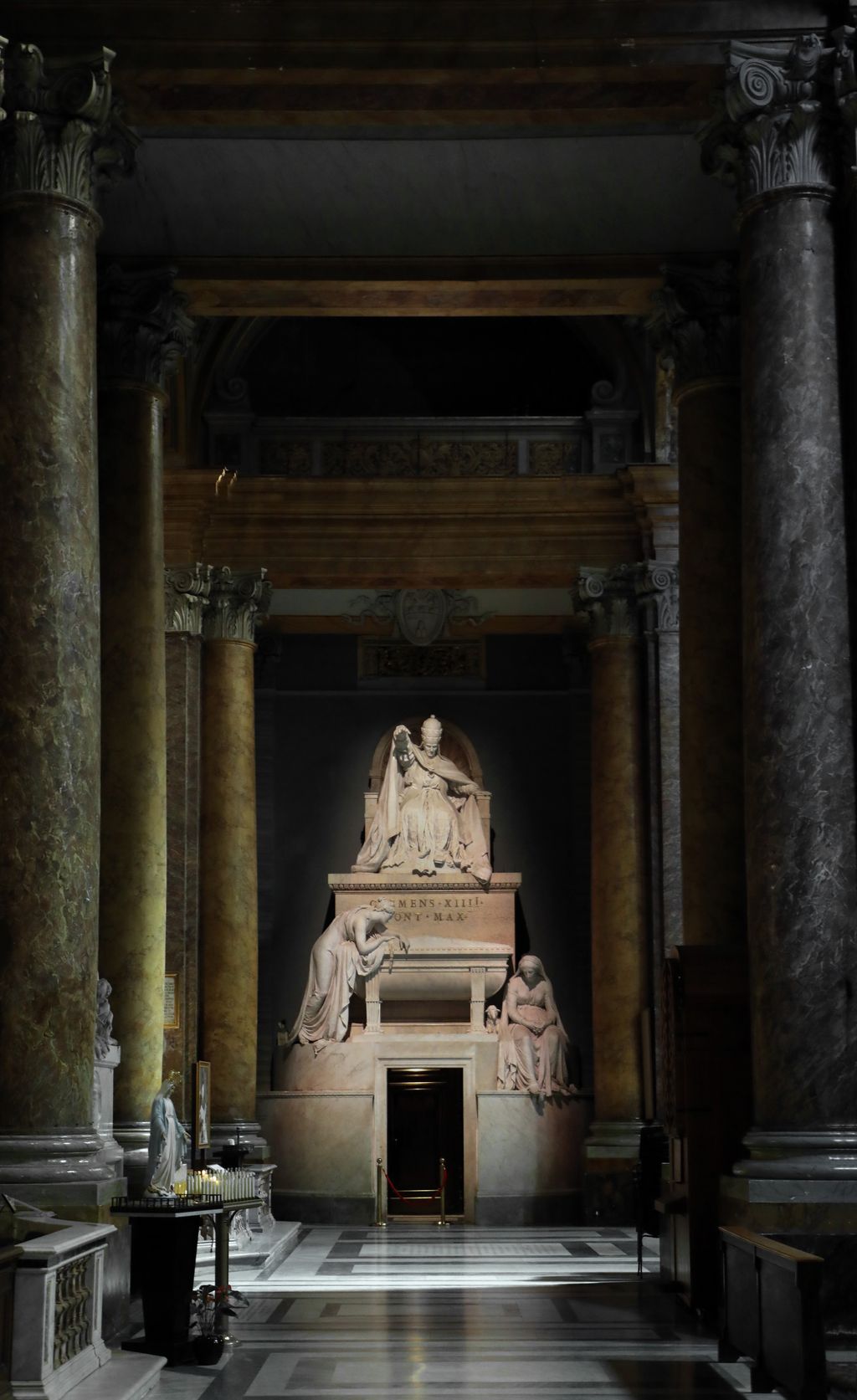
The tomb of Clement XIV above the sacristy doorway at Santi Apostoli in Rome. Sailko. Image source. CC BY 3.0. Resized for display.
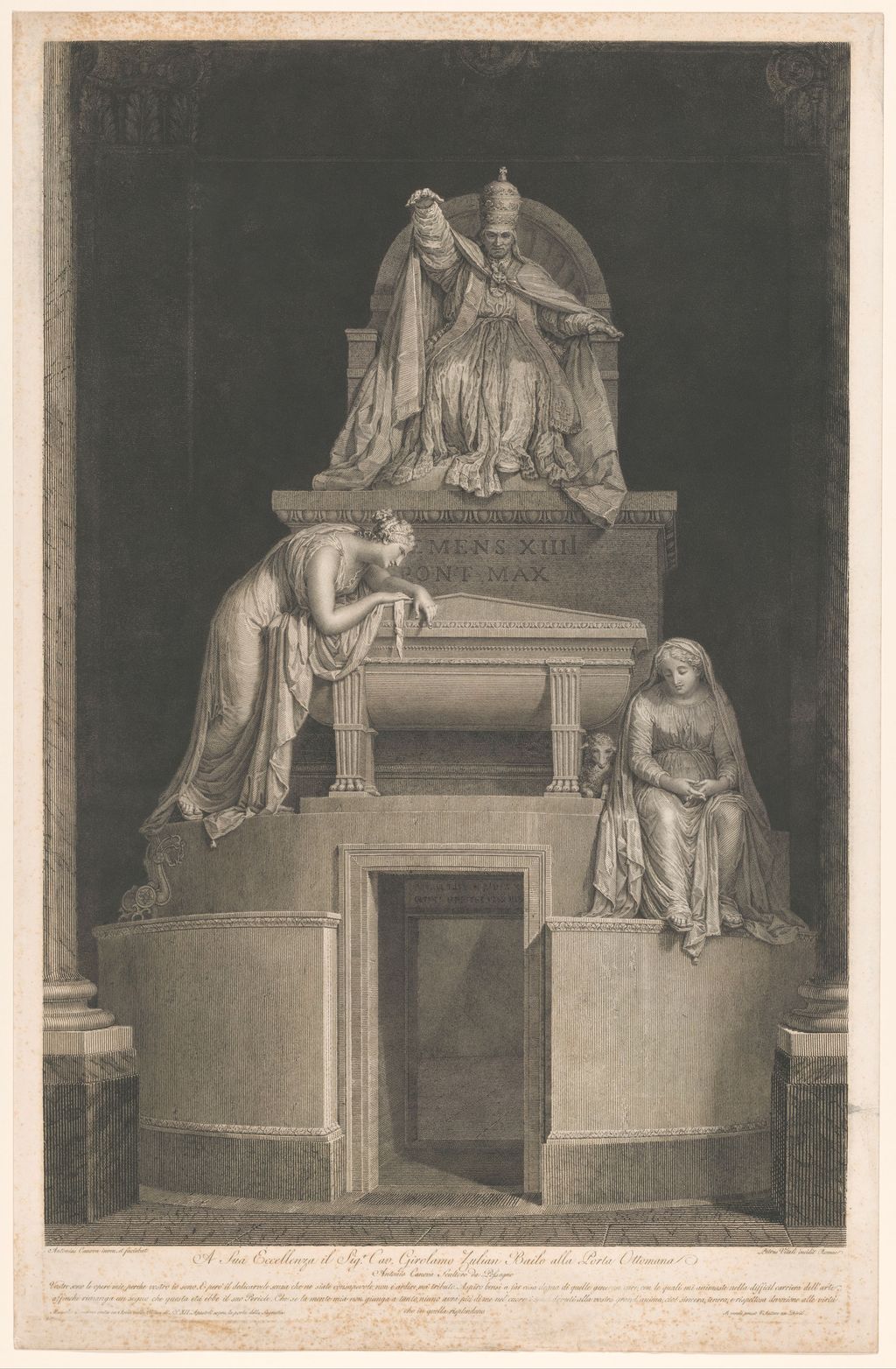
Vitali’s engraved view of the monument, with the dedication below the image. Rijksmuseum. Image source. Public domain. Resized for display.
At a Glance
- Artist and dateAntonio Canova, 1783–87. [1] [4]
- LocationBasilica of Santi Apostoli, Rome, above the sacristy doorway. [1] [3]
- PatronCarlo Giorgi, through Giovanni Volpato. [1]
- FiguresClement XIV above Temperance and Meekness, also called Humility in a design drawing. [2] [3]
Contents
- The doorway and the three levels
- The two figures below the pope
- Giorgi, Volpato and the commission
- Drawings, clay and marble
- What the engravings show
- Annotated details
The doorway and the three levels
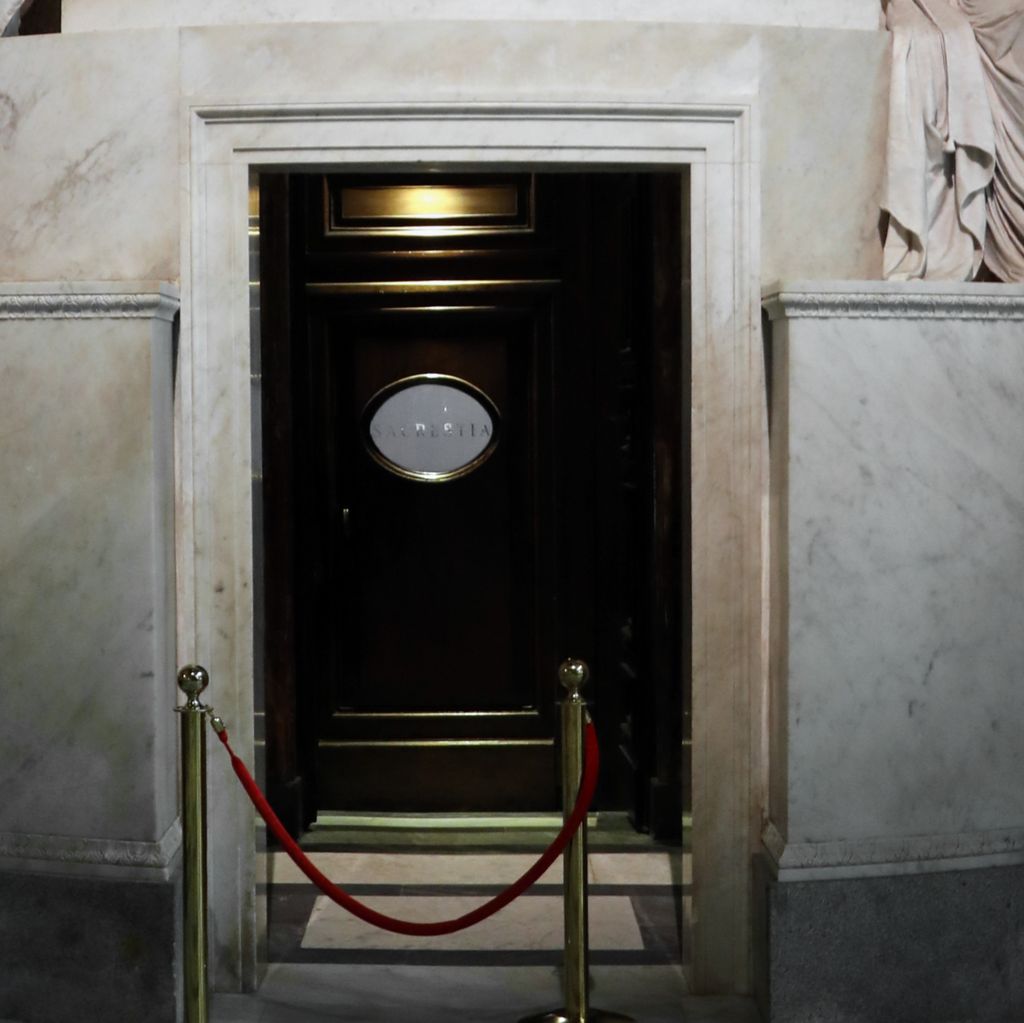
The monument is visible between the church’s columns. Looking along the floor towards it brings the door into view before the smaller forms around the pope’s face can be made out. A plain rectangular moulding sets the door apart from the broad, rounded fronts of the masonry at either side. The lower ledge runs at roughly the level of the seated woman’s feet. The sarcophagus rises directly over the doorway and projects from the plane of the wall, so the lip of its lid and the underside of its rounded bowl cast two different shadows. Its two fluted supports leave a recess that draws the eye back towards the wall. The doorway, the recess under the sarcophagus and the space behind the throne all read as interruptions in the pale stone. [1] [2]
At the next level, an inscription names the pope on a broad panel beneath his feet. It can be read from farther away than his features. An ornamental course separates the inscription from the platform of the throne. The carved fabric falls over the edge of the platform on the right, where it breaks the horizontal line of the stonework. Higher up, the back of the throne curves around the head and shoulders. From below it gives a clear outline to the tiara, while the raised forearm reaches beyond it. The wall and the recess behind the monument provide the dark field against which the arm can be seen. [1] [2]
The actual opening was a constraint from the outset. One design from Canova’s studio, published by Giuseppe Pavanello, labels the existing church architecture and identifies the passage to the sacristy. The architecture of the tomb could therefore be tested on paper against fixed parts of the church. In the installed work, the centre of the doorway lies directly under the centre of the sarcophagus. This alignment gives the asymmetrically arranged statues a common axis. Canova returned to the arrangement of a monument over a door in the Tomb of Pope Clement XIII in St Peter’s. There the pope kneels above the monument and lions occupy the lower level. In Santi Apostoli, two human figures flank the lower structures and Clement sits upright above them. [2] [3] [4] [5]
Annotated Details from Tomb of Clement XIV
The monument at Santi Apostoli in Rome. Photograph by Sailko, CC BY 3.0. Resized, annotated and cropped.
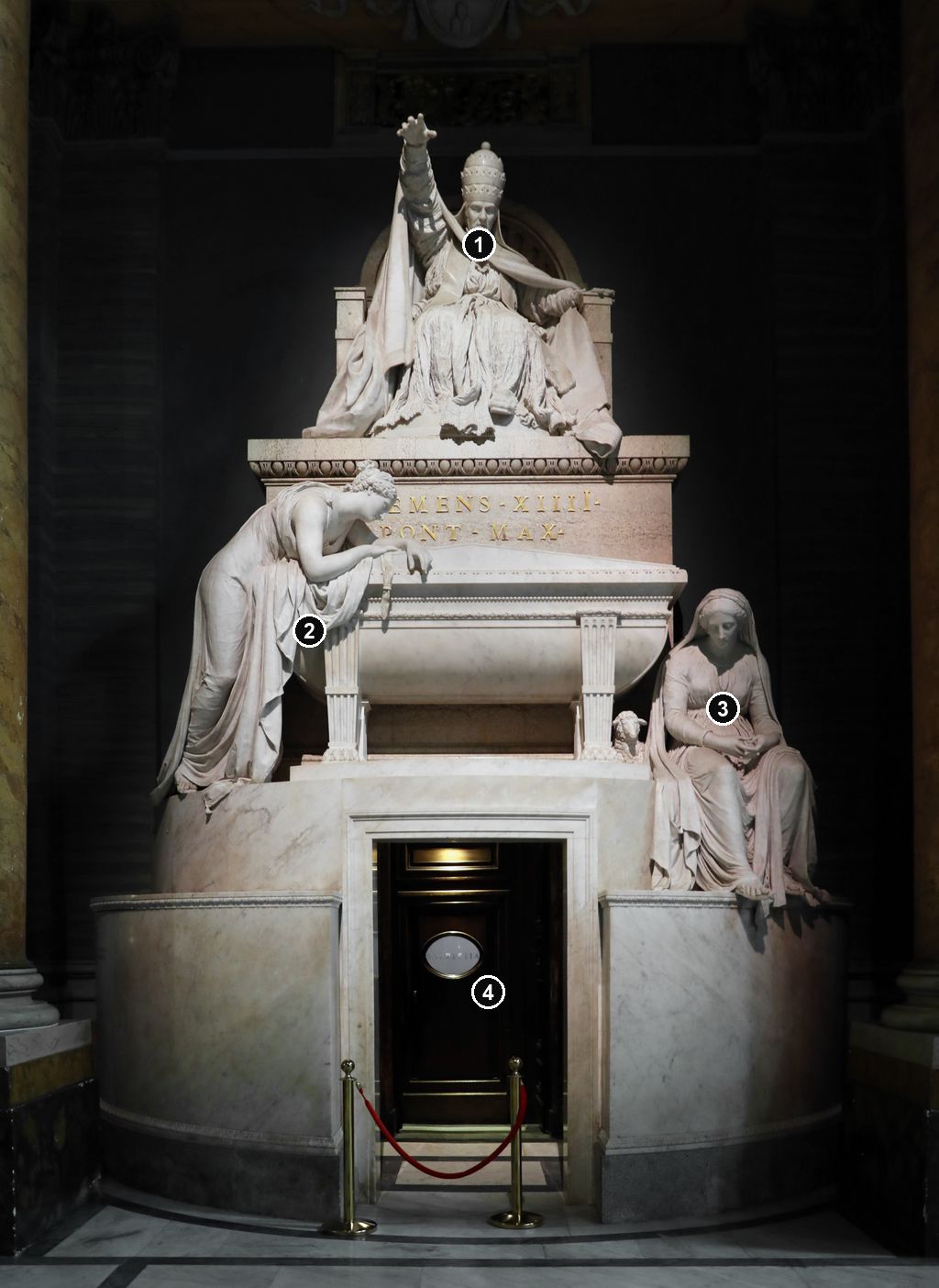
Details from TOMB OF CLEMENT XIV
Read the monument from the seated pope down to the working doorway.
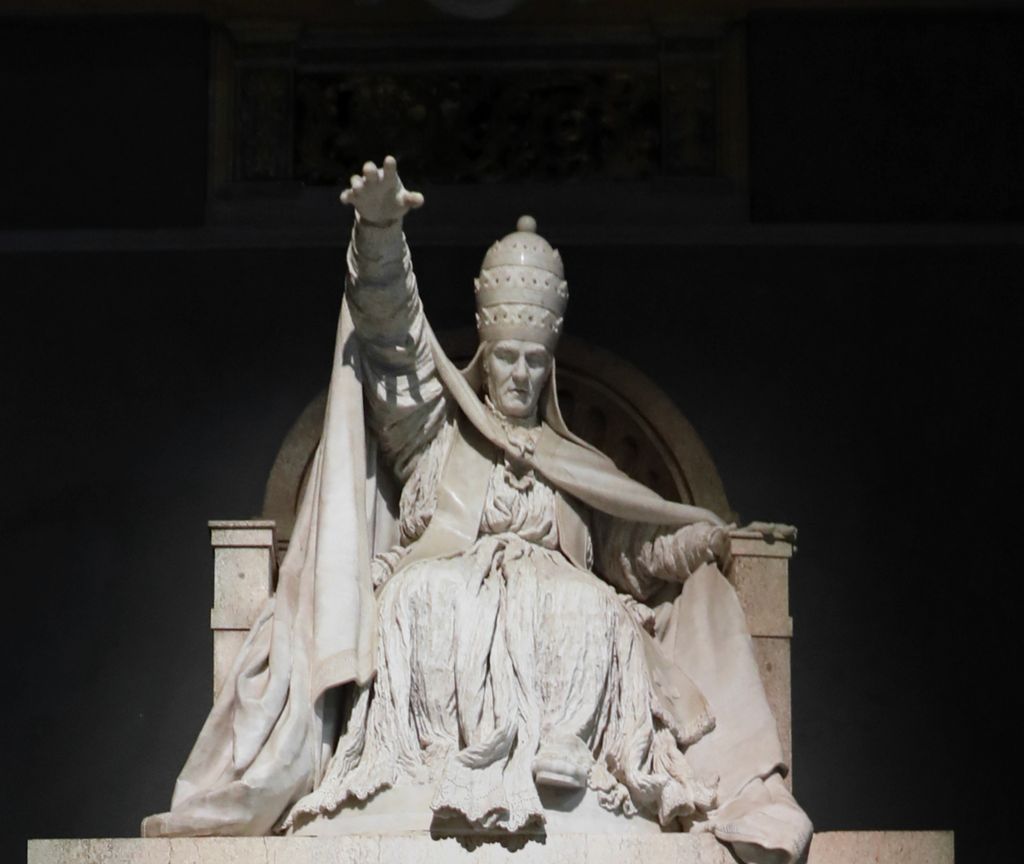
The pope’s raised hand
The seated pope extends his arm above the monument. The hand projects into the space over the viewer.
Temperance
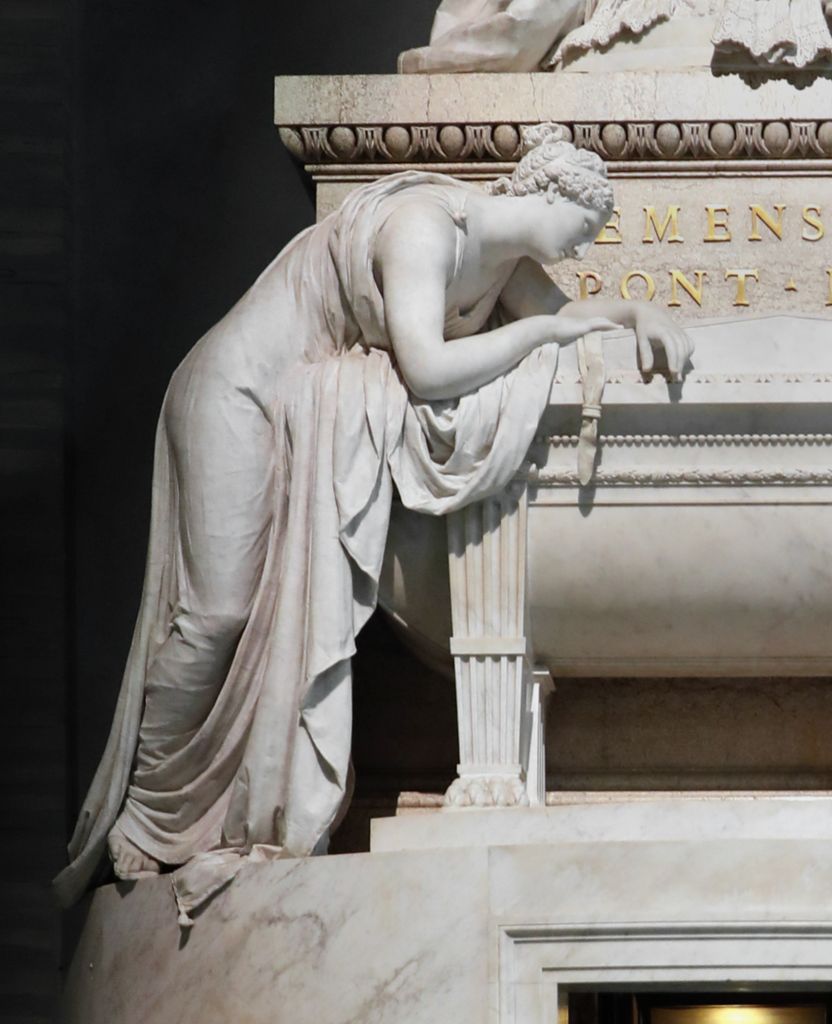
The standing figure bends over the sarcophagus. The folds descend to the ledge at her feet.
Meekness and the lamb
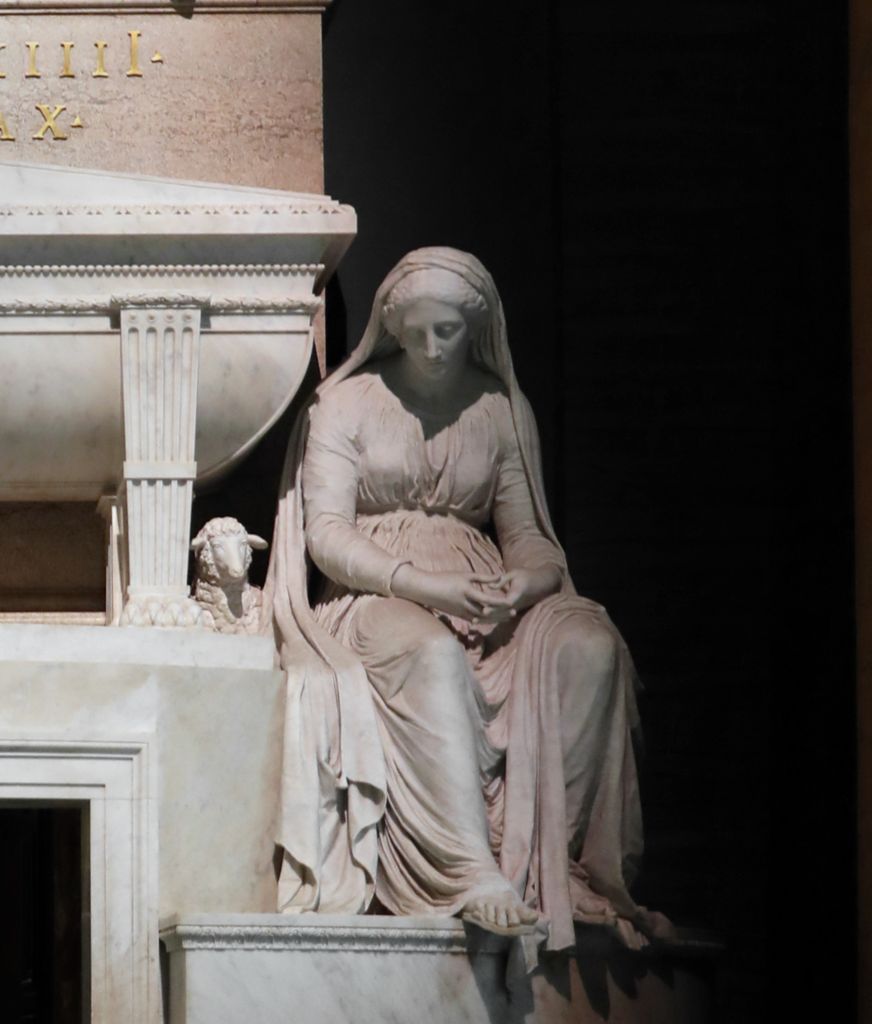
The seated figure occupies the opposite ledge, with the lamb near her side.
The sacristy doorway
The door remains part of the church. The monument rises around the opening.
The two figures below the pope
Temperance stands to the viewer’s left. Her feet are low at the outer edge of the base, and her back bends towards the centre so that her elbows and forearms can come to rest on the lid. The drapery descends from the hip in several long folds and gathers again on the platform beneath her. The face lies close to the forearm. One wrist extends over the sarcophagus, where the fingers hang beyond the carved edge. From across the church those small forms are difficult to distinguish, but the diagonal from the foot to the bowed head is clear. Canova gives the woman a solid object to lean on, allowing the weight of the upper body to register as part of the pose. [1] [2] [3]
Meekness, on the right, sits lower with both hands together in her lap. Her veil falls from the head to the shoulders and surrounds the face with a narrow shadow. The dress gathers at the knees and slips over the ledge. One bare foot emerges from the folds near the base. Beside her is a lamb, close to the right support of the sarcophagus and partly sheltered by it. The lamb is much easier to find once the eye has followed the downward angle of the woman’s head and then looked back towards the centre. The two women are near enough to seem engaged in the same act of mourning. Temperance bends sharply at the waist while the seated figure turns her attention downwards with much less movement. [1] [2] [3]
Pavanello notes that the written key on the early drawing calls the seated figure Umiltà, or Humility. Modern catalogues commonly call the marble Mansuetudine, or Meekness. The alternative names matter because they make different aspects of the same pose legible. The lower position and bowed head suit the older name. The lamb and the hands at rest give the figure a quietness that accords with the later one. The names attach to the seated figure rather than identifying separate figures on the finished monument. [1] [3] [6]
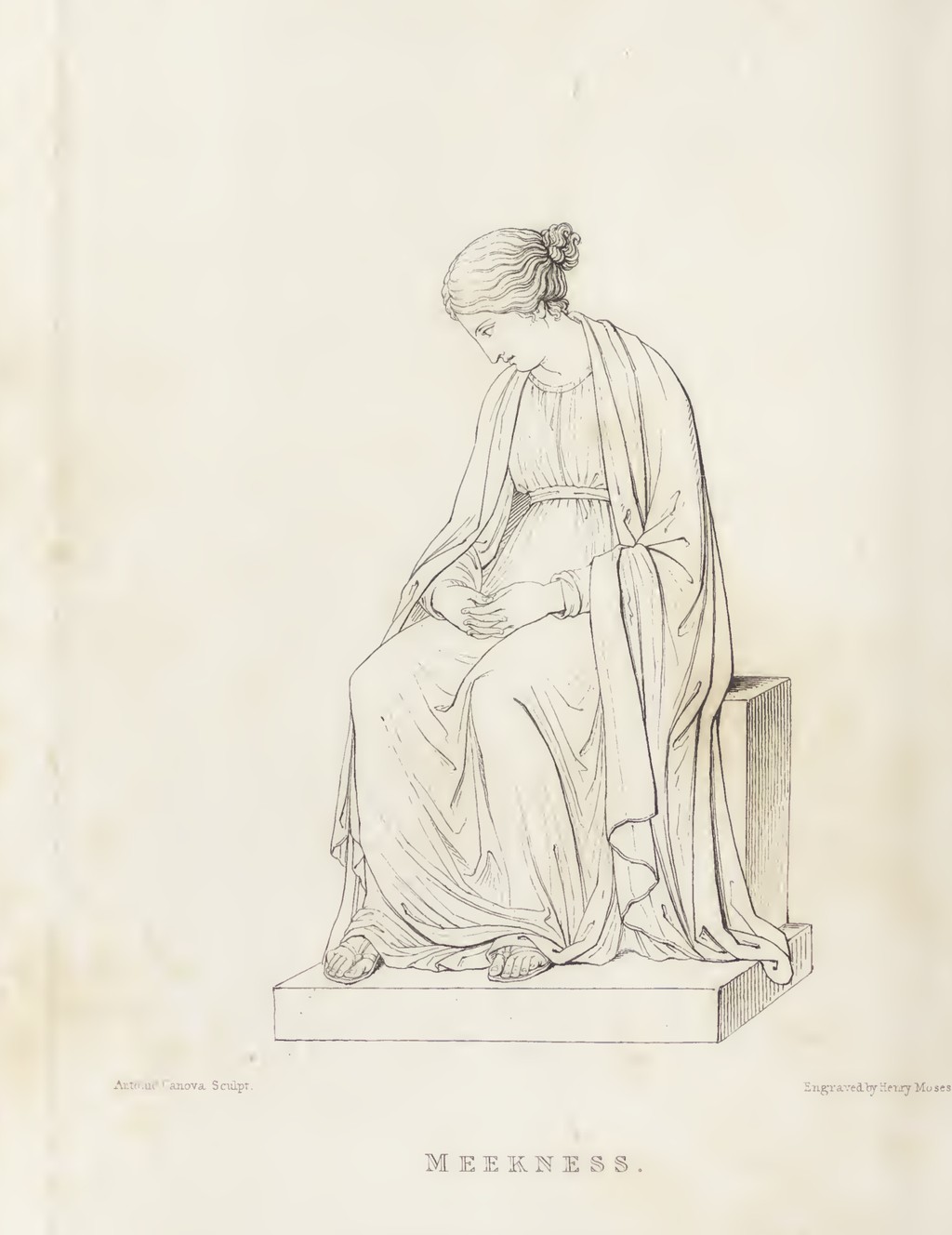
Moses’s plate of Meekness shows the seated allegory associated with the monument. Henry Moses, after Antonio Canova, engraving published in London, 1824. Getty Research Institute. Image source. Public domain. Scan margins trimmed and image resized.
Videos on Canova
Explore Canova’s workshop methods and the settings for his sculpture.
How does an artist copy the 200-year-old techniques of master sculptor Antonio Canova?
A sculptor demonstrates how Canova’s workshop methods can be used to recreate a marble Venus.
Watch on YouTubeGiorgi, Volpato and the commission
Clement XIV, whose family name was Ganganelli, had died in 1774. Giorgi undertook the commission several years later in gratitude for benefits received from the pope. Volpato, a printmaker and dealer with connections in Rome, acted as intermediary. The record of their relationship survives in another work at Santi Apostoli. Canova’s memorial to Volpato carries an inscription crediting his friend with arranging and approving the younger sculptor’s work on Clement’s tomb. In the engraving of that later memorial by Pietro Fontana, a seated woman mourns before Volpato’s portrait, and the inscription can be read beneath the two figures. [1] [4] [7]
The papal figure at the top of the monument is a portrait with a public gesture. The right sleeve falls away in a steep line from the lifted wrist, and a heavy length of mantle sweeps diagonally across the chest. The left arm stays close to the throne. The face inclines towards the floor while the arm rises in the other direction. This separation makes the gesture readable at the height of the statue. For a viewer moving towards the monument, the pope becomes more particular as the form of the tiara, the face and the embroidered surfaces of his clothing come into view. The gesture belongs to an office as much as to an individual, while the name on the block below makes clear whose office it was. [1] [2] [4]
Italy’s national catalogue records the inauguration in April 1787. A sonnet of 1785 published by Francesco Saverio Leopardi shows that Canova already had admirers in Rome while the work was still under way. The opening gave that reputation a permanent object in a public church. It also let viewers judge how the parts worked together at their intended scale. A drawing could show the door in relation to the figures. Only in the basilica could someone approach at floor level, see the papal hand come into view above the other statues and look back from beside the sacristy entrance. [1] [2] [3] [5]
Drawings, clay and marble
The design drawing sent to Giovanni Falier in Venice survives in a private collection in Treviso. It uses brown ink and grey wash, with letters keyed to the architecture, door and figures. The Museo Correr preserves a closely related sheet, inventory 5209. Pavanello attributes the drawing work to Canova’s studio and regards Girolamo Zulian as a possible recipient for the Correr sheet. On the Treviso drawing the pope’s coat of arms is placed above the door. In the church they are higher up, beyond the sculptural grouping. Putting the arms there leaves a clearer stretch of masonry around the doorway and puts a greater distance between the shield and the inscription on the tomb. The sheets show a proposal for how a wall might be organised at a time when some of those decisions were still open. [2] [3]
The 1783 painted terracotta of Clement XIV in Possagno addresses a different part of the design. It allows the body on the throne and the spreading mantle to be judged as a small sculpture. The white surface gives the clay something of the appearance of marble. The National Gallery of Art, which exhibited the model in Canova: Sketching in Clay, suggests that its finish made it suitable for showing to the patron. Small crosses on the model also record a later use in measuring and copying. Two other clay figures, Piety and Humility, document ideas for the lower part of the monument. The gallery describes Piety as an early option Canova went on to alter. Its deep cowl and flowing drapery show how much attention went into a figure whose final form was still undecided. [5]
Francesco Chiaruttini’s pen-and-wash drawing of Canova’s studio in 1786 shows the pope at the next scale. Against the right wall stands a full-size plaster beside the unfinished marble. Frames above the two held weighted lines, from which assistants could establish corresponding positions on the plaster and stone. Two workers operate a rope drill at the marble. The drawing gives some idea of the space a papal figure took up before it was set above the sarcophagus. There was room in the studio to work close to the sleeve, knees and face. In the church the same forms would have to carry across several metres of space, with the viewer looking up from below. [5]
What the engravings show
The Istituto Centrale per la Grafica places Pietro Maria Vitali’s engraving of the monument shortly after its installation. His first state, preserved in a Corsini impression, carried a coat of arms and a dedication to the Venetian diplomat Girolamo Zulian. The first state also includes the surrounding columns and the papal arms high above the throne. The copper was later cut down and the dedication recut without the shield. In a third state the dedication was scraped away. Payments in 1811 and 1812 document work on the copper and its lettering. The altered print had a history distinct from the stone monument. Someone buying it in Rome or through a bookseller could see the disposition of door, sarcophagus and throne alongside words that also recorded the sculptor’s obligations to a supporter. [8] [9]
Angelo Balestra’s engraved plate of Mansuetudine, after a drawing by Giovanni Tognolli, detaches the seated woman from the whole monument. The Istituto dates the matrix to 1818 and gives a much later date range for one of its impressions. Balestra turns the seated figure at an angle, places her on a simple rectangular plinth and leaves the lamb out of view. The folds around the knees and the fingers clasped in her lap become easier to see. The two prints offer quite different ways of looking at the figure. Vitali sets her beside the doorway and sarcophagus so that she occupies only a small part of the design. In the basilica the seated woman occupies the lower right edge of the ensemble. On a sheet devoted to her, the same lowered head and still hands become the centre of attention. [8] [10]
Explore Canova’s works
Browse the sculptures and paintings covered in this guide. Several entries compare versions or examine details of a larger work.
Discussion
Look again at the images and ideas explored in Tomb of Clemens XIV. These editorial prompts invite your observations.
Reader Insights
How does the doorway affect the way you read the monument?
What changes in the composition as your eye moves up to the pope?
Join the Conversation
Share a detail, comparison or question about Tomb of Clemens XIV below.
References
- Ministero della Cultura, Monumento funebre, complesso decorativo, national catalogue 1200143629-0, with component records. View source.
- Sailko, Tomb of Clemens XIV by Antonio Canova, photographs of the installed monument in Santi Apostoli, 17 March 2023. View source 1. View source 2.
- Giuseppe Pavanello, I primi scritti di Antonio Canova, figs. 2–4 and notes 7–9, analysis of the studio designs and papers. View source.
- Victoria and Albert Museum, Antonio Canova – an introduction, the papal tombs and the sculptor’s career. View source.
- National Gallery of Art, Canova: Sketching in Clay, exhibition texts on the papal tombs, the three terracottas and Francesco Chiaruttini’s studio drawing. View source.
- Fondazione Federico Zeri, photographic catalogue, Ritratto di papa Clemente XIV, Allegoria della Temperanza, Allegoria della Mansuetudine, record 84532. View source.
- Wellcome Collection, Pietro Fontana after Canova, A woman personifying friendship weeps before the bust of Giovanni Volpato, 2499383i. View source.
- Istituto Centrale per la Grafica, Pietro Maria Vitali, Monumento funerario di Clemente XIV, first-state impression S-FC51729. View source.
- Istituto Centrale per la Grafica, Pietro Maria Vitali, Monumento funerario di Clemente XIV, engraved matrix M-1298. View source.
- Istituto Centrale per la Grafica, Angelo Balestra after Giovanni Tognolli and Canova, Mansuetudine, matrix M-1261 and corresponding impressions. View source 1. View source 2.


 Antonio Canova.jpg)


