



 by Tom Gurney
Tom Gurney BSc (Hons) is an art history expert with over 20 years experience
Published on June 19, 2020 / Updated on November 13, 2026
Email: tomgurney1@gmail.com / Phone: +44 7429 011000
Venus Victrix: Introduction
The apple in Pauline Bonaparte’s left hand is easy to overlook. It sits against her thigh, partly enclosed by her fingers. At the other end of the chaise, her right elbow presses into a cushion and her fingertips touch her head. Antonio Canova carved the woman, the apple and the yielding cushions in marble. Underneath, a painted wooden frame carries the weight of the stone. The apple identifies the goddess, while the chaise places the portrait in a room Camillo and Pauline might have recognised. [1] [2]
Prince Camillo Borghese commissioned the sculpture in 1804, the year after he married Pauline. The Borghese dates its Carrara marble to 1804–08 in the formal record for inventory LIV. The introductory text gives the broader span 1804–10, while the catalogue documents a payment of 6,000 scudi on 15 May 1808. It gives a height of 92 centimetres for the sculpture and 160 centimetres with the bed. The ensemble is displayed in Room 1 of the Galleria Borghese in Rome. [1]
Venus Victrix Antonio Canova
At a Glance
- Object1804–08
This work across Antonio Canova’s career
Mars and Venus
1815–19 Collection recordThe Three Graces (Bedford marble)
Completed by 1817 Collection recordContents
- What the apple tells us
- A portrait for Camillo Borghese
- Marble upholstery and an Empire chaise
- Turning the sculpture and lighting the marble
- From Turin to the Paolina Room
- The plaster in Possagno and the portrait on paper
- Venus Victrix and Venus Italica
- What remains when the chaise is taken away
- Annotated details
What the apple tells us
Venus Victrix means Venus Victorious. The victory at issue is the Judgement of Paris. In the account preserved in the Library attributed to Apollodorus, Strife casts an apple as a prize of beauty and Zeus assigns the judgement to the Trojan prince Paris. Hera offers him sovereignty and Athena victory in war. Aphrodite, the Greek goddess identified with the Roman Venus, offers him Helen. Paris chooses Aphrodite and sails to Sparta. The promise sets in motion the events that lead to the Trojan War. [3]
Canova chooses a moment in which the contest is over and the fruit has changed hands. There is no need for three goddesses or a judge in the sculpture. Pauline’s left arm slopes down across the composition, and the wrist turns just enough for the apple to be seen. The relaxed grip makes it look as though she has held it for some time. Its position also sets up an interesting imbalance. The head, raised elbow and stacked pillows command one end of the composition, while the attribute that gives the work its title lies close to the middle. A person studying the face has to look away from it to read the myth. [1] [3]
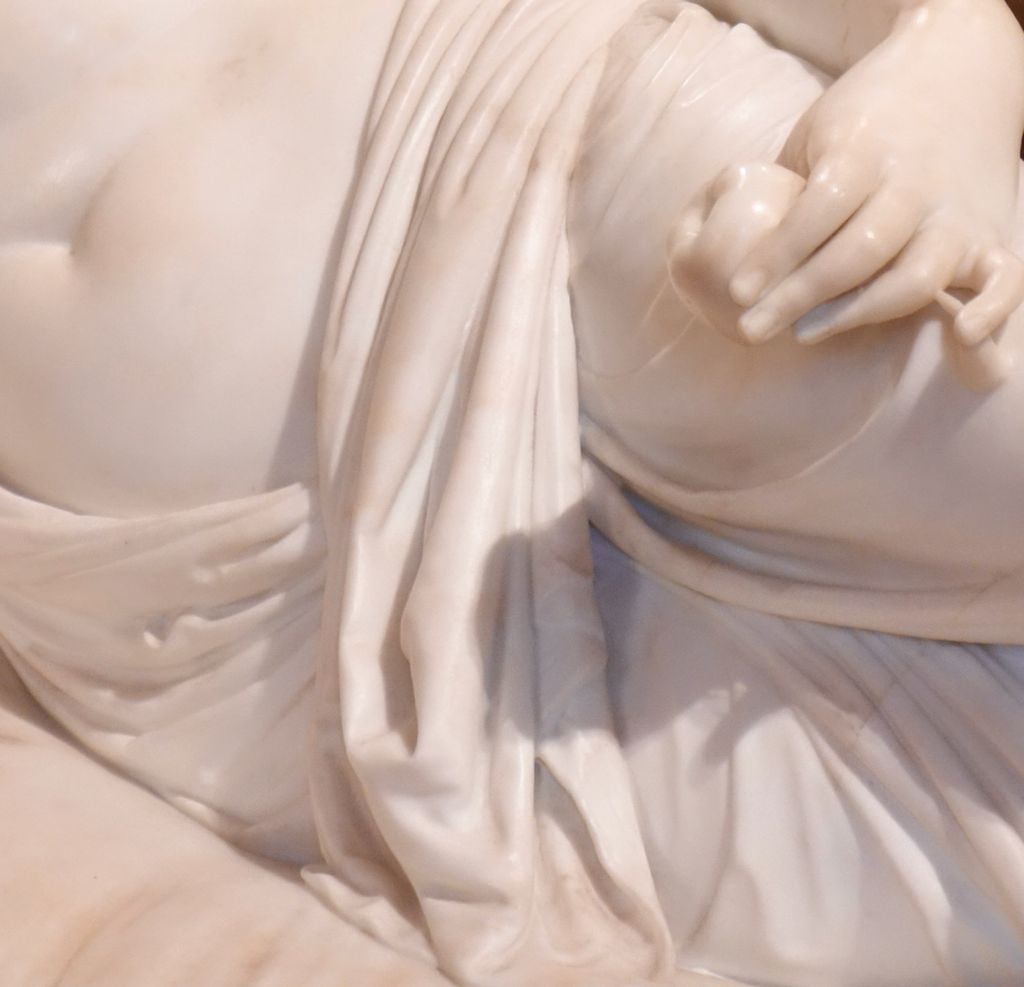
The gesture at the head and the gesture at the hip have different effects. The right hand bends back to the hair, where the small curls offer a cluster of shadows around the fingers. A bracelet picks out the bend of the raised wrist. The left hand brings another round form into view beside the long ridges of the drapery. From a low or oblique angle those fingers can nearly swallow the apple’s outline. Seen more squarely, the curve of the fruit stands apart from the thumb. The story depends on a few centimetres of carefully positioned marble. [1]
Annotated Details from Venus Victrix
This view of the Borghese marble brings Pauline’s gesture, the apple and the carved fabric into view. Photograph by Sonse, Flickr, CC BY 2.0. The photograph was resized, annotated and cropped for the details.
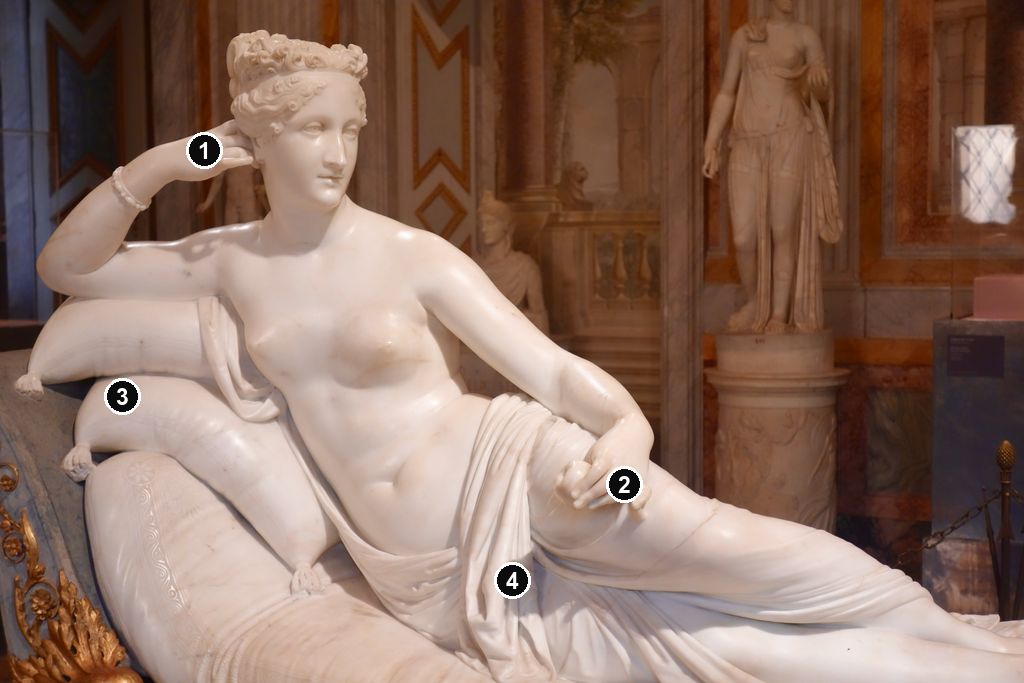
Details from VENUS VICTRIX
Follow the two hands, then compare how Canova carved the drapery and cushions.
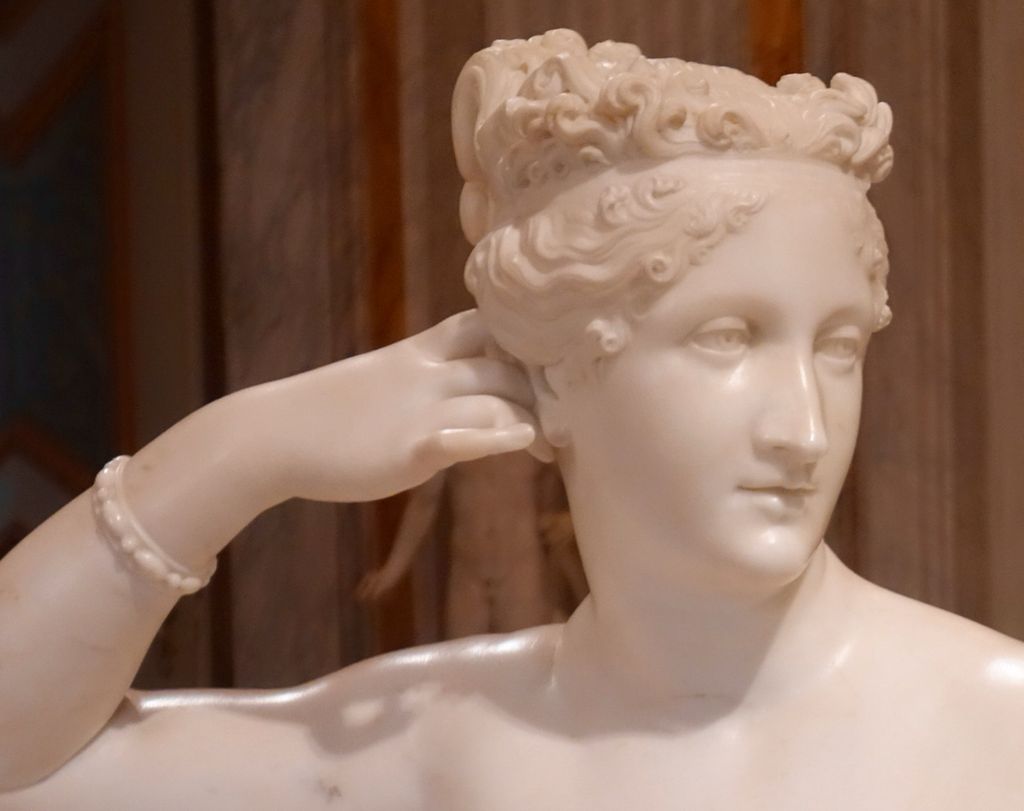
Hand at the temple
Pauline raises one hand to her head. The fingers rest lightly, and the elbow is supported by the pillows below.
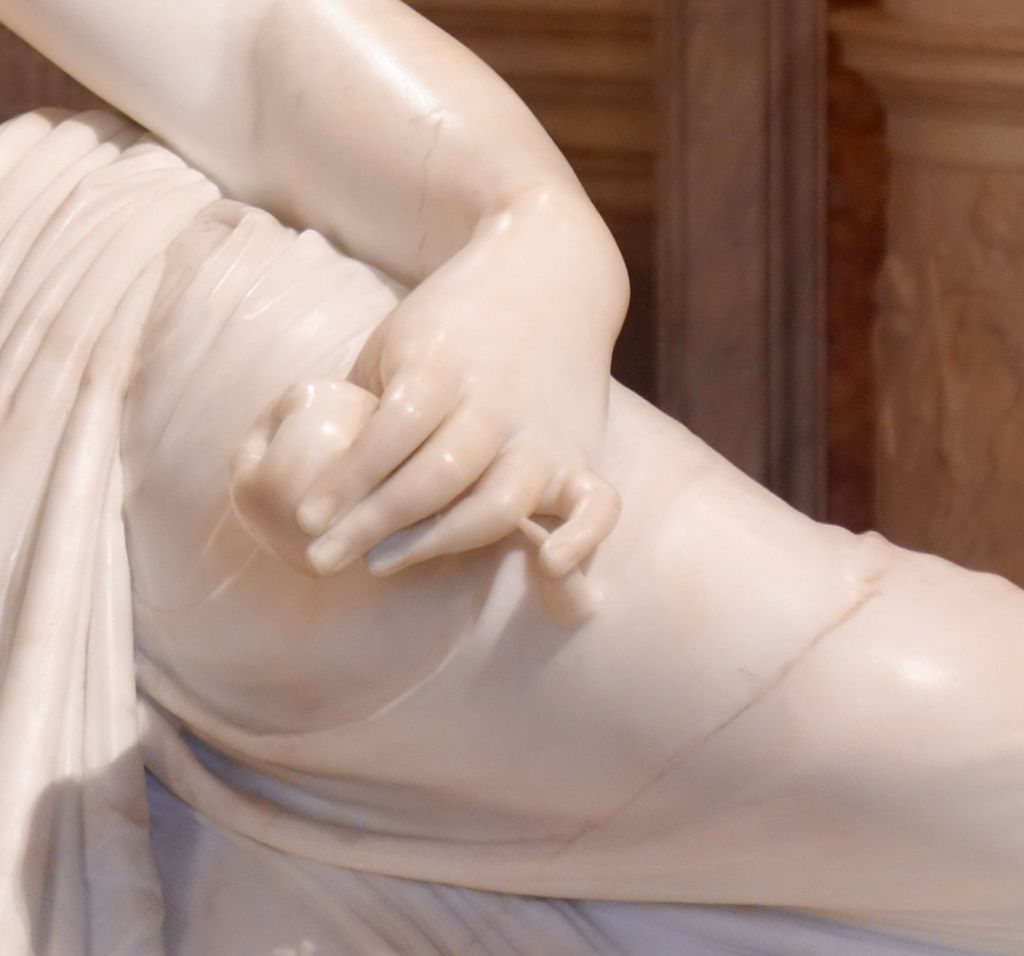
Apple of Venus
Pauline holds the apple that identifies her as Venus. It sits low against her lap, where the hand and nearby folds can partly conceal it as the view changes.
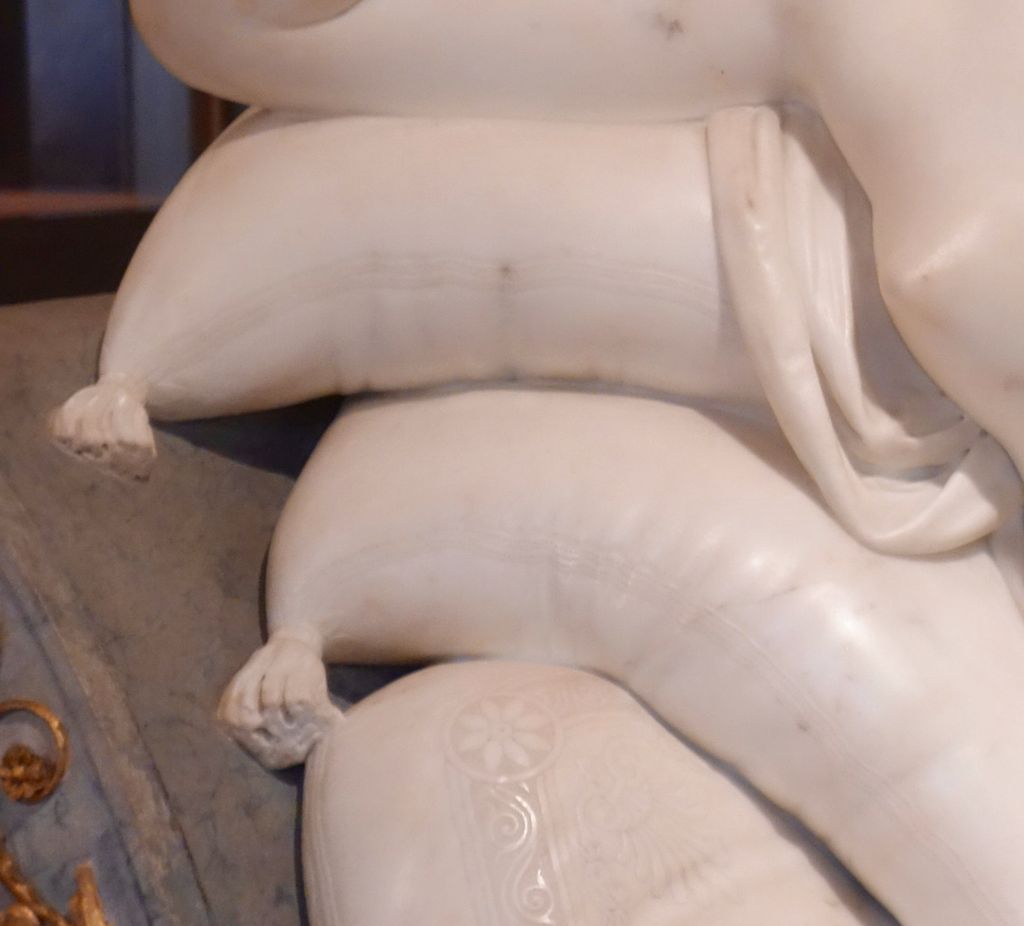
Carved cushions
The pillows support the raised elbow. Rounded edges and deep gaps between the cushions suggest the weight of one pillow resting on another.
Drapery at the hip
The cloth gathers in deep folds where it meets the bare torso. The grooves catch shadows that make the smoother surface of the body stand out.
A portrait for Camillo Borghese
Pauline, known in Italy as Paolina, was Napoleon’s sister. She was twenty-three and already the widow of General Charles Leclerc when she married Camillo in Paris in 1803. Napoleon was still First Consul. His sister’s marriage connected the Bonapartes to a long-established Roman family, and the couple moved to Palazzo Borghese in Rome. The commission followed in 1804, as Napoleon became emperor. In that setting, giving the princess the bearing and attributes of an ancient goddess was a way to make a recent alliance look at home among the Borghese family’s classical collections. The choice also offered a compliment personal enough to suit a portrait commissioned by her husband. [1] [4]
The raised head carries much of the portrait’s individuality, down to the way the curls sit above the hairband. The abdomen and shoulders are shaped in broad transitions with few interruptions. The Borghese classifies the work as an ideal portrait in the graceful register of Canova’s sculpture. Look at where his two aims meet. The coiffure belongs to a woman who could be recognised at court, while the slight turn of the head lets the face keep its composure above the fully exposed torso. The apple supplies the role in which the princess appears. [1]
The Museo Gypsotheca Antonio Canova says that Pauline sat in person. The Borghese recounts the gossip about whether she sat unclothed, including a remark attributed to Pauline about dropping a veil before Canova. The story circulated because viewers were interested in the relationship between the princess and the figure on the couch. The bare torso also belonged to a long-established way of representing Venus. [1] [5]
Canova’s portrait of Napoleon as Mars the Peacemaker gives a related problem a different physical form. Napoleon stands and holds up a globe carrying a small winged Victory. Pauline reclines and keeps the token of her victory low against her body. The elevated emblem and upright stance give her brother a commanding profile. In Pauline’s portrait the identifying object is so close to her body that it can escape notice at first. [1] [5] [6]
Marble upholstery and an Empire chaise
The chaise follows the agrippina type, a fashionable form in Canova’s time with an elevated end for reclining. The Borghese relates the pose to figures on Etruscan and Roman sarcophagi. A figure on a lid has to make sense against a long horizontal support. Here, too, the pose becomes legible through a series of changes in height. The raised end brings the pillows under the elbow. The shoulder lifts the head above the mattress. At the hip the contour drops and the legs stretch out into the long space the furniture provides. The reference to antiquity runs through a piece of contemporary furniture and the way someone might use it. [1] [2]
The cushions deserve a closer look. One bulges past the right elbow and ends in a tassel. The second supports the torso at a different angle, and the mattress beneath them shows its own shallow depressions and creases. These are three scales of apparent compression. The elbow bears on a small area of cushion, the torso puts pressure on a broader surface, and the mattress yields along the length of the body. Across the front edge, shallow lines in the marble suggest the texture and seams of upholstery. The frame below has a harder outline, with gold-coloured ornament set against painted wood. [1] [2]
The pale hanging swags below the mattress belong to the furniture and its mount. The carved folds across the hips belong to the marble figure. The lower swags repeat across the side at intervals set by the frame. Above them, the cloth gathers unevenly where it meets the bent thigh and draws out into longer folds across the legs. Follow a fold towards the front and the heavy pile at the edge of the mattress becomes visible. Those irregular folds help explain the position of the body underneath. [1] [2]
One precedent had belonged to the Borghese family. In 1620 Gian Lorenzo Bernini supplied a marble mattress and pillow for the ancient Sleeping Hermaphrodite, now in the Louvre. The ancient figure rolls into the bedding, which rises around the body in rounded folds and depressions. Canova’s figure is awake and props herself on one elbow. The response of the carved mattress to weight remains central to both works. It is one thing to polish marble until it catches the light and another to give an apparently rigid slab the shape that cloth takes under a reclining body. [1] [7]
The timing makes the comparison especially pointed. While Canova was working on Pauline’s portrait, the ancient sculpture with Bernini’s bedding was among the Borghese antiquities sold to Napoleon and taken to Paris. The gallery records Canova’s opposition to the sale. Another Sleeping Hermaphrodite, which Andrea Bergondi had fitted with its own marble bedding in the eighteenth century, was moved to the Villa Pinciana in place of the departing work. Canova’s handling of the mattress shows how much that established Borghese interest in reclining figures and carved upholstery could contribute to a portrait of a living member of the family. [1] [4] [7] [8]
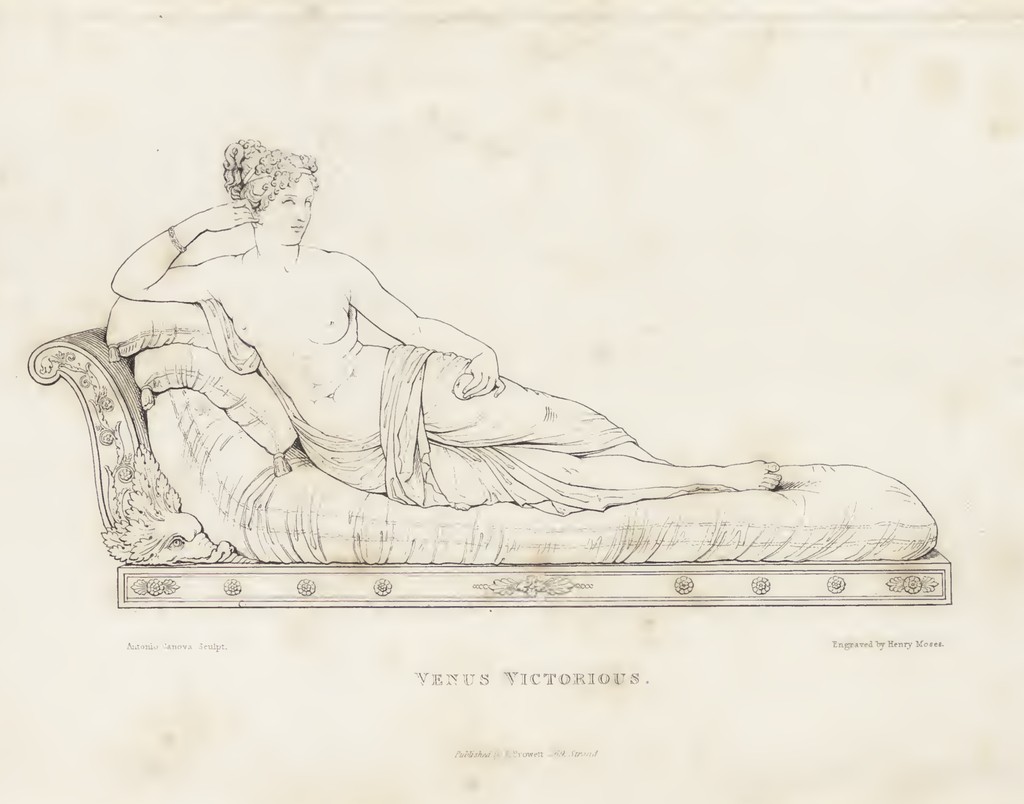
Moses’s front view records the cushions, mattress and carved profile of Pauline’s chaise. Henry Moses, after Antonio Canova, engraving published in London, 1824. Getty Research Institute. Image source. Public domain. Scan margins trimmed and image resized.
Videos on Canova
Explore Canova’s workshop methods and the settings for his sculpture.
From Sketch to Stone | Canova: Sketching in Clay
Watch sculptor Fred X. Brownstein recreate a Canova Venus, using clay, plaster and marble.
Watch on YouTubeTurning the sculpture and lighting the marble
The Borghese records a mechanism made in Turin that allows the ensemble to turn on a central axis. It sits beneath the chaise, concealed by the hanging drapery at the base, and was restored to working order in 1997. The mechanism permitted a full revolution. The museum also dates the addition of two lion feet to the bed to 1953. The added feet changed the silhouette of the furniture beneath the carving. [1] [2]
Start from the long side and move towards the foot end. The length of the chaise that was so clear in profile begins to contract. The toes and the near edge of the mattress now project towards you, and the distance from the apple to the face seems to shrink. A view nearer the head gives the two cushions more prominence. The stacked forms and the high end of the woodwork take on a bulk that a side view can flatten. From the back, the contact between body and bedding takes the place of the apple as a guide to the pose. The revolving mount could bring those views to someone in a fixed position. [1]
Lighting could change just as much as angle. The Borghese records that Canova entrusted the carving of the marble to assistants and took charge of the finishing, working down to progressively finer abrasives. Sonja Felici’s catalogue entry cites Leopoldo Cicognara’s 1824 account of the application of acqua di rota to the marble. This was water used at the grindstone when sharpening tools. The Borghese describes a rosy lustre associated with the treatment. The effect is easiest to understand by looking at the variety of surfaces. Across the shoulder, polished stone presents a wide curve to the light. In the creases beside the hip, narrow ridges interrupt the highlight and cast small shadows. Shifting the light across the sculpture makes those differences more pronounced and can change where the edge of a fold seems to fall. [1]
After the portrait returned to Palazzo Borghese in Rome, it could be seen by torchlight. In his 1834 biography, Antoine-Chrysostome Quatremère de Quincy describes visitors obtaining permission to see it at night and the installation of a barrier when crowds pressed close. He argues that torchlight could bring out fine passages of carving and expose careless ones. A torch held to one side can bring a bright patch to a cheek while the shadow under the hand deepens. The care with which Canova treated the shallowest changes of surface was open to scrutiny. [1] [9]
Caroline van Eck, Miguel John Versluys and Pieter ter Keurs place this account alongside Melchior Missirini’s biography and a letter Canova sent to Vivant Denon in 1811, in which the artist discussed what the illumination brought out in his treatment of flesh. The historians relate such viewings to a wider practice that had developed in late eighteenth-century Rome. The torch and the rotating mount offered two ways to vary a spectator’s view. One shifted highlights and shadows across the surface. The other brought different sides of the sculpture into sight. [1] [10]
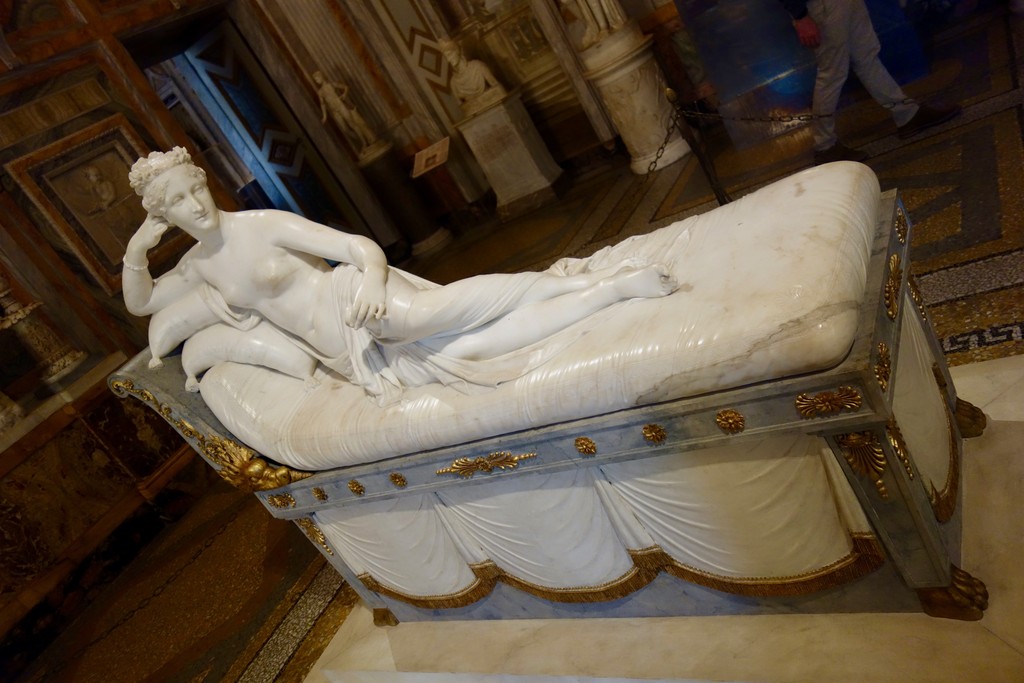
An oblique photograph shows the full length of the Borghese chaise and the raised end beneath Pauline’s cushions. Galleria Borghese, inv. LIV. Photo by Sonse. Image source. CC BY 2.0. Resized from source.
From Turin to the Paolina Room
The finished portrait went to Palazzo Chiablese in Turin in 1809. Camillo was then governor-general of the transalpine departments, and the palace served as his residence. In 1814 the statue travelled back to Rome by sea from Genoa and was installed in the family palace at Campo Marzio. It appears in the 1833 Borghese inventory. Five years later it was moved to the Villa Pinciana, where it was placed in the Room of Paris and Helen. There, the names of the room and its sculpture pointed to the same story. The woman on the bed holds the award that Paris gives her before setting out for Helen. [1] [3]
The portrait reached its present position in 1889, beneath Domenico de Angelis’s painted episodes from the story of Venus and Aeneas. That pairing places a different part of the goddess’s story above the marble. Venus is the mother of Aeneas, and in the vault her importance extends beyond the judgement that gave her the apple. There is a shift, too, in how the picture and sculpture occupy the room. To see the painted story you look up. To make sense of the small narrative attribute in Pauline’s hand, you have to look down along the inclination of her arm. The Italian state purchased the sculpture with the gallery in 1902. [1] [4]
The plaster in Possagno and the portrait on paper
Preparatory drawings survive at the Museo Civico in Bassano, and the Museo Gypsotheca Antonio Canova in Possagno preserves the plaster model. The Borghese records that the plaster still carries the marks used as reference points for transferring the composition to marble. In pointing, measurements taken from fixed landmarks on the plaster guide the removal of stone and establish the depth of particular features. For a reclining figure, those relationships include the height of the supported elbow, the tilt of the torso and the distance from the hip to the feet. Carving and finishing still determine how the final surfaces catch the light and how the softer forms meet the sharper ones. [1] [5] [11]
The plaster reached Possagno in 1829. Wartime bombardment damaged it in 1918. A photograph from the period shows the model missing its head and the hand raised towards it. The museum’s guide records the restoration of the complete form in 2004, and its 2021 annual report documents further conservation after damage the previous summer. This history changes what can be inferred from a comparison. The model preserves the arrangement of body, cloth and bedding at full size. For the finer details of the face and raised hand, its condition and restoration history matter alongside the surviving surface of the Roman marble. [5] [12] [13] [14]
Engraving could carry the portrait farther than either full-size object. The Istituto Centrale per la Grafica records a print by Domenico Marchetti after Luigi Durantini’s drawing, produced by etching and engraving for the Calcografia Canova. Its catalogue dates the plate to the first quarter of the nineteenth century and identifies impression S-FN29124 as a second state with censorship and a dedication from Canova to Lord Cawdor. A rear-view print in Possagno by Angelo Bertini, also after Durantini, carries a veil added at the Calcografia’s request, according to the Italian national catalogue. The two records show how reproductions could make different views available on paper while changing what the audience was allowed to see. [15] [16]
Copies also took sculptural form. The Italian national catalogue records a nineteenth-century example in the Fondazione Accorsi-Ometto in Turin, signed C. Fossi, with the maker’s given name unresolved. Turin therefore appears in the histories of two different objects. Palazzo Chiablese was an early home for Canova’s marble, while the Accorsi-Ometto example belongs to the later history of the design’s replication. [1] [17]
Venus Victrix and Venus Italica
Canova’s Venus Italica in Florence gives the same goddess a standing pose. The Uffizi describes her as drying herself after bathing. Her hands draw the cloth across the front of her body, and the head turns away from the direction in which the torso faces. The upright silhouette makes the slight turn of the head and the narrowing of the form near the ankles especially evident. A vessel by the feet fixes the scene at the bath. From the side, the cloth held in front of the body has a depth of its own. [18]
In the Borghese portrait, drapery is already gathered around the hips and falls across the bed. The left hand has been freed to hold the apple, the right to complete the line from the elbow to the head. Instead of following a standing body from the feet upwards, the eye travels between two separated gestures. The raised hand marks where Pauline’s weight meets the cushion and the low hand holds the prize that names her as the victorious goddess. At the Borghese, those gestures and the long stretch of mattress between them give the viewer a reason to move along the chaise. [1] [18]
What remains when the chaise is taken away
The British Government Art Collection catalogues a half-length marble version of the portrait, accession 16759. The format brings the sitter’s upper body forward and gives her less space in which to appear to recline. In Rome the couch and the length of the drapery establish how far the pose extends beyond the head and shoulders. That breadth sets up a long delay between seeing Pauline’s face and noticing the apple. In an abbreviated version the comparison begins with what the sculptor has retained of the likeness and how much of the surrounding furniture and pose can be inferred from it. The collection’s identification of the subject still depends on the connection to the larger composition. [1] [19]
A marble in the Athenaeum of Philadelphia preserves the whole length of the day-bed in a smaller format. Its catalogue dates it to about 1811 and attributes it to Canova. At thirty-nine inches long it is much shorter than the Borghese marble. The Athenaeum notes that its figure lacks the bracelet and does not extend the little finger in the same way. These are small changes compared with the decision to keep the figure, day-bed and fruit together. The scale makes it possible to see the arrangement at a glance. The Rome portrait rewards a slower movement from the bedding to the figure and back again. The Philadelphia record gives the gift of Stewart Huston as its provenance. [1] [20]
The Getty’s photographic collection preserves another kind of reduction. A photograph catalogued under Pauline’s name keeps the reclining figure on the couch and fixes the direction of her gaze in a single view. The photographer can determine how far the end of the chaise overlaps the body and whether the apple is easily legible. Those decisions are made for the person looking at the photograph. In the sculpture, the person looking can move to a different angle, or the couch can turn on its axis. Compare the photograph with the plaster at Possagno and two distinct uses of reproduction emerge. One records a selected view of the finished portrait. The other preserves the form at a stage when the workshop could still use it to establish points in the stone. [1] [13] [21]
Two engraved views in the London edition of Canova’s works, published in 1824, turn the experience of moving around the chaise into a sequence on paper. Henry Moses’s plates show the same sculpture from opposite sides. The hand with the apple helps organise one view. In the other, the elbow and cushions make the recline intelligible before the attribute does. The engraver could preserve the outlines, the frame and the changing overlap of the limbs. The play of torchlight on the polished surface had to be left to the reader’s imagination. With the sculpture still in a private palace, the paired plates gave a reader outside Rome a way to compare those views. [22]
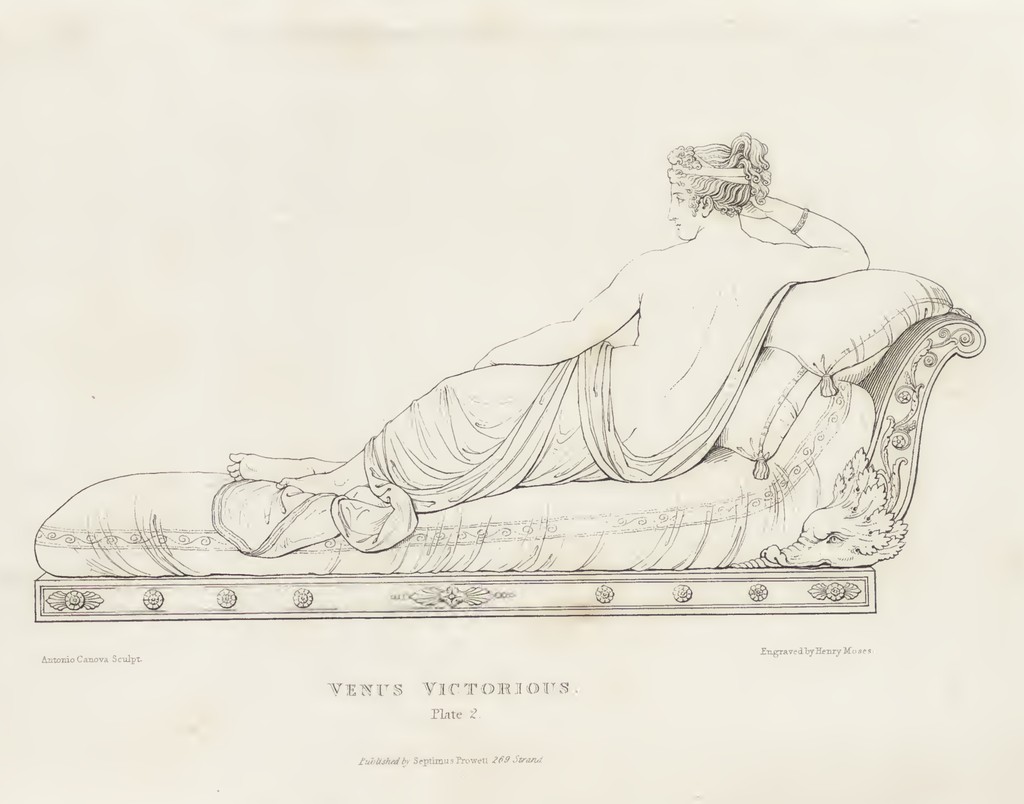
Moses’s rear engraving shows how the mattress, drapery and couch read from the other side. Henry Moses, after Antonio Canova, engraving published in London, 1824. Getty Research Institute. Image source. Public domain. Scan margins trimmed and image resized.
Explore Canova’s works
Browse the sculptures and paintings covered in this guide. Several entries compare versions or examine details of a larger work.
Discussion
Look again at the images and ideas explored in Venus Victrix. These editorial prompts invite your observations.
Reader Insights
What does the apple contribute to Pauline’s portrait?
What would the rotating mount change about the experience of viewing the marble?
Join the Conversation
Share a detail, comparison or question about Venus Victrix below.
References
- Sonja Felici, Galleria Borghese, Paolina Borghese Bonaparte as Venus Victrix, inventory LIV, catalogue entry, January 2024. View source.
- Magister Canova exhibition organisers, Magister Canova, Venice, 2018, exhibition press kit, descriptive sheet, “Paolina Borghese Is Venus Victorious.”. View source.
- Pseudo-Apollodorus, The Library, Epitome 3.2–3, translated by James George Frazer, Loeb Classical Library, 1921. View source.
- Galleria Borghese, “The Collection,” history of the Borghese collection. View source.
- Museo Gypsotheca Antonio Canova, Ala Scarpa, guide, “Paolina Borghese,” plaster model. View source.
- English Heritage, “Apsley House Collection Highlights,” Antonio Canova, Napoleon as Mars the Peacemaker, marble in the Wellington Collection. View source.
- Musée du Louvre, Hermaphrodite endormi, inventory Ma 231, Roman marble with bedding by Gian Lorenzo Bernini. View source.
- Sonja Felici, Galleria Borghese, Ermafrodito addormentato, Roman figure with bedding by Andrea Bergondi. View source.
- Antoine-Chrysostome Quatremère de Quincy, Canova et ses ouvrages, ou Mémoires historiques sur la vie et les travaux de ce célèbre artiste, Paris, A. Le Clère et Cie, 1834, pp. 147–49. View source.
- Caroline van Eck, Miguel John Versluys and Pieter ter Keurs, “The Biography of Cultures: Style, Objects and Agency,” Les Cahiers de l’École du Louvre, no. 7, 2015, pp. 15–16 and note 50. View source.
- National Gallery of Art, “Thinking in Clay: How Antonio Canova Made His Sculptures,” adapted from Anthony Sigel’s “Reading Canova’s Hand,” 2 June 2023. View source.
- Museo Gypsotheca Antonio Canova, Paolina Borghese. Storia di un capolavoro, exhibition booklet, history of the plaster. View source.
- Museo Gypsotheca Antonio Canova, “Ala Ottocentesca,” history of the museum and photograph of the damaged plaster after 30 October 1918. View source.
- Fondazione Canova, Relazione di missione 2021, conservation of the plaster and exhibition Paolina. Storia di un capolavoro. View source.
- Istituto Centrale per la Grafica, Domenico Marchetti after Luigi Durantini, Venere vincitrice, print S-FN29124, plate M-1268. View source.
- Catalogo Generale dei Beni Culturali, Angelo Bertini after Luigi Durantini, Paolina Borghese come Venere vincitrice (vista da tergo; velata), record 0500432749. View source.
- Catalogo Generale dei Beni Culturali, Paolina Borghese come Venere vincitrice, Fondazione Accorsi-Ometto sculpture, record 0100408563. View source.
- Elena Marconi and Arianna Borga, Gallerie degli Uffizi, Venere Italica, Antonio Canova, Galleria Palatina, Palazzo Pitti. View source.
- Government Art Collection, Pauline Borghese as Venus, half-length marble version, 16759. View source.
- Athenaeum of Philadelphia, Pauline Bonaparte Borghese, Bonaparte Collection, 1961.01.01. View source.
- J. Paul Getty Museum, photograph of Pauline Borghese as Venus Victrix in the Villa Borghese, catalogue object 1095F0. View source.
- Henry Moses, two engraved views of Venus Victorious, plates XXXI–XXXII, in The Works of Antonio Canova in Sculpture and Modelling, London, 1824, Getty Research Institute copy. View source.


 Antonio Canova.jpg)

