



 by Tom Gurney
Tom Gurney BSc (Hons) is an art history expert with over 20 years experience
Published on June 19, 2020 / Updated on November 13, 2026
Email: tomgurney1@gmail.com / Phone: +44 7429 011000
Penitent Magdalene: Introduction
Mary Magdalene kneels on a low ledge of rock. Her head sinks towards one shoulder and her arms hang forward, their weight carried by the thighs. Across her open hands lies a gilded bronze crucifix. A skull sits beside her left knee, low enough to be seen beneath the shaft of the cross. Antonio Canova carved the figure, the skull and the rock in marble. He gave the object that occupies her attention a different material from everything around it. [1] [2]
Canova made this first marble in Rome in the 1790s. It is now in Genoa, where the city museums date the carving to 1794–96. It took more than a decade for the figure to reach a public exhibition in Paris. There, the sight of a woman whose distress could be read in her shoulders and hands provoked discussion about what a marble statue could express. [1] [2]
Penitent Magdalene Antonio Canova
At a Glance
- Genoa marbleCarved in 1794–96, with a gilded bronze crucifix. Musei di Strada Nuova, inventory PB 209, 95 cm high. [1] [2]
- Padua plasterFull-figure model for the Genoa marble, 88.9 cm high. Musei Civici, inventory 896. [3]
- Hermitage marbleCanova’s second version, 1808–09, 95 cm high. State Hermitage Museum, inventory Н.ск-1108. The crucifix is lost. [4]
Contents
- The kneeling figure and her crucifix
- The drawing, clay studies and Padua plaster
- How the first marble reached Paris
- The Salon and Sommariva’s cabinet
- The Hermitage version
The kneeling figure and her crucifix
Begin at the base, where the bare knees press into the rock. From the front, those rounded forms establish how low the body has settled. The folds between them gather into a narrow channel, while the cloth at the side spreads out against the stone. Above the waist the arms descend on either side of the torso. Seen at an angle, the line from the crown of the head through the rounded shoulders bends forward over the lap. The shape of the body in profile gives the face its context. Her expression belongs to a figure who seems to have been kneeling for some time. [1] [2]
The bronze crucifix runs across the front of the figure, its shaft spanning both palms. The fingers curl just enough to receive it. The gold-toned surface can appear dark along the length of the shaft and catch the light at a raised edge, so that the cross alternately merges with the shadows and cuts through them. From directly in front its long axis can look almost horizontal. A view from above helps separate the crosspiece from the skull beneath it. The broad space between the wrists allows the crucifix to command the whole width of the pose. [1] [2]
The skull’s sockets and teeth are legible near the broken surface of the rock. Beside them, Canova gave the knee a broad, continuous curve. The proximity of living flesh and bone makes the skull a reminder of mortality as well as an object in the scene. At the waist the knotted cord bears down on the fabric, and the upper edge of the cloth leaves the shoulders and much of the back exposed. From behind, the hair trails down that expanse of marble. Its strands have their own direction, crossing the slope of the shoulder and drawing the eye towards the cloth. The front gives prominence to objects of devotion and meditation. The back reveals how much of the figure’s character Canova entrusted to the turn of the body. [1] [2] [4]
Mary Magdalene appears by name as a follower of Jesus in the Gospels. Western tradition associated her with the unnamed woman in Luke who wets Jesus’s feet with her tears and wipes them with her hair. Pope Gregory the Great helped establish this association, which also joined her story to that of Mary of Bethany. That tradition explains why loose hair and tears could be read as signs of penitence. Canova gives her the crucifix to contemplate and the skull as a sign of transience, placing those familiar attributes low enough that a viewer looking at the figure has to follow her downcast eyes to find them. [1] [4] [5]
The drawing, clay studies and Padua plaster
The Genoa catalogue traces the design through a drawing in the Bassano sketchbook, an unfired clay study in the Venetian civic collections, a fired terracotta in Bassano del Grappa and a full-size plaster in Padua. The early clay allows the lean of the body and the sweep of the arms to carry the emotion while the details are still loose. In its account of the two sketches, the Hermitage catalogue singles out the more developed treatment of the Bassano figure and its closeness to the finished composition. The National Gallery of Art exhibited the Bassano study alongside the Genoa marble in Washington in 2023. Seen together, they made it possible to follow a gesture that was already clear at a much smaller scale. [1] [6] [7]
The Padua plaster allows a different comparison. At just under 89 centimetres high, it preserves the disposition of the shoulders and arms at nearly the scale of the marble. The head sinks between the bare shoulders, the hair follows the back and the cloth gives the crouching lower body its shape. Padua’s curators describe the crucifix as resting on the skull and point out the tears on the face. Those details make it possible to read the model as a scene of penitence in its own right. The pale plaster gives the cross and skull a common tone, so that their shape and the shadows around them do most of the work of separating them. In Genoa, the marble’s polished skin, the rough rock and the bronze introduce changes of surface and colour within that same arrangement. The Padua museum dates its model to the late eighteenth century. Sergey Androsov records that Canova dated the full-size model to January 1795. [1] [2] [3] [7] [8]
A separate plaster study of the head at Possagno shows how the design could be carried from one material to another. It retains the metal points that mark fixed locations for measuring the head and transferring its proportions into stone. With those reference points, a carver could establish the depth of a recess or the projection of the nose relative to other points. The National Gallery of Art suggests that the head plaster may have been used for the second version. The whole figure in Padua has its own history. Antonio Piazza kept it on a white painted stand in the form of a fluted column in the dining room of his home near the gardens of Vanzo. That raised support would have changed how a visitor could look down at the hands and the crucifix. Padua bought his collection in 1856 and restored the plaster in 2009. [3] [6] [8]
Videos on Canova
Explore Canova’s workshop methods and the settings for his sculpture.
From Sketch to Stone | Canova: Sketching in Clay
Watch sculptor Fred X. Brownstein recreate a Canova Venus, using clay, plaster and marble.
Watch on YouTubeHow the first marble reached Paris
Tiberio Roberti, a friend of Canova from Bassano, originally commissioned the figure. He gave up the purchase amid financial difficulties that Genoa’s catalogue links to the war in the Venetian territories. The critic Francesco Milizia helped find an interested buyer in Giovanni Priuli, an auditor at the papal tribunal. The museum distinguishes Priuli’s agreement from possession of the work. The sculpture eventually went to Jean-François Julliot, who acquired it in 1798. He also bought Canova’s small figure of Apollo, known as the Apollino. The two sculptures remained together as they changed hands again. [1] [2] [9]
The story of the collector Giovanni Battista Sommariva’s purchase used to depend on a letter in which he announced his acquisition to Canova on 28 March 1808. Genoa’s catalogue proposes that he may have bought the marbles in Milan in late 1806. A receipt dated 24 September 1807, published by Clario Di Fabio, documents a transaction in Paris. A seller identified by the initials E.H. acknowledged receiving 19,500 livres tournois from Rieul Rocheux, a dealer in furniture, bronzes and curiosities, for two marble statues. The receipt identifies the Magdalene by her position on her heels, the cross in her hands, the skull and the rope around her body. Di Fabio reconstructs a later sale from Rocheux to Sommariva before the letter. The receipt gives a date for Rocheux’s purchase, while Sommariva’s letter establishes that the work was his by March 1808. [1] [2] [9]
The Salon and Sommariva’s cabinet
The Madeleine pénitente appears under Canova’s name in the catalogue of the Paris Salon that opened at the Musée Napoléon, now the Louvre, on 14 October 1808. Other marbles by Canova shown that year included Hebe, a portrait of Napoleon’s mother and the standing Cupid and Psyche. Christina Ferando singles out the Magdalene as the work that drew the most commentary. Critics were considering how a sculptor could make an emotion intelligible through a fixed figure. A slight turn of the head and the release of weight into the hands gave them something specific to discuss. Louis-Léopold Boilly included the kneeling figure alongside Canova’s portrait of Napoleon’s mother in his painting of Napoleon honouring the sculptor Pierre Cartellier at the Salon. The kneeling saint appears in the same gallery as a portrait made for the imperial family. [10] [11]
After the Salon, Sommariva showed the statue in a small room in his Paris townhouse. He lined the room with grey silk, lit the figure selectively and placed a mirror behind it. The mirror gave visitors a view of the back while they stood facing her. That doubled view brought the fall of the hair and the uncovered back into sight at the same time as the cross and the lowered face. The dark fabric and concentrated light would have helped the pale shoulders stand out against the room. From that position, a visitor could consider the devotional gesture and the beauty of the body in a single look. [2] [11] [12]
The room also changed how the marble occupied a visitor’s attention. In a public exhibition, viewers came to it among other new works and could compare Canova’s handling of a saint with his treatment of a court portrait or a classical figure. Sommariva gave the Magdalene a space of her own, where the cloth behind her and the light on her shoulders could be considered part of the encounter. Ferando connects both Paris displays to an emerging interest in the spectator’s emotional response. Sommariva also had a separate copy made for his villa at Tremezzo on Lake Como, now Villa Carlotta. [11] [12]
The Genoa marble went back to Milan and was sold to the Marquis Aguado, returning to Paris in 1839. Raffaele de Ferrari, Duke of Galliera, bought it after Aguado’s death for 59,000 francs and placed it at the Hôtel de Matignon, his Paris residence. His widow, Maria Brignole-Sale de Ferrari, left it to Genoa in 1889. [1] [2]
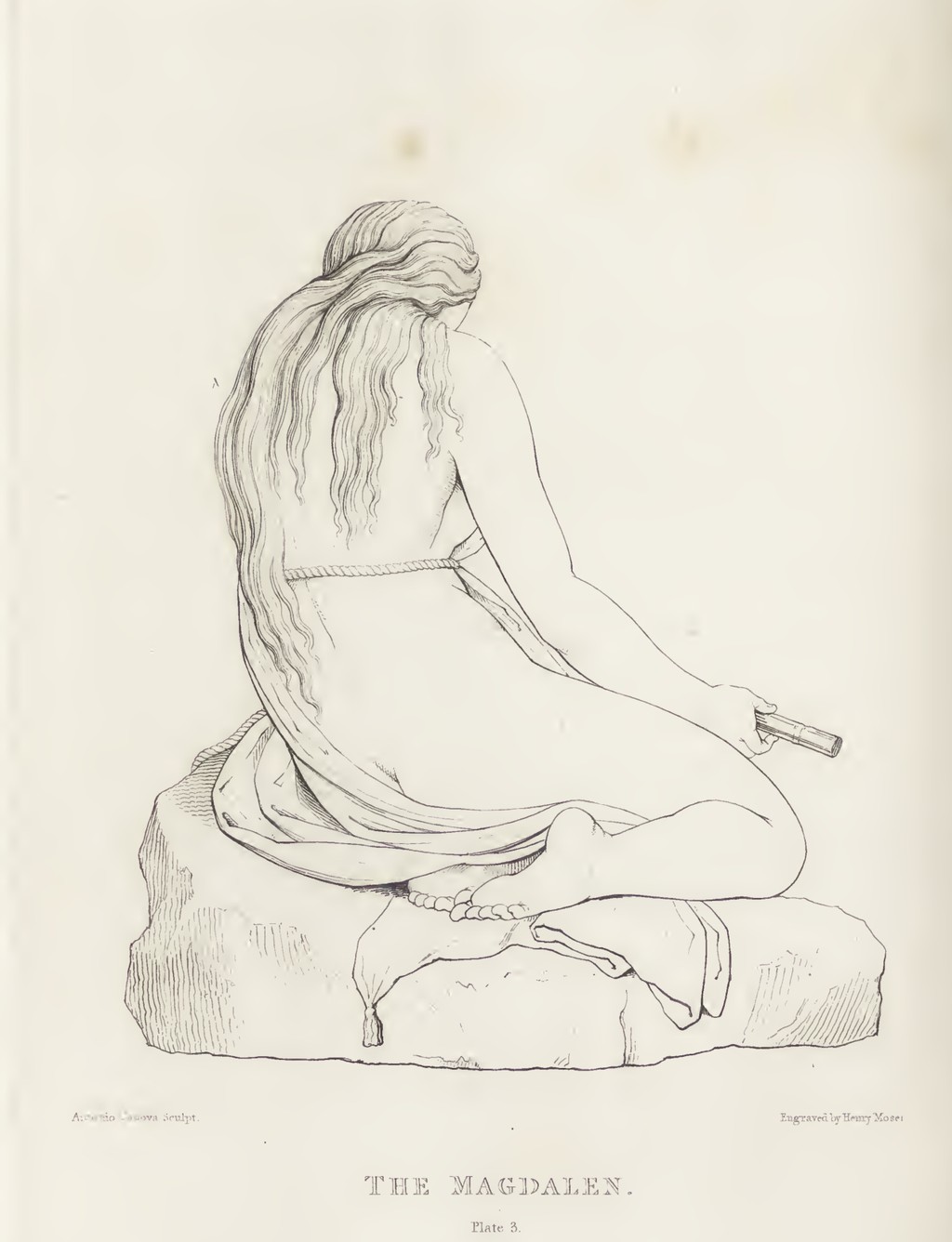
Moses’s third view of the kneeling Magdalene gives particular weight to the curve of the back and the lowered head. Henry Moses, after Antonio Canova, engraving published in London, 1824. Getty Research Institute. Image source. Public domain. Scan margins trimmed and image resized.
The Hermitage version
Eugène de Beauharnais, Napoleon’s stepson and viceroy of Italy, ordered a second marble after the success of the first in Paris. Canova made it in 1808–09, drawing on the same model according to Androsov. Eugène subsequently became Duke of Leuchtenberg and settled in Munich. His son Maximilian married Grand Duchess Maria Nikolaevna, daughter of Nicholas I of Russia. The sculpture passed into the family’s collection in St Petersburg and entered the Hermitage in 1922. The Hermitage also owns a larger workshop version, 104 centimetres high, from the Winter Palace. It has a different accession and provenance. [4] [7]
The two marbles preserve the same lowered head, bent knees and open hands. Androsov finds the stone of the Hermitage version finer in quality and records repairs to the fingers and damage to the skull. The crucifix that once lay in the hands is missing. In Genoa the bronze sets a strong line in front of the body. In St Petersburg, the break between the empty palms leaves the gathered cloth and the skull in clearer view. The slope of the head still leads the eye towards the place where the cross lay. The replica makes it possible to see how much the gesture carries on its own and how precisely the bronze in Genoa completes it. [1] [2] [4] [7]
Explore Canova’s works
Browse the sculptures and paintings covered in this guide. Several entries compare versions or examine details of a larger work.
Discussion
Look again at the images and ideas explored in Penitent Magdalene. These editorial prompts invite your observations.
Reader Insights
How do the hands and crucifix direct your attention?
How might the lighting in Sommariva’s cabinet have changed the way visitors saw the marble?
Join the Conversation
Share a detail, comparison or question about Penitent Magdalene below.
References
- Musei di Genova, Maddalena penitente, marble and gilded bronze, inv. PB 209 (in Italian). View source.
- Musei di Genova, Penitent Magdalene, English collection entry for PB 209. View source.
- Padova Musei Civici, Maddalena penitente, plaster, inv. 896 (in Italian). View source.
- State Hermitage Museum, Penitent Mary Magdalene, 1808–09, inv. Н.ск-1108 (in Russian). View source.
- Städel Museum, Storytelling, Mary Magdalene exhibition research. View source.
- National Gallery of Art, Canova: Sketching in Clay, exhibition texts for the Genoa marble, Bassano terracotta and Possagno plaster head, 2023. View source.
- Sergey Androsov, State Hermitage Museum, Italian Sculpture, 17th–18th Centuries, 2014, cats. 243 and 251, pp. 264–66 and 278–79 (in Russian). View source.
- Padova Cultura, La partenza della Maddalena di Canova, curatorial note on the plaster and the Piazza display, 2019 (in Italian). View source.
- Clario Di Fabio, La Maddalena e l’Apollino di Canova tra Julliot e Sommariva: luci documentarie sugli anni bui parigini (1806-1807), Atti e Memorie dell’Arcadia, 11 (2022), pp. 269–87. View source.
- Musée d’Orsay, Base Salons, Madeleine pénitente, transcription of the 1808 Salon catalogue entry. View source.
- Christina Ferando, Defining Modern Sculpture, in Exhibiting Antonio Canova, Amsterdam University Press, 2023. View source.
- Villa Carlotta, Museo, display and Tremezzo copy of the Penitent Magdalene. View source.


 Antonio Canova.jpg)

