


 of Napoleon Bonaparte Antonio Canova.jpg)
 by Tom Gurney
Tom Gurney BSc (Hons) is an art history expert with over 20 years experience
Published on June 19, 2020 / Updated on November 13, 2026
Email: tomgurney1@gmail.com / Phone: +44 7429 011000
Bust (Colossal Head) of Napoleon Bonaparte: Introduction
Napoleon turns his head away from the middle of his bare chest. A curve in the fringe leads down to the brow, and the shadow beneath it deepens towards the farther eye. The mouth is small in relation to the broad jaw. From the side, the turn lifts the line of the throat out of the shadow cast by the chin. Antonio Canova’s marble at Chatsworth preserves the scale of a colossal figure in a bust that ends just below the collarbones. [1] [2]
The portrait grew out of sittings with Napoleon in 1802, when he was still First Consul. Canova developed more than one sculptural image from that encounter. The head on a uniformed plaster, the head of the standing Napoleon as Mars and the bare-chested bust are related. Each gives the features a different frame. The marble at Chatsworth was still in Canova’s possession when he died in 1822. [1] [3]
Bust (Colossal Head) of Napoleon Bonaparte Antonio Canova
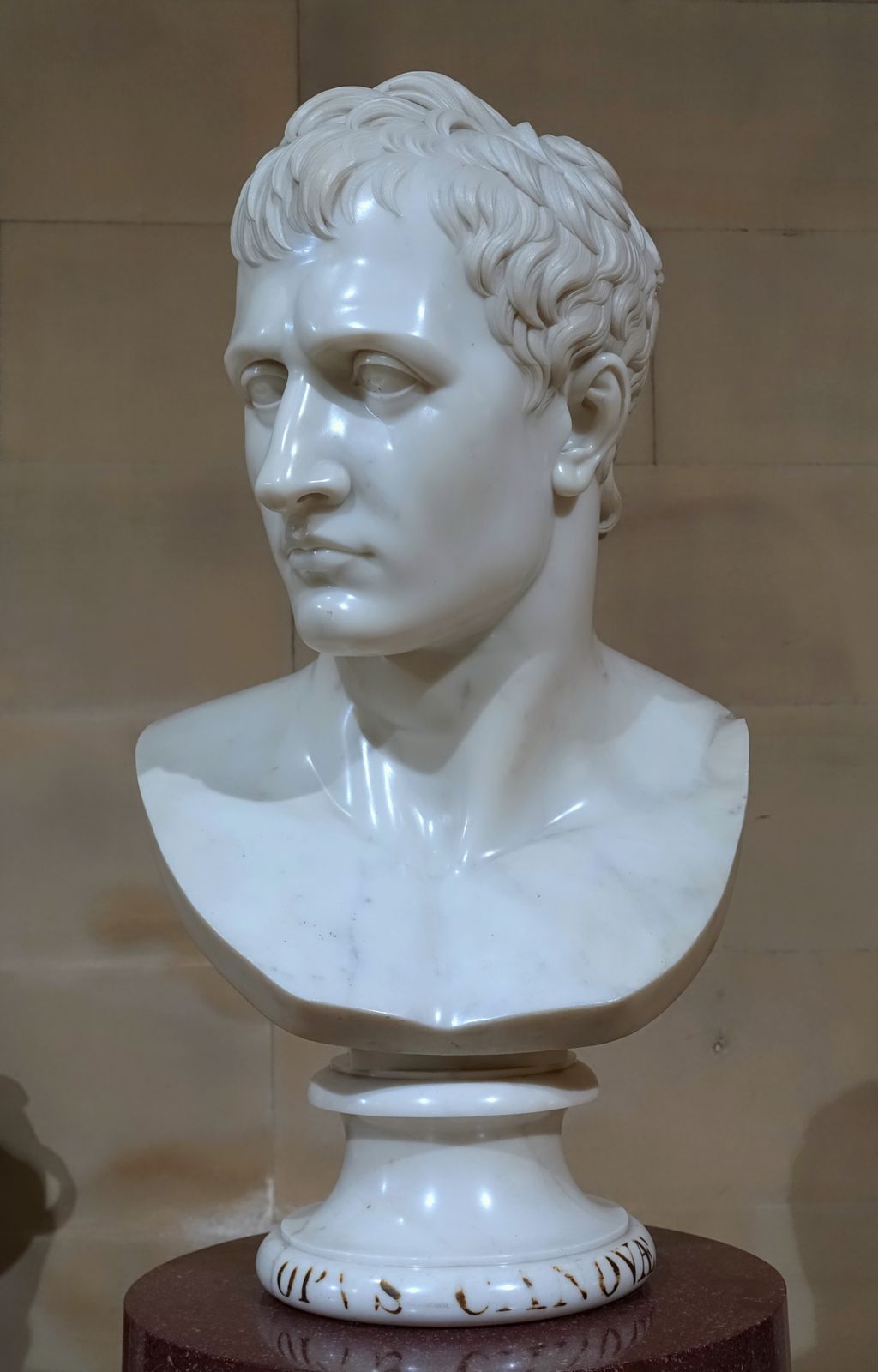
The colossal Chatsworth marble, including the signed support beneath the bust. Daderot. Image source. CC0 / Public domain. Resized for display.
At a Glance
- Artist and materialAntonio Canova, marble, Devonshire Collection, Chatsworth. [1] [4]
- Life sittingsFive at Saint-Cloud in October 1802. [3]
- First recorded transferAnne, Marchioness of Abercorn, bought the bust after Canova’s death and bequeathed it to the 6th Duke of Devonshire. [1]
Contents
- The face above the cut of the chest
- Five sittings at Saint-Cloud
- The head and the standing Mars
- Copies in marble and plaster
- From Canova’s room to the Sculpture Gallery
The face above the cut of the chest
Look at the outer edges of the shoulders. They fall away on either side and meet in a shallow curve above the round support. There is no uniform collar to mark the base of the throat. The collarbones make two raised lines instead, and the light on the polished surface follows them inwards towards the turn of the neck. The low outline of the chest leaves most of the marble’s height for the head. Even across a room, the face carries more weight than the shoulders below it. [1] [2]
As you move towards the profile, the brow appears to project over the eyes and the tip of the nose becomes more distinct. The lips press together above the jut of the chin. The change in surface is clearest at the temple. Individual locks are separated by deep channels, but the transitions across the cheek and jaw are broad and smooth. The small reflections moving over the cheek let the planes of the face show through the polish. The closely cut locks over the forehead keep the broad forehead from becoming a single uninterrupted plane. [2]
Chatsworth lists the marble as perhaps made in 1803–06. The Uffizi’s Italian exhibition text dates the last version it regards as by Canova himself to 1822 and identifies it as the bust at Chatsworth. The Uffizi’s date and the Devonshire Collection’s tentative range concern the carving of this particular object. The five sittings that supplied the likeness took place earlier. [1] [3] [4] [5]
Five sittings at Saint-Cloud
The Accademia Nazionale di San Luca dates the sittings between 6 and 17 October 1802 at the Château de Saint-Cloud, outside Paris. Canova worked in clay while the First Consul posed. The commission had a diplomatic side. Canova was responsible for the fine arts in the Papal States, and Cardinal Ercole Consalvi helped persuade him to go. Antonio D’Este later recalled that the sculptor took the opportunity to speak to Napoleon about the ancient works removed from Rome. The same meetings that supplied the portrait’s likeness gave Canova a chance to discuss the fate of other sculptures. [3]
The approach to Canova came through François Cacault, the French Republic’s minister to the Holy See. The sculptor had initially tried to decline, citing among other things his duties in Rome. D’Este’s account preserves a more personal concern. Canova told him that he had worried about making a portrait and was relieved that both Napoleon and Joséphine expressed approval. In the same account Napoleon left him freedom in how he worked. The reported approval concerns the likeness produced around the sittings. The final form of the standing statue was still to come. [3]
The Accademia holds a plaster of Napoleon in consular dress. It traces its plaster and a related one in Possagno to a lost plaster made after the clay portrait. On the Roman bust the high collar and the decorated front of the coat rise towards the face, which is presented squarely and inclines slightly down. Small reference points in the plaster gave the workshop fixed positions from which to measure when transferring the design into stone. The Accademia takes those marks as evidence that the cast served for carving. The whereabouts of the resulting marbles are unknown. [3]
The Roman plaster came to the Accademia in 1886, given by the daughters of Rinaldo Rinaldi, a sculptor who had worked in Canova’s studio and kept it in his own atelier. Its survival owes something to that workshop afterlife. The Possagno museum also presents a marked plaster connected to the sittings. Its title calls it an original plaster with repères, while its catalogue text leaves open whether the cast is the first one or a copy of the lost original. The spots on its surface tell us something more definite about the purpose of the object. They give the carver reference positions that can be located again once the sitter and the original clay are gone. [3] [6]
The National Gallery of Art’s account of Canova’s studio explains how callipers and weighted lines allowed assistants to transfer those locations to stone. Think of the tip of the nose and the line of the brow. A likeness depends on their positions relative to one another and on how far each stands out from the rest of the head. Those relationships can be measured even before the planes between them are finished. In the uniformed plaster, the reference marks survive alongside the expression. In the Chatsworth marble the measuring work has given way to finished planes of skin and hair. The marks on the consular cast document a general method. They cannot link the Chatsworth marble to that specific cast. [2] [3] [7]
The bare chest and sideways glance at Chatsworth change what a viewer notices first. The uniformed figure gives the eye a clear line up from the coat to the face. In the marble the exposed neck makes the rotation itself conspicuous. The Fondation Napoléon describes a classical bust in the development from the consular portrait to the colossal statue. The Met explains the form of its own later bust through the full-length figure. A portrait model could supply the likeness for a statue, and the monumental statue could in turn furnish the scale and proportions for further busts. [2] [3] [8] [9]
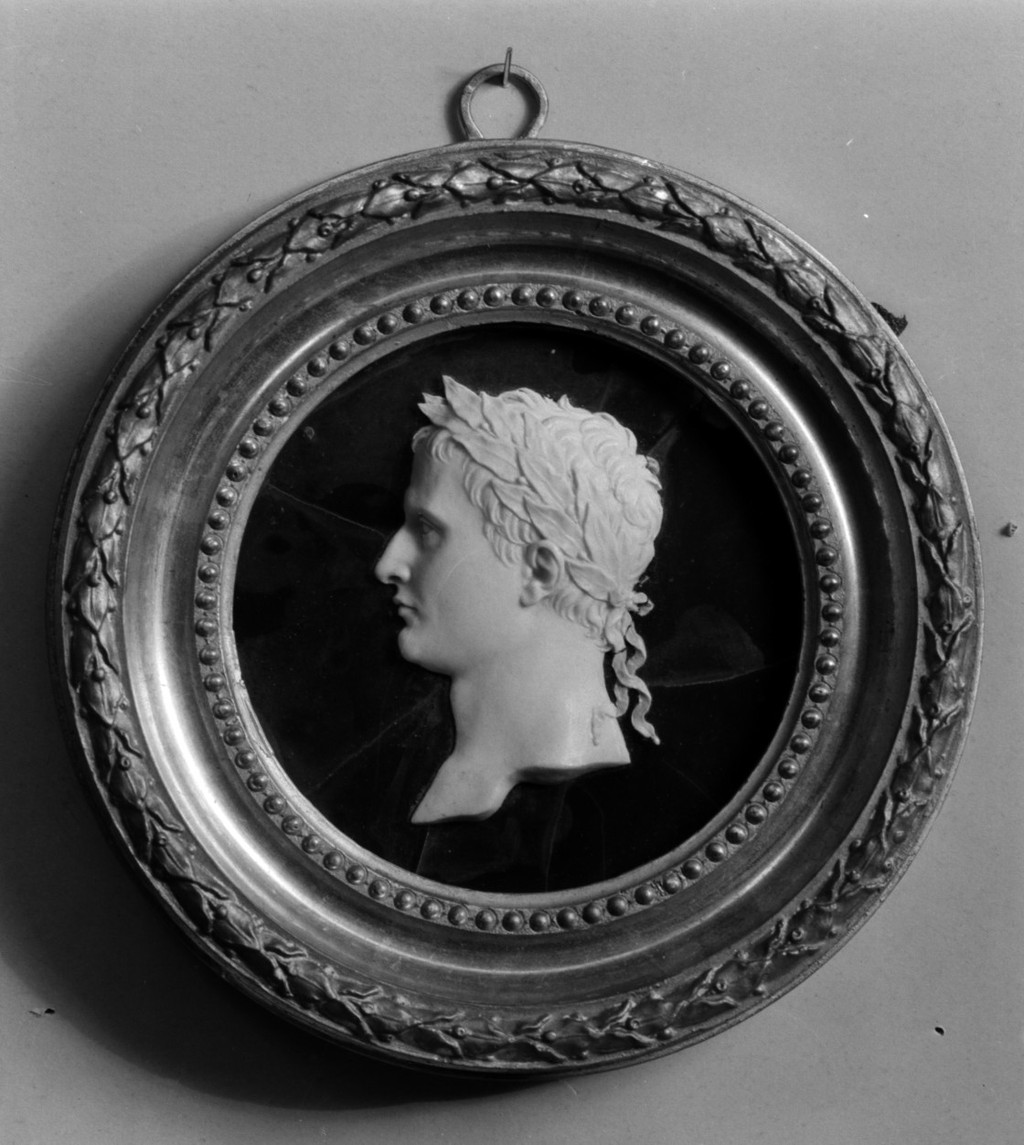
Santarelli’s wax profile offers a comparison with a separate image of Napoleon made for a much smaller scale. The Metropolitan Museum of Art. Image source. CC0 / Public domain. Resized from source.
The head and the standing Mars
In Napoleon as Mars the Peacemaker the head belongs to an idealised standing figure. The drapery falls from one shoulder, one hand takes a staff, and the other carries a globe with a winged Victory. The attributes tell the viewer how to read the emperor’s body. Canova finished the marble in Rome in 1806, and it reached Paris in 1811. Napoleon disliked the treatment of his figure, and the statue never went on public display there. It later entered Wellington’s collection at Apsley House. [10]
The bust dispenses with the staff and the Victory. Its close framing leaves enough of the chest to make the head’s turn clear. The height of a pedestal can alter the effect. From below, the underside of the jaw and the prominent brow become more apparent. From nearer eye level, the mouth and the shape of the nose are easier to study. The same outsized features that had to carry a likeness on the standing figure could therefore serve as the entire focus of a sculpture at the scale of a room. [1] [2] [9] [10]
The likeness also outlasted the office in which Napoleon sat for Canova. The clay was modelled while he was First Consul in 1802. When Canova finished the full figure in 1806, Napoleon was Emperor. The head’s youth and the steady gaze carry through into versions carved during the Empire. This is one reason the names on museum labels vary. Some describe the status of the man who posed and others the status of the ruler when his image circulated. On the classical bust the identity is carried by the features and the repeated turn, without a consular coat or imperial insignia to settle the question of rank. [1] [3] [5] [9] [10]
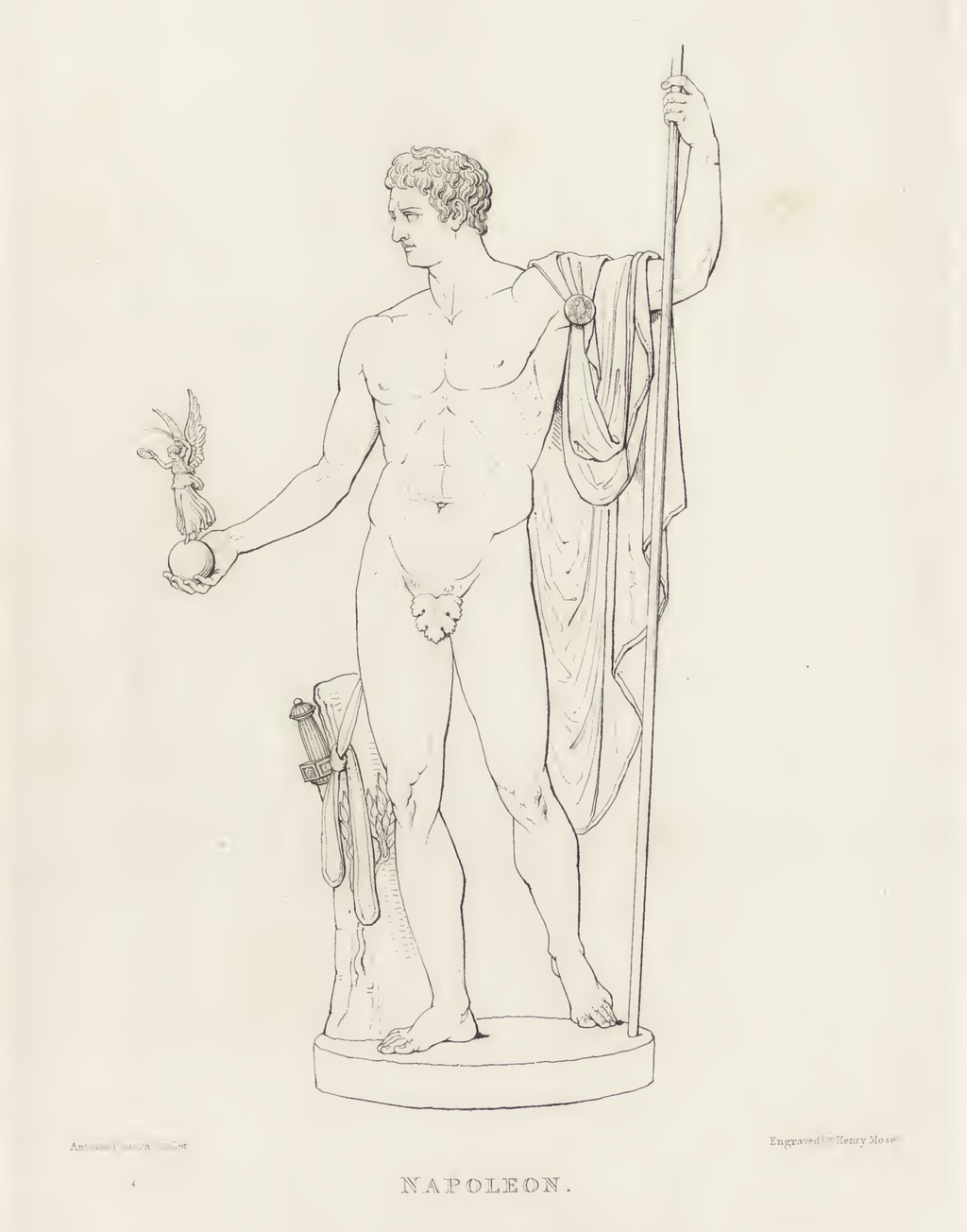
The complete figure engraved by Moses shows how the head originally sat within Canova’s standing composition. Henry Moses, after Antonio Canova, engraving published in London, 1824. Getty Research Institute. Image source. Public domain. Scan margins trimmed and image resized.
Videos on Canova
Explore Canova’s workshop methods and the settings for his sculpture.
From Sketch to Stone | Canova: Sketching in Clay
Watch sculptor Fred X. Brownstein recreate a Canova Venus, using clay, plaster and marble.
Watch on YouTubeCopies in marble and plaster
Canova’s Roman studio made busts and sold plaster models. At Carrara, under the patronage of Napoleon’s sister Elisa Bonaparte Baciocchi, carvers supplied portraits in marble. The Met records forty-two busts after Canova’s design reaching Paris from the Carrara workshop for sale between 1808 and 1814, in both colossal and life-size forms. Its own marble, 73.7 centimetres high, is catalogued as after a model by Canova. It may have been among those sent to Paris. Its carving is almost certainly the work of another hand, and even Canova’s supervision is uncertain. [9]
The Met identifies the bust as one of Napoleon’s official images and calls it the only Canova model reproduced in marble outside his own Roman workshop during his lifetime. Carrara’s capacity to supply such a market had roots in the local academy, which predated Elisa’s government. The Baciocchi issued new statutes for it in 1807. Elisa also founded the Banca Elisiana to support her plans for an industry that would sell finished sculpture as well as quarried stone. The workshops used models by several sculptors, including Lorenzo Bartolini, Antoine-Denis Chaudet and François-Joseph Bosio. An imperial portrait shipped from Carrara might therefore owe its design to Canova, but it might just as readily reproduce another sculptor’s Napoleon. [5] [9] [11]
At 120 kilograms, the Met bust helps put the number of shipments in perspective. A marble like it needed stone, carving time and transport even if a plaster supplied the proportions. The museum dates its example to around 1808–14 and identifies the white marble as probably Carrara. The workshop chronology and the material are consistent with a Carrara origin, while a documented place in one of the shipments would be a separate piece of evidence. The white marble bust described by the National Museum in Kraków is comparably large at 75 centimetres and is most likely a workshop replica, according to that museum. From the side the curved truncation and the full volume of the skull keep the proportions of a monumental head even on a shelf or pedestal. A similar size and shape help connect the objects to the design, without identifying a common carver. [9] [12]
The marble in the Pitti Palace, dated about 1810 and catalogued as Canova and workshop, has a documented family connection. Louis Bonaparte gave it to Grand Duke Leopold II of Tuscany in 1845, in thanks for the hospitality he had received in Florence. A related plaster in the Museo Glauco Lombardi in Parma has a different history. Its conservators removed three layers of tempera in 2008 and uncovered the lightly incised and black-painted name AVGUSTO on the base. The museum traces the bust to the Parma Academy, where in May 1814 the provisional government allowed it to be kept among the art models under the identity of Augustus. The classical appearance helped the portrait survive a change of government. [5] [13]
The Pitti gift and the Parma inscription show two ways an image survived the end of the Empire. In Florence an emperor’s brother could offer the portrait in his own name as a personal gift to a restored dynasty. In Parma the provisional authorities could admit the likeness to an academy as a model from antiquity. The Italian catalogue transcribes the inscription as AVGvSTO and cites the specific authorisation of 21 May 1814. It also notes a gap between the Academy and the collection of the engraver Paolo Toschi, whose heirs passed the cast to the museum. The date of the government decision is firmer evidence for the plaster’s early existence than the stylistic resemblance alone. It is compatible with an early version of the bust design, while the date of the individual Chatsworth marble remains disputed. [1] [4] [5] [13]
An inscription can identify a sitter or a design without settling who carved it. The marble at Sudbury Hall bears Napoleon’s name alongside Canova’s. The National Trust dates it to 1829, seven years after Canova’s death, and catalogues it as after his model. The 1808 bronze at the Fitzwilliam Museum belongs to another sculptor’s portrait type altogether. Antoine-Denis Chaudet presents Napoleon facing forward in a squared herm. The inscription on its side names Chaudet, the founder Honoré Gonon and the chaser Charles Stanislas Canleurs. The turn of the head and the curved cut below the chest at Chatsworth make the distinction visible before any inscription is read. [2] [14] [15]
The portrait John Soane called a Canova
John Soane thought his plaster of Napoleon was taken from Canova. His museum identifies it instead as a cast from, or a bust based on, Chaudet’s design. Soane’s 1835 description of his house contains an engraved view of the Colonnade in which the plaster can be seen. How he acquired it is unknown. The image was reproduced in marble, plaster, bronze and unglazed Sèvres porcelain, so the plaster could have reached him by several routes. His attribution is evidence of what a British collector could believe about the object by the 1830s. The cut and position of the head are better guides to its design than the name of the sculptor Soane associated with it. [15] [16]
Chaudet’s name also covers more than one Napoleon portrait. The Louvre’s 1811 Sèvres example, after a second model, adds a wreath, an antique-style mantle and a circular clasp. It derives from Chaudet’s full-length statue of Napoleon as legislator. That gives it something in common with the Met’s account of Canova’s bust, which also relates the cut-off portrait to a standing figure. Each sculptor could use the full statue as a source for a smaller object. At Sèvres the cloak and laurel transfer part of the larger figure’s imperial character into the bust. In Canova’s design the bare chest and turned face do more of that work. [9] [17]
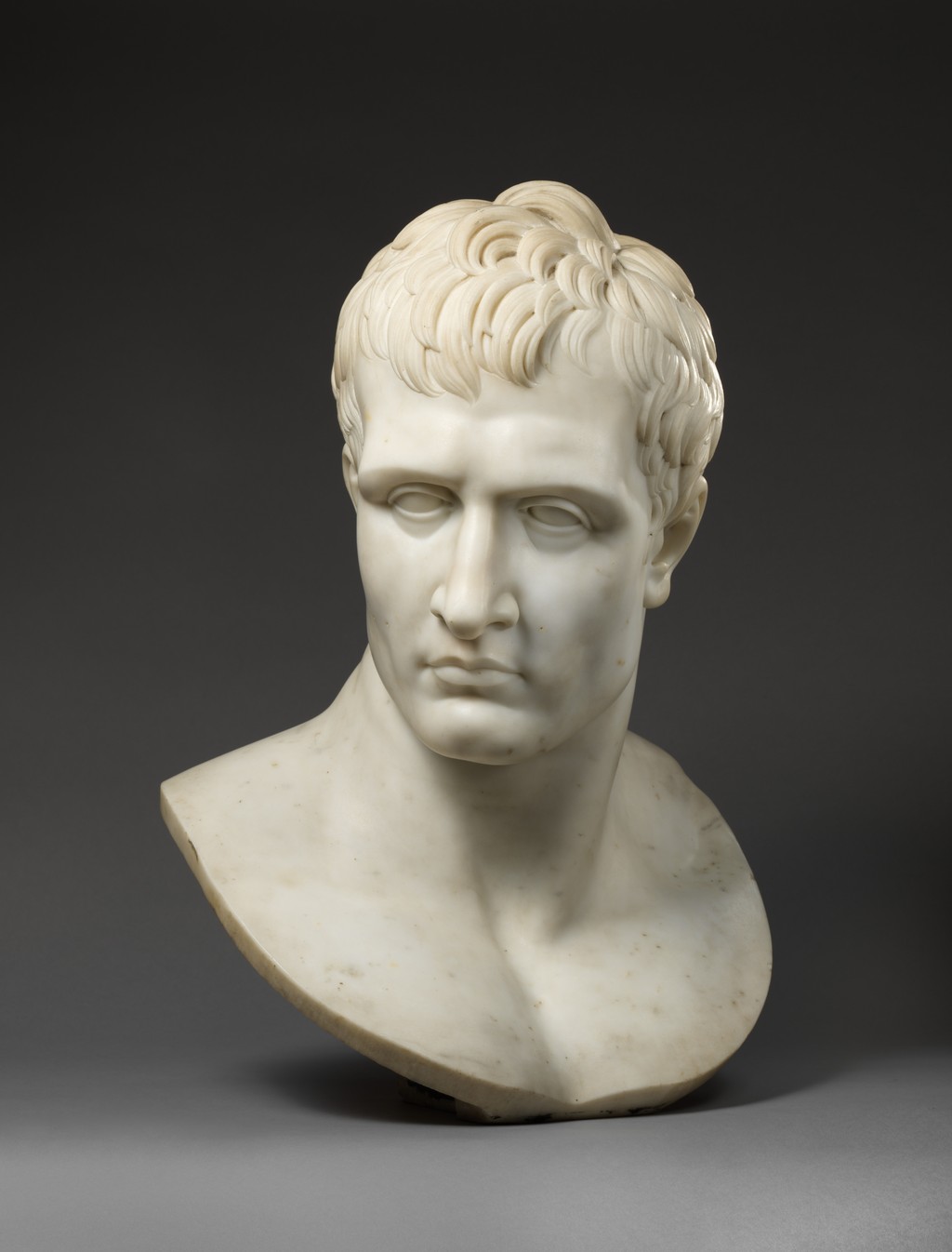
The Metropolitan Museum of Art’s colossal marble follows Canova’s model and is attributed to the Carrara production discussed here. The Metropolitan Museum of Art, 2015.489. Image source. CC0 / Public domain. Resized from source.
From Canova’s room to the Sculpture Gallery
Chatsworth records that the bust stayed in Canova’s bedroom in Rome until his death. The Fondation Napoléon identifies his half-brother Giovanni Battista Sartori as the seller to Lady Abercorn. The Duke’s diary, cited by Alison Yarrington, records the unpacking of Lady Abercorn’s bust at his London house in July 1823, alongside Canova’s Endymion. This was before the bust passed to the Duke by bequest when the Marchioness died in 1827. The Duke believed it was the only bust of Napoleon carved by Canova himself. His judgement helps explain the place he gave it in his collection. [1] [8] [18]
At Chatsworth he set the head opposite a colossal bust of Alexander the Great. On the same side as Napoleon he placed Canova’s seated Letizia Ramolino Bonaparte and Thomas Campbell’s portrait of Napoleon’s sister Pauline. The scale of the head holds its own beside two seated figures. Across the gallery, the ancient portrait answers the modern one with a comparison in marble, giving the classical treatment of Napoleon’s features a setting as well as a form. [1] [18]
The family portraits give the two heads at Chatsworth a more personal setting. Napoleon’s mother and sister sit in their own full bodies on either side of a head on the scale of the figure that stayed out of public view in Paris. When the viewer turns across the gallery to Alexander, the two heads can be taken together across the same interval. As Alison Yarrington notes, Alexander was also the name of the Russian emperor associated with Napoleon’s downfall. The room thus joined the fate of the modern family to an ancient likeness and to the historical associations that a nineteenth-century visitor might have brought to it. [1] [10] [18]
Lady Abercorn also passed on Canova’s modelling tools. The Duke displayed them in one of the two shallow bowls by Bartolini that flanked Napoleon in the early gallery. Yarrington connects the bowls, tentatively, to designs for Napoleon’s residence on Elba. In that arrangement a visitor could look from the finished marble to the tools used for the kind of work that began at Saint-Cloud. The tools had belonged to Canova, just as the marble had, and the same collector had brought both into the Duke’s circle. The portrait could be looked at as a relic of the sculptor as well as a likeness of Napoleon. [1] [18]
Explore Canova’s works
Browse the sculptures and paintings covered in this guide. Several entries compare versions or examine details of a larger work.
Discussion
Look again at the images and ideas explored in Bust (Colossal Head) of Napoleon Bonaparte. These editorial prompts invite your observations.
Reader Insights
What does the format of the bust emphasise in Napoleon’s portrait?
Which details help distinguish the bust from the full-length marble?
Join the Conversation
Share a detail, comparison or question about Bust (Colossal Head) of Napoleon Bonaparte below.
References
- Chatsworth, Colossal head of Napoleon Bonaparte, Devonshire Collection, object and provenance record. View source.
- Daderot, Colossal bust of Napoleon, by Antonio Canova, photograph of the Chatsworth marble in the Sculpture Gallery. View source.
- Paola Picardi, Accademia Nazionale di San Luca, Ritratto di Napoleone Bonaparte come Primo Console, consular plaster and account of the sittings with references to Antonio D’Este. View source.
- Chatsworth, Sculpture, Devonshire Collection, summary catalogue and tentative date for the colossal head. View source.
- Gallerie degli Uffizi, Gli Uffizi e Napoleone, section 1, Pitti marble, Palatina 879, and the date proposed for Chatsworth. View source.
- Museo Gypsotheca Antonio Canova, Napoleon — Original plaster bust with repères, collection record and photograph on Google Arts & Culture. View source.
- National Gallery of Art, Canova: Sketching in Clay, “Canova’s Process,” exhibition text and illustration of the pointing process. View source.
- Fondation Napoléon, Buste de Napoléon par Canova, Parma plaster and the consular and classical versions. View source.
- Denise Allen, Metropolitan Museum of Art, Bust of Napoleon, 2015.489, after a model by Antonio Canova. View source.
- English Heritage, Apsley House Collection Highlights, entry for Napoleon as Mars the Peacemaker. View source.
- Ministero della Cultura, Tuscany, La Toscana napoleonica, section on the Carrara academy, its 1807 statutes and the Banca Elisiana (in Italian). View source.
- National Museum in Kraków, Bust of Napoleon Bonaparte, object details and workshop attribution. View source.
- Museo Glauco Lombardi, Busto di Napoleone Bonaparte, plaster 2531, conservation findings and archival record of its treatment in 1814. View source.
- National Trust, Napoleon I, Emperor of France, Sudbury Hall, NT 653264. View source.
- Fitzwilliam Museum, Napoléon I, M.1-1866, bronze by Antoine-Denis Chaudet, Honoré Gonon and Charles Stanislas Canleurs, with inscriptions and provenance. View source.
- Sir John Soane’s Museum, after Antoine-Denis Chaudet, Bust of Napoleon, M589, collection record and photograph. View source.
- Musée du Louvre, Buste de Napoléon Ier, Sèvres, after a model by Antoine-Denis Chaudet, OA 10420, object record (in French). View source.
- Alison Yarrington, ‘Under Italian skies,’ the 6th Duke of Devonshire, Canova and the Formation of the Sculpture Gallery at Chatsworth House, pp. 51 and 55, on the Duke’s diary and the gallery arrangement. View source.


 Antonio Canova.jpg)

