



 by Tom Gurney
Tom Gurney BSc (Hons) is an art history expert with over 20 years experience
Published on June 19, 2020 / Updated on November 13, 2026
Email: tomgurney1@gmail.com / Phone: +44 7429 011000
Mars and Venus: Introduction
Mars holds his spear upright while Venus reaches around his neck. His right elbow projects out to one side, and his left hand comes round her back. Their faces are close enough for the downward tilt of his head and the lift of hers to be read together. At their feet a shield rests against a stump, with a small horn of plenty nearby. Antonio Canova gives the god of war the equipment to leave for battle and the goddess of love a reason for him to stay. [1] [2]
The Prince Regent, the future George IV, commissioned the sculpture for Carlton House in 1815. Canova described the pair to Leopoldo Cicognara as figures of peace and war. The Royal Collection catalogues the marble as Mars and Venus, 1815–19, and records its arrival at Carlton House on 10 April 1824. It now stands at the foot of the Ministers’ Stairs in the Marble Hall at Buckingham Palace. [1]
Mars and Venus Antonio Canova
At a Glance
- Sculptor and patronAntonio Canova, commissioned by the Prince Regent in 1815. [1]
- Royal Collection marbleRCIN 2038, 208 × 137 × 65.5 centimetres, with painted wooden sections on the spear. [1]
- Possagno modelFull-scale plaster, dated 1816, Museo Gypsotheca Antonio Canova, inventory 246. [3]
This work across Antonio Canova’s career
Venus Victrix
1804–08 Collection recordThe Three Graces (Bedford marble)
Completed by 1817 Collection recordContents
- The embrace
- The arms behind the figures
- Peace after Waterloo
- From clay to marble
- From Carlton House to Buckingham Palace
The embrace
Follow the line from the spear to Mars’s raised hand, then across his shoulder towards Venus. His chest opens towards the viewer while his face turns to her. One leg extends towards the outer corner of the base and the other comes down close beside her feet. Venus keeps her lower body almost upright and arches her upper body back far enough to look up at him. Her arm crosses the front of his chest and bends around his neck. The uneven height of the two figures makes the action clear even at a distance. [1] [2] [3]
Their hands give the embrace different degrees of pressure. Mars curls his right fingers around a straight shaft, with the forearm raised to keep the spear vertical. His other fingers spread over the curve of Venus’s back. Her hands gather near his neck and shoulder, where the contact is lighter. Look at the narrow interval below the faces and between the bodies. The separation lets light reach the contours, so the figures stay legible as two people even where they overlap. [1] [2] [3]
Venus wears a diadem and the cloth gathered below her hips falls in long folds towards the base. A fold curves back over her leg, and the fabric bunches where it reaches her feet. Mars’s helmet ends in a crest that continues the line of his lowered head up and back. The small ridges in the crest and the deeper folds of the cloth catch shadows differently from the wide surfaces of the torso. The changes in depth give the eye something to follow from the upper part of the group all the way down to the base. [1] [2]
The arms behind the figures
From the back, the tree stump fills part of the interval between the two bodies. Venus’s drapery covers some of it. Mars’s round shield leans against the stump and the sword, still in its sheath, hangs by a belt across the shield. Behind the embrace, Canova arranges cloth, wood and arms into a compact mass close to the base. The shield’s circle stands out against the descending folds. Its central foliage is carved in low relief, so a shallow change in the surface carries the ornament. [1]
The prince had asked for his own profile to appear on the shield, according to the Royal Collection Trust. Instead the shield carries foliage, and the lions carved on either side of the helmet offer a more indirect compliment. The Trust identifies the lion as a British emblem. Its placement keeps the reference within the costume of Mars, where it becomes visible as the viewer approaches the helmet from the side. [1] [4]
The horn of plenty lies low beside the armour, its fruit crowded into the little space left at the feet. Both museums connect this detail with what peace brings. The distribution of the objects makes that meaning gradual to discover. The spear and the helmet identify Mars immediately. The shield and sheathed sword come into view on walking round, and the fruit appears close to the ground. The equipment is still there, but at this moment most of it has been set aside. [1] [3] [4]
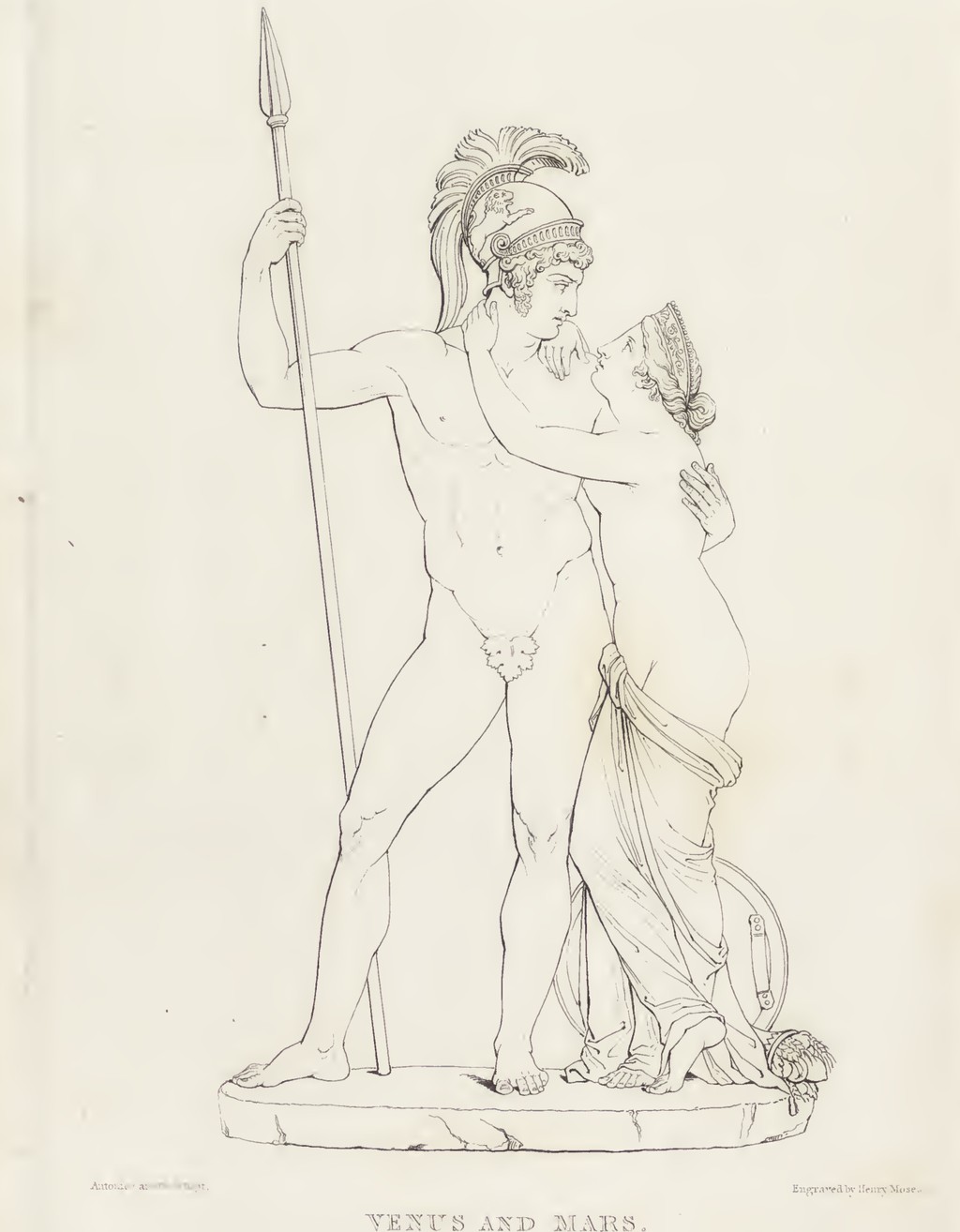
The early engraving shows the spear rising alongside the embrace. Henry Moses, after Antonio Canova, engraving published in London, 1824. Getty Research Institute. Image source. Public domain. Scan margins trimmed and image resized.
Videos on Canova
Explore Canova’s workshop methods and the settings for his sculpture.
From Sketch to Stone | Canova: Sketching in Clay
Watch sculptor Fred X. Brownstein recreate a Canova Venus, using clay, plaster and marble.
Watch on YouTubePeace after Waterloo
Canova came to Britain in November 1815, several months after Waterloo. He was seeking help with the expense of bringing works of art taken under Napoleon back to Rome. On 4 December he attended a levée at Carlton House and conveyed the pope’s thanks for British assistance. The sculptor’s diplomatic business and the prince’s commission brought the same two men together. By the following January, the encounter had produced a subject suited to a residence where a victory and its aftermath could be given visible form. [1]
Canova’s letter of 17 January 1816 to Leopoldo Cicognara, president of the Venice academy, says that the ideal group for the regent would symbolise peace and war. Calling the group ideal meant that the gods could carry the idea without having to bear the likenesses of contemporary rulers. The contrast is especially clear beside Napoleon as Mars the Peacemaker. There a recognisable ruler appears as Mars and holds up a winged Victory. In the prince’s sculpture the god’s identity is established by his arms, and the action depends on where he directs his attention. The earlier portrait also passed into British hands and was presented to the Duke of Wellington in 1816. [1] [5]
The old story adds a different meaning to the intimacy. In Book VIII of the Odyssey, the bard Demodocus sings of Ares and Aphrodite, the Greek counterparts of Mars and Venus. Aphrodite’s husband Hephaestus discovers their affair and traps the lovers in a net. Canova gives the couple a moment alone, before any consequence of their closeness becomes visible. The poem helps explain why they can be read as lovers, while the commission gives the embrace a public meaning. The raised spear allows both readings to remain in play. [1] [4] [6]
The pairing also had a history in sculpture. The Royal Collection links Canova’s interest to an ancient marble once in the Borghese collection. The Louvre catalogues that Roman work as a couple presented in the guise of Mars and Venus. In it, Venus reaches towards the man’s sword belt, and a tree trunk carries armour. A closer comparison in Canova’s own work is Venus and Adonis. The Possagno museum points to the earlier group as a precedent for two standing lovers drawn together. In the later work the tall spear keeps a strong upright line beside the embrace. [1] [3] [7]
From clay to marble
Charles Long handled correspondence with Canova on the prince’s behalf. By May 1816 he knew that the sculptor was at work on the commission. He asked for a drawing in August, by which time Canova had begun modelling in clay, and a full-size clay model was under way in September. A later conversation reported by Lady Shelley places Canova’s first idea at Dover while he was waiting for the boat. The exchange with Long shows how much work still lay between conceiving the group and preparing it for stone. [1]
The surviving plaster at Possagno stands 210 centimetres high. In the museum’s close photograph, small dark points show on the necks, shoulders and faces. In Canova’s workshop, fixed points on a plaster gave assistants a set of positions to measure and transfer to a marble block. The arrangement mattered particularly where the forms came close together. A few centimetres of difference at the neck or shoulder could affect the opening between the two profiles. The plaster fixes those relationships at nearly the same scale as the marble. [3] [8]
Faults discovered in the stone appear to have delayed the carving, and the Royal Collection identifies Adamo Tadolini as the likely assistant responsible for roughing out the group. The two bodies, cloth and lower details were made from one block. The spear point and the shaft above Mars’s right hand are painted wood. At the height of the hand the raised arm already has a distinct silhouette. Continuing the spear above it carries the eye above the helmet without requiring a long unsupported piece of marble there. The catalogue identifies the material but gives no date for those wooden sections. [1]
The Royal Collection uses 1815–19 for the marble, while the Possagno museum gives 1822 as its year of completion. Cicognara’s memoir of Canova also describes the sculptor finishing the group in the spring of his last year. The dates in the records belong alongside the securely documented commission in 1815, the modelling in 1816 and the delivery in 1824. [1] [3] [9]
From Carlton House to Buckingham Palace
Canova’s correspondence places the intended sculpture in the Circular Room at Carlton House, between the Crimson Drawing Room and the Throne Room. Charles Wild’s watercolour shows the Ionic columns and painted sky of a room used for entertainments and concerts. A visitor approaching on that line would have encountered the group at the centre of a sequence of rooms. The upright spear and the widening outline of Mars’s stance would have read well from a distance. The tree, shield and fruit would have rewarded a closer look. [1] [10]
The marble remained in Rome after Canova died in October 1822. Richard Westmacott oversaw the unpacking and installation at Carlton House in 1824, where it went into the temporary conservatory. In 1826 it moved to Francis Chantrey’s premises in Pimlico ahead of the demolition of Carlton House. The sculpture later went to Buckingham Palace, where it stood upstairs in the Silk Tapestry Room, at the southern end of the Picture Gallery. By 1910 it was at the south end of the Marble Hall. The Royal Collection records its move to the foot of the Ministers’ Stairs after 1914. [1] [2]
Prints and casts gave the group a life beyond those rooms. In Domenico Marchetti’s engraving after Giovanni Tognoli’s drawing, the figures stand against a plain field, with the tall spear and plumed helmet clearly outlined. The dedication to the Prince Regent identifies war and peace as the subject. Visitors to the Crystal Palace could encounter the group at full size in a cast. Anna Jameson’s 1854 guide to the Sculpture Courts described Venus as trying to keep Mars from the battlefield and drew attention to the cornucopia. Her reading picks up the two parts of the action that are easiest to miss from a distance: the hand around the neck and the fruit by the feet. [1] [11] [12]
Explore Canova’s works
Browse the sculptures and paintings covered in this guide. Several entries compare versions or examine details of a larger work.
Discussion
Look again at the images and ideas explored in Mars and Venus. These editorial prompts invite your observations.
Reader Insights
What does Venus’s gesture suggest about the relationship between the two figures?
How does the spear affect the outline of the group?
Join the Conversation
Share a detail, comparison or question about Mars and Venus below.
References
- Royal Collection Trust, Mars and Venus, RCIN 2038, with Canova’s letter to Leopoldo Cicognara of 17 January 1816 and provenance. View source.
- Royal Collection Trust, Mars and Venus, collection photograph and object record on Google Arts & Culture. View source.
- Museo Gypsotheca Antonio Canova, Venus and Mars, plaster, inventory 246. View source.
- Royal Collection Trust, Mars and Venus, in European Armour in the Royal Collection. View source.
- English Heritage, Apsley House Collection Highlights, entry on Napoleon as Mars the Peacemaker. View source.
- Homer, Odyssey, Book VIII, lines 266–366, translated by A. T. Murray. View source.
- Musée du Louvre, Roman statue group of a couple as Mars and Venus, Ma 1009. View source.
- Museo Gypsotheca Antonio Canova, Antonio Canova’s Opera, on plaster, pointing and carving. View source.
- Leopoldo Cicognara, biographical memoir in The Works of Antonio Canova in Sculpture and Modelling, vol. I (1824), pp. xxviii–xxix. View source.
- Royal Collection Trust, Charles Wild, The Circular Room, Carlton House, c. 1817, RCIN 922177. View source.
- Wellcome Collection, Mars [Ares] and Venus [Aphrodite], engraving by Domenico Marchetti after Giovanni Tognoli and Antonio Canova, 11593i. View source.
- Anna Jameson, A Hand-book to the Courts of Modern Sculpture (1854), pp. 51–52, no. 135. View source.


 Antonio Canova.jpg)

