



 by Tom Gurney
Tom Gurney BSc (Hons) is an art history expert with over 20 years experience
Published on June 19, 2020 / Updated on November 13, 2026
Email: tomgurney1@gmail.com / Phone: +44 7429 011000
Venus with Cupid: Introduction
Cupid puts an arm around Venus’s neck and leans his face against hers. She steadies him with an arm across his body while turning her eyes towards the viewer. His small wings identify him as the god of love. Everything about the way he climbs into her arms suggests a child familiar with the person holding him. Canova set the embrace against a red curtain and opened a view of the landscape beside the couch. Two oils of this design are preserved in Possagno. [1] [2] [3]
Venus with Cupid Antonio Canova
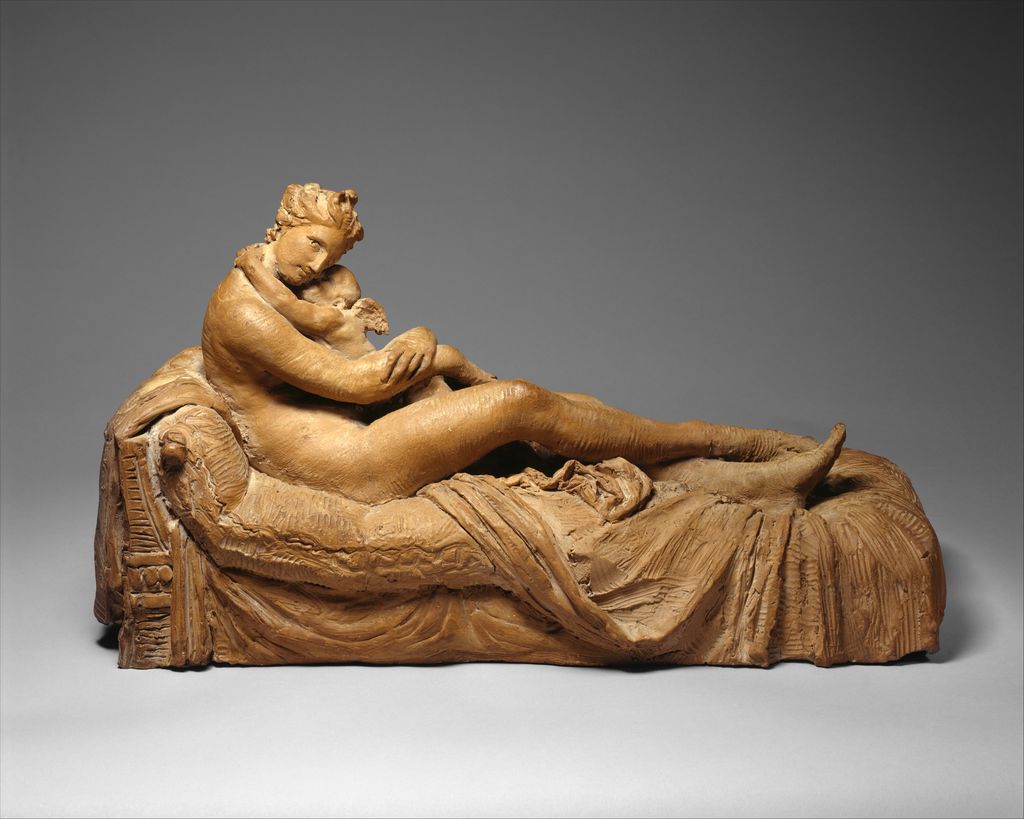
A related clay group at the Metropolitan Museum of Art, with an attribution to Canova that has been questioned. The Metropolitan Museum of Art. Image source. CC0 / Public domain. Resized for display.
At a Glance
- Artist and mediumAntonio Canova, oil on canvas. [1] [2]
- CollectionMuseo Gypsotheca Antonio Canova, Possagno, inventories 45 and 46. [1] [2]
- ReplicaThe Italian national catalogue dates inventory 46 to 1798–99. [2]
Contents
- The figures on the couch
- A mother and child in myth
- The other side of each canvas
- The comparison in terracotta
- Cupid in other Canova works
The figures on the couch
Begin with Venus’s shoulder and follow the arm that crosses her lap. It makes a broad curve below Cupid, ending in a hand which rests across him. His arm runs the other way, up across her chest to her neck. The two gestures fit together at different heights. The child can reach her cheek because she carries his weight, and the turn of her head brings his face into the light. You can read where the bodies meet even though the outlines of their arms partly disappear into one another. Cupid’s wing opens out towards the right, filling some of the space the two faces leave beside them. [1] [3]
Canova places the heads high at one end of the picture. Below them the adult figure runs diagonally across the canvas towards the raised knee. The dip where Venus settles into the cushion and the lift of her knee give that long form two different directions. The crook of her arm answers the bend of the knee on a smaller scale. Cupid fits into the space between them. His head and outstretched wing pull the eye back up from the lower half of the picture. The arrangement lets the size and weight of Venus’s body register even while the action is concentrated at her face. [1] [3]
A cord pulls the red curtain to the left, leaving a dark area behind the heads. The edge of the opening on the right runs almost vertically past Cupid’s wing. Beyond it the land and sky flatten into bands of muted colour. The faces and shoulders stay close to the viewer, with the opening behind them giving the room a sense of depth. The gold tones of the flesh and the red of the fabric recur in the wing. The soft border where his cheek touches hers is especially easy to pick out beside the firmer line of the curtain. [1] [3]
A mother and child in myth
In his 2001 exhibition catalogue, Giuseppe Pavanello suggested that Canova could have borrowed the child’s reaching gesture from a painting of the Madonna and Child. The Italian national catalogue records his comparison with Pompeo Batoni’s Holy Family, which the Capitoline Museums date to about 1760. In Batoni’s picture the child also stretches an arm around his mother’s shoulder. Mary bends her face towards him and Joseph watches from beside them. Canova gives Venus an outward gaze and sets her reclining, while retaining the close fit of a child’s arm around an adult’s neck. The resemblance is most specific in that small contact. Pavanello offered Batoni as a possible source for the gesture, alongside the example of sixteenth-century painting. [1] [4]
Another Possagno record places the design alongside La Sorpresa and Le Grazie. The latter oil is signed and dated 1799, and Pavanello treated the three as related studies of the female nude that recalled Titian and Correggio. In La Sorpresa, the woman draws a garment against her chest as she turns. Venus’s arm crosses her body at a similar height, with the different task of holding a child. The settings bring out the difference in action. The scholar Cora Gilroy-Ware notes that La Sorpresa has a dressing table and clothes of Canova’s own time, while the red curtain in Venus with Cupid also occurs in Canova’s earlier Venus with a Faun. Details of cloth and furniture help give each painted body its setting and story. [3] [5]
Videos on Canova
Explore Canova’s workshop methods and the settings for his sculpture.
From Sketch to Stone | Canova: Sketching in Clay
Watch sculptor Fred X. Brownstein recreate a Canova Venus, using clay, plaster and marble.
Watch on YouTubeThe other side of each canvas
The Italian national catalogue gives the two oils separate entries under Venere con Amore. Inventory 45 is record 0500432560. Its reverse carries two monochrome groups on pedestals that the catalogue leaves unidentified. Inventory 46 is record 0500432561, and is described as a replica of the preceding painting. The reverse of this second canvas has two monochrome sketches for possible sculptural groups. The two records therefore describe four studies in all. The title applies to the figure pair on the painted fronts. [1] [2]
The pedestal is an important detail on the back of inventory 45. Giving a group a base fixes where it meets the ground and helps a sculptor see how the figures stand together as a single object. On the front, the couch supports Venus and her child within the scene. On the back, the pedestals belong to the way a sculpture could be presented. That distinction helps explain why the notes for both canvases matter even though their fronts repeat the same subject. Each object preserves its own record of Canova using the surface of a canvas to think about forms in three dimensions. [1] [2]
The comparison in terracotta
The Metropolitan Museum of Art dates its terracotta Venus and Cupid to 1798–99. The group is fifty centimetres wide, with the length of the bed and Venus’s extended legs visible. The model lets you follow the edge of the mattress and see the folds hang over the foot of the bed. In the oil, the knee occupies much of the foreground and the edge of the frame cuts off the legs. In both versions the child rises close to the shoulder and Venus curls an arm around him. The clay carries the eye further along the bed, while the oil gives more of the space beside the embrace to the curtain and the distant view. [6]
The Met’s catalogue essay connects the clay with the painted composition that Pavanello catalogued as D23. James David Draper proposed that the terracotta preceded the painting. He also records that Hugh Honour and Pavanello questioned its attribution to Canova. The museum retains the attribution and discusses the marks of the modelling tool, the shape of the back and the long limbs as evidence. Its condition notes describe painted plaster additions to parts of the bed and Cupid’s wings. These details give the terracotta its own history and help explain why the form of the wings as they appear now can tell only part of the story. [6]
Cupid in other Canova works
Canova returned to the pair at different points in his painting career. Fernando Mazzocca identifies a separate Venus with Cupid in Swaddling Clothes as signed and dated 1789. In the later composition the child can get his arm around his mother and lift himself towards her. That freedom makes a difference to the pose. Much of what the two figures do in the painting begins with his reach. The two versions of the later design belong among Canova’s paintings, where he could use the position of a curtain, the colour of a wing and the edge of a canvas to bring a mythological encounter close to the viewer. [1] [2] [7]
A comparison with Psyche Revived by Cupid’s Kiss shows how differently Canova used Cupid’s wings and arms. In the Louvre marble, Cupid bends over Psyche and the open wings lift the silhouette above the two faces. The arms guide the viewer towards the interval between their mouths. The child in the oil presses against Venus, with one wing seen at the side of the compact group. In the painting the viewer encounters a face that looks out of the picture. In the marble the two faces are turned towards each other and the space they leave between them becomes part of the sculpture. [1] [8]
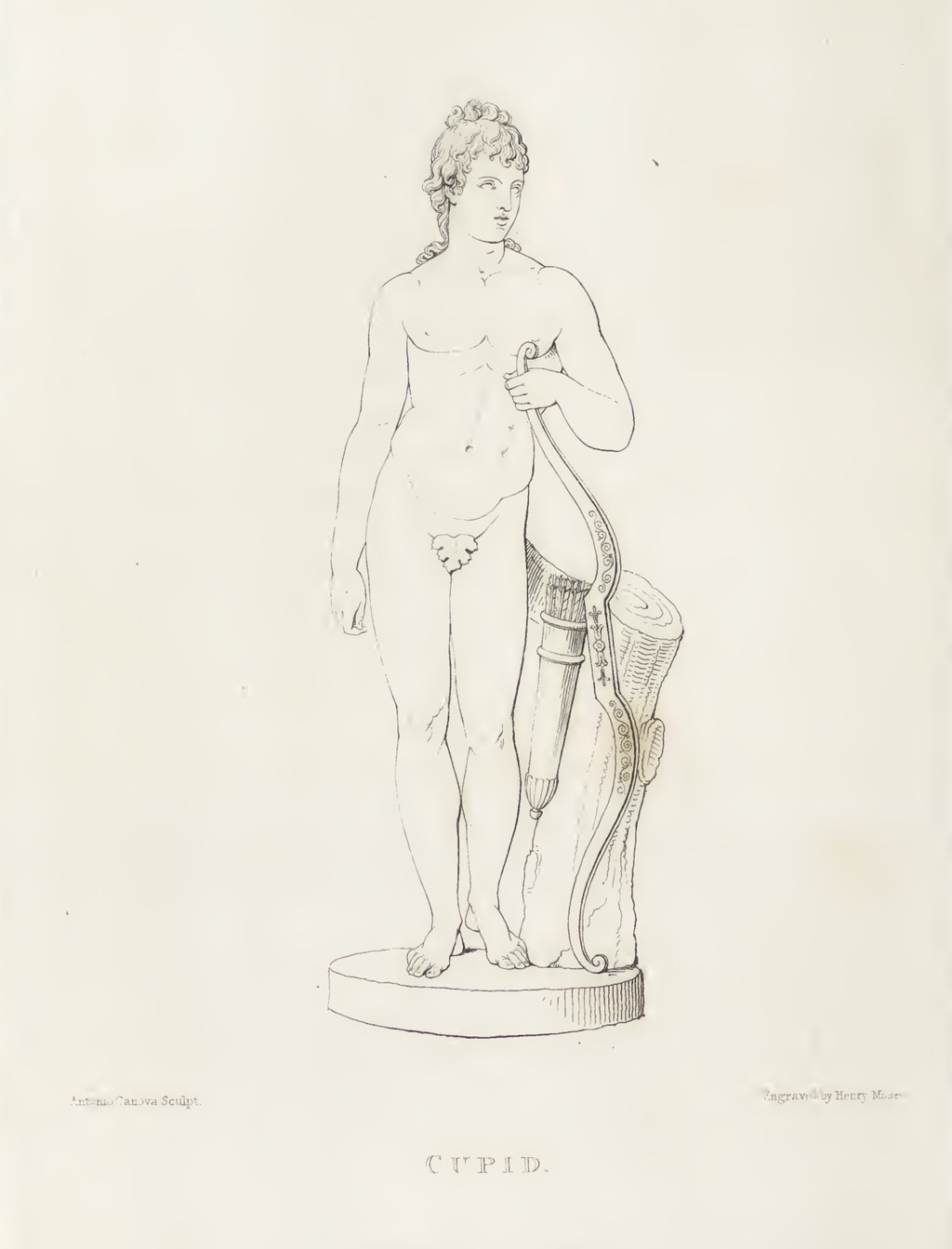
An engraved Cupid by Moses shows the god as a freestanding figure in another design by Canova. Henry Moses, after Antonio Canova, engraving published in London, 1824. Getty Research Institute. Image source. Public domain. Scan margins trimmed and image resized.
Explore Canova’s works
Browse the sculptures and paintings covered in this guide. Several entries compare versions or examine details of a larger work.
Discussion
Look again at the images and ideas explored in Venus with Cupid. These editorial prompts invite your observations.
Reader Insights
How does the embrace draw your attention across the painting?
What changes when Canova treats a similar subject in sculpture?
Join the Conversation
Share a detail, comparison or question about Venus with Cupid below.
References
- Catalogo generale dei Beni Culturali, Venere con Amore, Possagno inventory 45, national record 0500432560, citing Giuseppe Pavanello’s 2001 exhibition catalogue. View source.
- Catalogo generale dei Beni Culturali, Venere con Amore, Possagno inventory 46, national record 0500432561. View source.
- Cora H. Gilroy-Ware, Antonio Canova and the Whatever Body, Open Library of Humanities 3, no. 1 (2017), pp. 17 and 21–22. View source.
- Musei Capitolini, Pompeo Batoni, Sacra Famiglia, about 1760, Pinacoteca Capitolina, illustrated in VII Settimana della Cultura. View source.
- Catalogo generale dei Beni Culturali, Le grazie, Possagno inventory 132, national record 0500432558. View source.
- Metropolitan Museum of Art, Venus and Cupid, terracotta, 1993.170, with catalogue essay by James David Draper. View source.
- Fernando Mazzocca, The Self-portrait of Giorgione. A Painting by Antonio Canova Rediscovered, p. 14. View source.
- Musée du Louvre, Psyché ranimée par le baiser de l’Amour, reclining marble, inventory MR 1777. View source.


 Antonio Canova.jpg)

