



Caspar David Friedrich: German Romantic Landscape Painter
Caspar David Friedrich was born in Greifswald on September 5, 1774, and died in Dresden on May 7, 1840. [1] [2] He became the defining painter of German Romantic landscape, not because he made nature picturesque, but because he made it feel intellectually and spiritually charged. In his best-known works, coasts, mountains, ruins, fog, moonlight, ice and figures seen from behind become settings in which looking itself turns serious.
Friedrich studied at the Royal Danish Academy of Fine Arts in Copenhagen before settling in Dresden in 1798. [3] [4] From Dresden he worked between close observation and studio invention, drawing from Greifswald, Rügen, Saxon and Bohemian Switzerland, the Giant Mountains, the Elbe and the Baltic coast. The Metropolitan Museum of Art's exhibition framing emphasizes how his landscapes open nature into individuality, intimacy and complexity rather than offering simple scenery. [5]
This homepage introduces Friedrich's life, major paintings, places, methods and reputation. It is designed as the starting point for the full Friedrich cluster: a reader can move from here to the Biography, the Paintings hub, medium pages for Drawings and Prints, and close readings of individual works such as Wanderer above the Sea of Fog, The Monk by the Sea and The Sea of Ice.
At a Glance
- BornSeptember 5, 1774, Greifswald. [1]
- DiedMay 7, 1840, Dresden. [2]
- Known forGerman Romantic landscapes, Rückenfiguren, moonlit seas, ruins, mountains, fog and ice.
- TrainingRoyal Danish Academy of Fine Arts, Copenhagen, 1794-98. [3]
- Main working cityDresden from 1798. [4]
- Key placesGreifswald, Rügen, Saxon and Bohemian Switzerland, the Giant Mountains, Dresden and the Baltic coast. [8] [9]
- Major worksWanderer above the Sea of Fog, The Monk by the Sea, The Abbey in the Oakwood, The Cross in the Mountains and The Sea of Ice. [10] [11] [12] [13] [14]
- Modern revivalstrongly reintroduced to modern viewers at the 1906 German Centenary Exhibition in Berlin. [15]
Contents
- Introduction
- Connections Engine
- Artist Journey Map
- Why Friedrich Matters
- Life and Places
- Landscape as Inner Experience
- The Back-Turned Figure
- Faith, Ruins and Controversy
- Ice, Sea and Human Limits
- From a field study to a painted landscape
- The places from which his landscapes are seen
- Major Paintings to Start With
Why Friedrich Matters
Friedrich matters because he changed what landscape painting could ask of a viewer. Earlier European landscapes could be topographical records, classical settings, devotional backdrops or decorative views. Friedrich used landscape as the main event. A person standing before the sea, a cross on a mountain, a ruined abbey in winter, a ship crushed by ice or a window opening onto masts and sky could carry the emotional and philosophical burden of the painting.
His art is often associated with Romanticism, but the word is only useful when it is kept specific. Friedrich's Romanticism is not a generalized mood of sadness. It is a way of staging uncertainty. His paintings make the viewer ask where the human figure stands in relation to nature, death, faith, memory and time. The smallness of a person in The Monk by the Sea, the exposed viewpoint of Wanderer above the Sea of Fog, and the crushed hope of The Sea of Ice do different things, but each places human expectation under pressure. [10] [11] [14]
The Met's recent exhibition context is helpful here because it treats Friedrich as an artist of open-endedness and complexity rather than as a maker of simple symbols. [5] His pictures often resist a single explanation. The cross may be Christian, but it is also a sign placed in landscape, weather and light. The figure seen from behind may invite identification, but it can also hold the viewer at a distance. Fog may conceal, reveal or suspend judgment. Friedrich's importance lies in that tension: he gives the viewer enough visual clarity to look carefully, and enough interpretive openness to keep looking.
Life and Places
Friedrich's life began in Greifswald, a Baltic city whose low horizons, nearby coast and northern light remained central to his imagination. [1] His childhood also included severe losses recorded in the cdfriedrich.de Chronicle, including the deaths of his mother, siblings and his younger brother Johann Christoffer, who drowned while ice-skating. [3] Those facts should not be used to explain every later image, but they help clarify why mortality, winter, graves and memory never feel incidental in his art.
The Copenhagen years gave Friedrich formal training. From 1794 to 1798 he studied at the Royal Danish Academy of Fine Arts, building the drawing discipline that underlies his later paintings. [3] His mature landscapes can seem visionary, but they are not careless or vague. The placement of a tree, rock, horizon, ship, ruined wall or solitary figure depends on an exacting sense of structure.
Dresden became his principal working city after 1798. [4] From there he could use the Academy, encounter collections and colleagues, and walk into landscapes that fed his drawings. He returned imaginatively and physically to Greifswald and Rügen, moved through Saxon and Bohemian Switzerland, and crossed the Giant Mountains on foot with Georg Friedrich Kersting in 1810. [8] [9] These journeys gave him motifs, but the finished pictures usually do more than record where he had been.
That distinction is vital. Friedrich was deeply responsive to real places, yet his most powerful paintings are made landscapes. They join observed motifs from different settings, memories and drawings into compositions that feel plausible without being simple views. His places are therefore both geographic and inward: Greifswald is a birthplace, Rügen is a place of travel and marriage, Dresden is a working city, and each also becomes material for visual thought.
Landscape as Inner Experience
Friedrich's landscapes often begin with a strong physical fact: a shore, a cliff, a mountain, a line of trees, a frozen river, a church ruin. What makes them distinctive is the way those facts become experiences of thought. A Friedrich landscape rarely gives the viewer an easy path through space. Foregrounds can be abrupt, figures can block or invite entry, and the distance can be visible yet unreachable.
This is why the paintings often feel still without feeling empty. The Monk by the Sea strips the scene to shore, sea and sky, placing the human figure so low and small that the landscape seems to stretch beyond ordinary pictorial expectation. [11] The Abbey in the Oakwood turns winter trees and a ruined Gothic church into a scene of passage and burial. [12] The Sea of Ice builds a catastrophe from fractured floes and a crushed ship, transforming observed ice on the Elbe into an imagined polar wreck. [14]
A useful way to approach Friedrich is to ask what kind of viewing position the painting creates. Are we standing with the figure, looking past the figure, replacing the figure, or excluded by the figure? Is the landscape open, closed, infinite, broken or unreachable? These questions matter because Friedrich's paintings are not only about nature. They are about the conditions under which nature becomes meaningful to a human observer.
The Back-Turned Figure
One of Friedrich's most recognizable devices is the Rückenfigur, a figure seen from behind. The device is now inseparable from Wanderer above the Sea of Fog, where a man stands on a rocky summit and looks over a landscape of fog and distant forms. [10] The figure is not simply a portrait subject. He is a viewing position.
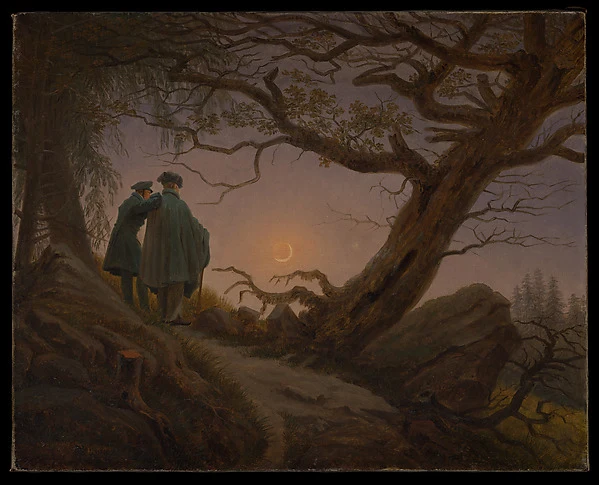
The back-turned figure can make the viewer feel close to the scene because it offers a human proxy. Yet it also prevents easy access, because the figure's face and thoughts remain hidden. That double effect is central to Friedrich's art. The figure in Wanderer might seem heroic, meditative, uncertain or almost obstructive depending on how the viewer reads the relationship between body and landscape.
The same device changes meaning across the cluster. In Chalk Cliffs on Rügen, figures are set within a landscape connected to travel and Rügen, with the visible cliff edge making looking feel precarious. [13] In Woman at a Window, the back-turned figure belongs to an interior, and the outward view is framed by architecture. Friedrich repeatedly adjusts the same problem: how does a viewer enter a picture through another viewer?
Faith, Ruins and Controversy
Friedrich's religious landscapes are among his most challenging works because they shift sacred meaning into landscape itself. The Cross in the Mountains (Tetschen Altar), made in 1807/08, places a crucifix in a mountain landscape and frames it in a carved and gilded structure by Christian Gottlob Kühn. [12] The work was commissioned, exhibited in Friedrich's Dresden apartment at Christmas 1808, and criticized in a public dispute by Basilius von Ramdohr. [16]
That dispute matters because it shows what was at stake. Friedrich was not merely putting a cross into a landscape. He was asking whether landscape could carry the seriousness expected of sacred art. The question continued in The Abbey in the Oakwood, where Gothic ruin, bare oaks, winter and burial form a meditation on death and faith without turning into a straightforward church picture. [12]
The ruin in Friedrich is never just picturesque decay. It can suggest history, loss, spiritual persistence and the fragility of human institutions. The cross is never just a prop. It changes how light, height, weather and distance are read. That is why reducing Friedrich to generic Gothic atmosphere misses the point. His religious and ruin imagery is disciplined, situated and often controversial.
Ice, Sea and Human Limits
Sea and ice gave Friedrich some of his starkest images of human limitation. In The Monk by the Sea, the sea is almost empty, but its scale overwhelms the monk and the viewer. In Moonrise over the Sea, the shore, figures, ships and moonlight suggest waiting, distance and the movement of time. In The Sea of Ice, the shipwreck narrative is pushed into a jagged structure of ice that dominates the entire painting. [14]
The polar subject of The Sea of Ice should be kept specific. Friedrich did not paint a generic disaster scene. He drew on contemporary interest in northern exploration and on observations of ice floes on the frozen Elbe near Dresden in the winter of 1820/21. [14] The result is a work sometimes connected to the wreck of hope, both as a title tradition and as a way of reading human ambition against forces that do not yield to it.
This is one reason Friedrich remains modern to many viewers. His paintings often avoid narrative closure. A figure looks but does not explain. A ship is crushed, but the scene does not become melodrama. A moon rises, but the waiting figures remain quiet. Friedrich lets nature exceed the human stories placed within it.
From a field study to a painted landscape
Friedrich's drawings can be remarkably specific about things that become difficult to see in his paintings. The Hamburger Kunsthalle's exhibition on his work describes pencil marks and written annotations that record proportions, distances and the artist's eye level. Such marks preserve something about the position from which a tree or rock was seen. Once Friedrich brought the observation into the studio, he could decide which of those relationships to retain and which to alter. In Morning in the Giant Mountains, technical study found a close fit between drawn ridge profiles and much of the distant panorama. Infrared images show a different kind of drawing in the foreground, where slopes and stones are marked individually.[9][18][19]
The drawings also give a way to follow the same feature from one work to the next. Two trees that Friedrich drew in April 1809 supplied elements for a winter landscape in Schwerin and for the oak in all three moonwatching paintings. In the winter scene the two trees remain distinct. In the moonwatching group the lower study supplied a crooked trunk and the other contributed the long branch that extends into the sky. Man and Woman Contemplating the Moon gives that branch a particularly clear silhouette. The tree's shape owes something to the precision of each drawing and something to the painter's ability to combine features observed separately.[20]
Friedrich sometimes began a figure by transferring a contour from tracing paper. The Nationalgalerie has identified the technique in the Berlin moonwatching canvas and in Moonrise over the Sea. One painting makes a small touch on a shoulder the point of contact between two figures. The other sets three seated people against water and sky. A comparable studio procedure could produce different kinds of attention because Friedrich was free to change the placement of a body, the surrounding light and what lay in front of it.[21]
The places from which his landscapes are seen
The town views make it easy to see how much depends on where Friedrich places the viewer. In Meadows near Greifswald, he retained the spacing of the skyline from a squared drawing and changed the activity beneath it, adding the two galloping horses. The foreground carries the eye across usable pasture towards the roofs. In Greifswald Harbor, the same town can be recognised by its church towers, but masts and rigging divide the view. The foreground puts us near people working at the water's edge. The city is familiar in each painting, and the route the eye takes to reach it is different.[22][23]
Friedrich could give the sea an even more open character. The Hamburger Kunsthalle points out that his seascapes often use a narrow strip of shore to establish a place from which to look. In the Chemnitz Sailing Ship, the high-seas view offers no comparable foothold. The contrast helps explain the importance of the little stretch of beach in The Monk by the Sea. The painting leaves little visible structure beyond it, but the strip gives the monk somewhere to stand and locates the viewer behind him. Across these works, a small change in the foreground can make a familiar landscape feel accessible, remote or difficult to place ourselves within.[11][18]
Major Paintings to Start With
For readers new to Friedrich, Wanderer above the Sea of Fog is the natural starting point because it condenses so much of his reputation: the elevated viewpoint, the Rückenfigur, the fog-filled distance and the unresolved identity of the viewing figure. [10] It should be read carefully rather than treated as a simple poster image of Romantic freedom.
The Monk by the Sea and The Abbey in the Oakwood form another essential route. Their Berlin exhibition and acquisition by King Friedrich Wilhelm III gave Friedrich important public recognition, and their relationship is best understood through source-bound pendant context rather than as a vague pair of melancholy scenes. [11] [12]
The Cross in the Mountains (Tetschen Altar) opens the religious landscape problem; Chalk Cliffs on Rügen links travel, figures and precipice; The Sea of Ice tests human ambition against polar destruction; and The Stages of Life turns ships, figures and shore into a late meditation on time. [13] [14]
Other works broaden the picture. Moonrise over the Sea and The Lonely Tree show Friedrich working with paired commissions and low, concentrated motifs. The Watzmann, Woman at a Window and Winter Landscape show how varied his subjects become once the cluster is seen beyond the few most reproduced paintings.
Reception and Rediscovery
Friedrich was not simply ignored in his lifetime. His career included exhibitions, commissions, major acquisitions and important viewers. The Berlin purchase of The Monk by the Sea and The Abbey in the Oakwood is one example of significant public recognition. [11] [12] Yet his reputation did change dramatically across the nineteenth century, especially as later tastes moved away from the form of Romantic landscape he had made his own.
The 1906 German Centenary Exhibition in Berlin is a key modern turning point. The cdfriedrich.de Chronicle records it as the moment at which Friedrich's art was rediscovered for a new public. [15] That wording is useful because it avoids pretending he disappeared entirely while still recognizing how decisively modern reception reframed him.
Twenty-first-century exhibitions have continued that reframing. Anniversary exhibitions in Germany and the Met's English-language exhibition context present Friedrich not as a narrow nationalist figure or a maker of scenic melancholy, but as a major European artist whose paintings remain urgent because they ask how nature, history, faith and selfhood are seen. [5] [17]
Explore the Friedrich Cluster
The best way into Friedrich is to move between biography, medium and individual works. Start with the Biography for the life chronology, then use Paintings for the main work set. The Drawings and Prints pages show why his finished oils depend on a broader practice of sketching, observation and early graphic work.
For close looking, begin with Wanderer above the Sea of Fog, then move to The Monk by the Sea, The Abbey in the Oakwood, The Cross in the Mountains, Chalk Cliffs on Rügen and The Sea of Ice. The Quotes page is useful only when statements and reception passages are kept carefully sourced, because Friedrich attracts many over-familiar paraphrases.
Frequently Asked Questions
Discussion
Reader insights are welcome, especially source-grounded observations about Friedrich's landscapes, viewing figures, places, religious imagery and modern reception.
Reader Insights
Which Friedrich painting most changes when you ask where the viewer is standing?
How do Greifswald, Rügen, Dresden or the mountains alter your reading of the work?
Where does a painting invite meaning without closing it down?
Which Friedrich work would you use to introduce a new reader to his art: Wanderer above the Sea of Fog, The Monk by the Sea, The Sea of Ice or another painting?
Join the Conversation
Share a close, source-aware observation about Friedrich's landscapes or viewing figures.
References
- Casper David Friedrich is born as the sixth of ten children in Greifswald on September 5, cdfriedrich.de Source
- Caspar David Friedrich dies on May 7, aged 65. He is buried in the Trinitatis Cemetery in Dresden, cdfriedrich.de Source
- Chronicle: Works and Biography, cdfriedrich.de Source
- Friedrich moves to Dresden, cdfriedrich.de Source
- Caspar David Friedrich: The Soul of Nature, Metropolitan Museum of Art exhibition page Source
- Intro, cdfriedrich.de, Caspar David Friedrich anniversary portal Source
- Anniversary Exhibitions, cdfriedrich.de Source
- Caspar David and Caroline Friedrich set off for Greifswald, cdfriedrich.de Source
- The Giant Mountains, cdfriedrich.de Source
- Wanderer above the Sea of Fog, cdfriedrich.de Source
- Monk by the Sea, cdfriedrich.de Source
- Abbey in the Oakwood, cdfriedrich.de Source
- Chalk Cliffs on Rügen, cdfriedrich.de Source
- The Sea of Ice, cdfriedrich.de Source
- Centenary Exhibition of German Art: 1775-1875, Nationalgalerie Berlin - the art of Caspar David Friedrich is rediscovered, cdfriedrich.de Source
- Friedrich exhibits Cross in the Mountains in his apartment over Christmas - generating controversial reactions, cdfriedrich.de Source
- Alison Hokanson and Joanna Sheers Seidenstein, Caspar David Friedrich: The Soul of Nature, Metropolitan Museum of Art, 2025 Source
- Hamburger Kunsthalle, Kunst für eine neue Zeit, exhibition chapters, sections on nature studies and seascapes.
- Mechthild Most, Eva Wenders de Calisse, Jens Bartoll and Kirsten Hinderer, Zur Maltechnik Caspar David Friedrichs, 2024.
- Sabine Rewald and Kasper Monrad, Caspar David Friedrich: Moonwatchers, Metropolitan Museum of Art, 2001, cat. 4.
- Alte Nationalgalerie, Infinite Landscapes, gallery texts, “Outlines of Figures.”
- Clara Blomeyer, Meadows near Greifswald, Hamburg exhibition catalogue, 2023.
- Birgit Verwiebe, Der Greifswalder Hafen, Alte Nationalgalerie.


