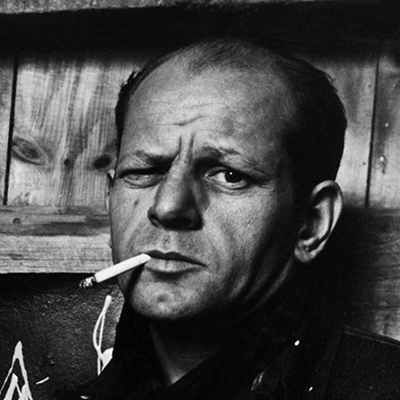
 by Tom Gurney
Tom Gurney BSc (Hons) is an art history expert with over 20 years experience
Published on June 19, 2020 / Updated on October 30, 2026
Email: tomgurney1@gmail.com / Phone: +44 7429 011000
Jackson Pollock: Introduction
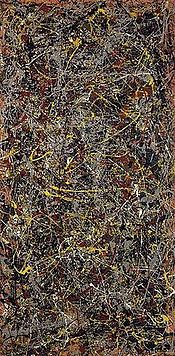
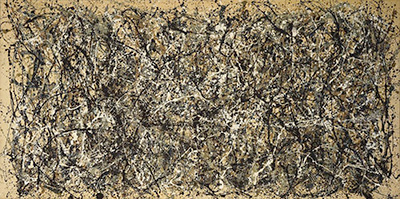
A line in a Jackson Pollock painting can be a fine thread, a heavy rope, a splash or a small pool. In One: Number 31, 1950, matte and glossy paint cross five metres of canvas. The lines suggest movement, yet their intersections ask for slow attention. In Full Fathom Five, made three years earlier, poured paint lies over a worked, encrusted surface containing such everyday things as nails, buttons and a key. The apparent freedom of these paintings grows out of very particular materials and decisions. [1] [2] [3]
Pollock changed the relationship between drawing and painting. A line could travel through the air before reaching the canvas; a picture could develop as the painter moved around it; paint could describe the force and duration of a gesture without describing a recognisable object. These possibilities helped make him a central figure in Abstract Expressionism, the varied movement associated with New York painting in the 1940s and 1950s. His poured works became especially influential because their physical methods seemed to open painting towards other kinds of artistic activity. The art historian Kirk Varnedoe traced those possibilities into sculpture, installation and performance, while emphasising the continuing disagreements about what Pollock's achievement means. [4] [5] [6]
His career also contains mythic animals, compressed human figures, drawings, prints, thickly worked oil paint and late pictures organised around very different kinds of space. The celebrated poured paintings occupy a few years within that larger development. Following the changes makes each painting more interesting: Mural proposes one kind of breadth, Lavender Mist another, and The Deep makes emptiness itself compelling. This guide introduces those differences, with routes into the paintings, the biography and the techniques and materials behind them. [7] [8] [9] [10] [11] [12] [13] [5]
At a Glance
- MovementAbstract Expressionism
- Working placesNew York City and Springs, Long Island
- Start exploringPaintings · Biography
Jackson Pollock in context
Compare selected historical periods in the artistic contexts around Pollock.
Regionalism
1930–1945 [50]Mexican muralism
c. 1920–1940 [51]Surrealism
1924–1948 [52]Abstract painting
c. 1940–1960 [53]These bands show selected historical windows, not fixed start and end dates for every movement. The abstract-painting band focuses on Abstract Expressionism in the 1940s and 1950s; Surrealism’s window runs from its 1924 manifesto to the latest work in the cited survey.
Compare the lifetimes of Pollock and artists connected with his work.
Thomas Hart Benton
1889–1975 · Birth–death [44]David Alfaro Siqueiros
1896–1974 · Birth–death [45]Pablo Picasso
1881–1973 · Birth–death [46]Lee Krasner
1908–1984 · Birth–death [47]Janet Sobel
1894–1968 · Birth–death [48]Jackson Pollock
1912–1956 · Birth–death [49]Lifespans do not represent periods of direct collaboration. Sobel’s dates follow MoMA’s 1894–1968 record.
The Flame
c.1934–38The She-Wolf
1943Mural
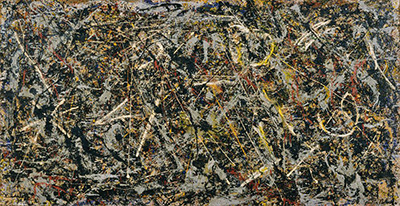
1943Alchemy
1947Number 1A, 1948
1948Blue Poles
1952The Deep
1953White Light
1954Artists around Pollock
Explore the training and artistic exchanges behind different parts of Pollock’s work.
- Thomas Hart Benton: Pollock studied with Benton at the Art Students League from 1930. [15]
- David Alfaro Siqueiros: Pollock joined Siqueiros’s New York experimental workshop in 1936. [15]
- Pablo Picasso: Picasso’s work belongs among the European sources explored in Pollock’s early development. [14]
- Lee Krasner: Krasner is one of the artists in the Picasso museum’s account of Pollock’s artistic exchanges. [14]
- Janet Sobel: Sobel also belongs to that network of early artistic exchanges. [14]
Contents
- Learning to look across the surface
- From western childhood to New York painting
- A changing language of paint
- Paintings that reveal the differences
- Krasner, patronage and the working life
- Why some paintings have numbers
- Drawings, prints and reproductions
- Fame, argument and influence
- Collections and further reading
Learning to look across the surface
An allover painting distributes attention across the picture. There may be areas of greater density, stronger accents and changes of pace, but the eye is given many possible paths. In One, MoMA describes a field without a single point of focus that nevertheless sustains an underlying order. That combination is a useful starting point. Let the whole painting register, then choose a particular line or meeting of colours and follow it for a while. Return to the whole and notice whether its balance has changed for you. [1] [5]
Different questions become useful at different distances. From farther away, attend to the shape of the canvas and the way activity spreads across it. Closer up, ask what happens when a line thickens, crosses another, disappears beneath paint or leaves an opening beside it. These are ways of looking, rather than a code to solve. A painting can hold together through relationships of interval, density, colour and direction even when it offers no central character or event. [17]
The word allover can be misleading if it suggests uniformity. An evenly patterned fabric repeats; a painting may keep altering the terms on which one part answers another. Nor does looking across the whole surface require every inch to carry the same amount of paint. Ask where the canvas remains visible, whether an open passage feels like a pause, and how the edges affect a line that seems to continue beyond them. Those questions allow differences between works to emerge before the general label takes over. [17]
Pollock's own explanations combine immersion with judgement. In his statement “My Painting,” published in Possibilities in the winter of 1947–48, he described the resistance of a hard support, the freedom to work from four sides and a period of becoming acquainted with what he had made. He also described changing and destroying an image. His phrase “the painting has a life of its own” belongs to an account of working, recognising and responding. It allows for revision as well as immediacy. [18]
In the interview with William Wright, Pollock spoke of learning to control flowing paint through experience. He described beginning with a general sense of what he was doing while allowing the particular image to develop through the act of painting. His advice to viewers was similarly receptive: give the work time to offer something, without first demanding that it represent a familiar subject. [19]
One can take that advice without suppressing associations. A tangle may suggest a landscape, a rhythm may feel musical, or a form may begin to resemble a body. The question is what the painting does with that suggestion. Does it sustain an identifiable figure, allow it to dissolve, or keep it suspended between possibilities? Pollock's earlier paintings and his black works of 1951 make this an especially productive question. Figuration was a resource he repeatedly changed, concealed and brought forward. [20]
Four stages of Jackson Pollock’s career
These four periods group overlapping developments. Figurative work, abstraction, drawing and material experiment continued across their boundaries.
Learning across traditions
Regionalism, Mexican muralism and European modernism shape the early work. [14]
A widening field of experiment
Figures, painting materials, engraving and sculpture belong to a varied practice. [14]
Painting with a fluid line
Pouring and dripping open new possibilities on canvas and paper. [16]
Black paint and returning figures
Black paint renews the exchange between recognisable imagery, drawing and painting. [20]
From western childhood to New York painting
Paul Jackson Pollock was born in Cody, Wyoming, in 1912, and grew up chiefly in Arizona and California after his family left Wyoming during his infancy. His early acquaintance with art came through several channels, including reproductions sent home by his older brother Charles and teaching in Los Angeles. In 1930 he moved to New York and enrolled in Thomas Hart Benton's class at the Art Students League. Benton gave him a serious engagement with composition, drawing and mural painting. The mature artist emerged from years of study and experiment. [21] [22] [23]
Mexican mural painting was another important encounter. Pollock saw José Clemente Orozco's Prometheus in California in 1930 and later studied other mural projects. In New York in 1936 he participated in David Alfaro Siqueiros's experimental workshop, where artists tried commercial paints and methods including pouring, dripping and spraying. These experiences brought the physical properties of paint into close contact with the ambition to work on a large scale. They preceded Pollock's mature poured paintings by more than a decade. [21] [23] [24]
The Federal Art Project of the Works Progress Administration supplied employment from the mid-1930s, with interruptions and changes of assignment. It also placed Pollock within a working community of artists. European modernism reached him through New York exhibitions, reproductions and personal contacts: he repeatedly saw Picasso's Guernica and its preparatory work in 1939, while Surrealism offered ways to explore associative imagery and images arising during the act of making. His paintings developed where these sources met the practical training of the earlier years. [21] [22]
Indigenous art also formed part of his experience, though it needs to be discussed specifically. MoMA’s historical account records his attendance at the museum's 1941 exhibition Indian Art of the United States, including demonstrations by Navajo artists making sand paintings. In “My Painting” he later compared working around his canvas to sand painting. That comparison records Pollock's understanding of his method; the Navajo practice has its own cultural purposes and history. A museum encounter and an artist's analogy cannot explain his entire development or make his paintings examples of that tradition. [18] [25]
A decisive change in his professional circumstances came in 1943. Peggy Guggenheim offered a contract with her gallery, Art of This Century, giving him a monthly income against sales, and commissioned the immense Mural for her New York townhouse. His first solo exhibition followed that November. The paintings shown included The She-Wolf, Male and Female and Guardians of the Secret, alongside works on paper. MoMA bought The She-Wolf in 1944. Institutional recognition therefore began while Pollock was still painting figures and symbolic subjects. [9] [18] [22]
Pollock and Lee Krasner married in October 1945 and moved the following month to a farmhouse in Springs, on eastern Long Island. He initially painted in an upstairs bedroom, then used a relocated barn as his studio; Krasner worked in the bedroom studio. In 1947 he developed a sustained body of poured paintings. These were followed by the major large canvases of 1950, the primarily black paintings of 1951 and further changes in the following years. The sequence was rapid, but it grew from a long preparation. [4] [5]
A changing language of paint
Mural, dated 1943 by its owning museum, made breadth a physical challenge. Commissioned for an entrance hall, it was painted on canvas and is now in the University of Iowa Stanley Museum of Art. Its listed medium is oil and casein on canvas. The work measures approximately six metres across: a portable painting with the presence of an architectural surface. [10]
The Getty's technical study changed the familiar account of its making. An initial composition may have developed quickly, but many later layers were placed over dry paint, indicating intervals of days or weeks. Researchers also found that effects once thought to require a horizontal canvas could be reproduced with the canvas upright. The evidence supports a staged process and makes upright working the stronger explanation. White house paint was used late in the process to reopen areas of space. The painting's energy includes considered returns to a developing surface. [26]
Materials continued to change before 1947. A study of eleven paintings in the Peggy Guggenheim Collection distinguished the thick paint squeezed from tubes in Croaking Movement and Eyes in the Heat, both from 1946, from the more developed pouring of the following year. Alkyd binder was confirmed in the orange paint of Eyes in the Heat. The original technical study describes alkyds in the black and yellow poured paints of the 1946 work on paper Untitled as possible. The Eyes finding moves documented alkyd use back to 1946. The findings concern specified colours in particular works. [27] [28]
That distinction matters because oil paint, enamel and alkyd describe different aspects of materials and cannot always be exchanged without losing information. The same study identified glossy and matte black alkyd paints in Alchemy and Enchanted Forest, both from 1947. The flow and drying characteristics of paint helped Pollock develop new kinds of mark. The technical story involves testing materials and discovering what they could do. [27] [29]
Full Fathom Five makes the coexistence of methods particularly clear. MoMA describes an easel beginning, paint built up with a brush and palette knife, embedded objects, and a move to the floor for the poured upper layers. Its current medium lists oil paint and objects including nails, tacks, coins and cigarettes; the museum's interpretive text identifies house paint in the upper skeins. A dense material body and a more open network occupy the same picture. Coddington and Hickey also note artist oils among some of its gestural tendrils. Calling it a drip painting identifies an important operation, while the object itself preserves several. [2] [3]
The floor changed the behaviour of liquid paint and the painter's access to the support. Pollock could approach from different sides, carry a line across a distance and work above an unstretched surface. Yet the canvas's position during making and its orientation for viewing are separate questions. A picture made horizontally can be presented vertically on a wall, where gravity, bodily movement and the picture's own directions become experiences for the viewer. Pollock's published statement also names the hard wall as a possible support. Conservation evidence makes that flexibility concrete. In One, MoMA conservators James Coddington and Jennifer Hickey identify late rust-brown drips whose form strongly suggests that Pollock made final adjustments while the canvas hung vertically. Their account of Echo also finds evidence for a baster touching the canvas as it released paint. These are findings about particular marks, revealing changes of position and contact within the broader practice. [3] [4] [18]
The question of how he used a brush is especially revealing. A brush can spread paint by touching the canvas or carry liquid above it; a tube can deposit a raised line; a can can release a broader flow. Later works again include direct tube application and brush manipulation. The technique guide follows those differences in greater detail. For the paintings, the useful question is how each kind of mark contributes to the particular surface and space being made. [11] [5] [19]
Paintings that reveal the differences
Begin with The She-Wolf, from 1943, to see how recognisable imagery and freely handled materials coexist. MoMA connects the animal provisionally with the Roman story of Romulus and Remus, while recording that Pollock declined to identify its meaning. Washes and spatters already loosen the image. The animal remains recognisable while its story stays open. It is a useful point from which to approach the later question of figures appearing and disappearing within a field of marks. [9]
The three large canvases One, Autumn Rhythm and Number 32 show the reach of his work in 1950. At MoMA, One: Number 31, 1950 extends its interwoven threads, pools and splashes across a broad horizontal field. The museum describes an intricate range of tans, blues and greys crossed by black and white. A line may register as a forceful action when considered on its own, then become part of a delicate relationship within the whole. [1] [5]
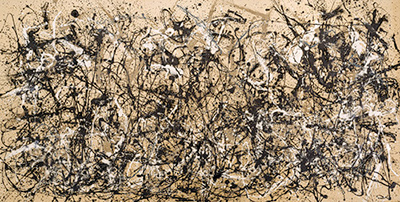
Autumn Rhythm: Number 30, 1950, in the Metropolitan Museum of Art, takes that ambition to another canvas more than five metres wide. The Met places it in the history of mural painting and records its medium as oil-modified alkyd resin on canvas. Its acquisition in 1957 also marks how quickly work that had seemed disruptive entered a major museum's account of modern art. Comparing the two paintings invites attention to their individual organisation rather than treating one as an example sufficient to explain the other. [30]
Number 32, 1950, in the Kunstsammlung Nordrhein-Westfalen, belongs to the same extraordinary year. The museum records Duco paint on canvas and dimensions of 269 by 457.5 centimetres. Its presence alongside the other monumental works helps establish the scale of the achievement without making scale the sole measure of importance. A painting's dimensions set the conditions for looking; its handling of those conditions gives the encounter its character. [31]
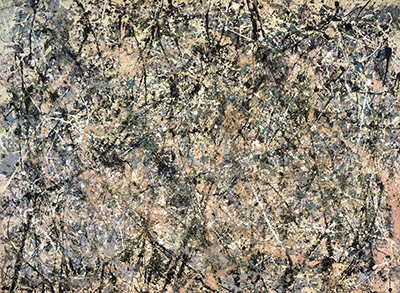
Number 1, 1950 (Lavender Mist), in Washington's National Gallery of Art, provides a further comparison. The museum's account identifies oil, enamel and aluminium paint and draws attention to handprints near the upper corners. Such traces make the maker's physical presence available within the field. The same institutional account places Pollock's experiments in a wider history, including Siqueiros's workshop and the allover paintings of Janet Sobel. His particular achievement becomes clearer when the other experimenters are allowed into the story. [7]
In 1951, Echo: Number 25 changed the balance. MoMA contrasts its economy with the more expansive activity of One and notes its approach towards figuration. Black enamel draws across the canvas, allowing the possibility of bodies or images to become more legible. In later recollection Krasner related the black paintings to Pollock's earlier drawings and to images that he had sometimes chosen to veil. The change can be followed through his continuing concerns with drawing, concealment and recognition. [20] [19]
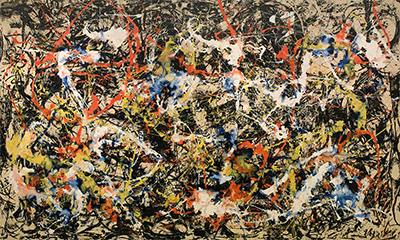
Colour returned forcefully in Convergence: Number 10, 1952. The Buffalo AKG Art Museum explains that Pollock began the work in black and white, then added colour as he reworked it. A small match embedded in the paint supplies a reminder of the picture's material substance. Its development makes revision part of the visual story: the decision to add something can transform the relationships already present. [32]
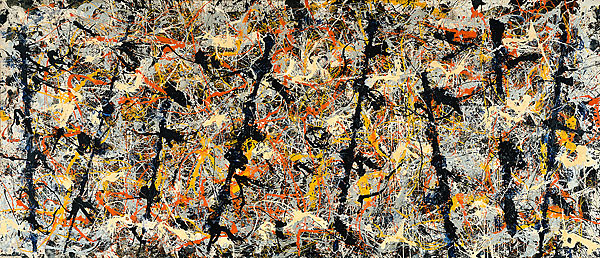
Blue Poles, also from 1952, gives the field a series of strong upright accents. National Gallery of Australia curator Sarina Noordhuis-Fairfax describes eight dark poles added late in the process, formed by pressing the painted edge of wood against the canvas and then crossed by further lines. The work also contains metallic paint and passages in which wet colours mingled. Its structure developed through both airborne paint and direct contact. The poles introduce a recurring measure across the broad canvas without bringing its other movements to a halt. [33]
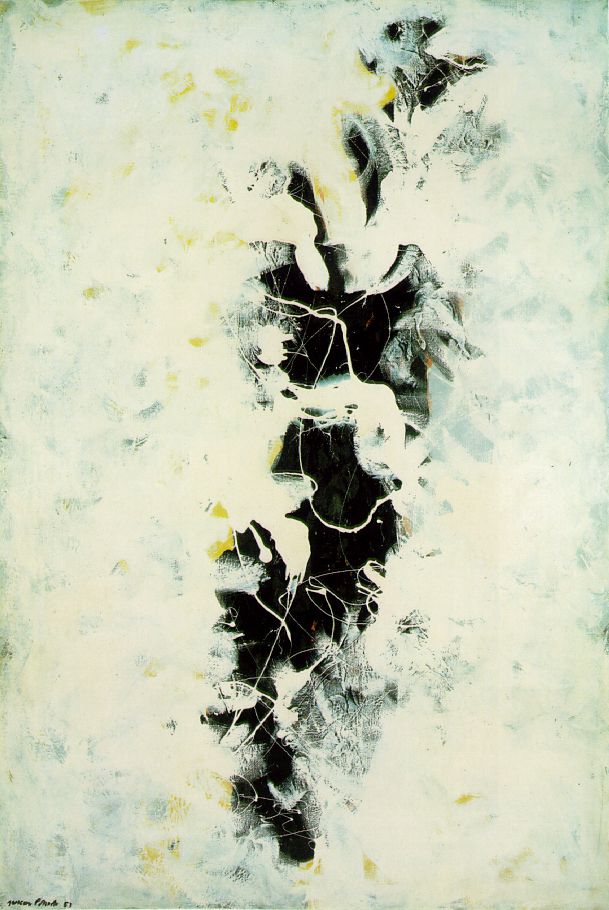
The later paintings open several further directions. In Easter and the Totem, from 1953, MoMA describes brush-painted forms that approach figures, bright colour and large passages of black, suggesting a relationship with Matisse. In The Deep, from the same year, a pale painted expanse opens around a dark fissure. Centre Pompidou's account stresses the relationship between the light surface and dark underlayer. Looking from one work to the other makes “late Pollock” a question about different pictorial possibilities. [8] [34]
White Light, from 1954, brings a further material variation. MoMA describes raised lines squeezed from tubes and areas of wet paint worked with a brush into marbled effects. Its oil, enamel and aluminium paint create a compact, layered surface. These pictures complicate the familiar rise-and-fall outline in which the poured paintings are followed by a single unsuccessful final manner. The works themselves offer several distinct problems to consider. The paintings guide provides a fuller route through those changes. [11]
Krasner, patronage and the working life
Lee Krasner belongs in this history as an artist with her own professional standing, working methods and ambitions. Her close relationship with Pollock developed around the exhibition organised by John Graham at McMillen in early 1942. Accounts differ over whether to date her important studio visit to late 1941 or attach it to the exhibition year. The broader point is secure: she recognised work that mattered to her and brought a developed understanding of modern painting to their exchange. During 1942 she directed WPA projects and employed Pollock on her teams. [6] [35] [36]
Her recollections of Springs describe two working artists whose schedules and studios remained distinct. She preferred the morning; he generally began later. They entered each other's studios by invitation and discussed whether a painting worked. This gives collaboration a concrete meaning: attention, criticism, encouragement and the experience of watching another artist's work develop. It does not require a shared style. Krasner's own painting continued, with a solo exhibition at Betty Parsons in 1951 and a show of large collages at Stable Gallery in 1955. [19] [35] [36]
Guggenheim's support was practical as well as public. A stipend bought time; a major commission supplied a challenge; exhibitions and collecting brought work into circulation. When she closed Art of This Century and returned to Europe, Betty Parsons became Pollock's dealer. The relationship with Parsons encompassed the mature poured paintings and the black works. Pollock moved to Sidney Janis in 1952 amid dissatisfaction with slow sales. Fame and economic security moved at different speeds. [18] [22]
Those relationships make the history more tangible. A painting reaches an audience through opportunities to make it, rooms in which to show it, people who advocate for it and viewers willing to spend time with it. Pollock's work was distinctive, but its public life depended on this network. The page on Krasner and Pollock follows their reciprocal artistic relationship; the biography gives the fuller history of training, work, exhibitions and support. [35]
Why some paintings have numbers
Pollock's titles offer several ways into the work. Descriptive names can evoke a mood, story or environment; numbers can postpone those associations and bring attention to the painting itself. In Berton Roueché's 1950 account of a visit to Springs, Krasner explained numerical titles in terms of their neutrality, while Pollock spoke about avoiding further confusion. These are participants' explanations of a practice, rather than a promise that numbers remove every association a viewer may have. [37]
The year is essential. Number 1A, 1948 and Number 1, 1950 (Lavender Mist) are different paintings. According to the MoMA chronology, Parsons added “A” to several unsold works from 1948 when they were shown alongside paintings from 1949. The suffix distinguished titles; it did not identify a preparatory version. Similarly, One: Number 31, 1950 is one canvas with a combined title. Keeping the complete title and year together makes it much easier to follow exhibition histories and compare works. [1] [7] [6] [38]
Descriptive titles could also arrive after a picture had been made. Blue Poles was first shown as Number 11, 1952 and received its descriptive title later. The title of Full Fathom Five, suggested by a neighbour, comes from Shakespeare's The Tempest. Such names offer associations without proving that the painting began as an illustration of the named subject. When a title prompts an image in the mind, it is useful to return to what the surface actually does with line, colour, interval and form. [2] [33] [38]
Drawings, prints and reproductions
Drawing was part of Pollock's thinking throughout his career, and works on paper deserve attention in their own right. MoMA's Untitled (Animals and Figures), from 1942, combines gouache and ink in a sheet where simplified creatures and people meet superimposed coloured lines. The museum relates it to Stenographic Figure and The She-Wolf while treating it as an independent work. Its layers offer a smaller-scale way to consider how an image can gather and change beneath subsequent marks. [12]
The Met's drawing War provides a different encounter. Inscribed 1947, it is linked by the museum to the imagery Pollock explored around 1943–44. Ink and coloured pencil carry a scene of violence in which figures are partly obscured by the movement of lines. The museum also discusses his use of sketches to develop ideas. Taken together, these examples show why drawings need to be approached individually: a sheet can be a finished independent work, a place of experiment or part of a process of working something out. The drawings guide explores that varied practice. [39]
Pollock also worked in printmaking, including at Stanley William Hayter's Atelier 17 in New York in the mid-1940s. MoMA holds a steel-faced copper plate for Untitled (4), dated about 1944–45, worked in engraving and drypoint. A printing plate and an impression on paper are different objects: the first carries the marks from which the second is printed. The date of the plate alone does not establish when any particular paper impression was made. [13] [22]
This distinction is helpful whenever the word print is used. An original print belongs to a printmaking process and has a particular publication and impression history. A reproduction of a painting translates the image of another object into a new format. Both can be worth looking at, but they answer different questions about authorship, materials and the experience of scale. The prints and posters pages follow these separate subjects. [40]
Fame, argument and influence
On 8 August 1949, Life asked, “Is he the greatest living painter in the United States?” The question greatly widened Pollock's visibility. It was a provocative headline, and contemporary judgements remained divided. The Pollock-Krasner House’s biography places Greenberg's enthusiastic advocacy alongside an adverse response to the tangled surfaces. Supportive critics, curious readers and unconvinced viewers encountered the work at the same time. [24] [41]
The history of one dispute is especially revealing. In 1950 the Italian critic Bruno Alfieri described qualities of chaos in Pollock's work but concluded with strong praise for his position in advanced art. Time selected the negative language. Pollock objected that the magazine had omitted the most exciting part of the account. The disagreement concerned both the paintings and how criticism reached a wider public. Taking a hostile fragment out of a mixed judgement could change the apparent reception of the work. [18] [25]
Hans Namuth's photographs and the film he made with Paul Falkenberg added another powerful form of visibility. Namuth photographed Pollock working in 1950, including on One and Autumn Rhythm, and filmed him painting on glass as well as canvas. The film premiered at MoMA in 1951. These records made the act of painting part of the audience's experience. They also invite a useful distinction: watching an artist work can illuminate a picture, while the finished picture continues to make its own demands on attention. [3] [22] [42]
Varnedoe's opening essay for MoMA's 1998 retrospective addresses the difficult relationship between the art and the celebrity surrounding it. He treats publicity and myth as historical forces, while resisting explanations that dissolve the paintings into the stories told about their maker. His account of influence is similarly open: artists could respond to Pollock's permission to act differently, to the physicality of making or to the resulting pictorial space. The consequences extend beyond resemblance to his signature webs of paint. [6]
Pollock died at forty-four in a car crash in Springs on 11 August 1956 while driving under the influence of alcohol. Edith Metzger, a passenger, also died; Ruth Kligman survived. The MoMA exhibition planned for him became a memorial retrospective. This history belongs to the life, with its consequences for other people. It supplies no inevitable ending to the artistic development and no explanation sufficient for the paintings. The surviving work continues to ask more particular questions about decision, material, image and scale. [5] [24]
Collections and further reading
Museum collections allow those questions to be pursued through different groups of works. MoMA holds The She-Wolf, Full Fathom Five, One, Echo, Easter and the Totem and White Light: a particularly useful span of changes. In New York, the Met's Autumn Rhythm provides another major point of comparison. Current collection records are also useful for distinguishing the materials and complete titles of works that a reproduction can make seem more alike. [1] [2] [9] [20] [11] [30] [34]
Other important destinations include the Stanley Museum of Art at the University of Iowa for Mural, the National Gallery of Art in Washington for Lavender Mist, Buffalo AKG for Convergence, the National Gallery of Australia in Canberra for Blue Poles, and Kunstsammlung Nordrhein-Westfalen in Düsseldorf for Number 32. Centre Pompidou holds The Deep. These are collection destinations; an individual painting's availability in a gallery depends on loans and changing displays, so consult the museum's own information when planning a visit. [7] [8] [10] [31] [32] [33]
The Peggy Guggenheim Collection in Venice offers a concentrated group of earlier and transitional works. Its comparative technical study helps explain how changes in materials accompanied changes in imagery, making the collection a rewarding introduction to his development. [27]
For reading, MoMA's 1998 Jackson Pollock catalogue brings together an extended account of the work, documentation and a detailed chronology by Elizabeth Levine and Anna Indych. Pepe Karmel's edited Jackson Pollock: Interviews, Articles, and Reviews provides artist statements, contemporary responses and later testimony, including Krasner's interviews. Reading a statement alongside a painting and its museum record is especially useful: the statement gives a participant's account, while the object may preserve qualifications and changes that no general explanation can contain. [6] [19] [29]
For deeper research, the Pollock-Krasner Study Center describes holdings that include catalogue raisonné archives, documents, periodicals and related research files, with oral histories and other material also associated with the house. That documentary world offers further ways into two intertwined artistic lives. For readers beginning here, the biography supplies the fuller chronology, and the individual paintings return the attention to the work: one surface, one sequence of decisions, one experience of looking at a time. [43]
Essential Jackson Pollock works
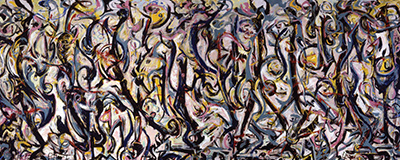
Mural
1943 · A wall-sized commission
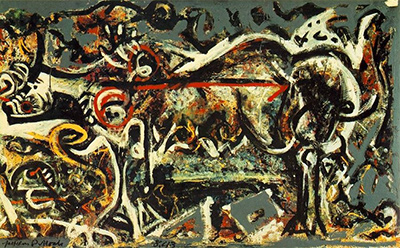
The She-Wolf
1943 · Figures and layered materials
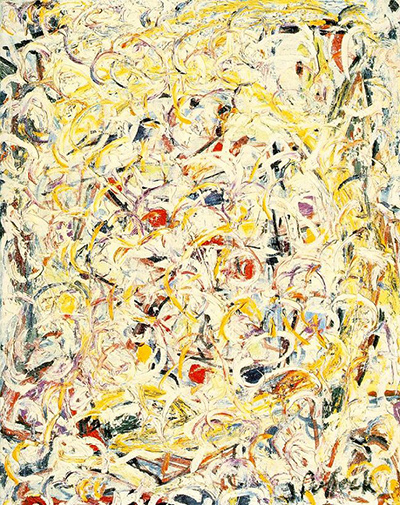
Shimmering Substance
1946 · Colour and substantial paint
Alchemy
1947 · An early poured painting
One: Number 31, 1950
1950 · An expansive painted field
Blue Poles
1952 · Colour and eight uprights
The Deep
1953 · A late spatial opening
Pollock artworks directory
Explore the distinct works discussed in these guides. This selection is not a complete catalogue. Green Silver and Untitled, 1949 are two guides to the same painting.
Discussion
Look again at the images and ideas explored in Jackson Pollock. These editorial prompts invite your observations.
Reader Insights
Which detail in “Learning to look across the surface” changes how you understand this work?
What comparison comes to mind after “From western childhood to New York painting”?
What would you like to discuss about “A changing language of paint”?
Join the Conversation
Share a detail, comparison or question about Jackson Pollock below.
References
- The Museum of Modern Art, One: Number 31, 1950, 1950, object 7.1968. Object details; MoMA Learning text; excerpt from MoMA Highlights: 375 Works from The Museum of Modern Art, New York (2019), especially the passages on materials, scale, focus and underlying order. View source.
- The Museum of Modern Art, Full Fathom Five, 1947, object 186.1952. Object details; In the Studio: Postwar Abstract Painting course text (2017); gallery label for Abstract Expressionist New York, 3 October 2010–25 April 2011, on the layered process, embedded objects and title. View source.
- James Coddington and Jennifer Hickey, “MoMA’s Jackson Pollock Conservation Project: Insight into the Artist’s Process”, The Museum of Modern Art, 17 April 2013. Paragraphs on artist oils in Full Fathom Five, late rust-brown drips and inferred vertical finishing in One, and evidence of baster contact in Echo. View source.
- National Park Service, Jackson Pollock House and Studio: National Historic Landmark Nomination, National Park Service, 1993, pp. 6, 8–10, 15–16. View source.
- Sam Hunter, Jackson Pollock (New York: The Museum of Modern Art, 1956), pp. 4, 6–13. View source.
- Kirk Varnedoe, with Pepe Karmel, Jackson Pollock (MoMA, 1998), pp. 16–19; Elizabeth Levine and Anna Indych, “Chronology,” pp. 319, 323. View source.
- Alex Dean, “The Energy and Motion of Jackson Pollock's ‘Number 1, 1950 (Lavender Mist)’”, National Gallery of Art, 12 January 2026. Caption, image description and sections “Pollock's Action Painting” and “Making Lavender Mist”; work 1976.37.1. View source.
- Centre Pompidou, The Deep (La Profondeur), 1953, AM 1976-1230. Object details, introductory text and Olivier Michelon's analysis, excerpted from Collection art moderne—La collection du Centre Pompidou, Musée national d'art moderne, ed. Brigitte Leal (Paris: Centre Pompidou, 2007). View source.
- The Museum of Modern Art, The She-Wolf, 1943, object 82.1944. Object details; 2025 gallery label for “Art of This Century”; MoMA Highlights excerpt, revised 2004, on the possible Roman myth and use of washes and spatters. View source.
- University of Iowa Stanley Museum of Art, “Jackson Pollock, Mural”, object 1959.6. Current object entry: 1943; oil and casein on canvas; Gift of Peggy Guggenheim. View source.
- The Museum of Modern Art, White Light, 1954, object 337.1967. Object details; gallery label for Jackson Pollock: A Collection Survey, 1934–1954, 22 November 2015–1 May 2016; opening In the Studio course text (2017), on tube application and brush manipulation. View source.
- The Museum of Modern Art, Untitled (Animals and Figures), 1942, object 12.1958. Object details and gallery label for Jackson Pollock: A Collection Survey, 1934–1954, 22 November 2015–1 May 2016, on independent drawing, layered lines and relationships with paintings. View source.
- The Museum of Modern Art, Plate for Untitled (4), c. 1944–45, object 452.1969. Object details: engraving and drypoint on steel-faced copper plate. View source.
- Musée national Picasso-Paris, Jackson Pollock: Les premières années, 1934–1947, exhibition introduction. French-language source. View source.
- Peggy Guggenheim Collection, Jackson Pollock, artist biography. View source.
- The Museum of Modern Art, Jackson Pollock: A Collection Survey, 1934–1954, exhibition introduction, 2015. View source.
- James Coddington and Jennifer Hickey, “MoMA’s Jackson Pollock Conservation Project: Looking Closely at One: Number 31, 1950”, The Museum of Modern Art, 8 January 2013. Text on varied layers and textures. View source.
- Jackson Pollock, “My Painting” (1947–48), in Francis V. O’Connor, Jackson Pollock (New York: MoMA, 1967), p. 40; chronology, pp. 27–29, 39, 54–56, 64. View source.
- Jackson Pollock, interview with William Wright (recording/broadcast disputed), pp. 20–23; Francine du Plessix and Cleve Gray, “Who Was Jackson Pollock?” (1967), pp. 30–34; B. H. Friedman, “An Interview with Lee Krasner Pollock” (1969), pp. 35–36; in Pepe Karmel, ed., Jackson Pollock: Interviews, Articles, and Reviews (New York: MoMA, 1999). View source.
- The Museum of Modern Art, Echo: Number 25, 1951, 1951, object 241.1969. Object details and opening gallery-label passage comparing Echo with One and discussing figuration. View source.
- Musée national Picasso-Paris, Jackson Pollock : les premières années (1934–1947), dossier documentaire (2024), pp. 9–11, 18–19. French text. View source.
- Myra McIntyre, “Jackson Pollock Chronology”, National Gallery of Australia, entries 1922–1952. View source.
- National Gallery of Art, “Jackson Pollock”, artist biography. View source.
- Helen A. Harrison, “Jackson Pollock”, Pollock-Krasner House and Study Center, Stony Brook University. View source.
- Kirk Varnedoe and Pepe Karmel, eds., Jackson Pollock: New Approaches (New York: The Museum of Modern Art, 1999), pp. 9, 38, 101, 167–168, 223–224. View source.
- J. Paul Getty Trust, “Getty Completes Conservation of Milestone Painting by Jackson Pollock”, 21 January 2014. Technical findings reported by Tom Learner and Yvonne Szafran: initial wet-into-wet composition, later layers over dry paint, white house paint and tests concerning upright application; see also Getty's Jackson Pollock's Mural project, 2012–14. View source 1. View source 2.
- Peggy Guggenheim Collection, “New Paints for a New Way of Painting”. Comparative study summary, especially tube application and named binder findings. View source.
- Francesca Rosi, Costanza Miliani, John Delaney, Kathryn Dooley, Lena Stringari, Grazina Subelyte and Luciano Pensabene Buemi, “Jackson Pollock’s Drip Paintings: Tracing the Introduction of Alkyds Through Non-invasive Analysis of Mid-1940s Paintings”, in Science and Art: The Contemporary Painted Surface, ed. Antonio Sgamellotti, Brunetto Giovanni Brunetti and Costanza Miliani (Royal Society of Chemistry, 2020), pp. 1–18, especially pp. 9 and 13. View source.
- Tom Learner, “Modern Paints: Uncovering the Choices,” in Modern Paints Uncovered, ed. Thomas J. S. Learner et al. (Los Angeles: Getty Conservation Institute, 2007), pp. 4–5. View source.
- The Metropolitan Museum of Art, Autumn Rhythm: Number 30, 1950, 1950, object 57.92. Current object details and introductory text on muralism and the 1957 acquisition; medium recorded as oil-modified alkyd resin on canvas. View source.
- Kunstsammlung Nordrhein-Westfalen, Number 32, 1950, inventory 1006, O'Connor/Thaw 274. German object entry, “Werkdaten”: Lackfarbe (Duco) auf Leinwand, image dimensions 269 × 457.5 cm. View source.
- Buffalo AKG Art Museum, Convergence: Number 10, 1952, object K1956:7. Object details and collection interpretation, especially the black-and-white beginning, subsequent colour and embedded match. View source.
- Sarina Noordhuis-Fairfax, “Blue Poles: How Pollock Created a Masterpiece”, National Gallery of Australia. Caption and passages on wet and dry layers, metallic paint, the eight poles, direct contact with painted wood and the Number 11, 1952 title. View source.
- The Museum of Modern Art, Easter and the Totem, 1953, object 425.1980. Object details and gallery label for Jackson Pollock: A Collection Survey, 1934–1954, 22 November 2015–1 May 2016, on brushwork, quasi-figurative forms and the suggested relationship with Matisse. View source.
- Helen A. Harrison, “Lee Krasner”, Pollock-Krasner House and Study Center, Stony Brook University. View source.
- The Museum of Modern Art, “Lee Krasner: Selected Chronology” (1984), entries 1942, 1951 and 1955. View source.
- Berton Roueché, “Unframed Space”, The New Yorker, 5 August 1950, p. 16. View source.
- The Museum of Modern Art, Number 1A, 1948, object 77.1950. Object details and 2010/2018 gallery labels on naming and looking. View source.
- The Metropolitan Museum of Art, War, object 1982.147.25. Object details and introductory discussion of drawing, the 1947 inscription, the relationship to imagery of about 1943–44 and Picasso precedents. View source.
- Smithsonian American Art Museum, “Want to Research Prints or Find Posters?”, “Getting Started.” View source.
- Solomon R. Guggenheim Museum, Away from the Easel: Jackson Pollock’s Mural, exhibition wall texts (2020), “Untitled (Green Silver),” PDF p. 4, quoting the 1949 Life headline. View source.
- The Morgan Library & Museum, Sketchbook, Jackson Pollock, ca. 1950–1953, accession 2010.130, object notes on the Namuth–Falkenberg film. View source.
- Pollock-Krasner House and Study Center, Stony Brook University, “Study Center”, institutional descriptions of the reference library, research collections and oral-history holdings. View source.
- The Museum of Modern Art, Thomas Hart Benton, artist record; birth and death years. Source
- The Museum of Modern Art, David Alfaro Siqueiros, artist record; birth and death years. Source
- The Museum of Modern Art, Pablo Picasso, artist record; birth and death years. Source
- The Museum of Modern Art, Lee Krasner, artist record; birth and death years. Source
- The Museum of Modern Art, Janet Sobel, artist record; birth and death years. Source
- The Museum of Modern Art, Jackson Pollock, artist record; birth and death years. Source
- Smithsonian American Art Museum, Oh Freedom! glossary, “Regionalism”; popular 1930–1945. Source
- Routledge Encyclopedia of Modernism, “Mexican Muralism (c.1920–1940)”. Source
- James Voorhies, “Surrealism”, The Metropolitan Museum of Art, 2004; 1924 manifesto and selected works through 1948. Source
- Stella Paul, “Abstract Expressionism”, The Metropolitan Museum of Art, 2004; the 1940s and 1950s. Source