



 by Tom Gurney
Tom Gurney BSc (Hons) is an art history expert with over 20 years experience
Published on June 19, 2020 / Updated on November 13, 2026
Email: tomgurney1@gmail.com / Phone: +44 7429 011000
Hercules and Lichas (Ercole e Lica): Introduction
Hercules braces himself across a rocky base, with one arm bent above his head. Beyond it a bare leg rises at a steep angle. It belongs to Lichas, the young messenger whose body curves back down beside him. Hercules holds the youth at the ankle and by the hair. From one side the great chest and shoulders partly hide Lichas. From another, his body comes into view and the gaps between the two figures open up. Antonio Canova chose the instant before the messenger is thrown into the sea. [1] [2] [3]
The marble stands in the Galleria Nazionale d’Arte Moderna e Contemporanea in Rome, where it is on deposit from the Galleria Nazionale d’Arte Antica. It measures three and a half metres high in the displaying museum’s catalogue. The early full-size plaster is at Possagno. The two objects belong to a commission that began in Naples in 1795 and ended with the installation of the marble in a Roman palace in 1815. [1] [3] [4]
Hercules and Lichas Antonio Canova
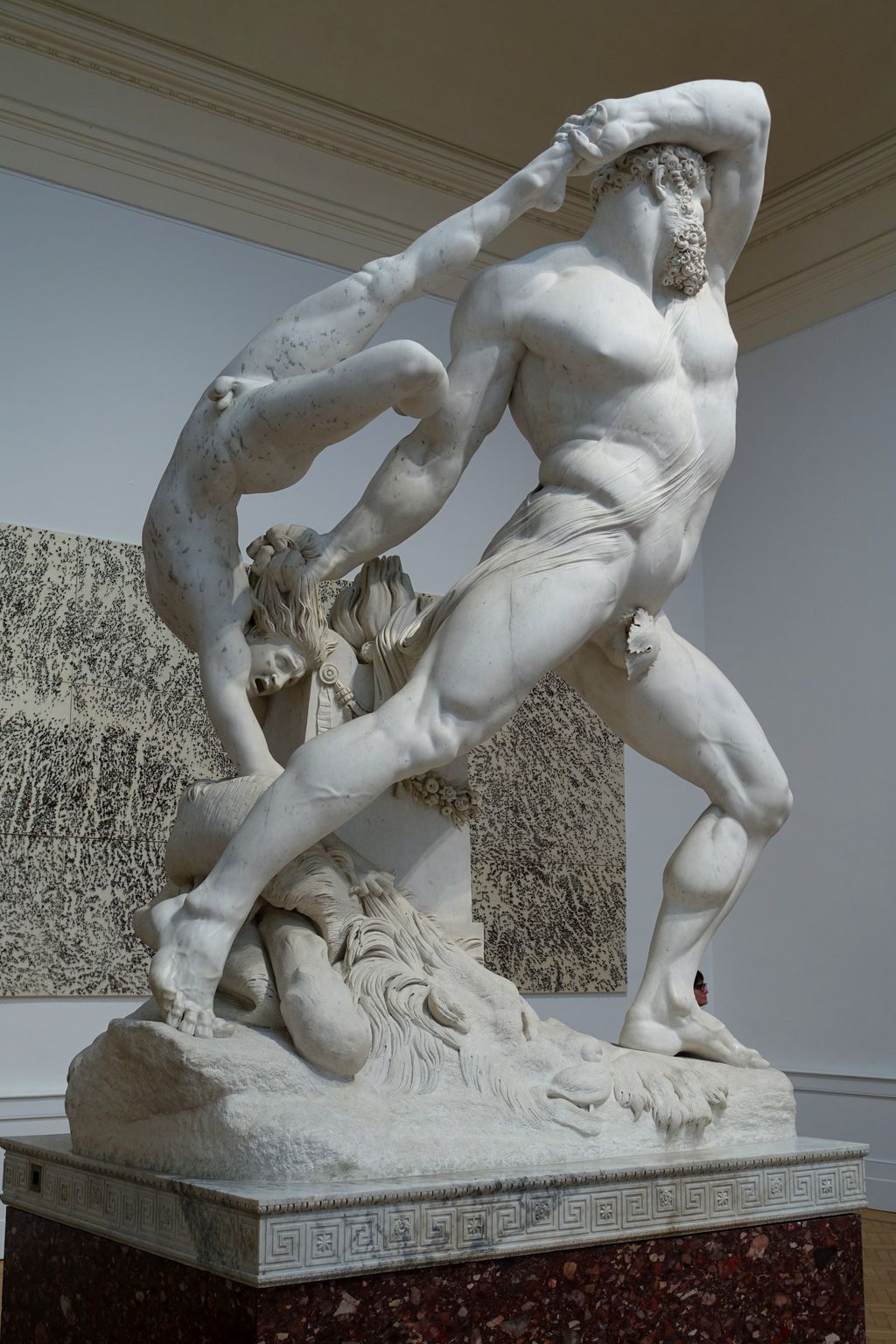
The Rome marble from the front, with both figures and the support visible. Daderot. Image source. CC0 / Public domain. Resized for display.
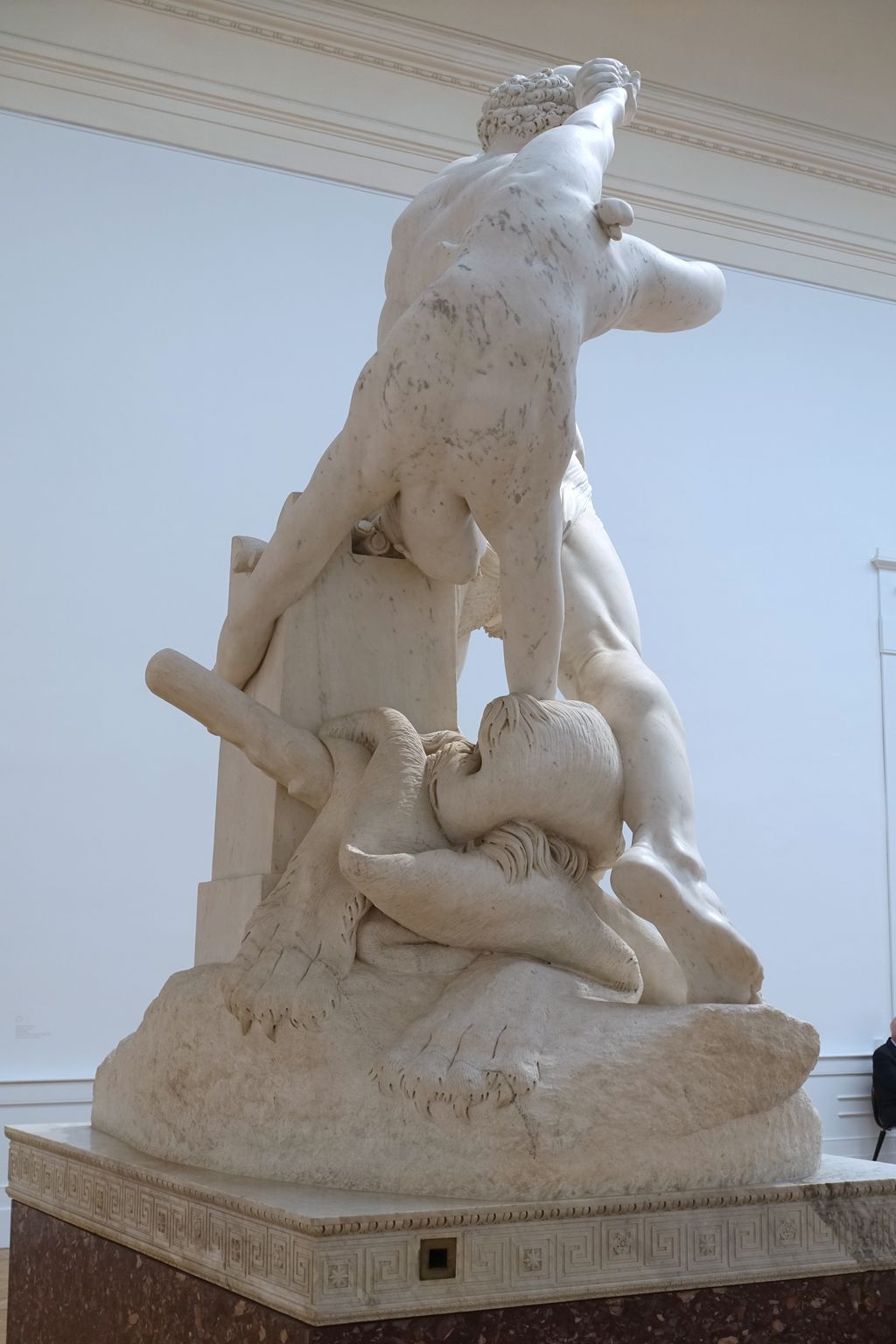
From the back, the club and folded lion skin are visible against the support. Daderot. Image source. CC0 / Public domain. Resized for display.
At a Glance
- Rome marbleAntonio Canova, 1795–1815, 350 × 215 × 175 centimetres. Galleria Nazionale d’Arte Antica, inventory 4140, on deposit at the Galleria Nazionale d’Arte Moderna e Contemporanea. [1]
- Possagno plaster1795–96, 335 × 220 × 130 centimetres, inventory 87. The plaster belongs to the Gallerie dell’Accademia in Venice. [3]
- PatronsOnorato Gaetani d’Aragona first commissioned the group. Giovanni Raimondo Torlonia took up the project and installed the finished marble in his palace. [4]
Contents
- Two bodies around a single turn
- The messenger in Ovid
- Studying the pose and enlarging the group
- The commission changes hands
- From Palazzo Torlonia to Valle Giulia
- The group on paper and in miniature
- Annotated details
Two bodies around a single turn
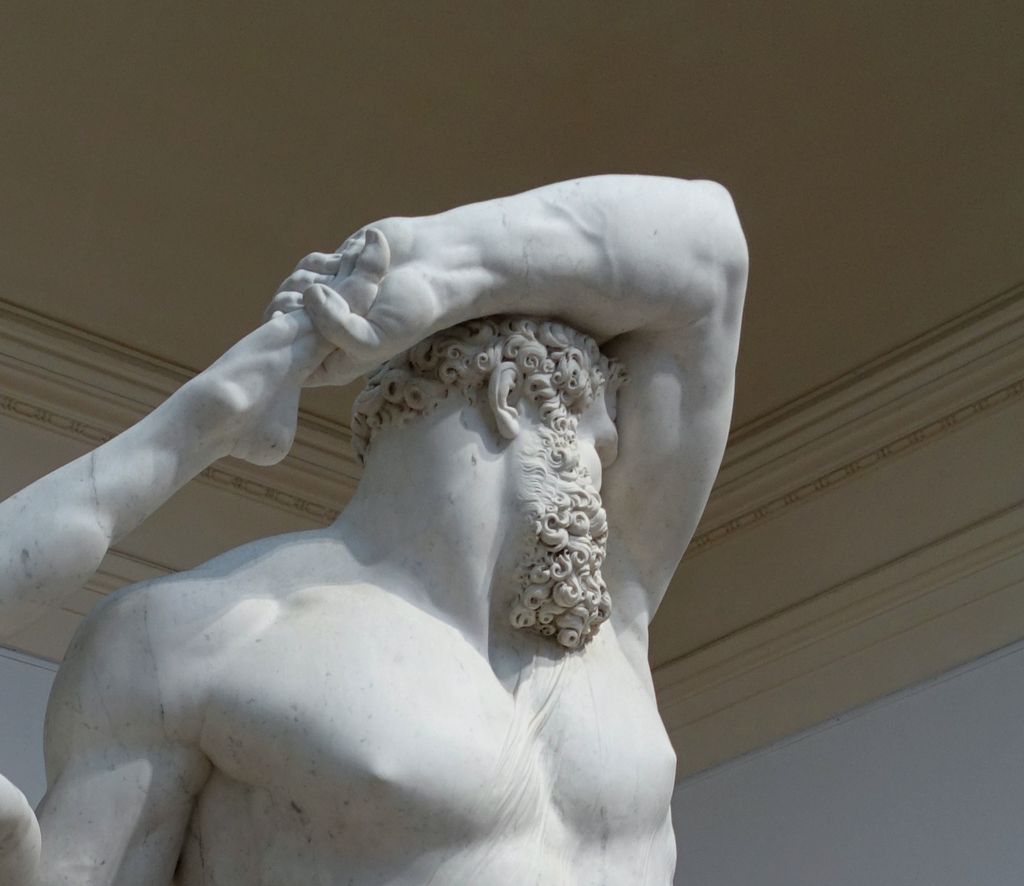
From the front, Hercules takes up most of the width of the group. One knee bends deeply, while the other leg stretches diagonally across the stone. The chest faces out and the head turns under the lifted arm. That arm forms an arch above the forehead and casts a shadow over the eyes. The body remains recognisable from a distance through the wide stance and high elbow. Closer in, the cut of the mouth and the tightly packed curls of the beard give the face a tension of its own. [2] [5]
The same view can make Lichas look like a collection of separate limbs. As you move towards his side, the raised leg leads down into the curve of his back. His second leg bends in towards Hercules, and the smaller head comes into view low against the figures. The arm that drops alongside Hercules’s hip ends at the messenger’s hair. The raised hand meets the ankle high above it. Two distant points of contact give the narrow figure a continuous outline. His open mouth is visible just where the larger body seems about to shut him from sight. [2] [3] [5]
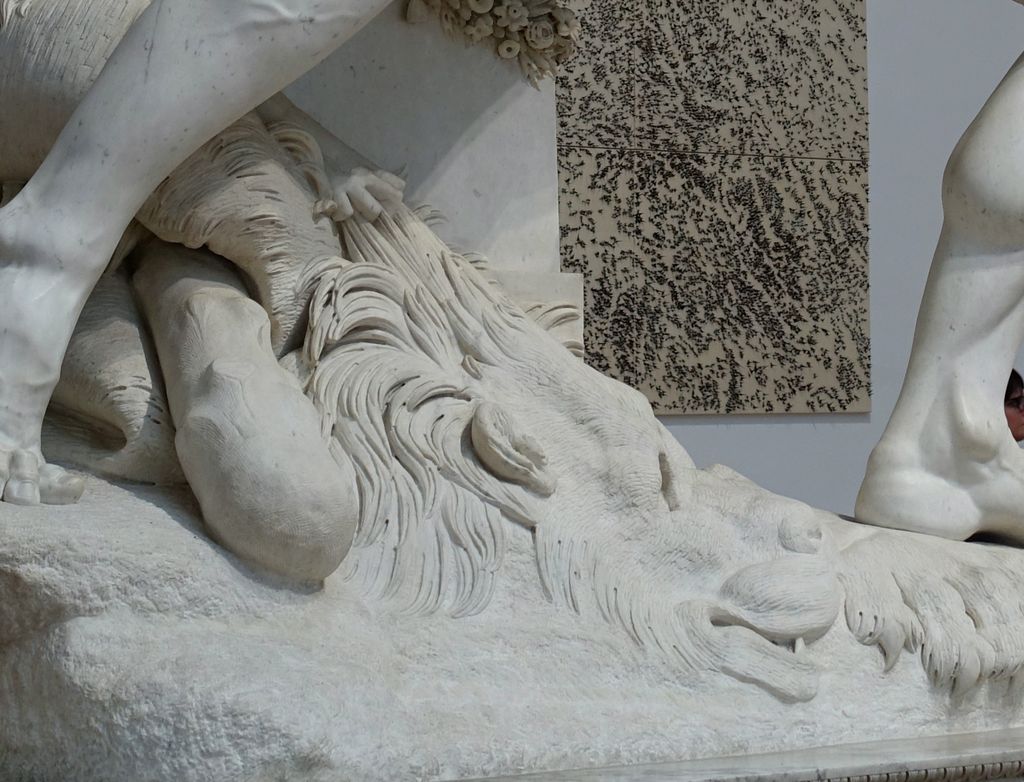
There is more to see below the figures than a place for Hercules to stand. A lion’s muzzle lies among the folds and irregular surfaces of the base. The skin carries the memory of an earlier exploit and provides a contrast to the smoother limbs. Round the back, the club projects beside the upright mass of stone, and the skin, rock and backs of the figures appear much closer together. The forward view makes Lichas seem almost suspended. The rear view shows how much marble stands beneath him. [2] [6]
The treatment of the garment contributes to Hercules’s expression. Along the front of his torso, thin ridges lie close enough to the body that they can look like marks in the flesh. The eye meets the folds only after taking in the swelling chest and tightened abdomen. The Roman gallery and the Possagno museum both point out that the garment is indicated more lightly on the plaster. In marble, where the folds are more legible, a viewer can see something of the source of Hercules’s pain while looking directly at its effects. [3] [5]
Annotated Details from Hercules and Lichas
The marble in the Galleria Nazionale d’Arte Moderna in Rome. Photograph by Daderot, CC0. Resized, annotated and cropped.
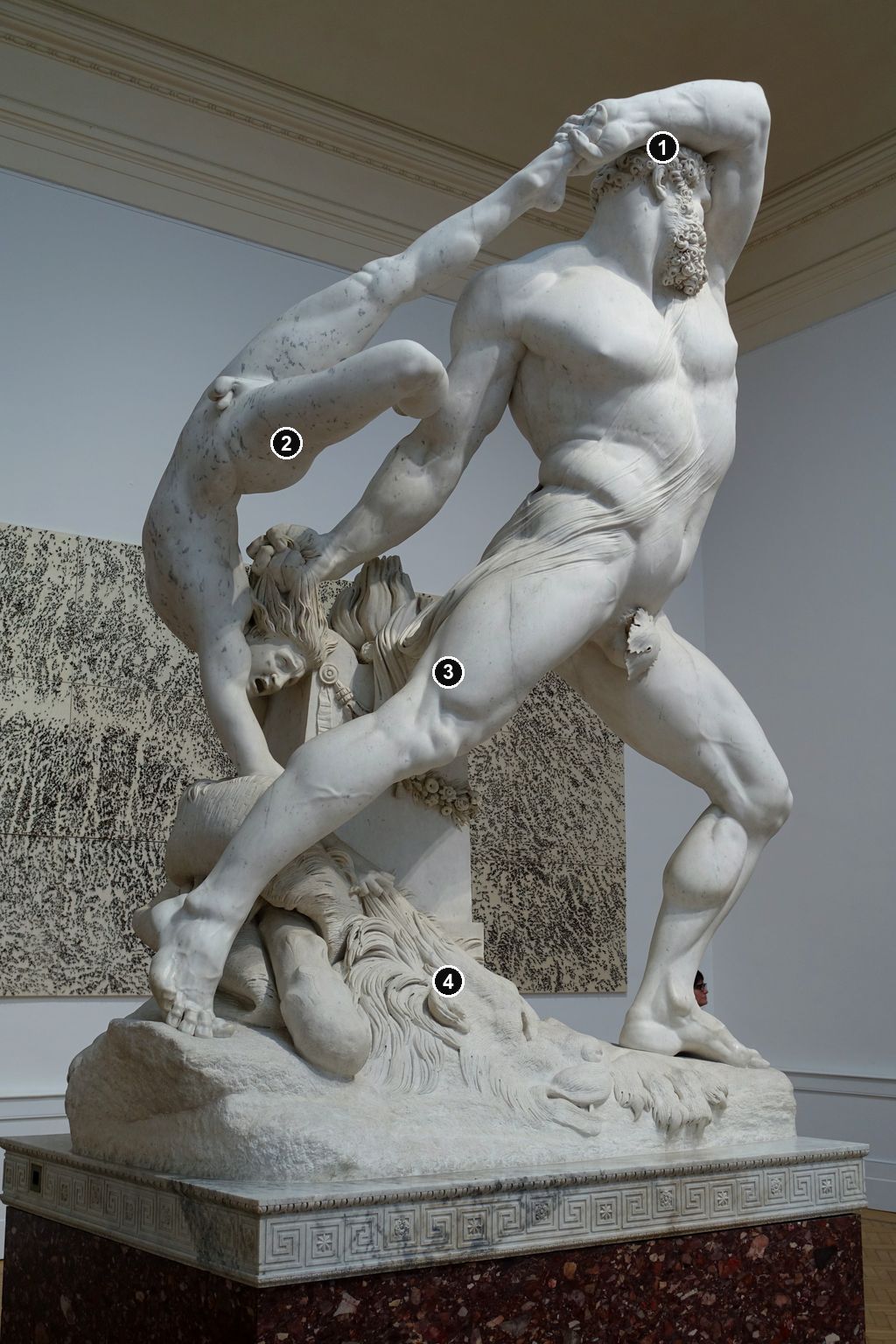
Details from HERCULES AND LICHAS
Follow the connections between the figures and the forms supporting them.
The lifted arm
The raised arm forms an arch above Hercules’s head, where the fingers meet Lichas’s ankle.
Lichas’s suspended body
Lichas bends through the waist and hangs to one side of the taller figure.
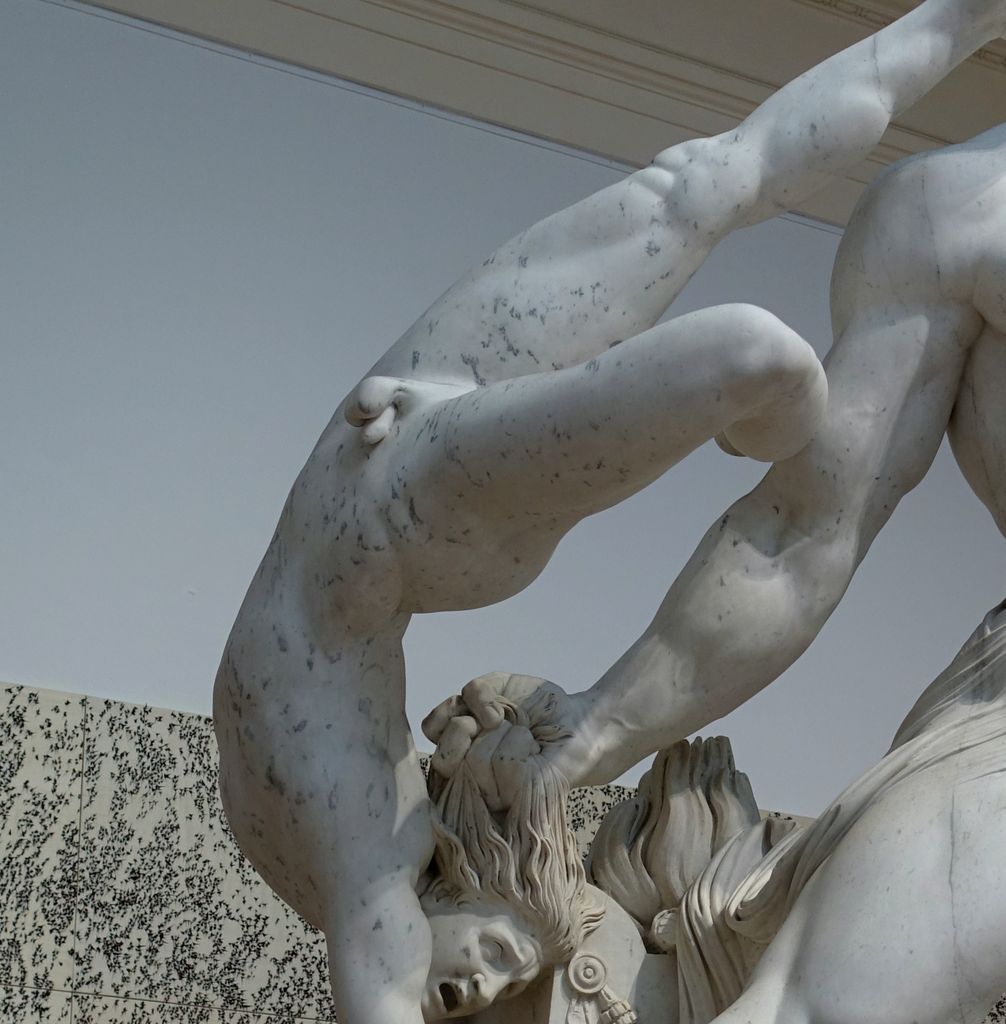
The crossed forms
The curve of Lichas’s body crosses the straighter diagonal of Hercules’s leg.
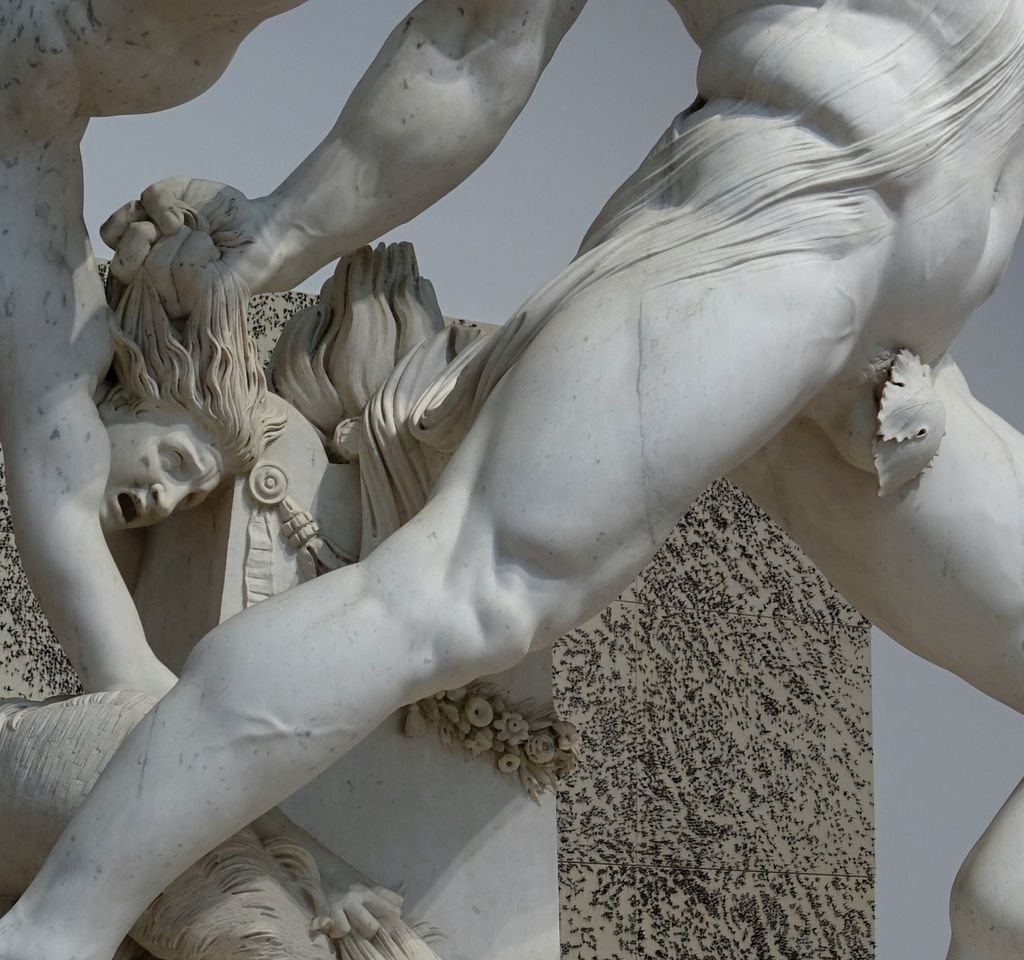
The lion skin
The folds and mane gather low on the support, beneath the open space between the figures.
The messenger in Ovid
In Book IX of the Metamorphoses, the dying centaur Nessus gives Deianira a cloth soaked with his blood after Hercules wounds him with a poisoned arrow. Nessus leads her to believe that the blood can restore her husband’s affection. When Deianira hears that Hercules loves Iole, she sends him the blood-soaked garment, entrusting the delivery to Lichas. The heat of the sacrifice brings out the poison. As Hercules tries to remove the garment, it clings to him. He turns on the messenger, who has carried it without knowing its power. [7]
The sea and the rocks enter the story in a different way from the base of the sculpture. Ovid describes Lichas becoming stone as he passes through the air and gives his name to a rock off Euboea. Canova keeps him recognisably human. His face, thin limbs and curved back give the viewer the time to see him before the transformation. In Theseus and the Centaur, which Canova undertook later, the opponent bears on the ground as Theseus closes in. Here Lichas is already lifted clear. The figure unable to plant his feet determines the outline of the whole group. [2] [3] [7] [8]
Studying the pose and enlarging the group
The national catalogue connects the commission with the reputation of the ancient Farnese Hercules, which the Bourbon rulers had brought to Naples. Canova’s drawings also point towards a different antique comparison. Francesco Leone traces an October 1794 study at Bassano to the Roman Hercules and Antaeus in the courtyard of the Pitti Palace. The older group gave Canova a way to think about one body lifting another. In the drawing the standing figure receives the most attention. The second body is only lightly indicated. Leone reads that uneven emphasis as evidence of a sculptor testing the standing figure with a live model while working out what the other figure might do. [4] [9]
Another sheet at Bassano, dated October 1795, shows how the design had developed. The lifted arm already crosses above the standing figure’s head, and the outline of Lichas descends next to it. A small study of a separate male nude occupies the corner of the same sheet. The two studies put different questions on a single page, one about the tension within a figure and the other about the space between two of them. [9]
A small clay version existed while the project was still with Gaetani. The national catalogue identifies the small group beside the sculptor in Angelika Kauffmann’s portrait of Canova as the clay sketch. The painting records an intermediate stage when the shapes could already be shown to a visitor but the monumental marble still lay ahead. By 1795–96 the group had also been developed in the full-scale plaster now at Possagno. At that scale, the turn of the limbs could be judged in relation to a person standing on the floor, and the depth of the group could be worked out before it was carved. [3] [4]
The Possagno plaster has its own history after Canova’s death. His half-brother Giovan Battista Sartori gave it to the Venetian academy in 1825. The national catalogue records its deposit at Possagno in 1947 and says it had to be taken into sections for both journeys. At the museum it occupies the large niche at the end of the nineteenth-century gallery. A note incised on the back records the height of a doorway. On a model of this size, such a note is as much a part of the object’s practical history as the details that made it across to the marble. [3] [10]
Videos on Canova
Explore Canova’s workshop methods and the settings for his sculpture.
From Sketch to Stone | Canova: Sketching in Clay
Watch sculptor Fred X. Brownstein recreate a Canova Venus, using clay, plaster and marble.
Watch on YouTubeThe commission changes hands
Gaetani commissioned the group after Canova’s Venus and Adonis had made an impression in Naples. The works ask for different kinds of attention. In Venus and Adonis, the two standing figures lean together and the smaller details become clearer as one walks around them. In Hercules and Lichas, the forms have to read across the much greater span from the ankle held overhead to the head hanging low by the base. Gaetani gave Canova the opportunity to try this for the first time on a colossal scale. Political and financial upheaval in Naples, and disagreements with the sculptor, led him to withdraw. [3] [4] [5]
The plaster was still in the Roman studio when the French occupied Rome in 1798. The Possagno museum records that the French read the group as the Revolution throwing off monarchy. The very next year, Canova proposed the work to Francis II to celebrate the Austrian victory at Magnano. The emperor declined. These two readings assigned opposing causes to the same Hercules. Neither could be read from a uniform or an emblem on the figure. In the marble, the lion skin, club and garment hold the story in the world of the myth. [3] [5]
The national catalogue dates Giovanni Raimondo Torlonia’s commission of the marble to 1801 and records the price as 18,000 scudi. The completed work was presented in 1815 and installed on the first floor of Palazzo Torlonia in Piazza Venezia. The twenty years in the museum’s date range encompass the first commission, the modelling, the change of patron and the completion. They give a sense of how far the design travelled before the finished marble was put in place. [1] [4] [5]
From Palazzo Torlonia to Valle Giulia
For the palace, Canova designed a columned setting with a coffered half-dome. It gave the group an architectural frame large enough to carry the eye above the raised arm. From the 1830s Giovanni’s son Alessandro transformed the gallery further. Francesco Podesti and Francesco Coghetti painted mythological subjects on the vault, and Alessandro commissioned twelve statues of Olympian gods. The standing gods lined the approach to the scene of Hercules in distress. The contrast of scale and movement could unfold across the length of a room before a visitor came close to the figures. [4]
When plans to redevelop Piazza Venezia put the palace in the way of demolition, the Torlonia collection passed to the Italian state in 1892. The group itself remained in the palace until 1901. It went first under a portico at Palazzo Corsini, then into a room built there by Gustavo Giovannoni in 1907. It reached the modern art gallery’s building at Valle Giulia in 1917. The national catalogue records a further change within that building in the 1950s, when the marble was moved from the large central room to a corridor between the wings. The successive settings show how much room this sculpture demands, both around its base and along the approach to it. [4]
The Rome gallery records that an original mechanism devised by Canova can turn the marble about its own axis. The museum briefly operated it again on Fridays in late 2022. For a viewer standing in one place, the movement lets the outline change before the eye. The torso that dominated a moment earlier turns away, and the downward curve of Lichas and the stone behind him take its place. A photograph can stop at any one of those views. The turn lets each view lead into the next. [2] [6] [11]
The group on paper and in miniature
A rear view engraved by Pietro Fontana after Giovanni Tognolli is dated 1812 in the Rijksmuseum catalogue, three years before the marble’s presentation. Fontana’s print carries the composition onto a sheet 62 centimetres high. Its choice of angle gives space to the turn of the back and the stone below Lichas. A viewer can follow these features without first encountering the great chest and lifted elbow that dominate the front. The date shows the composition was circulating in another medium before the palace installation. [4] [12]
Other objects made the arrangement portable in three dimensions. The Nelson-Atkins Museum of Art dates its bronze reduction to about 1834 and traces it to the Pierre Fontaine foundry in Paris. At roughly 43 centimetres high it can be taken in from much closer. The Metropolitan Museum of Art’s onyx version, made in the first half of the nineteenth century, is only about five and a half centimetres high. On that scale the figures can be read together at a glance, with no need to look up to take in the high arm. The collections catalogue both objects after Canova. They preserve his arrangement in forms that could travel independently of the plaster and marble. [13] [14]
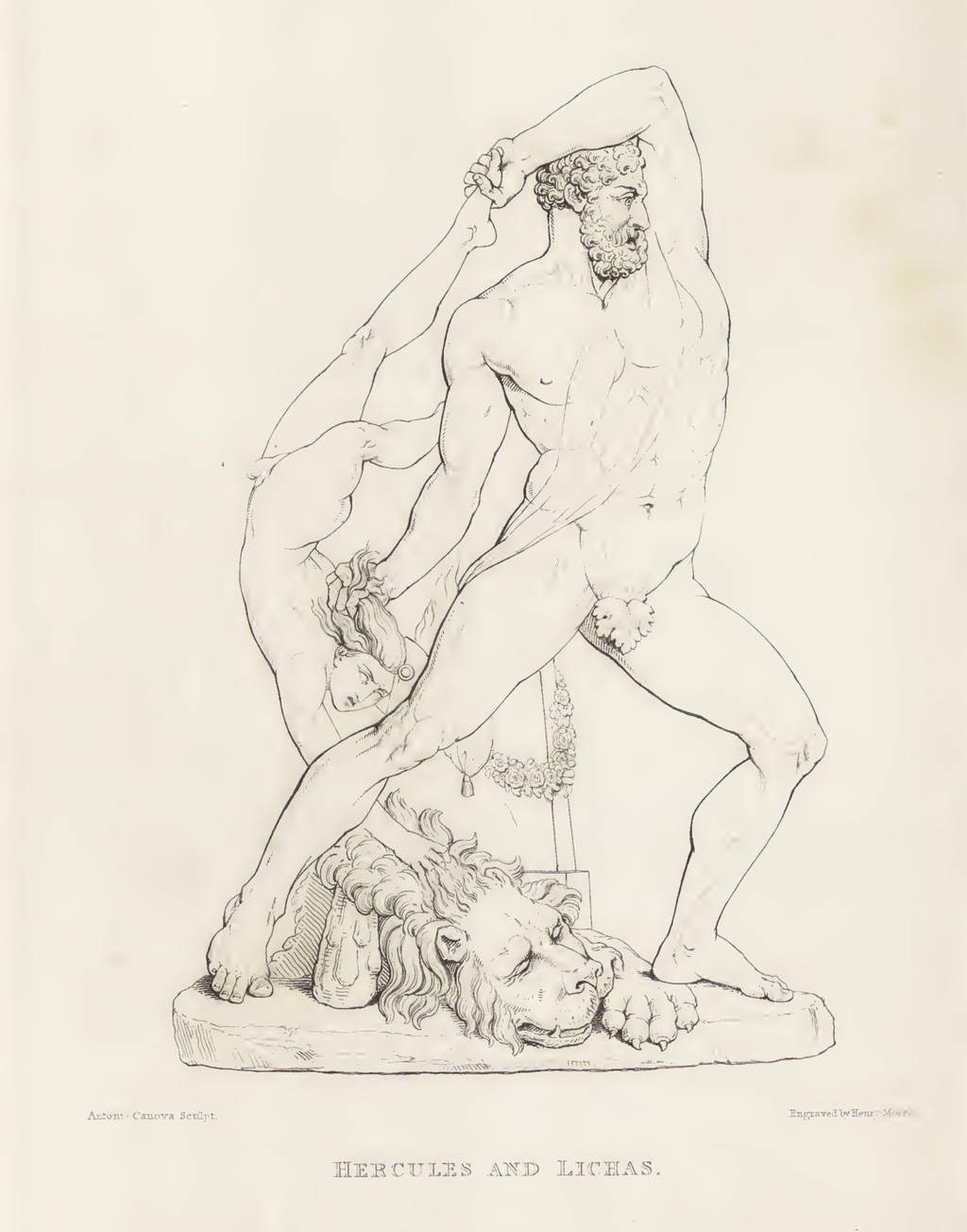
Moses’s engraved outline shows how the raised Lichas crosses Hercules’s body. Henry Moses, after Antonio Canova, engraving published in London, 1824. Getty Research Institute. Image source. Public domain. Scan margins trimmed and image resized.
Explore Canova’s works
Browse the sculptures and paintings covered in this guide. Several entries compare versions or examine details of a larger work.
Discussion
Look again at the images and ideas explored in Hercules and Lichas (Ercole e Lica). These editorial prompts invite your observations.
Reader Insights
Which forms connect the two figures in the marble?
What becomes visible when you walk behind the sculpture?
Join the Conversation
Share a detail, comparison or question about Hercules and Lichas (Ercole e Lica) below.
References
- Galleria Nazionale d’Arte Moderna e Contemporanea, Ercole e Lica, deposit register 1239 and Galleria Nazionale d’Arte Antica inventory 4140. View source.
- Daderot, front-oblique photograph of the Rome marble, 14 April 2019, DSC05261. View source.
- Museo Gypsotheca Antonio Canova, Ercole e Lica, plaster, inventory 87. View source.
- Italian Ministry of Culture, national catalogue Ercole e Lica, record 1200828202, marble, commission and installation history. View source.
- Galleria Nazionale d’Arte Moderna e Contemporanea, From Canova to Canova, on the commission and the treatment of the figures and garment. View source.
- Daderot, rear photograph of the Rome marble, 14 April 2019, DSC05270. View source.
- Ovid, Metamorphoses, Book IX, lines 101–229, Latin and French edition, Bibliotheca Classica Selecta, UCLouvain. View source.
- Museo Gypsotheca Antonio Canova, Theseus and the Centaur, plaster, inventory 163. View source.
- Francesco Leone, Note sull’estetica canoviana: ideale classico e natura tra imitazione e invenzione, Studi Neoclassici III, 2015, pp. 89–91 and figs. 9–10. View source.
- Italian Ministry of Culture, national catalogue Ercole e Lica, record 0500428241, original plaster and its collection history. View source.
- Galleria Nazionale d’Arte Moderna e Contemporanea, 2022 Annual Report, section 4.5, on the rotation of Ercole e Lica for the Canova bicentenary. View source.
- Rijksmuseum, Pietro Fontana after Giovanni Tognolli and Antonio Canova, Hercules and Lichas, 1812 engraving, RP-P-OB-39.044. View source.
- Nelson-Atkins Museum of Art, Hercules and Lichas, bronze after Canova, about 1834, inventory 89-30. View source.
- Metropolitan Museum of Art, Hercules about to hurl Lichas into the sea, onyx after Canova, inventory 40.20.27. View source.


 Antonio Canova.jpg)


