



 by Tom Gurney
Tom Gurney BSc (Hons) is an art history expert with over 20 years experience
Published on June 19, 2020 / Updated on November 13, 2026
Email: tomgurney1@gmail.com / Phone: +44 7429 011000
George Washington: Introduction
George Washington steadies a tablet with his left hand. His right brings a pen towards its surface. His head turns down towards the work, and the elbow that holds the tablet opens out from his body. A cloak and fitted armour give him the appearance of a Roman commander. A sword and baton lie below, near his feet. In Antonio Canova’s full-size plaster at Possagno, the difference between the things Washington has put down and the one he is using gives the figure its subject. The president is writing the address in which he announced his retirement. [1] [2]
Canova carved the marble for the North Carolina State House in Raleigh. It was unveiled on Christmas Eve 1821 and broken when the building burned in 1831. The plaster that preceded it stayed in Italy and survives intact. The marble in the Raleigh Capitol rotunda today is a twentieth-century replacement made from Canova’s design. A surviving piece of the first marble carries the sculptor’s signature, cut into the base beside part of the sword sheath. [2] [3] [4] [5]
George Washington Antonio Canova
At a Glance
- Original marbleCompleted in Rome in 1820, unveiled in Raleigh on 24 December 1821 and destroyed as a complete statue in the State House fire of 1831. [3] [4]
- Full-size preparatory plasterCanova’s Modello for George Washington, completed in April 1818, Museo Gypsotheca Antonio Canova, Possagno, inventory 264. [1] [2]
- Surviving fragmentA piece of the original marble base, with part of the sword sheath and Canova’s signature, North Carolina Museum of History, Raleigh. [4]
- Raleigh replacementThe modern Carrara marble associated with sculptor Romano Vio, installed in the rotunda of the present North Carolina State Capitol in 1970. [5] [6]
Contents
- A president at work
- North Carolina looks to Rome
- A likeness without a sitting
- From clay to the full-size plaster
- The marble in the State House
- What survives in Possagno and Raleigh
- The four histories beneath the statue
A president at work
From the front, the two arms take the eye towards the tablet. Washington’s left arm holds its weight away from his torso, so the tablet projects into the space beside his knee. His right hand is comparatively close to his body, poised for the smaller movement of writing. Between the hands, the broad surface of the tablet gives this slight action room to register. The shift from a frontal to an oblique view brings one edge of the tablet forward and makes the relation between the lowered face and the hand clearer. Canova gave visitors to the rotunda a figure whose action could be pieced together as they moved around it. [1] [2] [7]
The eye can also follow the figure downwards. The armour fits close to Washington’s chest, then breaks into smaller details and overlapping edges at his shoulders and waist. The cloak adds a looser set of folds. The knees bring the lower half of the figure forward, but the sword and baton sit much lower than the tablet. Their position lets the armour and weapons recall Washington’s military command while the hands establish the task that occupies him. For a spectator looking up at the statue on its pedestal, the broad outlines of head, arms and tablet could establish the action before the lettering or the smaller objects came into view. [1] [2] [3] [7]
The full-size plaster names Washington, addresses the people of the United States and gives the date 1796. It begins the greeting to friends and fellow citizens in Italian. Washington’s Farewell Address was an open letter, first published in a Philadelphia newspaper on 19 September 1796 and circulated through other papers. James Madison helped with an earlier draft and Alexander Hamilton with the later text. Washington announced that he would leave office after his second term and urged Americans to resist divisions that might undermine the Union. Canova puts the viewer in the presence of a writer at work, a particularly apt invention for a document that reached the country through print. The inscribed year belongs to the event. The Italian words belong to the Roman studio that gave it a sculptural form. [2] [8]
North Carolina looks to Rome
In December 1815, both houses of North Carolina’s legislature passed a resolution authorising Governor William Miller to obtain a full-length statue of Washington. The senators Nathaniel Macon and James Turner looked into whether it could be made in the United States. The architects William Thornton and Benjamin Henry Latrobe thought it could. Thomas Jefferson advised Macon otherwise. Writing from Monticello on 22 January 1816, he recommended Canova and pointed to the marble of Carrara. He had helped secure a block from those quarries for Houdon’s Virginia statue. In his letter to Macon, he could describe the likely start of the journey, from the sculptor’s studio in Rome down the Tiber. [9] [10] [11]
Thomas Appleton, the American consul in Livorno, handled the commission from Italy. In March 1817, Miller replied to Appleton’s letters reporting the contract with Canova. He was willing to leave the pose, inscription and the choice of episode in Washington’s life to the consul and the sculptor. The correspondence continued as Appleton helped make decisions about the portrait and later arranged for the finished statue to cross the Atlantic. [9] [12]
There was an architectural reason for the seated figure. The Frick’s curators point out that the available ceiling height was too low for a monumental standing statue. A seated body could fill the centre of the space, allow for a pedestal and still give the portrait presence. Canova’s choice also belonged to the classical repertory he used throughout his career. Jefferson favoured Roman dress and thought the boots and uniform of the Revolutionary era would make a poor impression in sculpture. With a chair, armour and weapons he could lay aside, Canova found a way to give the costume a role in the scene. [3] [7] [13]
The armour makes sense in light of a comparison Washington’s contemporaries made with Cincinnatus, the Roman who was given emergency powers, won a war and went back to his farm. Washington had resigned his military command in 1783 and went back to Mount Vernon. He returned to private life again in 1797 after two terms as president. Canova chose the later episode, though the equipment beside the chair keeps the earlier one in view. It is possible to recognise the general and understand the significance of his stepping aside even before reading the tablet. [8] [13] [14]
Jefferson had taken a different position when Virginia commissioned Jean-Antoine Houdon’s standing Washington for its Capitol in Richmond. That monument shows a man in the military uniform of his own day. His hand rests on a walking stick, and thirteen rods bound together recall both the Roman fasces and the original states. A plough behind him refers to the life he returned to after relinquishing his command. Houdon puts the signs of military and civic authority alongside a tool associated with Washington’s life at Mount Vernon. Canova’s design puts the signs of command at the sitter’s feet and asks the hands to carry out a civilian act. Both sculptors could find a use for Rome in portraying the same American, even though only one dressed him in armour. [13] [14]
The difference is just as striking within Canova’s own work. In Napoleon as Mars the Peacemaker, an upright, colossal figure holds a small winged Victory where it can be seen from a distance. In Washington, a large tablet occupies the corresponding field of attention, but the president bends his attention towards its surface. Mars gives Napoleon the body and attributes of a god. The analogy with Cincinnatus gives Washington a recognisable decision to make. [2] [13] [15]
A likeness without a sitting
Washington died in 1799. A sculptor who received a commission nearly two decades later had to start from images made by other hands. Gilbert Stuart’s painted portraits were one possibility. The Frick owns a 1795 replica by Stuart himself of his first portrait of Washington from life. In this version the white hair and cravat stand out against the darker coat and background. The picture establishes the likeness through colour as well as through the contour and modelling of the face. Canova would have had to decide how much of that effect could be carried over into the relief of a sculpted head. [6] [12] [16]
Houdon’s work offered another kind of evidence. He visited Mount Vernon in 1785, where he modelled a bust and took a life mask. The face in the mask carries information about the sitter’s features that a painter could select or adjust. For a full statue, a mask still leaves the sculptor to decide how to set the head on the shoulders and how the person should look when seen from below or from the side. Houdon could draw on his own encounter with Washington when he made the Virginia monument. Canova’s starting point was already an interpretation of the man. [14] [17]
The likeness that Jefferson and Appleton favoured came from the Italian sculptor Giuseppe Ceracchi. He had portrayed Washington from life in the early 1790s, and Appleton owned a plaster version of the bust, which he sent to Rome. Ceracchi’s terracotta is in Nantes, and an early marble version is at the Gibbes Museum of Art in Charleston. The plaster Appleton supplied belongs to that chain of versions. It gave Canova a head to study in the round, already framed by short, classical curls. In the seated statue, the same kind of close curls leave the forehead and profile easy to read, even though the head is inclined towards the tablet. [2] [7] [12] [18]
The face and the rest of the body thus came from different kinds of work. Ceracchi’s likeness gave Canova the proportions and features of a particular person. Canova still had to invent a plausible way for that person to sit, write and hold a tablet while in armour. The choice of bust can explain why the head has a family resemblance to another artist’s work. The studies Canova made in Rome show how much of the portrait depended on the decisions he took below the neck. [7] [12] [18] [19]
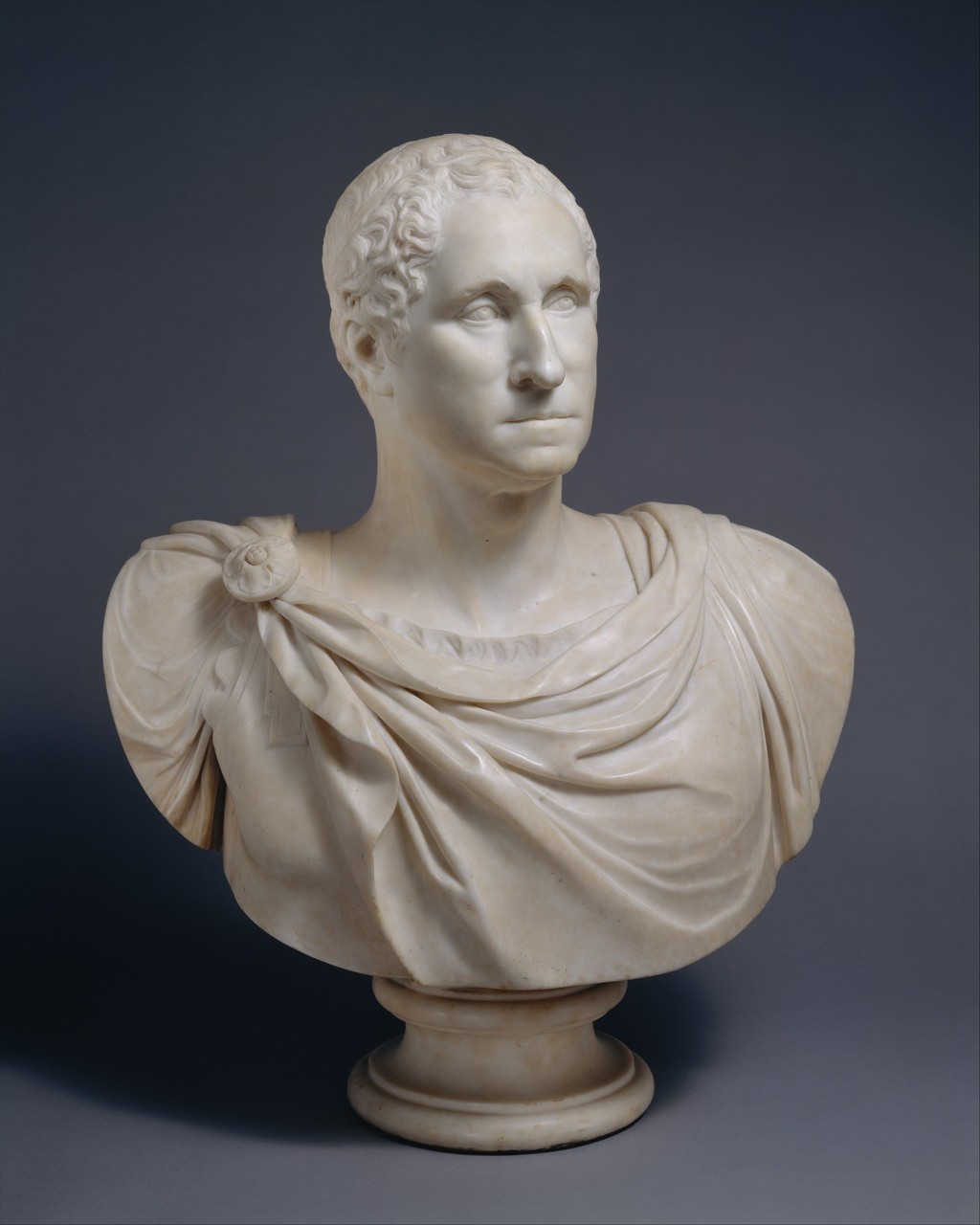
Ceracchi’s marble Washington shows the classical bust type from which Canova took his sitter’s features. The Metropolitan Museum of Art, 14.58.235. Image source. CC0 / Public domain. Resized from source.
Videos on Canova
Watch the Frick’s introduction to the Washington commission and see how a sculpture moves from model to marble.
Canova's George Washington
Frick curator Xavier F. Salomon introduces the exhibition on Canova’s lost Raleigh statue and its surviving model.
Watch on YouTubeFrom clay to the full-size plaster
Canova began working on the figure in the summer of 1817. In his first surviving clay study, now in the Museo di Roma, the sitter is already seated, with one shoulder bare and the other arm gathered into loose drapery. The object in the extended hand is harder to identify. The Frick’s Xavier F. Salomon proposes an inverted cornucopia, which might stand for abundance, or a lowered torch, which could suggest peace after war. The clay bears the marks of fingers and tools. Canova could work out the space around a hand or the fall of the cloth while leaving the small object only roughly indicated. [7] [19] [20]
Two surviving drawings from Bassano del Grappa show the tablet entering the composition. On one sheet, Canova tried different arm positions for the seated figure below a study for an equestrian monument. The neighbouring sketches place two problems of public sculpture on the same piece of paper. A figure on horseback has to make its purpose clear high above a spectator. A seated figure holding something before him has to direct attention towards the relatively small movement of his arms. At this stage Canova could turn the tablet or bring a hand closer to his body with a few strokes. [7] [19]
The small plaster studies take that work further. One sets a crown and sceptre at Washington’s feet. The placement could suggest that monarchical power had been set aside, although the symbols themselves could still draw attention towards kingship. In the more finished 1817 plaster, Canova replaced them with a sword and baton, objects closer to Washington’s own history as a commander. The tablet in that study bears a short Latin inscription naming homeland, liberty and law. In the full-size plaster, the same surface is put to a different use. The new words locate the act of writing in a particular year and give the president a public to address. [2] [7] [21]
By April 1818 Canova had completed the full-size plaster. Its scale allowed him to settle how far the tablet and knees projected, how the fold of the cloak ran across the back and how the minor objects fitted between the base and the figure. Canova generally used a full-scale model to establish the forms before carving, with fixed measurements enabling their transfer into stone. The smaller studies preserve the changes he made while developing the design. The full-size plaster shows how those choices held together when the subject took up the space of a person. [1] [2] [19] [22]
The marble in the State House
Canova finished the marble by the summer of 1820. It left Italy in March 1821, accompanied by a pedestal carved by his pupil Raimondo Trentanove. From the studio it went down the Tiber on a barge. The American warship USS Columbus brought it to Boston. From there it travelled to Wilmington on a coastal vessel, up the Cape Fear River to Fayetteville and overland to Raleigh. The marble and its pedestal had to pass between different forms of transport before they could occupy the space for which they had been made. The Christmas Eve inauguration placed the statue at the centre of the Raleigh rotunda. A newspaper compared it with the Apollo Belvedere and the Medici Venus, the famous ancient statues by which educated readers could be expected to judge a new marble from Italy. [3] [12] [9]
The Marquis de Lafayette saw it on his visit to Raleigh in March 1825. A later print commemorates the visit, showing a group of people in the rotunda with the seated figure raised above them. It gives a sense of the way the statue and its pedestal occupied the centre of a public encounter. The Frick dates the print to at least a decade after the fire and cautions that it renders both statue and interior inaccurately. The print is better evidence of how the visit was remembered than of the height of the pedestal or the exact design of the lost room. [5] [23]
On 21 June 1831 the State House burned and the dome came down over the statue. Pieces were recovered, and in January 1832 the legislature authorised the governor to contract with the sculptor Robert Ball Hughes to restore it. Hughes’s undertaking came to nothing. The fragment displayed at the Frick in 2018 is roughly the width of a person’s shoulders. It includes part of the sheath that lay beneath Washington’s legs and a signature identifying Canova as the maker and Rome and 1820 as the place and year of completion. The fragment preserves a portion of the carved floor of the composition. Its damaged surface also records the difference between the carefully transported marble that reached Raleigh and the pieces that had to be recovered after the fire. [3] [4] [5] [10] [9]
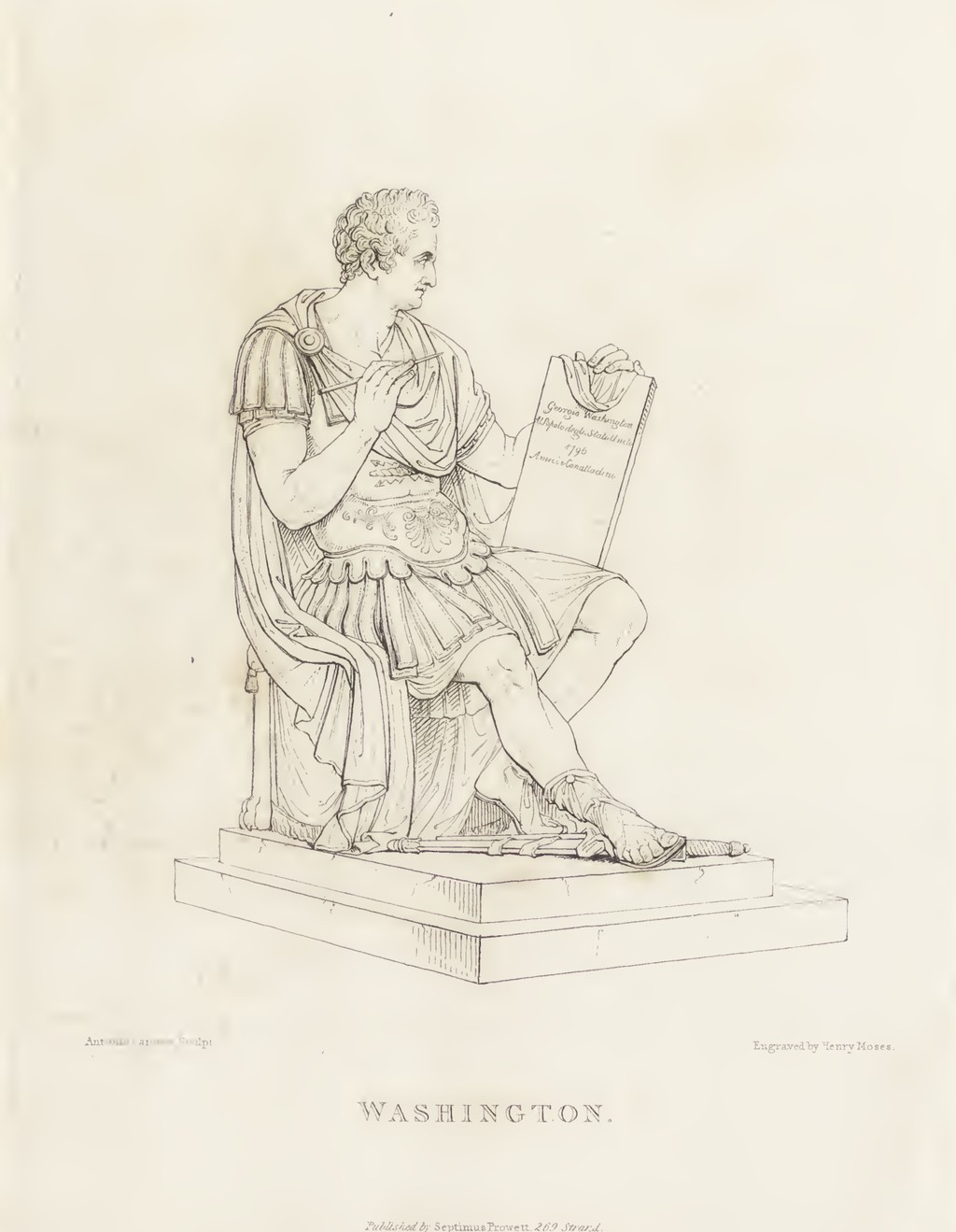
Moses’s engraving records Canova’s original Raleigh design, showing Washington writing on his tablet. Henry Moses, after Antonio Canova, engraving published in London, 1824. Getty Research Institute. Image source. Public domain. Scan margins trimmed and image resized.
What survives in Possagno and Raleigh
In the early twentieth century, renewed attention to the full-size model in Possagno led to permission to make a plaster replica. Italy shipped the cast in three cases in November 1909, and it was placed temporarily in a corridor of the Capitol in January 1910. This plaster brought the complete figure back to Raleigh. A later project returned the design to marble. The North Carolina State Archives records the state’s receipt of a marble copy in May 1970. Romano Vio is credited in the Smithsonian’s Catalog of American Portraits, and its sculpture inventory also lists Mario Cacciatori. The replacement was installed in the rotunda of the Capitol completed in 1840, on the site of the earlier building. It restores the relationship between a seated statue and the centre of Raleigh’s seat of government. [5] [6] [9] [10] [24] [25]
The only sculpture Canova made for the United States is thus represented on both sides of the Atlantic. Canova’s own full-size plaster remains in Possagno. In 2018 it went to the Frick Collection in New York for its first exhibition outside Italy. In the Oval Room the curators displayed it alone on a faux-marble pedestal, evoking a freestanding statue in a rotunda. Nearby, they showed the studies, likenesses and fragment. The juxtaposition made it possible to move from the rough clay of the first idea to the full size of Washington’s lowered head and outstretched hand, then to a piece of the marble that had actually been under those hands in Raleigh. The tablet can still be read in the plaster, where the first words of the farewell are caught in the act of being written. [1] [2] [4] [7] [26]
The four histories beneath the statue
The pedestal gave the sculpture a second scale of action. Canova’s Washington is a single seated man, much larger than the figures in the four reliefs beneath him. In a letter accompanying his accounts, Thomas Appleton explained that Governor William Miller had approved the idea of a pedestal devoted to episodes in Washington’s life and had left the choice of episodes to him. Appleton selected Cornwallis’s surrender, Washington’s resignation from military command, his return to the plough and his acceptance of the presidency. Raimondo Trentanove carved the reliefs under Canova’s direction. The pedestal and statue were accounted for separately. [9]
The sequence makes a fuller comparison with Cincinnatus than the armour can carry on its own. A viewer could encounter the surrender and then the surrender of authority, followed by the plough and a return to public office. The plough translates the familiar Roman example into a visual episode. The presidency complicates the parallel because Washington returned to government. At the top, the writing figure brings another relinquishment into view. The four reliefs could be followed by walking around the base, while the tablet above them singles out a later moment of withdrawal. Appleton understood the scenes as a way of keeping a viewer’s attention on Washington’s life even after the eye dropped from the statue. [9] [27]
The accounts in the North Carolina Historical Commission’s edition also record 1,700 gold zecchini paid for the pedestal, equated there to 4,044 silver dollars. Among the other charges were packing materials, transport to the Tiber and correspondence. The bill helps explain why the undertaking was larger than the cost of the seated figure alone. It included the work of a second sculptor, a separate piece of marble furniture for the rotunda, and the organisation needed to move the two works out of Rome. The large plaster at Possagno makes the statue’s design visible again. The correspondence is what lets the pedestal regain its place in that design. [1] [9]
The Frick also put a portrait of the sculptor beside the materials for the commission. Thomas Lawrence began painting Canova from life in London in 1815, exhibited the canvas at the Royal Academy the next year and returned to it in Rome in 1819. That second sitting took place while the Washington was in progress. The portrait brings two different kinds of studio encounter into view. Lawrence could ask his sitter to return and reconsider a pose or expression in front of the canvas. Canova had to choose among existing likenesses and rely on Appleton to send a cast. In the finished statue, the attitude of Washington’s head belongs to a scene Canova invented, even as the features retain a debt to Ceracchi’s encounter with the living man. [12] [28]
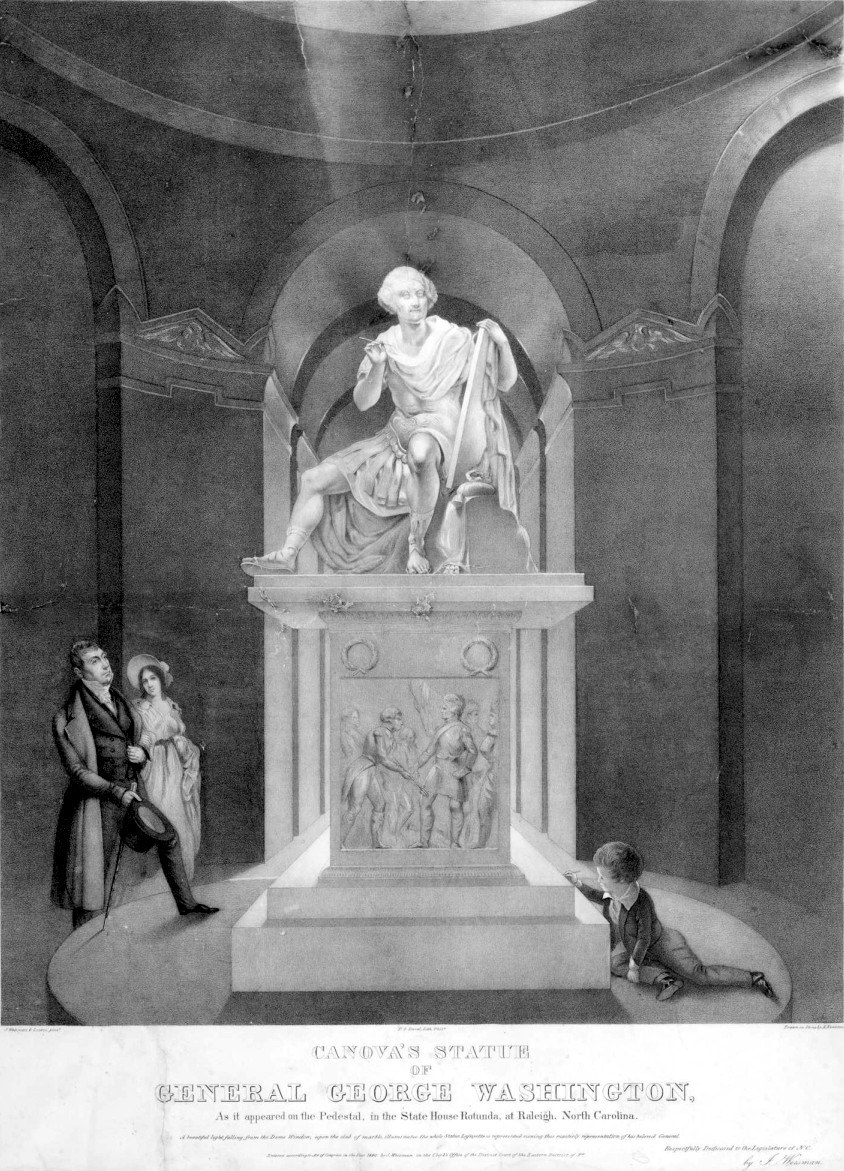
Albert Newsam’s later lithograph recalls the statue on its relief pedestal in the State House rotunda. Albert Newsam, lithograph, 1840s. North Carolina Museum of History. Image source. Public domain. Resized from source.
Explore Canova’s works
Browse the sculptures and paintings covered in this guide. Several entries compare versions or examine details of a larger work.
Discussion
Look again at the images and ideas explored in George Washington. These editorial prompts invite your observations.
Reader Insights
What does the act of writing tell us about this Washington?
How does the full-size plaster help explain the lost marble?
Join the Conversation
Share a detail, comparison or question about George Washington below.
References
- Museo Gypsotheca Antonio Canova, George Washington, plaster, 1818, inv. 264. View source.
- The Frick Collection, Modello for George Washington, 1818, exhibition object record. View source.
- The Frick Collection, “George Washington in Raleigh: Arrival and Destruction,” Canova’s George Washington. View source.
- The Frick Collection, Fragment of George Washington (base and signature), 1818–20, exhibition object record. View source.
- North Carolina Department of Natural and Cultural Resources, “Canova Selected to Sculpt George Washington Statue in State Capitol,” 22 January 2016. View source.
- Smithsonian National Portrait Gallery, George Washington, 1970, Catalog of American Portraits, NC900066. View source.
- Xavier F. Salomon, audio tour transcript, Canova’s George Washington, The Frick Collection, 2018. View source.
- United States Senate Historical Office, introduction to George Washington’s Farewell Address, official text and historical introduction. View source.
- R. D. W. Connor, Canova’s Statue of Washington, North Carolina Historical Commission Bulletin No. 8, 1910, with transcriptions of the legislature’s resolution and correspondence. View source.
- State Archives of North Carolina, Vault Collection finding aid, “Letter from Thomas Jefferson, Monticello, January 22, 1816, to Nathaniel Macon.”. View source.
- Thomas Jefferson, letter to Nathaniel Macon, Monticello, 22 January 1816, State Archives of North Carolina, North Carolina Digital Collections, item 412446. View source.
- The Frick Collection, Canova’s George Washington, 2018 exhibition press release. View source.
- The Frick Collection, “Washington – A Modern Cincinnatus,” Canova’s George Washington. View source.
- Xavier F. Salomon, “The Boast and Pride of North America,” in Canova’s George Washington, The Frick Collection, 2018, catalogue excerpt. View source.
- English Heritage, Apsley House Activity Trail, “Napoleon as Mars the Peacemaker,” p. 4. View source.
- The Frick Collection, Gilbert Stuart, George Washington, 1795, exhibition object record. View source.
- The Frick Collection, Jean-Antoine Houdon, Life Mask of George Washington, 1785, exhibition object record. View source.
- The Frick Collection, Giuseppe Ceracchi, George Washington, c. 1792, Gibbes Museum of Art marble, exhibition object record. View source.
- The Frick Collection, “Canova at Work,” Canova’s George Washington. View source.
- Ashley Patton, “Antonio Canova Sculpts George Washington,” National Gallery of Art, 2 June 2023. View source.
- The Frick Collection, Bozzetto for George Washington, 1817, final small plaster study, exhibition object record. View source.
- National Gallery of Art, “Canova’s Process,” wall text for Canova: Sketching in Clay, 2023. View source.
- The Frick Collection, The Marquis de Lafayette Visiting the State Capitol in Raleigh in March 1825, exhibition object record. View source.
- Smithsonian American Art Museum, George Washington, Inventories of American Painting and Sculpture, IAS 76005424. View source.
- North Carolina Department of Natural and Cultural Resources, “State Capitol (H-4),” 21 December 2023. View source.
- The Frick Collection, Canova’s George Washington, exhibition overview, 23 May–23 September 2018. View source.
- The Frick Collection, Washington – A Modern Cincinnatus, exhibition interpretation of the resignation, farewell and Roman comparison. View source.
- The Frick Collection, Thomas Lawrence, Antonio Canova, 1815–19, exhibition object record. View source.


 Antonio Canova.jpg)
