



 by Tom Gurney
Tom Gurney BSc (Hons) is an art history expert with over 20 years experience
Published on June 19, 2020 / Updated on November 13, 2026
Email: tomgurney1@gmail.com / Phone: +44 7429 011000
Canova Lions: Introduction
Two lions lie at the foot of Antonio Canova’s monument to Pope Clement XIII in St Peter’s Basilica. The one on the viewer’s left has raised its head, with its eyes open and its mouth parted. Its companion on the right has lowered its head to its paws. Both stretch across the base of the monument, close to the level of the church floor. Their backs are almost level with each other. The change in the heads and paws is enough to give one animal the air of a guardian on watch and the other the weight of a body at rest. [1] [2]
Canova made the pair for the Rezzonico family’s memorial, inaugurated in 1792. The published guide to St Peter’s identifies their stone as travertine. The lions were also copied as independent sculptures. The sixth Duke of Devonshire commissioned two large marble versions for Chatsworth in 1823. A later bronze pair came to flank the entrance of the Corcoran Gallery of Art in Washington. At Racconigi, two small stone lions show how the design could be reduced to a scale that a traveller could carry home. [1] [3] [4] [5] [6] [7]
Canova Lions Antonio Canova
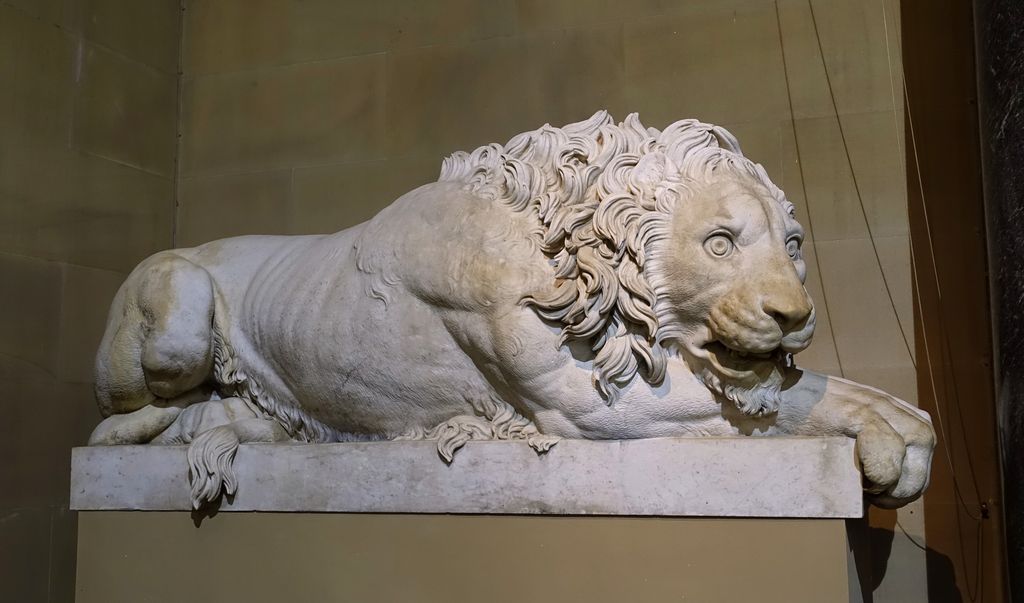
Francesco Benaglia’s awake lion after Canova, Chatsworth. Daderot. Image source. CC0 / Public domain. Resized for display.
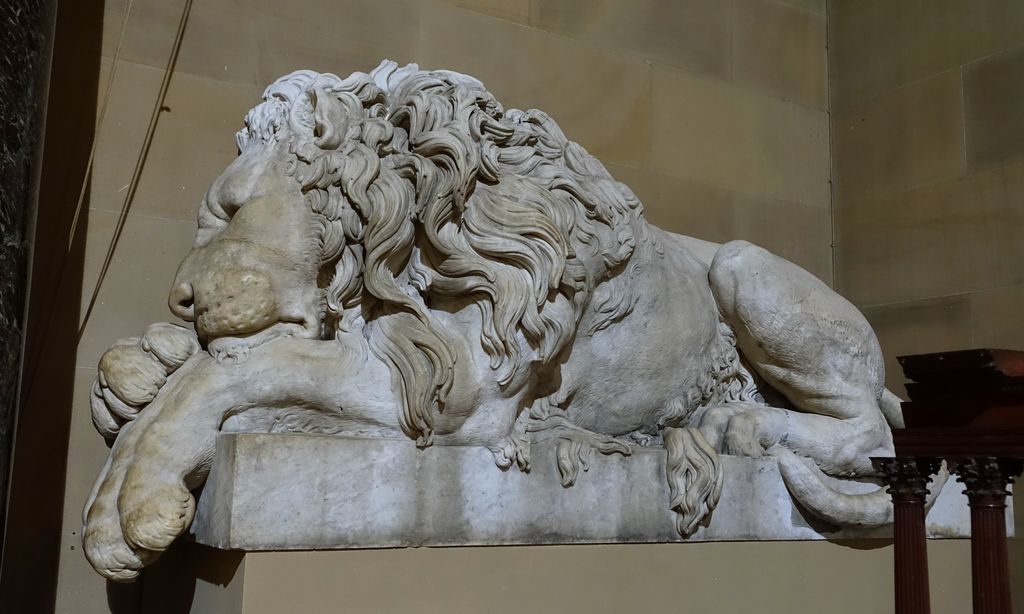
Rinaldo Rinaldi’s sleeping lion after Canova, Chatsworth. Daderot. Image source. CC0 / Public domain. Resized for display.
At a Glance
- Original pairAntonio Canova, at the base of Clement XIII’s monument in St Peter’s Basilica. The basilica guide identifies the stone as travertine. [1] [3]
- Chatsworth pairCarrara marble, commissioned in 1823. Rinaldo Rinaldi carved the sleeping lion and Francesco Benaglia the alert lion. [4] [8]
- Corcoran pairBronze on marble bases, cast about 1860 according to the Smithsonian inventory, accession numbers 88.10.1 and 88.10.2. [5]
Contents
- How the lions frame the doorway
- The marble lions at Chatsworth
- Bronze guardians in Washington
- Lions on a smaller scale
- The plaster lions in Venice
- From the church doorway to the iron catalogue
How the lions frame the doorway
In the Tomb of Pope Clement XIII, the lions lie beneath the sarcophagus, where a doorway interrupts the lower part of the memorial. Their paws extend over the front of their ledges. The alert lion holds its head well clear of the supporting stone and turns out from the monument. The mane falls around the cheeks and over the shoulder in uneven waves. In the face, the edges of the eyelids and the opening under the muzzle give the gaze its direction. The paws look planted even where they extend past the ledge. [1] [2]
The sleeping lion presents the same large forms from another state of rest. Its muzzle lies closer to the forelegs, and the closed lids are much less prominent than the raised eyes of the lion opposite. The mane spreads out beside the face, helping the head merge into the low outline of the body. From a little distance the forepaws make the end of the animal easier to read than the eyelids do. The two sculptures depend on these large differences in contour when the visitor is still some way from the memorial. [1] [2]
Travertine is the material identified for the two animals by the published basilica guide and the National Trust. The other principal figures of the monument are in white Carrara marble. The Smithsonian inventory of the Washington copies describes the Vatican originals as marble. The account of the installed monument distinguishes the stone of the lions from that of the figures above. In photographs of the ensemble the lions register as a warmer band of stone below the pale drapery and faces. The raised head is on the same side as the standing figure of Religion and her cross. The lowered head is beneath the winged funerary Genius, whose torch points down. Those relationships are easy to lose when a copy of either lion is seen alone. At St Peter’s, the pair brackets the doorway while the figures above draw the eye upwards towards the praying pope. [1] [2] [3] [5]
Francesco Chiarottini’s etching of a design for the monument already shows a lion on either side of the opening. Its inscription identifies the proposed site as a niche above a door in St Peter’s. The engraving fixes the arrangement on a sheet, where the two silhouettes can be read together. A separate record in the Fondazione Zeri catalogue identifies a large plaster cast of the alert lion at Possagno. The plaster brings one of those silhouettes away from the other figures and into a setting where the animal can be studied on its own. [9] [10]
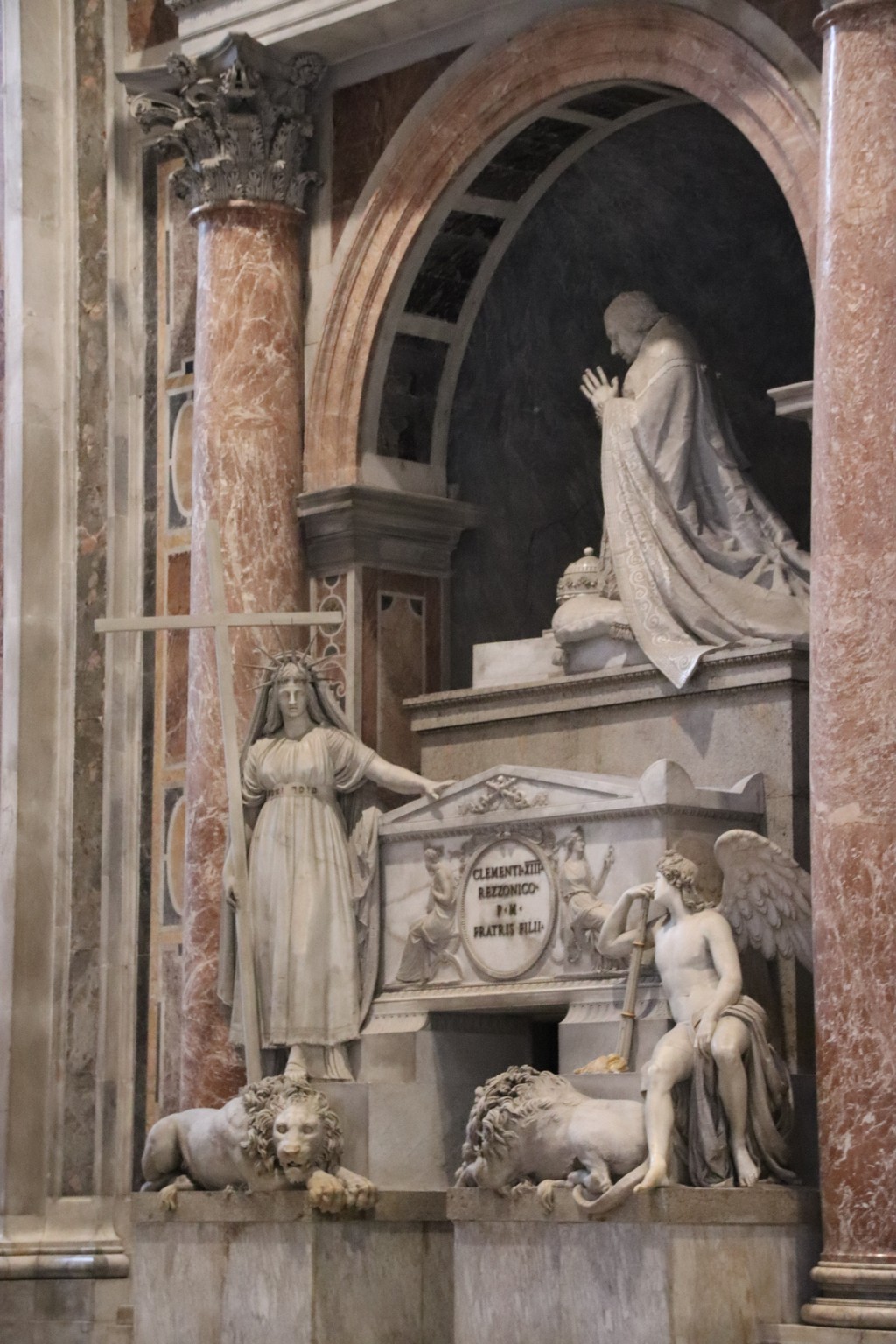
The lions flank the low doorway beneath the figures in Canova’s monument to Clement XIII. Gary Todd. Image source. Public domain. Resized from source.
The marble lions at Chatsworth
The sixth Duke of Devonshire ordered his lions in Rome in January 1823, a few months after Canova’s death. In his diary he recorded giving one to Francesco Benaglia and the other to Rinaldo Rinaldi. Chatsworth identifies Benaglia as the maker of the alert, or crouching, lion and Rinaldi as the maker of the sleeping one. The estate’s account explains that they worked from casts taken from the originals. They carved the new pair in Carrara marble, each weighing about three and a half tonnes. The lions reached Chatsworth in December 1825. [4] [8] [11]
The marble versions offer a close view of details that are harder to separate at St Peter’s. In Rinaldi’s sleeping lion, one forepaw bends down over the edge of the rectangular base. The other lies higher, close to the muzzle. The curls gather under the jaw and break into separate locks along the edge of the stone. In Benaglia’s lion the round eyes remain clear against the thick curls on the brow, and the neck lifts before it joins the broad slope of the back. The raised muzzle leaves a shadow beneath the chin that has no equivalent in the sleeping lion’s lower outline. [12] [13]
At Chatsworth the Duke placed the lions at the far end of the Sculpture Gallery, where they guard the doorway to the Orangery. Portrait medallions of Canova and the Duke hang above them. The doorway and the paired placement carry over an aspect of the Vatican setting. In Derbyshire the animals mark the end of a gallery that also contains Canova’s bust of Napoleon and his portrait of Letizia Ramolino Bonaparte. The medallions turn the setting into a tribute to the sculptor and to the Duke’s association with him. [4] [11] [14]
Videos on Canova
Explore Canova’s workshop methods and the settings for his sculpture.
Antonio Canova in the Vatican Museums
The Vatican Museums introduce Canova’s Roman studio and their collection of his work.
Watch on YouTubeBronze guardians in Washington
The Smithsonian inventory traces the bronze pair in Washington to Benjamin Holladay, who bought the lions in Rome in 1860 and set them on the steps of his home in K Street. The Corcoran Gallery of Art bought them at the sale of his estate in 1888. They first stood outside its gallery at Pennsylvania Avenue and Seventeenth Street, the building now known as the Renwick Gallery. When the Corcoran opened its new building at Seventeenth Street and New York Avenue in 1897, the lions went with it. [5] [15]
The Corcoran’s early catalogue describes the bronzes as made from moulds taken from Canova’s lions. It records them on white marble pedestals to either side of the entrance steps, where the dark metal contrasts with the bases. At the Vatican the stone animals belong to the same architectural composition as the doorway. In Washington the bronzes stand apart on individual plinths, each clear against the building. Seen from the street, they signal an entrance at the scale of the whole façade. George Washington University took responsibility for their care under the agreement that transferred the building and reported cleaning and conservation in 2015. [5] [15] [16] [17]
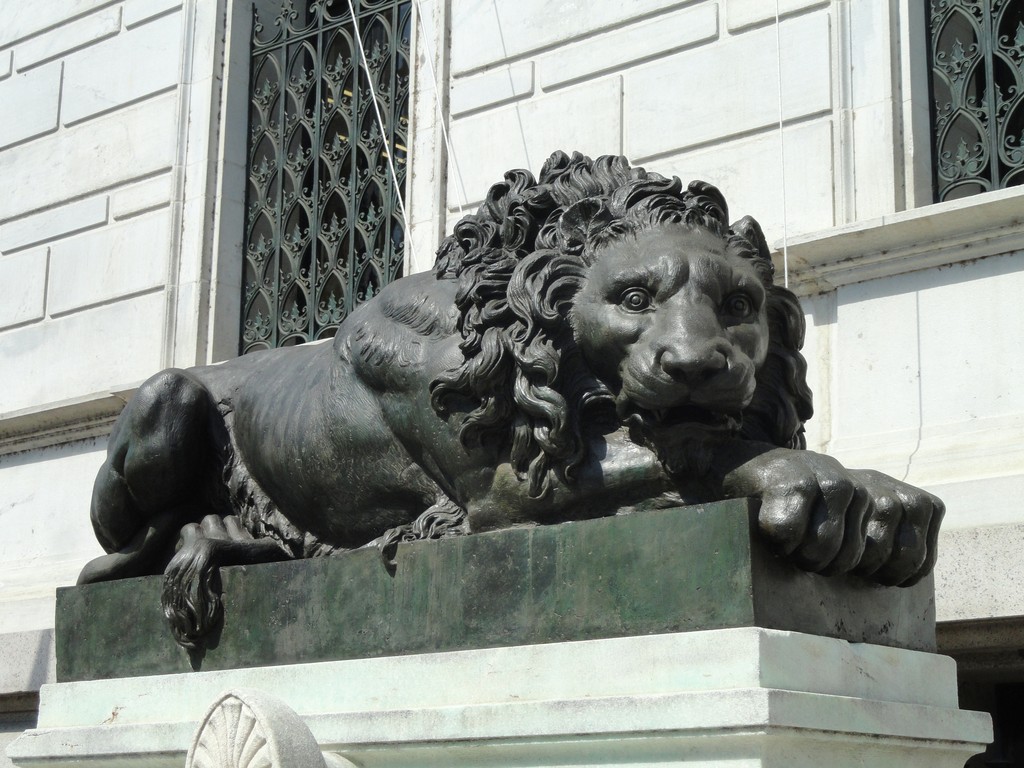
A bronze lion outside the former Corcoran Gallery of Art shows Canova’s design adapted for an outdoor entrance. Former Corcoran Gallery of Art, Washington, D.C. Photo by Daderot. Image source. CC0 / Public domain. Resized from source.
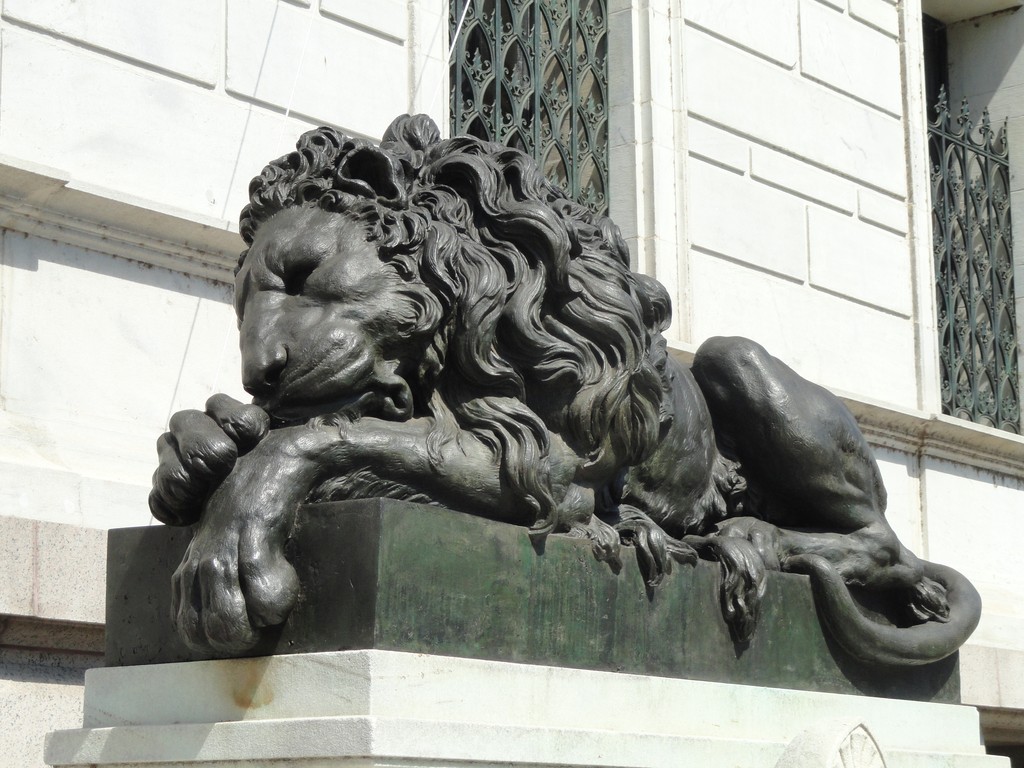
The companion Corcoran bronze rests its head on its paws. Former Corcoran Gallery of Art, Washington, D.C. Photo by Daderot. Image source. CC0 / Public domain. Resized from source.
Lions on a smaller scale
The lions at the Castello di Racconigi in Piedmont are small enough to examine from above as well as from the front. The Italian national catalogue records them as a pair made after 1792 and by about 1840. It describes the sleeping lion on a base of dark and yellow marble and gives its width as 33 centimetres. The entries associate the pair with copies made for Grand Tour visitors. A traveller could take away both versions of the pose, together with the contrasting stones of the bases, in a form suited to a room far smaller than a church or a sculpture gallery. [6] [7]
A nineteenth-century sleeping lion in the National Trust’s Ardress House collection shows a further scale. This stone version measures 114.3 centimetres in length, considerably more than the small Racconigi example. Its paws extend over its base and its tail passes under the left hind paw. The catalogue identifies the Vatican sleeper as the model and leaves room for manufacture in Italy, Ireland or Britain. The sculpture shows how readily the lowered head and hanging paws identified the design once it circulated on its own. The details that make the sleeping lion recognisable can survive even when the stone, maker and setting all change. [3] [6]
The plaster lions in Venice
The Gallerie dell’Accademia in Venice preserves two large plasters of the Rezzonico lions. Its object record traces them to Antonio d’Este’s studio in Rome and records an acquisition from Giuseppe d’Este in 1840. Venice in Peril, which helped fund their conservation, gives the same year for their transfer but describes it as a gift by Antonio d’Este. It dates the plasters to after 1792. Their relationship to the Vatican pair is clear in the figures, but the surviving casts should be distinguished from whatever forms Canova used to plan and carve the originals. [18] [19]
At the Accademia the lions served as teaching objects. The bulk of an animal could be studied at close quarters, and the profile of the head could be compared with the mass of the shoulder from a position unavailable at the foot of a monument. Venice in Peril’s photograph of the alert lion from behind before treatment shows the support structure and damaged plaster. From this angle a plaster animal is visibly a constructed object. The body can look solid from the front while its weight is distributed by internal wood and metal supports. [18] [19]
Daniele Angellotto’s conservation addressed old breaks and earlier repairs, renewed the supports and treated the plaster surfaces. That work made it possible to display the casts in the refurbished Palladio Wing. The gallery groups them with Canova’s funerary reliefs and plasters for the metopes of his temple at Possagno. At St Peter’s the lions lead the viewer into the larger monument. In Venice they can be read among other examples of the sculptor’s working designs and among casts that survived because students continued to use them. [19] [20]
From the church doorway to the iron catalogue
The nineteenth-century copies include cast iron as well as bronze. At Belmont Mansion in Nashville, the holding collection dates a cast-iron pair to about 1850–60 and records a length of three feet six inches. It places the lions there by the beginning of the American Civil War and cautiously suggests that they may have been installed when the house was completed in 1853. The record identifies related figures in catalogues from Wood & Perot and other ironworks. Catalogue evidence establishes that this design was offered in more than one commercial setting. It leaves open the maker of the Belmont pair. [21]
This is a different route of transmission from the duke commissioning two sculptors to carve Carrara marble in Rome. A foundry’s catalogue could offer corresponding forms to people who would never visit Canova’s monument. It could also show one animal as an object to be ordered on its own. At Belmont the pair is substantially smaller than the gallery lions at Chatsworth. The difference changes what a viewer notices. The iron figures can be taken in from a standing position at a domestic entrance, whereas the great Carrara animals at Chatsworth rise to the scale of the room and the doorway they frame. [4] [8] [21]
The variations help identify unfamiliar examples. First look at how far the muzzle sits from the forepaws and whether the eyes are raised. Then follow the front paws down to the edge of the base. At St Peter’s the dark opening and the figures above set up a relationship between the two heads. At Belmont and in the Corcoran bronzes, material and placement belong to the later object, while the two different states of rest remain the inherited design. The same clues let a viewer recognise a single sleeping lion at Ardress without treating it as the lost half of a documented pair. [1] [3] [5] [21]
Explore Canova’s works
Browse the sculptures and paintings covered in this guide. Several entries compare versions or examine details of a larger work.
Discussion
Look again at the images and ideas explored in Canova Lions. These editorial prompts invite your observations.
Reader Insights
Which details distinguish the sleeping lion from the watchful one?
How does the change in size or material affect a later version?
Join the Conversation
Share a detail, comparison or question about Canova Lions below.
References
- St Peter’s Basilica Virtual Tour, Monument to Clement XIII, monument description and photographs. View source.
- Gary Todd, St. Peter’s Basilica, Monument to Pope Clement XIII, photograph, 2019. View source.
- National Trust Collections, A sleeping lion, NT 247726, catalogue entry by Jeremy Warren. View source.
- Chatsworth House, The Chatsworth Lions: A Monument to Friendship and Art, assistant curator Katherine Hardwick-Kulpa’s account. View source.
- Smithsonian American Art Museum, Canova Lions, Inventories of American Painting and Sculpture, IAS 71500324. View source.
- Catalogo generale dei Beni Culturali, Leone dormiente, 0100405044, Castello di Racconigi, inventory R 6485. View source.
- Catalogo generale dei Beni Culturali, Leone vegliante, 0100405043, Castello di Racconigi. View source.
- Chatsworth House, Chatsworth Lions, identification of the individual sculptors and materials of the gallery pair. View source.
- Catalogo generale dei Beni Culturali, Francesco Chiarottini, Monumento funerario di Clemente XIII, national catalogue 0500315702. View source.
- Fondazione Federico Zeri, Leone, object catalogue for the plaster at Possagno. View source.
- Alison Yarrington, “Under Italian skies,” the 6th Duke of Devonshire, Canova and the Formation of the Sculpture Gallery at Chatsworth, with the Duke’s diary entry for 15 January 1823. View source.
- Daderot, photograph of Rinaldo Rinaldi’s sleeping lion at Chatsworth, 2016. View source.
- Daderot, photograph of the alert lion at Chatsworth, 2016. View source.
- Chatsworth House, Sculpture Gallery, collection and display. View source.
- National Register of Historic Places, Corcoran Gallery of Art, registration form, section 8, pp. 13–14. View source.
- Corcoran Gallery of Art, Catalogue of the Paintings in the Corcoran Gallery of Art, description of the Seventeenth Street entrance, p. 16. View source.
- George Washington University, Corcoran Renovations Underway, 2015 conservation and custodial account. View source.
- Gallerie dell’Accademia di Venezia, Leoni, plaster pair and provenance. View source.
- Venice in Peril, Plaster models of Rezzonico lions, conservation account and photographs. View source.
- Gallerie dell’Accademia di Venezia, Sala 7, display of Canova’s plasters. View source.
- Belmont Mansion, Sleeping (Recumbent) Lions, cast-iron pair and nineteenth-century trade-catalogue evidence. View source.


 Antonio Canova.jpg)

