



 by Tom Gurney
Tom Gurney BSc (Hons) is an art history expert with over 20 years experience
Published on June 19, 2020 / Updated on November 13, 2026
Email: tomgurney1@gmail.com / Phone: +44 7429 011000
Helen of Troy: Introduction
Helen lowers her eyes. Loose waves rise from a centre parting and gather into tighter curls beside her cheeks. Above them is a smooth dome, so close to the shape of the head that it is easy to mistake for a cap. The Victoria and Albert Museum describes it as half an eggshell, an allusion to the story of Helen’s birth. Antonio Canova made the version that long stood at Mount Stewart in 1816–17 for Robert Stewart, Viscount Castlereagh. The bust pictured here is the related marble at the V&A, attributed by the museum to Canova and his workshop. [1] [2] [3]
The Castlereagh marble was a gift in recognition of the statesman’s help in securing the return of artworks taken from Italy during the French campaigns. A dedication cut into the back names him. From the front, the bust gives a face to a figure known through ancient poetry and myth. Turning it around reveals what that face meant in a particular exchange between a sculptor and a statesman. [1] [4]
Helen of Troy Antonio Canova
At a Glance
- Castlereagh marbleAntonio Canova, 1816–17, 50.2 cm high and 62.2 cm with its circular marble socle. [1]
- Mount Stewart displayComposite-marble facsimile made by Factum Foundation in 2025 after the original sold in 2023. [4]
- Pictured marbleCanova and workshop, after 1812, Victoria and Albert Museum, A.46-1930. [2] [3]
Contents
- The face, curls and shell
- The woman in the story
- Isabella Albrizzi and the first Helen
- Canova’s gift to Castlereagh
- The facsimile and other versions
The face, curls and shell
Seen from the front, the Castlereagh bust is close to symmetrical. The two eyelids descend at nearly the same angle, the nose carries the line of the brow down the middle of the face, and the lips meet in a shallow line. Helen’s gaze falls below the viewer’s. The Castlereagh marble’s slight inclination reads most clearly from the side, where the brow, nose and chin stand in profile above the long slope from the throat to the chest. The profile also separates the rounded shell from the ridges of hair. The shell rises in one broad curve, while several small locks push out beside it. [1] [2]
Canova changes the depth of the carving from one part of the head to another. On the forehead the waves are shallow enough to read as several parallel lines. Near the temples they bunch together and throw small shadows against the sides of the face. The hair at the back is gathered into a knot, with long ringlets falling away from it across the nape. Seen from behind, the ringlets leave stretches of bare neck between them. Their shadows separate the raised loops of the knot from the looser curls on the shoulders. [1]
The carved chest forms a broad arc, narrowing abruptly where it meets the support. A short rectangular section carries the bust above the round mouldings of its marble socle. In profile you can see the chest project in front of that support and the shoulder line run back past it. The construction gives the face room above a relatively narrow base. It also leaves a flat area at the rear for the dedication, visible in the auction photographs just above the joint with the socle. [1]

The woman in the story
The eggshell identifies Helen by recalling an account of her birth to Leda after Zeus came to her in the form of a swan. It is a discreet attribute for someone whose name recalls an entire war. In the third book of Homer’s Iliad, the Trojan elders see Helen approach the city gate and compare her to the goddesses. From the walls she names Greek warriors for Priam. The episode gives her a voice and a view of the people fighting below. The bust concentrates on her face, leaving the viewer to supply the setting. Thomas Lawrence later drew on those Trojan elders when he praised the Castlereagh marble in a letter to Canova. [1] [2] [5]
A different clue appears on Canova’s Bust of Paris. The Trojan prince wears a Phrygian cap, which rises and folds at its tip. Helen’s smooth shell follows the rounded outline of her head. Both devices identify figures without requiring the rest of a scene. They also distinguish the silhouettes before the viewer can pick out either face. The State Hermitage Museum displays a version of Helen paired with a Paris bust from its own collection, giving the two ancient figures a relationship through their separate heads. [2] [6] [7] [8]
Videos on Canova
Explore Canova’s workshop methods and the settings for his sculpture.
From Sketch to Stone | Canova: Sketching in Clay
Watch sculptor Fred X. Brownstein recreate a Canova Venus, using clay, plaster and marble.
Watch on YouTubeIsabella Albrizzi and the first Helen
The historian Sergey Androsov records that the first marble was signed and dated July 1811. Canova’s half-brother, Giambattista Sartori, had already announced the work that May to its intended recipient, Isabella Teotochi Albrizzi. The correspondence records its arrival in Venice in June 1812. Albrizzi received the head as a gift. She wrote about Canova’s sculpture and hosted writers and artists in her Venetian salon, where the marble became an object of conversation. The editors of Canova’s correspondence describe it as the prototype of his ideal heads, a group of works he was developing around the same time in Rome. [1] [7] [9]
The term ideal head helps explain the title. Helen gives the head a name, and the shell links it to a story. Albrizzi’s role was to receive and show the sculpture. In the same period, Canova could also work in the other direction, using the likeness of a living sitter as the starting point for a figure of antiquity. The marble Terpsichore began as a portrait of Alexandrine de Bleschamps and acquired an idealised face before it went to a new owner. In the bust of Helen, the subject is carried by the features and the shell alone. [2] [9] [10]
Byron saw the first marble in Albrizzi’s house. His letter to John Murray of 25 November 1816 records his admiration, and the poem dated the same day imagines Canova achieving in stone what nature had left unrealised. The surviving letter names the house, so Byron’s response belongs to the marble given to Albrizzi. The attention that bust attracted helps explain why the design could travel so readily to other collections. [1] [9] [11]
Canova’s gift to Castlereagh
After Napoleon’s defeat in 1815, Canova went to Paris on behalf of Pope Pius VII to recover artworks removed from papal collections. Castlereagh, the British foreign secretary, supported the recovery effort. The Vatican’s Apollo Belvedere shows how directly those removals had already affected Canova’s work. When the ancient marble was sent to France, Pius VII placed Canova’s Perseus on the Apollo’s pedestal. The ancient sculpture returned to the Vatican in 1816. In the marble of Helen, Canova expressed his thanks to Castlereagh on a scale suited to a private interior. [1] [4] [12] [13]
The inscription is on the back of the bust, below the ends of the hair. In Latin it says that Antonio Canova made the work and gave it to the distinguished Viscount Castlereagh. The letters are cut into the stone rather than set on a separate label. Their narrow shadows make them easier to read from some angles than others. Lawrence saw the sculpture at Castlereagh’s Loring Hall and told Canova how much he admired it. By the time it was lent to the National Trust at Mount Stewart, the bust was part of a larger group of family objects documenting Castlereagh’s diplomatic career. It remained in the family until its sale at Christie’s in London in July 2023. [1] [4] [14] [15]
The facsimile and other versions
The National Trust commissioned a facsimile for Mount Stewart after the sale. Factum Foundation’s record shows the moulding and casting of the replacement in composite marble, as well as the finished bust installed in the stone hall. The facsimile includes the rear inscription. Visitors can still connect the carved face with its recipient in the house where the gift was displayed, while the original has a separate history after the 2023 sale. [1] [4] [14]
The V&A marble came through a different family. The museum dates it to after 1812 and traces it through the Baring collection to the Stratton Park sale in 1930. The National Portrait Gallery acquired it and transferred it to the V&A. Its front view shows the same high shell and lowered lids, with squared sections within the long curls beside the face. The museum’s measurements give the bust a height of 64 centimetres. The Castlereagh measurements explicitly separate the bust from its socle, so the figures alone give little basis for judging the relative size of the two heads. [1] [2] [3]
A third marble, now at the State Hermitage Museum, is dated 1819 and has inventory number Н.ск-825. It was recorded in the museum’s 1859 inventory. Androsov identifies it with the bust made for the Polish general Ludwik Michał Pac, tracing that version through Pac’s Warsaw palace and the confiscation of his property after the Polish uprising of 1830–31. The National Edition of Canova’s correspondence illustrates a plaster Head of Helen from the Gypsotheca in Possagno. The plaster preserves the arrangement of the shell and the curls in a material that Canova’s workshop used to develop and repeat designs. The shell and curls carry the design across these objects. The material, ownership and, in the Castlereagh marble, the words cut into the back establish which Helen is which. [1] [6] [7] [16]
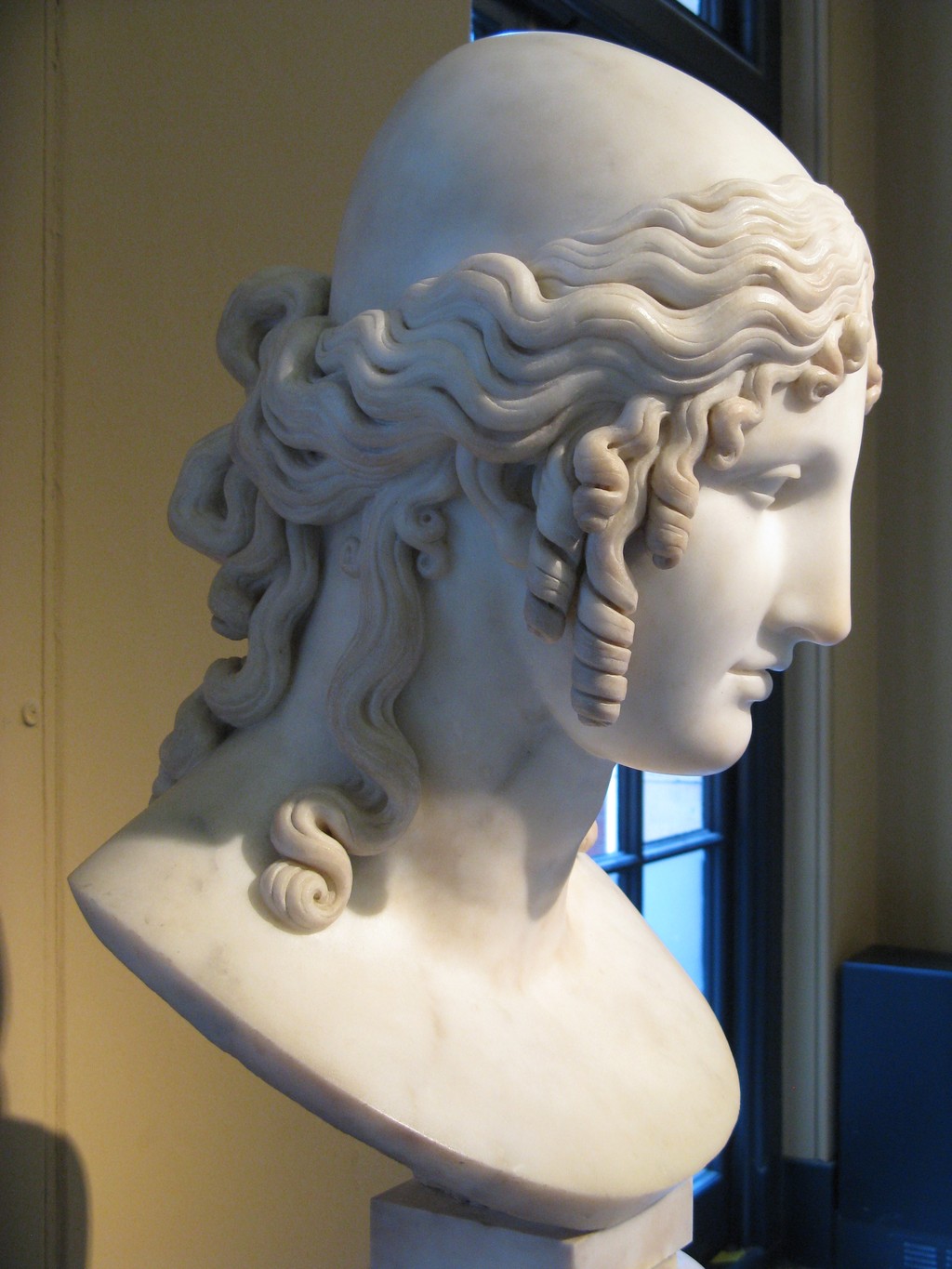
The Victoria and Albert Museum’s Helen shows the long sweep of the hair below the cap. Victoria and Albert Museum, A.46-1930. Photo by Yair Haklai. Image source. CC BY-SA 3.0. Resized from source.
Explore Canova’s works
Browse the sculptures and paintings covered in this guide. Several entries compare versions or examine details of a larger work.
Discussion
Look again at the images and ideas explored in Helen of Troy. These editorial prompts invite your observations.
Reader Insights
How do the head turn and hairstyle shape the expression?
Which details distinguish the Castlereagh marble from the V&A version?
Join the Conversation
Share a detail, comparison or question about Helen of Troy below.
References
- Christie’s, Bust of Helen, 1816–17, lot 33, 6 July 2023. Catalogue, provenance, inscription and four object views. View source.
- Victoria and Albert Museum, Helen of Troy, A.46-1930, O127047. Collection data, physical description, photographs and object history. View source.
- Victoria and Albert Museum, Antonio Canova, collection highlights and attribution of the museum’s bust. View source.
- Factum Foundation, The bust of Helen of Troy at Mount Stewart, 2025 project account and photographs of the facsimile. View source.
- Homer, Iliad, Book 3, translated by William Cullen Bryant. View source.
- State Hermitage Museum, Helen the Beautiful, collection record Н.ск-825. View source.
- Sergey Androsov, Italian Sculpture, 17th–18th Centuries, State Hermitage Museum, 2014, catalogue entries 248–249. View source.
- Ian Wardropper and Thomas F. Rowlands, Antonio Canova and Quatremère de Quincy: The Gift of Friendship, Art Institute of Chicago, pp. 38–39, on the Chicago bust. View source.
- Edizione Nazionale delle Opere di Antonio Canova, Epistolario 1812, introduction, especially pp. XXXIX and XLIII–XLIV, and related correspondence. View source.
- Fondazione Magnani-Rocca, La Tersicore di Antonio Canova, catalogue account of the Sommariva marble. View source.
- Lord Byron, On the Bust of Helen by Canova, 25 November 1816, and letter to John Murray of the same date, in The Works of Lord Byron, Poetry, vol. 4. View source.
- Museo Gypsotheca Antonio Canova, Biografia di Antonio Canova, on the papal recovery mission of 1815. View source.
- Vatican Museums, Perseus Triumphant and Apollo Belvedere, collection records. Perseus · Apollo. View source 1. View source 2.
- National Trust, The Londonderry Collection at Mount Stewart, account of the family loan and Castlereagh objects. View source.
- Christie’s, Antonio Canova’s Bust of Helen, 2023, with Loring Hall context and sale result. View source.
- Edizione Nazionale delle Opere di Antonio Canova, Epistolario 1811, fig. 19 and introduction, pp. XXX–XXXI. View source.


 Antonio Canova.jpg)

