



 by Tom Gurney
Tom Gurney BSc (Hons) is an art history expert with over 20 years experience
Published on June 19, 2020 / Updated on November 13, 2026
Email: tomgurney1@gmail.com / Phone: +44 7429 011000
Monument to the Royal Stuarts: Introduction
Two winged figures lower their heads beside a closed pair of marble doors. Above them, three men appear in profile on a projecting ledge. A few lines of Latin give their names and explain how they are related. Antonio Canova made the monument for St Peter’s Basilica in Rome, where it was installed in 1819. Its tapering sides bring the eye up from the figures and doors towards the family’s arms. From the aisle you can read the whole composition at once. The details that explain whom it honours and why take longer to come into view. [1] [2] [3]
The monument commemorates James Francis Edward Stuart and his sons Charles Edward and Henry Benedict. Their remains are in the Vatican Grottoes below the basilica. The doors on the monument are carved in stone, with panels and rings that give them the appearance of doors someone might open. Canova’s arrangement sets those ordinary details beside the wings and the lowered torches. The memorial gives visitors a place to stand and remember three men buried elsewhere in the building. [1] [2] [4]
Monument to the Royal Stuarts Antonio Canova
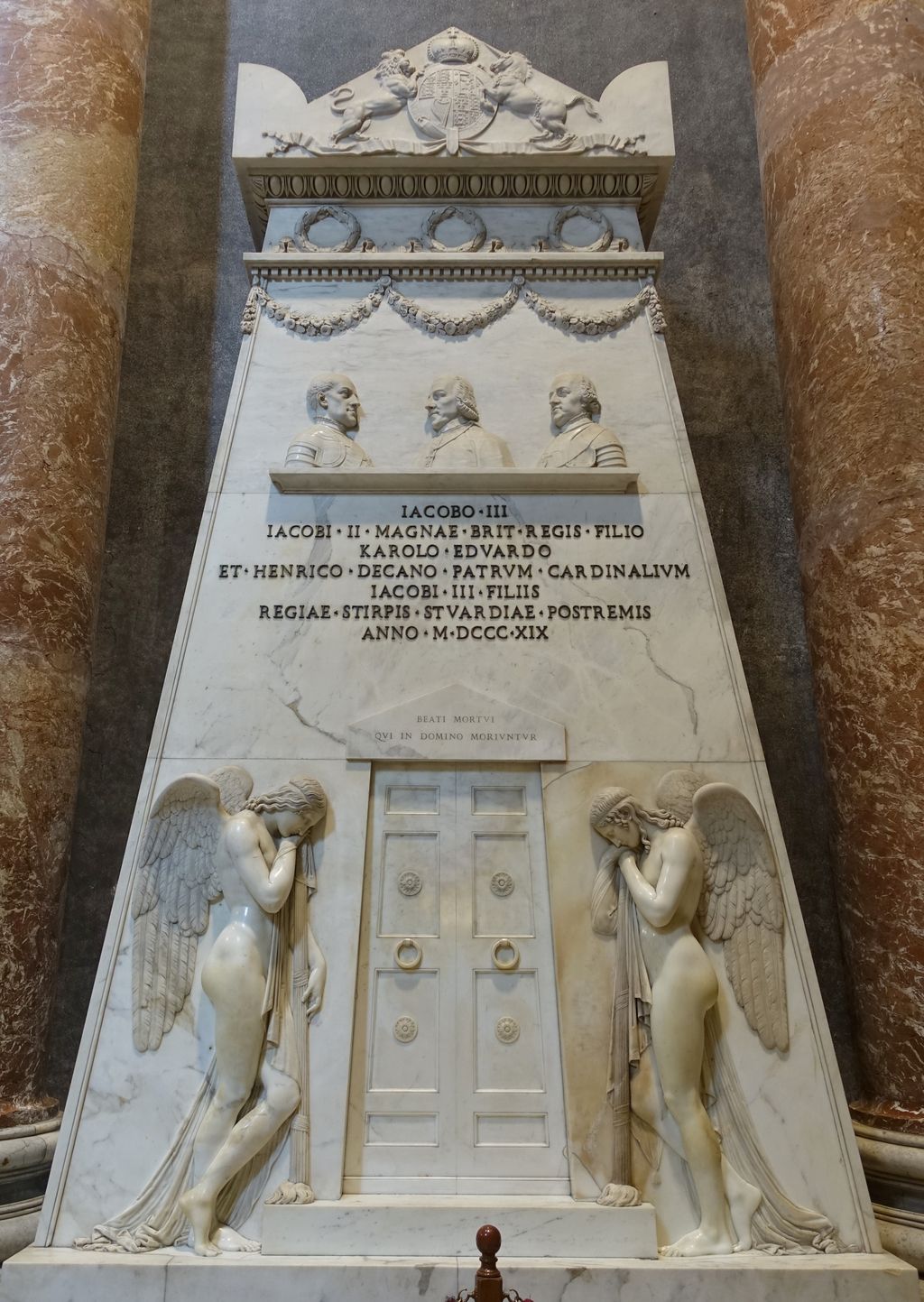
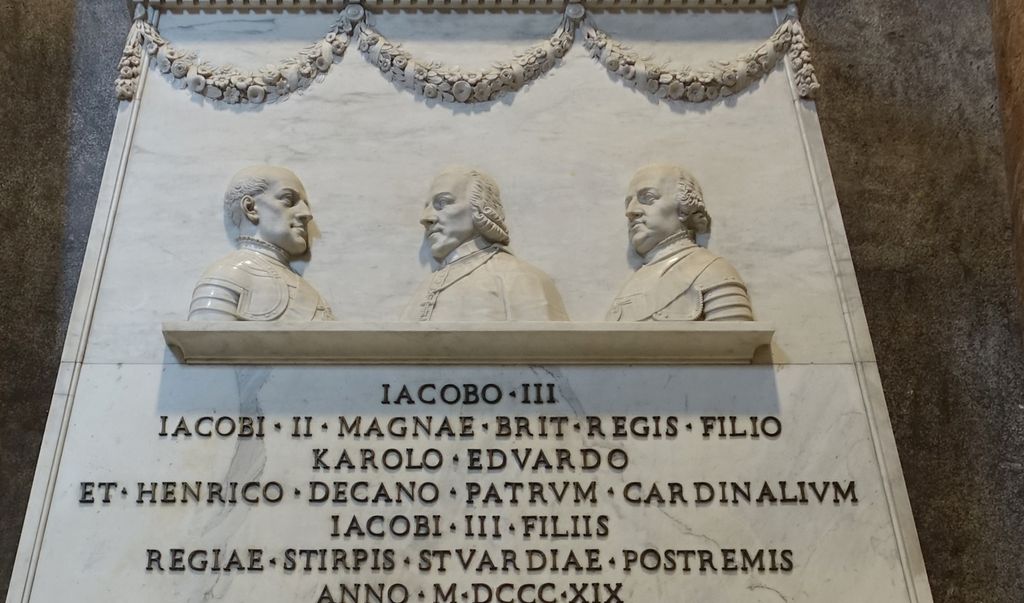
The Royal Stuarts monument in St Peter’s, with the portraits above its inscription. Daderot. Image source. CC0 / Public domain. Resized for display.
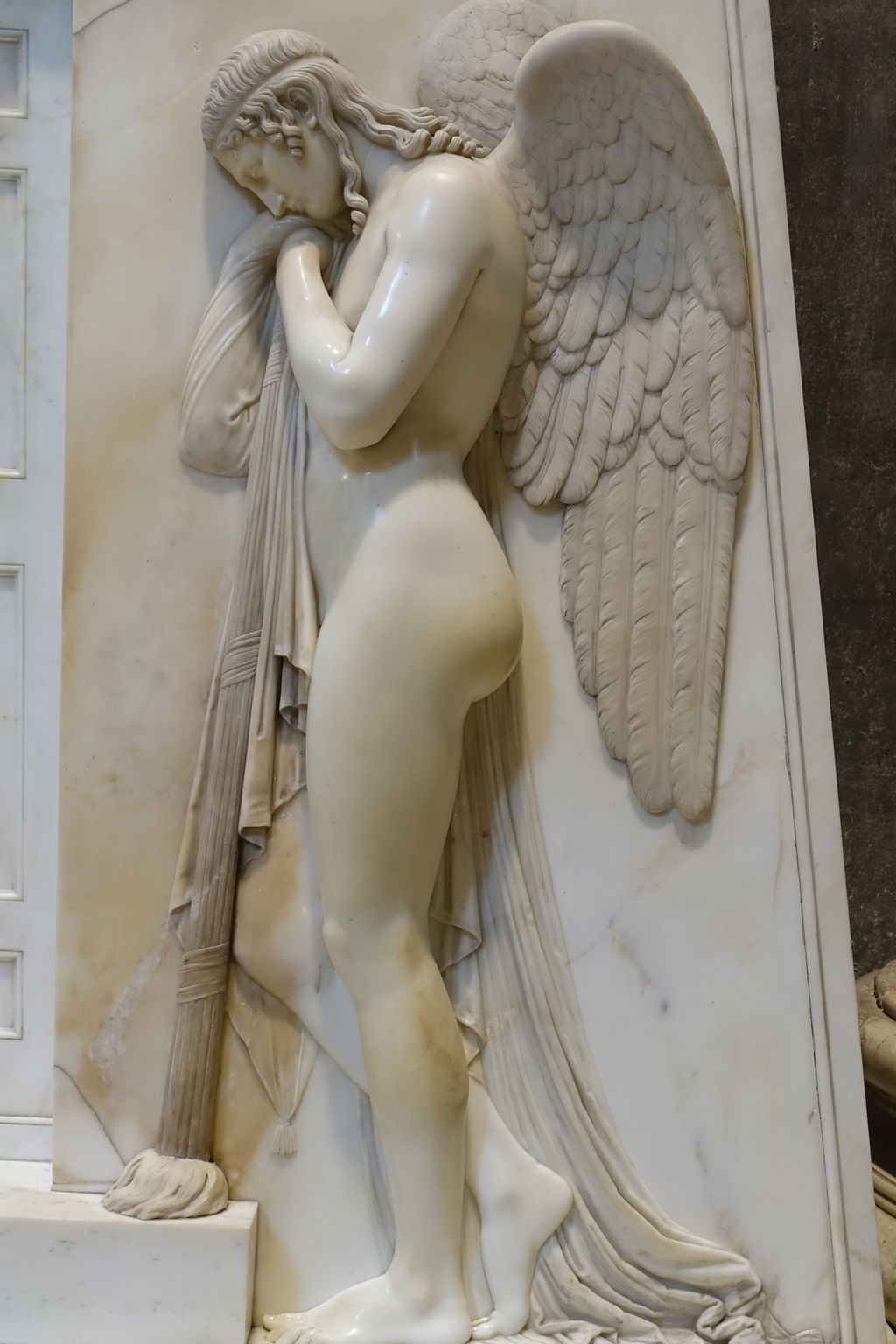
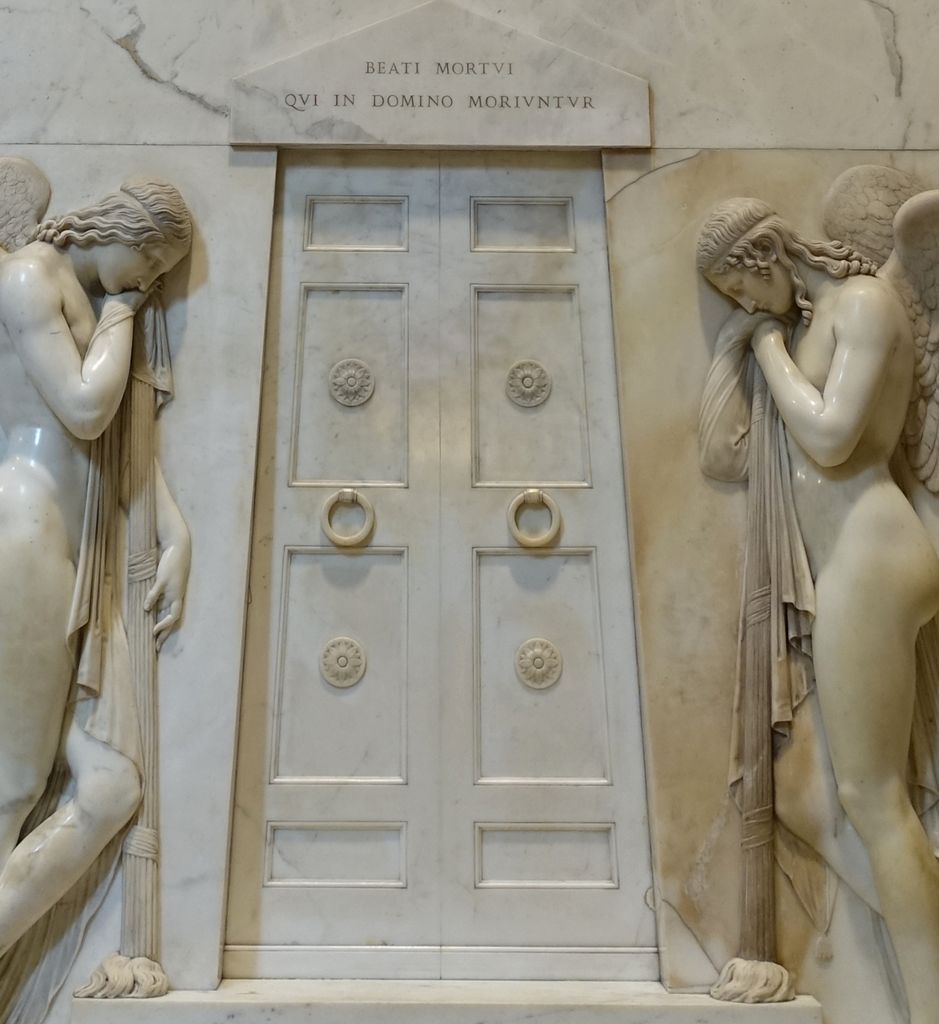
The winged figure on the right of the closed doors. Daderot. Image source. CC0 / Public domain. Resized for display.
At a Glance
- ArtistAntonio Canova. [2]
- Material and locationMarble, St Peter’s Basilica, Vatican City. [1] [2]
- CommissionAngelo Cesarini contracted with Canova in 1810. The Prince Regent later secured British funding towards the work. [3]
- Installation1819, also the date on the monument. The family’s burial is in the Vatican Grottoes. [1] [3] [4]
Contents
- The two figures and the closed door
- The three names and the royal arms
- Cesarini’s commission and the Prince Regent’s contribution
- The monument upstairs and the burial below
- Early viewers and reproductions
- Annotated details
The two figures and the closed door
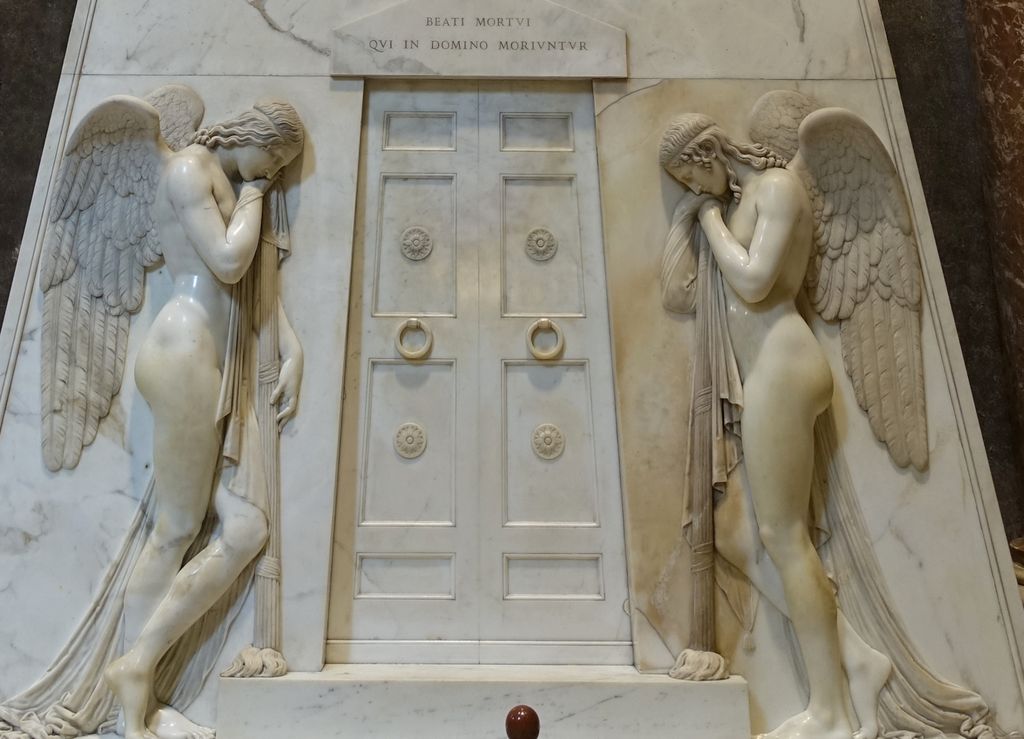
From the front, each leaf of the double door carries a ring at the same height, set between recessed panels. The two rings are small enough to suggest the scale of a hand. Their shadows give them weight, even though they are part of a fixed marble surface. The narrow ledge below reads as a step. The doorway has a horizontal lintel and vertical sides, while the edges of the monument incline inwards. That change of direction gives the doors a distinct shape within the tapering monument. [1]
The winged figures, or genii, follow the inward turn of the monument with their heads. Each bends towards the centre and rests against a long torch with its flame turned down. On the left, a forearm drops almost straight beside the shaft. On the right, a bent elbow brings the hand higher and a foot set back opens a narrow gap between the legs. Their similarities are easy to see from the centre of the aisle. From nearer the monument the small changes in the position of their arms, heads and feet give each figure its own weight and balance. [1]
Look at the right figure from the side and the different depths of the carving become clearer. The shoulder and hip project from the marble plane. The outer wing stays close to it, with the rounded ends of the feathers overlapping in rows. Drapery descends beside the torch and gathers by the feet. The turn of the bare shoulder catches a wider patch of light than the small, layered feathers behind it. Canova uses these differences to keep the figure distinct from the slab while leaving it within the architecture of the monument. [1] [5]
The smaller inscription above the door draws on Revelation 14:13. It blesses the dead who die in the Lord. Its low position brings those words into the same field of view as the inverted torches and bowed heads. In Canova’s earlier Tomb of Pope Clement XIII, the winged figure appears once, seated off to the side, above one of the lions. Here the two genii keep attention on the closed doors between them. The paired gestures can be read in the time it takes to pass the monument, while the feathers, folds and torch flames reward a pause. [1] [6] [7]
Annotated Details from Monument to the Royal Stuarts
The monument in St Peter’s Basilica. Photograph by Daderot, CC0. Resized, annotated and cropped.
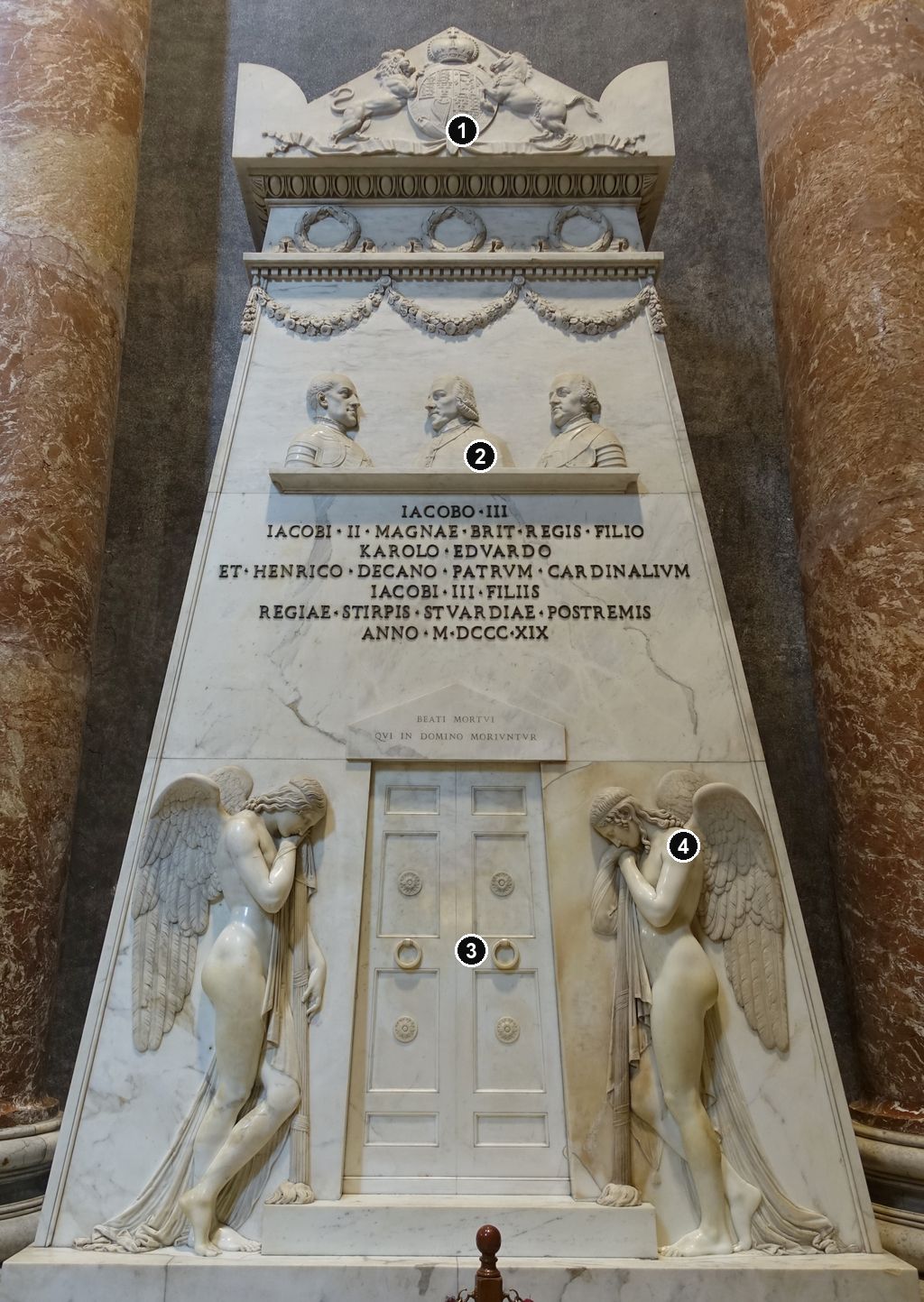
Details from MONUMENT TO THE ROYAL STUARTS
Follow the monument from the arms and three portraits down to the closed doors.
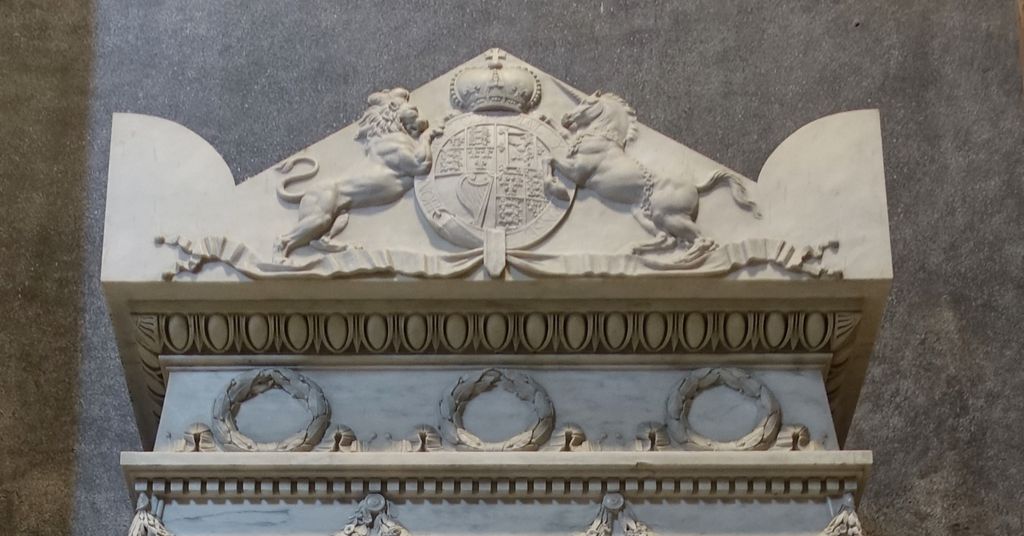
Royal arms
The crown and arms sit at the top, above the wreaths and portraits.
Three portraits
The shallow portraits form a single row, with the inscription immediately below.
The closed doors
The carved doors occupy the central axis. Rings and recessed panels give the opening the appearance of a real door.
The bowed figures
The winged figures incline their heads towards the doors. Their upright bodies frame the lower part of the monument.
The three names and the royal arms
The portraits run along a narrow shelf above the dedication. James Francis Edward occupies the middle. His face turns in the same direction as the head at the right, while the head on the left turns towards him. The raised contours of their brows, noses and chins stand away from the slab. At either end the repeated bars across the shoulders give the busts a similar edge. Above them, carved garlands hang in three curves. Higher up, three wreaths lie in a row beneath the crowned arms. The repeating groups make the family legible as a unit across several levels of the monument. [1] [3] [6]
The Latin inscription addresses James as James III and identifies him as the son of James II. It then names Charles Edward and Henry as James’s sons, calling Henry dean of the cardinals. It describes all three as the last of the royal Stuart line. James’s numeral records the title his supporters recognised after the death of his father, who had reigned as James II in England and Ireland and James VII in Scotland. James Francis Edward’s claim was contested, and he never reigned in Britain. The sons are named without royal numerals, even though Jacobite supporters also recognised their claims in succession. [1] [3] [8] [9]
Charles led the rising of 1745 on his father’s behalf. The Jacobite defeat at Culloden in April 1746 ended that attempt to restore the family to the throne. Henry became a cardinal and spent much of his life in Italy. After Charles’s death in 1788, Jacobite supporters regarded Henry as Henry IX. By then the family’s claim and Henry’s actual public standing in Rome belonged to different worlds. The dedication makes his rank in the Church explicit. A visitor who knows the story of the rising can read the same monument as the record of a dynasty in exile and a family with a place in Roman Catholic life. [3] [4] [8] [9]
Videos on Canova
Explore Canova’s workshop methods and the settings for his sculpture.
From Sketch to Stone | Canova: Sketching in Clay
Watch sculptor Fred X. Brownstein recreate a Canova Venus, using clay, plaster and marble.
Watch on YouTubeCesarini’s commission and the Prince Regent’s contribution
Henry’s secretary and heir, Monsignor Angelo Cesarini, set the project in motion after the cardinal’s death. The contract of 24 April 1810 called for a monument within nine years and specified 9,000 Roman scudi in instalments. Canova received 1,000 scudi on signing. The surviving evidence does not establish how much more was paid under that agreement. The contract already specified the position opposite the monument to Maria Clementina Sobieska, the wife of James and mother of Charles and Henry. The place was part of the plan years before the marble was put in position. [3]
A second phase followed Canova’s meeting with the Prince Regent at Carlton House on 4 December 1815. The sculptor had travelled to Paris on papal business to recover works of art taken to France and then went on to London. William Richard Hamilton, a British official who helped arrange the contribution, sent Canova a memorandum to pass to Cardinal Ercole Consalvi. The archival account records a British commitment of 50,000 francs. In a December 1816 letter to Leopoldo Cicognara, Canova described the payment as a discretionary contribution towards the expenses and explained that it would have to suffice for the work. These records distinguish the original contract, the later British contribution and the financial limits under which the work was finished. [3] [10]
Canova’s letter to Louise, Countess of Albany, on 1 January 1818 gives another view of the arrangement. Louise was Charles Edward’s widow. Canova described his work on the monument as a way to show gratitude to her, the Prince Regent and Consalvi. The regent’s participation stayed out of the finished inscription. His name is absent beneath the Stuart portraits. This was a different kind of patronage from his commission for Mars and Venus, a sculpture intended for Carlton House. The monument went into a Roman basilica, and its inscription speaks about the family being commemorated. [1] [3] [10] [11]
The monument upstairs and the burial below
James was buried in the Vatican Grottoes in 1766. Henry was buried near his father in 1807. Charles had first been buried at Frascati, where Henry was bishop, and his remains were subsequently brought to the Vatican. The Fabbrica’s account of the grottoes records a request in 1938, approved by Pius XI, to provide a single tomb for the three men. The three were buried together in a travertine sarcophagus in 1939. A bronze crown on a cushion sits above its curved lid, which also bears two wreaths. Canova’s relief portraits and the double doors are on the basilica floor, where someone walking through the aisle can see them. [2] [4]
The family is visible on both sides of that part of the church. Opposite Canova’s marble stands the earlier monument to Maria Clementina Sobieska, whose likeness appears in a medallion. The spatial relationship was already set out in Cesarini’s contract. On one side Canova places the three men along a single ledge. Across the aisle Maria Clementina has a memorial of her own. Even a visitor who has never been down to the grottoes can see how the two works bring the family together across the space of the church. [3] [4] [6]
Early viewers and reproductions
An early English account published with Henry Moses’s engravings describes the winged figures through their sympathy with human grief. William Hazlitt, writing after his visit to Rome in the 1820s, paid closer attention to the source of the money and the implications of the epitaph. He asked what it meant for a reigning house to pay tribute to the dynasty it had displaced. The same marble prompted a response to the figures’ posture and another to the political history suggested by the dedication. The second response depended on knowing about the British contribution, since the donor’s name could not be read on the stone. [1] [3] [7] [12]
The Rijksmuseum holds an engraving of the monument by Domenico Marchetti after a drawing by Giovanni Tognolli. The sheet belongs to a series that took Canova’s sculpture to readers who might never visit Rome. The museum records that Canova dedicated the print to the Countess of Albany. The carved inscription identifies the three men, while the dedication on paper names the woman who had been married to one of them. The same memorial could therefore address the public in the basilica and acknowledge someone with a personal connection to Charles. [1] [13]
Fondazione Zeri catalogues a photograph by Anderson of a detail of the monument. A detail brings the viewer close to one area of carving, while an engraving of the whole preserves the sequence from the double doors to the coat of arms. You can make much the same change in the aisle. From farther back the doors hold the centre and the genii turn towards them. From nearer the marble, a polished shoulder, a ring on the door or one of the three faces can occupy the whole field of view. [1] [5] [13] [14]
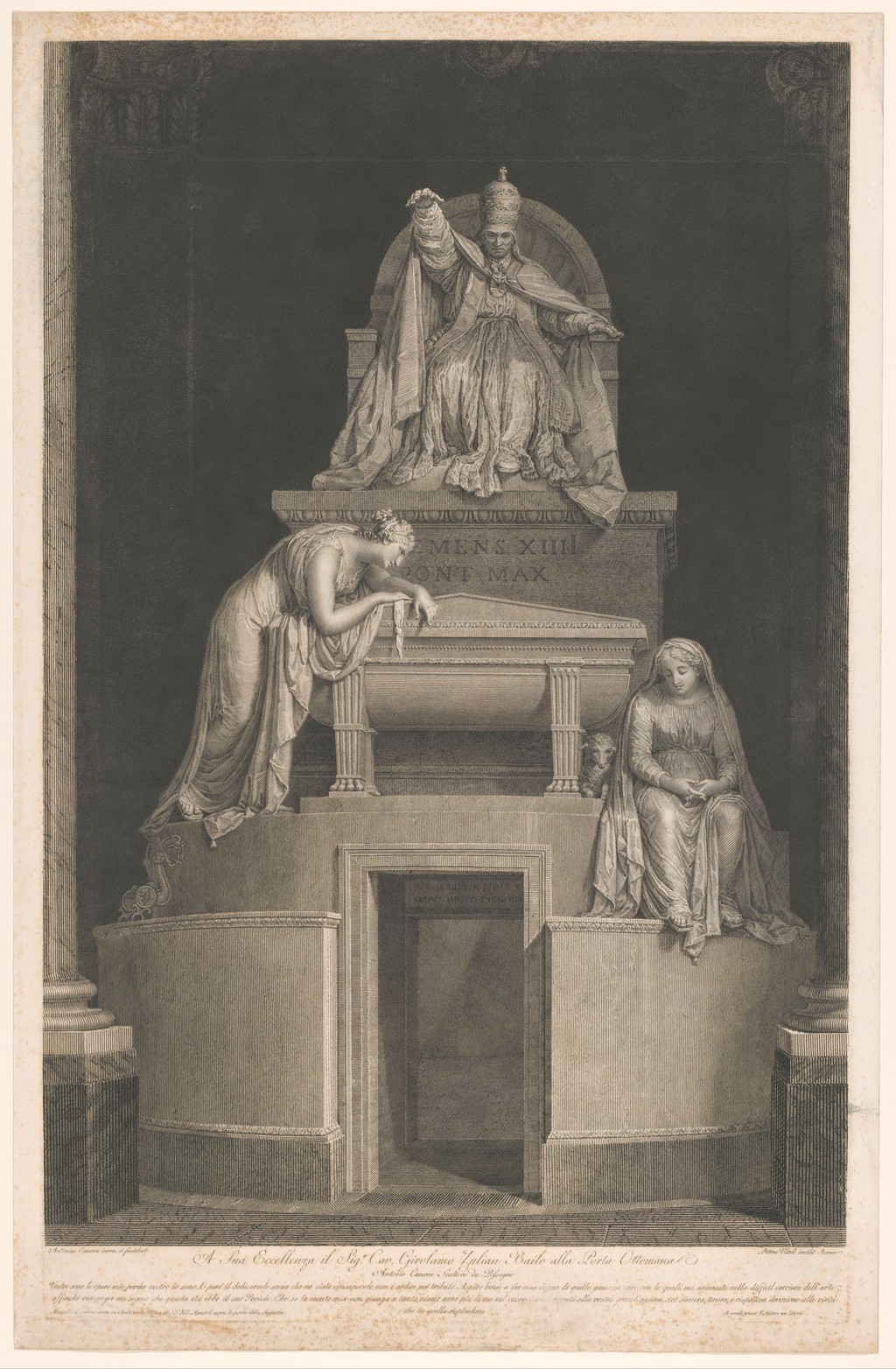
Vitali’s engraving of Canova’s Clement XIV tomb shows how another Roman wall monument was circulated as a print. Rijksmuseum. Image source. Public domain. Resized from source.
Explore Canova’s works
Browse the sculptures and paintings covered in this guide. Several entries compare versions or examine details of a larger work.
Discussion
Look again at the images and ideas explored in Monument to the Royal Stuarts. These editorial prompts invite your observations.
Reader Insights
How do the paired figures draw your attention to the doorway?
How does the inscription shape your understanding of the memorial?
Join the Conversation
Share a detail, comparison or question about Monument to the Royal Stuarts below.
References
- Daderot, frontal photograph of Canova’s monument in St Peter’s Basilica, 2019, DSC01269. View source.
- Museo Gypsotheca Antonio Canova, Canova around the world, Rome and Vatican City. View source.
- Alessio Costarelli, doctoral research, Università di Bologna, pp. 67–74, on Cesarini’s contract, the Carlton House meeting and the diplomatic context. View source.
- Fabbrica di San Pietro, Roma Sacra: The Vatican Grottoes, account of the Stuart burials reproduced in St Peter’s Basilica. View source.
- Daderot, detail photograph of the right-hand winged figure, 2019, DSC01274. View source.
- St Peter’s Basilica guide, Monument to the Stuarts, with inscription and extracts from the basilica guides. View source.
- Isabella Teotochi Albrizzi and Henry Moses, The Works of Antonio Canova in Sculpture and Modelling, entry on the sepulchral monument of Cardinal York. View source.
- National Museums Scotland, Exile, rebellion, and vanquishment: The Jacobite challenge. View source.
- Royal Collection Trust, The Sobieski Hours, RCIN 1142248, on the Stuart family and Henry’s succession claim. View source.
- Christopher M. S. Johns, Antonio Canova and the Politics of Patronage in Revolutionary and Napoleonic Europe, 1998, on the Stuarts and Canova’s letter to the Countess of Albany. View source.
- Royal Collection Trust, Mars and Venus, RCIN 2038, on the Prince Regent’s commission. View source.
- William Hazlitt, Notes of a Journey through France and Italy, in The Collected Works of William Hazlitt, vol. 9, p. 245. View source.
- Rijksmuseum, Domenico Marchetti after Giovanni Tognolli and Canova, engraving of the Stuart monument, RP-P-OB-36.455. View source.
- Fondazione Federico Zeri, Anderson photograph of a detail of Canova’s Stuart monument, inventory SI_056/3/9. View source.


 Antonio Canova.jpg)


