



 by Tom Gurney
Tom Gurney BSc (Hons) is an art history expert with over 20 years experience
Published on June 19, 2020 / Updated on November 13, 2026
Email: tomgurney1@gmail.com / Phone: +44 7429 011000
The Graces Dancing with a Cupid: Introduction
Three dancers move together on a narrow strip of ground. The woman in the middle looks straight out and stretches her arms across her companions’ shoulders. The two beside her incline their heads towards the right of the picture. On that side a winged child lifts a lyre almost to his face. On the left, grey smoke rises from a tripod and thins into the black background. Antonio Canova’s composition gives the women a place to dance, a musician to dance to and very little else to share the space. [1] [2]
This is the tempera on paper catalogued at Possagno as Danza delle Grazie con Amorino, inventory 131. The museum’s digital presentation dates it to 1799. The Italian national catalogue places it after 1798, while the 2015 Turin exhibition catalogue groups the design with Canova’s temperas conceived around 1806–08. The subject and inventory number identify the picture more securely than a single year. A version on canvas at Bassano del Grappa retains the dancers and Cupid, with an open space where the tripod stands in the tempera. [1] [2] [3] [4]
The Graces Dancing with a Cupid Antonio Canova
At a Glance
- ArtistAntonio Canova. [1] [2]
- MediumTempera on paper, Museo Gypsotheca Antonio Canova, Possagno, inventory 131. [2]
- Related paintingLe Tre Grazie con un amorino, monochrome on canvas, Bassano del Grappa, inventory M13. [3] [4]
- PrintGiovanni Martino De Boni’s design after Canova, preserved in several impressions. [2] [5] [6]
Contents
- Three dancers on a narrow stage
- The musician and the tripod
- The Bassano canvas and the Possagno oil
- De Boni’s print after the tempera
Three dancers on a narrow stage
The middle dancer’s arms form a line across all three figures. Her companions’ gestures break that line in different ways. The woman on the left bends her elbow sharply outwards and brings her hand to her waist. Her counterpart on the right lifts a hand to her cheek, close to the fingers resting on her shoulder. Their heads tilt in the same direction, with one inclining towards the middle woman and the other towards Cupid. The frontal gaze in the centre and the shared tilt at the sides give the group both a stable axis and a sense of movement across the picture. [1]
Look down from the arms to the feet. The women touch the ground lightly and each draws the other foot up close to the standing leg. Pale folds follow those legs in long curves. Around the hips the fabric opens into shorter, curling edges picked out with warmer colour. Red bands at the waist tie the three costumes together, while the edges of the skirts spread to different widths. The long shape of each dress makes the figures seem tall, and the small gap beneath each lifted foot makes the step legible even in a modest reproduction. [1]
The dark ground gives those gaps a particular clarity. Black shows between the folds and around the outlines of the elbows, necks and feet. Below, the pale strip tapers to a point at either side, with a few fine strokes of vegetation near the tripod. There is no painted wall or landscape to tell us where this dance takes place. The edges of the figures supply most of the information about space. In Graces and Venus Dance Before Mars, Canova gives the dance an audience and extends it across a wider scene. Here the compact arrangement makes the contact at the shoulders much easier to follow. [1] [7]
The musician and the tripod
Cupid lifts one foot as he raises the lyre. The instrument curls above his hands and crosses the edge of his face. The wing extends behind him into a patch of open black, leaving his smaller silhouette easy to separate from the nearest dancer. His pose echoes the women’s raised feet, but his lifted arms give him his own outline. He looks up towards the lyre while the women turn their heads along the line of the dance. The composition lets the musician take part in the movement without joining their embrace. [1]
Across the picture, the tripod’s three slender legs meet the ground in an upright structure. The rim of the bowl picks up the warm colour of the instrument. Above it the smoke gives the eye a softer shape to follow, spreading and thinning as it rises. The smoke and the lyre occupy roughly the same low part of the picture and leave open space above them. Both suggest sensations the paint can only evoke through sight. The lyre suggests music, and the curling smoke suggests the fire inside the bowl. Each adds an activity beyond the dancers’ steps. [1]
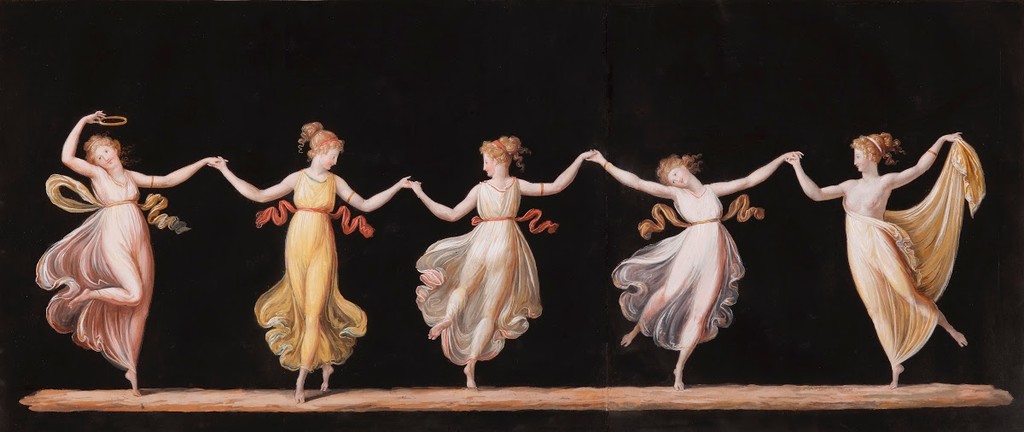
In a related tempera, Canova uses linked hands to organise another chain of dancers. Museo Gypsotheca Antonio Canova, Possagno. Image source. Public domain. Resized from source.
Videos on Canova
Explore Canova’s workshop methods and the settings for his sculpture.
From Sketch to Stone | Canova: Sketching in Clay
Watch sculptor Fred X. Brownstein recreate a Canova Venus, using clay, plaster and marble.
Watch on YouTubeThe Bassano canvas and the Possagno oil
On the Bassano monochrome, the same three women stretch across the canvas and Cupid again raises his instrument on the right. The tripod is absent. The change makes the musician the only separate figure or object at either side of the group. The pale modelling on the rough canvas brings forward the women’s faces and the ridges of their dresses, and a squared grid remains visible through the composition. The Bassano collection history relates such grids to the transfer of designs into other formats. The Turin catalogue dates the Bassano monochromes M7 and M13 to around 1805–06. The grid shows that this arrangement could be worked on and transferred, while the differing dates for the Possagno picture leave the sequence between the two versions open. [2] [3] [4]
Canova’s Le grazie, a separate oil on canvas in Possagno, bears his name and the date 1799. Its three women appear at half length and gather in an embrace, bringing their bodies and faces close to the picture plane. The composition gives the viewer little sense of the ground beneath them. In the tempera, the standing legs and lifted feet matter as much as the linked shoulders. The two paintings share Canova’s interest in making the contact between three bodies readable, and the different framing gives that contact a different purpose. The oil concentrates on an embrace. The tempera gives it the shape of a step. [1] [3] [8]
The sculpted Three Graces take that problem into the round. In the Bedford marble one figure shows her back, and the interlaced arms invite the viewer to walk around the group to see the faces and hands. In the tempera, the black ground and upright bodies hold the group to a single view. The tilted faces, coloured hems and lifted feet make that view sufficient to suggest the movement. [1] [9]
De Boni’s print after the tempera
The national catalogue places Giovanni Martino De Boni’s work on the print between 1810 and 1813. The Istituto Centrale per la Grafica dates the etched plate, M-290_6, to before 1813 and catalogues three surviving impressions from it. For the nineteenth-century impression S-FN31963, the institute credits De Boni as printmaker and Canova as designer, and records a sheet measuring 433 × 594 millimetres. The work on the plate belongs to the early nineteenth century, while the date assigned to that particular impression covers the century as a whole. [2] [5] [6]
In another impression from the same plate, S-CL2323_12119, the three women, the smoking tripod and the lyre player retain their positions. The print translates the tempera’s colours into a range of tones. The wide dark field makes the costumes stand out, while fine strokes give the smoke shape as it rises from the bowl. A narrow rectangular border encloses the dark field and leaves a pale margin around the scene. The relationship between the painted costumes and the black ground survives the change of medium, down to the small marks that distinguish a foot in the air from a foot on the ground. [5] [10]
The prints belong to a series after Canova’s designs that also includes separate scenes with nymphs, dancers and Cupids. One neighbouring design accompanies the Graces with two Cupids and places a statue of Venus before them. The statue gives those dancers a focus beyond their own circle. In this composition, the single Cupid lifting his instrument and the single column of smoke direct attention back to the women’s shared step. The Bassano canvas, Possagno tempera and De Boni print preserve the same gesture while showing how Canova’s arrangement can change when its materials and setting change. [1] [4] [10] [11]
Explore Canova’s works
Browse the sculptures and paintings covered in this guide. Several entries compare versions or examine details of a larger work.
Discussion
Look again at the images and ideas explored in The Graces Dancing with a Cupid. These editorial prompts invite your observations.
Reader Insights
How does Cupid’s position change the balance of the group?
What does the tripod contribute to the scene?
Join the Conversation
Share a detail, comparison or question about The Graces Dancing with a Cupid below.
References
- Museo Gypsotheca Antonio Canova, Danza delle Grazie con amorino, museum image and object entry on Google Arts & Culture. View source.
- Catalogo generale dei Beni Culturali, Danza delle Grazie con Amorino, Possagno inv. 131, national record 0500432535. View source.
- Canova. La bellezza e la virtù, Turin exhibition catalogue, 2015, pp. 92–93, chronology and comparison of the Three Graces designs. View source.
- Storia di Bassano, Storia e collezioni, figs. 18–19, Bassano monochrome M13. View source.
- Istituto Centrale per la Grafica, Danza delle Grazie con Amorino, plate M-290_6. View source.
- Istituto Centrale per la Grafica, Giovanni Martino De Boni after Antonio Canova, Danza delle Grazie con Amorino, impression S-FN31963. View source.
- Fondazione Federico Zeri, Ratto di Elena, Danza di Venere e delle Grazie davanti a Marte, paired Possagno temperas. View source.
- Catalogo generale dei Beni Culturali, Le grazie, Possagno inv. 132, national record 0500432558. View source.
- National Galleries of Scotland, The Three Graces, the Bedford marble. View source.
- Istituto Centrale per la Grafica, Giovanni Martino De Boni after Antonio Canova, Danza delle grazie con amorino, impression S-CL2323_12119, with image. View source.
- Istituto Centrale per la Grafica, Giovanni Martino De Boni after Antonio Canova, Le Grazie e due amorini danzano davanti al simulacro di Venere, impression S-FN31962. View source.


 Antonio Canova.jpg)

