by Tom Gurney
Tom Gurney BSc (Hons) is an art history expert with over 20 years experience
Published on June 19, 2020 / Updated on November 4, 2026
Email: tomgurney1@gmail.com / Phone: +44 7429 011000
Hieronymus Bosch's Hell: Introduction
Hieronymus Bosch's Hell is not a single place in a single painting. It is a recurring moral world: dark, crowded, inventive, comic in the bitterest way, and rooted in late medieval Christian thought about sin, judgement and the fate of the soul. Bosch's most famous infernal scenes appear in the right wing of The Garden of Earthly Delights, the right wing of The Haywain Triptych, the Vienna Last Judgement Triptych and the afterlife panels now associated with Venice. His demons also press around the saint in The Temptation of Saint Anthony, where evil is imagined as assault, deception and spiritual testing rather than final damnation.
That range matters. Bosch is often treated as if he were a painter of horror fantasy before its time, but his Hell imagery is more serious than that. It belongs to the devotional and moral culture of the Netherlands around 1500, to a world of sermons, sin, confession, Last Judgement imagery, pilgrimage, prayer, satire and visual instruction. Bosch's demons are astonishing, but they do not float free from that culture. They give bodily form to moral disorder.
The best way to read Bosch's Hell is therefore not to ask what every monster "means" in isolation. It is better to ask how each infernal scene works: what kind of sin it answers, what forms of pleasure it reverses, how it relates to Paradise or judgement, and how Bosch turns ordinary things into instruments of punishment. Musical instruments, knives, ladders, taverns, buildings, animals, tools, bodies and fires become parts of a moral architecture. Hell is not just a spectacle. It is the consequence of a world looking in the wrong direction. [1] [2] [4] [7]
Contents
- At a Glance
- Hell As Moral Architecture
- The Garden Of Earthly Delights: Hell As Reversed Pleasure
- The Haywain: Hell Under Construction
- The Last Judgement: Hell Beneath The Judge
- Visions Of The Hereafter: Heaven, Descent And Infernal Passage
- Demons, Punishment And Moral Satire
- Saint Anthony And The Difference Between Temptation And Damnation
- Fire, Architecture And The Built World Of Hell
- Reading Bosch's Hell Responsibly
At a Glance
- ThemeBosch's Treatment
- Main worksThe Garden of Earthly Delights, The Haywain Triptych, The Last Judgement Triptych, Visions of the Hereafter and The Temptation of Saint Anthony
- Central ideasSin, judgement, temptation, punishment, inversion of pleasure, spiritual blindness and moral satire
- Typical imageryDemons, hybrid creatures, fire, dark water, buildings, musical instruments, tools, bodies under pressure and monstrous transformations
- Important cautionBosch's imagery should not be reduced to a fixed symbol dictionary or detached from devotional culture
- Related pagesHieronymus Bosch, Seven Deadly Sins and Four Last Things, Visions of the Hereafter, Bosch symbolism, Bosch style and technique and Bosch workshop and attribution
Hell As Moral Architecture
Bosch's Hell scenes usually appear as part of a larger structure. In the Garden of Earthly Delights, Hell follows the closed image of Creation, the left panel of Paradise and the central panel of earthly delight. In The Haywain Triptych, Hell receives the crowd that has followed the cart of hay through the world. In the Vienna Last Judgement, Hell extends a central field already filled with punishments beneath Christ as Judge. In the Venetian afterlife panels, infernal descent belongs to a sequence that also includes ascent, Paradise and the fate of the blessed. [1] [2] [4] [5]
This structural thinking is essential. Bosch does not simply gather horrible inventions and call the result Hell. His infernal imagery answers what comes before it. Paradise, worldly desire, temptation, folly and judgement are all part of the same moral sequence. Hell is the final state of disorder, but Bosch often shows that disorder beginning much earlier.
In The Haywain, for example, the right wing shows devils constructing a tower. The Prado presents the triptych as a moral warning about humanity's pursuit of perishable goods, with the hay wagon moving toward infernal consequence. The Hell panel is particularly chilling because it is active: demons build, carry, raise and prepare. Damnation is not only a destination waiting at the end of the road. It is a worksite, a structure made ready for the sinners who arrive behind the wagon. [2]
In the Garden, the movement is less direct but just as powerful. The right panel turns the brilliant world of the centre into a dark anti-world. Delight becomes punishment. Music becomes torture. Bodies that seemed free become bound, pierced, consumed or humiliated. Architecture no longer shelters; it traps. Bosch's Hell is a collapse of created order, but it also feels like an exact answer to misused pleasure. [1]
The Vienna Last Judgement gives the same problem an apocalyptic scale. The Academy of Fine Arts Vienna describes the triptych as one of Bosch's largest and densest works, with Christ as Judge above a world of torments. Here Hell is not merely the rightmost destination after a worldly middle panel. The central panel itself is dominated by punishment, while the right wing deepens the infernal condition. A small possibility of salvation remains visible, but the painting's visual weight falls on the consequences of sin. [4]
The Garden Of Earthly Delights: Hell As Reversed Pleasure
The Hell wing of The Garden of Earthly Delights is Bosch's most famous infernal image. Its power comes from inversion. The central panel of the triptych is full of bodies, fruit, birds, pools, movement and fragile pleasures. The right wing takes that abundance and darkens it into punishment. The viewer moves from a luminous field of desire into a night landscape of fire, ice, instruments, monsters and exposed bodies. [1]
This Hell is not simply a furnace. Fire burns in the background, but Bosch also gives the scene dark water, frozen surfaces, tavern disorder, monstrous machinery, body parts enlarged beyond sense, and demons who seem both absurd and terrifying. The variety is important. Damnation is not one punishment repeated. It is a world in which every faculty and pleasure has been distorted.
Musical instruments are among the clearest examples. In ordinary life, music can suggest harmony, worship, celebration or sensual pleasure. In Bosch's Hell, instruments become devices of torment. Bodies are pinned to them, stretched across them or crushed by them. The lute, harp and other instruments no longer produce order; they enforce pain. Bosch turns culture against the body.
The same logic governs the famous giant ears pierced by a knife. The image is strange enough to resist any tidy explanation, yet it belongs to the panel's larger treatment of the senses. Hearing, touch, taste, sight and bodily appetite are all exposed to judgement. Bosch does not translate each sense into a neat emblem. He dismembers and enlarges the human body until ordinary experience feels unstable.
The so-called tree-man is another central figure. This hollow-bodied being, supported by tree-like limbs and turning a pale face toward the viewer, has attracted many speculative readings. It should be handled carefully. It is safer to see the figure first as Bosch's extraordinary fusion of body, architecture and landscape within Hell. The tree-man is not a solved code. He is a visual centre of instability: part person, part ruin, part tavern, part impossible building. [1] [7]
The Hell wing of the Garden also warns against sensationalism. The image is shocking, but Bosch's shock has purpose. The right panel completes the triptych's moral structure. It shows what happens when created abundance is experienced as appetite without spiritual order. That does not make every detail easy to decode, but it gives the panel its gravity. The horror belongs to a Christian moral imagination, not to fantasy detached from belief.
The Haywain: Hell Under Construction
The Hell wing of The Haywain Triptych is less famous than the Garden's musical Hell, but it is one of Bosch's sharpest moral inventions. In the centre panel, humanity follows a huge cart of hay, fighting, flirting, stealing, bargaining and scrambling for a share of something perishable. Rulers, clerics, peasants and ordinary travellers all participate. The right wing reveals where the cart is going. [2]
Bosch's great idea is to show Hell being built. Devils carry materials up a ladder, raise a tower and receive the sinners who arrive. The punishment is architectural. It has tools, labour and organisation. Hell is not chaotic in the simple sense. It is an inverted order, a demonic version of human industry.
This makes the painting's satire especially severe. In the central panel, people work hard to seize hay, a temporary earthly good. In the right panel, devils work hard to construct the place where such misdirected desire ends. Human activity and demonic activity rhyme with one another. The ladder beside the hay and the ladder in Hell are not identical, but they belong to the same moral movement. What looks like striving in the world becomes construction in damnation.
The Haywain also shows how Bosch links Hell to ordinary behaviour. The central sin is not exotic. It is grasping after status, possession, pleasure and advantage. The crowd does not look monstrous; it looks recognisably human. By the time the demons appear, the moral route has already been chosen. Bosch's Hell is frightening because it is continuous with the road of life.
That continuity is one reason Bosch's infernal images remain so persuasive. The demons may be fantastic, but the causes are familiar. People ignore Christ, follow the crowd, mistake movement for purpose and treat perishable goods as if they were worth the soul. The right wing merely reveals the end of a journey already under way.
The Last Judgement: Hell Beneath The Judge
The Vienna Last Judgement Triptych places Bosch's infernal imagination inside one of the most important subjects of Christian art: the judgement of all humanity at the end of time. The Academy dates the work to c. 1490-1505 and identifies it as a major winged altarpiece whose interior moves from Paradise and the Fall to judgement and damnation. [4]
In many Last Judgement images, the composition balances salvation and damnation with strong clarity. Bosch shifts that balance. Christ appears above with the heavenly court, but the lower world is overwhelmingly occupied by punishment. The central panel already feels infernal. The right wing then extends that darkness into Hell. Salvation is present, but visually small against the scale of catastrophe.
This does not mean Bosch abandons doctrine for nightmare. The work is grounded in Last Judgement tradition: Christ, angels, saints, trumpets, sinners, Paradise and Hell remain part of the structure. What Bosch changes is the intensity. The world under judgement is filled with procedures of pain. Demons bind, carry, cut, prod, display, cook and drag. Tools, buildings and objects become instruments of sentence.
The Vienna triptych also clarifies the role of fire. Fire is important in Bosch's Hell, but it is not the whole subject. In the Last Judgement, flames belong to a wider geography of darkness, torture, ruined architecture and demonic action. Bosch's punishments often feel mechanical or bureaucratic as much as fiery. Evil has methods. That organisation makes the painting more disturbing than a simple burning landscape.
The closed wings of the Vienna triptych add another layer. They show saints in grisaille, a quieter devotional exterior that contrasts with the opened interior. The viewer moves from holy example into the catastrophe of sin and judgement. That physical movement from closed to open reinforces Bosch's larger moral pattern: what is hidden, restrained or devotional on the outside gives way to the revealed destiny of the soul. [4]
Visions Of The Hereafter: Heaven, Descent And Infernal Passage
Bosch's afterlife imagery is not only infernal. The panels known as Visions of the Hereafter, associated with the Gallerie dell'Accademia in Venice, show a broader movement through the destiny of souls. The official Venetian account connects the panels with Cardinal Domenico Grimani's collection and describes a sequence from heavenly ascent to infernal descent, while noting scholarly debate about whether the four panels once formed part of a larger or more complex structure. [5]
These panels matter because they remind us that Bosch's imagination of the afterlife includes more than punishment. The Ascent of the Blessed gives one of the most haunting images of salvation in Northern Renaissance art: souls guided upward toward a radiant passage. Other panels move through Paradise, the Fall of the Damned and a river or route toward Hell. The sequence gives Bosch's afterlife a directional quality. Souls travel, rise, fall, cross thresholds and approach destinations.
The Gallerie dell'Accademia notes possible inspiration from visionary literature, including the Vision of Tnugdalus and Dante's Divine Comedy. Such connections should be handled as context rather than proof of a one-to-one source for every detail. They do, however, place Bosch within a culture rich in narrated journeys through the afterlife. Hell could be imagined not just as a place, but as a passage, a descent and a revelation. [5]
This makes the Bosch afterlife different from a modern gallery of monsters. The saved and damned exist within a moral geography. Light, darkness, ascent, descent, water, fire, bridges, tunnels and thresholds all help organise the soul's fate. For that wider sequence, see Visions of the Hereafter.
Demons, Punishment And Moral Satire
Bosch's demons are unforgettable because they are rarely just beasts. They are hybrids of animal, human, object, tool and costume. Some look ridiculous; others are repulsive; many are both. Their absurdity is part of the moral satire. Evil in Bosch is not grand and dignified. It is degrading, busy, inventive, grotesque and often foolish.
The punishments they administer frequently turn earthly habits back upon the sinner. Music can become torture. Gluttony can become consumption. Violence can return as bodily violation. Greed, gambling, lust, vanity and spiritual neglect appear not only as sins to be named, but as behaviours that generate their own infernal logic. Bosch's punishments are not always easy to match to exact sins, but they often feel like reversals of misused desire.
This is why Bosch's Seven Deadly Sins and Four Last Things remains relevant even though its attribution is debated. The Prado presents the work as Bosch, while the Bosch Research and Conservation Project has raised serious questions about authorship and workshop or follower status. That debate belongs on the artwork's own page, but the subject itself matters here: late medieval moral culture linked sin to death, judgement, Heaven and Hell. Bosch's accepted triptychs work within that same imaginative world, whether or not every object historically associated with his name is by his hand. [3] [7]
Satire is central to this moral culture. Bosch often makes sin look absurd before he makes it terrifying. The fools in a boat, the crowd around the hay wagon, the fraudulent surgeon in The Cure of Folly, the tempted saint amid demonic theatre and the damned musicians in Hell all belong to a world where error is visible in action. Bodies lean, grasp, play, cheat, consume, fall and fail to look where they should.
That visual comedy should not be mistaken for lack of seriousness. Bosch's laughter has judgement inside it. The viewer may smile at a monstrous musician or a ridiculous demon, then realise that the joke belongs to damnation. Bosch's Hell is frightening partly because it knows how closely folly and terror can sit together.
Saint Anthony And The Difference Between Temptation And Damnation
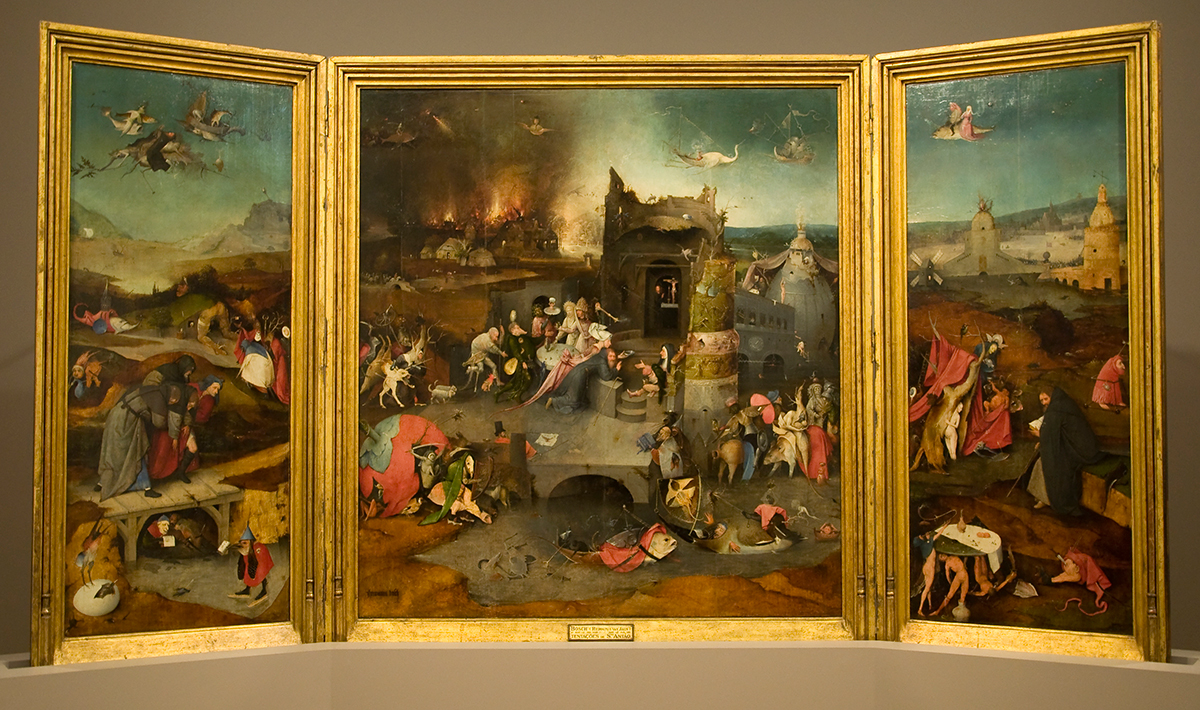
The Lisbon Temptation of Saint Anthony and related Boschian Saint Anthony images are often grouped with Bosch's Hell because they teem with demons. Yet they do something different. Saint Anthony is not damned. He is tested. The demons, false rituals, hybrid creatures and impossible structures surrounding him represent spiritual assault, deception and endurance. The subject is temptation resisted, not punishment after judgement. [6] [7]
That distinction is important for reading Bosch responsibly. Not every demon in Bosch belongs to Hell as final destination. Some demons tempt, distract, mock or fabricate false worlds. In the Saint Anthony tradition, the holy figure's endurance changes the meaning of the surrounding horror. The image is frightening, but the saint's presence turns the scene into a drama of resistance.
This also helps explain why Bosch's demons are so inventive. Evil in his art is not only punitive. It can be theatrical, persuasive and deceptive. It appears as spectacle, false ceremony, appetite, noise and visual confusion. Hell is the final consequence of sin, but temptation is the ongoing condition in which choices are made.
The relation between Saint Anthony and Bosch's Last Judgement imagery is therefore complementary. The saint shows the possibility of resistance within a world under attack. The damned in the Hell scenes show what happens when disorder has hardened into fate. Bosch's moral universe includes both warning and endurance.
Fire, Architecture And The Built World Of Hell
Fire is one of the most familiar signs of Hell, and Bosch uses it powerfully. Burning cities appear in the distance. Flames break the darkness of infernal landscapes. Fire marks destruction, exposure and final danger. Yet Bosch's Hell is not defined by fire alone. It is also built.
The built character of Hell is clearest in The Haywain, where demons literally construct an infernal tower. But architecture also matters in the Garden and the Last Judgement. Buildings burn, collapse, trap or merge with bodies. The tree-man in the Garden turns a body into a strange tavern-structure. Towers, platforms, ladders and dark interiors give punishment places to happen.
This architectural imagination makes Bosch's Hell feel organised. It is not only a natural disaster or a supernatural blaze. It has rooms, devices, thresholds, roads, waters and work crews. It can receive, sort, enclose, expose and display. The order is grotesque, but it is still order.
The inversion of ordinary construction is part of the horror. Human beings build houses, churches, bridges, cities, tools and instruments to support life. In Bosch's Hell, the built world turns against life. Ladders no longer lead upward in hope. Instruments no longer make music. Buildings no longer protect. Tools no longer serve craft. Culture itself becomes punishment.
This is one reason Bosch's infernal scenes connect so strongly with his style and technique. His Hell imagery depends on precise invention at small scale: tools, hinges, bodies, mouths, instruments, blades, ladders and buildings all have to be legible enough to function. Technical study through Prado, the Academy and BRCP-related research helps modern viewers see that Bosch's fantasy is built on disciplined looking and working methods. [1] [4] [7]
Reading Bosch's Hell Responsibly
Bosch's Hell rewards close looking, but it punishes overconfidence. Many details invite interpretation: owls, ears, knives, fish, musical instruments, shells, ladders, taverns, hybrid animals and bodily openings. Some details can be connected with late medieval moral culture, proverbs, biblical traditions, sin, folly or devotional literature. Others remain uncertain. A responsible reading distinguishes between secure observation, plausible interpretation and speculation.
The secure anchors are strong. Bosch repeatedly links Paradise, human conduct, sin, judgement and Hell. The Prado's records for the Garden and Haywain, the Academy's material on the Last Judgement, the Venetian material on Visions of the Hereafter, BoschDoc's documentary context and BRCP/Closer's corpus and technical research all support an object-based approach. [1] [2] [4] [5] [9] [7]
The risk is making Bosch either too simple or too modern. He is too simple when every image becomes a one-word symbol: fruit equals lust, instrument equals sensuality, owl equals evil, monster equals sin. He is too modern when Hell becomes a private nightmare detached from theology, devotion, judgement and satire. Bosch is stranger and more disciplined than either approach allows.
Attribution is another reason for caution. Bosch's name became powerful after his death, and many workshop, follower and copy works circulated in Boschian modes. The Bosch workshop and attribution question matters whenever an image is uncertain, disputed or known through later copies. Infernal monsters alone do not prove Bosch's hand. The Bosch Research and Conservation Project has made that point central to modern study by distinguishing accepted works, workshop material, followers and later Boschian inventions. [7] [8]
The most generous way to read Bosch's Hell is to hold its contradictions together. It is terrifying and funny. It is religious and satirical. It is fantastically inventive and carefully structured. It gives sin grotesque bodies but also shows how ordinary behaviour leads toward disaster. It turns music, fire, architecture and tools into punishment, yet it remains part of a wider Christian world in which salvation, temptation, judgement and moral choice still matter.
That is why Bosch's Hell continues to hold attention. It is not merely a gallery of demons. It is a visual argument about what happens when created things are loved wrongly, used wrongly and seen wrongly. Bosch makes that argument with such imaginative force that the viewer can hardly look away. The challenge is to keep looking without turning the image into either entertainment or a solved puzzle.
Artworks and related attributions
Browse paintings, drawings and related attributions. Records group triptychs, fragments and two-sided sheets where appropriate. Dates follow the cited museum records or catalogue headings and are generally estimates. Rows marked “2016 catalogue” report that publication’s attribution and collection information; these are dated opinions, rather than a claim that every work is an accepted autograph Bosch.
| Name | Date | Medium, attribution and collection |
|---|---|---|
| A Crossbowman | Second half of the sixteenth century | Oil on oak panel · Copy after Hieronymus Bosch · Museo Nacional del Prado, Madrid · P002695 Source 1. Source 2. |
| A Woman Spinning and an Old Woman | Museum estimates: about 1480–1490 for the women and 1500–1505 for the reverse; the precise chronology is disputed | Pen and brown and grey ink on the front; pen and brown ink on the reverse · Hieronymus Bosch · Museum Boijmans Van Beuningen, Rotterdam · N 190 recto and verso (PK) Source 1. Source 2. |
| Adoration of the Child in Cologne | Second half of the sixteenth century | Oil on oak panel · Imitator of Hieronymus Bosch, in the city collection record · Wallraf-Richartz-Museum & Fondation Corboud, Cologne · WRM 0474 Source 1. Source 2. |
| Adoration of the Magi in Philadelphia | Early sixteenth century in the museum record; around 1495–1520 in the BRCP catalogue | Oil on oak panel · Hieronymus Bosch in the museum record; workshop of Bosch in the 2016 BRCP catalogue · Philadelphia Museum of Art, John G. Johnson Collection, 1917 · 1321; museum object 103592 Source 1. Source 2. |
| Adoration of the Magi — New York | c.1470–1480 | 2016 catalogue: Bosch; oil on oak · Metropolitan Museum 13.26 2016 catalogue. |
| Adoration of the Magi — Prado triptych | c.1494 | Oil on oak; grisaille exterior · Bosch · Prado P002048 Object source. |
| Adoration of the Magi — three associated fragments | c.1515–1535 | 2016 catalogue: Follower of Bosch · Two Shepherds / Retinue in Philadelphia; associated Adoration in private collection in 2016 2016 catalogue. |
| Ascent of the Blessed — Venice | c.1505–1515 | Oil on panel · Bosch · Gallerie dell’Accademia; Visions of the Hereafter Object source. |
| Battle of the Birds and Mammals | Not specified in catalogue heading | 2016 catalogue: Bosch; pen and brown ink · Berlin KdZ 14715 2016 catalogue. |
| Beggars and Musicians | Around 1530–1540 | Ink and wash on paper · Unknown follower of Hieronymus Bosch · Albertina, Vienna · 7798 Source 1. Source 2. |
| Christ Carrying the Cross Drawing | Around 1470 in the museum catalogue | Black chalk or charcoal, pen and brush in brown ink, white corrections · Anonymous, workshop of Rogier van der Weyden · Museum Boijmans Van Beuningen, Rotterdam · N 81 recto and verso (PK) Source 1. Source 2. |
| Christ Carrying the Cross in Vienna | Around 1490–1510 in the current KHM record and BRCP catalogue | Oil on oak, painted on both sides · Hieronymus Bosch; possible workshop involvement in the Passion side discussed by the BRCP · Kunsthistorisches Museum, Vienna · Gemäldegalerie, GG 6429 Source 1. Source 2. |
| Christ Carrying the Cross — El Escorial | c.1495–1505 | 2016 catalogue: Bosch; oil on oak · Patrimonio Nacional 10014739 2016 catalogue. |
| Christ Carrying the Cross — Ghent | c.1510–1516 (museum) | Oil on panel · Bosch in museum listing; authorship disputed · MSK Ghent 1902-H Object source. |
| Christ Mocked — London | c.1510 | Oil on wood · Bosch · National Gallery NG4744 Object source. |
| Concert in the Egg, After Hieronymus Bosch | Around 1561; third quarter of the sixteenth century | Oil on canvas · Anonymous, after Hieronymus Bosch · Palais des Beaux-Arts, Lille · P 816 Source 1. Source 2. |
| Conjurer / Comical Concert — Louvre drawing | Not specified in catalogue heading | 2016 catalogue: Bosch (recto), follower (concert verso) · Pen and brown ink · Louvre INV 19197 2016 catalogue. |
| Conjurer / Cross-bearing and beggars — Liège sheet | Not specified in catalogue heading | 2016 catalogue: Bosch (verso), follower (recto) · Pen and brown ink · Album d’Arenberg 534 2016 catalogue. |
| Crowning with Thorns — El Escorial | c.1530–1540 | 2016 catalogue: Follower of Bosch; oil on oak · Patrimonio Nacional 10014743 2016 catalogue. |
| Crucifixion with a Donor | Circa 1495–1505; Circa 1490–1500 | Oil on oak panel · Hieronymus Bosch · Royal Museums of Fine Arts of Belgium, Brussels · 6639 Source 1. Source 2. |
| Death and the Miser Drawing | Not securely established; probably made after the painting | Pen and brush, dark ink and white highlights on prepared paper · Workshop of Hieronymus Bosch in the BRCP catalogue; alternatives recorded by the Louvre · Musée du Louvre, Department of Prints and Drawings, Paris · RF 6947, Recto Source 1. Source 2. |
| Death and the Miser — Washington | c.1485/1490 (NGA) | Oil on panel · Bosch · National Gallery of Art 1952.5.33 Object source. |
| Ecce Homo Triptych — Boston | c.1495–1500; wings c.1500/1503 | 2016 catalogue: Workshop of Bosch; oil on oak · Museum of Fine Arts Boston; several production phases 2016 catalogue. |
| Ecce Homo — Frankfurt | c.1490 | Mixed technique on oak · Bosch · Städel 1577 Object source. |
| Fall of the Damned — Venice | c.1505–1515 | 2016 catalogue: Bosch; oil on panel · Visions of the Hereafter · Venice 2016 catalogue. |
| Garden of Earthly Delights | 1490–1500 (Prado) | Oil on oak; grisaille exterior · Bosch · Prado; triptych Object source. |
| Gluttony and Lust / Allegory of Intemperance — Yale fragment | c.1500–1510 (group dating) | 2016 catalogue: Bosch; oil on oak · Yale 1959.15.22; fragment associated with Ship of Fools 2016 catalogue. |
| Group of Ten Spectators, a Follower of Bosch | Around 1510–1540 in the current museum record | Pen and two brown inks on paper, with a brown framing line · Follower of Hieronymus Bosch in the Morgan record; Bosch in the BRCP catalogue · Morgan Library & Museum, New York · I, 112 Source 1. Source 2. |
| Head of an Old Woman | About 1500 | Oil on panel · Attributed to Jacob Cornelisz. van Oostsanen · Museum Boijmans Van Beuningen, Rotterdam · 2439 (OK) Source 1. Source 2. |
| Hell and the Flood — Rotterdam panels | Around 1515 in the museum records; around 1510–1520 in the BRCP catalogue | Oil on oak panels · Jheronimus Bosch in the museum records; workshop of Bosch in the BRCP catalogue · Museum Boijmans Van Beuningen, Rotterdam Source 1. Source 2. |
| Hermit Saints Triptych | Circa 1495–1505 | Oil on oak panels · Hieronymus Bosch · Gallerie dell’Accademia, Venice · 2044 Source 1. Source 2. |
| Infernal Landscape | Not specified in catalogue heading | 2016 catalogue: Bosch; pen and brown ink, red accent · Private collection in 2016 2016 catalogue. |
| Infernal Scene with Anvil / Monster Studies | Not specified in catalogue heading | 2016 catalogue: Bosch; attribution debated in entry · Pen and brown ink · Berlin KdZ 548 2016 catalogue. |
| Infernal Scene with Tree-Man / Standing Man | Not specified in catalogue heading | 2016 catalogue: Workshop of Bosch; pen and brown ink · Dresden C 1875; historical reverse title includes a proposed prophet 2016 catalogue. |
| Job Triptych — Bruges | c.1510–1520 | 2016 catalogue: Workshop of Bosch; oil on oak · Groeningemuseum / Hoeke loan in 2016 2016 catalogue. |
| Last Judgement — Bruges triptych | c.1495–1505 | 2016 catalogue: Bosch; oil on oak · Groeningemuseum 2016 catalogue. |
| Last Judgement — Munich fragment | c.1530–1540 | 2016 catalogue: Follower of Bosch; oil on oak · Alte Pinakothek 5752 2016 catalogue. |
| Last Judgement — Vienna triptych | c.1500–1505 (BRCP 2016) | Oil on oak · Bosch and workshop (BRCP 2016) · Academy of Fine Arts Vienna 2016 catalogue. |
| Man in a Basket and Comic Figures | Around 1500–1515 in the museum record | Pen and brown ink on paper; the reverse is catalogued as iron-gall ink · Hieronymus Bosch in the current Albertina record; attribution has been debated · Albertina, Vienna · 7797 recto and verso Source 1. Source 2. |
| Man Seen from Behind | About 1550–1569; About 1565–1570 | Traces of black chalk, pen and brush in light brown ink · Anonymous, circle of Pieter Bruegel the Elder · Museum Boijmans Van Beuningen, Rotterdam Source 1. Source 2. |
| Mary and John at the Foot of the Cross | About 1440 | Brush in grey and black · Unknown, possibly Netherlandish · Kupferstich-Kabinett, Staatliche Kunstsammlungen Dresden · C 815 Source 1. Source 2. |
| Model Sheet with ‘Witches’ | Disputed; proposals depend on the attribution | Pen and brown ink; the BRCP also records underlying black chalk · Hieronymus Bosch; follower attributions also recorded · Musée du Louvre, Département des Arts graphiques, Paris · INV 19721 recto Source 1. Source 2. |
| Peasant and Three Bust-Length Figures | 1401–1500 | Brown pen over a black preliminary drawing · Attributed to the Master of the Drapery Studies; Bosch circle also recorded · Kupferstichkabinett, Staatliche Museen zu Berlin · KdZ 777 Source 1. Source 2. |
| River to Hell — Venice | c.1505–1515 | 2016 catalogue: Bosch; oil on panel · Visions of the Hereafter · Venice 2016 catalogue. |
| Saint Anthony and a Concert in an Egg | Around 1510–1525 in the museum’s 2016–17 exhibition texts | Pen in light and dark brown inks · Workshop of Hieronymus Bosch; underlying monsters: Bosch (BRCP), possibly Bosch (exhibition text) · Kupferstichkabinett, Staatliche Museen zu Berlin · KdZ 711 recto and verso Source 1. Source 2. |
| Saint Christopher Carrying the Christ Child | c.1500; 1490–1505 in restoration material | Oil on panel · Bosch · Boijmans St 26 Object source. |
| Saint James and Hermogenes | About 1551–1575 in the KIK-IRPA catalogue | Oil on wood, painted on both sides · Anonymous follower of Hieronymus Bosch · Musée des Beaux-Arts, Valenciennes · P.46.1.44; older number 176 Source 1. Source 2. |
| Saint Jerome at Prayer | Circa 1485–1495 | Oil on oak panel · Hieronymus Bosch · Museum of Fine Arts, Ghent · 1908-H Source 1. Source 2. |
| Saint John on Patmos / Passion Scenes | c.1495–1505; estimates vary | Oil on oak · Bosch · Gemäldegalerie Berlin 1647A Object source. |
| Saint John the Baptist in Meditation | Late 15th century; c.1485–1510 (Prado exhibition) | Oil on panel · Bosch · Lázaro Galdiano 8155 Object source. |
| Saint Liberata Triptych | Circa 1495–1505 | Oil on oak panels · Hieronymus Bosch · Gallerie dell’Accademia, Venice · 2045 Source 1. Source 2. |
| Seven Deadly Sins and the Four Last Things | 1505–1510 (Prado) | Oil on poplar · Bosch (Prado); workshop/follower disputed · Prado Object source. |
| Ship of Fools — Louvre painting | 1475–1500 (record); c.1505–1515 (exhibition) | Oil on oak · Bosch · Louvre RF 2218; fragment Object source. |
| Ship of Fools — Louvre workshop drawing | Not specified in catalogue heading | 2016 catalogue: Workshop of Bosch · Pen, brush, grey-brown ink and white highlights on prepared paper · Louvre RF 3714 2016 catalogue. |
| Studies of Monsters | About 1530–1550, according to the current Ashmolean record | Pen and brown ink on laid paper, both faces · Anonymous follower of Hieronymus Bosch · Ashmolean Museum, University of Oxford · WA1863.155 Source 1. Source 2. |
| Studies of Saint Anthony and Monsters | No execution date specified in the current Louvre records | Pen and brown ink on paper · Bosch listed; reverse questioned by Louvre; BRCP accepts both faces · Musée du Louvre, Département des Arts graphiques, Paris · INV 20871 recto and verso Source 1. Source 2. |
| Temptation of Saint Anthony — Kansas City fragment | c.1500–1510 | 2016 catalogue: Bosch; oil on oak · Nelson-Atkins 35–22 2016 catalogue. |
| Temptation of Saint Anthony — Lisbon triptych | c.1500 | Oil on oak · Bosch · Museu Nacional de Arte Antiga 1498 Pint Museum. |
| Temptation of Saint Anthony — Prado panel | c.1530–1540 | 2016 catalogue: Follower of Bosch (2016 opinion); oil on oak · Prado P002049 2016 catalogue. |
| Terrestrial Paradise | Approximately 1505–1515 | Oil on oak panel · Hieronymus Bosch · Gallerie dell'Accademia, Venice Source 1. Source 2. |
| The Burning Ship Drawing | 1500–1520 | Pen and iron gall ink on paper · Attributed to Hieronymus Bosch · Academy of Fine Arts Vienna, Graphic Collection · HZ-2554; numbered 2554 in the BRCP catalogue Source 1. Source 2. |
| The Comical Barber Scene | About 1550–1580, according to the British Museum | Pen and brown ink, grey and brown wash, over black chalk · Anonymous follower, after Hieronymus Bosch · British Museum, Department of Prints and Drawings, London · 1854,0628.46 Source 1. Source 2. |
| The Conjuror, After Hieronymus Bosch | Probably after 1525; around 1530–1540 in the BRCP technical report | Oil on oak panel · Anonymous follower of Hieronymus Bosch · Musée Ducastel-Vera, Saint-Germain-en-Laye · 872.1.87 Source 1. Source 2. |
| The Cure of Folly / Extraction of the Stone of Madness | 1501–1505 (Prado) | Oil on oak · Bosch (Prado); workshop/follower disputed · Prado P002056 Object source. |
| The Entombment Drawing | About 1505–1515, current museum record | Brush and black and grey ink, with grey wash, over black chalk · Workshop of Hieronymus Bosch; drawn by the Master of the Prado Haywain Triptych; Hieronymus Bosch, argued by the BRCP in 2016 · British Museum, Department of Prints and Drawings, London · 1952,0405.9 Source 1. Source 2. |
| The Gathering of the Birds | Not specified in catalogue heading | 2016 catalogue: Bosch; pen and brown ink · Berlin KdZ 13136 2016 catalogue. |
| The Haywain — Prado triptych | 1510–1516 (BRCP 2016) | Oil on oak · Bosch (BRCP 2016) · Prado; separate Escorial version exists 2016 catalogue. |
| The Hearing Forest and the Seeing Field | Circa 1500–1505 | Pen and brown ink on paper · Hieronymus Bosch; reverse: Bosch and workshop · Kupferstichkabinett, Staatliche Museen zu Berlin · KdZ 549, front and reverse Source 1. Source 2. |
| The Owl’s Nest — Rotterdam | Not specified in catalogue heading | 2016 catalogue: Bosch; pen and brown ink · Boijmans N 175 2016 catalogue. |
| The Passion Triptych in Valencia | Workshop of Bosch, about 1510–1520; Follower of Bosch; centre about 1530–1540, wings about 1540–1550 | Oil and gold on oak panels · Workshop of Bosch, about 1510–1520; Follower of Bosch; centre about 1530–1540, wings about 1540–1550 · Museu de Belles Arts de València Source 1. Source 2. |
| The Pedlar / Wayfarer — Rotterdam | c.1500 (museum) | Oil on panel · Bosch · Boijmans 1079 (OK); rejoined exterior Object source. |
| The Tree-Man — Vienna drawing | c.1505 | Pen and brown ink · Bosch · Albertina, Vienna Object source. |
| The Wedding at Cana, After Hieronymus Bosch | Approximately 1560 in the current museum record | Oil on panel, 93 cm high × 72 cm wide · Anonymous, after Hieronymus Bosch · Museum Boijmans Van Beuningen, Rotterdam, St 25 Source 1. Source 2. |
| Two Fantastical Creatures — Berlin KdZ 550 | Around 1505–1515 in the museum’s 2016 exhibition text | Pen in brown ink on reddish prepared laid paper · Hieronymus Bosch · Kupferstichkabinett, Staatliche Museen zu Berlin · KdZ 550, recto and verso Source 1. Source 2. |
| Two Figures Wearing Mitres | About 1480 | Oil on panel · Anonymous (Boijmans); Bosch circle (RKD) · Museum Boijmans Van Beuningen, Rotterdam · 1177 (OK) Source 1. Source 2. |
| Two Men and the Temptation of Eve | About 1505–1515 in the Prado’s 2016 exhibition guide | Pen and grey-brown ink on paper · Hieronymus Bosch in the 2016 catalogues discussed here · Private collection, as recorded in 2016 Source 1. Source 2. |
| Two Men Fighting | Not specified in the current Louvre record | Pen and brown ink · In the manner of Hieronymus Bosch · Musée du Louvre, Département des Arts graphiques, Paris · INV 20660 recto; formerly NIII 8896 and MA 8400 Source 1. Source 2. |
| Two Men — Berlin KdZ 5210 | Not specified in catalogue heading | 2016 catalogue: Bosch questioned · Pen, brush, ink, chalk and white highlights · Berlin KdZ 5210; historical title Two Oriental Men 2016 catalogue. |
| Two Monsters — Berlin KdZ 547 | Approximately 1500–1510 in Berlin's 2016 exhibition catalogue; an estimated range | Pen and brown ink on paper · Hieronymus Bosch · Kupferstichkabinett, Staatliche Museen zu Berlin · KdZ 547, drawn on both sides Source 1. Source 2. |
Frequently Asked Questions
The most famous is the right wing of The Garden of Earthly Delights, now in the Museo Nacional del Prado. It includes the burning city, musical-instrument punishments, giant ears pierced by a knife and the so-called tree-man. [1]
No. Bosch painted saints, Passion subjects, moral satires, devotional triptychs and scenes of temptation as well as Hell. His infernal imagery is famous because it is so inventive, but it belongs to a broader body of paintings about sin, salvation, judgement and human conduct.
They are fantastical, but they are not merely decorative fantasy. Bosch's demons usually serve moral and devotional purposes. They tempt, punish, mock, invert earthly pleasures and make spiritual disorder visible.
In Bosch's infernal imagery, instruments often reverse the pleasures of music into pain. They can suggest corrupted harmony, sensual distraction or the punishment of misused delight, but their meaning depends on context rather than one fixed code. [1]
Hell is the destination of the damned after judgement, but Bosch often shows the route toward it through ordinary sin and folly. The Vienna Last Judgement Triptych places infernal punishment directly beneath Christ as Judge, while The Haywain shows the social pursuit of worldly goods ending in Hell. [4] [2]
Discussion
Look again at the images and ideas explored in Hieronymus Bosch's Hell. These editorial prompts invite your observations.
Reader Insights
Which detail or passage most changes how you understand this subject?
Which comparison with another work by Bosch helps you see it differently?
Which interpretation is best supported by the sources, and which remains uncertain?
Join the Conversation
Share a detail, comparison or question about Hieronymus Bosch's Hell below.
References
- Museo Nacional del Prado, The Garden of Earthly Delights Triptych, Hieronymus Bosch: View source
- Museo Nacional del Prado, The Haywain Triptych, Hieronymus Bosch: View source
- Museo Nacional del Prado, Table of the Seven Deadly Sins, Hieronymus Bosch: View source
- Paintings Gallery of the Academy of Fine Arts Vienna, The Last Judgement Triptych by Hieronymus Bosch: View source
- Gallerie dell'Accademia di Venezia, Visions of the Hereafter: View source
- Museu Nacional de Arte Antiga, Lisbon, Temptations of St Anthony: View source
- Bosch Research and Conservation Project and Closer to Bosch, high-resolution corpus and technical research presentation: View source
- Matthijs Ilsink, Jos Koldeweij, Ron Spronk, Luuk Hoogstede, Robert G. Erdmann, Rik Klein Gotink, Hanneke Nap and Daan Veldhuizen, Hieronymus Bosch, Painter and Draughtsman: Catalogue Raisonne, Yale University Press, 2016: View source
- BoschDoc / Huygens ING / KNAW, documentary material on Hieronymus Bosch, his family, surroundings, patrons and works: View source