



 by Tom Gurney
Tom Gurney BSc (Hons) is an art history expert with over 20 years experience
Published on June 19, 2020 / Updated on November 13, 2026
Email: tomgurney1@gmail.com / Phone: +44 7429 011000
Creugas: Introduction
Creugas raises his left arm until the forearm lies across the top of his head. His other fist hangs beside his thigh. Antonio Canova gives the boxer a broad stance and turns his face towards the opponent he knows is there. The lifted elbow opens up one side of his torso. The figure is still standing, and the outcome of the contest is contained in a gesture that takes a moment to recognise. [1] [2] [3]
The Vatican marble stands 225 centimetres high. In the Cabinet of the Perseus in the Octagonal Court, it faces Canova’s Damoxenos. Each figure has a separate base, and the encounter takes place across the space between them. An ancient account explains why the two boxers stand apart and why one of them has raised his arm. [1] [2] [4]
Creugas Antonio Canova
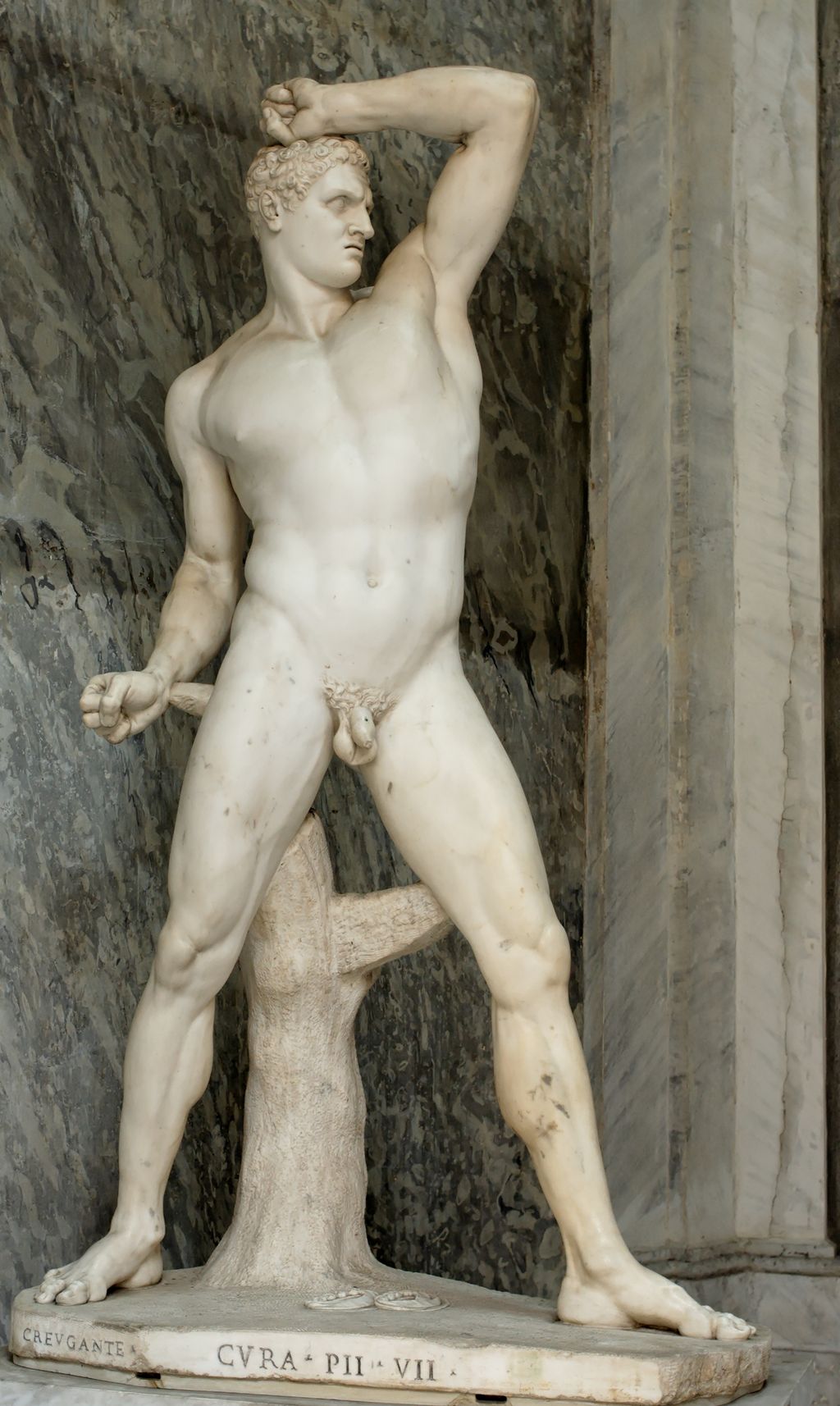
The Vatican marble, with Creugas’s name and Pius VII’s inscription along the base. Jastrow. Image source. Public domain. Resized for display.
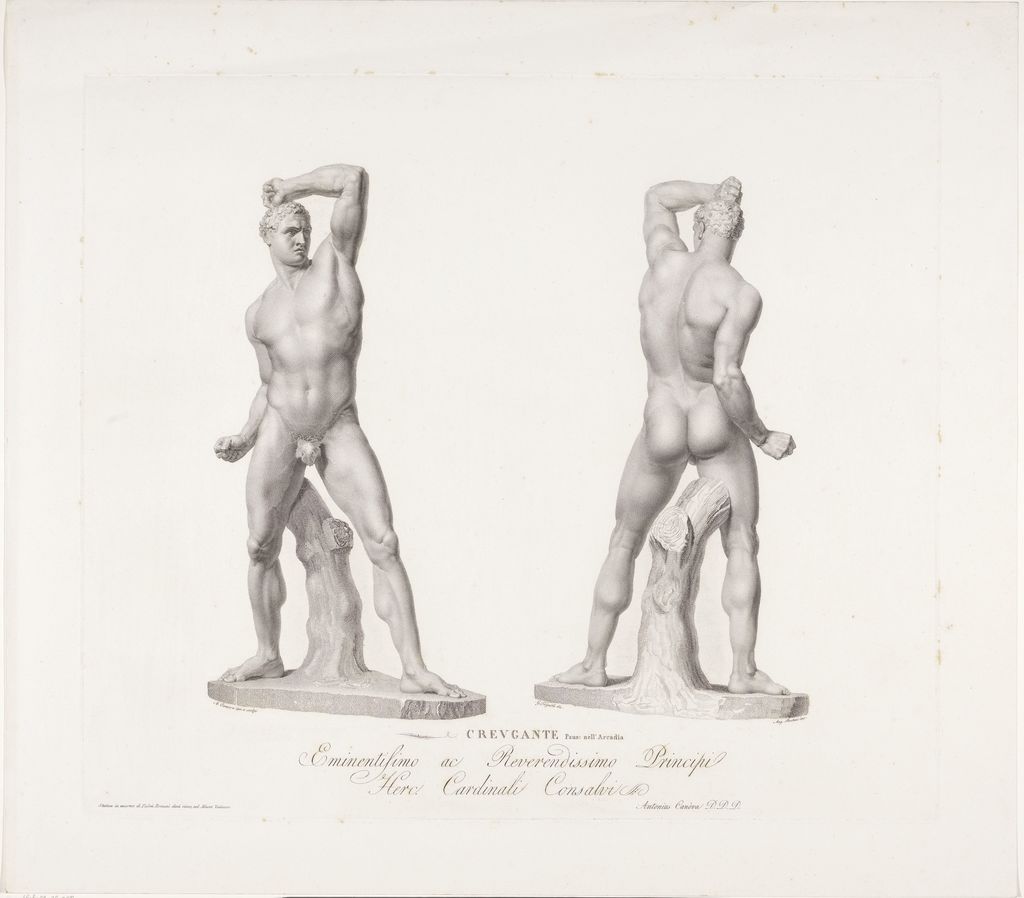
Bertini’s engraving gives front and back views of the figure and its support. Rijksmuseum. Image source. Public domain. Resized for display.
At a Glance
- SculptorAntonio Canova. [2]
- Vatican marbleCompleted in 1801, 225 × 120 × 62 cm, Pio Clementino Museum, Vatican Museums. [2] [5]
- Possagno plasterDated 1796, inventory 52, Museo Gypsotheca Antonio Canova. [6]
Contents
- The lifted arm
- The agreement at the games
- From plaster to the Octagonal Court
- Creugas in plaster and on paper
The lifted arm
The left shoulder rises with the arm. Under it, a long stretch of marble leads down from the armpit to the hip, interrupted only by shallow changes in the surface. The right shoulder sits much lower, and on that side the arm separates from the torso near the waist. The low fist projects far enough to leave a small opening between the forearm and the body. The two arms give the figure a broad outline near the head and a different, lower projection near the hip. [1] [7]
The left hand closes close to the crown of the head. Canova puts the knuckles alongside a cluster of tight curls. The nearby forms are similar in scale, but the curves of the fingers run into one another while the curls end in short turns. Beneath them, a furrow above the nose and the compressed lips give the turned head its expression. The face is visible in three-quarter view even though the chest is close to frontal. The turn draws the eye away from the figure’s centre and gives the pose a direction across the court. [1] [4] [7]
Both feet meet the base. One stretches away under the raised arm, leaving a long diagonal from hip to ankle. The other sits beneath a visibly flexed knee. The trunk between them widens at the ground, where its rough surface catches the light in smaller patches than the smoother calves. It touches the figure in places and gives the marble a solid connection to the base behind the wide stance. Seen from the back in Bertini’s engraving, the cut branches become more prominent and the line from the raised shoulder to the opposite hip becomes easier to follow. [1] [7]
The agreement at the games
Pausanias tells the story in his Description of Greece. Creugas came from Epidamnus and Damoxenos from Syracuse. As evening approached during their match at the Nemean Games, the two men agreed before witnesses to take turns accepting one blow from the other. Pausanias places the encounter in a period when boxers wrapped their hands with soft rawhide thongs that left their fingers free. His account concerns a particular agreement made by the two contestants as daylight ran out. [3]
Creugas struck first. When his turn came to receive the other man’s blow, he raised his arm at Damoxenos’s request. The second blow killed him. In Pausanias’s telling, the Argives judged that Damoxenos had violated their agreement by dealing what they counted as several blows in one action. They expelled him and awarded the crown to Creugas after his death. Pausanias says that the statue the Argives erected in his honour still stood in the sanctuary of Apollo Lykeios at Argos in his own day. [3]
Canova makes Creugas stand at the point in the story where he keeps his part of the bargain. His face is alert, his feet remain planted and the arm rises above the place the viewer now knows is vulnerable. The fists and the spread of the legs convey the strength he has already used in the contest. The body shows no visible injury. The later verdict matters to the way the pose reads, because the person left standing in marble is also the one who will receive the crown. [1] [3] [4]
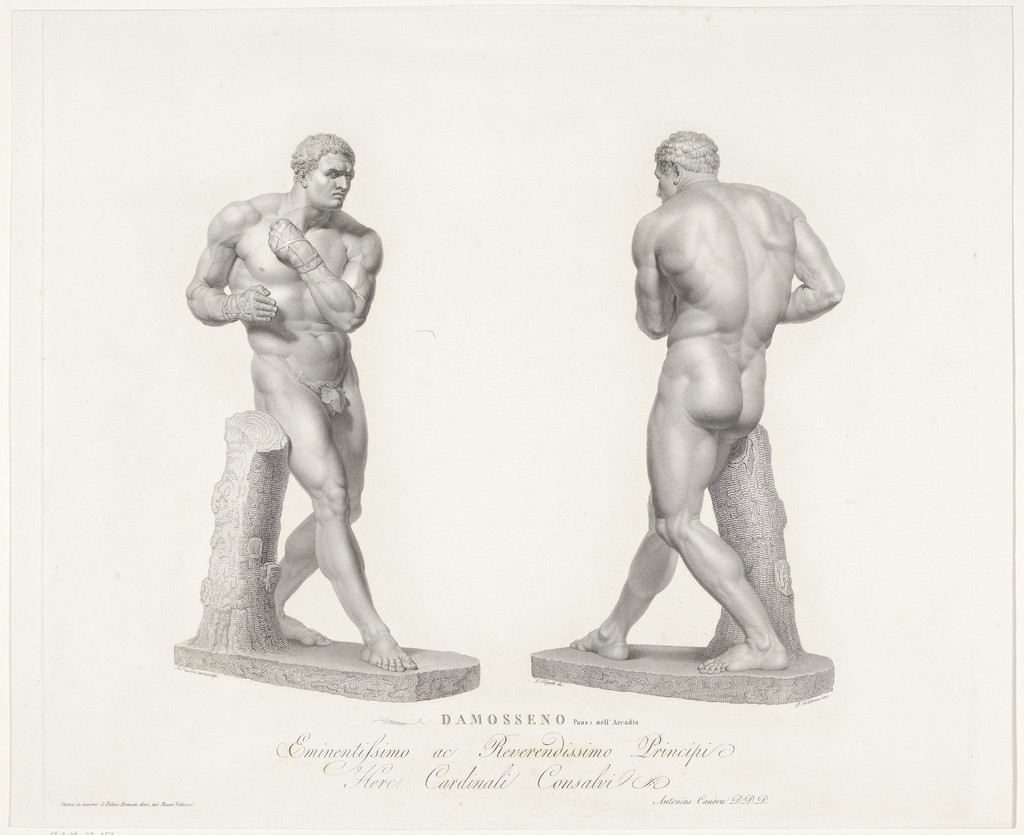
Fontana’s two views of Damoxenos show the opponent in the same boxing story. Rijksmuseum. Image source. Public domain. Resized from source.
Videos on Canova
Explore Canova’s workshop methods and the settings for his sculpture.
From Sketch to Stone | Canova: Sketching in Clay
Watch sculptor Fred X. Brownstein recreate a Canova Venus, using clay, plaster and marble.
Watch on YouTubeFrom plaster to the Octagonal Court
Canova began the project on his own initiative. The Vatican Museums’ conservation account places the preparatory drawings in 1795 and the models in 1796, with work on the Creugas marble beginning the following year. The full-size plaster at Possagno is 223 centimetres high and preserves the same spread of the feet and lifted forearm. Dark marks visible in the plaster photographs give the surface a different appearance from the finished marble, especially across the torso. Their small scale makes the underlying changes in the large forms easier to trace. [2] [6]
Pope Pius VII acquired the marble for the Vatican Museums. Possagno gives the acquisition as 1801, the year in which the Vatican conservation account dates the marble’s completion. The conservation account gives 1802 for the papal purchase of the works. The front edge of the base keeps the patron’s name in view, with CVRA PII VII carved alongside the name CREVGANTE. The raised arm and wide stance carry across the court, while the small lettering asks a viewer to come closer and look down. [1] [2] [6]
The purchases came after French forces removed major antiquities from the papal collection. The Vatican Museums identifies the Treaty of Tolentino of 1797 as part of the history of those requisitions. The three modern marbles entered the setting where the papacy had long displayed ancient sculpture. The Vatican’s account of its Canova exhibition describes the boxers as facing one another beside Perseus Triumphant, as Canova envisaged them. The two contestants answer each other through the gap, while Perseus raises a trophy already won. [2] [4] [8]
Creugas in plaster and on paper
A separate plaster cast reached the Venetian Academy in 1802. Chiara Piva’s study identifies an unpublished response to the cast by Pietro Edwards, addressed to Canova. It documents a viewer examining the figure away from the Vatican setting while the work was still new. The Gallerie dell’Accademia presents its Creugante cast with Canova’s plaster Paris. In that company the boxer’s long diagonals and high elbow sit beside a figure who leans on his support and keeps the apple close to his back. Putting a cast into an academy collection made those differences available for sustained comparison. [9] [10]
Canova also sent a plaster of the boxer to the Academy of Fine Arts in Florence. Sandro Bellesi records the gift in his study of the academy’s cast collection. A letter connected the cast with the plaster of the ancient Barberini Faun, sent to Florence in 1803 as an example for students to draw. The ancient figure sits with its head tipped back and one arm above it. In Canova’s standing boxer a raised arm belongs to a body holding itself upright. An academy student could study how the line from elbow to shoulder serves two very different poses. [7] [11] [12]
Angelo Bertini’s engraving after Giovanni Tognolli places two views of Creugas on the same sheet. The front view shows the turned face and the long line beneath the lifted arm. In the rear view the face disappears, and the high shoulder and muscles of the back register more clearly. The trunk, almost squeezed into the gap between the thighs from the front, spreads towards the viewer from behind. The Italian catalogue records that Bertini finished the plate in July 1816. In the Rijksmuseum impression the lettering below the figures dedicates the print to Cardinal Ercole Consalvi. It makes room for both views at once, giving the reader a comparison the marble demands that a visitor make in succession. [7] [13]
The surface of the marble has its own history. In the conservation proposal for the pair, the Vatican team recorded that the sculptures were generally in good condition and identified small fissures for examination. They called for checks of the bases, photographic documentation and surface cleaning that took account of the existing patina. Those tasks concern some of the same things that make the figure legible in the court. The base secures the wide stance, and the surface carries the gradations of shadow from the smooth shoulder to the grooves in the trunk. [1] [2]
Explore Canova’s works
Browse the sculptures and paintings covered in this guide. Several entries compare versions or examine details of a larger work.
Discussion
Look again at the images and ideas explored in Creugas. These editorial prompts invite your observations.
Reader Insights
What do the arms and stance tell you about the moment represented?
What changes when you see Creugas beside Damoxenos?
Join the Conversation
Share a detail, comparison or question about Creugas below.
References
- Jastrow, Creugas, Pio Clementino Museum, 2006 photograph of the Vatican marble and base inscription. View source.
- Patrons of the Arts in the Vatican Museums, Classical Pugilists Creugas and Damoxenos, Vatican Museums conservation project, with object data and proposed treatment. View source.
- Pausanias, Description of Greece, 8.40.3–5, translated by W. H. S. Jones. View source.
- Holy See Press Office, Antonio Canova nei Musei Vaticani, 20 October 2023, Cabinet of the Perseus and paired display. View source.
- Museo di Roma, Canova. Eterna bellezza, exhibition materials, Vatican Creugante entry. View source.
- Museo Gypsotheca Antonio Canova, Creugante, plaster, 1796, inventory 52. View source.
- Rijksmuseum, Bokser (Creugante), engraving by Angelo Bertini after Giovanni Tognolli and Antonio Canova, RP-P-OB-38.958. View source.
- Vatican Museums, Antonio Canova in the Vatican Museums, exhibition and historical context. View source.
- Chiara Piva, Pietro Edwards and the Creugante by Antonio Canova, Ricerche di storia dell’arte, 135 (2021), pp. 59–69. View source.
- Gallerie dell’Accademia di Venezia, Sala 13, gallery account of the Creugante and Paris casts. View source.
- Sandro Bellesi, I gessi ottocenteschi dell’Accademia di Belle Arti di Firenze, in L’Accademia di Belle Arti di Firenze negli anni di Firenze Capitale 1865–1870, pp. 20–21, account of Canova’s gift. View source.
- Staatliche Antikensammlungen und Glyptothek, Masterpieces of Ancient Sculpture, collection photograph of the Barberini Faun. View source.
- Catalogo generale dei Beni Culturali, Creugante, reproductive print, record 0500432648. View source.


 Antonio Canova.jpg)

