



 by Tom Gurney
Tom Gurney BSc (Hons) is an art history expert with over 20 years experience
Published on June 19, 2020 / Updated on November 13, 2026
Email: tomgurney1@gmail.com / Phone: +44 7429 011000
Naiad: Introduction
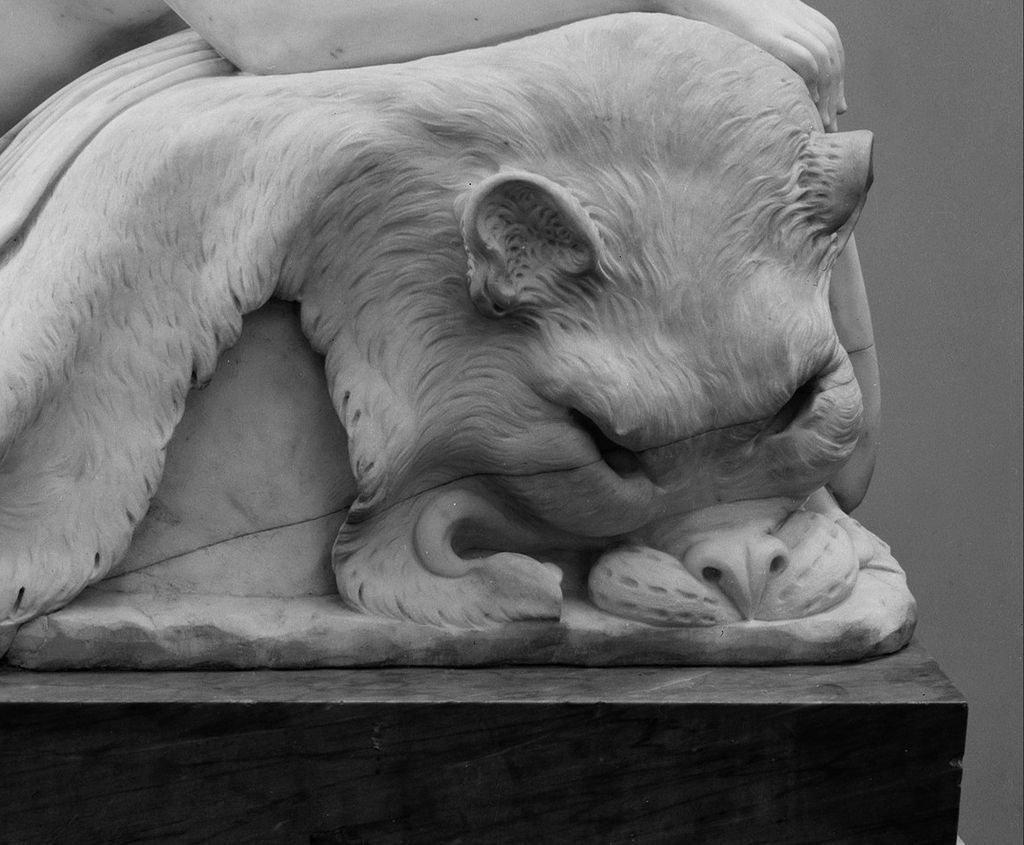
A woman lies on a panther skin with her upper body raised and her feet crossed. Her right forearm lies across the hide and her left hand comes up beside her ear. Her head turns back along the line of her body, towards the end of the sculpture where her feet rest. Below the elbow, the panther’s head hangs over the rock. The edges of the fur gather light in a different way from the broad surface of the shoulder. [1] [2]
Antonio Canova began this version of the reclining figure for John Bligh, the fourth Earl of Darnley. The marble was still in his Roman studio when he died in 1822. His assistants brought it to completion and it reached Cobham Hall in Kent in 1824. The Metropolitan Museum of Art, which now owns it, credits Canova and his studio. A related marble acquired by the Marquess of Londonderry belongs to the National Gallery of Art in Washington. [1] [2] [3] [4]
Naiad Antonio Canova
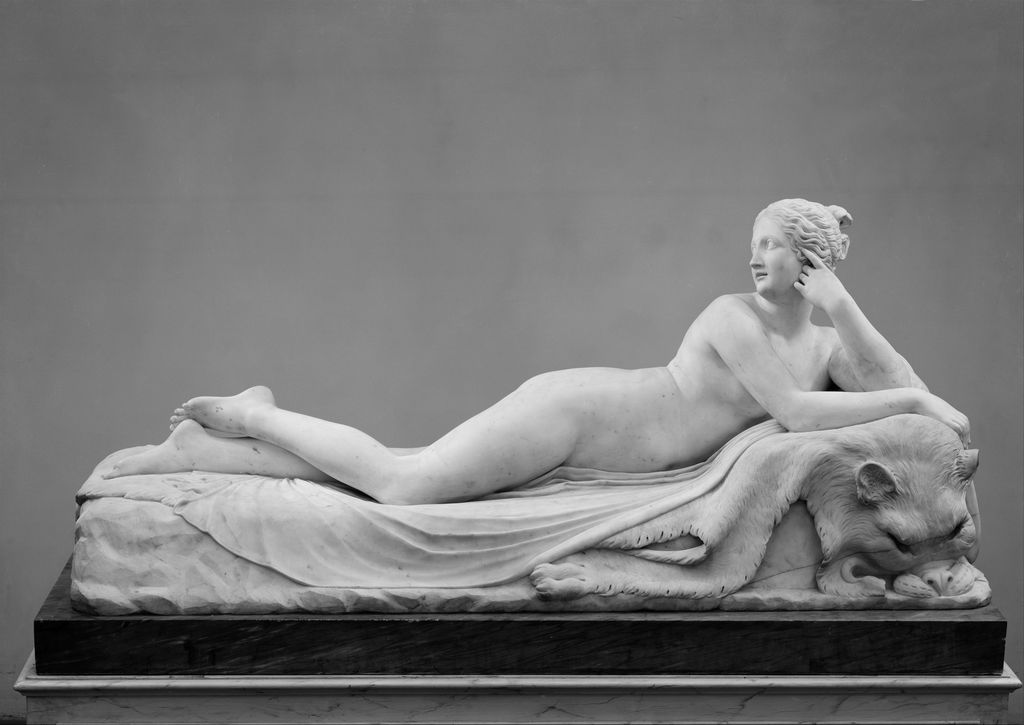
The Darnley marble from the front, with the lion skin draped over the rock. The Metropolitan Museum of Art. Image source. CC0 / Public domain. Resized for display.
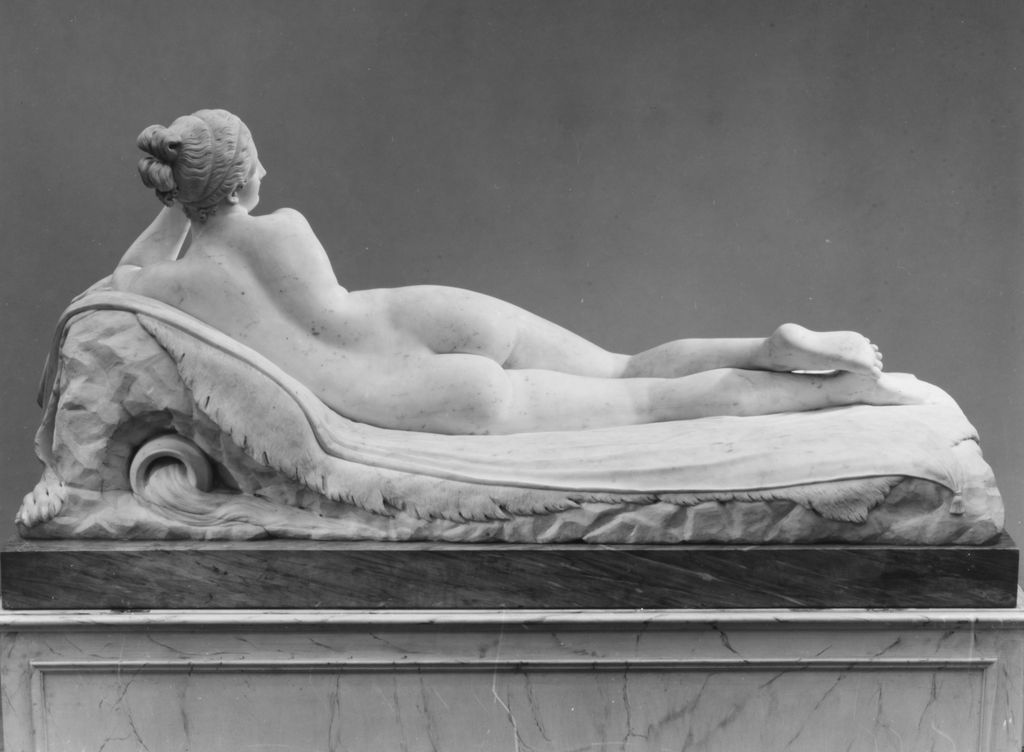
The back of the Darnley marble reveals the jar and its carved stream. The Metropolitan Museum of Art. Image source. CC0 / Public domain. Resized for display.
At a Glance
- Darnley marbleAntonio Canova and studio, 1819–24, Carrara marble, Metropolitan Museum of Art, 1970.1. [1]
- Londonderry marbleNational Gallery of Art, Washington, 2003.62.2. Acquired from the sculptor’s studio around 1823 according to the gallery’s provenance. [4]
- PlasterThe Museo Gypsotheca Antonio Canova at Possagno dates its Najade to 1817. [5]
Contents
- The water behind the figure
- A nymph with Cupid
- Darnley’s marble goes to Cobham
- The Londonderry Naiad
- Annotated details
The water behind the figure
From the front, the line of the body runs almost the entire length of the rocky base. The ankles overlap at one end. The near arm and the panther head occupy the other. Between them, the edge of the drapery rises towards the elbow, tracing a curve beneath the hips. A view from the head end brings the eyes of the panther and the folds of its skin into the foreground. Walk around to the back and the arm drops out of sight. There, a long stretch of shoulder, back and leg becomes the clearest line. The curve of the raised rock beneath the elbow keeps the head above that line. [1] [2]
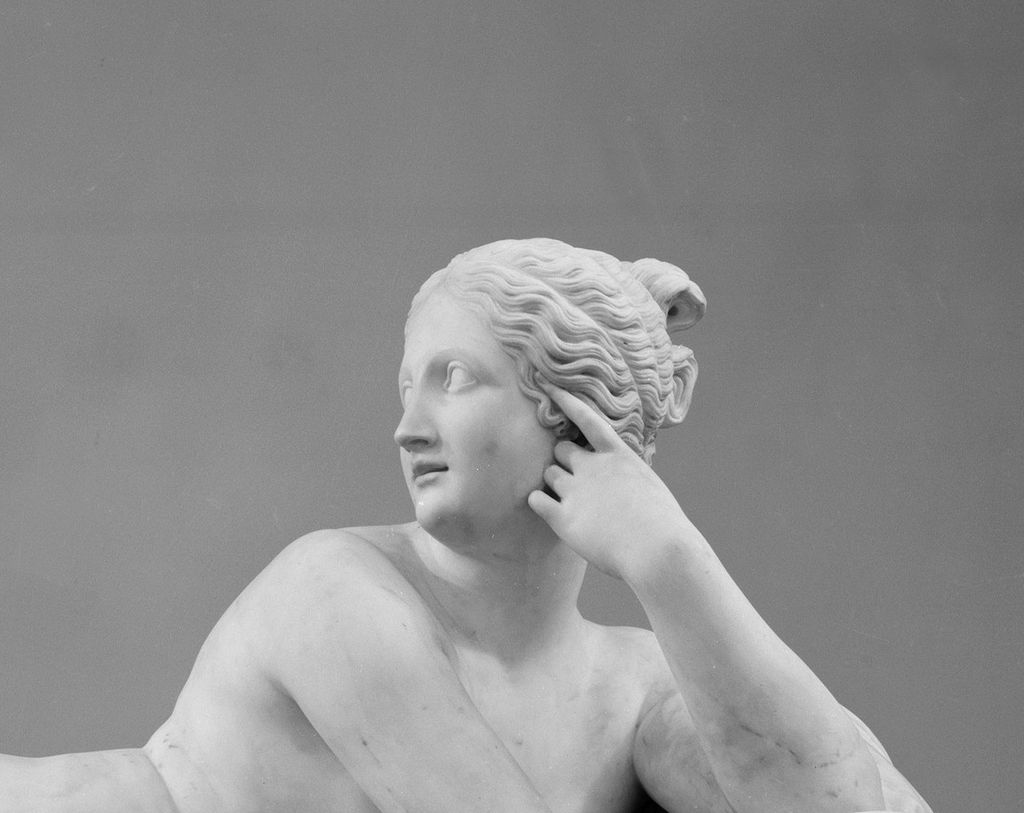
The head can be read against open space in the long view. From closer in, the fingers beside the ear follow the curve of the hair, which is drawn back from the face and gathered into a knot. The other hand hangs over the hide. Its fingers lie near the animal’s ear, so the two hands lead to quite different details at opposite edges of the same view. [1]
The back also reveals what the pelt conceals from the front. Water pours from a tipped vessel embedded in the rock below the raised part of the figure. The mouth of the vessel is rounded and recessed, and the flow spreads low over the rough surface underneath. The detail belongs to the figure’s setting. A naiad is a nymph associated with fresh water, such as a spring or river. The sculptor called the figure a nymph, and his friend and biographer Leopoldo Cicognara called her a naiad. The little stream supports Cicognara’s title without giving the figure an individual name from myth. [1] [2]
The back view interested the Met curator John Goldsmith Phillips because it brought out the resemblance to the Borghese Sleeping Hermaphrodite in the Louvre. The ancient figure turns into a low, extended silhouette, with the back running towards feet that lie close together. The Louvre dates the Roman statue to the first half of the second century AD and identifies its marble mattress and pillow as additions made by Gian Lorenzo Bernini in 1620. Canova used a rougher kind of bed for the Naiad. The rock and hide change how the figure’s weight reads, and her propped shoulders and turned head make her seem awake. In the V&A’s Sleeping Nymph, Canova used the ancient reclining pose again, with the head resting low and the body settled into the drapery. [1] [2] [6] [7]
Annotated Details from The Darnley Naiad
The Darnley marble from the front. Photograph from The Metropolitan Museum of Art. Public domain. Resized, annotated and cropped for the details.
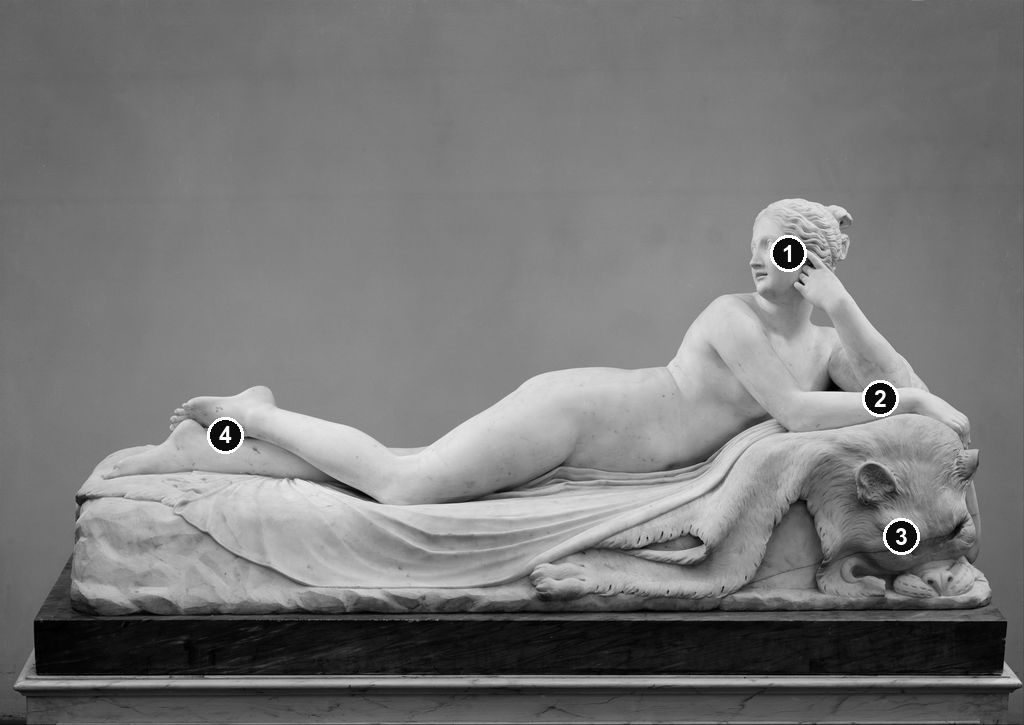
Details from THE DARNLEY NAIAD
Follow the turn of the head and the line of the figure down to the folded skin.
The turned head
The head turns back over the shoulder while the fingers rise to the hair.
The resting arm
The lower arm follows the top of the support. Its long line leads towards the hand at the edge.
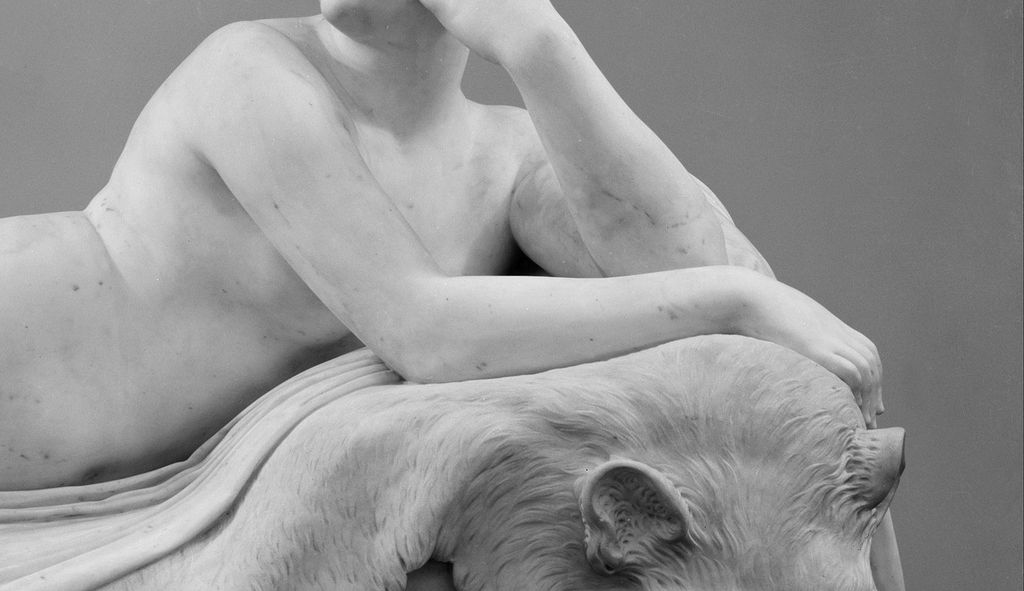
The lion skin
The lion’s head hangs over the edge of the rock. Its muzzle and paws identify the skin beneath the figure.
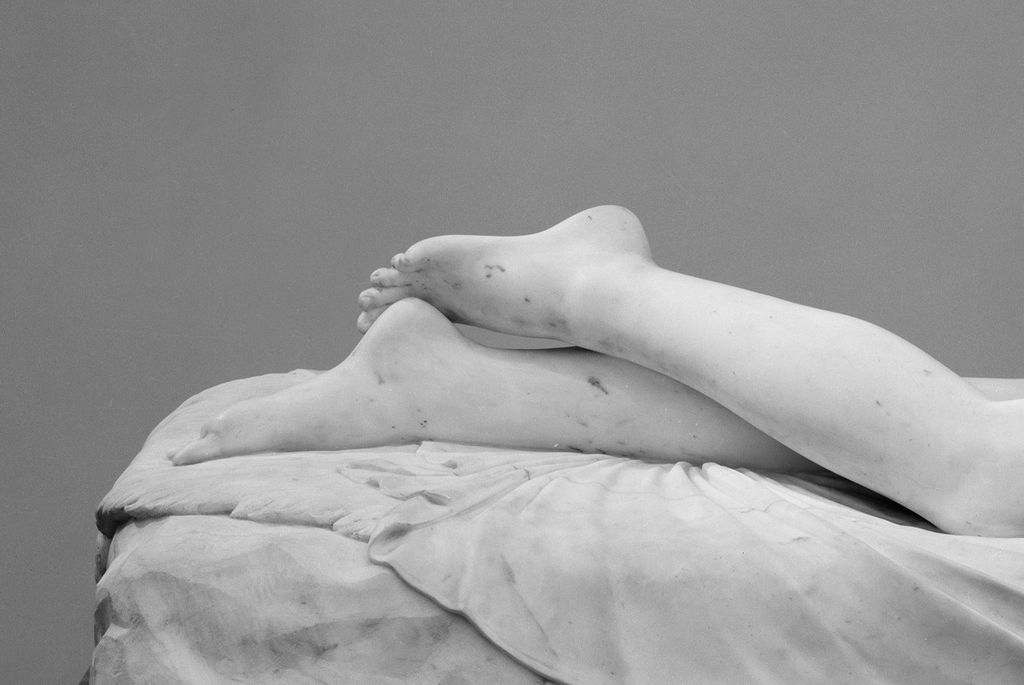
Crossed feet
The feet cross low at the other end of the rock, where the edge of the cloth drops below them.
Videos on Canova
Explore Canova’s workshop methods and the settings for his sculpture.
From Sketch to Stone | Canova: Sketching in Clay
Watch sculptor Fred X. Brownstein recreate a Canova Venus, using clay, plaster and marble.
Watch on YouTubeA nymph with Cupid
Canova began modelling the earlier Fountain Nymph for Lord Cawdor in 1815. The Royal Collection records that Cawdor agreed to let the Prince Regent take over the commission after Canova learned of the prince’s interest in such subjects. The completed marble reached Carlton House in 1819. The Royal Collection dates the work itself to 1815–17, distinguishing its making from its arrival in London. Its accession number is RCIN 2039. [2] [8]
The fountain nymph in the royal marble turns towards a small Cupid playing a lyre near her feet. Following her glance brings the viewer to a second figure within the group. The turn in the Darnley marble is still quite pronounced, but the eye meets crossed feet and open space beyond them. The missing musician changes the focus of the sculpture. The head seems to turn towards something that has caught the nymph’s attention outside the group. In his account of the commission, Alessio Costarelli cites correspondence showing that Darnley asked for a version without Cupid. [1] [2] [8] [9]
The full-size plaster survives at Possagno. Fondazione Zeri records it at about 80 by 190 centimetres, close to the length of the Met marble. Its surviving contours show the low line of the legs and the rise of the support beneath the upper body. The museum’s archival photograph also shows the damage to the figure during the First World War. In Canova’s studio a full-size model supplied a stable set of forms that could be measured when work moved to the marble. That made it possible to retain the pose and support while adjusting the parts of the design that differed from one commission to another. [2] [5] [10] [11]
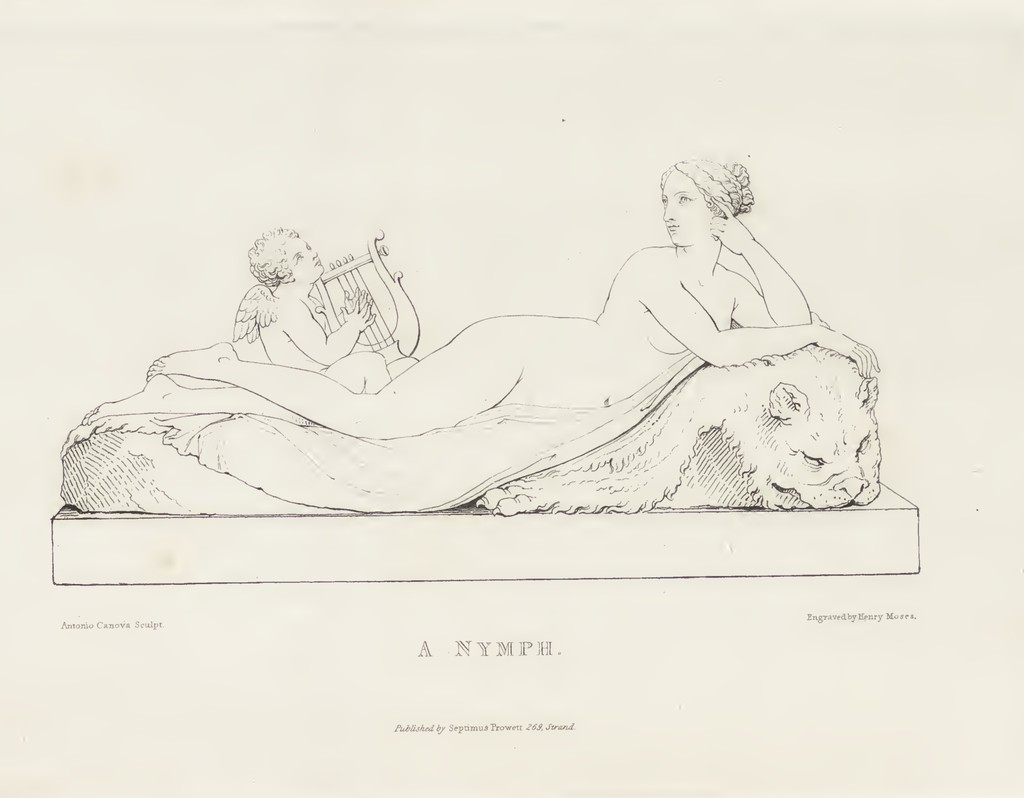
Moses’s engraving shows the reclining nymph with a lyre-playing Cupid near her feet. Henry Moses, after Antonio Canova, engraving published in London, 1824. Getty Research Institute. Image source. Public domain. Scan margins trimmed and image resized.
Darnley’s marble goes to Cobham
Costarelli traces Darnley’s interest to a visit to Canova’s Roman studio in 1818, when the earl saw the version destined for the Prince Regent. In 1819 Canova wrote to him about the new figure and the marks that had appeared in the marble. Darnley replied from Cobham that he would accept a work from Canova even with spots. Canova later offered a standing dancer as a substitute. In July 1821 the earl confirmed that he still wanted the reclining figure. His choice kept the commission alive through a change of stone and a proposed change of subject. [2] [9]
After Canova died, his half-brother and heir Giovanni Battista Sartori took over the correspondence. Sartori described the marble as far advanced. In September 1823 Darnley accepted the price and asked that no other hand work on the figure. The Met nevertheless records that studio assistants finished it. The surviving correspondence describes what the patron wanted, and the museum’s attribution accounts for the role of the workshop. Individual passages of the carving cannot be securely assigned on that evidence. In 1824 the marble arrived at Cobham Hall. It later entered the Met in 1970 through a purchase funded by Mrs Joseph A. Neff in memory of her husband. [1] [2] [3] [9]
The Londonderry Naiad
The Washington marble shows much the same turn of the head and the same crossing of the feet. In the National Gallery’s front view the right forearm lies against the animal head and the left index finger reaches the side of the face. The skin and cloth spread across a low base, with the plinth’s darker veins visible below. These features are so close to the New York work that the collection history is a better guide to the identity of either marble than its overall silhouette. The National Gallery explicitly notes that the two were treated as one object in some earlier catalogues. [1] [4]
The National Gallery places the Londonderry acquisition around 1823, when the sculpture was still in the artist’s studio. A letter places the marquess in Rome that February, and the gallery treats purchase during that visit as a possibility. The marble subsequently passed through the family at Londonderry House in London and was sold at Sotheby’s in 1962. Lillian Rojtman Berkman’s bequest brought it to Washington in 2003. The documented routes lead back to two different houses. The sculpture that went to Darnley at Cobham is the New York marble, with the small stream behind the figure that gives the reclining nymph her setting. [1] [2] [3] [4]
Explore Canova’s works
Browse the sculptures and paintings covered in this guide. Several entries compare versions or examine details of a larger work.
Discussion
Look again at the images and ideas explored in Naiad. These editorial prompts invite your observations.
Reader Insights
How does the turn of the head change the reclining pose?
What do you discover about the figure when you see the jar from behind?
Join the Conversation
Share a detail, comparison or question about Naiad below.
References
- The Metropolitan Museum of Art, Reclining Naiad, Antonio Canova and studio, 1819–24, 1970.1, with front, rear and detail photographs. View source.
- John Goldsmith Phillips, Canova’s Reclining Naiad, The Metropolitan Museum of Art Bulletin 29, no. 1, Summer 1970, pp. 1–10. View source.
- Peter Humfrey, The Collection Formed by the 4th Earl of Darnley and His Picture Gallery at Cobham Hall, Kent, 2021, discussion of the 1824 arrival at Cobham. View source.
- National Gallery of Art, Naiad, 2003.62.2, object photographs, provenance and bibliography. View source.
- Museo Gypsotheca Antonio Canova, Nineteenth-Century Wing, 1817 plaster and archival photograph of the damaged Najade. View source.
- Musée du Louvre, Hermaphrodite endormi, Ma 231 and Ma 231.1, ancient figure and Bernini’s mattress and pillow. View source.
- Victoria and Albert Museum, Antonio Canova: An Introduction, discussion and photographs of Sleeping Nymph, A.30-1930. View source.
- Royal Collection Trust, 10 Great Sculptures in the Royal Collection, account of Canova’s Fountain Nymph, RCIN 2039. View source.
- Alessio Costarelli, Canova e gli Inglesi, University of Bologna doctoral dissertation, p. 170 and correspondence nos. A-I 258, 322, 337, 412 and 424, and A-II 180 and 188. View source.
- Fondazione Federico Zeri, Canova Antonio, Naiade, record 83452, Possagno plaster. View source.
- National Gallery of Art, Canova: Sketching in Clay, exhibition wall texts on models and their transfer into marble. View source.


 Antonio Canova.jpg)

