



 by Tom Gurney
Tom Gurney BSc (Hons) is an art history expert with over 20 years experience
Published on June 19, 2020 / Updated on November 13, 2026
Email: tomgurney1@gmail.com / Phone: +44 7429 011000
Tomb of Pope Clement XIII: Introduction
At the foot of Antonio Canova’s monument in St Peter’s Basilica, one lion raises its head and the other rests. Between them is a doorway. Above it stands the sarcophagus, with a woman holding a cross on one side and a winged youth lowering a torch on the other. Pope Clement XIII kneels at the top. His hands are lifted in prayer and his tiara lies on a cushion. From the floor the figures appear to occupy separate levels. As you move past the monument, their different depths become clearer. The lions project towards the aisle, the doorway recedes into shadow, and the pope kneels against the dark interior of the arch. [1] [2] [3]
Clement XIII was the Venetian Carlo Rezzonico, pope from 1758 until his death in 1769. His nephews commissioned the memorial, with Abbondio Rezzonico taking a leading role. The dedication cut into the sarcophagus identifies the donors as the sons of the pope’s brother. The monument was unveiled in April 1792, while Pius VI was pope. The basilica setting, family inscription and kneeling figure give the work several functions at once. It commemorates a particular man, identifies the family who paid for his monument, and makes the pope’s prayer the focus of the entire arrangement. [1] [3] [4] [5]
Tomb of Pope Clement XIII Antonio Canova
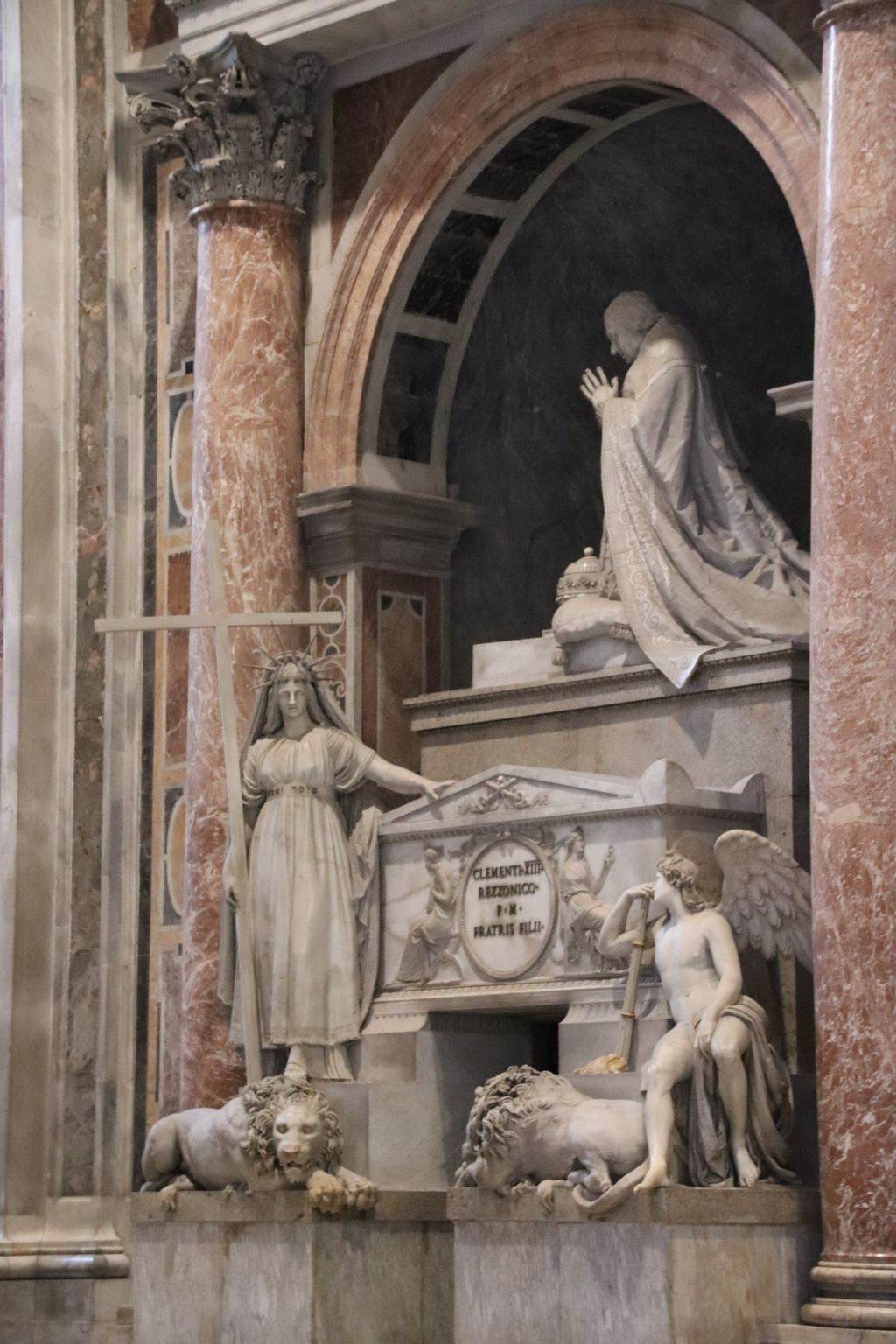
The installed monument to Clement XIII, with the pope, Religion, Genius of Death and two lions. Gary Todd. Image source. Public domain. Resized for display.
At a Glance
- ArtistAntonio Canova. [1]
- LocationSt Peter’s Basilica, Vatican City, opposite the Navicella altar. [1]
- CommissionThe Rezzonico family, with Abbondio Rezzonico leading the project. [3] [4]
- Unveiling6 April 1792, in the presence of Pius VI. [5]
Contents
- A monument built around a doorway
- The pope, his tiara and his family’s name
- Religion and the Genius of Death
- The lions and the floor of the basilica
- The commission, the blocks and the unveiling
- The monument in prints and photographs
- Annotated details
A monument built around a doorway
The architectural frame is visible before the individual sculptures. Tall columns rise on either side of the niche, and the arch bends around the figure of the pope. Within that larger frame Canova repeats a much smaller set of straight lines. The steps, the stonework around the doorway and the projecting ledges beneath the pope lie one above the next. Against these courses of stone, the folds of the cope seem to flow. The outer arch rounds off the group, while the sloping sides of the sarcophagus lid draw the eye towards its centre. [1] [2]
In a frontal view the low entrance gives the monument its central axis. The dark doorway sits underneath the light sarcophagus, and the oval of the dedication holds the middle of the sarcophagus front. A viewer approaching from an angle loses some of the doorway behind the base and the lions. The angled view reveals how far the figures stand forward of the dark wall. Religion extends her cross into the space on one side. The Genius leans towards the sarcophagus from the other. As a result, the same monument can look like a set of stacked architectural elements from one position and a gathering of figures on separate planes from another. [1] [2] [3]
The doorway gives a suggestion of a burial chamber without requiring Canova to illustrate a funeral. A print of a design for the monument makes clear that the opening was a condition of the project from early on. Its inscription describes an idea for a mausoleum to stand in a niche over a door in St Peter’s. Francesco Chiarottini’s etched view already brings a kneeling pope, a sarcophagus and two lions into this scheme. The finished monument makes the contrast between the low opening and the elevated pope especially easy to read. The opening is only one part of the composition, yet it determines where both lions can rest and how far apart the figures above them have to stand. [1] [2] [6]
Annotated Details from Tomb of Pope Clement XIII
The monument in St Peter’s Basilica. Photograph by Gary Todd. Public domain. Resized, annotated and cropped.
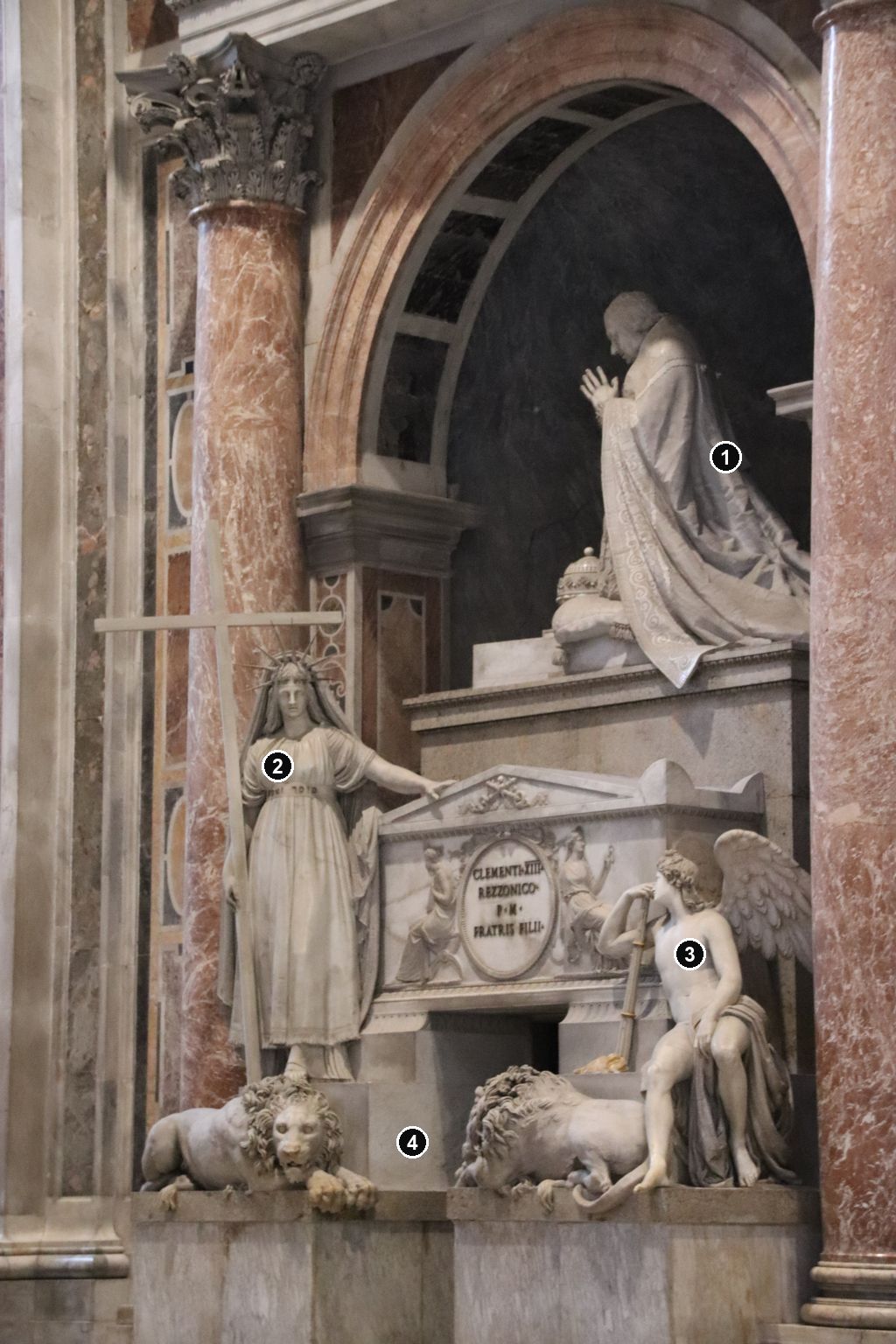
Details from TOMB OF POPE CLEMENT XIII
Compare the praying pope, the standing Religion and the figures below.
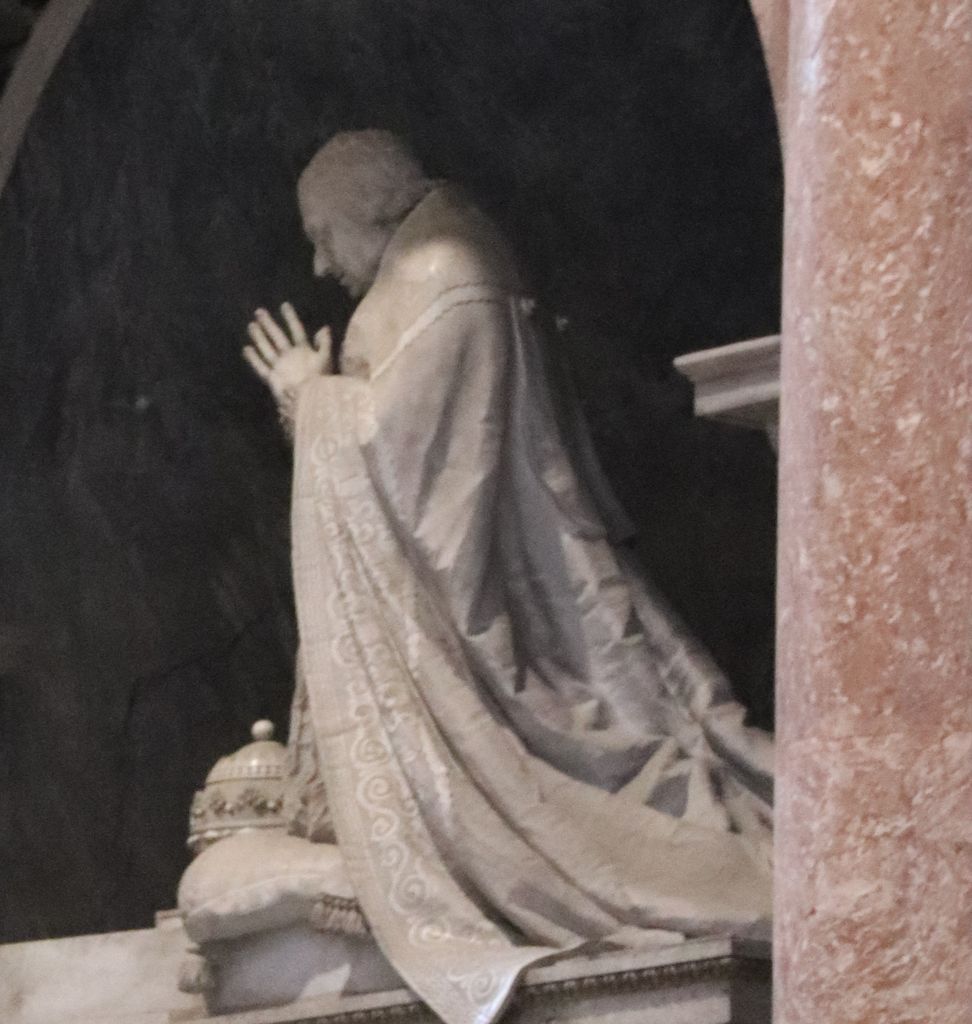
The praying pope
Clement kneels with his hands raised in prayer. Drapery falls over the ledge beneath him.
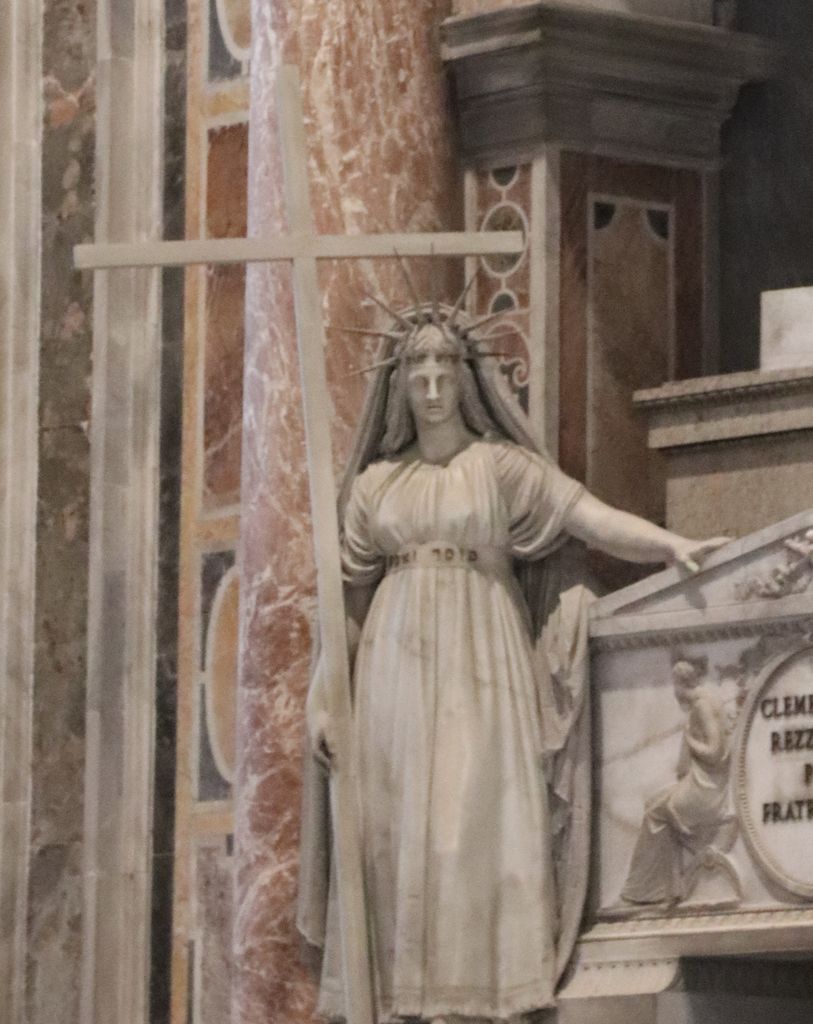
Religion
Religion stands beside the sarcophagus, where the long cross continues above her head.
The Genius of Death
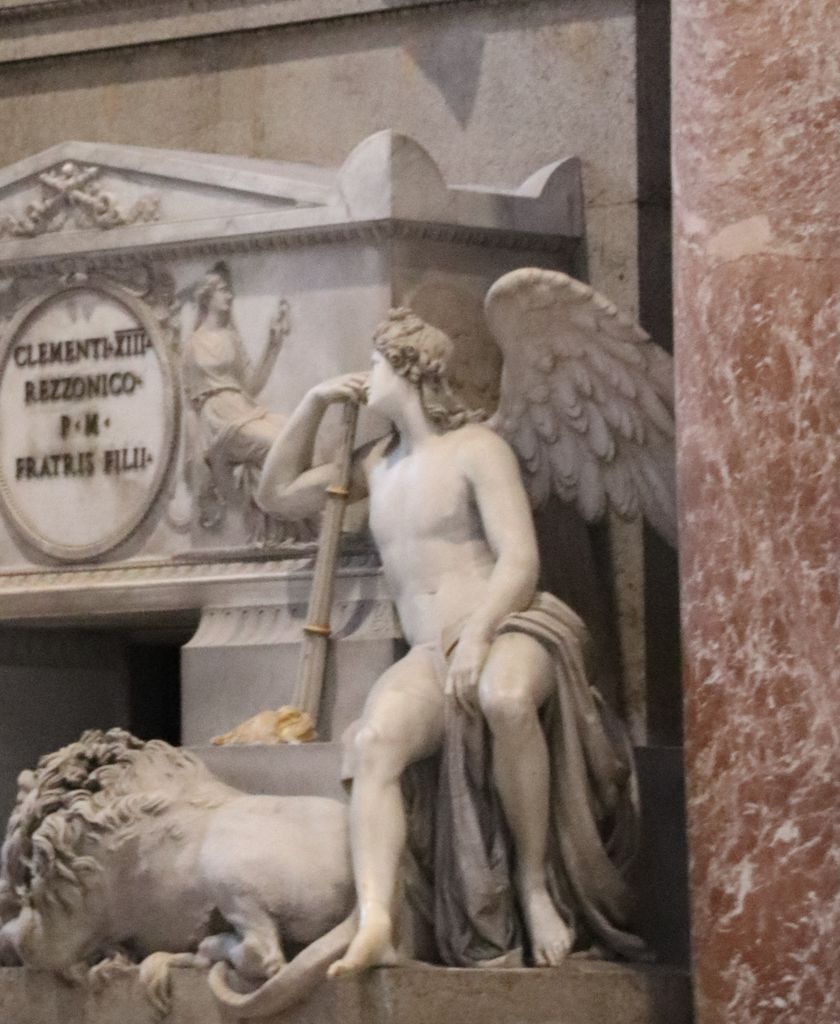
The winged figure sits near the lower opening and leans against an inverted torch.
The paired lions
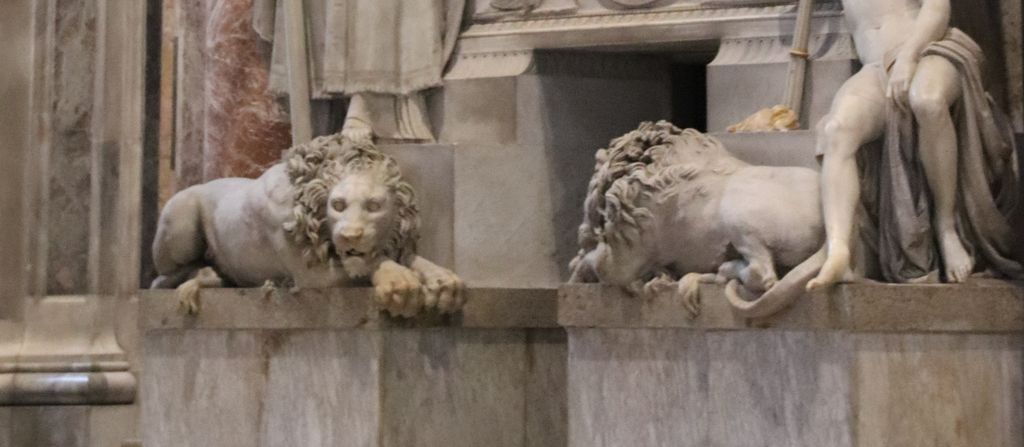
One lion faces outward. The other lowers its head onto its forepaws.
The pope, his tiara and his family’s name
The pope kneels on a cushion above the sarcophagus. His pose is easier to see from the side, where the bend of his head brings his chin close to his chest and the edges of his hands become distinct. The long cape falls back from his shoulders, spreads behind him and descends over the edge of the platform. From below, that drop helps define the height of the ledge. The separate tiara, set farther forward, provides a small, upright silhouette beside the curving folds. [1] [2] [3]
The tiara makes the pope’s office legible, but the face itself is given room to show age. The Accademia Nazionale di San Luca in Rome preserves a monumental plaster of the head. Its catalogue draws attention to the original waxed finish that survives on the face and contrasts it with the rougher treatment of the hair and cope. Seen close up in the plaster, the transition from smooth skin to coarse detail brings out features that are difficult to isolate in the basilica. Seen in place, the bowed profile and lifted hands carry the gesture at a distance. The two viewing conditions help explain the importance of both broad silhouette and close finish. [2] [7]
The dedication gives the composition another centre. Charity and Hope appear in low relief to either side of its oval, below the two free-standing allegories. The small figures occupy the surface of the sarcophagus, so their edges are defined by shallow shadows. Religion and the Genius, by comparison, stand out from the architecture almost in the round. A visitor reads the larger figures first and must look again for the smaller ones. In that closer view, the inscription makes the family relationship explicit. Its final words, fratris filii, mean the sons of the pope’s brother. [1] [2] [3] [7]
Religion and the Genius of Death
On the viewer’s left, Religion carries an upright cross. Its long shaft follows the direction of the column beside her and its horizontal arm extends across the field above her head. The veil and heavy garment give the figure a firm outline. Her free arm reaches towards the sarcophagus, tying the outer figure to the centre. In the installed work the weight of the figure appears to continue through the long folds to the platform. The shape of the cross can be made out before the face or the ornament on the costume. [1] [2] [3]
Canova studied the figure at several scales. The clay study preserved at the Accademia Tadini in Lovere includes wood and wax and is dated about 1786–87 by the National Gallery of Art. The back is incomplete. The exhibition catalogue explains that the marble figure was intended to be read within the monument, where a viewer could not walk around it. The clay allowed Canova to develop the mass and deep folds that would register at the intended distance. A separate full-size plaster head at Possagno, dated about 1787–88, shows the next problem at a different scale. The face and the edges of the head covering had to be worked out as forms that could hold their definition in the much larger ensemble. [8]
The youth on the viewer’s right is the funerary Genius, also called the Genius of Death. He rests his head against a bent hand while his other arm drops towards the knee. His wings rise behind him and the torch points down. The downturned torch is a sign of life extinguished. His weight falls unevenly across the seat and the cloth, so his pose has a diagonal movement that answers Religion’s upright cross without repeating it. The angle of the head also brings his attention inward, towards the sarcophagus and the inverted torch. [2] [7] [9]
The contrast carries through to the surfaces. Cloth surrounds Religion from head to foot. The youth’s bare shoulder and torso show much larger passages of smooth stone, broken by the feathers behind him and the folds beneath his knee. The cast of his head and shoulders at the Galleria d’Arte Moderna Achille Forti in Verona draws out the combination of a classical funerary figure and wings familiar from Christian imagery. The related Genius of Death bust in the Hermitage is a separate marble. Androsov’s catalogue discusses whether it might preserve work on a block Canova rejected. The figure at St Peter’s remains the evidence for the full gesture, with the torch, the wings and the bend of the body all contributing to its meaning. [2] [9] [10]
Videos on Canova
Explore Canova’s workshop methods and the settings for his sculpture.
Antonio Canova in the Vatican Museums
The Vatican Museums introduce Canova’s Roman studio and their collection of his work.
Watch on YouTubeThe lions and the floor of the basilica
The lions mark the nearest edge of the monument. On the left the awake animal brings its head and paws forward. The lips part beneath a mass of curls and the head faces out of the niche. The sleeping lion on the right keeps its body low, with the neck sinking towards the paws. A visitor’s glance can pass across the two backs and pause at the dark gap between them. Their horizontal bodies define the width of the base, while the different positions of the heads keep it from reading as a single continuous band of stone. [1] [2]
The difference is visible without assigning each animal a fixed moral quality. The alert head rises below Religion and her cross. The sleeping head lies close to the lowered torch. Each lion therefore brings the gesture above it closer to the floor of the church. The stone is described as travertine in the basilica guide, in contrast to the white Carrara marble used for the figures above. In the colour photograph the manes and paws have a warmer cast than the pope’s cope, although colour in a photograph also depends on the light. The separate Canova Lions article follows versions and later casts, which can present either animal without the architecture that sets up the contrast in St Peter’s. [1] [2]
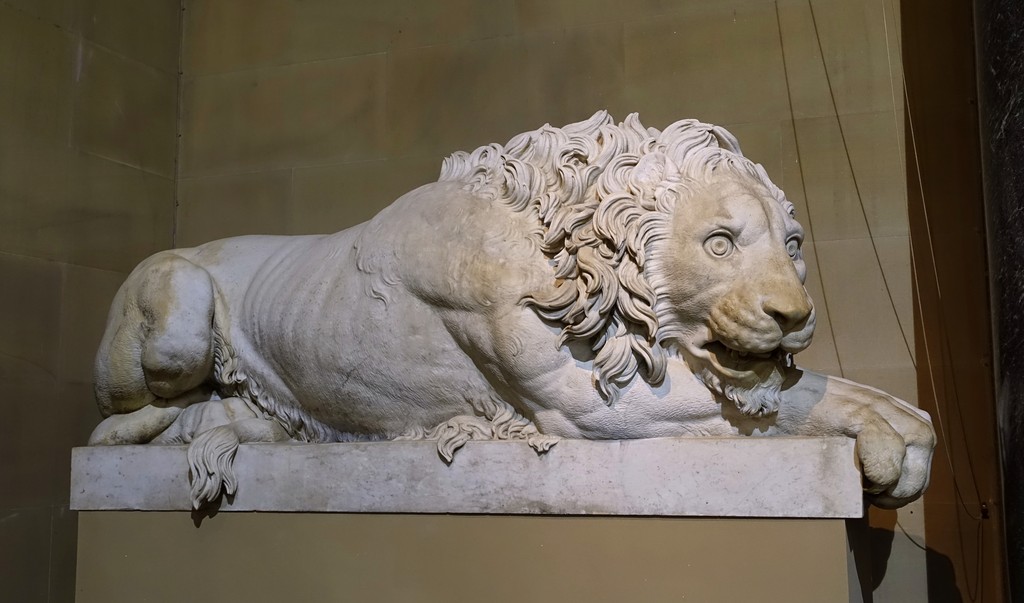
The awake Chatsworth lion is a later marble after Canova’s Vatican design. Daderot. Image source. CC0 / Public domain. Resized from source.
The commission, the blocks and the unveiling
The Italian national catalogue dates Canova’s work on the project from 1784, which it also gives as the probable year of Abbondio Rezzonico’s commission. The National Gallery of Art labels the full monument 1783–92. The distinction matters because an extended undertaking like this one included preliminary ideas, models at different scales, selection of stone, carving and fitting the work into the church. Chiarottini’s print records one stage in that sequence. Antonio D’Este’s recollection, cited in the National Edition of Canova’s writings, records another. Canova had a wooden representation of the architectural frame made, with the two side columns painted to resemble those in St Peter’s. Only after completing the mock-up did he begin the large clay models. The wood gave him a way to judge the relative heights and projections before committing to them in stone. [6] [8] [11]
Finding suitable stone also affected the schedule. In February 1787 Canova wrote to Carlo del Medico Staffetti about the quality of the Carrara blocks supplied for the two large figures. The marble for the pope gave him a point of comparison. In a letter of February 1790, he reported that stains in one of the large figures had led him to buy a fresh block at his own cost. He put the extra expense at five hundred scudi and expected a delay of months. The editors of the correspondence identify the figure as the Genius. Canova stressed that the stains would have been particularly conspicuous on a nude sculpture in a church visited by so many people. The correspondence gives a material reason why a design that was already circulating in images could still take years to complete. [4]
The monument was unveiled on 6 April 1792, during Holy Week, in the presence of Pius VI. The Venetian representative Antonio Cappello reported on it the following day. He described the praise the monument was receiving in Rome and presented Canova’s reputation there as a distinction for Venice. The report also shows how quickly the work was being assessed as part of St Peter’s, alongside the memorials already in the basilica. In Canova’s earlier Tomb of Clemens XIV at Santi Apostoli, the seated pope raises one arm above the doorway. In St Peter’s the pope’s body turns and his hands are occupied by prayer. Both designs use the entrance below to organise the figures above, but the different gestures change where the viewer’s attention settles. [4] [5] [8]
The monument in prints and photographs
In Antonio Banzo’s print at the Museo Nacional de Cerámica in Valencia, the monument is translated into etching and engraving. The museum credits Stefano Tofanelli for the drawing on which Banzo worked. The museum describes an entrance flanked by the two allegories, with the pope kneeling above. The engraving brings these parts together on one sheet. In the basilica the cross may be easier to see on approaching from one side, while the youth’s torch emerges on the other. The print allows a reader to compare them without changing position. The two lions sit at the feet of the larger figures, carrying the arrangement down to the entrance. [2] [12]
Raffaello Morghen made a separate engraving after Tofanelli. The Italian national catalogue notes that a proof had reached Giovanni Gherardo De Rossi by January 1792, before the unveiling. Gaetano Marini reported in April that Morghen was still touching up the copperplate. These records give the image a chronology alongside that of the marble. The drawing, proof and completed impression belong to different moments. Banzo’s impression is another object again. Its catalogue records his part in carrying the design onto copper without equating his plate with Morghen’s. [12] [13] [14]
Fratelli Alinari photographed the monument in place. The Museum für Kunst & Gewerbe Hamburg holds an albumen print made between 1860 and 1900, catalogued among its architectural photographs. Each medium directs the eye differently. The H. C. White Company issued a stereograph of the tomb in 1902. Its two slightly offset photographs were meant to be seen together through a viewer that makes the depth apparent. On the card the doorway is visible all the way down to the floor, while the lions stand well forward of it. This view gives the entrance a much larger presence than it has in a photograph taken from farther to the side. [2] [15] [16]
Canova’s later Funeral Monument to Maria Cristina of Austria gives the doorway an even more visible role, as mourners ascend towards it. At St Peter’s no figure walks into the opening. The doorway holds the centre while the sculpture leads the eye upwards to the praying pope. [2] [8]
Explore Canova’s works
Browse the sculptures and paintings covered in this guide. Several entries compare versions or examine details of a larger work.
Discussion
Look again at the images and ideas explored in Tomb of Pope Clement XIII. These editorial prompts invite your observations.
Reader Insights
How does the monument guide your eye from the lions to the pope?
What do the different poses of the figures contribute to the memorial?
Join the Conversation
Share a detail, comparison or question about Tomb of Pope Clement XIII below.
References
- St Peter’s Basilica Virtual Tour, Monument to Clement XIII, location, materials, inscription and component images. View source.
- Gary Todd, St. Peter’s Basilica, Monument to Pope Clement XIII, by Antonio Canova, 1792, photograph, 2019. View source.
- Fondazione Federico Zeri, Ritratto di papa Clemente XIII, Allegoria della Religione, Genio funebre, Allegorie della Carità e della Speranza, Leoni, Iscrizione, object and photograph catalogue. View source.
- Giuseppe Pavanello, ed., Antonio Canova, Epistolario (1779–1794), Edizione Nazionale, introduction, sections 16 and 23, with the letters of 10 February 1787 and 20 February 1790 and Antonio Cappello’s report of 7 April 1792. View source.
- Treccani, Dizionario Biografico degli Italiani, Canova, Antonio, on the Rezzonico circle and unveiling. View source.
- Catalogo generale dei Beni Culturali, Francesco Chiarottini after Canova, Monumento funerario di Clemente XIII, Remondini Collection, national catalogue 0500315702. View source.
- Accademia Nazionale di San Luca, Ritratto di Clemente XIII, plaster head, catalogue by Elisa Camboni and Paola Picardi. View source.
- National Gallery of Art, Canova: Sketching in Clay, exhibition texts on the two papal monuments, Religion and the Maria Cristina studies. View source.
- Galleria d’Arte Moderna Achille Forti, Verona, Bust of the Genius of Death (from the funeral monument to Clement XIII), cast and catalogue text. View source.
- Sergey Androsov, Italian Sculpture, 17th–18th Centuries, State Hermitage Museum, 2014, cat. 239, pp. 129–130 of the PDF. View source.
- Edizione Nazionale delle Opere di Antonio Canova, Scritti II, introduction, note 39, citing Antonio D’Este’s account of the wooden model. View source.
- Museo Nacional de Cerámica y Artes Suntuarias González Martí, Antonio Banzo after Stefano Tofanelli, Tomb of Pope Clement XIII, inv. CE4/00437. View source.
- Catalogo generale dei Beni Culturali, Raffaello Morghen after Stefano Tofanelli, Monumento funerario di Clemente XIII, national catalogue 0500432659. View source.
- Catalogo generale dei Beni Culturali, Morghen’s Monumento sepolcrale di papa Clemente XIII, national catalogue 0800437675, with correspondence on the early proof. View source.
- Museum für Kunst & Gewerbe Hamburg, Fratelli Alinari, Antonio Canova: Grabmal Papst Clemens XIII, Petersdom, Rom, 1860–1900, albumen print P2013.9. View source.
- Library of Congress, H. C. White Co., Tomb of Pope Clement XIII, by Canova, St. Peter’s Church, Rome, Italy, stereograph, 1902, LC-DIG-stereo-1s28957. View source.


 Antonio Canova.jpg)


