



 by Tom Gurney
Tom Gurney BSc (Hons) is an art history expert with over 20 years experience
Published on June 19, 2020 / Updated on November 13, 2026
Email: tomgurney1@gmail.com / Phone: +44 7429 011000
Self Portrait: Introduction
Antonio Canova lifts his chin and looks beyond the viewer. His lips part, and his head turns across a chest cut off in a wide curve below the shoulders. In the marble at the Canovian Temple in Possagno, the hollows under the brows and the opening of the mouth show dark against the face. A plaster version at the Art Institute of Chicago, the bust pictured here, carries the same raised gaze and turn. The plaster and the marble belong to the same design, which Canova developed in Rome in 1812. [1] [2] [3]
Self Portrait Antonio Canova
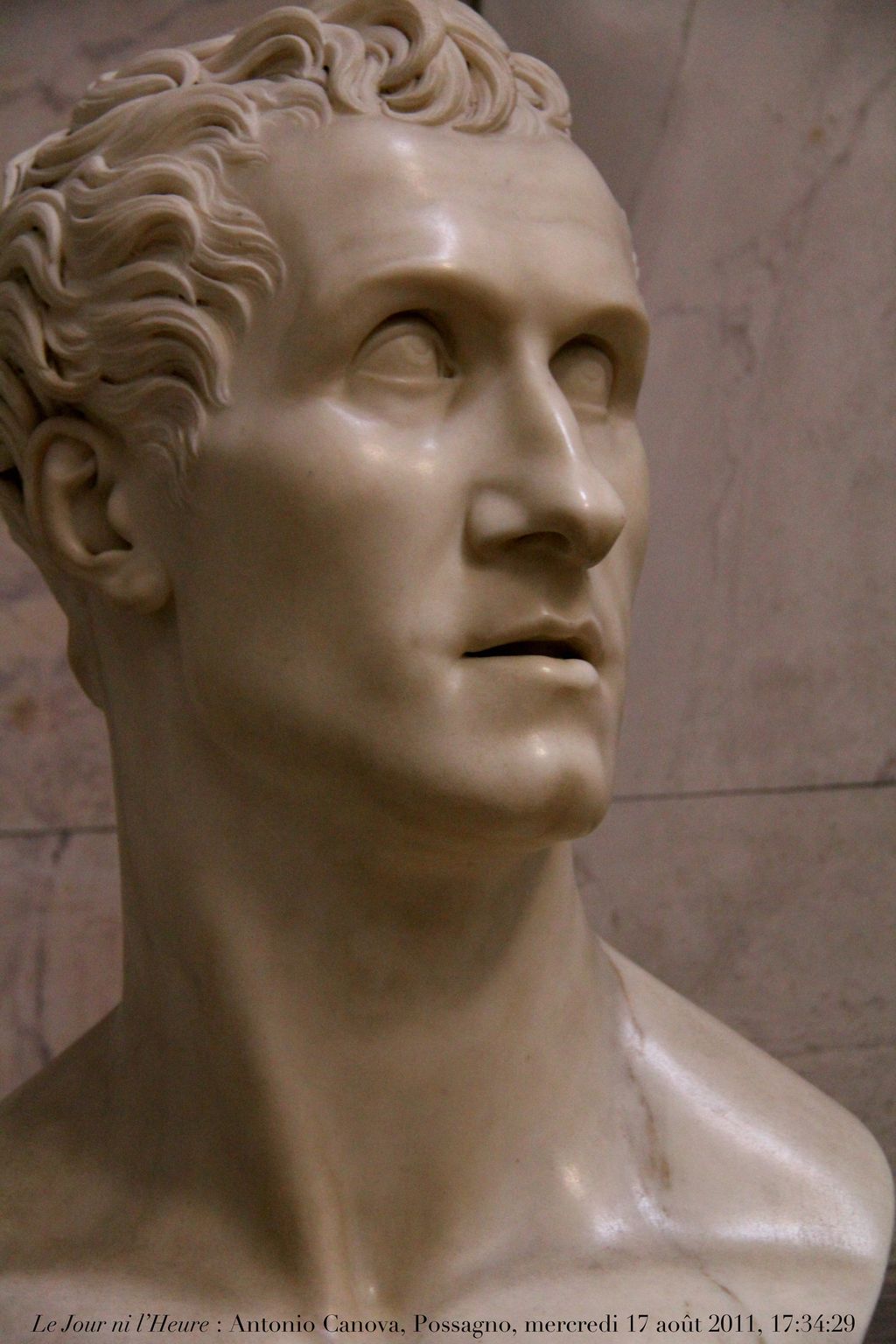
The marble self-portrait in the Canovian Temple at Possagno, seen close up. Renaud Camus. Image source. CC BY 2.0. Resized for display.
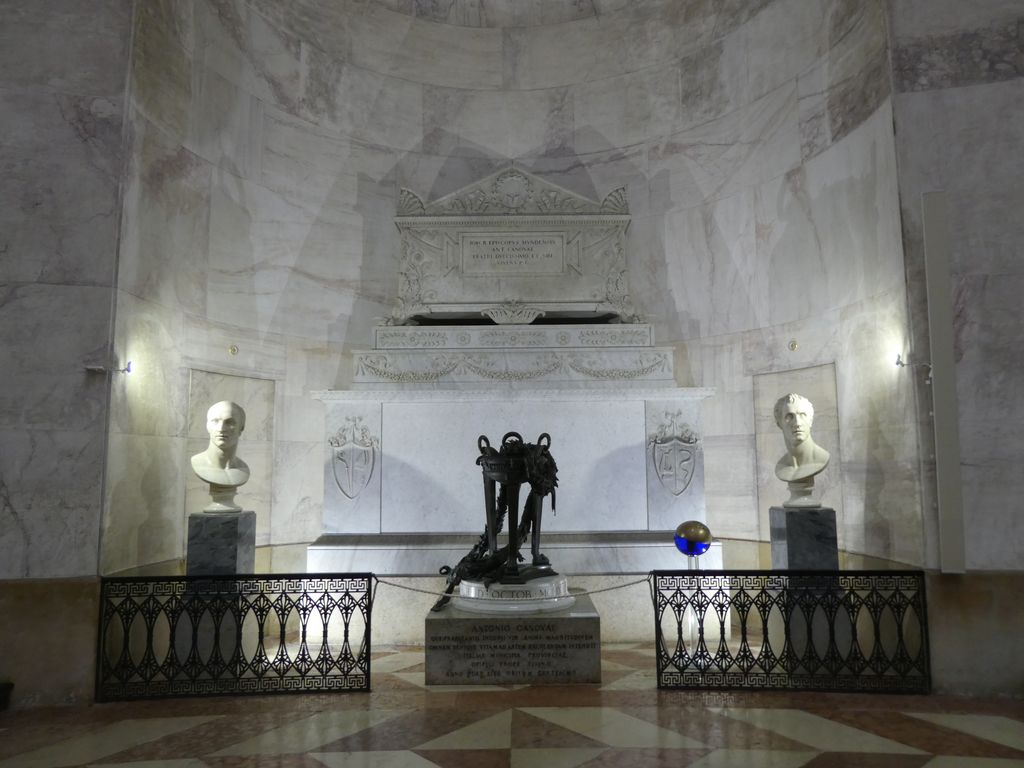
Canova’s tomb at Possagno, with his self-portrait at the right and Sartori’s bust at the left. Syrio. Image source. CC BY-SA 4.0. Resized for display. The resized photograph uses the same licence.
At a Glance
- MarbleAntonio Canova, 1812, Canovian Temple, Possagno. [1]
- Possagno plasterMuseo Gypsotheca Antonio Canova, inventory 213, catalogued as 1811–12. [4]
- Pictured versionArt Institute of Chicago, plaster, accession 1975.203. [3]
Contents
- The face from two sides
- The first months of 1812
- What the plasters preserve
- A likeness sent to friends
- The marble in Possagno
The face from two sides
Look first at the Chicago bust from the front of the chest. The shoulder on one side rises beside the neck, while the far edge of the chest falls away below it. The face has already begun to turn. Both eyes remain visible, but the nose and mouth are directed away from the line of the chest. There is little below the collarbones to hold the eye. The whole movement runs from the tilted outline of the shoulders to the higher line of the brow. The short hair stays close to the head at the temples and rises in thicker waves above the forehead. [2] [3]
The closer three-quarter view of the Temple marble shows the effect of that turn. The near cheek presents a broad surface between eye and jaw. Along the farther side, the nose, lips and chin begin to separate into a profile. The line from the underside of the chin to the chest is long enough to make the tilt unmistakable. Deep cuts between the waves of hair hold shadow, while light catches the cheek and forehead in broader patches. In the photograph, the gap between the lips remains dark even where the light picks up the chin below it. [2]
Canova has given the face a definite nose, jaw and arrangement of hair. He has also enlarged the bust and left out clothes, tools and hands. The result can be recognised as a likeness and read as an image of a sculptor thinking about his work. Isabella Teotochi Albrizzi described the movement of the head as an expression of the moment when the artist’s mind fills with images of beauty. Leopoldo Cicognara also understood the pose in terms of invention. Their accounts help explain why the raised face mattered to early viewers. The posture carries a meaning that an easel or a chisel could have made more literal. [1] [4] [5]

The first months of 1812
Antoine-Chrysostome Quatremère de Quincy encouraged Canova to make a self-portrait in a letter dated 3 May 1811. Canova’s own account suggests that other people also pressed him to make one. Writing to Pietro Giordani on 22 February 1812, he described having set to work on the likeness in clay. He was surprised at what he had been able to make of his own features and hoped Giordani would find the result alive. The letter belongs to the modelling stage, when the head and shoulders could still be altered by adding or taking away clay. [1] [5]
On 11 March, Canova’s half-brother Giovanni Battista Sartori wrote to Daniele Francesconi about the model. What impressed him was the combination of resemblance and grandeur. He considered it a better likeness than the portraits he already knew, even though the head had a bearing he found more imposing than Canova’s everyday appearance. His reaction gives a contemporary account of how close observation and idealisation could operate in the same portrait. The difference lies less in any one feature than in the combination of scale, open lips and upturned head. [1] [5]
Videos on Canova
Explore Canova’s workshop methods and the settings for his sculpture.
Antonio Canova in the Vatican Museums
The Vatican Museums introduce Canova’s Roman studio and their collection of his work.
Watch on YouTubeWhat the plasters preserve
The Museo Gypsotheca Antonio Canova catalogues its plaster, inventory 213, as 1811–12 and identifies it as an original model for the marble. In Rome, the Museo di Roma holds another plaster, MR 1468, from the studio of Canova’s pupil Adamo Tadolini. It is 89 centimetres high. The museum notes the visible reference points used in translating the form into marble. They give the carver places from which to check the projection of a cheek, the height of the shoulder or the depth of the turn. The points belong to the making of the object. The tilt that seems so natural in the finished stone had to be fixed in three dimensions before the carver could reproduce it. [4] [6]
The Accademia Nazionale di San Luca holds a plaster measuring 90 by 47 by 39 centimetres, inventory 71. The academy records it as a gift from its secretary Melchiorre Missirini in 1829. A restoration in 2007 revealed an inscription low on the nape that says Canova made his own likeness in 1812. The academy reports the same inscription on the Possagno marble. Its position is worth noticing. The front conveys the sculptor’s identity through his face and pose. At the back, the inscription supplies the maker, sitter and date in words. [5]
A likeness sent to friends
The design circulated beyond Canova’s studio. The Accademia di San Luca records that he gave a version to Quatremère, the friend who had encouraged him to make it. The Villa Carlotta plaster at Tremezzo offers another glimpse of how a version reached a collection. Giovanni Battista Sommariva received a plaster in Paris in September 1813, and a bust of Canova is documented at his villa in 1831. The Lombardy catalogue leaves open whether the plaster at the villa is the one sent to Paris. Sommariva also had casts made of works he owned. [5] [7]
The date on a cast can travel with the design. The inscription on the Chicago plaster includes 1812, the year of Canova’s original. The Art Institute’s published study also raises the possibility that its plaster is an after-cast. In Edinburgh, the National Galleries of Scotland hold a white marble version 59 centimetres high, NG 2776, by an unknown maker. The gallery considers its smaller size evidence that it was probably copied freehand. That judgement depends on both material and scale. A mould can preserve the dimensions of the object it was taken from, while a carver making a smaller version has to work out the proportions anew. [3] [8] [9]
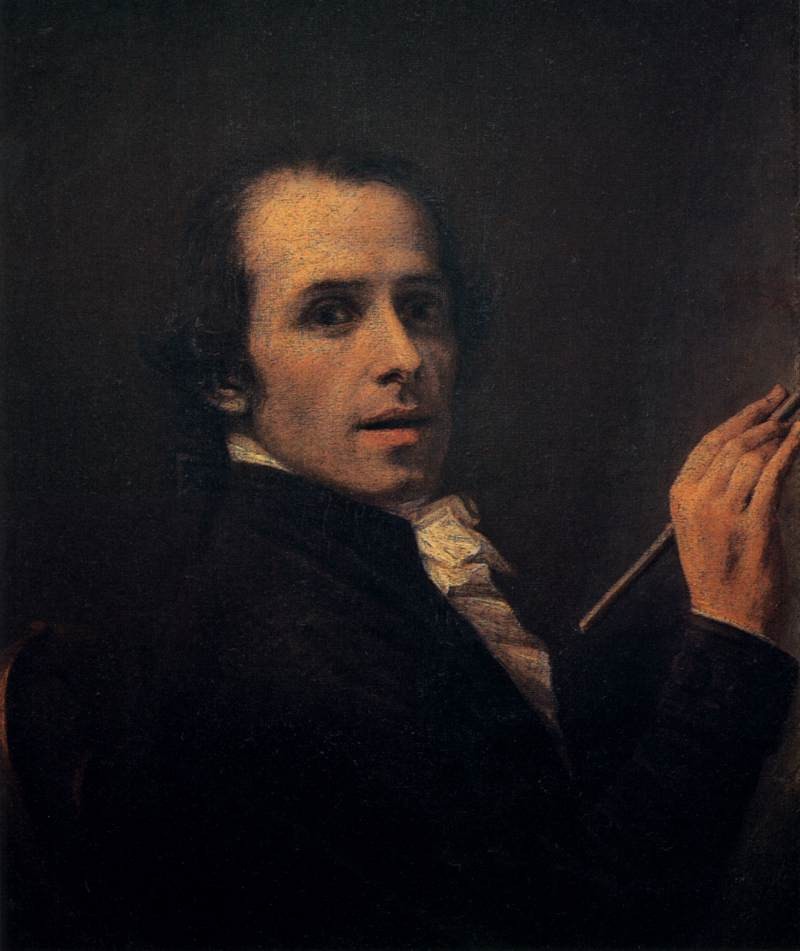
Canova’s earlier painted self-portrait in the Uffizi offers a comparison with the later sculpted likeness. Uffizi Galleries, Florence, inv. 1925. Image source. Public domain. Resized from source.
The marble in Possagno
The bust stands beside Canova’s tomb in the parish church he designed for Possagno. The first stone of the church was laid in July 1819, seven years after the portrait. Canova died before the building was finished. Sartori carried the project through and consecrated the church in 1832. The marble is now on the right of the tomb when seen from the front, with a portrait of Sartori on the left. That setting puts the sculptor’s own likeness alongside that of the man who oversaw the completion of the church. [1] [2] [10] [11]
The church’s plan identifies the portrait of Sartori as the work of Cincinnato Baruzzi. It also locates an earlier marble likeness of Canova, carved by Antonio d’Este in 1795, near the high altar. Walking from the tomb towards the altar thus brings the visitor from a portrait Canova made of himself to one made by another sculptor seventeen years earlier. At the tomb, each bust stands on its own pedestal. From a distance the pair frames the monument, while up close their separate positions leave room to read each face. [11] [12]
Canova’s painted self-portrait in Florence shows the face turning out of a dark room, with a brush held up beside it. He painted himself again in 1799, this time as a sculptor, in the work held by the Possagno museum. Both paintings give an occupation visible form. In the marble the head is exposed to light and the chest is bare. The sculptor’s identity comes through the way the face is made to move across the shoulders and the way the gaze holds its direction above the viewer. Set beside the tomb, that gaze still carries something of the active mind Canova hoped his friend would recognise in the clay. [1] [2] [4] [13] [14]
Explore Canova’s works
Browse the sculptures and paintings covered in this guide. Several entries compare versions or examine details of a larger work.
Discussion
Look again at the images and ideas explored in Self Portrait. These editorial prompts invite your observations.
Reader Insights
What does the sculpted pose tell you about how Canova presents himself?
How does the way you meet Canova’s gaze differ in sculpture and paint?
Join the Conversation
Share a detail, comparison or question about Self Portrait below.
References
- Edizione Nazionale delle Opere di Antonio Canova, Epistolario (1812), introduction pp. XLIV–XLV, notes 163–165 and plate 1. View source.
- Renaud Camus, Possagno, Tempio Canoviano, Autoritratto Canova, photograph of the Temple marble, 17 August 2011. View source.
- Art Institute of Chicago, Self-Portrait of the Sculptor Antonio Canova, plaster, 1975.203. AMICA object record and Art Institute photograph. View photograph. View source 1. View source 2.
- Museo Gypsotheca Antonio Canova, Autoritratto, plaster, 1811–12, inventory 213. View source.
- Accademia Nazionale di San Luca, Paola Picardi, Autoritratto, plaster, 1812, inventory 71. View source.
- Museo di Roma, Modello per autoritratto, plaster, 1811–12, MR 1468. View source.
- Lombardia Beni Culturali, Autoritratto, workshop of Antonio Canova, Villa Carlotta, Tremezzina, record x8020-00049. View source.
- Ian Wardropper and Thomas F. Rowlands, Antonio Canova and Quatremère de Quincy: The Gift of Friendship, Art Institute of Chicago Museum Studies 15, no. 1 (1989), note 1. View source.
- National Galleries of Scotland, Portrait of Antonio Canova, artist unknown, white marble, NG 2776. View source.
- Tempio Canoviano, La storia, account of the building and consecration. View source.
- Syrio, Tomb of Antonio Canova and Giovanni Battista Sartori, photograph of the installed monument, 15 June 2025. View source.
- Tempio Canoviano, Opere di Canova e della sua cerchia, annotated plan of the church and its artworks. View source.
- Wikimedia Commons, photograph of the Uffizi Self-Portrait as Painter. View source.
- Catalogo generale dei Beni Culturali, Autoritratto, oil painting, 1799, Museo Gypsotheca Antonio Canova, record 0500432565. View source.


 Antonio Canova.jpg)

