



 by Tom Gurney
Tom Gurney BSc (Hons) is an art history expert with over 20 years experience
Published on June 19, 2020 / Updated on November 13, 2026
Email: tomgurney1@gmail.com / Phone: +44 7429 011000
Paintings: Introduction
Antonio Canova turns towards us with a brush still raised in his hand. The point aims towards the edge of the canvas, while the face, shirt and fingers catch the light against a dark background. In this self-portrait, dated 1792 by the Museo Gypsotheca Antonio Canova, the artist chose to show himself painting. He was already known for his Roman monuments in marble. Here a few strokes of colour are enough to show what he does and where his attention has gone. [1] [2]
A different use of colour comes into view in his small paintings of dancers. A pale sleeve, a raised foot or the edge of a veil catches the eye against dark paper. The pose of one dancer leads to the next, and the space between them becomes part of the movement. In his oils, Canova could build up a face or a fold gradually with shadow. In the dance temperas, he could use the whole width of a sheet to set several gestures in motion. Both ways of working carried ideas that he could take up again in drawings, reliefs and statues. [2] [3]
Antonio Canova Paintings
At a Glance
- Self-portraitsThe Uffizi canvas shows Canova as a painter. The 1799 canvas at Possagno presents him as a sculptor. [1] [4]
- Oil paintingsSurviving works range from the intimate Venus and Cupid canvases to the large altarpiece at Possagno. [5] [6]
- Dance temperasPossagno preserves small paintings on paper with pale figures, coloured drapery and dark grounds. [3]
- Related worksCanova returned to some painted designs in monochrome or sculpture. Printmakers also issued versions on paper. [3] [7]
Contents
- Canova at the easel
- Venetian painting in the Roman studio
- Venus and Cupid in oil
- How the tempera dancers move
- From painted design to printed line
- Painting for the church at Possagno
Explore Canova’s paintings


Canova at the easel
In the Uffizi self-portrait, Canova turns his head much further than his body. The near shoulder forms a dark mass under the face, and the white cravat breaks that shadow with small folds. The two bright passages at the face and the hand give the pose its direction. His body is still angled towards the work, while his eyes meet ours. Since the painted surface he is working on lies at the edge of the composition, it is the brush and the turn of his neck that make the interruption legible. [1] [2]
In the oil self-portrait of 1799, at Possagno, the implements identify him as a sculptor. Canova used paint in both pictures to show a person whose work occupied his hands. The later sculpted self-portrait gives the head more independence. In the plaster model at Possagno, dated 1811–12, the turned face and parted lips carry the expression without the apparatus of a studio. The painted portrait puts us close to a person at work. The model for the marble at the Temple of Possagno gives the face the more lasting form of a memorial. [1] [4]
The Uffizi painting is also part of a collection built around the question of how artists chose to show themselves. The gallery traces that collection to Cardinal Leopoldo de’ Medici in the seventeenth century. Canova’s portrait joins a tradition in which a brush, a palette, a hand or a piece of studio furniture can carry as much information about a sitter as dress or setting. His lifted brush records a small action, and the face has the alertness of someone who has looked up in the middle of it. [1] [2] [8]
Venetian painting in the Roman studio
In Venus with a Faun, an oil on canvas made about 1792, Venus lies across a broad couch. The faun appears low at her feet, so the visitor in the scene comes into view at the far end of the composition. Cloth and cushions extend the horizontal line of her body, and the couch lends weight to the place where she rests. The Possagno museum connects the picture with the Venetian painting of Giorgione and Titian. The painting takes advantage of distinctions that oil colour can make immediately, including the glow of skin, the sheen of cloth and the dark space from which the faun emerges. [9]
The national catalogue also records Pietro Vitali’s reversed engraving of the picture, made between 1793 and 1798 as a counterpart to Venus with a Mirror. The engraved version takes the composition into another material and reverses its direction. Later, Canova used the reclining pose in a different way for Pauline Borghese as Venus Victrix. The marble shows a named sitter with the apple of Venus, and the couch supports a figure meant to be viewed from more than one side. Look at what survives the change of medium. The lifted upper body and the long support still make reclining into a deliberate pose. [9] [10] [11]
Canova also tested how convincingly he could paint in the manner of an earlier Venetian artist. Fernando Mazzocca traces the story of a portrait passed off as a Giorgione at a dinner given by Abbondio Rezzonico in Rome. His study identifies the design’s source in a printed likeness in Carlo Ridolfi’s seventeenth-century book on Venetian artists. Examination of the panel also detected an earlier image of the Holy Family beneath Canova’s portrait. The old panel and the published likeness gave Canova two different kinds of material to work with. The episode makes an instructive counterpart to the Uffizi painting, where the identity of the artist depends on a visible face and the brush in his hand. [2]
Venus and Cupid in oil
In Venus with Cupid, the child brings his face up to his mother’s cheek. His arm closes around her neck while hers supports him lower down. The red curtain at the edge gives the encounter a warm enclosure, and the landscape opening beyond the figures lets light into the space they occupy. The child’s wings signal the subject. The lean of his body and the turn of his mother’s head make the contact readable as an ordinary embrace. The national catalogue cites Giuseppe Pavanello’s suggestion that an image of the Madonna and Child, possibly Pompeo Batoni’s Holy Family in the Capitoline collections, could have informed the gesture. [5]
Possagno has two oils of this design. The national catalogue numbers the canvases 45 and 46 and calls the latter a replica of the former, dated 1798–99. Each canvas also carries two monochrome studies of possible sculptural groups on the back. The two sides ask for different kinds of attention. The front sets warm skin and drapery in an interior that opens to the light. The reverse treats figures as shapes that can be gathered on a base. The catalogue leaves those groups unidentified, but the canvases show how closely painting and work on sculpture could sit together in Canova’s practice. [5] [12]
The oil Le grazie at Possagno, signed and dated 1799, belongs to the same period. The national catalogue records it alongside La sorpresa and Venus with Cupid, and cites Pavanello’s reading of the three as related variations on the nude. They are paintings in oil on canvas. The dancing women on dark paper give the same mythological company a different occupation and arrangement. The name of the Graces can point to an oil, a tempera or a group of figures in marble, each with its own composition. [5] [7] [13]
Videos on Canova
Explore Canova’s workshop methods and the settings for his sculpture.
From Sketch to Stone | Canova: Sketching in Clay
Watch sculptor Fred X. Brownstein recreate a Canova Venus, using clay, plaster and marble.
Watch on YouTubeHow the tempera dancers move
The Museo Gypsotheca Antonio Canova connects the dance paintings to the ancient wall paintings Canova knew from Pompeii and Herculaneum. In the temperas, he often gave the figures a dark ground and little space beneath their feet. That arrangement makes raised heels and hems easy to see. A strip of material can travel beyond the body, and an extended arm can reach into empty space without meeting another figure or an architectural feature. Canova used that room to vary the lengths and directions of movements. [3] [4]
The five figures in Five Dancers with Veil and Crowns share a narrow band of ground. The middle dancer lifts a crown towards her head, and the arch of the veil repeats that upward movement on a larger scale. The bodies on either side bend or lift a foot at different angles. Their pale dresses carry the eye from one gesture to the next, while the figures at the ends open their arms outwards. The small differences matter because the painted sheet allows us to see the whole line at once. Our eyes can move from the central lift to the turns at the edges and back again. [3] [14]
There is a tighter formation in The Graces Dancing with a Cupid. Three women keep close together, with the figure in the middle upright and the two beside her inclining their heads. The tripod and its smoke sit off to one side and the small lyre-playing Cupid answers it from the other. Their positions widen the composition without breaking the closeness of the dancers. The national catalogue says Canova used the design again in a monochrome at Bassano, dropping the tripod. One object removed from the edge is enough to change how firmly the three women hold the centre. [3] [7]
In the complete Dance of Venus and the Graces before Mars, the seated Mars watches from one side. Small torchbearers occupy the other, and a garland runs across the top. The detail of the three central dancers brings their raised arms and interlaced movements forward. Restoring the edges puts those movements back in front of an audience. Zeri catalogues the complete picture with The Rape of Helen, two temperas on paper of the same size. Possagno also records a relief of the Mars subject made in 1797. On the dark paper the torch flames and the light drapery give the dance its accents. In the relief a viewer reads the gathering of figures through projection, outline and the shadows on the surface. [15] [16]
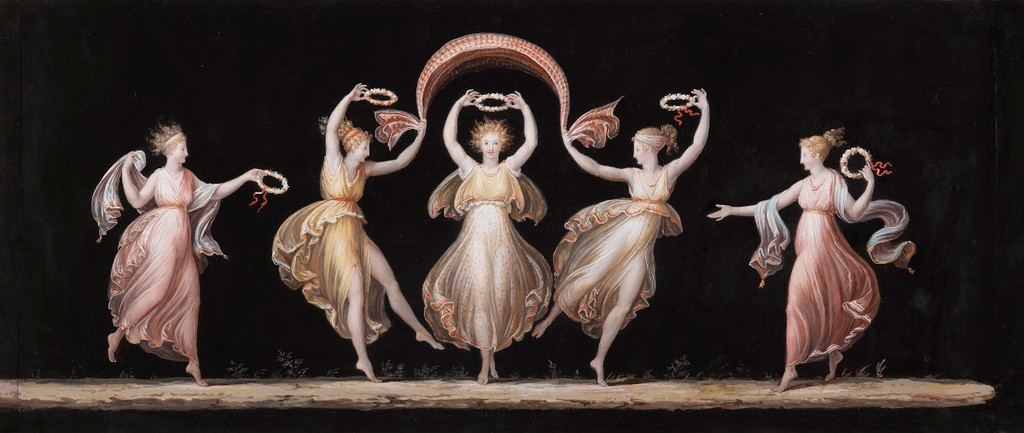
In Five Dancers with Veil and Crowns, the dancers are spaced across a shallow, frieze-like field. Museo Gypsotheca Antonio Canova, Possagno. Image source. Public domain. Resized from source.
From painted design to printed line
The drawing, painting and print catalogues sometimes describe similar subjects with the same words. The national record for the Graces with Cupid is filed under drawings, but its materials field identifies tempera on paper. The corresponding etching by Giovanni Martino De Boni in the Istituto Centrale per la Grafica is a different object. It credits Canova with the design and De Boni with making the print. The point of comparison is the disposition of the figures. Colour can make smoke, skin and cloth distinct, while the printmaker has to work through marks and intervals on a sheet. [7] [17]
The five dancers offer a clear way to follow this further. The Possagno museum dates the painted design to 1798–99, and the print collection dates De Boni’s engraved plate to about 1811. Its impression S-CL2173_38 was printed later. A date for the painting tells us when Canova worked out the group in colour. A date for the plate or the surviving impression tells us about the history of the image once it could circulate on paper. The comparison belongs as much to the history of Canova’s prints as to the study of his painting. [3] [14] [18]
The museum also follows dance motifs through drawings, temperas, monochromes and sculptural models. The Dancer with Finger on Chin gives one marble figure the work that a whole row of figures could do in paint. A tilted head, a lifted hand and a raised foot supply several directions within one outline. The folds seem to continue the turn of the leg. In the temperas, a veil can curve out across the dark with space beneath it. In marble, a long fall of cloth can make a visible connection to the support behind the figure. The composition has to work for a viewer moving around it and for the weight of the material itself. [3] [19]
Painting for the church at Possagno
The largest change of scale comes in The Deposition of Christ, the oil painting on the high altar of the Temple of Possagno. Its dedication names the town and dates the work to 1799. Canova began it after returning from Rome the year before, initially for the parish church, and returned to the picture in 1810 and 1821. His revisions included removing the tomb and repainting the Virgin’s mantle black. The work has its own history of adjustments, visible in records of the painting before it reached its final setting. [4] [6]
At the bottom of the picture, Christ’s body lies across the canvas while the people around him bend or reach towards it. In the centre, the Virgin’s open arms direct attention upwards. High above her, God the Father opens his arms, and the dove appears in the light between the two levels. The Possagno museum identifies sources for the arrangement in Anton Raphael Mengs and Guido Reni. The painting can carry the weight of the body and the grief around it low in the composition while giving the figures above a quite different light. From the floor of the Temple, the dark mantle and the bright space above it help the eye pick out the Virgin’s gesture before the figures crowded around Christ come into focus. [6]
Explore Canova’s works
Browse the sculptures and paintings covered in this guide. Several entries compare versions or examine details of a larger work.
Discussion
Look again at the images and ideas explored in Paintings. These editorial prompts invite your observations.
Reader Insights
Which painted passage most changes how you look at Canova’s sculpture?
How does the dark background affect the movement of the dancers?
Join the Conversation
Share a detail, comparison or question about Paintings below.
References
- Museo Gypsotheca Antonio Canova, Autoritratto, the 1811–12 plaster and the Uffizi and Possagno painted portraits. View source.
- Fernando Mazzocca, The Self-portrait of Giorgione. A Painting by Antonio Canova Rediscovered, discussion of the Uffizi portrait, Venetian painting and examination of the Giorgione panel. View source.
- Museo Gypsotheca Antonio Canova, Canova e la Danza, digital exhibition with photographs of the dance temperas. View source.
- Museo Gypsotheca Antonio Canova, Biografia di Antonio Canova, including the illustrated 1799 self-portrait and visits to Herculaneum and Pompeii. View source.
- Catalogo generale dei Beni Culturali, Venere con Amore, Possagno inv. 45, national record 0500432560. View source.
- Moira Mascotto, Museo Gypsotheca Antonio Canova, La Deposizione di Cristo di Antonio Canova, painting, revisions and iconography. View source.
- Catalogo generale dei Beni Culturali, Danza delle Grazie con Amorino, tempera on paper, Possagno inv. 131, national record 0500432535. View source.
- Uffizi Galleries, The Uffizi Self-portraits, history of the collection. View source.
- Museo Gypsotheca Antonio Canova, Venere con Fauno, inv. 8, oil painting and Venetian context. View source.
- Catalogo generale dei Beni Culturali, Venere con Fauno, national record 0500432551, including Vitali’s engraving and the comparison with Pauline. View source.
- Galleria Borghese, Pauline Bonaparte as Venus Victrix, marble LIV. View source.
- Catalogo generale dei Beni Culturali, Venere con Amore, Possagno inv. 46, national record 0500432561. View source.
- Catalogo generale dei Beni Culturali, Le grazie, signed oil on canvas, Possagno inv. 132, national record 0500432558. View source.
- Istituto Centrale per la Grafica, Cinque danzatrici con velo e corone, De Boni after Canova, impression S-CL2173_38. View source.
- Fondazione Federico Zeri, Ratto di Elena, Danza di Venere e delle Grazie davanti a Marte, painting pair, catalogue entry 94611 and photographs. View source.
- Museo Gypsotheca Antonio Canova, Canova e la danza, exhibition account with the 1797 Mars relief and dance sculptures. View source.
- Istituto Centrale per la Grafica, Danza delle Grazie con Amorino, etching by De Boni after Canova, impression S-FN31963. View source.
- Istituto Centrale per la Grafica, Cinque danzatrici con velo e corone, De Boni’s plate M-292_3, c. 1811. View source.
- National Gallery of Art, Dancer with Finger on Chin, marble 2003.62.1, with alternate views. View source.


 Antonio Canova.jpg)

