



 by Tom Gurney
Tom Gurney BSc (Hons) is an art history expert with over 20 years experience
Published on June 19, 2020 / Updated on November 13, 2026
Email: tomgurney1@gmail.com / Phone: +44 7429 011000
Hebe: Introduction
Hebe lifts a pitcher in one hand and carries a shallow cup in the other. Her left toes make contact with the support beneath her, and the right foot is still in the air. At the waist, the folds gather where the dress is tied. Below it they spread over the forward leg and sweep back towards the trailing foot. Antonio Canova gave the cupbearer of the gods the appearance of arriving in the middle of her task. Her face stays calm as her feet, dress and raised arm carry the movement. [1] [2]
Canova made four versions of the subject that can be traced through their original patrons. The marbles in Berlin and Saint Petersburg preserve a cloud under the figure. Those at Chatsworth and Forlì use a tree trunk. The two designs can also be traced through full-size plasters in Milan and Possagno. Looking from the feet to the vessels and around to the back brings out changes that a single view can hide. [1] [3] [4]
Hebe Antonio Canova
At a Glance
- SubjectHebe, goddess of youth and cupbearer to the gods on Olympus. [1] [3]
- Cloud versionsAlte Nationalgalerie, Berlin, and the State Hermitage Museum, Saint Petersburg. [1] [4]
- Tree-trunk versionsDevonshire Collection, Chatsworth, and the civic collection at the Musei di San Domenico, Forlì. [1] [4] [5]
Contents
- The step and the serving gesture
- The first marble in Berlin
- Joséphine’s marble and the Paris Salon
- A tree trunk at Chatsworth
- The necklace and the last marble
The step and the serving gesture
In the opening lines of Book IV of the Iliad, Hebe pours nectar while the gods sit with Zeus and look down on Troy. Canova left the company of gods outside the sculpture. The two vessels tell the story on their own. The pitcher sits above shoulder level, where its outline is easy to distinguish, and the lower hand extends the cup into open space. The gap between them lets the eye anticipate the pour. It also gives the arms different tasks, one lifted and bent, the other lower and reaching away from the body. [1] [3] [6]
The dress picks up the movement of the step. It lies close against the advancing leg, where the raised contours of the thigh and knee can be read through the surface, then separates into narrow folds towards the hem. Those deeper channels hold shadow beside the smoother stretches of bare shoulder and arm. A side view makes the lifted heel and the space behind it easier to see. The step feels suspended because the toes take so little visible weight while the cloth and the other foot seem to be catching up. Berlin’s exhibition on Canova and dance drew attention to the same suggestion of weightlessness in his later dancers. In Dancer with Finger on Chin, the position of the hand helps define the figure just as clearly, though it serves a different gesture. [1] [2]
The first marble in Berlin
The Venetian Giuseppe Giacomo Albrizzi is generally identified as the first patron. Prince Nikolai Yusupov had asked Canova about a life-size Hebe in December 1794, but the Hermitage catalogue finds no evidence that his proposal went ahead. It dates the first plaster to spring 1796 and work on the Albrizzi marble to 1796–97. The statue was sent to Venice in December 1799 and stood in the Palazzo Albrizzi. The Alte Nationalgalerie lists it as a work of 1796, 160 centimetres high, with inventory number B I 31. The museum dates its acquisition for Friedrich Wilhelm III of Prussia to 1825. The Hermitage catalogue gives 1830 for the purchase, while the German collection documentation uses 1830 for the opening of the Berlin museum where it was subsequently shown among antiquities. [2] [4] [7] [8]
On the Berlin marble, the bronze cup and pitcher stand out against the pale stone. Small forms such as the pitcher’s handle and the cup’s rim read separately from the fingers that carry them. Lower down, the swelling lobes of the cloud reach up behind the foot. The two ends of the sculpture describe the goddess’s work and her setting. At eye level she carries objects recognisable from a table. Near the ground the carved cloud puts the step on Olympus. [2] [3] [8]
The Milan plaster, inventory GAM 515, preserves the first design at 162 centimetres high. It still has the small nails that gave the workshop fixed points from which to take measurements for carving. Its cloud sits in the same relationship to the feet that it has in the early marbles. In Milan the body, drapery and support share the visual continuity of plaster, making the placement of the folds particularly easy to trace. The work entered the civic collection through the Marchesi Fogliani bequest in 1862. After the 1993 bombing in Via Palestro shattered it, conservators reassembled the fragments and removed layers of later paint. [3] [9]
Videos on Canova
Explore Canova’s workshop methods and the settings for his sculpture.
From Sketch to Stone | Canova: Sketching in Clay
Watch sculptor Fred X. Brownstein recreate a Canova Venus, using clay, plaster and marble.
Watch on YouTubeJoséphine’s marble and the Paris Salon
The second marble was begun in 1800 for a French patron named in the Hermitage catalogue as M. Duveriez. Joséphine de Beauharnais took over the commission in 1801. Canova used the same plaster design, with the cloud, and the marble was complete by 1805. It appeared at the Paris Salon in 1808 and entered the Hermitage from Joséphine’s heirs at Malmaison in 1815. It is 161 centimetres high and has inventory number Н. ск. 16. Those dates mark making, exhibition and acquisition, each several years apart. [4]
Canova gave the Malmaison figure more colour. Androsov identifies gilding on both vessels, the head ornament and the bow at the back of the tunic. From the front, the vessels put points of warm colour on either side of the white torso. A viewer walking around the statue can pick up the gilded bow where the dress gathers at the back. In 1818 Valeria Tarnowska, who had seen the Albrizzi marble in Venice and had commissioned Canova’s Perseus with the Head of Medusa, saw Hebe in the Hermitage. She disliked the effect of the head ornament and gold cup and preferred the simpler appearance of the figure she remembered from Venice. [4] [10]
Canova also had to defend the quiet face. In a letter to Daniele Francesconi of September 1801, he argued that giving Hebe more expression would turn her into a bacchante. The raised elbow, the loose dress and the extended foot could suggest vigorous motion, so the face helped define the character of that motion. A slight inclination of the head is enough to carry the serving gesture. For Canova, the distinction between the goddess and a bacchante depended partly on how much animation he gave the face. [1] [4]
The surviving Saint Petersburg sculpture bears old restoration joins on the arms and the base. In a later treatment, Hermitage conservators removed corroded iron dowels and reattached a loose front section of the base with stainless-steel pins. They fitted a thin steel plate beneath it to distribute the strain across several fragments. The repair allowed the statue to travel to an exhibition in Frankfurt. The cloud still reads as a soft mass under the foot, even though the weight of the marble has required careful support at the point where the figure meets the base. [4] [10]
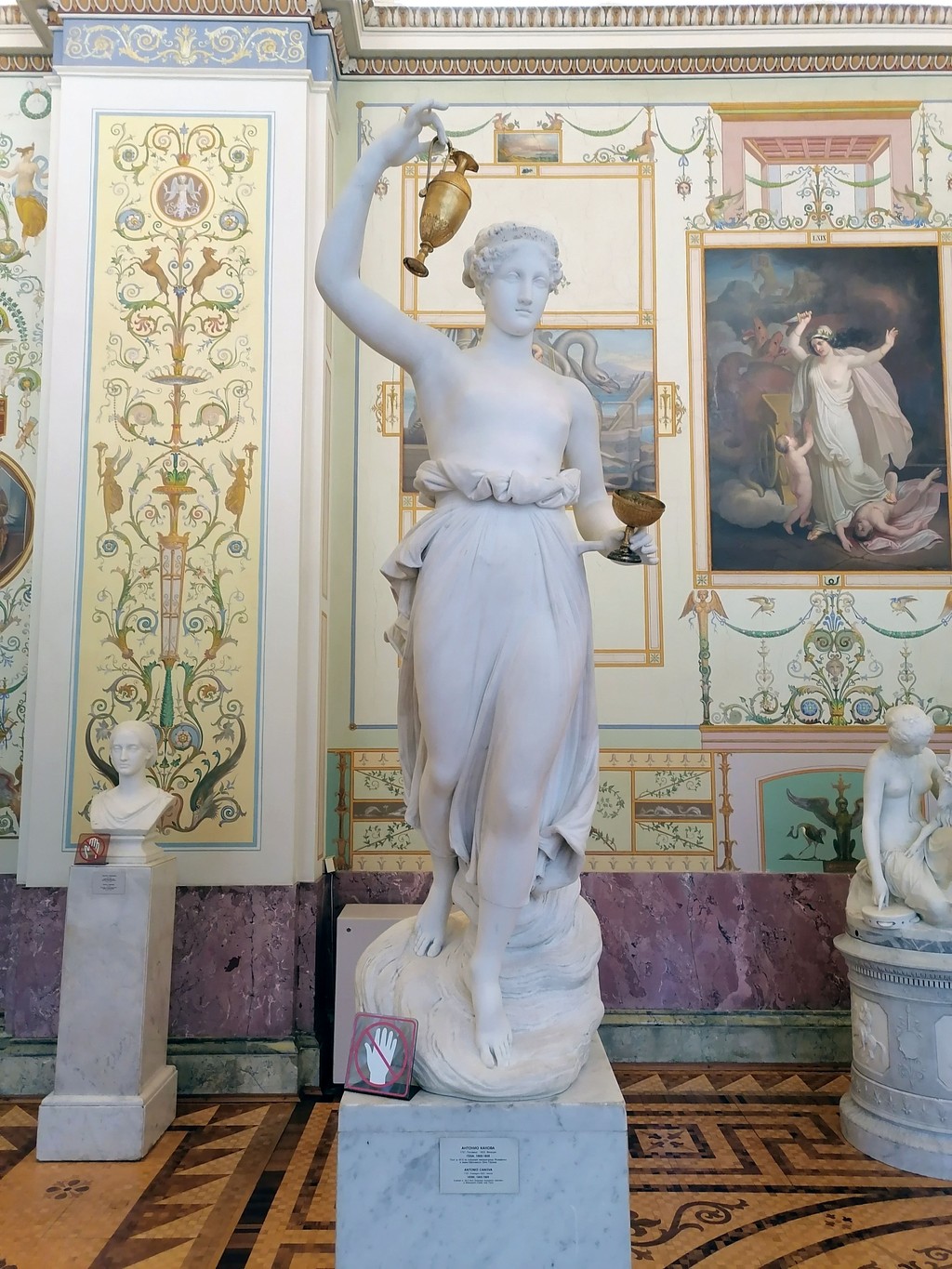
The Hermitage marble of Hebe, with the cup, ewer and billowing drapery. State Hermitage Museum. Photo by Netelo. Image source. CC BY-SA 4.0. Resized from source.
A tree trunk at Chatsworth
Canova revised the model for the third version, made for John Campbell, Lord Cawdor, and dated 1808–14 by Possagno and the Hermitage catalogue. Possagno’s plaster of 1808 has the tree support and a longer fall of drapery. The trunk sits behind the figure, where it helps join the long descending lines of cloth to the base. The small interval under the lifted foot is still there. By giving the step a point of contact on the ground, Canova shifted the action from a descent out of the clouds towards a figure passing lightly across a surface. Both Milan and Possagno link the change to criticism of the cloud. The Hermitage catalogue also points to criticism of the earlier marble, so the revision can be placed in the debate about the work without assigning it to one particular Salon review. [1] [3] [4] [11]
The marble was exhibited at the Royal Academy in London in 1816 and subsequently passed to the sixth Duke of Devonshire. Chatsworth records Hebe among the works the Duke assembled after visiting Canova’s studio. In Alison Yarrington’s reconstruction of the Sculpture Gallery as the Duke used it, guests came in from the Great Dining Room after dinner. At the far end, below the colossal bust of the Duke, stood Hebe with her ewer and cup. The arrangement made her serving gesture visible along the length of the room. On approaching her, guests could see the finer work in the folds and the supporting trunk. The placement gave a figure associated with the gods’ hospitality a particular role in the passage from dining room to gallery. [4] [12] [13]
The necklace and the last marble
Countess Veronica Zauli Naldi Guarini commissioned the fourth marble, made in 1816–17. The city of Forlì bought it with its wooden pedestal in 1887. It has a dedicated oval room at the Musei di San Domenico. The tree support identifies the later design, and the gilded necklace is a feature of the Forlì version. It draws a thin line around the neck, picking up the gold of the ribbon and the vessels. The direction of the gaze and the small turn of the head are easier to follow once the necklace has drawn attention to that part of the figure. [1] [4] [5] [14]
The necklace also covers a join. Canova used one piece of marble for almost all the figure and a smaller piece for the head, securing them with an internal metal pin. The ornament breaks the line of white stone at the place where the pieces meet. Over time corrosion in the internal metalwork caused staining and cracking, including a fissure high on the back. A joint study by the universities of Ferrara and Bologna and the civic collection used several kinds of laser scanner to record the surface and monitor damage. The survey made the back as important to understanding the sculpture as the graceful profile the necklace was designed to frame. [1] [15]
The plasters have their own histories of damage and repair. The plaster shown at Possagno lost parts including the arms when a shell hit the Gypsotheca during the First World War. Another plaster, associated with the Forlì marble and held by the civic museums in Bassano del Grappa, was shattered in an air raid in April 1945. Bassano conserved the surviving fragments and worked with the Forlì museums to bring the cast back into view. The plaster figures show how readily Hebe’s step and serving gesture can be recognised even when the glitter of the vessels and the finish of the marble are absent. [1] [16]
Domenico Marchetti’s print after a drawing by Giovanni Tognolli gives a further way of looking at Hebe. The Rijksmuseum connects the engraving with the Hermitage marble. In the print the support is a narrow upright form that resembles the trunk in the later design. The cup and pitcher are clear in both the engraving and the marble. By recording the pitcher, the cup and their relation to the body, the print preserves enough of the action for a viewer to recognise the cupbearer away from the marble. [17]
Explore Canova’s works
Browse the sculptures and paintings covered in this guide. Several entries compare versions or examine details of a larger work.
Discussion
Look again at the images and ideas explored in Hebe. These editorial prompts invite your observations.
Reader Insights
How do the cup and pitcher help you read Hebe’s stride?
How does the change from a cloud to a tree trunk affect the figure’s appearance?
Join the Conversation
Share a detail, comparison or question about Hebe below.
References
- Museo Gypsotheca Antonio Canova, Ebe, il simbolo della grazia, 1808 plaster, two designs and the construction of the Forlì marble. View source.
- Staatliche Museen zu Berlin, Canova and the Dance, exhibition and Berlin marble photograph. View source.
- Galleria d’Arte Moderna, Comune di Milano, Antonio Canova – Ebe, plaster inventory GAM 515. View source.
- Sergey Androsov, Italian Sculpture, 17th–18th Centuries, State Hermitage Museum, 2014, catalogue no. 244, pp. 267–268. View source.
- Regione Emilia-Romagna, Forlì, il centro storico, section on the Musei di San Domenico. View source.
- Homer, Iliad, Book IV, lines 1–5, translated by A. T. Murray. View source.
- Staatliche Museen zu Berlin, Canova und der Tanz, exhibition checklist, entry B I 31. View source.
- Bildindex der Kunst & Architektur, Hebe, Nationalgalerie collection documentation and photography. View source.
- Galleria d’Arte Moderna, Milano, Ebe, conservation history and object photograph. View source.
- State Hermitage Museum, conservation report for Hebe, inventory Н. ск. 16, pp. 106–107. View source.
- Museo Gypsotheca Antonio Canova, Canova around the world, Chatsworth and the Cawdor commission. View source.
- Devonshire Collections, In Plain Sight: Canova’s Tools, account of the sixth Duke’s Canova acquisitions. View source.
- Alison Yarrington, Under Italian Skies: The 6th Duke of Devonshire, Canova and the Formation of the Sculpture Gallery at Chatsworth, pp. 48–63. View source.
- Comune di Forlì, Sezione Antica, civic collection and display of the Guarini marble. View source.
- Università degli Studi di Ferrara, DIAPReM, Rilievo Statua dell’Ebe, diagnostic study and digital survey of the Forlì marble. View source.
- Musei Civici di Bassano del Grappa, Canova. Ebe, the Bassano plaster and its conservation. View source.
- Rijksmuseum, Sculpture of the Greek Goddess Hebe, Domenico Marchetti after Giovanni Tognolli and Antonio Canova, RP-P-OB-36.461. View source.


 Antonio Canova.jpg)

