



 by Tom Gurney
Tom Gurney BSc (Hons) is an art history expert with over 20 years experience
Published on June 19, 2020 / Updated on November 13, 2026
Email: tomgurney1@gmail.com / Phone: +44 7429 011000
Biography: Introduction
In the autumn of 1815 Antonio Canova went to Paris on the pope’s behalf to recover works of art taken during the French campaigns in Italy. He knew one of the most valuable pieces, the Apollo Belvedere, from his first months in Rome, when he had drawn it as a young sculptor. In the years between his study of the Apollo and his efforts to bring it back, a marble of his own had occupied its vacant pedestal at the Vatican. Few sculptors had such a direct stake in where the works of antiquity were kept, how artists could study them and what happened when they were taken away. [1] [2] [3]
Canova was born in Possagno in 1757, trained in Venice and made Rome his principal base. He carved monuments for churches, figures for private galleries and portraits for patrons who disagreed profoundly about how power should look. His career stretched from the last decades of the Venetian Republic to the years after Waterloo. The same Roman studio that produced a colossal image of Napoleon eventually sent a seated George Washington to North Carolina. The studio’s contents then went back to Possagno, where his half-brother Giovanni Battista Sartori gave the plaster models a permanent home. [1] [4] [5]
Antonio Canova Biography
At a Glance
- Born1757 in Possagno. [1]
- Died1822 in Venice.
Antonio Canova in context
Daedalus and Icarus
1777–79 [6]Venus Victrix
1804–08 [8]The Three Graces (Bedford marble)
Completed by 1817 [9]Mars and Venus
1815–19 [10]Contents
- Possagno and Venice, 1757–1779
- Rome and the public commissions, 1779–1790s
- Europe, the papacy and Napoleon, 1798–1815
- Restitution, late commissions and Possagno, 1815–1822
- What Sartori saved
Possagno and Venice, 1757–1779
Antonio Canova was born on 1 November 1757 to Pietro Canova and Angela Zardo. His father worked in stone and died while Antonio was still a small child. Angela married Francesco Sartori, and Antonio grew up in Possagno in the care of his paternal grandfather Pasino. Pasino was a stoneworker with commissions for churches and country houses, including a marble relief of the Madonna for the Falier family’s villa near Asolo. The connection between Pasino’s work and that household helps explain how a boy from Possagno came to the attention of the Venetian senator Giovanni Falier. [1] [4]
Falier supported Canova’s training with Giuseppe Bernardi, known as Torretti, at Pagnano d’Asolo. Canova followed Bernardi to Venice in 1768. There he could combine work in a sculptor’s shop with evening sessions drawing from the living model. He stayed for a time when Bernardi died and Giovanni Ferrari took over the workshop. Pasino sold a piece of land to help his grandson reduce his working hours and devote more time to study. Among the places where he did so was the Farsetti collection, where artists could draw from casts of ancient and more recent sculpture. He learned to look at a body in motion in the drawing room and to study how another artist had fixed that movement in a durable material in the cast gallery. [1] [4]
The Faliers’ early orders included two baskets carved in marble in 1772. The small terracotta Wrestlers, preserved at the Gallerie dell’Accademia in Venice, shows another side of his training. The artist was still in his teens when he entered it in a competition in 1775 and took second place. In little more than thirty centimetres of clay, one body pushes against another, and the intertwined limbs concentrate the action in a compact mass. The basket was a lesson in cutting a surface and keeping brittle details intact. The wrestlers posed the question of how much of an action could be understood from the way two bodies bear on one another. By 1810 the terracotta had entered the academy’s collection, where it could serve artists of the next generation. [4] [11] [12]
The first large figures that made Canova’s name in Venice came out of his association with the Faliers. The two stone statues of Orpheus and Eurydice were intended for the family villa. The museum in Possagno dates their presentation at Venice’s Ascension fair to 1776. Art historian Franco Miracco identifies a documented display of Orpheus alone at the fair in 1777 and places Eurydice at the villa at that time. The statues are now in the Museo Correr. The story turns on a glance. Orpheus has secured permission to lead Eurydice out of the underworld, provided he waits until they have left before looking back. In Canova’s pair, the turning bodies carry the consequences of his decision. By placing each figure on a separate base, the sculptor made the distance between them part of the story. [1] [4] [6] [13]
A commission from Pietro Vettor Pisani gave Canova a different problem. The marble Daedalus and Icarus, made in 1777–79 for Palazzo Pisani Moretta on the Grand Canal, brings its figures into a single group. The aged craftsman fits a wing to his son before their escape. The thread that stretches between their hands draws attention to a space that is otherwise open, while the tools at the base bring the story into the world of someone who makes things by hand. The contrast between the two bodies depends as much on their bearing as on their age. The father bends to his work and the boy stands tall. Canova took this example of what he could do to Rome in plaster, where it helped him win the confidence of people who could advance his career. [1] [6]
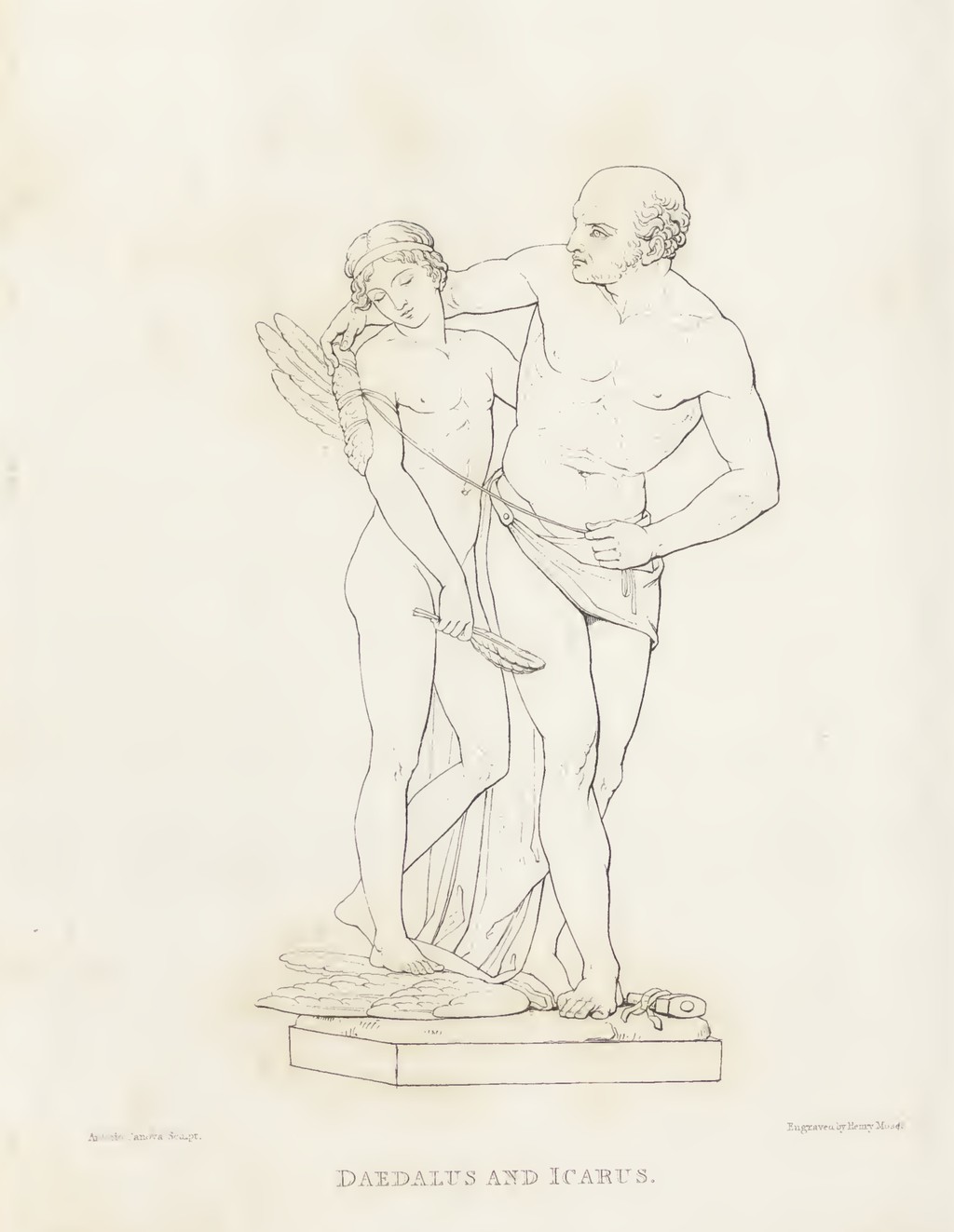
Daedalus threads the wings in this early engraving after Canova’s Venetian group. Henry Moses, after Antonio Canova, engraving published in London, 1824. Getty Research Institute. Image source. Public domain. Scan margins trimmed and image resized.
Four stages of Antonio Canova’s career
The periods overlap. Studio work continued while Canova travelled and undertook public duties.
Learning to sculpt in Venice
Early work for Falier and Pisani gave Canova opportunities to organise figures on a large scale. The thread and tools in Daedalus and Icarus give his Venetian group a tangible centre.[6]
Commissions in Rome
Canova established his studio in Rome and drew on classical sculpture for mythological works. Papal memorials required him to fit figures and gestures to church architecture.[4]
Sculpture and imperial portraiture
Canova modelled Napoleon and carved Pauline Bonaparte as Venus. Her Borghese portrait combines a likeness, a mythological attribute and furniture that shaped how the marble could be viewed.[8]
Commissions after the Napoleonic wars
Canova’s 1815 visit to London led to Mars and Venus for the Prince Regent. A letter to Cicognara identifies the two figures with war and peace.[10]
Rome and the public commissions, 1779–1790s
Canova first arrived in Rome in 1779 with the architect Giannantonio Selva. Girolamo Zulian, the Venetian ambassador, lodged him at Palazzo Venezia and introduced him to collectors and artists. The circle included the engraver Giovanni Volpato and Gavin Hamilton, a Scottish painter who also excavated and dealt in antiquities. Canova had access to the Vatican collections and made studies of the Apollo. He spent time looking at Michelangelo’s Sistine Chapel paintings too. The city gave him access to work on a scale and in settings that he had largely known through casts, drawings and prints. [1] [14]
Canova and Selva visited Naples and its surroundings early in 1780. In a letter to his friend Bernardino Renier dated 4 March, Canova described his admiration for the ancient bronzes at the royal museum at Portici. He singled out a seated figure then known as Mercury. The trip took him from the great standing marbles of Rome to smaller objects, furnishings and bronzes recovered from the towns around Vesuvius. When the plaster of Daedalus and Icarus arrived in Rome that June, Zulian invited Hamilton and others to see it. Canova returned briefly to Venice to settle his affairs and was back in Rome by the end of the year. A pension granted by the Venetian Senate in 1781 helped him establish himself there. [1] [15]
Zulian encouraged the young sculptor to make a large marble on a subject of his choosing. The result, Theseus and the Minotaur, was finished by 1783. Canova chose the moments after the fight, when Theseus has time to sit and look down on the creature he has killed. The position makes the hero’s weight and bearing part of the account of victory. Compared with the twisting Orpheus and Eurydice, the drama here rests in an encounter already over, still legible in the relationship between two bodies. The difference helps explain why the young sculptor made such an impression in Rome. He could take a familiar story and choose an instant that changed what a sculpture asked its viewer to notice. [1] [14]
Volpato helped Canova secure the commission for the monument to Clement XIV in the church of Santi Apostoli. The project ran from 1783 to 1787. A painted terracotta of the pope from 1783, preserved in Possagno, already puts the pontiff high on a seat with one arm extended. The completed monument carries that gesture into the space of the church. Below the seated pope, two figures bow or turn their attention towards the sarcophagus. From the floor of the church, the arrangement gives the public gesture above and the acts of mourning below their own places. A drawing of the Roman studio records assistants at work with the full-size model and marble of the pope, evidence of the resources a commission of this size required. [14] [16] [11]
The work took place in Canova’s studio in Via delle Colonnette, near the Tiber. The river gave the shop a route for bringing in large blocks of Carrara marble. A quick study in clay let Canova explore how a figure would balance or how two figures would fit together. To work out the details, he could model the design in clay at full size and have a plaster cast made. Points on the plaster gave the workshop positions and depths to transfer to the stone. A drawing of the studio gives some sense of the space needed for the plaster of Clement XIV and for the carving of a figure on the same scale. [4] [16] [11] [17]
The surviving studies preserve decisions that disappeared when a marble was polished. Canova could build up a limb, push a fold into place with his fingers or cut clay away to open a gap between the figures. Some of these little objects stayed among the studio materials, and others were worked to a greater finish and given to friends. The technical study undertaken for the National Gallery of Art’s exhibition on the clay sketches examined about forty of the roughly sixty known terracottas. Tool marks, joins and surviving surface coatings help the researchers distinguish the stages of modelling and later alterations to the objects. [16] [17]
The Rezzonico family entrusted him with a second papal tomb, for Clement XIII in St Peter’s. Canova began work in 1784 and the monument was installed in 1792. Here the pope kneels in prayer with the tiara set aside. Religion and a seated funerary genius occupy the level of the sarcophagus. Two lions flank the entrance at the base, one alert and the other asleep. The door that the animals seem to guard belongs to the architecture of the tomb, giving the figures an immediate relation to the building. The Rezzonico family’s commission placed Canova’s work among the papal monuments of St Peter’s while he was still in his thirties. An early engraving by Raffaello Morghen helped make that design known outside Rome. [1] [18] [7]
Alongside public monuments he continued to make figures for private patrons. Colonel John Campbell commissioned the reclining Cupid and Psyche in 1787. In the finished marble, Cupid bends over Psyche, whose uplifted arms enclose the space between their faces. Campbell never received the group. It passed to Joachim Murat, who displayed it at his estate outside Paris in 1801, and eventually entered the Louvre. The Russian prince Nikolai Yusupov commissioned a second marble of the reclining design, now in the Hermitage. Two collectors could thus see closely related designs in places far from Rome, while the sequence of owners attached a different history to each work. [7] [19] [20]
Canova continued to rely on Venetian friendships after he settled in Rome. Antonio D’Este, a sculptor he had known since his Venetian years, eventually administered the studio and also worked as a conservator at the Vatican Museums. His memoir of Canova, published in 1864, records a working life he had known at close quarters. The painter and engraver Giovanni Martino De Boni helped Canova develop his interest in painting and later made prints after his sculpture. Their work followed two paths out of the studio. D’Este helped maintain the conditions in which the marbles could be made, and De Boni helped their compositions reach people who had never seen the finished objects. [21]
Canova’s interests extended beyond the commissions for which he was becoming famous. In 1792 he painted the self-portrait now at the Uffizi. The Possagno museum dates his group of temperas on dark paper to 1798–1804. In their processions and dances he could space bodies in a shallow field, making a gesture or a fold of cloth carry the movement from one figure to the next. The use of slender figures against a dark ground recalls ancient wall paintings. It also shows how differently an artist who relied on the depth and weight of stone could work when he had a brush in his hand. [22] [23]
In 1792 the Venetian Senate commissioned Canova to commemorate the admiral Angelo Emo. On the marble stele a winged figure brings a civic crown to the admiral’s bust. On the other side Fame bends to write Emo’s name. The work was completed in Rome in 1794 for a room in the Doge’s Palace where delegations waited to be received. The Senate diverted it to the Arsenal after recognising that the monument would partly obscure a large painting by Andrea Vicentino. Canova protested that the new setting would deprive the work of an audience and that, given advance notice, he would have designed it differently. He went to the Arsenal in 1795 to find a place for it. A commission that began as a tribute for one of Venice’s ceremonial interiors had become an object among naval relics in a room with a different public. [1] [24]
The Roman painter Angelica Kauffman also belonged to Canova’s circle. Around 1796 he modelled a portrait of her in terracotta. The two artists had international clients and worked among people whose friendships and commissions connected Rome with London, Vienna and Venice. When Kauffman died in 1807, Canova directed the arrangements for her funeral. Paintings accompanied the procession and members of Rome’s academy carried her coffin. The occasion gave paintings the kind of public ceremonial role Canova was accustomed to thinking about in his own work for churches and civic interiors. [16] [25] [26]
Videos on Canova
Explore Canova’s workshop methods and the settings for his sculpture.
Antonio Canova in the Vatican Museums
The Vatican Museums introduce Canova’s Roman studio and their collection of his work.
Watch on YouTubeEurope, the papacy and Napoleon, 1798–1815
In 1798 Canova went to Vienna in the company of Abbondio Rezzonico. The Venetian Republic had fallen the previous year, and the trip was an opportunity to ask the Austrian emperor to confirm the pension Venice had promised him for his monument to the admiral Angelo Emo. In Vienna a new patron, Duke Albert of Saxe-Teschen, asked Canova to commemorate his wife, Archduchess Maria Christina, who had died that June. On 13 November Canova sent the duke a first drawing of the monument. The resulting marble was installed in Vienna’s Augustinian Church in 1805. [27]
For this memorial Canova set a procession of mourners against a broad pyramid. The figures move towards the dark entrance at its centre, carrying the eye away from the open church and towards the interior of the monument. The portrait of Maria Christina is high above them in a medallion. A drawing in the Albertina records an outline of the installed monument with corrections by Canova. The duke also commissioned hand-coloured impressions of a print, which allowed the design to circulate outside Vienna. Where the two papal monuments put an authoritative figure at the summit, the Vienna memorial gives its emotional weight to the people approaching the door. [16] [18] [27]
From Vienna Canova continued through Prague, Dresden, Berlin and Munich. He was back in Possagno in the autumn of 1798. The time away from Rome gave him a sustained opportunity to paint. Alongside a second oil self-portrait and a painting of Hercules now at Bassano, he worked on the Deposition for his parish church. The museum in Possagno identifies the upper room of his birthplace as the space where he painted the altarpiece. He spent time in Venice in the circles of Isabella Teotochi Albrizzi and Giustina Renier Michiel before returning to Rome towards the end of 1799. His half-brother Sartori joined his household and served as his secretary. Albrizzi went on to publish accounts of his sculpture, including the Emo monument. Her description makes the gestures of the allegorical figures intelligible to people who had little chance of seeing them in the Arsenal. [1] [4] [24] [28]
Albrizzi’s descriptions also preserve the experience of a contemporary viewer. In her account of the sleeping Endymion, she extends the story of the beautiful hunter beyond the figures named in the myth and addresses women looking at the sculpture in her own time. The outline illustrations in her book give readers the attitude of the figure, while the text asks them to imagine what it would be like to stand before him. The descriptions belong to a period when readers could encounter sculpture in a print or a book years before they had the chance to see the marble. [29]
One of his first distinctions on returning to Rome came from the Accademia di San Luca. On 5 January 1800 the academy elected him a full member and waived its usual waiting period. His admission gifts included the plaster relief Socrates Defending Alcibiades at Potidaea and thirty scudi. The plaster supplied the academy with an example of a contemporary artist using a story from ancient history. It joined the sort of institutional collection on which artists could draw in the way Canova had used the Farsetti casts in Venice. [1] [30]
Rome’s own collections were changing under pressure from France. The Treaty of Tolentino in 1797 led to the transfer of the Apollo Belvedere and other works to Paris. Pope Pius VII acquired Canova’s Perseus and displayed it on the Apollo’s pedestal. Anyone familiar with the ancient statue could recognise affinities in the proportions and stance of the new one, with Medusa’s severed head held out at arm’s length. In 1802 Pius appointed him Inspector General of Antiquities and Fine Arts in the Papal States. The post gave him responsibility for the Vatican and Capitoline museums and authority over the export of works from Rome. He also helped to develop the Chiaramonti Museum, where works of different kinds could be seen together along a long gallery. [3] [14] [31] [32]
Pius VII’s 1802 decree describes the appointment in the context of the works Rome had lost. It puts the preservation of art alongside the discovery of antiquities and the instruction of artists. The objects subject to its export restrictions included statues, detached wall paintings, mosaics, engraved gems and inscriptions. Even fragments could be protected because they offered evidence useful to artists. The decree invoked Raphael’s service under Leo X as a precedent for appointing a living artist to supervise the city’s artistic inheritance. The career of an artist who had drawn the Apollo as a newcomer now depended in part on decisions about what the next newcomer would have the opportunity to see. [33]
Canova also took turns directing the academy’s school for drawing the nude. Its competitions reveal the range of exercises he set. In some, students drew cloth arranged on a mannequin. In others, they worked from a living model and had to account for the shifts in weight and muscular tension that made a pose possible. The academy’s records also show how its teachers drew on contemporary sculpture. For a competition in March 1808, the model’s placement of the legs and feet echoed Canova’s seated Theseus. The sequence could now run from an ancient work to a modern marble to a pose that an artist could study in a living body. [30]
That same year Napoleon Bonaparte sat for Canova in France. Napoleon was First Consul in 1802 and became emperor in 1804. The encounter provided a likeness for busts and for a colossal marble carved in Rome. For Napoleon as Mars the Peacemaker, Canova joined the features of the living man to an idealised, unclothed body. The finished statue, completed in 1806, reached Paris in 1811. Napoleon disliked the result and the marble was withheld from public display. Eugène de Beauharnais had already ordered a bronze version for Milan, where it eventually stood in the courtyard at Brera. Brera also preserves a plaster from the casting enterprise. After Waterloo the British government bought the original marble and presented it to the Duke of Wellington. [34] [35] [36]
Other members of the Bonaparte family found different uses for Canova’s classical portraits. Camillo Borghese commissioned him to carve his wife Pauline, Napoleon’s sister. In Venus Victrix she reclines on a couch holding the apple awarded to Venus in the judgement of Paris. The Galleria Borghese dates its marble to 1804–08 and documents payment in May 1808. The base had a mechanism for turning the group so that a stationary viewer could see different aspects of the figure. The portrait combined the visibility of a named sitter with the possibilities of an unusually intimate form of display. [8]
The commission for a Venus to replace the ancient Medici statue in Florence had begun in 1802 as a request for a copy. Canova instead proposed a new figure, and the Queen Regent of Etruria, Marie Louise of Bourbon, confirmed the commission in 1805. The Venus Italica reached the Uffizi Tribune in 1812, after Napoleon’s sister Elisa Baciocchi helped secure payment for it. The work received a revolving base of its own. Canova gave the figure a towel and the gesture of a woman drying herself after a bath. The room could again show a marble Venus while the sculpture invited viewers to judge how a living artist might approach a subject already familiar from a celebrated ancient work. [37]
The Countess of Albany brought Canova a different portrait commission after the death of the playwright Vittorio Alfieri in 1803. An early relief set a mourning figure of Italy before a bust of the writer. Following advice from the painter François-Xavier Fabre, the countess asked for a more imposing monument with a freestanding figure. In the finished tomb at Santa Croce in Florence, Italy grieves beside a sarcophagus bearing Alfieri’s profile. Tragic masks and a lyre identify his work. The monument was placed between the tombs of Michelangelo and Machiavelli. Completed in 1810, it helped establish the church as a place where the lives of writers and artists could be commemorated as part of the history of Italy. [38]
That September, while Canova was still in Florence working on the Alfieri monument, San Luca elected him its president, or principe. In 1814 the academy granted him the title for life. His trip to the imperial court in 1810 helped secure funding for the academy’s work, including teaching and the preservation of art. By 1812 he had begun to fund an anonymous competition with pensions for young artists working in Rome. Hayez had reached Rome on a Venetian scholarship in 1809, with letters from Selva and Cicognara asking Canova to look after him. Among the first entrants were the painter Francesco Hayez and the sculptor Rinaldo Rinaldi. Their studies of a victorious athlete gave each artist a chance to consider how weight and readiness could be conveyed by a single standing figure. The academy relates both works to the Apollo Belvedere and Canova’s Perseus. Canova’s later competition added a place for architecture and its own pensions. A young artist could now draw support from the institution as well as learn from its holdings. [30] [39]
Canova’s dealings with Napoleon’s family continued alongside the papal appointment and the academy. Joséphine acquired sculpture for Malmaison, and the Paris Salon held over the winter of 1812–13 gave French viewers an opportunity to see recent work by Canova together. Among the exhibits were Terpsichore and Palamedes, made for the collector Giovanni Battista Sommariva, and Dancer with Hands on Hips for Joséphine. Quatremère de Quincy wrote to Canova about the reception in Paris in February 1813. Viewers who had seen reproductions or individual works could now compare Canova’s treatment of dance, poetic inspiration and heroic posture in the same exhibition. [1]
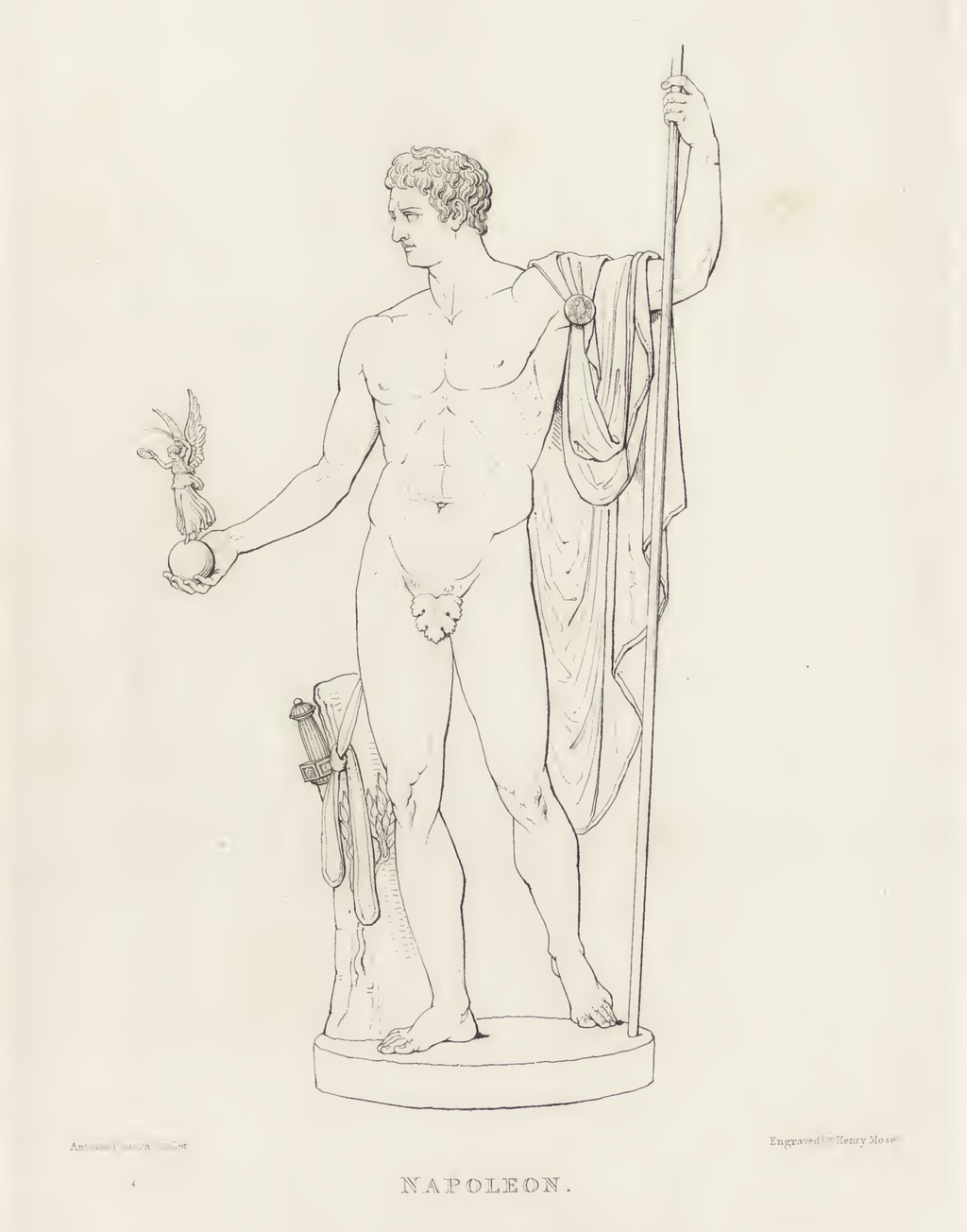
The engraved imperial statue shows the scale of the classical imagery Canova devised for Napoleon. Henry Moses, after Antonio Canova, engraving published in London, 1824. Getty Research Institute. Image source. Public domain. Scan margins trimmed and image resized.
Restitution, late commissions and Possagno, 1815–1822
In August 1815 Cardinal Ercole Consalvi, the papal secretary of state, sent Canova to Paris to reclaim works taken from the Papal States. Sartori accompanied his half-brother. Restitution still had to be negotiated after Waterloo. Vivant Denon, director of the Louvre, resisted the claims, and the Allied powers took different positions on whether the French should surrender the works. British support and the intervention of the Austrians helped Canova gain access to the collection. He also needed reliable lists to identify what could be reclaimed and where it might be found. [1] [2]
Canova’s letters to Consalvi record the practical stages of the mission. On 10 October he reported that roughly forty pieces of sculpture and more than thirty paintings had been recovered and were being guarded at an Austrian barracks. Later that month he reported the dispatch of the Apollo and Raphael’s Transfiguration. Other objects went by a later shipment. The recoveries included the Laocoön, which survived an accident to its wagon on the journey. Some works remained in France, including works dispersed outside Paris. The Vatican describes the result as the recovery of almost all the sculptures taken from its collection. The Louvre, for example, kept Veronese’s enormous Wedding Feast at Cana, taken from Venice, in an exchange for a painting by Charles Le Brun after concerns about the risk of transport. [1] [2] [32] [40] [41]
Canova travelled on to London, where he sought British help with the costs of sending the recovered works to Rome. The trip also brought him face to face with the sculptures removed from the Parthenon by Lord Elgin. Writing to Antoine-Chrysostome Quatremère de Quincy on 9 November, he explained that prints, casts and fragments had given him some idea of the reliefs, but that the larger figures were a revelation. The skill he admired lay in the selection of forms observed in nature and in the absence of exaggerated proportions. A letter to Elgin the following day expressed his gratitude for the chance to study the marbles. What Canova chose to praise in London illuminates the value he had placed since his Venetian years on looking at sculpture and living bodies in tandem. [10] [42] [43]
London also produced a portrait of the sculptor. Thomas Lawrence began it during Canova’s visit, showed it at the Royal Academy in 1816 and returned to the painting in Rome in 1819. The coat and carefully arranged neckcloth present Canova as a prosperous gentleman. In Canova’s own marble self-portrait, the bare neck and turned head belong to a different tradition of likeness. The two images tell viewers something about the public roles the sculptor occupied by the end of the Napoleonic wars, as a maker working through examples from antiquity and as a representative of Rome in negotiations with other governments. [22] [44]
On 1 December 1815 Benjamin West, the American-born president of the Royal Academy, hosted a banquet for Canova at Somerset House. Relations continued after the dinner. Canova proposed West for membership in the Roman academy, and also proposed the British foreign affairs undersecretary William Hamilton in recognition of his help with the restitution. John Flaxman, Henry Fuseli and Lawrence subsequently joined. The London visit that had grown out of a problem of freight and finance gave the academies new ways to recognise artists and officials whose work crossed national boundaries. [45]
Back in Italy, Canova was made Marquis of Ischia by Pius VII in January 1816. For his coat of arms he chose a lyre and a snake, the emblems of Orpheus and Eurydice. The choice recalled the figures he had made for Giovanni Falier at the start of his career. His work as inspector continued. At Canova’s suggestion a commission was formed in 1816 to identify works that had received little attention in churches and convents and could be made more accessible in Rome’s museums. The members included the sculptors Antonio D’Este and Bertel Thorvaldsen. In the Chiaramonti Museum a fresco by the young Francesco Hayez later commemorated the return of the works from Paris. [1] [2] [32]
Thorvaldsen’s presence on the commission was the continuation of an older professional relationship. In 1808 Canova and the sculptors Francesco Massimiliano Laboureur and Carlo Marin had proposed the Dane for membership in San Luca. Canova and Thorvaldsen took up some of the same subjects, including Hebe and the Graces. Their treatments of a shared myth gave pupils and patrons alternatives to compare. At the same time, the academy and the museums gave the two men occasions to work together on the collections that both drew on. [30] [32]
Pius VII thanked the Prince Regent for Britain’s support with plaster casts after Vatican sculpture. Moulds were made under Canova’s supervision. A gift of casts went to the Royal Academy for teaching. The collection now in Cork followed a different course. The Royal Academy lacked room for it, and William Hare obtained it for the Cork Society for Promoting the Fine Arts. The casts were shipped from Deptford in October 1818. The Cork collection included the Laocoön, whose original had only recently made its way home from France. There the casts provided objects of study for generations of artists, including the young Daniel Maclise. Their route recalls Canova’s visits to the Farsetti collection. A city at a distance from Rome could offer students sustained access to the forms of a major ancient collection. [45] [46] [47]
The restitution also changed the architecture of the Vatican collection. Work began on the Braccio Nuovo to provide space for its antiquities following the return from France. Canova chaired the committee charged with the display alongside Filippo Aurelio Visconti and Antonio D’Este. Raffaele Stern designed the gallery, and Pasquale Belli carried on after Stern’s death. The gallery opened in February 1822. Light descends from overhead, statues stand in niches, and Roman mosaics form part of the floor. Ancient sculpture could be approached here through the order of the gallery and the relation between individual figures and the architecture around them. The recovered originals and the casts made for Britain and Ireland put related objects before audiences with very different conditions for seeing them. [32] [48]
London also brought commissions. The Prince Regent, later George IV, asked Canova for a group in marble for Carlton House. Writing to Leopoldo Cicognara on 17 January 1816, Canova identified Venus and Mars as personifications of peace and war. In Mars and Venus the goddess looks up at the helmeted figure beside her and draws him into an embrace. His sheathed sword and shield lie against the tree support behind them. The Royal Collection dates the group to 1815–19, but it remained in Rome when Canova died and only reached Carlton House in April 1824. In the space of two decades Canova had used Mars to give a body to the First Consul and then set the god beside Venus for a patron celebrating Napoleon’s defeat. [35] [10]
By the time of the English visit, the Duke of Bedford had already agreed to take a second version of The Three Graces. The duke had seen the unfinished group commissioned by Joséphine de Beauharnais in 1812 in Canova’s Roman studio in December 1814. Joséphine had died the preceding May, and her son Eugène wanted the family’s marble. Canova therefore offered Bedford a version with alterations, including a round support and a different choice of marble. Bedford entrusted the changes to Canova in a letter of January 1815. He received his group in 1817. At Woburn Abbey it was eventually installed in a top-lit rotunda, with a base that let it turn. The V&A records that Canova apparently offered advice on the light and position during his visit to Woburn in 1815. [2] [9]
For North Carolina’s statue of George Washington, a sitting was impossible. Washington had been dead since 1799. Thomas Jefferson recommended Canova in January 1816, and the American consul at Livorno, Thomas Appleton, handled the commission. A likeness by Giuseppe Ceracchi gave Canova a starting point for the head. Jefferson favoured ancient Roman dress, and Canova showed Washington in armour, seated and drafting his farewell address on a tablet. The statue reached Raleigh in December 1821 and was unveiled on Christmas Eve. The Capitol fire of 1831 shattered the marble, but the full-size plaster had stayed in Italy and preserved the design. [5] [49] [50]
In the years before Canova began building in Possagno, he tried to give Rome a colossal statue of Religion. He planned it as a gift to Pius VII after the pope returned to Rome in 1814. The design developed a figure he had used in the tomb of Clement XIII. Its intended size made a site difficult to secure, and the marble was never carved. Sartori later gave the plaster model to San Luca, where it was broken during building works in 1926. The design had a separate life in a smaller, adapted marble for the tomb of Lady Sophia Brownlow at Belton in Lincolnshire. [30]
Canova’s last large project in Possagno began with a request from his neighbours for help repairing their parish church. In a letter of 5 August 1818 he told Selva he had decided to pay for a new building. Its circular interior and porch brought together features of the Roman Pantheon and the Doric columns of the Parthenon. Canova financed the work while residents supplied building materials and labour. Construction began on 11 July 1819. From Rome he followed the work by correspondence. Canova died in Venice on 13 October 1822, and Sartori took responsibility for completing the church. It was consecrated in 1832 and houses Canova’s marble self-portrait, for which the plaster model survives nearby. [1] [4] [22] [51]
What Sartori saved
Canova’s death left work at different stages in the studio. The fourth Earl of Darnley’s Reclining Naiad was completed by assistants and delivered to Cobham Hall in 1824. The original plaster model, completed in 1817, is in Possagno. The Metropolitan Museum credits the marble to Canova and his studio. Small indentations in its surface may preserve traces of the system for transferring measurements from model to marble. In this case the survival of both objects helps explain how a commission could continue after the artist’s death. [52]
The division of Canova’s remains reflected the different places that claimed a part in his life. He was buried at Possagno. His heart went to the Frari in Venice, where former pupils adapted the unexecuted design for his monument to Titian. Canova had already used that pyramidal design as a starting point for the Vienna memorial to Maria Christina. In 1827 Antonio Fabris made a bronze medal showing the Venetian monument. A design that had passed from one commission to another, and then from the master to his pupils, could now be held in the hand. [7] [53]
Sartori arranged for the transfer of studio works from Rome, with shipments from Civitavecchia beginning in 1829. He commissioned a purpose-built gallery from Francesco Lazzari beside Canova’s house in Possagno. The gallery was completed in 1836, and the first curator, Pasino Tonin, prepared the collection for display. Canova’s plasters had served as working models, alongside clay studies and other studio material. Taken together, they preserve evidence on a scale that a collection of finished marbles, assembled one purchase at a time, would rarely provide. [54] [55]
The crates went from Civitavecchia by sea, were unloaded at Marghera and continued by cart to Possagno. After the new gallery opened, the curatorial work continued until the first arrangement was complete in 1844. The gathering of so much of the studio in one place also made the collection vulnerable. Shelling struck the museum on Christmas night in 1917. Some models were destroyed, and the curator Stefano Serafin photographed the damage and catalogued fragments. The record of the breakages is now part of the history of the objects, alongside the marks left by the workshop that made them. [54] [55]
The conservators Stefano and Siro Serafin restored damaged casts, and the museum reopened in 1922. After another wartime move, this time to Canova’s temple, the works returned to the gallery in 1946. In the 1950s Carlo Scarpa designed a new wing with a square room and a lower gallery that leads the eye towards The Three Graces. Windows bring daylight across the white casts, picking out the space between figures as the viewer moves. Their placement in a museum also enables comparisons that a nineteenth-century patron with one finished marble could seldom make. The plaster bodies, the smaller studies and the room in which they are seen all contribute to what visitors can learn about how Canova worked. [55] [56]
The plaster of George Washington makes that achievement particularly tangible. A statehouse fire destroyed the sculpture for which the plaster was made, but the model survived in the collection Sartori established. In 2018 the Frick Collection brought the plaster to New York and displayed it alongside studies and likenesses that had helped shape the commission. At the beginning of Canova’s career, the plaster of Daedalus and Icarus had allowed him to show a Venetian marble to new patrons in Rome. Almost two and a half centuries later, a plaster made in his Roman studio enabled another audience to encounter a marble it could no longer see. [1] [5] [50] [55]
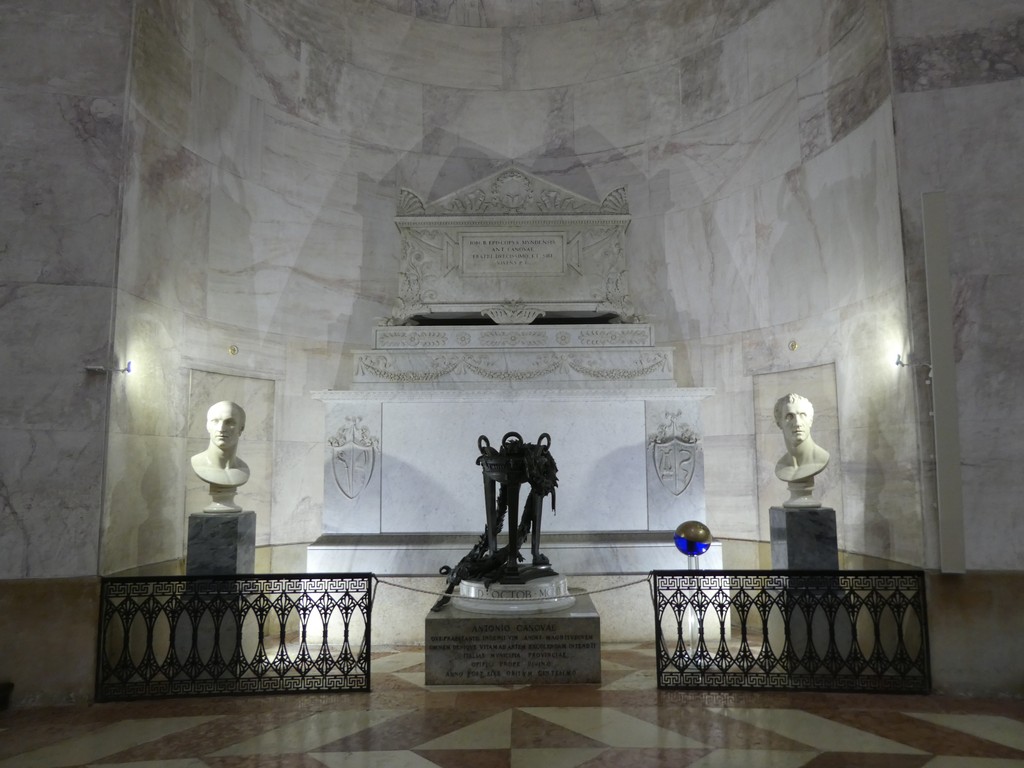
The Tempio Canoviano at Possagno is the setting for the marble likeness and Canova’s tomb. Syrio. Image source. CC BY-SA 4.0. Resized from source.
Explore Canova’s works
Browse the sculptures and paintings covered in this guide. Several entries compare versions or examine details of a larger work.
Discussion
Look again at the images and ideas explored in Biography. These editorial prompts invite your observations.
Reader Insights
Which commission best shows how Canova adapted to a new patron?
What did Canova’s work for the papacy add to his responsibilities as a sculptor?
Join the Conversation
Share a detail, comparison or question about Biography below.
References
- Massimiliano Pavan, “Canova, Antonio,” Dizionario Biografico degli Italiani, vol. 18, 1975, including Canova’s letters to Bernardino Renier, 4 March 1780, and Giannantonio Selva, 5 August 1818. View source.
- Edizione Nazionale delle Opere di Antonio Canova, Epistolario, introduction, account of the Paris mission and journey home. View source.
- Vatican Museums, A Private Visit, collection notes on the Belvedere and Canova’s Perseus. View source.
- Museo Gypsotheca Antonio Canova, “Biografia di Antonio Canova.” View source.
- The Frick Collection, “Canova’s George Washington,” exhibition press release, including the 2018 display of the Possagno plaster. View source.
- Museo Correr, “Sale Neoclassiche e Collezione canoviana.” View source.
- Christina Ferando, The Metropolitan Museum of Art, “Antonio Canova (1757–1822),” including the engraving after Canova’s tomb of Clement XIII. View source.
- Galleria Borghese, Paolina Borghese Bonaparte as Venus Victrix, collection record LIV. View source.
- Victoria and Albert Museum, “The Three Graces by Antonio Canova,” including the Duke of Bedford’s letter, January 1815. View source.
- Royal Collection Trust, Mars and Venus, RCIN 2038, including Canova’s letter to Leopoldo Cicognara, 17 January 1816. View source.
- National Gallery of Art, “Who Is Antonio Canova? 10 Things to Know,” including the depiction of Canova’s Roman studio. View source.
- Gallerie dell’Accademia di Venezia, Lottatori, collection record S. 5. View source.
- Franco Miracco, 1777, l’anno della nuova fiera della Sensa, Ateneo Veneto, pp. 151–164. View source.
- Victoria and Albert Museum, “Antonio Canova – an introduction.” View source.
- Edizione Nazionale delle Opere di Antonio Canova, Epistolario 1779–1794, letter no. 3 to Bernardino Renier, 4 March 1780, p. 6, indexed in the online selection. View source.
- National Gallery of Art, Canova: Sketching in Clay, exhibition wall text. View source.
- National Gallery of Art, Canova: Sketching in Clay, exhibition catalogue and technical study. View source.
- Ministero della Cultura, Monumento funerario di Clemente XIII, national catalogue record 0500315702. View source.
- Musée du Louvre, L’Amour et Psyché à demi couchée, collection record MR 1777. View source.
- Sergei Androsov, State Hermitage Museum, Italian Sculpture of the Seventeenth and Eighteenth Centuries, cat. 241, reclining Cupid and Psyche. View source.
- Federico Piscopo, “La triade amicale Canova, Martino De Boni, Antonio D’Este,” Ateneo Veneto, 2023, pp. 39–45. View source.
- Museo Gypsotheca Antonio Canova, Self-Portrait, collection record, including the Uffizi oil of 1792. View source.
- Museo Gypsotheca Antonio Canova, Ala Scarpa, museum guide, PDF pp. 51–53. View source.
- Sandro Menegazzo, “Canova al Museo Storico Navale di Venezia,” Ateneo Veneto, 2023, pp. 59–68. View source.
- Royal Academy of Arts, Angelica Kauffman, exhibition press release, 2024. View source.
- Angelika Kauffmann Research Project, “Biography.” View source.
- Albertina, Das Kenotaph der Erzherzogin Marie Christine in der Augustinerkirche in Wien, collection record. View source.
- Museo Gypsotheca Antonio Canova, “Birthplace,” including the room where Canova painted the Deposition. View source.
- Johannes Myssok, “Isabella Teotochi Albrizzi e le opere di Canova. Lo sguardo femminile sulla scultura maschile,” Ateneo Veneto, 2023, pp. 69–79. View source.
- Accademia Nazionale di San Luca, Canova. L’ultimo Principe, exhibition guide with academy records, 2022. View source.
- Vatican Museums, “Apollo Belvedere,” including the statue’s removal to Paris and its conservation history. View source.
- Vatican Museums, “Chiaramonti Museum.” View source.
- Pius VII and Giuseppe Doria Pamphilj, Editto Doria Pamphilj, 1802, digitised text and facsimile. View source.
- Gallerie degli Uffizi, “Uffizi and Napoleon,” including the portrait from life in 1802 and the imperial chronology. View source.
- English Heritage, “Apsley House Collection Highlights,” Napoleon as Mars the Peacemaker. View source.
- Pinacoteca di Brera, Napoleone come Marte pacificatore, collection record. View source.
- Gallerie degli Uffizi, Venus Italica, collection record 1912 n. 878. View source.
- Opera di Santa Croce, Monumental Tomb of Vittorio Alfieri, site catalogue. View source.
- Accademia Nazionale di San Luca, Canova. L’ultimo Principe, exhibition release, 2022. View source.
- Antonio Canova, Lettere inedite di Antonio Canova al cardinale Ercole Consalvi, ed. Alessandro Ferrajoli, 1888, letters from Paris, 10 and 25 October 1815, pp. 12 and 23. View source.
- Musée du Louvre, “From the ‘Mona Lisa’ to ‘The Wedding Feast at Cana’,” Salle des États. View source.
- Antonio Canova, letter to Antoine-Chrysostome Quatremère de Quincy, 9 November 1815, reproduced in The Works of Antonio Canova in Sculpture and Modelling, biographical memoir, p. 11. View source.
- Antonio Canova, letter to the Earl of Elgin, 10 November 1815, reproduced in A Letter from the Chevalier Antonio Canova and Two Memoirs Read to the Royal Institute of France, 1816. View source.
- The Frick Collection, Thomas Lawrence’s Antonio Canova, exhibition catalogue entry. View source.
- Francesco Moschini, “The Prince and the President: Antonio Canova and Benjamin West at the Royal Academy in London,” in American Latium, Accademia Nazionale di San Luca, pp. 67–76. View source.
- Michael Waldron, Crawford Art Gallery, Recasting Canova, exhibition booklet, 2nd ed., pp. 4–7. View source.
- Crawford Art Gallery, Canova Casts, learning notes on the Cork School of Art and Daniel Maclise. View source.
- Vatican Museums, “Braccio Nuovo,” Italian collection presentation. View source.
- North Carolina Department of Natural and Cultural Resources, “Canova Selected to Sculpt George Washington Statue in State Capitol.” View source.
- The Frick Collection, “Washington’s Features,” Canova’s George Washington. View source.
- Tempio Canoviano, “La storia,” history of the church at Possagno. View source.
- The Metropolitan Museum of Art, Reclining Naiad, collection record 1970.1. View source.
- The Metropolitan Museum of Art, Antonio Fabris, Tomb of Antonio Canova, medal, collection record 67.219.1. View source.
- Istituto Centrale per il Catalogo e la Documentazione, “La Gypsotheca Canoviana.” View source.
- Museo Gypsotheca Antonio Canova, “Ala Ottocentesca,” history of Sartori’s museum and its first installation. View source.
- Museo Gypsotheca Antonio Canova, “Scarpa Wing,” gallery history and architecture. View source.


 Antonio Canova.jpg)

