



 by Tom Gurney
Tom Gurney BSc (Hons) is an art history expert with over 20 years experience
Published on June 19, 2020 / Updated on November 13, 2026
Email: tomgurney1@gmail.com / Phone: +44 7429 011000
Theseus and the Minotaur: Introduction
Theseus has just killed the Minotaur. He sits across the creature’s body with a club in his left hand and his right hand resting on its bent leg. His head dips towards the body beneath him. The bull’s muzzle lies close to one of his feet. Antonio Canova gives the victor the highest point in the group, then turns his face down into it. The longer you follow his gaze, the more of the victory you see in the body below. [1]
Canova carved the group in Rome, where the Venetian ambassador Girolamo Zulian gave him the block of marble and let him choose the subject. The Victoria and Albert Museum dates the marble to 1782. The related plaster at Possagno dates to 1781 in the catalogue of the Museo Gypsotheca Antonio Canova, which gives 1781–83 as the period of work on the marble. [1] [2] [3]
Theseus and the Minotaur Antonio Canova
At a Glance
- Artist and subjectAntonio Canova. Theseus rests after killing the Minotaur. [1]
- London marbleRome, dated 1782 by the V&A, where it is catalogued as A.5&A-1962. The group measures 145.4 cm high, 158.7 cm long and 91.4 cm wide. [1]
- Possagno plasterDated 1781, Museo Gypsotheca Antonio Canova, inventory 4. [3]
Contents
- A victory seen from several sides
- Ariadne’s thread
- Zulian’s commission and Canova’s choice
- The model and the marble
- Morghen’s engraving and the journey to London
- The other Theseus in Vienna
A victory seen from several sides
The composition changes shape as you move from the end with the bull’s head towards Theseus’s right side. Near the bull’s head, the hero’s chest and face come forward, and one of his shins descends almost in front of the creature’s muzzle. From his right side, the span of the group is clearer. The Minotaur’s bent leg runs beneath the hand that rests on it, and its foot hangs past the rock at one end. At the other end, the torso rolls towards the head. What looked from the first angle like a relatively upright figure on a compact base becomes a long body lying across the stone with a seated man above it. [1]
Theseus’s right hand helps explain the pose. Its fingers curve over the Minotaur’s leg, and the arm reaches down and back from his shoulder. His left hand closes around a rough club held nearly upright. The weight of that shaft is legible even at a distance. It is wider towards the bottom, where it runs alongside the bodies, and the irregular surface catches the light in patches. Set beside the smooth swell of the arm, it reads as a length of wood shaped into a weapon. It also gives the group an upward line at the side, balancing the descent of the hero’s head. [1]
Both bodies are muscular. Theseus’s chest opens towards the viewer and his legs are arranged to either side of the body he straddles. The Minotaur’s torso is broad too, but its weight has settled into the rock. Its arm bends low across the base, the wrist turns inwards, and the neck falls back so that the muzzle points up. From some angles the human shoulder and arm register before the bull’s head comes into view. The shift can make the creature’s death look uncomfortably human. Canova makes the difference between the two figures clear through what each body can still do. [1]
The lowered chin can suggest thought or exhaustion. The parted knees and the hand at rest give that impression more substance than the face alone. Theseus’s features are regular and composed, and the curls above his forehead are worked into close, orderly masses. His expression can be read as ruminative because of where the face is turned and what the viewer encounters below it. His level brows and closed lips keep that expression ambiguous. The strongest evidence of victory is the simple fact that he can sit there. [1]
Ariadne’s thread
Near the Minotaur’s left leg, coils of thread hang over the rocky base. They are easiest to pick out from the side where Theseus’s right hand rests on the bent leg. The thread gathers into long loops, each with a sharp return at the bottom. Their regularity sets them apart from the folds of cloth on Theseus’s thigh and the broken texture of the rock. They are easy to miss in a view from the other end, where limbs overlap much of the base. [1]
The V&A connects Canova’s choice of subject to Ovid’s Metamorphoses. In Book VIII, Minos has Daedalus build the labyrinth in Crete to contain the Minotaur, which feeds on victims sent from Athens. Daedalus designs its turns to defeat anyone trying to find the way back. Theseus kills the creature and retraces his route by winding up the thread that Ariadne has given him. Ovid spends more time describing the design of the labyrinth than the killing. Canova lets a small object stand for that architecture and for Ariadne’s part in the escape. With the figures set on an open patch of rock, the coils are enough to make the space beyond the base part of the story. [1] [4]
The club and the thread point in different directions in the narrative. One recalls the encounter that has just taken place, while the other will lead Theseus back out. Ancient authors differed about the fight itself. In the Epitome attributed to Apollodorus, Theseus strikes the Minotaur with his fists, and Ariadne obtains the means of escape from Daedalus. The club is clear in Canova’s marble and in the Possagno catalogue’s description of the plaster. In the group, the object that looks most imposing belongs to the action that has ended. The quiet detail down by the rock still has work to do. [1] [3] [4] [5]
Zulian’s commission and Canova’s choice
Canova came to Rome from a family of stonecutters in Possagno and an early career in Venice. He visited Rome in 1779 to see ancient and modern sculpture, and settled there in 1780. His introduction to Zulian, the ambassador of the Venetian Republic, gave him a place to stay and access to the people who could help a young sculptor establish himself. Zulian supplied the marble for the group. The commission gave Canova the freedom to design a work on a scale that could make his name in Rome. [1] [6]
One of his Roman contacts was the Scottish painter, archaeologist and dealer Gavin Hamilton. The V&A’s object record credits Hamilton with suggesting that Canova show the aftermath, a choice Hamilton thought would find greater favour than a scene of violent struggle. The advice concerned the timing of the action. Choosing that instant gave Canova a reason to place the victor’s feet on either side of the fallen figure, to lower his head and to let his right hand rest. The same myth told at the height of the struggle would have called for bodies exerting force against one another. Here their contact bears weight. [1] [6]
A comparison with the Venetian Daedalus and Icarus makes the change visible. In that earlier marble, now at the Museo Correr, Daedalus bends towards his son to fit his wings. The figures stand apart, and the thread that runs between Daedalus’s hand and the wing helps define the open space between them. Canova gives the father the features and body of an older man and the son the proportions of ideal youth. In Theseus and the Minotaur, the bodies come together in a compact group and the thread lies down by the base. The taut thread in Venice shows the work of fitting the wing in progress. The slack thread in London lies waiting for the next action. [1] [3] [7]
Canova’s contemporaries admired the new group as a revival of classical sculpture. The V&A emphasises that he made an original composition in a classical style at a time when sculptors in Rome commonly worked by copying antiquities. The measured features of Theseus, the attention to his anatomy and the composed posture account for some of that effect. The classical character also depends on how much of the story the artist gives to the pose. A spectator can read the hero’s relation to the creature before identifying the myth, and knowing the myth makes the small details around them more significant. [1] [6]
Videos on Canova
Explore Canova’s workshop methods and the settings for his sculpture.
From Sketch to Stone | Canova: Sketching in Clay
Watch sculptor Fred X. Brownstein recreate a Canova Venus, using clay, plaster and marble.
Watch on YouTubeThe model and the marble
The 1781 plaster at Possagno preserves the same arrangement on a comparable scale. Theseus has already been placed astride the Minotaur, the club rises in his hand, and the creature’s body lies at an angle across the rock. The museum records the plaster as 150 × 160 × 95 cm and identifies another plaster version at the National Museum in Warsaw. These dimensions belong to the Possagno object. The measurements of the London marble come from the V&A’s own catalogue. [1] [3]
In Canova’s studio practice, modelling a composition and giving it its final surface were different stages. The National Gallery of Art’s technical account describes how Canova developed designs in clay and used full-size plaster casts to transfer them into stone. Assistants took measurements from fixed points using the pointing system, then worked the block to those measurements. Canova undertook the finishing. On a group of this scale, the system could carry the relation of widely separated forms, such as the top of the head and a projecting foot, from one material into another. A figure could keep the proportions worked out in the model while the finish was developed in the marble. [8]
In the London group, the carving changes character over short distances. Where Theseus’s left arm meets the drapery, broad areas of skin turn into ridges and dark recesses in the cloth. The club next to it has its own uneven grain. At the lower end, the Minotaur’s hairy neck meets a shoulder that reads as human skin. These changes of texture help separate forms that overlap, especially where the near foot almost touches the bull’s head in some views. They also let Canova make the Minotaur’s mixture of animal and human anatomy apparent in the stone, through surfaces as well as outlines. [1]
Morghen’s engraving and the journey to London
Raphael Morghen engraved the group after a drawing by Buenaventura Salesa. The Rijksmuseum impression shows the hero obliquely from his right, with the bent leg beneath his resting hand and the coils hanging below. The bull’s head can be seen behind the hero’s extended leg at the right of the image. In the V&A’s view from closer to the head end, the muzzle is much more prominent and the coils are harder to see. The engraving brings the hand, the thread and the head into a single view. The dark background keeps the outer edges of the figures clear, while fine lines distinguish the curls of hair, the uneven club and the skin. [1] [9]
The engraver also gives the group a setting on paper. The rough edge of the rock sits above a curved, moulded support. Below the image are a coat of arms and an inscription naming Canova and Count Giuseppe de Fries in Vienna. The plate thus records a collector’s connection with the work as well as disseminating its design. The Metropolitan Museum of Art dates its impression, a third state of the engraving, to 1787. The Rijksmuseum identifies the marble reproduced in its impression by the London inventory number A.5-1962. [9] [10]
The V&A records the work in Canova’s Roman studio before its purchase by Johann Josef Graf von Fries. Its provenance entry places the move to the Fries palace in Vienna in 1788. Charles William Vane, the third Marquess of Londonderry, purchased it in 1822 and brought it to Londonderry House in London in 1824. The Zeri photographic catalogue records Londonderry House as its former location. In 1962 the V&A bought the marble for £3,000 with a £1,000 grant from the National Art-Collections Fund, now Art Fund. The group passed from a working studio through private collections before entering a museum where it could be studied from several sides. [1] [2] [6] [11]
Art Fund credits Morghen’s engraving with making the group widely known. The paper and marble offered viewers different access to its details. On the sheet, the dark rectangle immediately isolates the composition, and the bright loops under the knee remain legible at a glance. The London catalogue records the marble group at 940 kilograms, with a separate weight of 238 kilograms for the base. Those figures give a sense of what it took to bring the sculpture to each successive setting, while the print could carry Canova’s composition far beyond the places where it stood. [1] [9] [11]
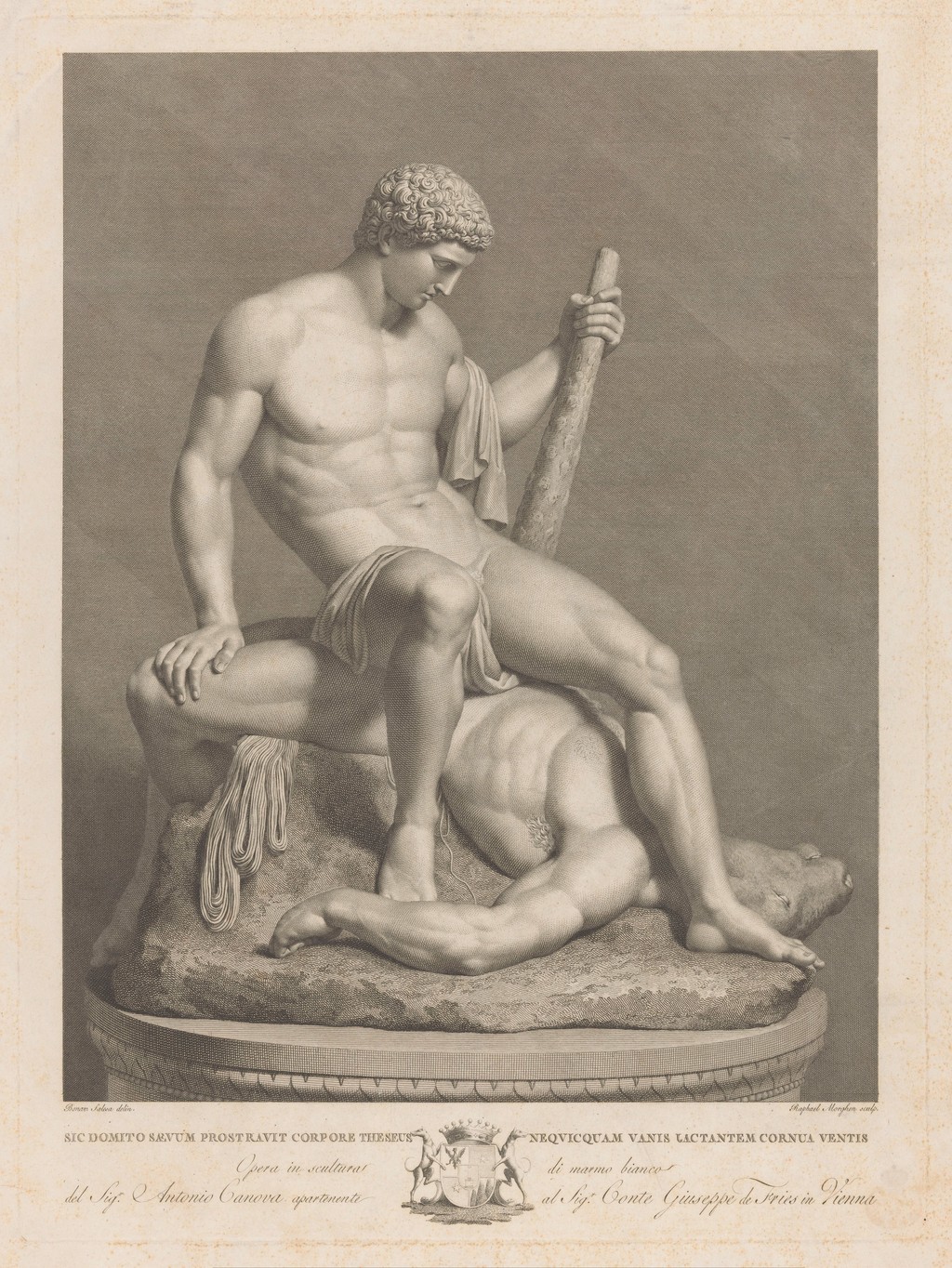
Morghen’s engraving after Canova shows the seated victor above the Minotaur. Rijksmuseum. Image source. Public domain. Resized from source.
The other Theseus in Vienna
Canova returned to the hero in Theseus and the Centaur, a separate commission from 1804. The colossal marble once stood in the Theseus Temple in Vienna’s Volksgarten and is now on the grand staircase of the Kunsthistorisches Museum. The opponent has a man’s upper body joined to a horse’s body. Theseus bears down with his knee and raises his club, and the centaur strains beneath him. The plaster at Possagno preserves the grip and the compressed posture, and the museum catalogue describes its original club as missing. [12] [13]
In Vienna the uplifted arm gives the struggle its height and makes a downward blow imaginable. In London the corresponding weapon stays close to the seated body. The Minotaur’s bent arm lies on the ground, and the folds of cloth and thread descend around it. The contrast shows the importance of the instant chosen for the earlier group. Canova was able to make violent motion legible in stone. For the Minotaur he made the end of that motion the event a viewer spends time with. [1] [12] [13]
Explore Canova’s works
Browse the sculptures and paintings covered in this guide. Several entries compare versions or examine details of a larger work.
Discussion
Look again at the images and ideas explored in Theseus and the Minotaur. These editorial prompts invite your observations.
Reader Insights
What does Theseus’s seated pose tell you about the moment Canova chose?
What does Morghen’s engraving emphasise about the group?
Join the Conversation
Share a detail, comparison or question about Theseus and the Minotaur below.
References
- Victoria and Albert Museum, Theseus and the Minotaur, marble, Rome, 1782, A.5&A-1962. View source.
- Fondazione Federico Zeri, Canova Antonio, Teseo sul Minotauro, Fototeca Zeri record 81865. View source.
- Museo Gypsotheca Antonio Canova, Theseus and the Minotaur, plaster, 1781, inventory 4. View source.
- Ovid, Metamorphoses, book VIII, lines 152–182, translated by A. S. Kline, Poetry in Translation. View source.
- Apollodorus, Epitome, 1.8–9, translated by Sir James George Frazer, University of Victoria, Mythology and Literary Theory. View source.
- Victoria and Albert Museum, Antonio Canova – an introduction, updated 17 April 2024. View source.
- Museo Correr, Sale Neoclassiche e Collezione canoviana, section on Dedalo e Icaro. View source.
- National Gallery of Art, Canova: Sketching in Clay, exhibition announcement, 10 February 2023. View source.
- Rijksmuseum, Raphael Morghen after Buenaventura Salesa and Antonio Canova, Theseus en de Minotaurus, engraving, RP-P-OB-36.554. View source.
- Metropolitan Museum of Art, Raphael Morghen after Buenaventura Salesa and Antonio Canova, Theseus, holding a club in his left hand, seated atop the conquered Minotaur, engraving, third state, 1787, 47.100.442. View source.
- Art Fund, Theseus and the Minotaur, acquisition grant record, 1962. View source.
- Museo Gypsotheca Antonio Canova, Theseus Defeating the Centaur, plaster, 1805, inventory 163. View source.
- Kunsthistorisches Museum Wien, Reopening of the Theseus Temple, museum announcement, 24 April 2012. View source.


 Antonio Canova.jpg)

