



 by Tom Gurney
Tom Gurney BSc (Hons) is an art history expert with over 20 years experience
Published on June 19, 2020 / Updated on November 13, 2026
Email: tomgurney1@gmail.com / Phone: +44 7429 011000
Self Portrait (Painting, 1792): Introduction
Antonio Canova sits with his body turned towards the right edge of the canvas. A long brush passes diagonally through his raised fingers, its tip near the edge. His shoulder is still turned towards the work, but his face has come round and his eyes meet ours. A white cravat, the curve of his cheek and the back of his hand catch the light against a brown ground. The Uffizi painting shows the sculptor at work as a painter. [1] [2] [3]
The portrait is an oil on canvas, 68 centimetres high and 54.5 wide. The Fondazione Zeri catalogue identifies it by the Uffizi’s 1890 inventory, number 1925, and dates it to about 1792. The Museo Gypsotheca Antonio Canova also gives 1792, as did the checklist for the Uffizi portrait exhibition held at the Istituto Veneto in 2007. The art historian Massimo Ferretti dated the canvas to 1790 in his biographical entry on Canova. Both dates put the painting in the early part of the decade in which Canova’s major commissions in Rome drew increasing attention to his sculpture. [1] [3] [4] [5]
Self Portrait (Painting, 1792) Antonio Canova
At a Glance
- Artist and subjectAntonio Canova, shown holding a painter’s brush. [1] [2] [3]
- Medium and sizeOil on canvas, 68 × 54.5 cm. [1] [4]
- CollectionGallerie degli Uffizi, Florence, inventory 1890 no. 1925. [1]
- DateAbout 1792 according to the Fondazione Zeri, with 1790 given in Ferretti’s biography. [1] [5]
Contents
- A brush held at the edge
- Painting while working in marble
- How the painting reached Florence
- Canova with a mallet and in marble
A brush held at the edge
The raised hand occupies very little space relative to the coat. Its narrow silhouette is nevertheless easy to follow, from the cuff to the knuckles and along the fingers almost to the frame. The fingers gather close to the working end of the brush, leaving its shaft visible below. That thin diagonal runs in the opposite direction to the white folds of the cravat, which descend across his chest. The two lines make the face and hand feel like parts of the same action. The head turns towards us while the hand keeps its place by the surface he is about to touch. [1] [2]
Most of the composition is given to the sitter. At the far right, the raised hand and a narrow plane leave just enough room to suggest what he is painting on. We have no clear view of a picture taking shape there. The object we can examine is the one in front of us, where he has already used the brush to give shape to the face, the fingers and their surroundings. The nearness of the frame makes the hand seem to continue its task just outside the scene. The unseen work gives the pose a direction without drawing the eye away from the painter. [1] [2] [6]
The light is strongest on the forehead and down one side of the nose. The cheek passes gradually into the brown around it, and the hair breaks that edge into a few irregular curls. The lips part slightly, with a line of warm colour catching the eye below the stronger contrasts at the brow. Because the far side of the face is held in shadow, the two eyes are lit unevenly. That difference registers the turn of the head even before we have looked down to see how far the shoulders are angled away. [1] [2]
The coat fills the lower part of the canvas. A row of buttons and the turn of the sleeve give form to the near arm, while the broad area around the shoulder is much quieter. At the neck, the folds of white cloth are separately visible against the dark collar. A curved stretch of brown at the opposite edge suggests the back of his chair. Canova gives us enough of the seat to locate the body and enough of the sleeve to follow the raised arm. Much of the setting can stay in shadow because those few forms explain how he is sitting. [1] [2]
Videos on Canova
Explore Canova’s workshop methods and the settings for his sculpture.
From Sketch to Stone | Canova: Sketching in Clay
Watch sculptor Fred X. Brownstein recreate a Canova Venus, using clay, plaster and marble.
Watch on YouTubePainting while working in marble
Around the time of the portrait, Canova was completing one of his largest commissions, the monument to Pope Clement XIII in St Peter’s. It was unveiled in 1792. The tomb requires a viewer to look up from the doorway and reclining lions to a pope kneeling high above. In the canvas, a turn of the head and a movement of the hand fit within the space a viewer can take in at once. The portrait gives painting a place in Canova’s working life at a moment when commissions on the scale of the tomb were making his name. [5] [6] [7]
Canova’s paintings of this period included experiments with the handling of colour in Venetian art. Fernando Mazzocca has traced the story of a separate painting Canova made in the manner of Giorgione and presented as a likeness of that artist. Its soft transitions between face and shadow make a comparison with the Uffizi canvas possible. The subjects are different. In the Florentine picture the fingers poised around the brush belong to a man making his own likeness. In the Giorgione painting Canova worked out how to suggest a face and a period known through earlier images. [6]
The finished canvases also show how differently Canova could arrange his small areas of light. In the Uffizi portrait, the face, cravat and raised hand make three separate passages across the composition. In the painted likeness of Giorgione, the face and illuminated fabric sit nearer the centre. The difference is particularly clear at the edges. The end of the brush in the Uffizi picture seems to lead beyond the frame, while the sitter’s dark sleeve takes up the space below. [1] [2] [6]
How the painting reached Florence
An early account of Canova’s works records that he gave the painting of himself at work to Senator Giovanni degli Alessandri and that it was placed in the Florentine gallery. Their association is also visible in Canova’s correspondence. The National Edition traces their exchange to negotiations in 1803 over a replacement for the Medici Venus. Degli Alessandri later appears prominently in a study by Pietro Benvenuti for a painting of Canova modelling a portrait of Elisa Baciocchi. In the Uffizi self-portrait, the painter had left the rest of the room empty. Benvenuti puts the sculptor in a room of spectators, among them the man who received Canova’s canvas. [8] [9] [10]
The portrait entered a collection that had been growing since Cardinal Leopoldo de’ Medici began assembling artists’ likenesses in the seventeenth century. The gallery’s sculpture of Leopoldo by Giovanni Battista Foggini was commissioned by Cosimo III to honour his uncle when the inherited self-portraits were given their own room. Centuries later the Uffizi showed a selection in the Vasari Corridor, the setting recorded by the Zeri catalogue for Canova’s canvas. The Uffizi opened a new suite of rooms for the collection in 2023, arranged chronologically and with provision to rotate works. In such a collection, the brush is one of the ways an artist can tell visitors how to read a likeness among many other faces. [1] [11] [12]
Canova with a mallet and in marble
In his second painted self-portrait, dated 1799 by its inscription, Canova faces out squarely. He wears a brown coat with broad lapels and a patterned neckcloth. A pale sculpted head enters from the lower left, and a dark mallet rests in his hand. The face remains directly engaged with the viewer, while the tools and the work gather below it instead of reaching beyond the edge. The Possagno museum calls this canvas Self-Portrait as Sculptor. Conservation there revealed two painted faces beneath the visible portrait, evidence that Canova worked over a surface already in use. [3] [13] [14]
The sculpted self-portrait of 1812 changes where the likeness meets the viewer. The head tips upwards and turns to the side, and its eyes look above a person standing in front of it. In the plaster at the Accademia Nazionale di San Luca, the bare neck continues down to the cut of the bust, leaving the turn itself to give the figure its movement. The Florentine canvas establishes a different relationship with a viewer. Its eyes come round to meet ours, and the hand holding the brush keeps the other direction in view. We see Canova both looking at us and still attached to the task from which he has turned. [1] [2] [3] [15]
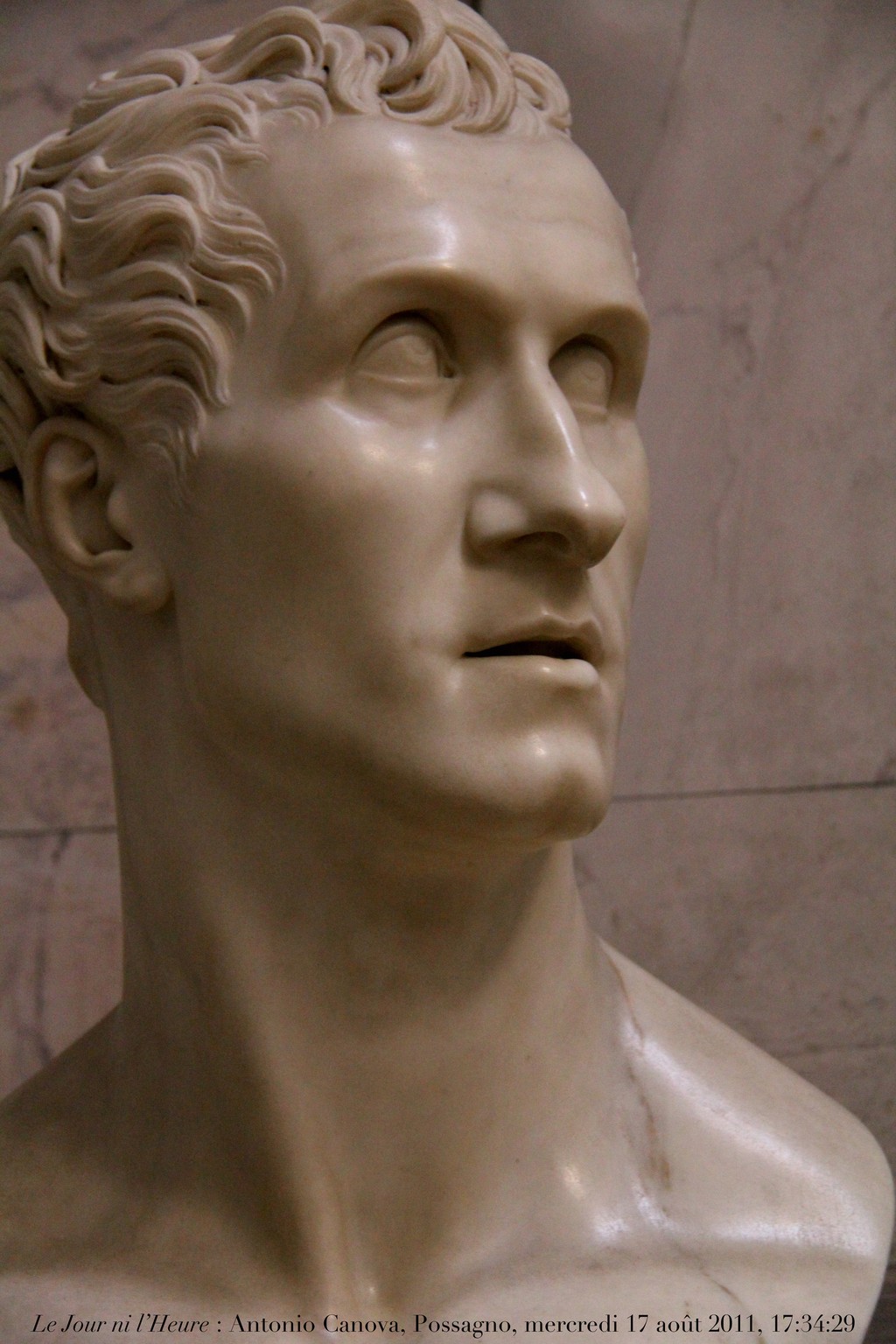
The sculpted self-portrait at Possagno gives a later view of Canova’s features. Renaud Camus. Image source. CC BY 2.0. Resized from source.
Explore Canova’s works
Browse the sculptures and paintings covered in this guide. Several entries compare versions or examine details of a larger work.
Discussion
Look again at the images and ideas explored in Self Portrait (Painting, 1792). These editorial prompts invite your observations.
Reader Insights
What do the hands and clothes tell you about Canova’s choice of role?
How does the painted gaze compare with the sculpted self-portrait?
Join the Conversation
Share a detail, comparison or question about Self Portrait (Painting, 1792) below.
References
- Fondazione Federico Zeri, Autoritratto di Antonio Canova, catalogue 94628, with the Uffizi inventory number and historical photographs. View source.
- Francesco Bini, Antonio Canova, autoritratto, 1792, photograph of the framed Uffizi painting, 7 February 2024. View source.
- Museo Gypsotheca Antonio Canova, Autoritratto, catalogue discussion of the sculpted self-portrait and the two painted likenesses. View source.
- Istituto Veneto di Scienze, Lettere ed Arti, I volti dell’arte dalla collezione degli Uffizi, 2007 exhibition checklist, entry for Antonio Canova. View source.
- Massimo Ferretti, Canova, Antonio, Dizionario Biografico degli Italiani, vol. 18, 1975. View source.
- Fernando Mazzocca, Antonio Canova. L’Autoritratto di Giorgione. Un dipinto ritrovato, exhibition catalogue, introduction and fig. 12. View source.
- Museo Gypsotheca Antonio Canova, Antonio Canova’s Biography, with the date of the monument to Clement XIII. View source.
- Emilio De Tipaldo, ed., Biografia degli italiani illustri nelle scienze, lettere ed arti del secolo XVIII, e de’ contemporanei, entry on Canova, list of paintings, p. 206. View source.
- Edizione Nazionale delle Opere di Antonio Canova, Epistolario, introduction, discussion of the correspondence with Giovanni degli Alessandri. View source.
- Gallerie degli Uffizi, Gli Uffizi e Napoleone, entry on the preparatory studies for Pietro Benvenuti’s painting of Canova modelling Elisa Baciocchi. View source.
- Gallerie degli Uffizi, Portrait of Cardinal Leopold de’ Medici by Giovan Battista Foggini, collection record. View source.
- Gallerie degli Uffizi, The Uffizi Self-portraits, 10 July 2023, on the display history and gallery arrangement. View source.
- Catalogo Generale dei Beni Culturali, Autoritratto, 1799, Possagno inventory 137, national record 0500432565. View source.
- Ministero della Cultura and Museo Gypsotheca Antonio Canova, Autoritratto come scultore, conservation project and photograph. View source.
- Accademia Nazionale di San Luca, Autoritratto, collection record for the plaster self-portrait. View source.


 Antonio Canova.jpg)

