



 by Tom Gurney
Tom Gurney BSc (Hons) is an art history expert with over 20 years experience
Published on June 19, 2020 / Updated on November 13, 2026
Email: tomgurney1@gmail.com / Phone: +44 7429 011000
Napoleon as Mars the Peacemaker: Introduction
Napoleon holds a small figure of Victory in his right hand. She stands on a globe, her wings raised, while his raised left hand grips a long staff. The gilded bronze Victory catches the light differently from the marble figure that holds her. Look first at the space between the globe and his torso. Canova leaves enough air there to give the little figure a clear outline, even though Napoleon stands about three and a half metres high. The marble stands at the foot of the stairs at Apsley House in London. The difference between the two figures comes into focus as you climb. The colossal figure is the portrait. The one that might fit on a table tells you what kind of ruler the portrait claims to show. [1] [2]
Antonio Canova finished the marble in Rome in 1806. Napoleon saw it in Paris in 1811 and kept it from public display. By then people in Milan had already seen the design at full size in plaster. Today there are two versions to find at the Palazzo di Brera. The bronze stands in the open courtyard and the plaster is inside the picture gallery. A separate plaster survives in Canova’s home town of Possagno. The same pose had very different fortunes as a portrait of the reigning emperor, an image of authority in his Italian kingdom and a work of art in the home of the man who defeated him. [1] [2] [3] [4] [5]
Napoleon as Mars the Peacemaker Antonio Canova
At a Glance
- ObjectPurchased for Britain in 1816
Contents
- A ruler with Victory in his hand
- From the First Consul to the marble in Paris
- Two colossi in Milan
- The purchase and the staircase
- Another bronze for a different emperor
A ruler with Victory in his hand
Start with the feet. One leg takes the figure’s weight while the other eases away, its knee relaxed. The hips tilt and the upper body opens out towards the bent arms. Canova makes the figure stable enough to hold its position and loose enough to seem capable of moving out of it. The raised left arm forms a high arch between the head and the long staff. On the other side the forearm extends at a lower level. That difference in height keeps the two arms from making a symmetrical display of the ruler’s emblems. Follow the upright staff down, then look across the body at the much smaller globe. One gives you the height of the figure, while the other asks you to look beyond its outline. [1] [2] [5]
Canova puts nearly all the cloth on the shoulder of the raised arm. From the front, the folds give that side a heavier outline, leaving much of the torso in view. The cloak suggests military dress through one recognisable part of it. The bare torso and legs belong to the classical tradition of the heroic nude, which gave gods, heroes and rulers a body suited to their elevated status. Here the broad chest, controlled turn and easy balance make command look like a physical quality. The head has a different job. The close cap of hair and the features preserve enough of Napoleon’s likeness to identify a man whose appearance could be recognised independently of the figure he plays. [1] [2] [5]
Mars is the Roman god of war. The Greek name Nike and the Latin name Victoria both identify the winged personification in the ruler’s hand. Her wings suggest that she has just alighted or could take flight, an uncertainty made sharper by the steady palm beneath her. The upright staff makes a sign of command out of a spear-like form. The globe gives that command a reach beyond the space immediately around the ruler. The title calls him a peacemaker, but the terms of peace are visible in the attributes. The little figure standing on the world is Victory. Peace in this portrait is the order a successful commander claims the right to establish. [2] [3] [5]
At the Palazzo di Brera, a painting made for a public competition shows another way of presenting the same ruler as a bringer of peace. Giuseppe Bossi’s Gratitude of the Italian Republic to Napoleon, which won the competition in 1802, shows the seated Bonaparte extending a branch of olive mixed with oak towards the personification of the republic. Bossi explained the two plants as signs of peace and lasting strength. A recipient stands ready to receive the gift. In Canova’s portrait there is no corresponding figure. Victory is poised in Napoleon’s palm, facing out from a gesture he can sustain without anyone approaching him. Bossi makes the relationship between the ruler and a particular republic legible through an exchange. Canova leaves the sphere of Napoleon’s authority as wide as the globe he holds. [6] [7]
The visual tension depends on scale as much as on myth. Napoleon’s head is high enough that the face takes time to inspect from floor level. His right hand, though still well above the viewer, is extended into the intervening space. At one angle the globe reads clearly while Victory’s wings and body come together in silhouette. At another the figure stands out and the hand that supports it becomes easier to see. The small emblem rewards a change of position as much as the large body does. The advantage of the London staircase is that it brings the viewer gradually up towards the details the first view gives only in outline. [1] [2]
From the First Consul to the marble in Paris
Napoleon was First Consul when Canova went to France to work on his likeness in 1802. The visit gave the sculptor material for a portrait in consular uniform and for a classical head developed from it. The history of the busts of Napoleon Bonaparte follows that likeness into a series of objects in different materials. A bust cuts off most of the body and can make costume, the direction of the head and the features carry the whole identification. The statue puts the recognisable face on a body whose proportions and pose belong to antiquity. By the time Canova completed the marble in Rome, Napoleon had become emperor. [1] [2] [8]
The statue also survives in a form small enough to study across a room. The Museo Revoltella in Trieste owns an 86-centimetre plaster, inventory 804, which it identifies as a probable cast after Canova’s lost terracotta sketch. At that height the relation of the arms to the body can be taken in at a glance. The Revoltella reports that an ivory-coloured coating was applied in the nineteenth century to give the plaster a marble-like appearance and cover reddish traces left by the clay. The museum also holds a bronze reproduction of the small figure. This plaster belongs to a different stage from the one at Brera. Its probable source was an early clay study. The Milan cast transmits the full-size design once it had reached marble. [4] [9]
An indoor place among ancient sculpture was discussed well before the marble left Italy. In 1803 the French ambassador in Rome, François Cacault, envisaged it in a museum amid ancient masterpieces. In 1806 Vivant Denon, the director of the Musée Napoléon, proposed the position of the Laocoön as a place where the statue could make an immediate impression on visitors. Such a placement would have invited a comparison across the gallery. A visitor could have looked from an ancient body to a new one and judged both the sculptor’s achievement and the political claim made for the man whose head he had carved. [2]
The marble left Rome in June 1810. The correspondence follows a shipment that was still struggling through France in the winter. In February 1811 Denon reported difficulties with flooded or frozen waterways, and in a note dated 16 March he informed Canova of its arrival in Paris. Canova was also concerned about how the figure would be lit. Through the writer and theorist Antoine-Chrysostome Quatremère de Quincy he sought the painter Pierre-Paul Prud’hon’s advice and asked for light from as high above the statue as possible. Light from above would help the raised arm and its drapery read as distinct forms while carrying down across the broad areas of the chest and legs. [10]
Napoleon saw the work in April 1811. English Heritage records his judgement that it was “too athletic”. The reaction has a contemporary paper trail. Denon wrote to Canova on 15 April, and Quatremère de Quincy’s letter of 3 May reported the imperial visit and the order to keep the statue from public view. The order put an end to the museum display Canova and his supporters had envisaged. By 1814 the marble was concealed behind a screen in the museum. [1] [2] [10] [11]
In a portrait in uniform, the insignia and cloth can establish a rank the sitter actually held. Canova’s marble puts the claim to authority into an imagined physique and a god’s attributes. Napoleon’s response shows how much the success of that approach depended on his willingness to let the public see the comparison. The very decision that gave Canova scope to make a monumental figure in the antique manner also made it harder for Napoleon to control how the public might see his likeness. [1] [2] [5] [11]
The image circulated on paper even as the fate of the marble was in doubt. In August 1809 Antonio Ricciani undertook to engrave the statue from Giovanni Tognolli’s drawing. The surviving sheet in Possagno credits the sculptor, draughtsman and engraver separately, and the National Edition reproduces an impression dated 1811. In an engraving, the light and shadow that suggest the roundness of a thigh or the set of a shoulder have already been chosen. The viewer of the print has a single view and can examine the whole pose without moving. The scale that made the marble a problem for shippers and gallery designers made very little difference to the movement of an impression on paper. [10] [12] [13]
The history of the copperplate has its own record of Napoleon’s response. The Istituto Centrale per la Grafica traces Canova’s unrealised intention to dedicate the print to Napoleon, a subsequent dedication to the Republic of San Marino, and the eventual removal of that dedication from the plate. The version preserved in Possagno and the impression catalogued by the institute belong to the history of these changes. The emperor had the power to prevent the marble from being shown in a state museum. The engraving could still give readers a clear idea of the figure and carry Canova’s name beyond the places where the large versions were exhibited. [12] [13]
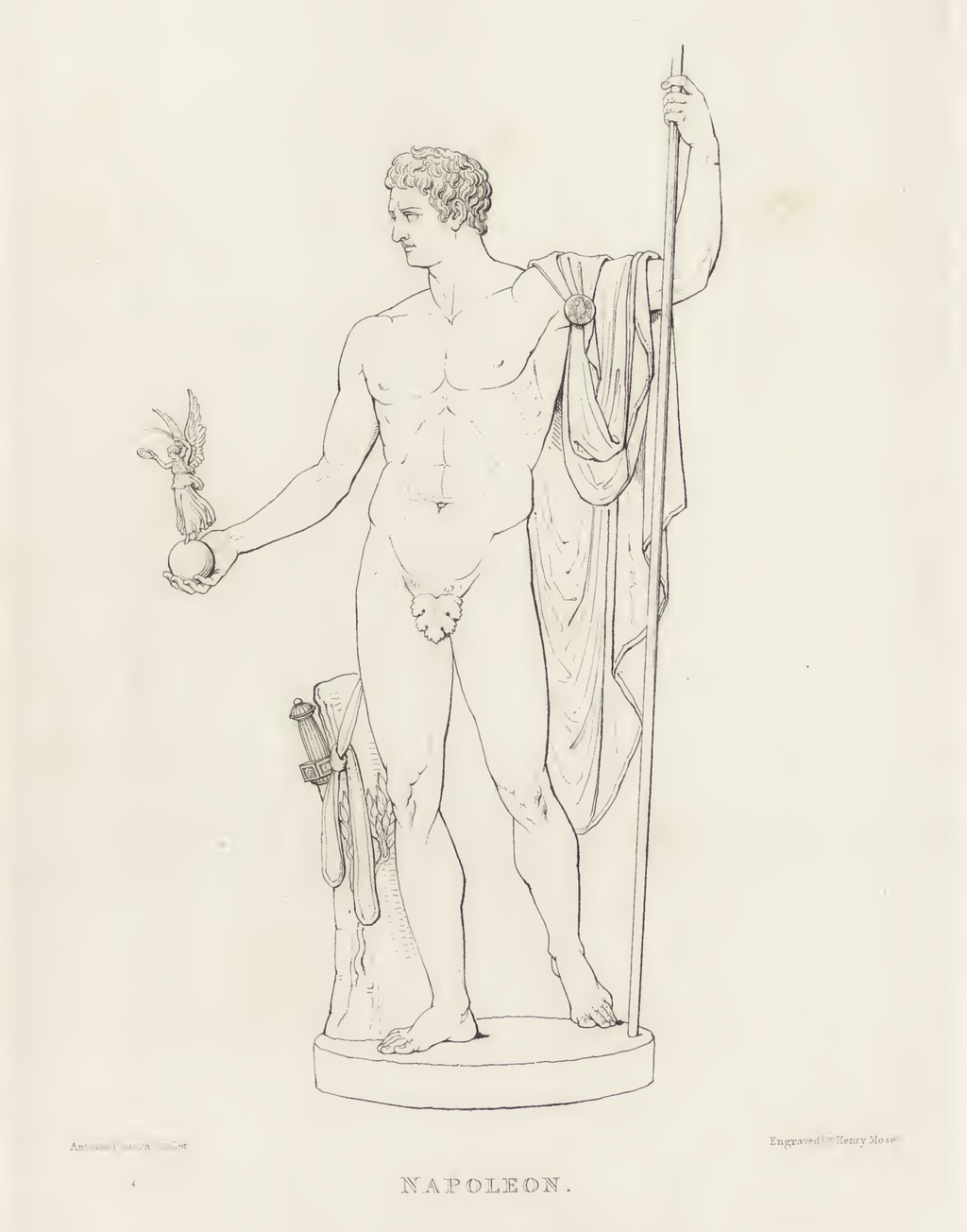
Moses’s engraving sets off the small Victory against the empty paper beside Napoleon. Henry Moses, after Antonio Canova, engraving published in London, 1824. Getty Research Institute. Image source. Public domain. Scan margins trimmed and image resized.
Videos on Canova
Explore Canova’s workshop methods and the settings for his sculpture.
From Sketch to Stone | Canova: Sketching in Clay
Watch sculptor Fred X. Brownstein recreate a Canova Venus, using clay, plaster and marble.
Watch on YouTubeTwo colossi in Milan
Eugène de Beauharnais, Napoleon’s stepson and viceroy in the Kingdom of Italy, commissioned the bronze version in 1807. The Righetti foundry in Rome undertook the casting. Brera records that the metal came from cannons at Castel Sant’Angelo and that it took two attempts to produce the statue. That history gives the bronze a particular relation to the subject. Metal that had served as artillery became the surface of a figure who represents peace as the outcome of military victory. The finished bronze reached Milan in 1812. [3] [6]
The workshop accounts add some precision to the foundry story. The National Edition records payments to Francesco and Luigi Righetti in early 1808 and the arrival of Malpieri’s plaster at their workshop on 12 March. By August they had received 5,100 scudi of the 9,000 agreed for the casting. The editors describe a first attempt by the end of 1808 that failed, followed by further financing and a successful casting in the autumn of 1809. Published dates for the bronze differ. The accounts distinguish the expense and risk of producing the object from its arrival in Milan. The completion of the marble in 1806 settled the design, but the foundry still had to work out how to realise it at full scale in a new material. [3] [4] [14]
The plaster had the earlier public life. Brera dates it to 1808 and identifies it as a cast taken from the mould made in preparation for the bronze. Its exhibition dossier names Vincenzo Malpieri as the maker of a set of five casts. The one now at Brera was intended for the university library in Padua. The purchase there fell through, and the cast stayed crated at the customs warehouse. The viceroy bought it for the Royal Academy of Fine Arts in February 1809, and it reached Milan that April. The new Pinacoteca formally opened on 15 August, Napoleon’s fortieth birthday, with the plaster installed in its new galleries. A figure made through a process of replication could still occupy the place of honour. From the other end of a gallery, a visitor would see the vast silhouette and the gleam of its finish before getting near enough to inspect the material. [4] [6]
Michele Bisi’s 1812 engraving of a Brera interior records how the plaster took its place in the early gallery. The Lombardy catalogue identifies the statue in the background and records the impression as one of thirty copies made for the viceroy. The room occupies most of the sheet. The statue’s scale comes through in its relation to the people and architecture around it. Put that view beside Ricciani’s and the two uses of an engraving become clearer. Ricciani gives the reader the sculpture to study on its own. Bisi gives the plaster a place in the life of the new museum, where a visitor could see it among paintings and other people. [6] [12] [15]
The plaster also preserves evidence of the way the gallery intended visitors to see it. Brera’s bicentenary research describes a polished surface and dark gold effects on the original globe, staff and Victory. The pedestal imitated red porphyry. Light filtered from above through a ceiling veil, and a high base gave the figure room to project into the viewer’s field of vision. The plaster was removed from the Napoleonic galleries in 1814 and remained at the Academy. When it returned to the Pinacoteca’s rooms in 2009 after restoration, Brera drew on the evidence of that first arrangement. Its catalogue records losses and replacements to the attributes. The cast’s finish and losses help explain why it looks different from the marble even where it preserves the same folds and muscles. [4] [6]
When Daniele Angellotto restored the plaster under Matteo Ceriana’s direction, part of the work concerned the objects around the body. The team recovered the shape and red colour of the pedestal, where a motto from Horace had been painted to look like raised lettering. Brera reports that only the forms of the letters could be recovered. A replacement sword addressed a separate loss. In the 2009 dossier the missing Victory still posed a problem, and the museum identified the surviving figure on the London marble as a possible source for a new cast. The material that gave the statue its smooth outline could be cleaned and studied, while the lost words and attachments had to be understood through other evidence. [6]
Getting the plaster back into the gallery was itself part of the work. Brera records four days of handling, a crane, multiple forklifts and a specially engineered support for the floor. It is a practical counterpart to the earlier installation at Apsley House, where Wellington strengthened the floor below the marble. A plaster can be reproduced in a way that a marble must be carved afresh, but at this size either one needs a building that can receive and support it. The restored pedestal lifts the figure into the light and recalls the colour contrast the museum’s first visitors would have seen. [6] [16]
A plan discussed in 1812 would have placed the bronze in a courtyard of the Palazzo del Senato, where its designers considered the sightlines from the street and inside the court. The proposal went unrealised. The bronze eventually went up at Brera in 1859, when French support under Napoleon III had helped end Austrian rule in Milan. Brera’s account distinguishes the temporary mounting in 1859 from the formal inauguration in 1864. The eagle-decorated pedestal designed by Luigi Bisi lifts the figure high enough for the whole composition to register across the courtyard. By then a statue commissioned under Napoleon I could mark the city’s encounter with the France of his nephew. [3] [6]
In the courtyard the staff and the outward bend of the other arm still organise the same pose. But daylight on bronze can make the edge of the shoulder bright while the torso stays dark, and from farther back the columned court gives the figure a fixed architectural frame. Moving round it changes the background as well as the overlaps among the attributes. The winged Victory there today is a replacement for the one stolen in 1978. The large form may dominate the courtyard, but a small, separately made detail can change what a visitor sees of its central idea. [3] [6]
The bronze’s surface records a history of exposure very different from the plaster’s. Conservation scientists documented a bright green area on the shoulder that rain could reach and a glossy black surface in a place sheltered by the cloak. Copper corrosion products accounted for some of the green, while analysis found residues of earlier acrylic and wax treatments in sheltered areas. In some places where rain did not wash the surface, particles had accumulated in dark crusts. The team compared laser-cleaning trials on separate patches and checked colour, chemical composition and effects on corrosion. This was a way to test how much could safely be removed without treating every colour difference as the same problem. Two areas just a short distance apart had weathered differently because the cloak changed the path of the rain. [17]
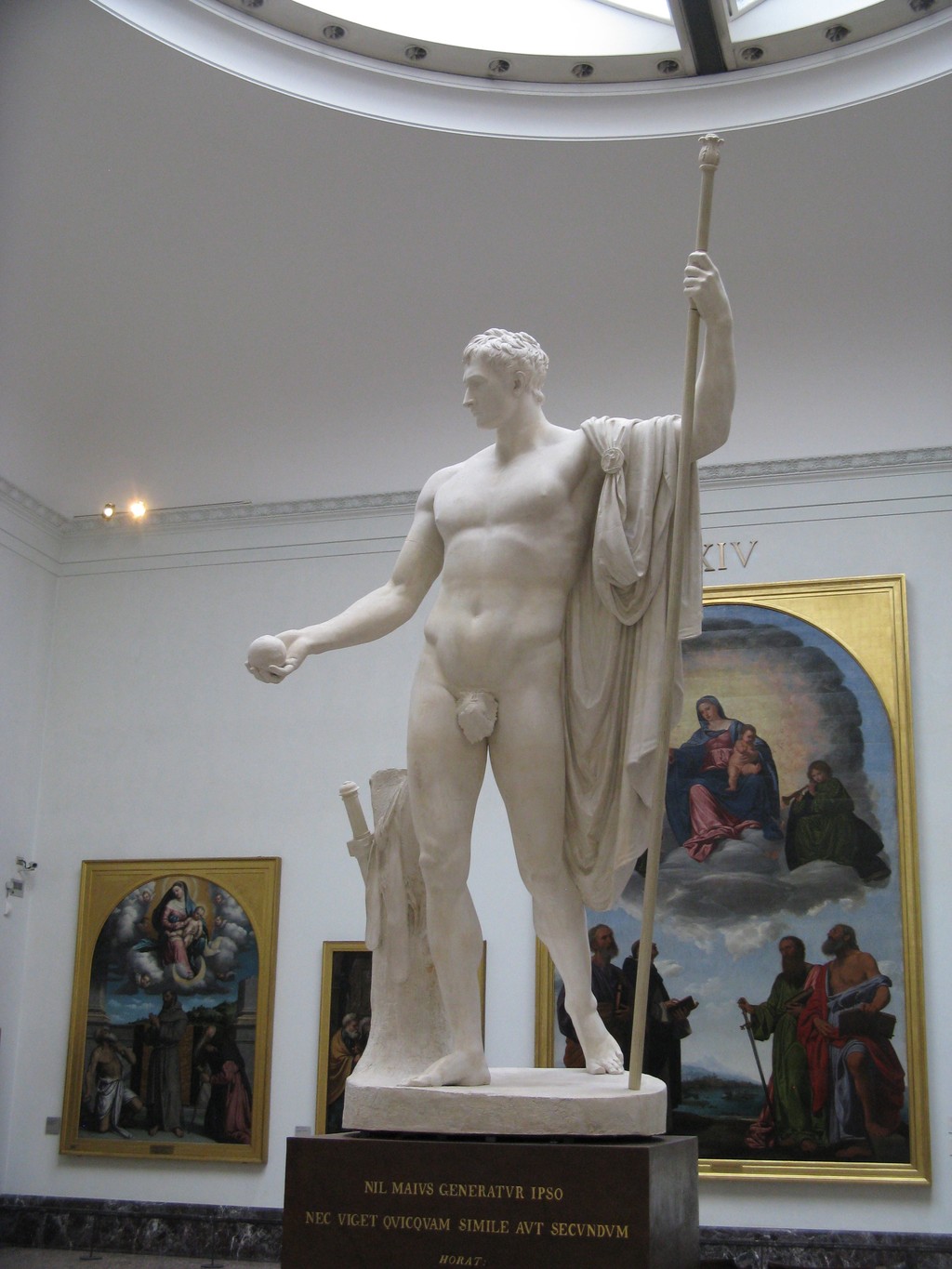
The full-size plaster in the Pinacoteca di Brera stands indoors beneath the gallery skylight. Palazzo Brera, Milan. Photo by Yair Haklai. Image source. CC BY-SA 3.0. Resized from source.
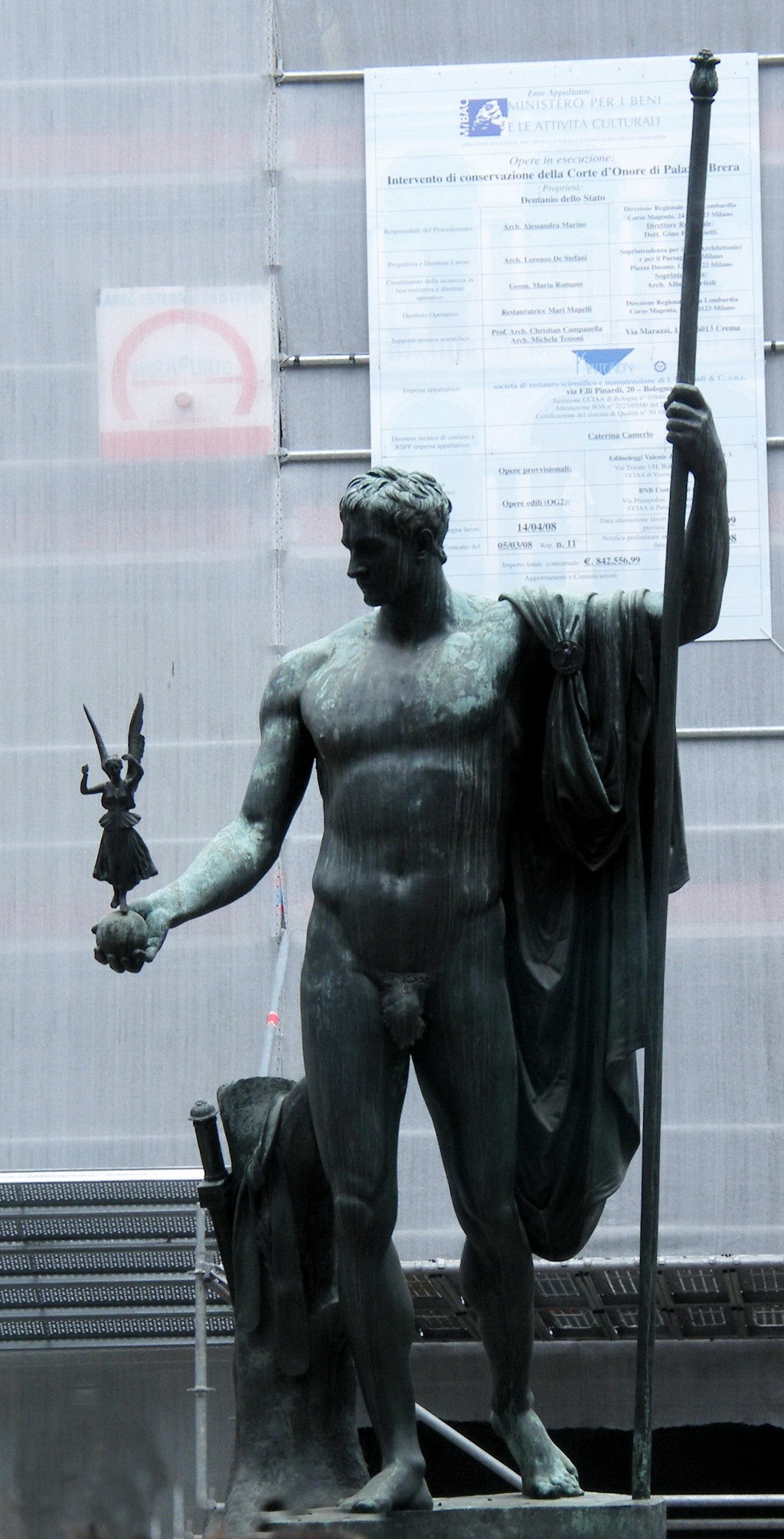
The Righetti bronze after Canova stands outdoors in the courtyard of Palazzo Brera. Palazzo Brera, Milan. © 2009, Pilise Gábor. Image source. CC BY-SA 3.0. Resized from source.
The purchase and the staircase
After Waterloo in 1815, Canova returned to Paris to recover works of art removed from Italy under Napoleon. Wellington supported the restitution effort. The colossal marble had a different status from the antiquities Canova sought. It was a modern work made for Napoleon, and it passed to Britain through a negotiated purchase. In 1816 the British government bought it from Louis XVIII for 66,000 francs. The Prince Regent presented it to Wellington that year. The statue reached Apsley House in 1817, after its arrival in London the previous year. [1] [2] [18]
Bringing a sculpture of this size into a house changed the house. Contemporary reporting records workmen building a temporary platform to get it from the courtyard into the hall. Accounts for the installation record a pier to carry the load below, where the Wellington Collection identifies the wine cellar. The stairwell gave the statue more space overhead and offered guests a succession of views as they went upstairs. It also kept the marble close to the threshold of the Duke’s reception rooms. [2] [18] [16]
The setting provoked different responses. Johann David Passavant, writing in 1836, recalled first seeing the statue at the Louvre and described it as a conspicuous sight amid the sculpture on Wellington’s staircase. Gustav Friedrich Waagen thought the space gave the viewer too little room to see it properly. Both responses make sense in the room. From the lower hall the marble can seem almost too big for the space allotted to it. From the stairs you can approach the raised arm and torso at levels impossible to reach from the floor of a gallery. The narrowness that one viewer found uncomfortable is part of what gives the encounter its force. [2] [16]
The statue’s presence in Wellington’s house naturally invited a reading as a trophy. The subject once ruled France, and his defeat made the purchase possible. The setting also belongs to the history of sculpture collecting. Wellington acquired antique marbles and displayed Canova’s work along the route into his collection. Canova himself gave him a head of a dancer in gratitude for his help with restitution. The household setting could therefore honour the work of the sculptor while reminding visitors of what had happened to his original patron. The marble still presents Napoleon at the height of his power, even as the place where you see it tells the story of his defeat. [2] [16]
The Prince Regent also commissioned Canova’s Mars and Venus in 1815 as a separate allegory for Carlton House. There the war god wears a helmet and turns towards Venus. A shield and sheathed sword sit lower down beside the figures, and the relationship between the two bodies carries the action. In the earlier portrait Napoleon holds Victory in front of him as a sign of his own command. In the later group the way Mars responds to another figure gives peace its form. The same British patron who presented Napoleon’s marble to Wellington asked Canova to give the aftermath of Waterloo an image of its own. [18] [19]
Another bronze for a different emperor
In 1858 Archduke Maximilian commissioned Giovanni Pandiani to make a new bronze after Canova’s design, intended as a gift for Napoleon III. The French alliance with the Kingdom of Sardinia against Austria ended that plan. The sculpture went to Maximilian’s estate at Miramare near Trieste, where it stands in the park. At Brera the older bronze had been commissioned under Napoleon I and finally taken into the courtyard in the year of his nephew’s victory in Lombardy. Pandiani’s adaptation was made in the hope that the image of the first Napoleon could help cultivate the goodwill of the second. In both cases the purpose of the bronze depended on the circumstances of a living ruler, even when the design itself could be copied. [3] [6] [20]
At Miramare the globe is present and the winged figure is absent by design. The national catalogue also records that Pandiani omitted the sword beside the trunk and that the staff was replaced in 1860. Those details help distinguish the work from the bronze at Brera, where the empty place left by the theft of Victory was filled with a replacement figure. The two bronzes share the outline of the standing ruler with one arm raised, but the comparison comes down to the small figure in his other hand. Its absence can be a sculptor’s decision, a record of a theft or a point in the history of a restoration, depending on which object you are looking at. [3] [20]
Explore Canova’s works
Browse the sculptures and paintings covered in this guide. Several entries compare versions or examine details of a larger work.
Discussion
Look again at the images and ideas explored in Napoleon as Mars the Peacemaker. These editorial prompts invite your observations.
Reader Insights
How does Victory change the meaning of Napoleon’s pose?
What changes when the figure is viewed on a staircase?
Join the Conversation
Share a detail, comparison or question about Napoleon as Mars the Peacemaker below.
References
- English Heritage, “Apsley House Collection Highlights”, Antonio Canova, Napoleon as Mars the Peacemaker. View source.
- Julius Bryant, “How Canova and Wellington Honoured Napoleon”, Apollo, October 2005, pp. 38–43. View source.
- Pinacoteca di Brera, “The Treasures of Brera Palace”, courtyard audio guide. View source.
- Pinacoteca di Brera, Napoleone come Marte pacificatore, 1808 plaster, collection record. View source.
- Museo Gypsotheca Antonio Canova, Napoleone come Marte Pacificatore, plaster, inv. 179. View source.
- Pinacoteca di Brera, Il ritorno di Napoleone. Il gesso di Canova a Brera restaurato, bicentenary exhibition dossier, 2009. View source.
- Catalogo Generale dei Beni Culturali, Giuseppe Bossi, La Riconoscenza della Repubblica Italiana a Napoleone, Accademia di Belle Arti di Brera (in Italian). View source.
- Francesca Sandrini, “Bust of Napoleon, by Canova”, Fondation Napoléon, July 2012, translated by H. D. W. View source.
- Museo Revoltella, Napoleone come Marte pacificatore, small plaster, inv. 804 (in Italian). View source.
- Edizione Nazionale delle Opere di Antonio Canova, Epistolario (1811), vol. XIII, 2019, introduction, pp. XXVII–XXVIII, and index of correspondence. View source.
- Christopher M. S. Johns, Antonio Canova and the Politics of Patronage in Revolutionary and Napoleonic Europe, University of California Press, 1998, pp. 88–109. View source.
- Catalogo Generale dei Beni Culturali, Antonio Ricciani after Giovanni Tognolli, Napoleone Bonaparte come Marte pacificatore, print at Possagno, 0500432649 (in Italian). View source.
- Istituto Centrale per la Grafica, Antonio Ricciani, Napoleone I in veste di imperatore romano, impression S-FC51333 from plate M-1312 (in Italian). View source.
- Edizione Nazionale delle Opere di Antonio Canova, Scritti II, 2014, introduction, pp. XXII–XXIII, workshop accounts and references to pp. 301–302 (in Italian). View source.
- Lombardia Beni Culturali, Michele Bisi, Pinacoteca di Brera: interno, 1812 engraving, H0110-11058 (in Italian). View source.
- English Heritage, “Significance of Apsley House”, principal staircase and collections. View source.
- Antonio Sansonetti, Mario Colella, Paola Letardi, Barbara Salvadori and Jana Striova, “Laser cleaning of a nineteenth-century bronze sculpture”, Studies in Conservation 60, supplement 1 (2015), pp. S28–S33. View source.
- The Wellington Collection, Napoleon as Mars the Peacekeeper, Apsley House collection record. View source.
- Royal Collection Trust, Antonio Canova, Mars and Venus, 1815–19, RCIN 2038. View source.
- Catalogo Generale dei Beni Culturali, Giovanni Pandiani, Napoleone Bonaparte nelle vesti di Marte pacificatore, Miramare bronze, 0600032401 (in Italian). View source.


 Antonio Canova.jpg)

