



 by Tom Gurney
Tom Gurney BSc (Hons) is an art history expert with over 20 years experience
Published on June 19, 2020 / Updated on November 13, 2026
Email: tomgurney1@gmail.com / Phone: +44 7429 011000
The Three Graces Dancing: Introduction
Two dancers lift a wreath over a third. Their raised arms meet at the flowers while their lower arms run across the group at waist height. Behind them a veil rises in a broad arc. The wreath, arms and veil make three curves on different scales, each centred on the woman whose face turns to the right. Lower down, the three dancers are caught in different stages of a step. Antonio Canova puts the moment of crowning above a group that is still moving. [1]
The image shows a detail of the Dance of Venus and the Graces before Mars, a tempera on paper at the Museo Gypsotheca Antonio Canova in Possagno. Fondazione Zeri dates the complete work to 1797–99 and catalogues it together with The Rape of Helen. Each sheet measures 26.5 × 41 centimetres. The detail gives the three women almost the whole field. Part of a torchbearer remains on the left, where he carries the movement of the dance down towards the strip of ground. [1]
The Three Graces Dancing Antonio Canova
At a Glance
- ArtistAntonio Canova. [1]
- Complete workDance of Venus and the Graces before Mars, tempera on paper, dated 1797–99 by Fondazione Zeri. [1]
- CollectionMuseo Gypsotheca Antonio Canova, Possagno. [1]
- Detail shownThree dancers gather beneath a floral wreath and a raised veil. [1]
Contents
- Hands at two heights
- Feet at different moments
- The veil against the dark
- Two ways of joining a group
Hands at two heights
At the top of the group the outside dancers raise their inside arms. The arm on the left passes close to the central head before the fingers reach the wreath. The one on the right follows a longer diagonal from the shoulder. Small pale blossoms and red centres make the circle visible where the hands come together. There is a little dark space between it and the hair below. The figure in the middle keeps her arms low, so the lift belongs to the two women beside her. That division makes it possible to read who is being crowned even before the eye picks out the flowers. [1]
At the waist, the woman in the middle brings one hand across her body to meet the hand of the dancer on the left. On the right, the third dancer reaches in with her lower hand. Her fingers sit where the edge of the veil comes down beside the central arm. The contact on each side looks different. The hands to the left make a small knot of fingers, whereas the reaching hand to the right continues the long line of its forearm. Between them the central forearm runs almost horizontally. It gives the group a low, steady line while the raised arms climb at a slant. [1]
Their faces also turn by different amounts. The two outer dancers lift their chins towards the flowers. The central figure keeps hers closer to level and looks towards the right. Her face leads the eye out of the arc made by the raised arms, towards the neighbouring profile. Below it a gold necklace follows the base of her throat, and its small curve stays visible against the pale skin. Canova gives that face room to turn by keeping the right arm clear of its outline and running a red ribbon out into the dark behind it. [1]
Videos on Canova
Explore Canova’s workshop methods and the settings for his sculpture.
From Sketch to Stone | Canova: Sketching in Clay
Watch sculptor Fred X. Brownstein recreate a Canova Venus, using clay, plaster and marble.
Watch on YouTubeFeet at different moments
Under the left dancer’s pale skirt the legs draw together and then separate again at the feet. One points down and out towards the torchbearer while the other reaches nearer the ground beneath her. The central dancer has a foot set farther forward, where the gold straps of the sandal make the position easy to see. Her other foot is raised beside it. At the right the standing leg makes a nearly vertical line, but the skirt streams towards the edge, following a second leg that continues beyond the detail. In the complete image its pointed foot reaches out towards the musician. [1]
The spacing matters as much as the direction of each foot. At the waist the bodies overlap closely, but below the hems there are narrow openings between the legs. A strip of darker ground lets the viewer distinguish a foot close to landing from one still lifted. The light fabric also gives each movement a different shape. The left skirt falls in long folds that narrow above the feet. The central skirt sweeps across one knee and opens into a row of broken folds picked out with a red border. The green skirt on the right pulls away from the group. Reading the hems from left to right gives a sense of the steps without requiring the dancers to move in unison. [1]
The torchbearer at the left offers a smaller version of the same problem. His lowered foot comes close to the ground while his other leg swings towards the dancers. One raised arm carries the flame, and the other reaches towards the skirt at the edge of the group. The flame and the raised foot pull the figure in opposite directions. That gives the women’s steps a neighbouring movement to answer even in the narrow view. [1]
The veil against the dark
The veil has a wider span than the wreath. Its pale edges rise behind the lifted arms, turn over the flowers and come back down beside the dancer on the right. Several parallel strokes follow the curve. The paint is thin in appearance between the brighter edges, and the dark ground shows through as a smoky colour. The space inside the veil is dark as well, so the eye can still distinguish the wreath and the two arms within it. Above, the floral garland travels horizontally across the sheet. Its regular dips give a measure of how far the veil climbs and how much more abruptly it turns. [1]
Canova’s birthplace museum places the black grounds of his paper temperas in the tradition of Pompeian painting. It also draws attention to the variety of poses he could invent through dance. Here the dark field keeps the veil, lifted arms and narrow ribbons separate from the coloured dresses. It leaves the space around a hand or between two hems open. There is still a strip of earth and grass beneath the dancers, where the light catches the feet and makes it possible to judge their distance from the ground. The painting can suggest lightness because it shows just enough of the surface that the dancers keep leaving. [1] [2]
Two ways of joining a group
The same problems of height and spacing appear in Canova’s Five Dancers with Veil and Crowns, another Possagno tempera. The central figure there raises a wreath in her own two hands. Neighbouring dancers lift the ends of a cloth behind her, while figures farther out hold wreaths apart from the group. The eye has time to travel along the row and register each interval. In the Mars detail the wreath belongs to a shared gesture, and the cloth makes a tighter arc over three overlapping bodies. Placing the two designs side by side shows how the same elements can stretch a dance across a sheet or gather it around one person. [1] [3]
Canova also brought the Graces together in marble. In the Bedford group, interlaced arms and a length of carved drapery bind three upright figures. Walking around the sculpture reveals how the hands meet and how the cloth passes between the bodies. The tempera can give a raised veil the width of the whole group, with a dark opening around the hands that hold the wreath. Here the figures stay in a single view. The eye can move from the tiny flowers above their heads to the toes near the ground, tracing the changes of direction that make the crowning feel like part of the dance. [1] [4]
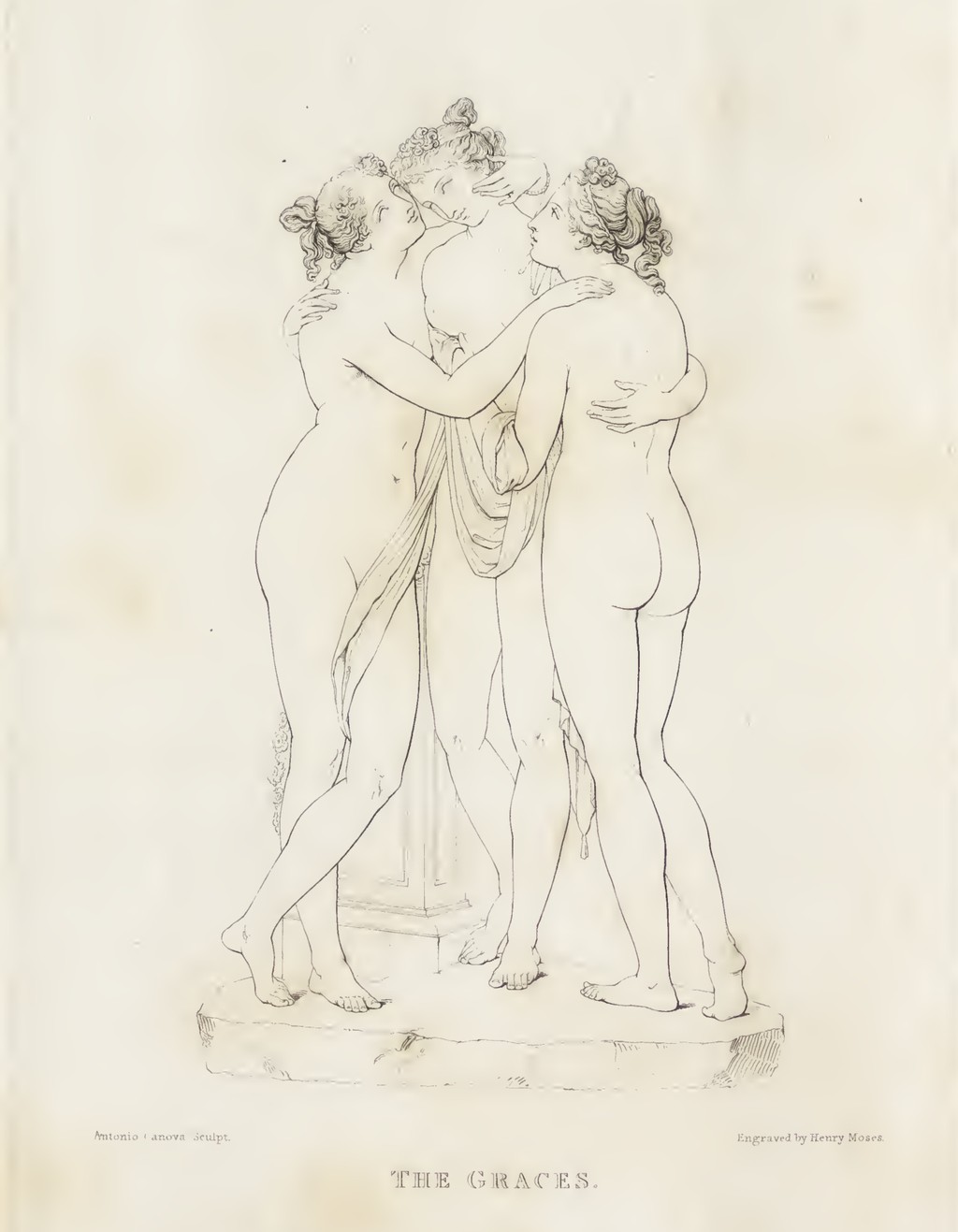
Moses’s engraving of the marble Graces shows the close embrace of the later sculptural design. Henry Moses, after Antonio Canova, engraving published in London, 1824. Getty Research Institute. Image source. Public domain. Scan margins trimmed and image resized.
Explore Canova’s works
Browse the sculptures and paintings covered in this guide. Several entries compare versions or examine details of a larger work.
Discussion
Look again at the images and ideas explored in The Three Graces Dancing. These editorial prompts invite your observations.
Reader Insights
How do the dancers’ linked hands affect your reading of the group?
What can you see in the detail that is harder to notice in the full scene?
Join the Conversation
Share a detail, comparison or question about The Three Graces Dancing below.
References
- Fondazione Federico Zeri, Ratto di Elena, Danza di Venere e delle Grazie davanti a Marte, catalogue entry 94611, with colour and monochrome photographs of the composition. View source.
- Museo Gypsotheca Antonio Canova, Casa natale, section on the paper temperas and their Pompeian background. View source.
- Museo Gypsotheca Antonio Canova, Five Dancers with Veil and Crowns, collection image on Google Arts & Culture. View source.
- National Galleries of Scotland, The Three Graces, Bedford marble, collection record and photographs. View source.


 Antonio Canova.jpg)

