



 by Tom Gurney
Tom Gurney BSc (Hons) is an art history expert with over 20 years experience
Published on June 19, 2020 / Updated on November 13, 2026
Email: tomgurney1@gmail.com / Phone: +44 7429 011000
Letizia Ramolino Bonaparte: Introduction
Letizia Ramolino Bonaparte sits sideways on a chair, with one arm laid over its back and the other hand resting near her knee. Her legs extend towards a low footstool while her face turns out towards the room. The chair and feet give the figure a broad base, and the turn of her head brings attention back to the face. Antonio Canova made the portrait in marble. It now stands in the Sculpture Gallery at Chatsworth House in Derbyshire. [1] [2] [3]
Letizia was Napoleon’s mother and commissioned the work herself during a stay in Rome in 1804. Canova borrowed the seated arrangement from an ancient statue then known as Agrippina. Terracotta studies and a smaller plaster survive from his preparation. They show how he altered the position of the arms and legs before settling on the arrangement that gives the marble its air of ease. [2] [4]
Letizia Ramolino Bonaparte Antonio Canova
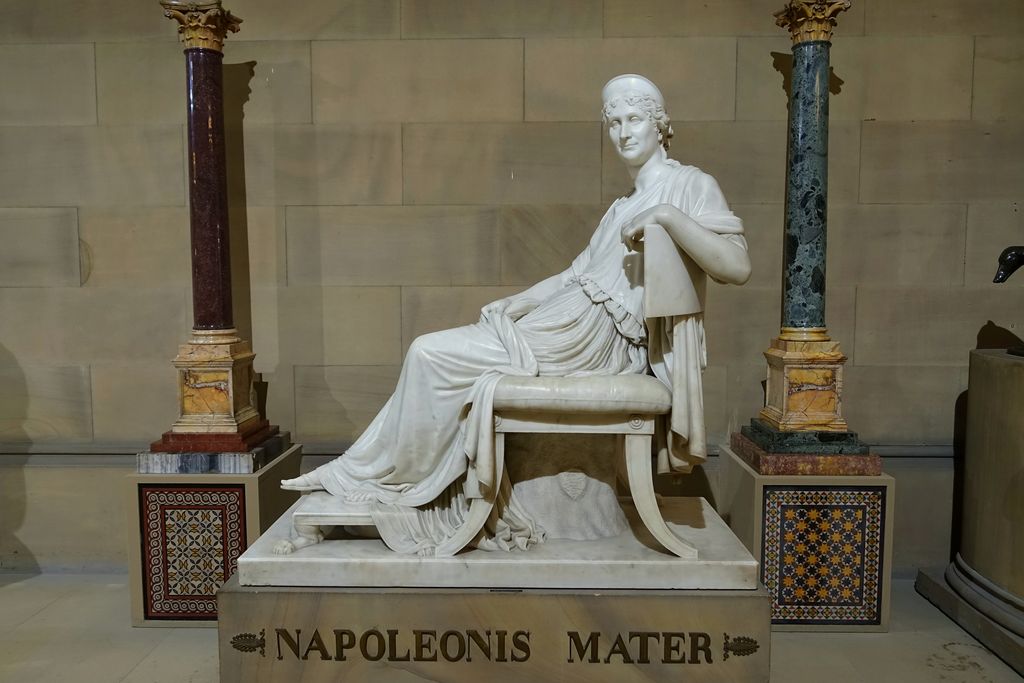
The seated portrait of Letizia Ramolino Bonaparte in the Sculpture Gallery at Chatsworth. Daderot. Image source. CC0 / Public domain. Resized for display.
At a Glance
- Sitter and patronLetizia Ramolino Bonaparte, known as Madame Mère, commissioned her own portrait in 1804. [2] [4]
- Seated marbleCompleted in 1807, Devonshire Collections, Chatsworth. [1] [2] [4]
- Preparatory plasterAbout 1805, Museo Gypsotheca Antonio Canova, Possagno. [4]
Contents
- A figure turning in her chair
- The Roman statue Canova knew as Agrippina
- From clay studies to the Possagno plaster
- From Paris to Chatsworth
- Casts, a print and the separate busts
A figure turning in her chair
The raised hand is one of the smallest gestures in the marble. Letizia’s forearm rests on the covered back of the chair, with the wrist bent and the fingers dropping over the edge. The arm makes a firm diagonal across the fabric before the wrist relaxes. Her other hand meets the cloth where it gathers over the knee. The difference in height between the two hands allows the body to turn without pulling the shoulders level. The face looks away from the line of the legs, as if someone had drawn her attention while she was sitting. [3] [4]
Below her elbow, a piece of fabric hangs over the chair in long folds. Across her lap the same downward movement gives way to a shallow sweep from the waist to the knee. Heavier folds fall below the seat and collect against the footstool. The curved chair legs remain visible behind them. Look at the straight edge of the stool and then at the soft hem just above it. The edge gives the eye a firm line against which to read the changes in direction where the cloth meets the feet. [2] [3]
The chair also sets the scale of the portrait. Its broad seat and splayed legs give the figure room to sit at an angle, with open space beneath the seat. A low support raises the sandalled feet just above the plinth. Together the seat and footstool form two levels, and the drapery passes from one to the other. Higher up, the smooth plane of the cheek makes the curls against her forehead more distinct. The National Gallery of Art’s exhibition account notes how Canova varied the finish of the hair, skin and garments. Shadows in the carved hair and folds give those surfaces a different weight from the face and forearm. [3] [4]
The Roman statue Canova knew as Agrippina
In Canova’s day the ancient seated woman at the Capitoline was known as Agrippina. The Capitoline Museums now call her Helena, mother of Constantine. The National Gallery of Art identifies this as the statue that supplied Canova with a model for Letizia. The ancient figure turns in her chair and brings one arm up to its back. This combination gives a seated figure an open outline and leaves room for the sculptor to direct the face away from the knees. The comparison also offered a precedent for portraying the mother of a ruler as a substantial figure in her own right. [2] [4] [5]
Canova addressed the resemblance in a letter to the French writer Quatremère de Quincy on 29 November 1806, before the marble went to Paris. He asked that the works be placed side by side and pointed to differences in the figure’s overall movement, her legs and head, and especially the disposition of the folds. The letter is specific about what he regarded as his own work. The chair supplies a common framework, while the placement of the limbs determines where the cloth stretches and where it gathers. In the Chatsworth marble the folds below the seat and across the footstool repay precisely the sort of comparison Canova proposed. [2] [3] [6]
The Roman precedent belongs to a set of choices Canova made for different members of the family. Letizia’s daughter appears as a reclining Venus in Venus Victrix, where the apple and couch are part of the goddess’s story. Her son stands with a sceptre and a figure of Victory in Napoleon as Mars the Peacemaker. In Letizia’s portrait the antique reference is carried by her pose, clothing and chair. These are the objects and gestures of a seated person, which is part of what makes the resemblance to a Roman matron persuasive. [2] [4]
Videos on Canova
Explore Canova’s workshop methods and the settings for his sculpture.
From Sketch to Stone | Canova: Sketching in Clay
Watch sculptor Fred X. Brownstein recreate a Canova Venus, using clay, plaster and marble.
Watch on YouTubeFrom clay studies to the Possagno plaster
Two early terracottas shown with the marble in the National Gallery of Art’s 2023 exhibition make the changes in pose visible. In the earlier study, from the Fondazione Querini Stampalia in Venice, the arms stay low at the sides. In the later one, from Museum de Fundatie in the Netherlands, the left arm rises to the chair back and the legs are uncrossed. The features remain loosely indicated in both. A shift of the elbow changes the silhouette of the whole figure, something Canova could try out in clay before attending to the sitter’s likeness at a larger scale. [4]
The plaster lent by the Museo Gypsotheca Antonio Canova is larger than the small studies and smaller than the marble. The exhibition dates it to about 1805 and describes it as an intermediate cast taken from a clay model. At that scale, the chair’s silhouette and the relationship between the seat, feet and drapery are easier to judge. The material also changes what can be seen. Where the clay studies have broad marks left by shaping, the pale plaster shows the larger masses and the edges of the fabric with greater clarity. This model belongs to the making of the portrait, while other surviving plasters preserve the completed design. [2] [4]
From Paris to Chatsworth
The sculpture was admired when it appeared in Paris, where the treatment of the surfaces attracted attention. Napoleon refused the proposed placement opposite his throne in the Tuileries and had the work put into storage. The reason remains uncertain. That decision tells us what happened to the proposed display, and the Paris reception records how differently the sculpture could be received outside that setting. Capodimonte dates the sixth Duke of Devonshire’s purchase in Paris to June 1818. [2] [4]
At Chatsworth the Duke recalled looking at the statue by lamplight when it arrived. A watercolour by William Henry Hunt records it in the Old Library, with samples of decorative stone around it. In the Sculpture Gallery the Duke later placed Canova’s seated Letizia and a seated portrait of Pauline by Thomas Campbell on either side of Canova’s colossal bust of Napoleon. In that arrangement the two women could be seen in relation to one another across the emperor’s enlarged head. Chatsworth still displays the seated marble in the gallery, where the depth of the seat and the arm over the chair back can be read from an oblique view. [1] [3] [7] [8]
Casts, a print and the separate busts
The plaster at Capodimonte was acquired in November 1808 by the court of Joachim Murat and Caroline Bonaparte. Canova proposed that it enter the royal collection alongside a plaster of Napoleon as Mars. By 1810 the two were shown in the same room of the royal drawing schools in Naples. The seated Letizia later moved to Capodimonte in 1957. In a conservation project opened to visitors in 2019, imaging showed a metal pin at the join of the head and metal inserts supporting a foot that had been fractured. It also revealed changes to the plaster in the rear legs of the chair. These details belong to the history of the Naples cast and explain what a viewer may see on its surface today. [2] [9]
The Crawford Art Gallery in Cork holds another plaster cast of the seated figure, which it dates to about 1816 and records at 150 centimetres high. A viewer could also encounter the composition on paper. The Rijksmuseum holds an impression of Angelo Bertini’s engraving and etching after a drawing by Luigi Durantini. It preserves the chair, footstool and drapery in a plate 44.6 centimetres high. Where the cast retains the space below the chair, the print gives those gaps a fixed shape, making the outline of the seat and legs easy to follow from one position. [10] [11]
The portrait head could also be viewed on its own. In Rome after Canova’s death, the Duke bought a finished bust of Letizia even though he already owned the seated statue. He judged the head of the bust more highly than the head on the statue. The bust removes the chair and the gestures that connect the hands with the face, leaving the inclination of the head and the arrangement of the hair to carry more of the likeness. The Maison Bonaparte in Ajaccio records its own bust as a work after Canova, from a Carrara workshop of the Empire period. Both examples keep the sitter recognisable while taking away the pose that linked her so closely to the Capitoline statue. [7] [12]
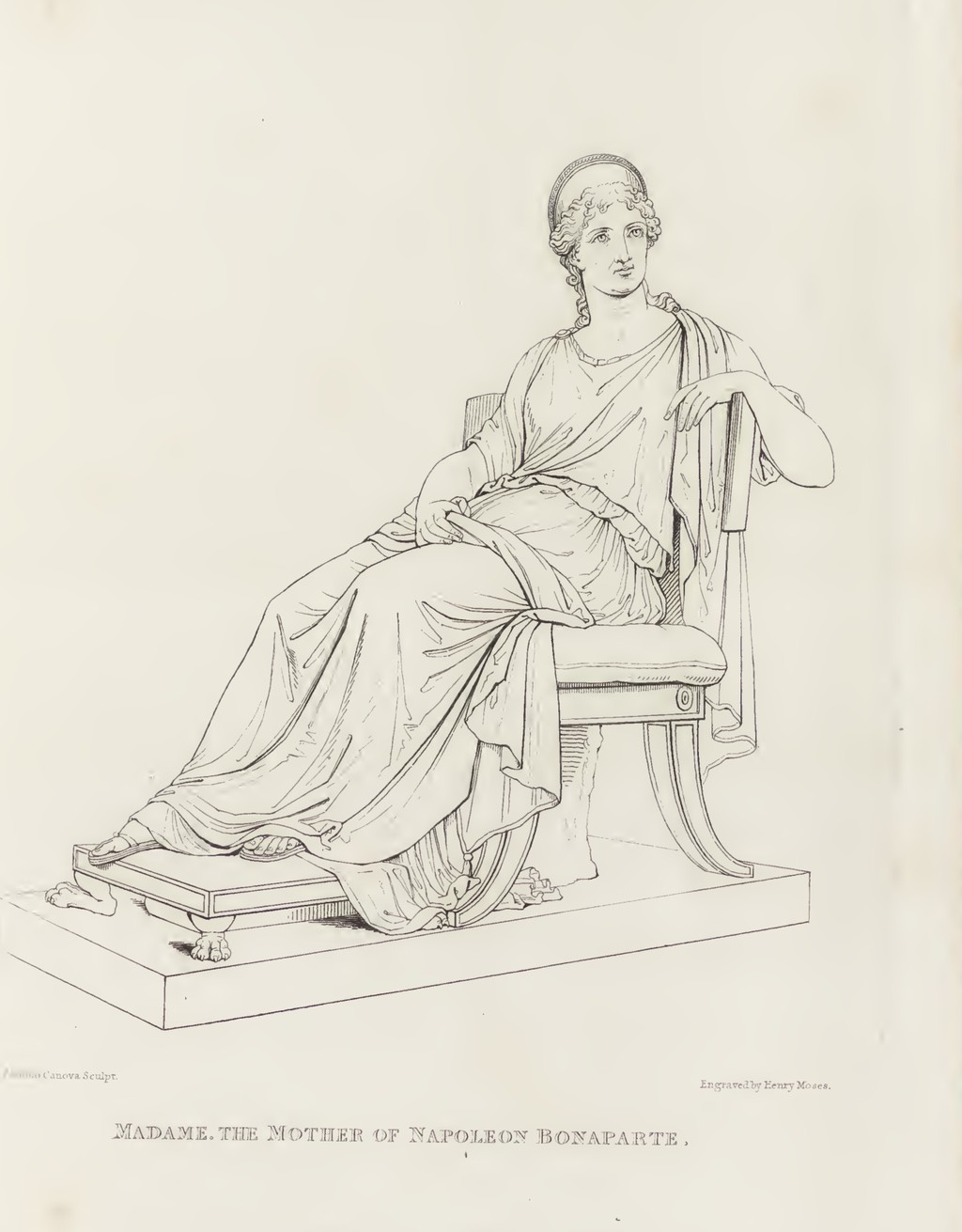
Moses’s engraving shows Letizia’s seated pose and the arm of the chair. Henry Moses, after Antonio Canova, engraving published in London, 1824. Getty Research Institute. Image source. Public domain. Scan margins trimmed and image resized.
Explore Canova’s works
Browse the sculptures and paintings covered in this guide. Several entries compare versions or examine details of a larger work.
Discussion
Look again at the images and ideas explored in Letizia Ramolino Bonaparte. These editorial prompts invite your observations.
Reader Insights
What does Letizia’s posture contribute to the portrait?
How do the chair and folds carry your eye through the seated figure?
Join the Conversation
Share a detail, comparison or question about Letizia Ramolino Bonaparte below.
References
- Chatsworth, Sculpture Gallery, collection and gallery history. View source.
- Museo e Real Bosco di Capodimonte, Canova. Un restauro in mostra, exhibition account and scientific dossier for the Naples plaster. View source.
- Daderot, Napoleon’s mother, by Antonio Canova, photograph of the seated Chatsworth marble, 2016. View source.
- National Gallery of Art, Canova: Sketching in Clay, exhibition wall texts for the Devonshire marble, preparatory models and Roman comparison. View source.
- Musei Capitolini, Sala degli Imperatori, on the seated statue of Helena. View source.
- Museo e Real Bosco di Capodimonte, Canova un restauro in mostra, dossier edited by Maria Tamajo Contarini and Alessia Zaccaria, with Canova’s letter of 29 November 1806. View source.
- Alison Yarrington, Under Italian Skies: The 6th Duke of Devonshire, Canova and the Formation of the Sculpture Gallery at Chatsworth House, study using the Devonshire archives. View source.
- Charles Noble, The Sculpture Gallery at Chatsworth, archival account with Hunt’s watercolour of the Old Library. View source.
- Ministero della Cultura, Ritratto di Letizia Ramolino, Capodimonte plaster IC4375, national catalogue 1500333729. View source.
- Crawford Art Gallery, Recasting Canova, catalogue entry for The Mother of Napoleon the Great, plaster cast, about 1816. View source.
- Rijksmuseum, Standbeeld van de moeder van Napoleon, Angelo Bertini after Luigi Durantini and Antonio Canova, RP-P-OB-35.269. View source.
- Musée national de la Maison Bonaparte, Letizia Bonaparte, collection record for the bust after Canova in Ajaccio. View source.


 Antonio Canova.jpg)

