



 by Tom Gurney
Tom Gurney BSc (Hons) is an art history expert with over 20 years experience
Published on June 19, 2020 / Updated on November 13, 2026
Email: tomgurney1@gmail.com / Phone: +44 7429 011000
Theseus and the Centaur: Introduction
A diagonal runs from Theseus’s outstretched foot to the club he holds overhead. Across it, the centaur’s body twists down towards the ground. The two figures meet where Theseus’s left hand bears on the centaur’s throat and his bent knee presses into the chest. The centaur’s fingers close around the hero’s forearm, holding him at the point where the pressure is greatest. Antonio Canova shows the fight at the moment when the outcome looks certain and the centaur is still resisting. [1] [2]
The finished white marble stands on the grand staircase of the Kunsthistorisches Museum in Vienna. The museum’s conservation report puts it at approximately 3.6 metres high and 3.75 metres long. The Museo Gypsotheca Antonio Canova dates the marble to 1805–19 and holds the large plaster model dated 1805. The scale of the plaster makes it possible to follow the same passage from the raised arm to the folded legs in the material Canova’s workshop used to work out the forms. [1] [2] [3]
Theseus and the Centaur Antonio Canova
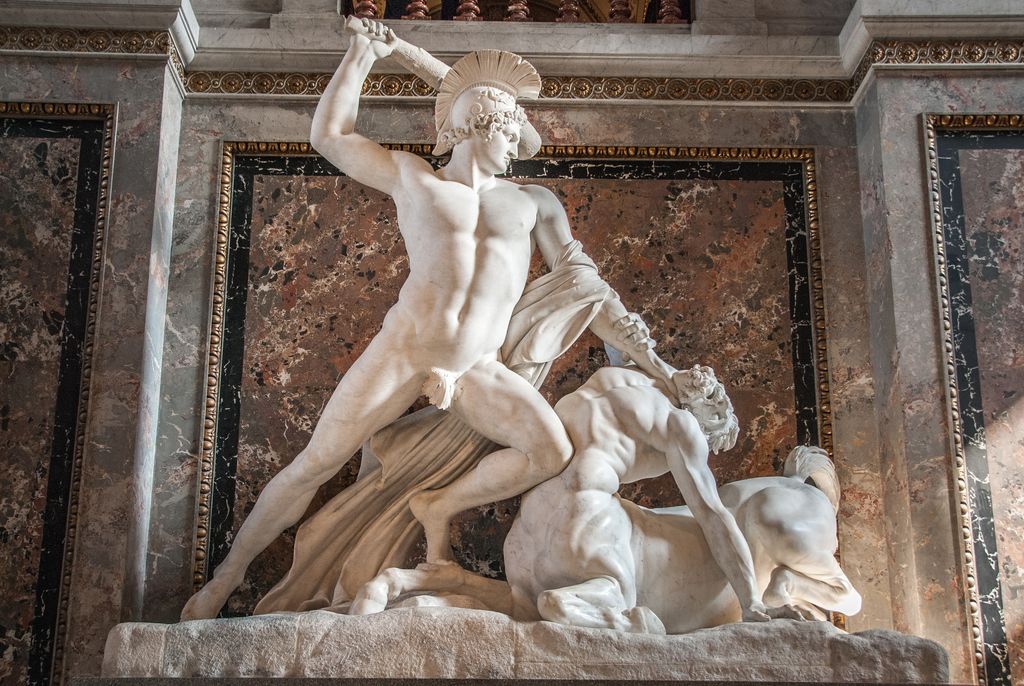
The Vienna marble on the Kunsthistorisches Museum’s grand staircase. Falcodigiada. Image source. CC BY-SA 4.0. Resized for display. The resized photograph uses the same licence.
At a Glance
- Artist and subjectAntonio Canova. Theseus pins a centaur and prepares to strike. [1] [2]
- Vienna marbleDated 1805–19 by the Museo Gypsotheca Antonio Canova. Grand staircase, Kunsthistorisches Museum Wien. [1] [3]
- Possagno plasterDated 1805, inventory 163, 340 × 372 × 152 cm. [2]
Contents
- Where the figures meet
- The battle in myth
- The model at Possagno and the engraving
- From a commission for Napoleon to the Theseus Temple
- On the grand staircase
- The other Theseus
- Annotated details
Where the figures meet
Theseus spreads his legs far apart. One runs back to the edge of the base, where the foot has little stone beyond it. The other bends and takes his weight towards the centaur. The torso turns above the hips, and the head looks back towards the opponent. Each part of the body is going somewhere slightly different. The long line of the extended leg makes the bent knee look more forceful, and the raised elbow opens up a gap beside the helmet. This gap makes room for the eye to imagine the movement of the club. [1] [2] [4]
Look from the side where Theseus’s chest and the centaur’s flank are both visible. The cloak falls from the left arm and sweeps down behind the bent leg, following the thrust of the hero’s body down to the base. Its deep folds gather in the space between the feet. The crest of the helmet rises above a face turned in profile, giving the head a clear outline against the space behind it. On the other figure, the hair and beard crowd together around the bent neck. As the head falls back, the features become harder to see, and the arm still exerting pressure comes to the fore. [2] [4]
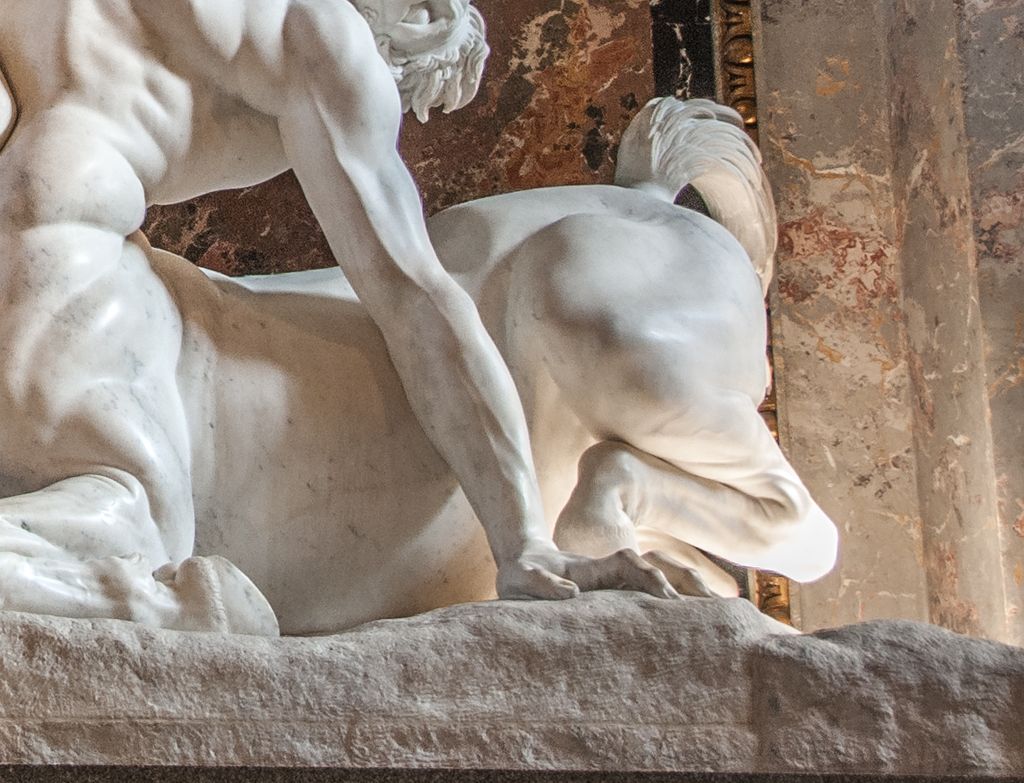
In the more oblique Possagno photograph, the centaur’s fingers on Theseus’s forearm are particularly clear. Their grip makes a small ridge across the long line of the arm. The centaur’s other arm reaches down to the ground, where the palm provides a point of support for the human upper body. Below it, the horse’s front legs fold in close to the base. The rounded hindquarters and gathered back legs are still full of tension. The centaur has the weight of a horse and the reach of a man. The figure’s twist brings the human shoulders well above the folded legs. [2]
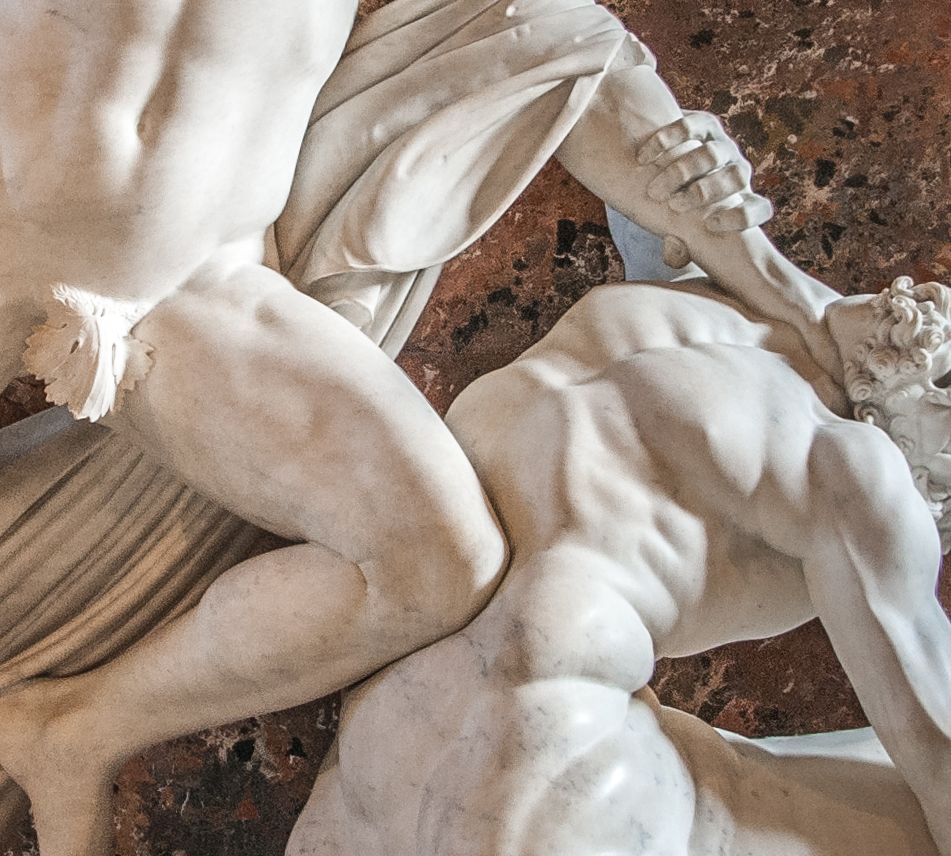
Canova locates the pressure of the knee at the place where the centaur’s two anatomies meet. The ribs turn towards the viewer while the horse’s body lies on its side. The resulting twist makes the transition between them feel continuous. The Possagno catalogue connects the contraction of the muscles to Canova’s anatomical studies. It also recounts that a horse was killed and its body used to make a plaster cast for the project. The sharp shift from the curved flank to the folded legs gives an idea of the sort of observation such a study could supply. [2]
Annotated Details from Theseus and the Centaur
The finished marble on the grand staircase in Vienna. Photograph by Falcodigiada, Wikimedia Commons. CC BY-SA 4.0. The photograph was resized, annotated and cropped. These adaptations use the same licence.
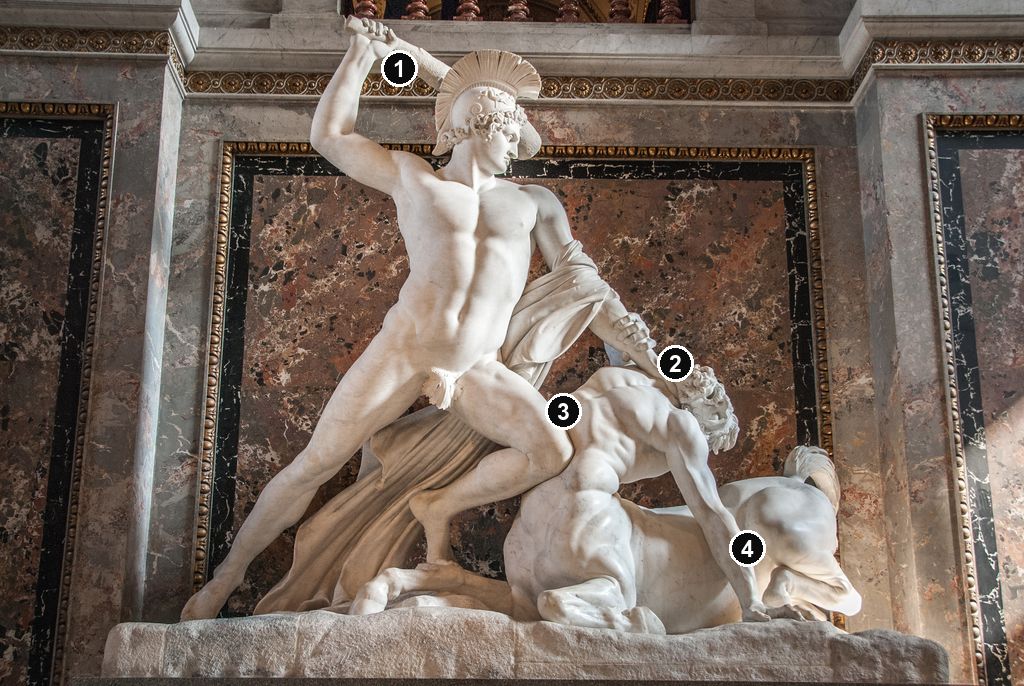
Details from THESEUS AND THE CENTAUR
Follow the club down through the places where the figures meet.
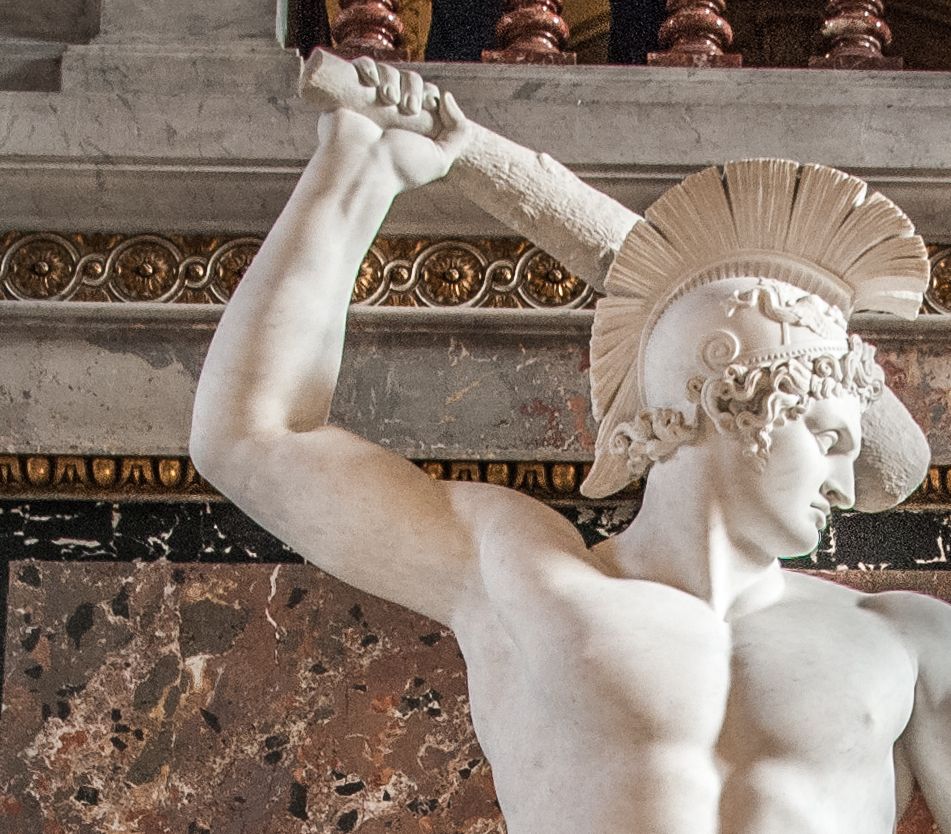
The raised club
Theseus raises the club above his helmet. The empty space below his bent elbow sets the arm apart from the torso.
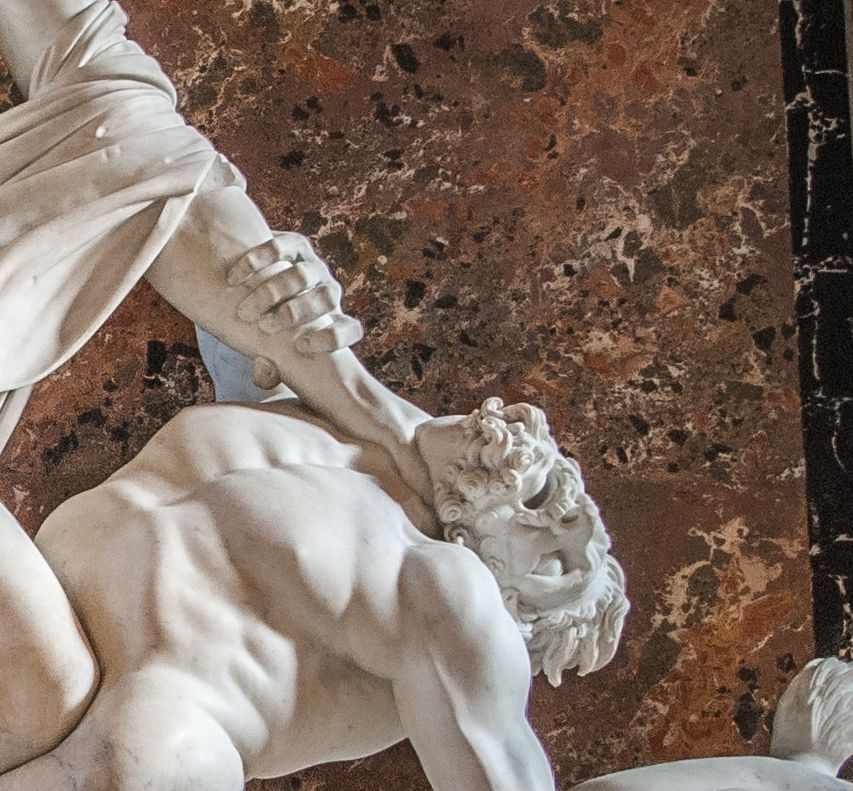
The grip at the throat
Theseus’s hand holds the centaur by the throat. The centaur closes his fingers around the forearm pressing down on him.
The bent knee
The bent leg presses down on the centaur while Theseus’s other leg extends behind him.
The supporting arm
The centaur braces himself against the ground as his horse legs fold beneath him.
The battle in myth
In Book XII of Ovid’s Metamorphoses, the wedding of Pirithous and Hippodamia brings together the Lapiths and the centaurs. The centaur Eurytus tries to carry off the bride, and the other centaurs follow his example. Theseus intervenes and kills Eurytus with a heavy mixing bowl. Later, he leaps onto the centaur Bienor’s back, grips the mane and strikes with an oak club. The poem offers several encounters involving Theseus, with different weapons and holds. The combination of a club and a close struggle in Canova’s group has parallels with the later episode. The lowered horse body and the grip at the throat give the encounter a shape of its own. [2] [5]
The Italian entry for the Possagno plaster calls the centaur Euritone. Its English version gives Triton. A late nineteenth-century print catalogued in Italy names him Phereus in German and Fereo in Italian. Bettelini’s earlier engraving calls Theseus the victor over the centaurs in the plural, though its image shows only one opponent. The Kunsthistorisches Museum uses the general title Theseus Slaying the Centaur. The names attached to the centaur vary even between records for the same object. [2] [4] [6] [7] [8]
The fight between the Lapiths and the centaurs was already an architectural subject in fifth-century BCE Athens. On the south side of the Parthenon, it occupied a series of metopes, the rectangular panels above the outer columns. Each panel could isolate two participants in the larger battle. In south metope XXVII, a Lapith restrains a wounded centaur that is trying to escape and prepares to strike. His cloak spreads behind the two bodies and fills part of the panel. Canova likewise gives a single pair the work of suggesting the larger battle. In the freestanding group the cloak hangs between the figures and the base. The centaur’s flank carries the eye out to the side, where the curved back and folded legs come into view. [9] [10]
Videos on Canova
Explore Canova’s workshop methods and the settings for his sculpture.
From Sketch to Stone | Canova: Sketching in Clay
Watch sculptor Fred X. Brownstein recreate a Canova Venus, using clay, plaster and marble.
Watch on YouTubeThe model at Possagno and the engraving
The large plaster preserves small dark marks across the chest and arms. In Canova’s workshop, metal reference points known as repères were set into full-size plasters. Assistants could use the distances between them to locate the corresponding forms in the marble. This was a way to carry a turn of the shoulder or the depth of a hollow from one material to the other while leaving stone for Canova to finish. Possagno also identifies a smaller plaster study for the composition, an earlier stage in working out the group. [2] [11]
The raised hand in the large plaster photographs closes around a short piece. The collection record describes the original club as missing. Bettelini’s engraving gives the club its full shape, with the thicker end projecting towards the crest of the helmet. The print is especially clear about the spacing between the arms and the line of the drapery behind the legs. From that single viewpoint, the long leg of Theseus, the centaur’s hand on the ground and the folded horse legs can all be read against the wide base. [2] [4]
The Rijksmuseum’s impression measures 582 by 555 millimetres at the plate mark. It belongs to a series of Canova’s sculptures drawn by Giovanni Tognolli and engraved by several printmakers. Here Tognolli translated the group into a drawing and Pietro Bettelini made the engraving. The record identifies a dedication by Canova to Francesco Melzi d’Eril, whose name appears under the image alongside a coat of arms. The shifts of light that a viewer sees when moving round the marble are fixed on the page. Bettelini uses graduated shadows to model the chest and flank, leaving plain paper above them so that the club and helmet stand out. [4]
The display of the large model posed an architectural problem of its own. Possagno records its arrival in the collection in 1948. When Carlo Scarpa designed an extension to the Gypsotheca in the 1950s, making room for the group was one of the project’s aims. He initially intended the square room of the new wing to house it. The museum’s catalogue places the model in the nineteenth-century wing today, where the surrounding sculpture and wall reliefs are visible behind it in the museum’s photographs. [2] [12]
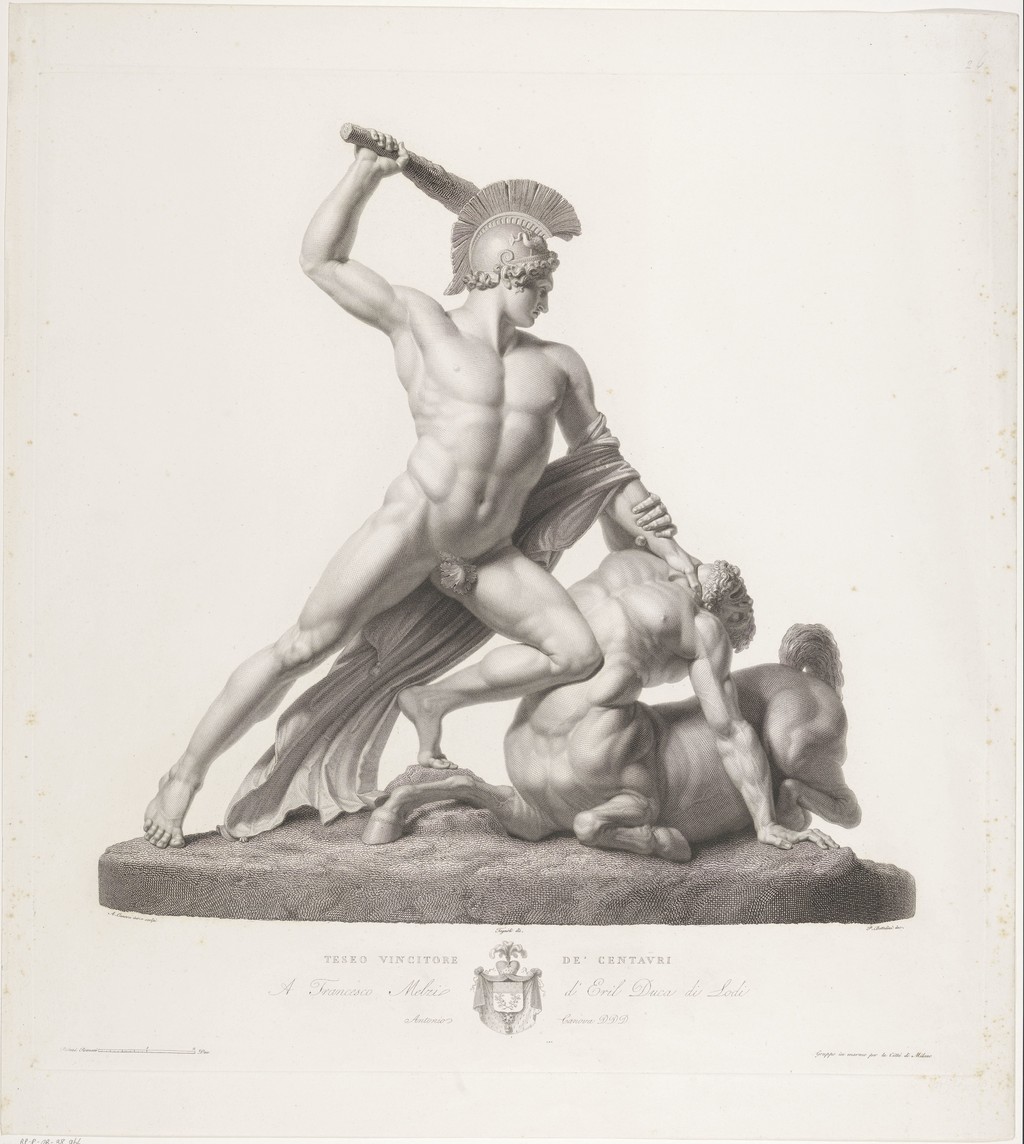
Bettelini’s engraving frames the diagonals of the standing Theseus and the collapsing centaur. Rijksmuseum. Image source. Public domain. Resized from source.
From a commission for Napoleon to the Theseus Temple
The Italian Republic commissioned the group in 1804 for ten thousand gold zecchini, intending to dedicate it to Napoleon Bonaparte. The plaster dates from the following year. The finished work was shown in Canova’s studio in Rome in March 1821, according to the Possagno catalogue, and Emperor Francis I of Austria acquired it for Vienna. A work commissioned as a gift to Napoleon thus became the centrepiece of a new public building in the Habsburg capital. [3] [6] [8]
The Theseus Temple in the Volksgarten was built between 1819 and 1823. Its architect, Pietro Nobile, adapted the ancient building then known as the Theseion in Athens on a smaller scale. The Viennese temple was designed to house this one modern sculpture. The white marble and the temple’s classical architecture drew on antiquity in different ways. The Doric columns surrounded a simple rectangular room. The temple stood on ground cleared after the Napoleonic Wars, where part of Vienna’s old fortifications had been demolished. Within that setting, the reach of the raised arm and the diagonal of Theseus’s body gave the eye a line that broke the building’s regular rhythm. The group stayed there for nearly seventy years. In 2012 the museum reopened the temple after renovation and revived its original format by showing one contemporary work at a time. Ugo Rondinone was the first artist in that programme. [8] [13]
On the grand staircase
The Kunsthistorisches Museum’s conservation report dates the physical transfer to April 1890. During the move, Theseus’s raised right arm broke off with the club, and the centaur’s right thigh was damaged. The Viennese sculptor Johannes Benk repaired the group. The museum opened to the public in 1891, the year often given in accounts of the sculpture’s move. The distinction matters for the arm in particular, since the position of the raised club that visitors see today depends in part on Benk’s repair. [1] [8] [14]
In the temple the group had an interior to itself. On the staircase the visitor approaches from below, then draws level with it on the way to the cupola hall. Seen from lower on the stairs, the two figures can resolve first into a white silhouette against the patterned wall. The helmet, shoulder and lifted club register high above the centaur’s body. At landing level, the overlap between the figures matters more, and the hands and bent limbs are easier to distinguish. The staircase lets the museum make a single monumental work part of the approach to the collections. [1] [14] [15]
The museum cleaned the sculpture in 2009. The conservation team first removed dust dry, then cleaned the marble with warm water and a controllable steam jet. It also renewed loosened plaster fills at the base and where the two figures meet. These areas matter visually because the eye is drawn to the places where a wrist, knee or arm seems to transmit weight between the bodies. The folds of the centaur’s legs make another cluster of details close to the base, well below the line of sight of a viewer who first notices the arm overhead. [1] [2]
The other Theseus
Canova had treated the same hero in the earlier Theseus and the Minotaur, a separate marble dated 1782 by the Victoria and Albert Museum in London. There the Minotaur has a bull’s head and a human body. Theseus sits on the fallen figure with his club held low beside him and his free hand resting on a bent leg. The gestures belong to the aftermath of the fight. In Vienna the centaur’s horse body spreads across the base, and the two figures still exert force on one another. The club opens a space above the hero’s head, and the opponent is still trying to prise his hand away. [1] [2] [16]
Explore Canova’s works
Browse the sculptures and paintings covered in this guide. Several entries compare versions or examine details of a larger work.
Discussion
Look again at the images and ideas explored in Theseus and the Centaur. These editorial prompts invite your observations.
Reader Insights
Where do the two figures put pressure on each other?
What can you see from the staircase that Bettelini’s engraving leaves out?
Join the Conversation
Share a detail, comparison or question about Theseus and the Centaur below.
References
- Kunsthistorisches Museum Wien, Jahresbericht 2009, Vienna, 2010, pp. 35–36, conservation report on Canova’s Theseus group.
- Museo Gypsotheca Antonio Canova, Theseus Defeating the Centaur, plaster, 1805, inventory 163. View source.
- Museo Gypsotheca Antonio Canova, Antonio Canova nel mondo, Vienna marble, dated 1805–19. View source.
- Rijksmuseum, Pietro Bettelini after Giovanni Tognolli and Antonio Canova, Theseus overwint de centaur, engraving, RP-P-OB-38.966. View source.
- Ovid, Metamorphoses, book XII, lines 210–244 and 327–392, translated by A. S. Kline, Poetry in Translation. View source.
- Museo Gypsotheca Antonio Canova, Teseo e il centauro, Italian catalogue record for plaster inventory 163. View source.
- Catalogo generale dei Beni Culturali, Alois Hanisch after Antonio Canova, Theseus besiegt den Kentaur Phereus / Teseo vincitore del Centauro Fereo, print, national catalogue number 1700035840. View source.
- Kunsthistorisches Museum Wien, Reopening of the Theseus Temple, 24 April 2012. View source.
- Acropolis Museum, The metopes, architectural placement and the battle of the Lapiths and centaurs. View source.
- British Museum, Room 18 Parthenon Large Print Guide, south metope XXVII. View source.
- Museo Gypsotheca Antonio Canova, Antonio Canova’s opera, account of models and the workshop’s transfer into marble. View source.
- Museo Gypsotheca Antonio Canova, Ala Scarpa, history of the extension to the Gypsotheca. View source.
- Burghauptmannschaft Österreich, Volksgarten, architectural history of the Theseus Temple and its site. View source.
- Kunsthistorisches Museum Wien, Museum, architectural history and public opening. View source.
- Kunsthistorisches Museum Wien, “Theseus” von Antonio Canova, programme with staircase photograph. View source.
- Victoria and Albert Museum, Theseus and the Minotaur, marble, Rome, 1782, A.5&A-1962. View source.


 Antonio Canova.jpg)


