


 by Tom Gurney
Tom Gurney BSc (Hons) is an art history expert with over 20 years experience
Published on June 19, 2020 / Updated on October 15, 2026
Email: tomgurney1@gmail.com / Phone: +44 7429 011000
Titian: a guide to his paintings and career: Introduction
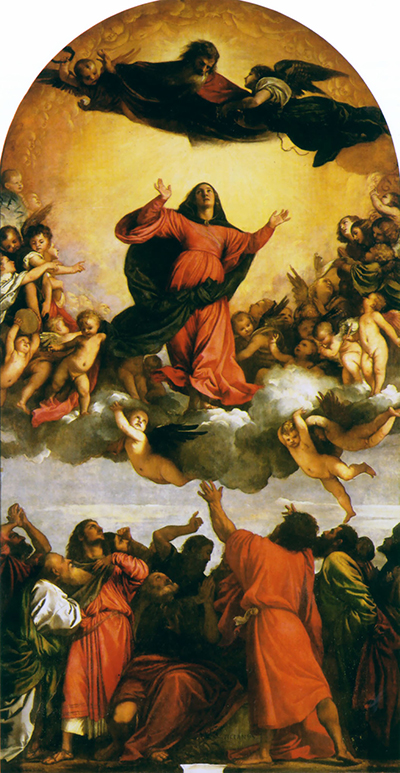
A visitor to the Frari in Venice can look up at Titian's Assumption of the Virgin above the high altar. In London, Bacchus and Ariadne recalls a private room made for the duke of Ferrara. In Madrid, an armoured Charles V rides through a landscape as the victorious emperor. These paintings differ in subject, scale and first audience, yet each shows Titian making a scene vivid through bodies, setting and colour. His career is easier to enter through such particular works than through a single description of “Venetian style.”[1][2][3]
Tiziano Vecellio, called Titian, was born in Pieve di Cadore, probably around 1488–90, and died in Venice in 1576. He spent most of his working life based in Venice, while patrons across Italy and the Habsburg world sought his paintings. The exact birth year is undocumented, and the authorship of some early pictures remains debated. Those limits do not obscure the broad shape of an unusually long career: religious works for public and private devotion, portraits, mythologies, drawings and designs circulated far beyond his home city.[1][2]
This page gives a way into the works and the evidence behind them. The biography follows the life in detail; the paintings guide explores commissions and settings; drawings, prints and technique address different ways an image was conceived, made and spread. The artwork directory below leads to individual objects.
At a Glance
- ArtistTiziano Vecellio (Titian)
- Lifetimec. 1488/90–1576
- BaseVenice
- PracticePainting, drawing and designs for prints
Contents
- Titian at a glance
- From Cadore into Venetian painting
- In the Frari: painting for distance and movement
- Ferrara: a room for mythological stories
- Images of people, rank and uncertain names
- A painter who remained based in Venice
- Philip II's poesie: one patron, six delivered pictures
- What colour and drawing do together
- Late paintings and a final unfinished work
- Where to begin
Titian at a glance
- Name: Tiziano Vecellio, usually known in English as Titian.
- Origins and lifetime: Born in Pieve di Cadore, probably about 1488–90; died in Venice in 1576. There is no document fixing an exact birth year.[1][2]
- Base: Venice, with important work and visits in Padua, Rome and Augsburg, and commissions for courts elsewhere.[1][2]
- Subjects: Altarpieces and other religious pictures, portraits, mythologies and pastoral scenes; a smaller surviving body of drawings and designs for prints.[2][4]
- Patrons: Venetian institutions and families, Alfonso I d'Este, the Gonzaga and della Rovere courts, the Farnese, Charles V and Philip II, among others.[1][2]
- A first set of works: Assumption of the Virgin, Bacchus and Ariadne, Venus of Urbino, Charles V at Mühlberg, the two Diana paintings, The Rape of Europa and Pietà.[3][5][6][7]
From Cadore into Venetian painting
Titian came to Venice from the mountain district of Cadore as a boy. The National Gallery describes training connected with Sebastiano Zuccato and the Bellini workshops, then a close artistic exchange with Giorgione. Later accounts of apprenticeship and youthful rivalry should not be mistaken for dated contracts, but the two painters' early work did share a pastoral mood and a way of letting landscape carry feeling. That closeness still complicates attribution in some pictures from about 1500–10.[1][2][4]
The fresco scenes Titian painted at the Scuola del Santo in Padua in 1510–11 are an early documented reference point. They were public narrative paintings rather than small studio exercises. Already he had to place figures where a viewer could follow an action within a real building. In Venice, Giovanni Bellini's death in 1516 opened space for Titian's growing prominence, though the city continued to include many painters and patrons. A career story that jumps directly from youthful Giorgione to “the master of colour” misses those public commissions and their demands.[1][2]
Two small Met drawings, Landscape with a Goat and Two Satyrs in a Landscape, also show an early interest in pastoral setting. Ink marks can make buildings, near figures and distant haze feel distinct. They are evidence that drawing and landscape were part of Titian's developing practice, even though only a small and disputed group of paper sheets survives. Their dates and relations to paintings are questions to examine, not an automatic sequence of preparatory steps.[4][8]
In the Frari: painting for distance and movement
The Assumption of the Virgin was displayed in 1518 above the high altar of Santa Maria Gloriosa dei Frari. Nearly seven metres high, it needed to register across the church. Apostles reach and gesture below while Mary rises above them into light. Large forms and strong colour make the movement legible from a distance; close looking then reveals the different responses in the group. The painting remains in the building for which it was made, so the relationship between image, altar and visitor can still be experienced.[1][3][4]
The Pesaro Madonna, completed for a Frari side altar in 1526, answers a different approach. The Virgin and Child sit high and off-centre as saints and members of the patron family create an angled exchange. The composition asks viewers to move their attention through the scene instead of reading a symmetrical group at one glance. These two altarpieces are religious paintings, but their settings and social purposes are distinct. The Frari guide and the paintings overview give a fuller account of that difference.[1][3]
Not every major church painting is still available to see. Titian's Death of Saint Peter Martyr, completed in 1529 for Santi Giovanni e Paolo, was destroyed in an 1867 fire. A copy and historic records preserve knowledge of it, yet they are not the lost canvas itself. The distinction matters when a famous career is illustrated online: a later copy can inform the story but should not silently become an image of a surviving Titian original.[2][4]
Ferrara: a room for mythological stories
For Alfonso I d'Este in Ferrara, Titian painted three mythological canvases for the Camerino d'Alabastro: The Worship of Venus, Bacchus and Ariadne, and The Bacchanal of the Andrians. Giovanni Bellini and Dosso Dossi contributed to the larger room; Titian also reworked Bellini's Feast of the Gods. The pictures are now divided among collections. Their original company explains why they belong to a commission larger than any one famous canvas.[2][5]
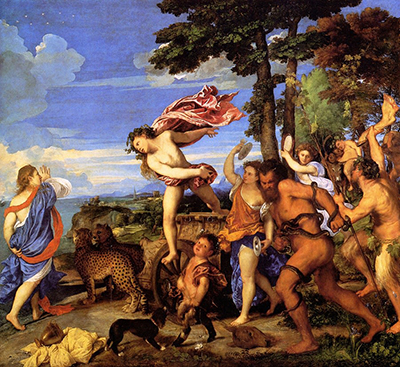
In Bacchus and Ariadne, Theseus' departing ship is a small form in the distance. Ariadne turns toward Bacchus, who leaps from his chariot, while stars above her point to a future in the story. The National Gallery traces the narrative to classical authors including Ovid and Catullus. Titian arranges past abandonment, present encounter and future transformation in one painted field. The strong ultramarine sky, other vivid pigments and changes in warm and cool colour help the viewer follow that crowded action.[5]
The duke sent canvases sized for his room, but the National Gallery says its exact location in the palace and the works' hanging arrangement remain uncertain. We can understand Bacchus and Ariadne as part of the Ferrara ensemble without pretending to know precisely which picture stood at its left. That is a useful model for approaching Titian generally: recover original context when evidence supports it, and leave reconstruction open where it does not.[5]
Images of people, rank and uncertain names
Titian painted portraits from youth into old age. Some place a powerful person before us through armour, fabric, position and a carefully held gaze. The Charles V at Mühlberg was painted in 1548 after the emperor's victory of the previous year. The Prado identifies the mounted ruler and the event it commemorates. No defeated opponent appears beneath the horse; the rider's isolation, equipment and forward movement make a controlled political statement. A different Titian portrait of Charles with a dog is a separate canvas from 1533, shaped by another portrait model and a different task.[2][6]
Other portraits are less secure in their names. The National Gallery's Portrait of Gerolamo (?) Barbarigo was long called Portrait of Ariosto and even proposed as a self-portrait. Its present title retains a question mark. The turning shoulder, large quilted sleeve and direct glance make the man physically convincing, but visual force does not prove an identity. The gallery also notes that a fading red lake has changed the sleeve's colour. A portrait can be clear in its presence while uncertain in sitter and altered in material appearance.[9]
Images of women introduce another question. A portrait-like face may belong to a named sitter, or a work may present a poetic or ideal figure rather than an individual likeness. The National Gallery of Art cautions against treating every later female portrait title as documentary identification. The Venus of Urbino has a different kind of evidence: the Uffizi cites a 1538 letter recording Guidobaldo II della Rovere's purchase of a “naked woman” from Titian. Its familiar title is later, and the museum interprets details of the room in relation to love and marriage. The recorded buyer, later name and interpretation are worth keeping separate.[2][10]
A painter who remained based in Venice
The range of court names can make Titian sound like a travelling employee of one ruler after another. He continued to live and work primarily in Venice. The relationship with Alfonso at Ferrara led to Mantuan commissions for Federico Gonzaga, while Urbino patrons included both Francesco Maria della Rovere and his successor Guidobaldo. In the 1530s and 1540s Titian also cultivated the Farnese family. These connections overlapped with Venetian altarpieces, portraits and public obligations; they widened his audience without turning every painting into an export for a foreign court.[1][2]
Titian visited Charles V's court at Augsburg and travelled to Rome in 1545–46, where he met Michelangelo. Those encounters brought him into contact with other artists and with patrons whose images could move through several territories. A ruler's portrait, a privately owned nude and a church altarpiece could be made within the same phase of his career yet ask different things of the painter. That is why the pages in this cluster identify each work's first purpose and subsequent route through collections, rather than placing every canvas on a single ladder from “early” to “late.”[1][2]
Philip II's poesie: one patron, six delivered pictures
Titian's work for Philip II included portraits, religious paintings and a linked group of large mythologies he called poesie. The National Gallery identifies six paintings produced from about 1551 to 1562: the Wellington Collection Danaë, Prado Venus and Adonis, Wallace Perseus and Andromeda, Diana and Actaeon, Diana and Callisto and the Gardner Museum's Rape of Europa. These works were made decades after the Ferrara Bacchanals for a different patron and purpose.[7]
The stories range across disguise, pursuit, exposure and rescue. Callisto is forced to reveal her pregnancy; Europa is carried away by a bull that is Jupiter in disguise. Titian's choices of pose, colour and setting shape how viewers experience those events. The beauty of the paint does not erase fear or coercion in the narratives. The poesie guide traces links among the six and sends readers to their object pages.[7]
The Death of Actaeon was related to the cycle but not delivered to Philip. Titian and his workshop also painted variants of subjects such as Danaë and Venus and Adonis. The Prado Danaë is not the Wellington canvas sent to Philip. Matching a title is therefore only a first step; the owner, image, provenance and technical study identify the actual work under discussion.[2][7]
What colour and drawing do together
Titian's colour is celebrated for good reason, but the old formula that Venetians painted with colour instead of drawing is misleading. Infrared study at the National Gallery has found underdrawing in examined works. X-rays and paint sections show revised positions and colours. In Bacchus and Ariadne, some figures and details were changed during painting. In later repeated subjects, transferred outlines could be reworked, and their use alone does not decide how much Titian painted himself.[5][11]
The visible surface also has a history after the painter. A blue pigment may lose colour; varnish may yellow; cleaning can expose or damage thin passages. A broad brushstroke can be an intentional effect, while another area of a painting may genuinely have been left incomplete. Technical evidence helps distinguish these possibilities in a named object. It does not supply a single recipe that Titian followed through seven decades, nor does a scan reveal his private thoughts. The technique guide explains the methods and their limits.[11]
His drawings are similarly varied. The Met's early landscapes are small, pictorial pen works; the Städel's Saint Sebastian study is a figure prepared for one panel of the Averoldi Polyptych, with further studies on its reverse. A woodcut or engraving made after a Titian design is another kind of object, often cut by a separate specialist. The drawings and prints guides separate these materials and makers rather than counting every image on paper as a sketch by Titian.[8][12]
Late paintings and a final unfinished work
Titian continued to make portraits, sacred pictures and mythologies late in life. Brushwork could be open and broken in one part of a picture while another remained carefully described. Modern condition matters: ageing pigment, varnish and later intervention can change what “late style” looks like today. The National Gallery's technical study treats later canvases one by one because a single story of progressive looseness hides those differences.[11]
The Pietà has a more specific history. Titian intended it for his own burial setting at the Frari. It was incomplete at his death in 1576, and Palma Giovane finished it. The Gallerie dell'Accademia in Venice now holds the work and describes that posthumous intervention. Its documented incompletion should not be used as proof that every painting with visible strokes was left unfinished.[1][13]
Titian's long life brought together works for places as different as a Venetian altar, a duke's private room and the Spanish king's collection. That range is part of his achievement. It also means each picture should be asked its own questions: where did it begin, who used it, what survives of its making, and how certain is the name or story attached to it?[2][11]
Where to begin
- Assumption of the Virgin shows a large public painting still answering its original church setting.[1][3]
- Bacchus and Ariadne turns a literary story into a dynamic image for Alfonso's Ferrara room.[5]
- Venus of Urbino combines a documented 1538 purchaser with a later title and debated reading.[10]
- Charles V at Mühlberg shows how a ruler's image can commemorate a political event.[6]
- Diana and Actaeon and Diana and Callisto form a linked pair within the poesie.[7]
- The Rape of Europa closes the delivered group with an image of abduction across water.[7]
- Pietà asks how Titian's work and Palma Giovane's completion meet in one final canvas.[13]
Readers interested in life and documents can continue to the biography. For works organised by first setting and function, use paintings; for the physical process, use technique. The directory below opens the individual object pages, where owner records, titles and versions can be checked one at a time.
Titian's career in four stages
Training and first commissions
Early attribution is complex; Padua provides a documented public project.
Altarpieces and mythologies
The Frari and Alfonso d’Este demanded different visual solutions.
Portraits across Europe
Titian worked for Italian rulers and Charles V while keeping his Venetian base.
Myth, devotion and revision
Philip II’s poesie and late sacred paintings show continuing experiment.
Essential works
Assumption of the Virgin
· A major work in Titian’s career.
Bacchus and Ariadne
· A major work in Titian’s career.
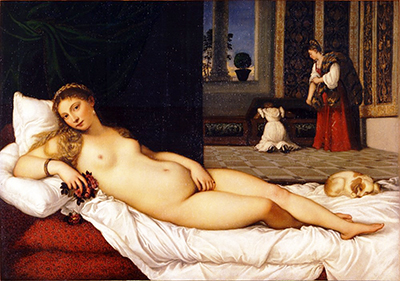
Venus of Urbino
· A major work in Titian’s career.
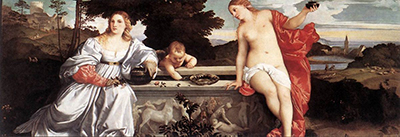
Sacred and Profane Love
· A major work in Titian’s career.
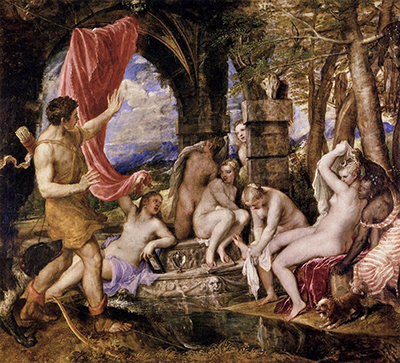
Diana and Actaeon
· A major work in Titian’s career.
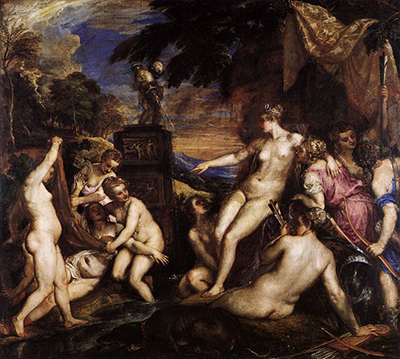
Diana and Callisto
· A major work in Titian’s career.
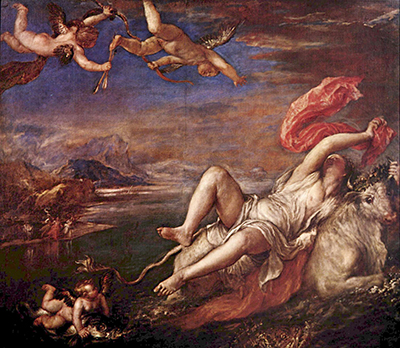
The Rape of Europa
· A major work in Titian’s career.
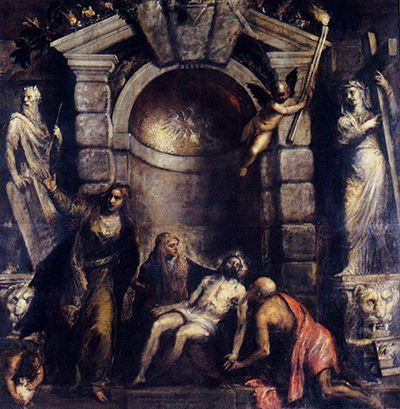
Pieta
· A major work in Titian’s career.
Researched Titian and related works
Frequently Asked Questions
He was born in Pieve di Cadore, probably around 1488–90. There is no document establishing one exact birth year.[1][2]
His surviving work includes religious paintings, portraits, mythologies, pastoral scenes and drawings. Designs associated with him also circulated through prints made with other specialists.[2][4]
No. The Bacchanals were made for Alfonso I d'Este earlier in the century. The six delivered poesie were made decades later for Philip II.[5][7]
Yes. Technical examination finds underdrawing in examined works, and surviving paper studies show other kinds of planning. Titian also revised compositions after painting began.[8][11]
No. Early works, repeated designs, workshop participation and later copies require object-specific research. Check the present collection's title, attribution and inventory before treating a familiar name as certain.[2]
Discussion
What do you notice when you look closely at Titian: a guide to his paintings and career?
Share a specific observation or a source that adds context.
Reader Insights
Which detail changes your reading?
How does its original setting affect what we see?
Which part of the evidence remains uncertain?
Join the Conversation
Add your observation below.
References
- National Gallery, London, “Titian,” artist account. View source.
- National Gallery of Art, “Titian,” artist biography and collection overview. View source.
- Basilica di Santa Maria Gloriosa dei Frari, official visitor guide. View source.
- The Metropolitan Museum of Art, “Titian (ca. 1485/90?–1576),” Heilbrunn Timeline of Art History. View source.
- National Gallery, London, “Bacchus and Ariadne,” NG35, collection and historical account. View source.
- Museo Nacional del Prado, “Carlos V en la batalla de Mühlberg,” P410, collection record. View source.
- National Gallery, London, “Titian's poesie: The Commission,” exhibition research. View source.
- The Metropolitan Museum of Art, “Two Satyrs in a Landscape,” 1999.28, and “Landscape with a Goat,” 1991.462. View source; View source.
- National Gallery, London, “Portrait of Gerolamo (?) Barbarigo,” NG1944. View source.
- Gallerie degli Uffizi, “Venus of Urbino,” collection record and 1538 purchase history. View source.
- Jill Dunkerton and Marika Spring, Titian technique essays, National Gallery Technical Bulletin 34 (2013) and 36 (2015). View source; View source.
- Städel Museum, “Study for St. Sebastian in the high altar of SS. Nazarro e Celso, Brescia,” 5518 Z. View source.
- Ministero della Cultura, Gallerie dell'Accademia account of Titian's Pietà, its intended Frari setting and Palma Giovane's completion. View source.