



 by Tom Gurney
Tom Gurney BSc (Hons) is an art history expert with over 20 years experience
Published on June 19, 2020 / Updated on November 13, 2026
Email: tomgurney1@gmail.com / Phone: +44 7429 011000
Funeral Monument to Maria Cristina of Austria: Introduction
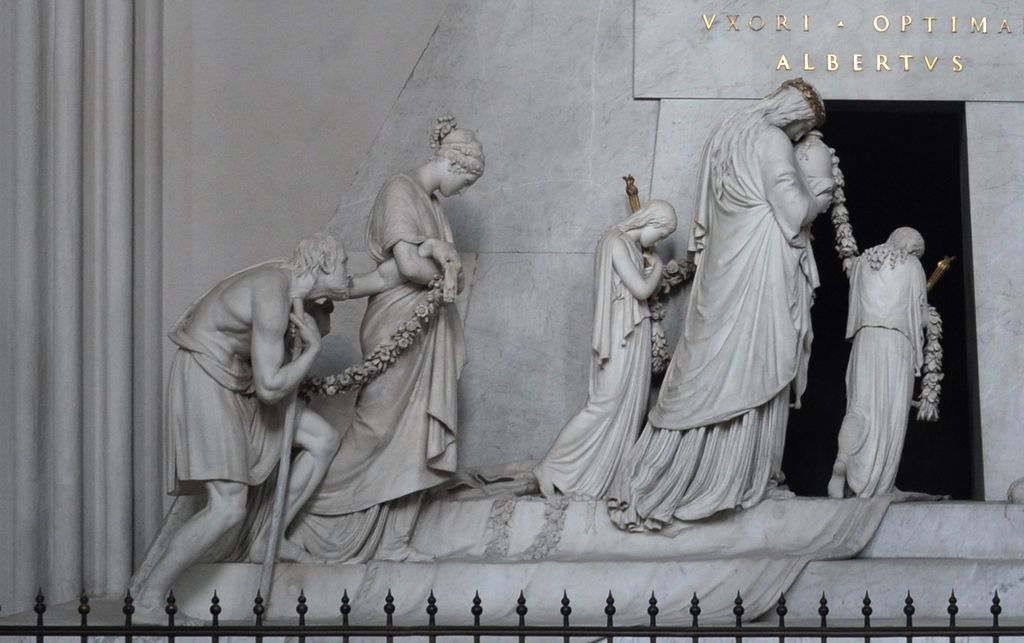
On the right as you enter Vienna’s Augustinerkirche, a line of figures climbs towards a dark doorway in a marble pyramid. A small figure at the head of the procession is already crossing the threshold. Behind her, a taller woman bows over the urn she carries. Farther down, an old man leans on a stick as a woman guides him. Their feet follow a strip of carved cloth that spills over the steps. Across the doorway, a winged youth rests against a lion, apart from the people on the move. Antonio Canova set a funeral in progress against the stillness of an almost blank wall. [1] [2] [3]
Duke Albert of Saxe-Teschen commissioned the work in 1798 after the death of his wife, Archduchess Maria Christina of Austria. It was installed in 1805 in the church adjoining his palace. Maria Christina was buried in Vienna’s Imperial Crypt, so the monument is a cenotaph. Canova could give the mourners a place to carry the urn while leaving what lies beyond the doorway out of sight. [1] [3] [4] [5]
Funeral Monument to Maria Cristina of Austria Antonio Canova
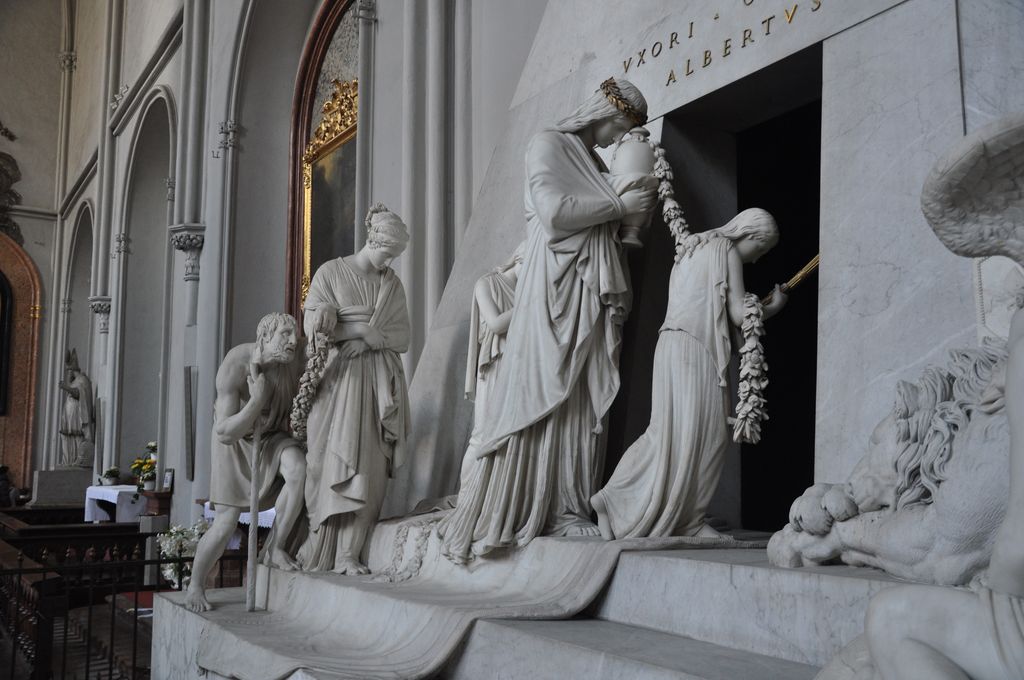
An oblique view of the procession approaching the pyramid’s doorway. Andreas Praefcke. Image source. CC BY 3.0. Resized for display.
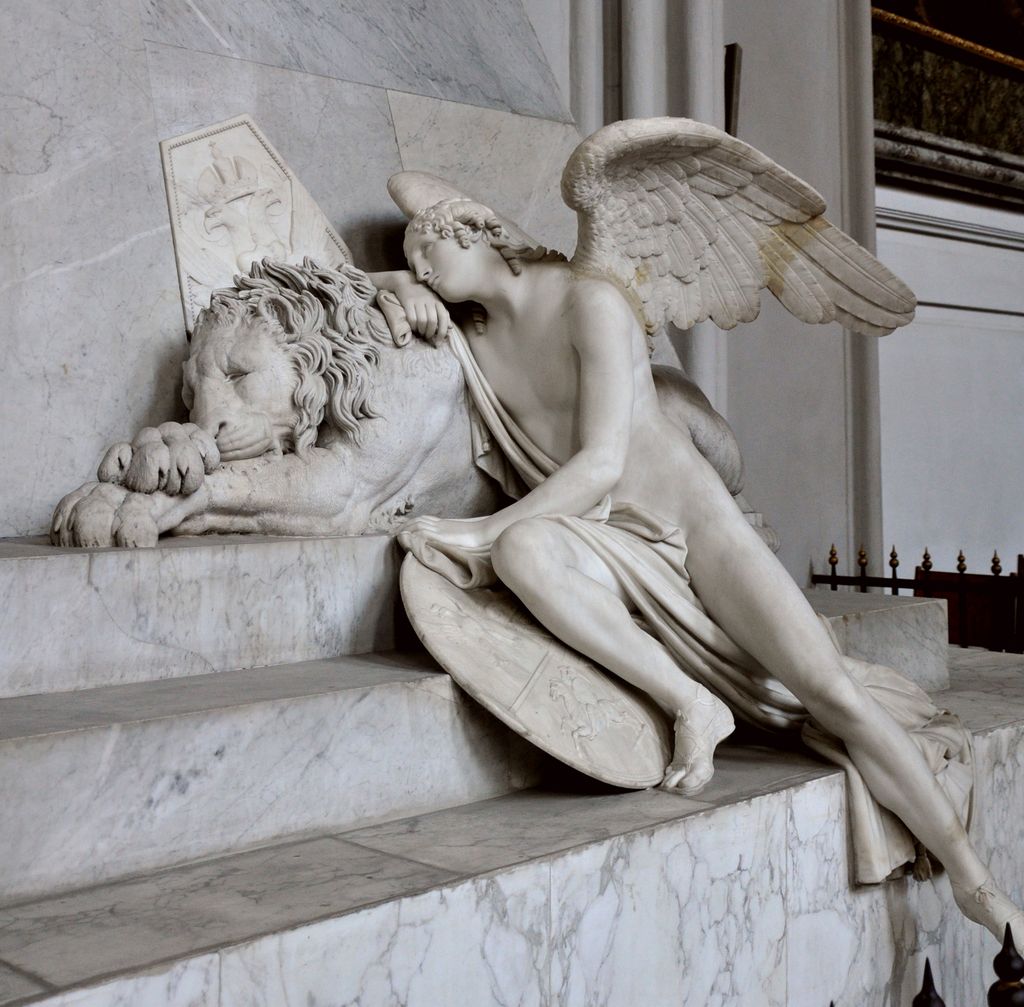
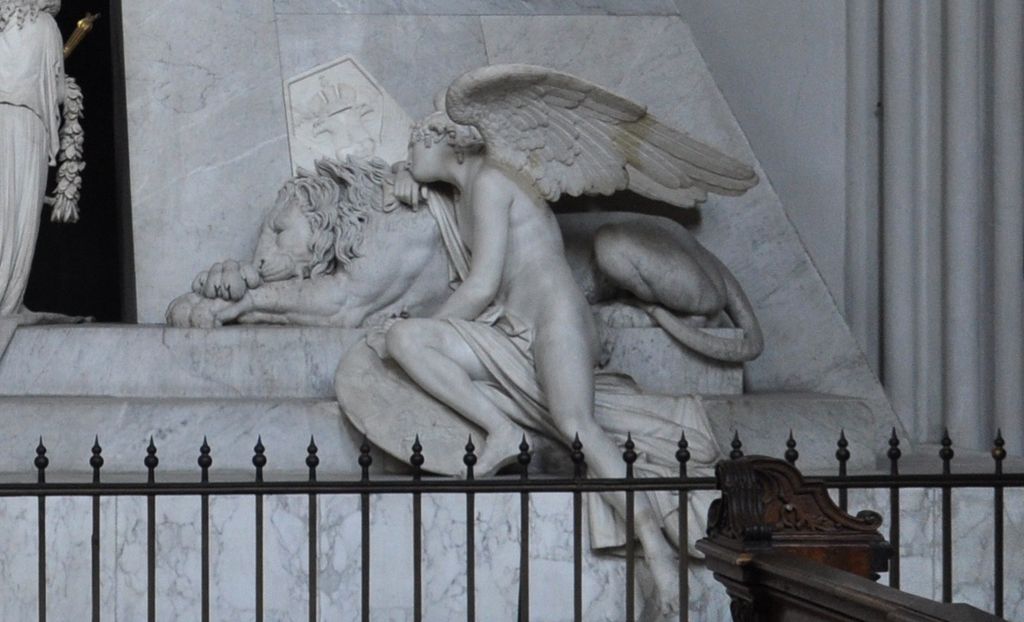
The winged figure, lion and shield to the right of the entrance. Andreas Praefcke. Image source. CC BY 3.0. Resized for display.
At a Glance
- ArtistAntonio Canova. [1]
- LocationAugustinerkirche, Vienna. [1]
- PatronDuke Albert of Saxe-Teschen, husband of Maria Christina. [3] [5]
- DatesCommissioned in 1798 and installed in 1805. [1] [3] [5]
Contents
- The pyramid and the threshold
- The figures in the procession
- The lion, the youth and the portrait
- Albert’s commission and the choice of site
- How the monument travelled on paper
- Annotated details
The pyramid and the threshold
From the front, the pyramid looks like a triangle set into the church wall. Its broad base nearly fills the space between the surrounding mouldings. The sides narrow past the reliefs to an unoccupied point. Veins in the marble and joints between the blocks remain visible. Near the bottom, a pair of plain jambs and a lintel frame the dark rectangle of the entrance. There are few distractions between the low doorway and the high point. The slope of the pyramid sends your eye back down towards the figures whenever you look up. [1] [2]
From the side, the procession comes forward into the church. The platform under the figures projects well beyond the pyramid’s face. A change of viewpoint makes it easier to separate the old man’s bent knee from the leg of his companion and to see how far the folds of the cloth project over the steps. It also makes the first mourner look closer to vanishing into the opening. Part of her body is already outlined against the darkness. Canova gives the eye enough of the interior to read it as space, then stops short of showing a destination. [1] [2] [3] [6]
The platform also places the people within reach of the viewer’s imagination. Look at the old man at the end of the line. He stands a little beyond the sloping edge of the pyramid, on the side from which the mourners come. That small projection makes the line appear to have started in the church. A visitor coming from Josefsplatz may first encounter the opposite end, where the lion and winged figure project into the aisle. Johannes Myssok points out that the entrance from Augustinerstraße offers a more frontal view. The first figure you notice can therefore depend on how you enter the church. [2] [3] [6]
Canova had already built his monument to Clement XIV around the opening to a working sacristy in Rome. There the doorway anchors an arrangement that rises in stages to the seated pope. In Vienna the movement runs across the front of the monument. Instead of leading the eye from the doorway up through the principal figures, the steps carry the mourners towards it from one side. The archduchess appears above them in a small relief. From most positions the people who attend her funeral occupy more space than the likeness of the woman being mourned. [1] [2] [3]
Annotated Details from Funeral Monument to Maria Cristina of Austria
The monument in the Augustinerkirche in Vienna. Photograph by Andreas Praefcke, CC BY 3.0. Resized, annotated and cropped.
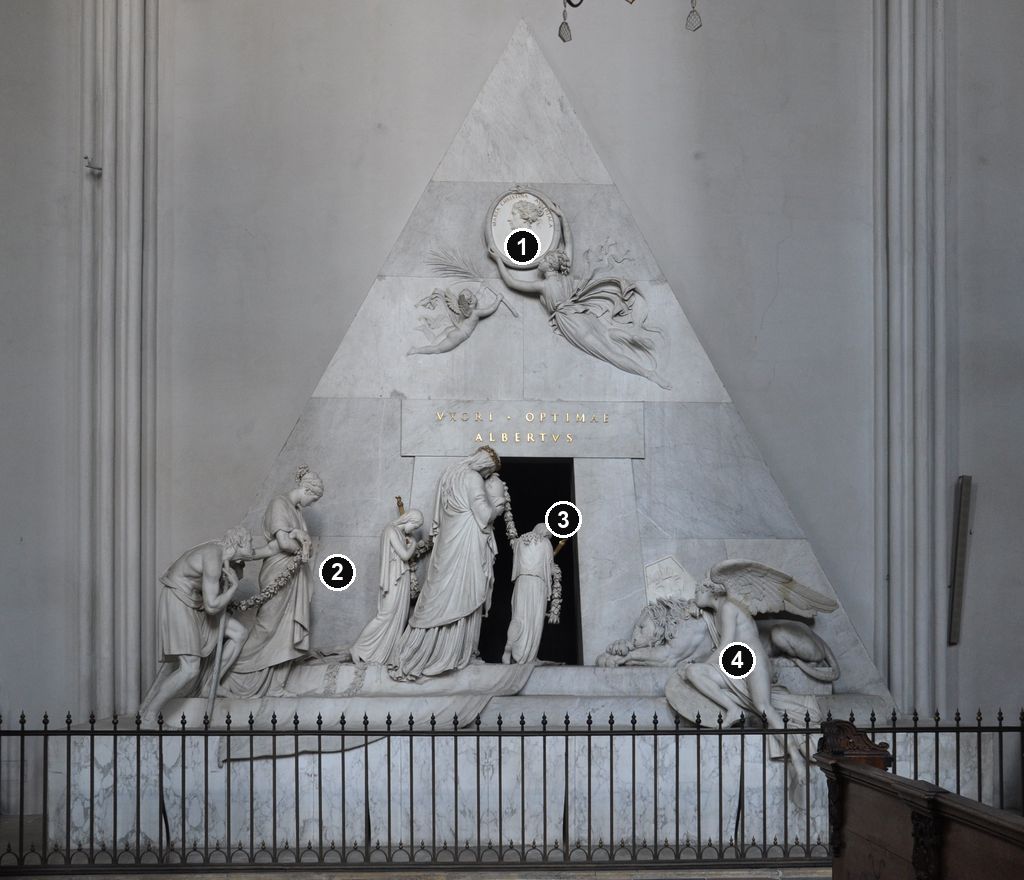
Details from FUNERAL MONUMENT TO MARIA CRISTINA OF AUSTRIA
Follow the procession towards the opening, then compare the figures above and to the right.
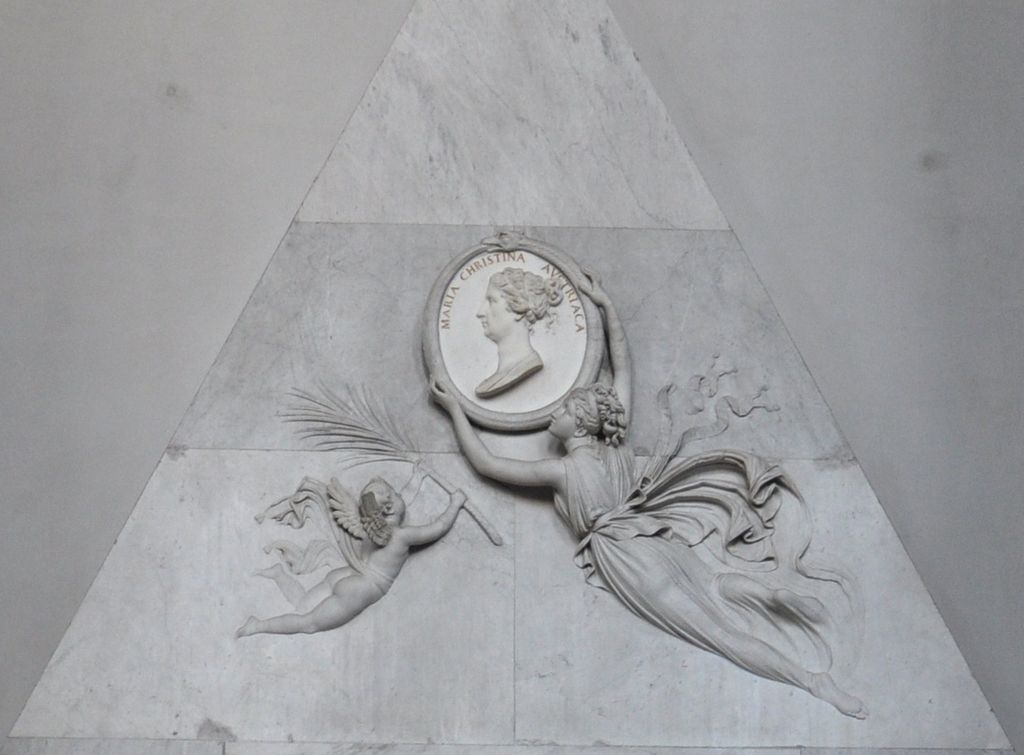
The portrait medallion
The portrait appears in profile high on the pyramid, above the dedication.
The procession
The figures climb towards the opening. The carved cloth follows the steps beneath them.
The dark opening
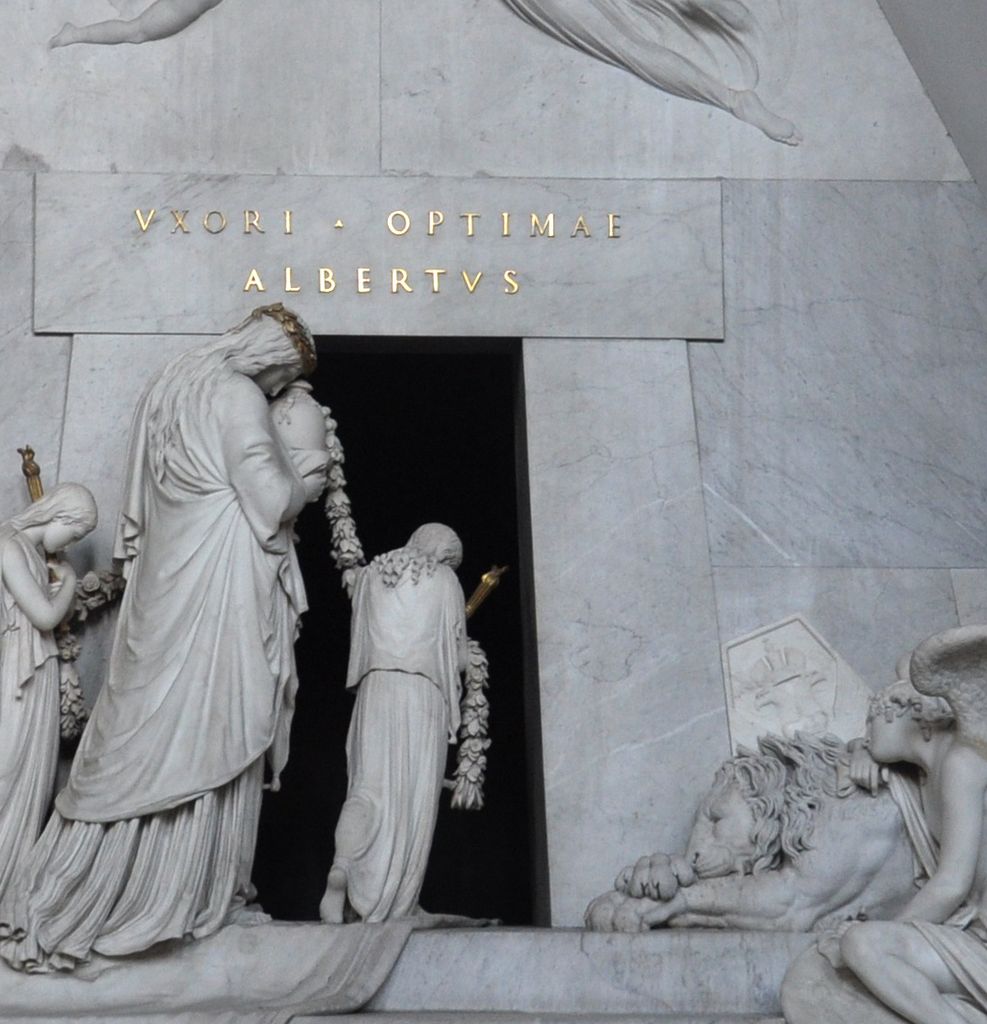
The rectangular opening cuts into the pale stone. The leading figure is already partly within it.
The winged figure and lion
The winged figure leans beside the lion, apart from the procession.
The figures in the procession
The tall woman with the urn forms the centre of the procession. A fold passes over her hair and falls forward, framing the lowered face. She holds the urn high enough to bring it close to her cheek. Her elbows and the rounded vessel project from the broad sweep of her dress. From the side, the face and the rim of the urn nearly meet. Beneath them the fabric opens into long folds around her advancing feet. The church identifies her as Virtue. Her burden and the careful way she carries it convey something of the solemnity of the occasion before the figure is given a name. [1] [2] [6]
Two smaller attendants accompany the urn bearer. One moves ahead into the doorway, bending forward with a garland over her arm. The other walks on the far side of the tall woman and is partly screened by her dress. The wreath of flowers is visible in separate passages as it falls around the group. From the side, its dense petals stand out against the open doorway and the broad, relatively smooth curves of the clothing. The contrast between the three figures’ heights makes it possible to see parts of the more distant attendant without losing the strong upright shape of the urn bearer. [2] [6]
The woman farther back lowers her head as she helps the old man up. The church calls her Charity. The man raises a knee to the step, his body pitched forward over the stick that bears some of his weight. The stick’s straight line brings out the bend of his back. A child accompanies the group. These figures are sometimes read as people Maria Christina helped. The stone gives that reading a visible action. The young woman steadies the old man, and his shorter step makes the rear of the procession seem to move at a different pace from its front. [1] [2] [3] [6]
Albert’s letter of 30 March 1799 shows how specific he was about the qualities he wanted represented. In the account reconstructed by Myssok, Albert wanted pity and mercy to lift his wife towards heavenly happiness, with fortitude and conjugal tenderness separately visible. Canova later explained that the prince had asked for symbols, and that he had tried to arrange them so viewers would recognise a funeral procession carrying ashes to a burial place. The two intentions meet in the action at the rear. Charity represents a quality Albert wished to celebrate and at the same time helps someone who needs support to climb a step. [3]
Videos on Canova
Explore Canova’s workshop methods and the settings for his sculpture.
From Sketch to Stone | Canova: Sketching in Clay
Watch sculptor Fred X. Brownstein recreate a Canova Venus, using clay, plaster and marble.
Watch on YouTubeThe lion, the youth and the portrait
To the right of the doorway, the lion has settled its heavy head on its paws. Its mane runs down into the softer outline of the face. A youth leans on the animal, his face close to his hand. The wing rises above his shoulder and then drops, with rows of feathers cut along its underside. The low angle of his body carries through to the legs, which project towards the viewer. A shield leans near his knee. The weight of the pair seems to sink into the steps, in contrast to the rising line of people across the doorway. [1] [2] [7]
This group grew out of the discussion about Albert’s wish to show fortitude. Canova proposed the lion as a sign of Maria Christina’s strength and the mourning genius beside it as a figure for the grieving husband. The genius has his own body and posture, rather than Albert’s portrait features. The sculpture gives the patron a place in the scene through a pose of exhaustion or grief. Above the doorway the inscription does something more direct. Its gilded letters read VXORI OPTIMAE ALBERTVS, naming Albert as the dedicator to his excellent wife. The words can be read without consulting the small portrait or knowing the symbolic programme. [2] [3] [7]
Canova had set a seated genius beside a sleeping lion on the monument to Clement XIII in St Peter’s. In that work a second lion occupies the opposite side of the opening, and the two animals help establish the width of the base. Vienna has one lion. It shares the steps with the procession, but its position on the far side makes it possible to see the youth and the animal together as a group. The inclined head of the genius repeats the bowed head of the woman with the urn without suggesting that the two are moving towards the same place. [2] [3] [7]
The archduchess’s profile appears in a circular medallion held aloft. Its rim and the raised arms of the supporting figure pick out the circle against the pyramid. The attendant’s drapery sweeps down to the right in shallow relief. A small flying figure carries a palm on the other side. Seen from below, these reliefs occupy a different kind of space from the people standing on the steps. The mourners cast deeper shadows and stand clear of the wall. The portrait and its bearers catch the light more gently across the surface of the stone, giving Maria Christina a presence above the funeral while her name is implied by her likeness and the dedication below. [1] [2] [3]
Albert’s commission and the choice of site
Maria Christina was a daughter of Maria Theresa and a painter in her own right. She and Albert built the collection of drawings and prints that became the Albertina. In 1776 their adviser Giacomo Durazzo presented them with about ten thousand sheets in Venice, a purchase financed by Maria Christina. Those works were acquired as examples of what artists and printmakers could do, with an educational purpose as well as a place in a private collection. When Albert later asked Canova to make a memorial, he was accustomed to looking at different versions of a design on paper. The surviving drawings for the monument carry his collector’s mark. [4] [5] [8]
Canova returned to an earlier project for a monument to Titian in the Frari in Venice. That proposal was left unfinished after the death of its patron, Girolamo Zulian, in 1795. The Museo Correr drawing for the Titian project and Canova’s two designs in the Albertina show how readily the pyramid could be carried over, and how much could change around its doorway. The Vienna commission led to alterations in the standing group and to the reworking of the lion and its companion. The second Albertina design also indicates a Gothic architectural setting. The pyramid survived the move from one project to the other because its opening could serve as the destination for a new set of figures. [3] [5] [9]
The contract was signed on 25 February 1800. The Albertina dates the completion of the plaster model to late summer and places the start of sculptural work in September. Possagno holds a plaster of the composition dated 1800. The pale model makes it possible to see the distribution of bodies and open space without the different tones of the marble or the shadows of the church. The choice of where to put the finished work remained open even while it was being made. The small St George’s Chapel was considered. Albert then proposed a fountain at the end of an aqueduct project, where the monument’s theme of charity could have been associated with supplying water. Canova opposed that proposal, and a further drawing explored a garden temple in the Augarten. The position in the Augustinerkirche was settled in 1804. Canova travelled back to Vienna in June 1805 to supervise installation. [3] [5] [9] [10]
How the monument travelled on paper
Albert was already discussing an engraving in May 1800. Domenico del Frate drew the monument in Rome and arranged for Pietro Bonato and collaborators to translate his drawing into a print. The Rijksmuseum holds an impression dated 1805, printed on a sheet nearly eighty centimetres high. The view gives the procession a continuous front and places the pyramid within its architectural surroundings. It also preserves a longer Latin dedication identifying Maria Christina as the wife of Albert, Prince of Saxony. The wording matches the early designs and del Frate’s drawing. A reader using the engraving alone would miss the brevity of the three words Canova used on the installed marble. Canova bought the copper plate in 1811, several years after the church monument was in place. [5] [9] [11] [12]
Jakob Merz made an outline drawing in Vienna after installation. The Albertina dates it to the period before Canova left the city in November 1805. Merz left the lintel blank in the drawing and adjusted the angle of some figures, moving the small girl forward to clarify her position on the flat sheet. His etching includes the shortened inscription. Albert commissioned Giovanni Maria Monsorno to colour some impressions, and a memorial publication prepared by Johann Melchior Birckenstock eventually appeared in 1813 with engravings by Carl Agricola. Those objects are part of the history of the monument’s reception. They also show what a maker had to decide when turning a group in real space into a view on paper. [5] [13]
The composition went on circulating in other media. Charles Swagers painted it in the 1820s and submitted his canvas to the Paris Salon in 1833. His painting picks out the procession in warm light and leaves much of the church in darkness. It retains the longer inscription familiar from the Bonato print. A London publication with engravings by Henry Moses likewise gives the longer wording. Its description treats the figures as an expression of the archduchess’s virtues and reads the work as a consolation for her grieving husband. The wording and the response travelled together, even though visitors in Vienna could read a different dedication. [3] [12] [14] [15]
The pyramid also returned to the Frari. Canova’s pupils made his memorial there between 1822 and 1827, using the Vienna monument as a precedent. The Frari lists the monument to Titian across from it as a later, separate work. In Vienna it is the location and dedication that keep the pyramid attached to Maria Christina. Albert’s name sits above the very point where the slow movement of the figures disappears from sight. [1] [3] [16]
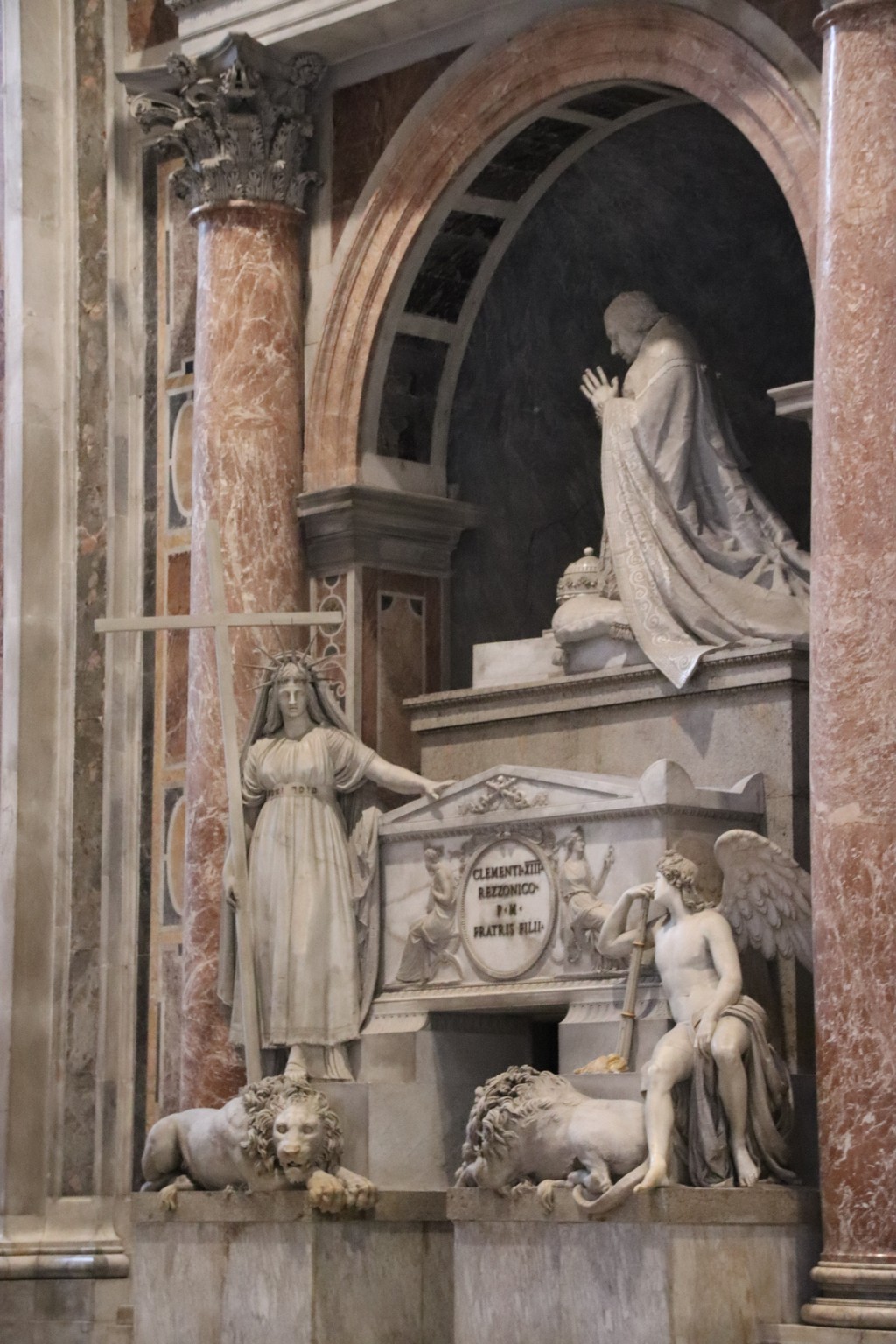
The tomb of Clement XIII provides a comparison for Canova’s placement of a doorway within a monument. Gary Todd. Image source. Public domain. Resized from source.
Explore Canova’s works
Browse the sculptures and paintings covered in this guide. Several entries compare versions or examine details of a larger work.
Discussion
Look again at the images and ideas explored in Funeral Monument to Maria Cristina of Austria. These editorial prompts invite your observations.
Reader Insights
How does the opening change the movement of the procession?
What draws your attention to the figure beside the lion?
Join the Conversation
Share a detail, comparison or question about Funeral Monument to Maria Cristina of Austria below.
References
- Augustinerkirche Wien, Rundgang durch die Kirche, Canova monument and church setting. View source.
- Andreas Praefcke, Cenotaph of Maria Christina, frontal view of the Augustinerkirche monument. View source.
- Johannes Myssok, Canova und Wien. Eine Geschichte der Rückkehr, Römische Historische Mitteilungen 65 (2023), pp. 37–44, on the design, correspondence, site and installation. View source.
- Kaisergruft Wien, Die Habsburger in der Kaisergruft, Maria Christina entry. View source.
- Albertina, Antonio Canova, Das Kenotaph der Erzherzogin Marie Christine in der Augustinerkirche in Wien, drawing 14390, catalogue by Veronika Birke and Janine Kertész. View source.
- Andreas Praefcke, Cenotaph of Maria Christina, oblique view of the procession and threshold. View source.
- Andreas Praefcke, Cenotaph of Maria Christina, view of the winged figure and lion. View source.
- Albertina, Collecting for the Future, exhibition research on the founding of the graphic collection, 2026. View source.
- Albertina, Antonio Canova, Entwurf für das Grabmal der Erzherzogin Marie Christine in der Augustinerkirche in Wien, drawing 14391, catalogue by Veronika Birke and Janine Kertész. View source.
- Museo Gypsotheca Antonio Canova, Funerary Monument to Maria Christina of Austria, plaster dated 1800, on Google Arts & Culture. View source.
- Albertina, Domenico del Frate, Das Kenotaph der Erzherzogin Marie Christine, drawing 17263. View source.
- Rijksmuseum, Pietro Bonato after Domenico del Frate and Antonio Canova, Funerary Monument of Maria Christina of Austria, RP-P-OB-70.461. View source.
- Albertina, Jakob Merz, Grabmal der Erzherzogin Marie Christine von Antonio Canova, drawing 5921, 1805. View source.
- Princeton University Art Museum, Charles Swagers, The Tomb of Maria Christina of Austria, by Antonio Canova, oil on canvas, y1970-12. View source.
- Isabella Teotochi Albrizzi and Henry Moses, The Works of Antonio Canova in Sculpture and Modelling, Getty Research Institute copy, plate and text for the monument to the Archduchess Christina of Austria. View source.
- Basilica di Santa Maria Gloriosa dei Frari, visitor plan and catalogue of monuments, entries 11 and 12. View source.


 Antonio Canova.jpg)


