



 by Tom Gurney
Tom Gurney BSc (Hons) is an art history expert with over 20 years experience
Published on June 19, 2020 / Updated on November 13, 2026
Email: tomgurney1@gmail.com / Phone: +44 7429 011000
Herm: Introduction
A band of cloth rises to a shallow point above the woman's forehead. It runs down both sides of her face, passes tightly under her chin and falls in much broader folds across her chest. At the bottom, the carved cloth meets a flat face of stone. The letters VESTALIS sit low on that surface. Antonio Canova's marble, now at the J. Paul Getty Museum, identifies a priestess of Vesta through her dress and the inscription. The shape of the stone gives the work its title, Herm of a Vestal Virgin. [1] [2]
Herm Antonio Canova
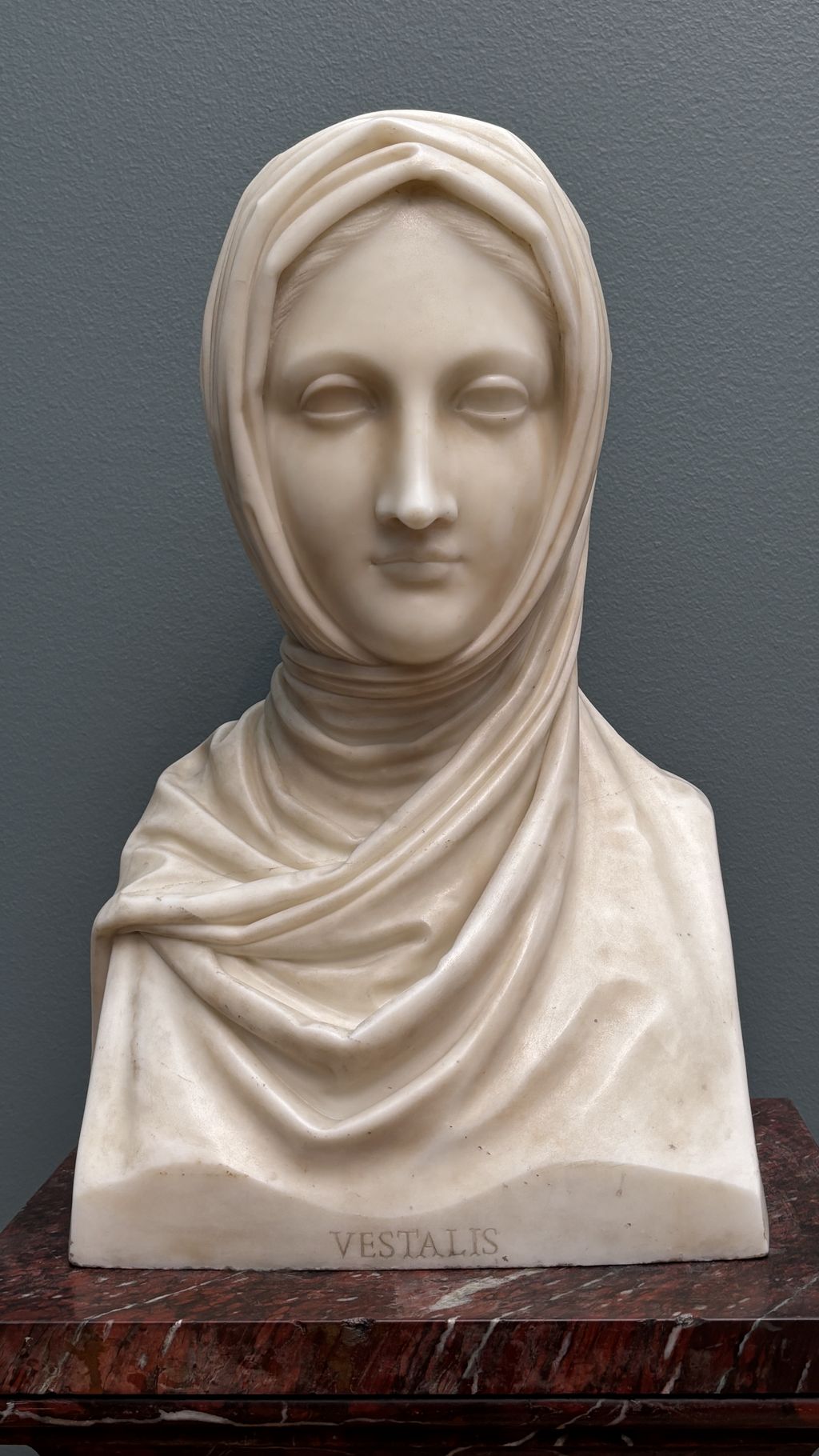
The Getty marble, with VESTALIS carved along its lower edge. A2D4. Image source. CC0 / Public domain. Resized for display.
At a Glance
- Artist and dateAntonio Canova, 1821–22. [1]
- Marble49.8 × 31.9 × 24.1 centimetres, J. Paul Getty Museum, 85.SA.353. [1]
- InscriptionVESTALIS, cut low on the front. [1]
- Probable first ownerPaolo Marulli d'Ascoli of Naples. [1] [2]
Contents
- The veil and the block
- A Vestal and the story of Tuccia
- A marble for a room in Naples
- Comparing the Milan and New York busts
The veil and the block
From the front, the eyelids, nose and mouth sit within an oval marked out by the cloth. A little hair remains visible at the temples. Its shallow lines give the forehead a fine edge, while the deeper channels of the wrap hold darker shadows around the cheeks. The corners of the mouth turn up slightly. That small change is easy to miss because the head sits squarely over the chest and the eyes meet the space in front of the sculpture. Canova gave the cloth a more varied movement. Tight folds make bands around the throat, then a sweep of stone travels diagonally down across the chest. [1] [2]
The two profiles make it possible to follow that sweep around the head. On one side, a broad edge of cloth descends from the crown towards the chest. On the other, the folds under the jaw gather and turn across the shoulder. Seen from behind, several narrow ridges fall down the nape and stop where the surface becomes a broad plane of marble. The back photograph shows a vein running across that plane. As you move around the piece, the surface goes from something that looks wrapped in cloth to a block with a definite edge and depth. [2]
A herm takes its name from an ancient sculptural form. In Greek examples the head of Hermes often stood on a rectangular pillar. Herms marked places such as crossroads and entrances, and the form came to carry other heads as well. Canova gives the Vestal the straight sides and level base of a short block. Her shoulders and chest merge with that block, which could itself rest on a separate support. The letters at the bottom address the viewer at the front. Walk around to read the folds and you leave the inscription behind. That division makes the front a formal view, with the upright head and the name of the priestly office on the same axis. [1] [2] [3]
A Vestal and the story of Tuccia
Rome's Vestal Virgins served the goddess Vesta and tended her sacred fire. They were required to remain chaste during their service. Dionysius of Halicarnassus tells the story of Tuccia, a priestess who was falsely accused of breaking her vow. She asked Vesta for help, drew water from the Tiber in a sieve and brought it to the Forum, where she emptied it at the feet of the pontiffs. Dionysius presents the feat as a marvellous story. It made a priestess's innocence visible through something she did in front of witnesses. [1] [4]
The Getty marble shows a woman without hands, a sieve or a river. Its inscription names her office. In Lisbon, the Calouste Gulbenkian Museum holds a related marble inscribed TVCIA VESTALIS, which supplies a personal name as well. The museum connects its work to the English collector Frederick Webb through an account of its purchase from his collection. An engraving published by Isabella Teotochi Albrizzi also names Tuccia but shows a Vestal with conspicuous curls, unlike the restrained hair in the Getty and Lisbon marbles. The engraving and the inscription show how the name could travel between versions that look quite different. [2] [5]
Canova included Vestals among the works he called teste ideali, or ideal heads. Some took their subjects from mythology or literature, like Helen of Troy. In the Getty Vestal, dress helps establish the subject, and the way it fits makes the face look more self-contained. Getty curator Peggy Fogelman compares the covering with the hood worn by Roman Vestals. She also notes that its tight wrapping around the neck differs from ancient representations of the priestesses. A draped ancient bust in Naples, known as the Zingarella, offers a closer resemblance in the arrangement of the cloth. The garment can suggest antiquity while preserving the sculptor's choices about how much of the face and hair to reveal. [1] [2]
Videos on Canova
Explore Canova’s workshop methods and the settings for his sculpture.
From Sketch to Stone | Canova: Sketching in Clay
Watch sculptor Fred X. Brownstein recreate a Canova Venus, using clay, plaster and marble.
Watch on YouTubeA marble for a room in Naples
Paolo Marulli had seen Venus and Adonis in the collection of Francesco Berio and wanted a full-length marble by Canova. In a letter of 28 December 1821, he agreed to take a herm of a Vestal. A letter of 25 January 1822 mentions a granite pedestal being carved for the work. Giovanni Battista Sartori, Canova's half-brother, designed the column on which the bust was placed in Marulli's palazzo on the Riviera di Chiaia. The granite would have extended the upright line of the herm and lifted a marble less than half a metre high into view. [2] [6]
Marulli put reliefs by Bertel Thorvaldsen into the walls of the same room. Their subjects included Night, Day and Nessus Abducting Deianira. The reliefs had a fixed surface behind them, while the Vestal stood on a support of its own. The different mounting gave each kind of carving a different relation to the room. The letter about the pedestal documents Marulli's attention to how the compact figure would be seen, as well as his interest in owning a work by Canova. [2] [6]
The Getty regards its marble as the likely Marulli herm. The work for Marulli is recorded in Naples in 1845, and the museum lists later ownership by descendants of the Marulli and Berio families as possible. The documented modern chain takes the marble from Fabian Walter in Basel to Capricorn Art International in 1937, then from Capricorn to the Getty in 1985. The collector's letters establish that a Vestal was made for his house, and the ownership record explains why the identification of the Getty marble with that commission is given as probable. [1] [2]
Comparing the Milan and New York busts
The Vestal Virgin associated with Luigi Uboldi in Milan is a separate marble. Its inscription also reads VESTALIS, but its folds gather higher and leave a larger area of flat stone beneath them. The difference can be seen in the frontal photographs published by Fogelman. She relates both compositions to the pointed plaster at Possagno, inventory 267. That plaster ends close to the lowest drapery fold. A marble could follow the same model for the face and the sweep of the cloth while giving the lower edge more height or cutting it differently. [2] [7]
There is also a difference in the way the front plane catches the light. In the Milan photograph, the flat surface under the folds carries the inscription across much of its width. In the Getty photograph, the letters are smaller in relation to the block and sit closer to its lower edge. A curved truncation and a round socle, like those on Canova's Bust of Paris, separate the head and chest from their support more plainly. In these two Vestals the inscription is cut into the lower part of the marble itself, within the same broad shape as the shoulders. [1] [2] [7]
The Metropolitan Museum of Art attributes its Vestal to Canova's workshop and dates it probably to about 1819–23. It is almost the same height as the Getty herm. In the Met's frontal photograph the fabric dips towards the middle just above the lower edge, and the plain strip below the folds has no comparable title in its centre. In all three marbles, the face and wrapping make the subject recognisable before the viewer looks at the base. The differing cuts and inscriptions show what can change even when a workshop retains the same design. [1] [2] [8]
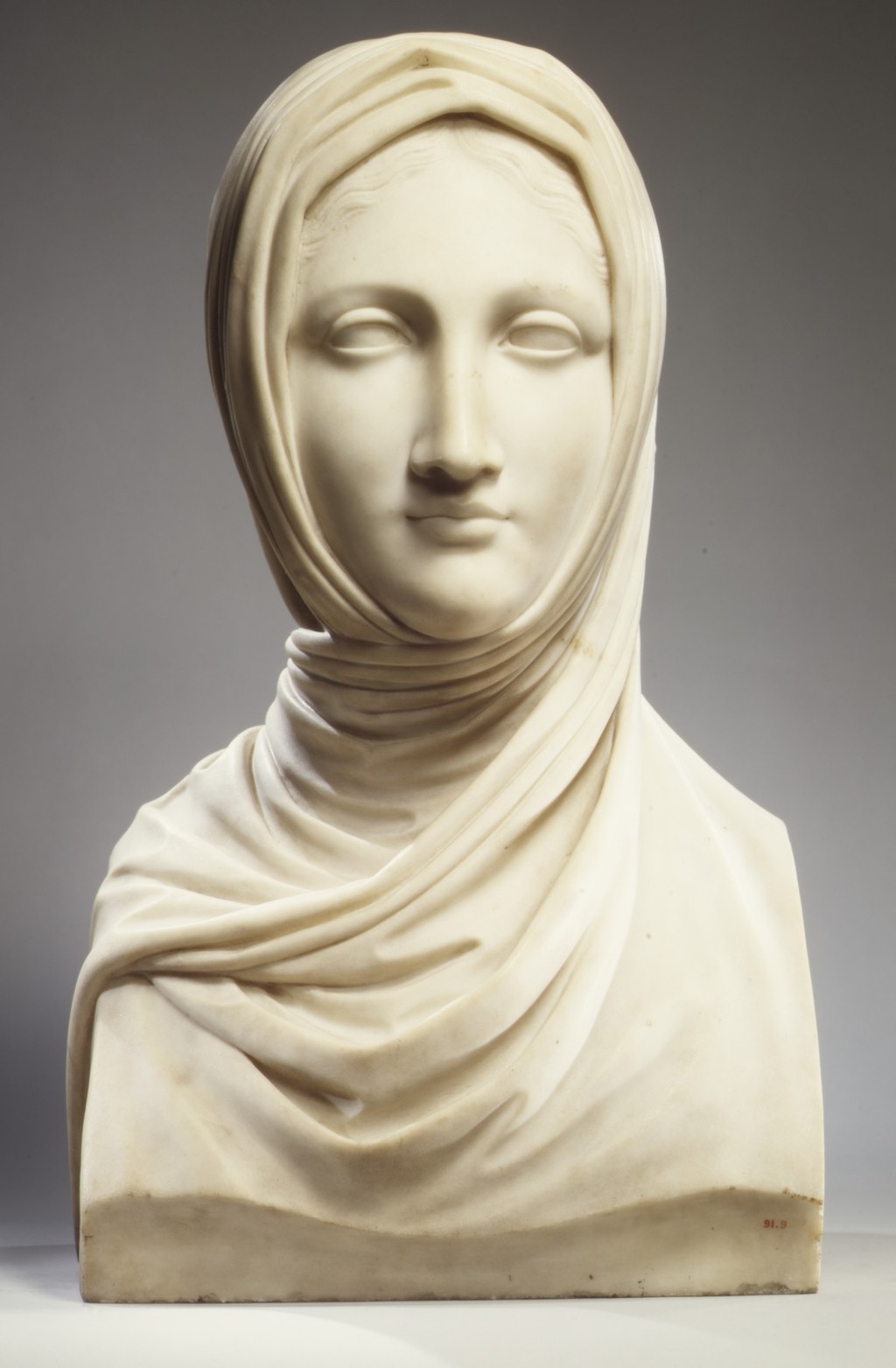
The Met’s workshop Vestal offers a comparison for the treatment of the veil and bust edge. The Metropolitan Museum of Art. Image source. CC0 / Public domain. Resized from source.
Explore Canova’s works
Browse the sculptures and paintings covered in this guide. Several entries compare versions or examine details of a larger work.
Discussion
Look again at the images and ideas explored in Herm. These editorial prompts invite your observations.
Reader Insights
How does the rectangular support affect the way you see the face?
What changes when you compare the herm with a bust of the same subject?
Join the Conversation
Share a detail, comparison or question about Herm below.
References
- J. Paul Getty Museum, Herm of a Vestal Virgin, 85.SA.353, object record and provenance. View source.
- Peggy Fogelman, “Canova's Herm of a Vestal Virgin”, The J. Paul Getty Museum Journal 22 (1994), pp. 43–55, with front, profile and rear photographs. View source.
- Metropolitan Museum of Art, Marble head of a bearded man from a herm, 1972.118.108, collection note on ancient herms. View source.
- Dionysius of Halicarnassus, Roman Antiquities, book II, chapter 69, translated by Earnest Cary. View source.
- Calouste Gulbenkian Museum, Herm of the Vestal Tuccia, 2214, museum account of the Webb provenance. View source.
- Ian Wardropper, “Bertel Thorvaldsen's Nessus Abducting Deianira”, Metropolitan Museum Journal 41 (2006), pp. 141–54, especially pp. 148–50. View source.
- Galleria d'Arte Moderna and Regione Lombardia, Vestale, GAM 478, catalogue record 2d050-00144. View source.
- Metropolitan Museum of Art, The Vestal, workshop of Antonio Canova, 91.9, collection record and photographs. View source.


 Antonio Canova.jpg)

