



 by Tom Gurney
Tom Gurney BSc (Hons) is an art history expert with over 20 years experience
Published on June 19, 2020 / Updated on November 13, 2026
Email: tomgurney1@gmail.com / Phone: +44 7429 011000
Drawings: Introduction
On a sheet in the Metropolitan Museum of Art, Antonio Canova drew two mourners huddled at the foot of a tall block. A length of cloth falls from its upper edge and sweeps down towards a figure on the right. Dark graphite fills the surface behind the cloth, which is almost the colour of the paper. The left-hand group is worked in much more firmly than the figure on the right. There is room below both for a few faint lines, then the paper is largely blank. In this small Study for a Tomb, Canova could see how much of the monument's weight rested on the relation between the upright block and the two groups at its base. [1]
Other sheets gave him a place to study one turn of the body, or to carry away the shape of an ancient statue he had seen. Drawings also moved between Canova and the people who helped make and publicise his work. A page from his own sketchbook and a view prepared by a studio collaborator can be evidence for the same project, even when they record different decisions. [2] [3]
Antonio Canova Drawings
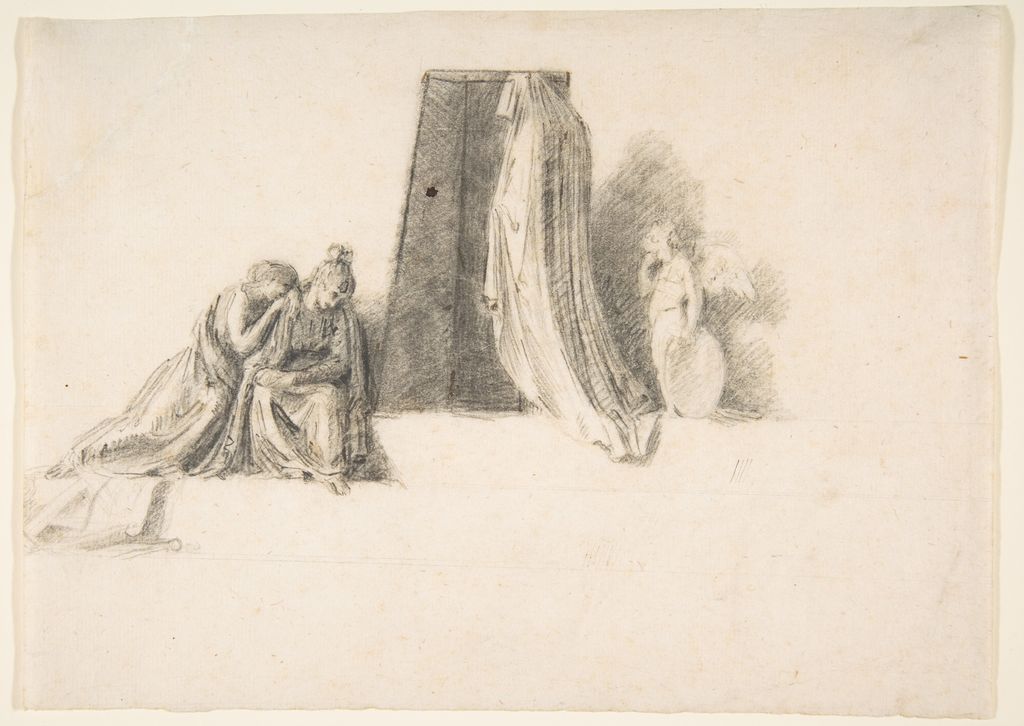
Canova’s graphite Study for a Tomb, Metropolitan Museum of Art, 2008.525. The Metropolitan Museum of Art. Image source. CC0 / Public domain. Resized for display.
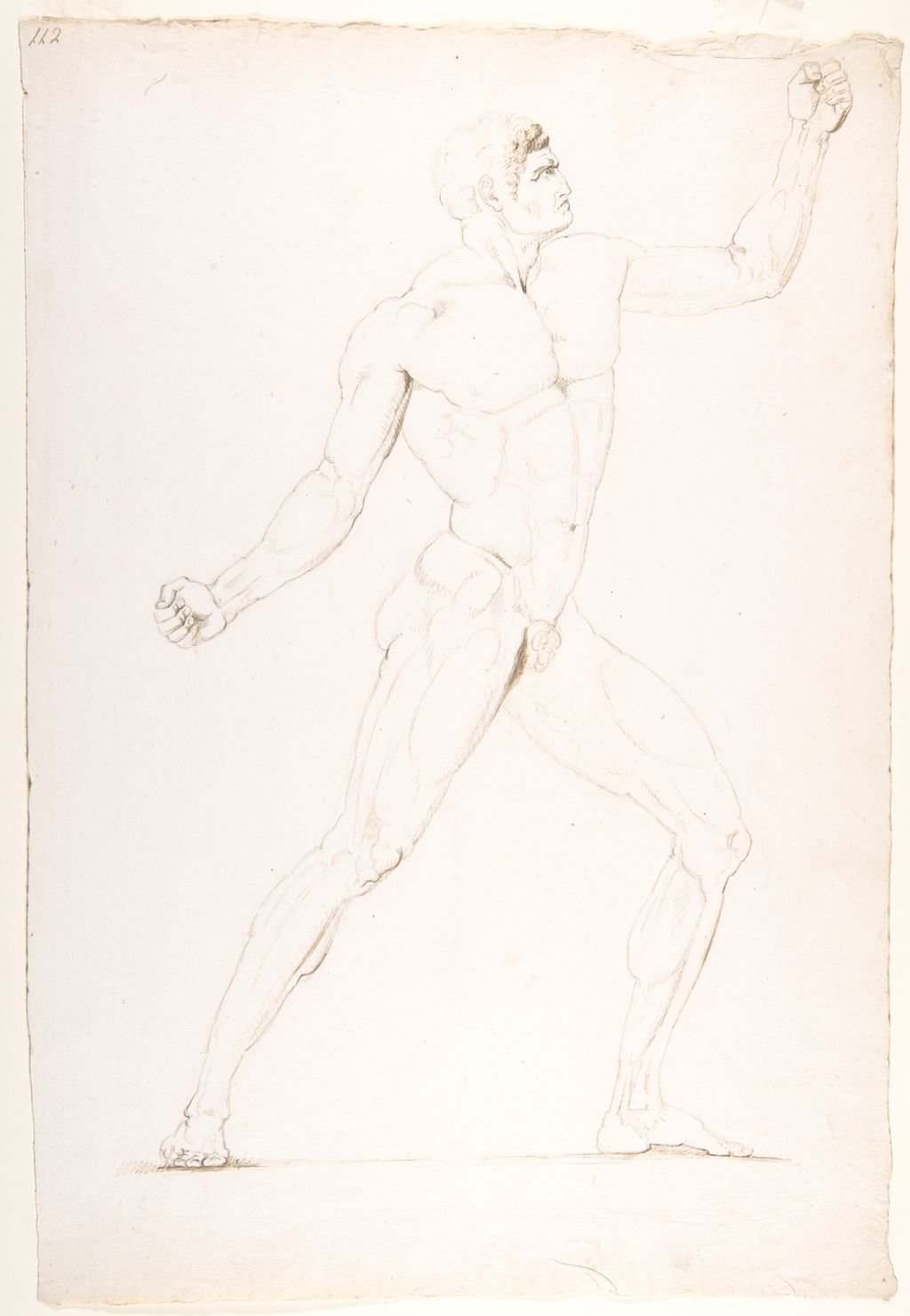
Canova’s study of a figure in profile, in brown ink over graphite, Metropolitan Museum of Art, 2008.526. The Metropolitan Museum of Art. Image source. CC0 / Public domain. Resized for display.
At a Glance
- MaterialsCanova used pencil for many exploratory studies. Surviving sheets also show how he worked over graphite in pen and brown ink. [2] [4]
- CollectionsThe Museo Correr holds drawings from collectors who knew Canova. His half-brother Giambattista Sartori Canova gave albums and sketchbooks to the Museo Civico in Bassano del Grappa. [2] [5]
- What to look forCompare the front and back of a sheet when both are available. A drawing from an antique sculpture and a new composition can share the same paper. [6]
Contents
- How pencil and ink carry a pose
- Turning over a page of The Three Graces
- A tomb design for another reader
- Drawings made after Canova's sculptures
How pencil and ink carry a pose
The Met's Study of a Nude Man in Profile turned to the Right occupies a sheet nearly 49 centimetres high. One leg stretches back until the toes reach the lower corner of the drawing. The other bends, with its foot firmly placed nearer the centre. The face turns towards the raised fist. The lower fist extends in the other direction, and the two hands pull against one another across the sheet. There are small strokes around the hair and muscles, but for long stretches it is the line along the edge of the body that describes the figure. [4]
The museum identifies the materials as pen and brown ink over graphite. Some of the light graphite remains visible around the figure. At the bent knee and foot, the outline carries more information about how the body balances than the much fainter lines inside it. Compare the treatment of the body with the heavy shading behind the drapery in the tomb study. A clear edge can describe where one limb passes another. Broader shading can make a thin fold of cloth seem to stand forward from a dense surface. Each sheet puts its strongest marks where they do the most work. [1] [4]
The Correr's collection guide associates pencil with Canova's search for a subject or arrangement and fine ink strokes with the closer definition of a pose. The two materials can also occur together on one sheet, as the Met nude demonstrates. The museum leaves that sheet undated and gives it no title identifying a particular statue. Its value lies in the way it lets a viewer follow the reach of the limbs and the distribution of weight without having to supply a story for the figure. [2] [4]
Turning over a page of The Three Graces
A pencil sheet from Bassano sketchbook F5, dated about 1812, carries a study of a draped antique figure on one side. Canova wrote that he had drawn it from the sculpture under the Loggia dei Lanzi in Florence. The Uffizi identifies the statue as an early second-century Roman figure of a captive woman, traditionally called Thusnelda. On the other side of the sheet Canova tried two arrangements for The Three Graces. The same piece of paper carries a record of an observed statue and alternatives for a group he was inventing. The pairing says more about his habits of drawing than it does about any direct borrowing from the Roman figure. [6] [7]
The Bassano museum holds an early terracotta for the commission as well. The Turin exhibition catalogue connects the terracotta with the sheet through one Grace whose back faces the viewer. On paper that decision can be made with a few lines across a shoulder. In clay it determines which arm meets the next figure and how the space between them opens. On the terracotta the three bodies have to hold together when viewed from a different side. A drawing can suggest that cohesion from one position, while modelling allows the sculptor to test it as the group turns. [6] [8]
The sheets also show how long Canova had been interested in the subject before Joséphine de Beauharnais commissioned the marble in 1812. An earlier Bassano drawing, about 1799, shows three young women embracing and is linked by the exhibition catalogue to an oil painting at Possagno. A second sheet with two sketches has been dated about 1806 in the Turin catalogue, while the Bassano collection history labels it 1812. Together these works show repeated attention to the embrace across different media. The drawing for the painting has its own purpose in that history, alongside the later sheets and clay models for the marble. [6] [8]
Videos on Canova
Explore Canova’s workshop methods and the settings for his sculpture.
From Sketch to Stone | Canova: Sketching in Clay
Watch sculptor Fred X. Brownstein recreate a Canova Venus, using clay, plaster and marble.
Watch on YouTubeA tomb design for another reader
The Museo Correr has a drawing of the proposed Tomb of Clement XIV, inventory 5209. Giuseppe Pavanello published it alongside a closely related sheet from a private collection in Treviso, prepared for Giovanni Falier. On the Treviso sheet, letters refer the reader to notes identifying the existing church architecture, the sacristy door and two allegorical figures. The papal arms appear above the door in that early design. Pavanello notes that they were placed higher in the executed work. A drawing that shows the setting as well as the figures lets its recipient see what the new marble would do to a part of the church people already used. [3]
Pavanello assigns these two sheets to Canova's studio, where a collaborator could prepare a detailed view of his design. The Correr sheet entered the collection through Bartolomeo Manfredini's bequest. The description in the bequest documents called it an original sketch of the first idea. The design belongs to Canova even where the hand that set it down belonged to someone working with him. Its doorway and figures give a kind of evidence that an individual study of a mourner could hardly supply. [3]
Francesco Chiarottini drew a different part of the project in 1786. In his view of the Roman workshop, the seated pope appears twice at the right, as a full-size plaster and as an unfinished marble. Above the figures hang frames for plumb lines. Two assistants work at the block with a rope drill. Chiarottini used pen, wash and touches of lead white on blue prepared paper. The sheet now in Udine brings a working room into view, with enough space around each object for a reader to see where the assistants stood. It records the transfer from plaster to stone through the equipment and people involved. [9] [10]
Drawings made after Canova's sculptures
A sheet at the Met, made around 1850 by someone in the circle of John Gibson, shows two of Canova's dancers side by side. The figure at the left sets her hands at her waist. The other draws one hand up towards her face, inclines her head and holds a garland. The draughtsman has included a base under each dancer and numbered the two views. The fine folds of the dresses take up most of the space inside the outlines. Putting the figures next to one another makes their gestures easy to compare on paper, even for someone who has never seen the marbles together. [11]
Drawings prepared for engravers could make similar choices about which view to carry into print. The Italian national catalogue records that Canova used two draughtsmen for a print of the Penitent Magdalene. Francesco Fontana provided the front view, and Giovanni Tognolli supplied the side and back. The division makes sense for a kneeling figure. The front makes the bowed head and hands visible together. The other views show how the body settles over the knees and how the cloth falls behind. The catalogue distinguishes the sculptor, the men who drew the views and the maker of the print. A print can preserve evidence of choices made by each of them. [12]
The Bassano albums preserve Canova's own side of this activity on paper. They contain studies of male and female figures, copies from antique reliefs and sculptures, sketches for monuments and notes from journeys. The Fondazione Giorgio Cini's photographic survey records most of the albums sheet by sheet. An image there represents a page kept in Bassano, while a Correr drawing might have reached Venice separately in a collector's papers. Those different histories help explain why a surviving image can belong to an album, a design can belong to Canova and the drawing that conveys it can still be another person's work. [2] [3] [5]
The Museo di Roma brought 79 drawings from the Bassano collection into an exhibition at Palazzo Braschi in 2012 and 2013. It displayed them beside plasters, terracottas, paintings, marbles and prints. That arrangement makes it possible to ask different questions of objects with the same subject. A visitor can look for a choice still open in the drawing, a pose being tested in clay or a view selected for a print. Each object carries a different part of the work. [13]
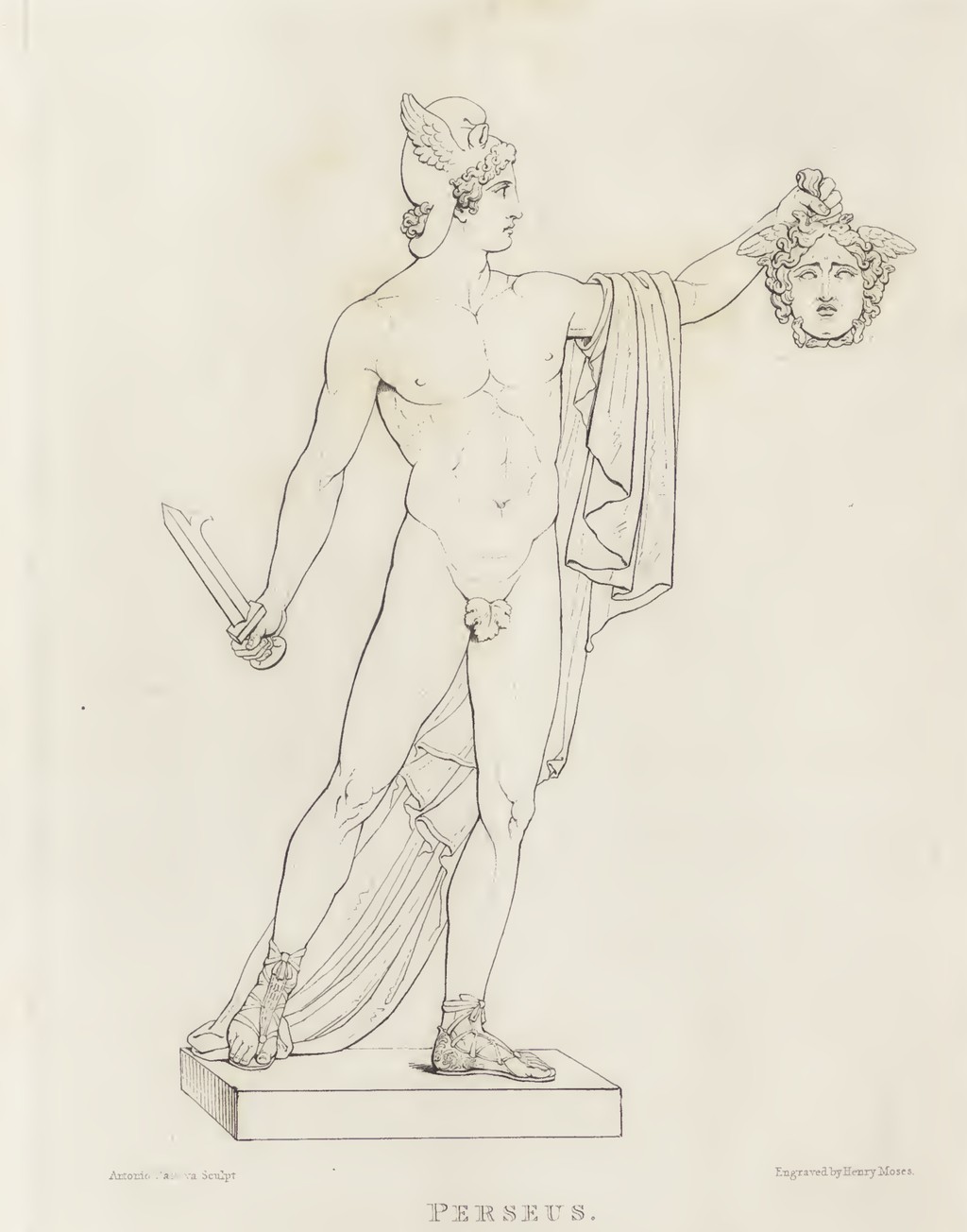
The outlines in Moses’s Perseus show how a printmaker rendered the silhouette of a sculpture. Henry Moses, after Antonio Canova, engraving published in London, 1824. Getty Research Institute. Image source. Public domain. Scan margins trimmed and image resized.
Explore Canova’s works
Browse the sculptures and paintings covered in this guide. Several entries compare versions or examine details of a larger work.
Discussion
Look again at the images and ideas explored in Drawings. These editorial prompts invite your observations.
Reader Insights
Which lines show Canova reconsidering a pose or a form?
What can a drawing tell you about a design that a finished marble leaves out?
Join the Conversation
Share a detail, comparison or question about Drawings below.
References
- Metropolitan Museum of Art, Antonio Canova, Study for a Tomb, graphite, c. 1790/91–95, 2008.525. View source.
- Museo Correr, The Neo-Classical Rooms and the Canova Collection, Room I, account of the autograph drawings and drawing media. View source.
- Giuseppe Pavanello, I primi scritti di Antonio Canova, figs. 3–4 and notes 7–9, study of the Falier papers and the two Clement XIV sheets. View source.
- Metropolitan Museum of Art, Antonio Canova, Study of a Nude Man in Profile turned to the Right, pen and brown ink over graphite, 2008.526. View source.
- Fondazione Giorgio Cini, Album di Antonio Canova, photographic documentation of the Bassano albums and sketchbooks. View source.
- Giuliana Ericani and Francesco Leone, Canova. La bellezza e la virtù, entries 11–13 and pp. 90–96, catalogue of the Bassano sketches and comparison with terracottas, held in the Università degli Studi Gabriele d'Annunzio repository. View source.
- Uffizi Galleries, Rebirth, entry 13, Thusnelda, Loggia dei Lanzi. View source.
- Museo Biblioteca Archivio di Bassano del Grappa, collection history, figs. 22–23, terracotta S268 and drawing F3 65-1574. View source.
- Regione Autonoma Friuli Venezia Giulia, Francesco Chiarottini, Studio di Antonio Canova, 1786, Civici Musei di Udine, record D_6756. View source.
- National Gallery of Art, Canova: Sketching in Clay, exhibition texts, interpretation of Chiarottini's studio view and the tools shown in it. View source.
- Metropolitan Museum of Art, Circle of John Gibson, Sketch of two statues: Ballerinas by Canova, c. 1850, 1977.382.8. View source.
- Catalogo generale dei Beni Culturali, Maddalena penitente, reproductive print and drawing credits, 0500432619. View source.
- Museo di Roma, Canova. Il segno della gloria. Disegni, dipinti e sculture, Palazzo Braschi exhibition, 2012–13. View source.


 Antonio Canova.jpg)

